Purpose To Passion with Amy McLaren
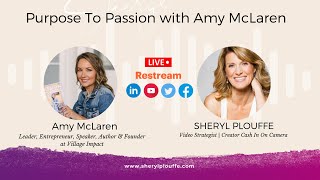
In this Cash In On Camera interview, host Sheryl Plouffe talks with author and entrepreneur Amy McLaren about her book Purpose to Passion and the journey that led her from a decade of grade‑1 teaching to founding the nonprofit Village Impact and co‑creating an online business with her husband, Stu McLaren. Amy explains how recognizing unsettled feelings sparked a shift toward purpose, outlines the 7‑step framework in her book (including a “quick‑win” exercise to identify lingering passions), and stresses self‑awareness and personal‑development habits—reading, podcasts, and modeling mentors like Oprah and Stu—as essential catalysts. She shares how Village Impact grew from a couch‑side inspiration to building 14 schools overseas, with proceeds from her new book funding a 15th school. The conversation also covers overcoming security fears and self‑doubt when changing careers, the importance of timing and leveraging existing platforms for modern, non‑dated marketing, and practical tactics such as coordinated book launches and bulk‑sale bundles. Throughout, Amy’s tone is conversational and encouraging, offering actionable advice for listeners seeking to align their passions with purposeful impact.
Chapters
If finding your purpose and passion and living your big, big dream seems unattainable, then you're in luck because Amy McLaren has written the book on Purpose to Passion, and she's here on Cash In On Camera today to talk about that. First of all, Amy, congratulations on the book. I've been reading it. You provide so much insight and story, your personal story in the book. I wonder if you can start by telling us, you know, what is it the first step around like helping people to realize that this is a real possibility? You can live a life like this.
Yeah, you know what, you totally can. And just to rewind a little bit, so I went from being a grade 1 teacher where I taught for 10 years and liking what I did but not loving it and really feeling like I wasn't really living all I was meant to do or fulfilling all the passions that I had inside of me. And that feeling of unsettlement, or being unsettled, led to me creating my nonprofit which led to me creating another business and another business after that. But it really was truly me following things that lit me up and lights me up and not ignoring that and following those kind of breadcrumbs of passion, if you will, to get to that point. Because I'm a big believer in, like I say in my book, Passion and Purpose, it's all about doing what we love and using what we love to do more good in the world. But doing what we love and being passionate about something is so important because it, I mean, it brings out the best in who we are, right? And who doesn't want want to be the best version of themselves. I want to be the best mom for my kids, you know, the best community leader, the best, you know, I just want to be the best version of me. And by following your passion and honoring it is a huge part of that.
You know, I so resonate with that message because even for me as a broadcaster, and I was in a position, you know, a really, I think, a coveted role, coveted position, you know, on national television. That sounds awesome. And it was great for a long time, but it did get to the point similar to you, I think, where you just have this internal knowing inside of you. It starts to bubble up. And I think a lot of people try to repress those feelings because it can seem scary to pursue that. So, you know, I think for me especially, I felt like, well, where do I start? And I know yours is a 7-step journey and people have to get the book to go through all 7 steps of how you get people to, you know, deal with those issues. But tell us, like, talk to me about the quick win idea. It's like How do you help people to kind of get that quick win so that they can see that there is a possibility that you can marry purpose to passion?
Yeah, absolutely. So I think the first, very first thing to do is to make sure you know kind of what your passion is, or if you have an idea around it. I don't think you have to know exactly what it is, but you have to have an idea around it. So the first thing is to identify what you're passionate about and whether that's you know, doing it through, like I like to say, a passion timeline and going back and looking at what you did in your 20s or 30s or 40s. Because I mean, I know, I mean, I'm 41. I know sometimes being a parent, you get to a point in your life, right, where it's like, how did I get here? Like, this isn't what I signed up for 15 years ago. Like, now my kids are older, they're in school, I don't know what to do. And that's often what people say to me. But I just encourage people to go back first and see if there's anything like lost passions that you just kind of left on the table that you're still passionate about and dabble in those, put them back into your life, whether it's a class a week or, you know, picking up the phone and talking to an old friend. But that would be the first thing. But I'm here to say, and like many other people, and you know, like that self-doubt, right, of when you're following this, is it meant to be? Like when you left your position, when I left my teaching, that can be hard and that can be really tricky because sometimes that self-doubt can keep you in that spot for longer than you should.
It's security. There's a security blanket to, especially if you're transitioning from teaching in your case, broadcasting in mine, and going into entrepreneurship. And I know you're so much more than an entrepreneur. You're the CEO of Village Impact. You have all these other things that you do, the Airbnb business. But going into that arena, it can seem scary because it's It's unknown. And so dealing with that is really challenging. And I heard you say something interesting there. You said, I was, you know, I'm 41 now. So you came to this realization at a, I would say, frankly, fairly early age. Do you think that the purpose to passion idea or concept is better suited to people who are maybe like 40 and above? Or can you have this crisis as early as 25 or 30?
Yeah, you know, I think that's a great question. I think more common than not, it's people that are kind of, you know, you're the kind of giving person that helps all your kids and do all this, and then you get to a point. But I also think it's in the 20s too. I think we're like bombarded in this world where there is a lot of opportunity, and sometimes it's hard to know which direction to go. But at the end of the day, I think you've got to come back to something that means something to you, something that lights you up, something that brings out that best version of yourself. For me, while teaching, I like to think that I was good at it and that I enjoyed it and the kids made progress and moved on now to high school or where they were, but I can show up for the world in a bigger way. I showed up for my community in a bigger way. And not to say that teaching isn't a wonderful profession. I mean, you and I know Canadian teachers are treated so well, respected really well, they do so much, any teacher does. But I'm a big believer that we're all in here, all on this planet to do something, and it is definitely aligned with, you know, what you're passionate about and what you're driven towards. And when I started my nonprofit, I just followed those breadcrumbs of, you know, giving back and having an impact and knowing that I wanted to do that. And I really believe that when you start small and you get intentional about your time and where you focus your time, those little things and steps that you take can lead to further opportunities. Like, I didn't think I would be, you know, a founder of a, multimillion-dollar nonprofit. That wasn't on my vision board, and nor was writing a book. But it's like you start somewhere, and then you've got to identify it, and you have to, you know, get through some of those self-doubt and courage to keep moving forward. And what I would say to someone that, you know, if you're wondering what to do, it's connect with that passion, find something to do around it, and just keep going in that direction. And know when you come to those hard times, or you have those moments of self-doubt, Guaranteed, we've all done something harder, right? I think oftentimes when we get to go to do something, it's like, oh, it's really hard. And then you remember, wait a minute, I've done harder things than this. Do you know what I mean? Remember the hard things that you've done because guaranteed you've done hard things like that before.
And I think— Well, it's not until you look back on it and maybe itemize that and spend a bit of time to think about the things that you have accomplished And I love what you talk about in Purpose to Passion about self-awareness. And I think that's really the theme that I see and read in this book is just this idea of self-awareness. And you actually have a journey to help people become more self-aware. And I know for me, a big part of that was personal development.
Yeah.
And that was a big shift for me back in the early— I would say maybe around 2013 or so when this journey began for me in marketing and video marketing and starting a business. I actually decided to really pay more attention to, you know, some of the books I think we're both familiar with and love, podcasts and learning. And that was a big, big part of shifting my ideal of what I am and what I'm capable of doing. Speak to me about your journey with personal development.
Yeah, absolutely. And mine, we chatted about this a few weeks ago where, you know, when I write in the book that I was, I was never one of those people that you know, read book after book after book on self-development that you might see people say, like, that was never my jam. Like, when my husband— my husband has always been into it. We've been married almost 15 years, together 20, and he has always done self-development. And I remember us riding around in the car years ago when cassette players and CD players were still in cars, and like, you would— he would be listening to all of this self-development leadership stop and then I am listening to, you know, books or Danielle Steele or, you know, and not to— Danielle Steele is amazing. I still listen to her on the plane when there's jet lag because it puts me in a complete— or not jet lag, turbulence, right? It puts me in a different world. But I really do credit jumping into this, if you want to call it the self-development world, or jumping into, you know, the possibilities of reading those books, a credit to the success I've had as an entrepreneur because like you said, it really is our mindset. And unless you start start reading or start surrounding yourself with other things that are out there, you don't know what's out there. You don't know what the possibilities are until you follow someone else's journey or you read another book about how you can think about different things differently, how you can reframe something so it becomes a positive story you're telling yourself and not a negative story, right? And I remember me coming back from teaching one evening and kind of laying in bed and on Stu's side of the bed there's, you know, a pile high of entrepreneur books and on my side it's like RL Stine and like thrillers and the Danielle Steele novels. And I just came to a point where I'm like, you know, these stories are amazing and I can get lost in them, but it's not serving me. It's not helping me move forward in my life or my business. It's just really filling that time. And, you know, so then I kind of rolled over and I looked at his side of the bed. I'm like, well, you know, maybe this guy has a good idea about what he's doing. Like, he seems driven, right? I mean, that was one thing that drew me to my husband was how driven he was and how he wanted to start his own business. And I love that about him. But I kind of felt I wasn't ready. And it took years for me to pick up my first book. But as soon as I identified that and picked up my first book and opened my mind to what's possible and started to listen to other speakers and read other books, it was like a whole new world opened up. And then you get hungry for more, right? And you go, what else can I read?
Or what can I do?
It's addictive.
It is. It's addictive because it's a mindset shift and you really start to get into it. And I know you talk about that in the book where you really, saw it one way, and then when you started getting into it, you realized, oh wow, I see now what all the fuss is about. And just for those who are watching, Amy's husband is Stu McLaren, who is a very accomplished entrepreneur in his own right. And I know that you both co-founded Village Impact. I'd love for you to talk about that because in my opinion, you know, this is just such the perfect marriage of again, purpose to passion, and you found a way to merge teaching with your love of travel. And then really the culmination is all the important work that you do with Village Impact. So tell us a little bit about that.
Yeah, so I left teaching, but didn't leave it right away. Like I left it with kind of one foot in the door, if you will, because I left it part-time first. And then eventually it went to me leaving full-time and then officially resigning, like I think 7 years ago now or 8 years ago. Feels like yesterday, but it was probably a few years ago now. But no, the charity Village Impact that we run now, it's 10 years, about 10 years old. We've built 14 schools in partnership with the government. So I'm very big on working with communities on the ground and working together to make an impact. So we're building our 15th school today, or just started, and all the proceeds from my new book go to this school. But that idea started with, you know, me sitting on the couch with my husband, watching Oprah's Big Give, which was like this amazing show we watched, and we'd cry every time we watched it because you would see her transform people's lives and like just be so generous and kind. And I said to Stu that night on the couch, I'm like, that's what I want to do. Like, I don't want to teach. I want to like be Oprah. But then I'm like, who doesn't want to be Oprah? Everybody does. But I said, I'm like, I want to do that, but I want to do it overseas because that is what lights me up. And that's what I'm passionate about. And I I think oftentimes that's where people, you know, not to say mess up, but they let society of what other people's opinion think that they should do with their life kind of jump in. Because I had so many people tell me like, there's so much need in Canada, why not Canada, you could do this. And there is, and I applaud everyone that helps within our own country. But for me, what lit me up and what I was really passionate was going overseas. Because I had spent my childhood growing up, you know, I lived in refugee camps, I lived with Thai families, and for me that really fulfilled my bucket, it fulfilled who I was. So I had to link that, the charity, with something that was really important to me and what fueled me up. So now, I mean, now we have a small staff, we've built several schools, and we have our partnerships, but I mean, that idea came, and inspiration came on a Friday night watching Oprah drinking a glass of wine. But you have to take action. And I think that's a big thing too, is like in that moment of inspiration, it's so important to take some form of action to get the ball rolling or to get momentum going on your side.
And it doesn't happen in a day. And I think a lot of people have this.
They're very impatient.
They want the results to be like immediate. But like you said, this is years in the making. And one thing, theme that's come up in this conversation is this idea of modeling others. You mentioned Stu and seeing his personal development books, and he was sort of a model or an example of, hmm, maybe there's something to that. And then you mentioned Oprah. She did that, and it was like, oh, there's a model that maybe I could follow. And so what I love about your book is I think this could be the model for those who are watching right now who could say, okay, well, maybe Amy's is the example that I could follow so I can find that marriage between my purpose and my passion. And so I love that idea. And I see you now. I see you on Instagram. I see you doing videos.
You're doing this interview with me right now.
Now, which is great. I know you do a lot of interviews, and you really are a speaker, uh, in your own right now, and the author, and, and so much more. But that was always the case. And I know in the book you mentioned how you didn't always feel comfortable on stage, you know, that you'd feel comfortable when you were up there with Stu. But now I see you, you're doing your own thing. What, what led you to find that courage to get out there and share messages of, of inspiration and motivation through Lady Strength or through Village Impact so that you could actually be making the impact that you have in the world?
Yeah. Well, first of all, I still find it a bit difficult. I think I have, I think I have gotten better a little bit every time. So my husband, for those who listen, yes, he's very established. He's always been an online entrepreneur. The more people he can speak to on stage in person, like the more excited he gets and like the more people I think, the more I want to like puke everywhere because that just makes me like so uncomfortable. But for me, it's, you know, I do, I still enjoy, we do podcasts together and we'll speak together and we play off each other and it's great. But I've had to learn to come out more myself and get out there on stages and put the message out. And for me, kind of things that I think about to myself before I do things like this are a couple of things that's been helpful because like I said, it's still, I still find it difficult, but I think of you know, the people that I'm helping. I mean, every time I speak about my book, we have people buying the book, and then that money and proceeds from the book all go to building the girls' school and working with the community. So I try as much as I can to think of what the book is doing or how, you know, how I'm helping. Because, and we've probably heard this before, it's not about me on stage. It's not about my hair, what I'm wearing, or any of that. It's about how well I can share the stories and the messages of the book. So the impact that it'll have. It's all about everybody else. It's all about what I can do to make a difference. And I try to remind myself, like I said earlier, before I walk out or before I come in an interview, I have a moment to myself and I'm like, okay, I've done this before. I've done it many times before and I've been fine. But there's still— so those are two things that I do. It's just remembering I've done it and then also thinking, you know, looking at a picture of the kids in the school that we help or support, or my team in Kenya that I adore. They're like family to me. And, you know, we've We've been working together for years and I just think of, I think of what can happen from one message or one speaking engagement or one summit because oftentimes I think we don't realize that just by sharing our message and being brave and just sharing one little thing about it, you don't know who's listening or who's watching and who resonates with your message and how they want to help. And I mean, that's how I built the nonprofit. We've never done any advertising. It's all been built through relationships with our community and relationships with other entrepreneurs we work with who have donated their time and funds that have helped build it. So I just try as much as I can to think of others, but it's still, for me, it's still, it still is challenging, but I find it, you know, like every, the more you do it, the more you get a bit more comfortable. I like wearing big earrings. I find when I wear big earrings, I feel a bit more confident. I love that.
Well, little secret. I do that too. Yes, I've done over 20,000 hours of broadcasting. But still, when I do an interview or if I'm speaking on a platform, I give myself a little pep talk. Yeah, I give myself a little pep talk before I do it. So, absolutely love that. Listen, Amy, we have a fun segment that we do here on Cash In On Camera where it's called Stop Marketing Like It's $19.99. And I know that you and Stu know about marketing because without marketing, you can't get your message out to, to all the people that you impact. So I'd love to know what is a tool, tip, a tactic, a technique that has really benefited you getting your message out to more people that's not marketing like it's 1999, marketing for the world that we live in today.
Yeah. So something I've done for my book that just came out is we purposely launched it the same time as we had other things happening. So we launched my book around my husband's event. So he just put on a big membership event in August. It happened the week after my book came out, so that was great for timing. It made the use of like, you know, his social media presence and his following combined with mine. So combining things you have already going on and getting the most that you can out of that time, because I mean, Facebook's changing over time and like platforms are changing, right? So the more kind of eyes you have on stuff with all your different resources, the better. And then something else that worked with us really well is So at his event we sold books in bulk and we combined our books together for buy 12 books and you get access to other things that we have. Stu and I are doing a workshop together if you buy 12 books. But it's combining all of your resources and timing it throughout the year where you get more eyeballs on your book, on your message, and then it's a better effort at the end of the day.
I love that, you know. So the, the idea of timing is some— Passion to Purpose book you'll be able to order today. So just get the, get the book. I've been reading, I love it. I think it's so important, and it's really, I think, especially important, Amy, for, for women. It's not just for women, but I just think a lot of women get themselves at a point in life where they feel like they're living their life for someone else. And if you're that person, then this is the book that you need to read. So I love that.
Thank you.
Thank you so much. Thank you, Amy, for coming on today. Really appreciate your time and look forward to connecting with you again soon.
Sounds good. Thank you so much. You're welcome.
More from Sheryl



From 'agreeable' to 'ruthless mentor' to 'strategic sparring partner' #substack #shorts







