Scaling Your Business Using Group Programs
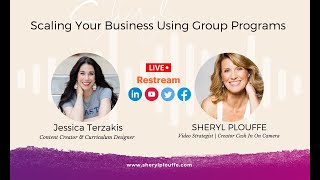
Jessica Terzakis explains how service-based entrepreneurs can scale with group programs instead of one-on-one coaching. Most need 3-5 years of business maturity first, plus an engaged email list and clear messaging. Price your first group program $797-$997 for 8-15 people, with 3-7 core steps pulled from patterns in your past client work.
Chapters
Ongoing education. I love books. I love courses. I've taken many courses. I've read many books. However, however, there comes a time in the entrepreneurial journey where you've got to put that stuff aside and really start taking action. And that's what we're going to talk about today. So Jessica Terzakis is with us today. She is a curriculum designer. She is a content creator herself. We both are We're going to dig into this conversation today around group programs. Jessica, thank you so much for being on Cash In On Camera today. Listen, scaling your business is something everybody wants to do. Like, we hear this word scaling, we go, oh, I want to scale. I want passive income. I want to be able to just open my phone and see a thing that says cha-ching. Tell us about that dream and where in the entrepreneurial journey does that dream come into play? Give us a timeline, the timeline of that.
For sure. So yes, this is probably the most common conversation I have in when I'm speaking or when I'm on a call with a potential client is they are wanting that income, that type of income immediately. And I think to answer your question about when in the journey, I think a lot of people just jump in way too soon, Cheryl. And so I know there's a lot of conversations out there about how Online courses are a great tool, but a lot of people are out there saying they don't work, they're not profitable, they're dead, like don't make one. And I really think that the better conversation around that is when to use that in your business. And the truth is online courses, that type of passive income where someone just signs up for your course and you as the creator are basically not involved at all, that's a very advanced and sophisticated tool to use in a business. And so I usually say to people, you know, there are a few ways that you can tell if you're ready for that type of passive income. The first is you certainly want to be in business for a few years. And what that's going to give you is an engaged email list. You have the revenue, consistent revenue to support you as it relates to your tech budget and ad budget. You also have a following on social media. You've developed relationships with potential affiliates, people that can support you and help promote your course. The problem is a lot of people jump into that too soon and really don't have any of those pieces. And so they launch it's a very lackluster result or they never launch at all, right? Cause they're stuck in creation mode. And so that's why I say, you know, if I had to give a timeline, I find that the 3 to 5-ish year mark seems to be generally speaking where people will find the most success with that. Um, that doesn't mean that there isn't a way for you to break out of one-to-one income. It's just that specific solution is, is, is, It needs to be used at the right time.
I want you to listen to what Jessica just said there, and that is actually very great. That's great advice. It's also very honest advice that the timeline of where you get to that scalability and that passive income dream is probably further ahead than you think it is, or further ahead than you— it— than it maybe, uh, ought to be for a lot of people who are impatient and want to get that cash right away. So, you know, 3 to 5 year timeline does make sense to me, you know, as someone who has done both. I have launched group programs. I have also launched courses. The more profitable way is group programs, 100%. You know, going into that, the online course world, it's a tough, it's a tough grind because you're typically— your online course price point is lower and then you're banking on the fact that you're going to be able to get more people to buy it, that it's a quantity kind of game. But if you don't have the fundamentals in place first— and you mentioned them, right? Your audience, your email list, and all of those things. And I would even go so far as to say your message. You have to have clarity on your messaging. And I've struggled with this over the years, you know, and being kind of like trying to do all these different things and see kind of where things land. I think that's part of the entrepreneurial journey is kind of figuring out messaging. How, what did that journey look like for you in terms of really getting clear on the messaging part?
Oh, this is critical, Sheryl. And I think, yeah, it's kind of implied for all of those pieces to work, your messaging has to be spot on, especially in the crowded online world we have. The journey to finding my message really wasn't that glamorous. And maybe it was the same for you, Sheryl. It was a lot of testing things out. Seeing, putting an offer out, seeing what resonated and what didn't. I had lots and lots of conversations either through speaking. So I did a lot of speaking. And so it was real-time feedback of like, all right, this landed because people were jumping up to sign up for a call with me. Or wow, that really didn't resonate because no one signed up. Or it was just having a lot of sales conversations with people to see what's the pain? What is going on in your everyday life? What are you trying to solve? So I wish it was a little bit more exciting, but, but that I would say is the one piece that, you know, when people try to jump into online courses too soon, they skip that critical phase. That's going to tell you everything you need to know in terms of what your ideal client is wanting from you and how to speak to them in terms of your messaging. And I think, you know, coming up with a tighter message, it's just time. It really, it's time. It's putting that experience in. And you know, if you're newer in business and you're listening to this, no, it's not to discourage you. It's to say the more you're willing to stick with it, the better you're going to be on the other side. Because everyone I talk to, Cheryl, says, Jessica, I want to stand out. I know there's a ton of people out there who do what I do. And I say to them, great, you need experience now. You need to have conversations. You need to test out offers. You need to see what lands and what doesn't land. Because on the other side of that, you're going to have that thread that helps you stand out, that's going to make you just a little bit different from that other health coach, that business coach, that, you know, money coach out there.
Yeah, you have to have time, and you, you're right, you have to have conversations, and you also have to listen during those conversations and take in the intelligence that you are gathering as a result. It's not enough just have a conversation, it's have a conversation and listen to what people are telling you. They're telling you that your, their problems are telling you what they want help with. Make notes after your calls and then also do some speaking. So we're both on the same page as far as that's concerned. Let's just say now, if an entrepreneur, they've been at it for, you know, a couple to a few years, they're really into, you know, they're like, okay, I'm ready now. I need to start really looking at the cash. I need to make money. Group programs are a great way to do that. So how can we take this first few steps to start developing curriculum or where do we start when we're looking at launching a group program?
Yeah, this is a great question. And I think just to be clear, the group coaching is not the same as an online course. Group coaching is obviously can still be online. It's interactive. You are doing calls with those clients. They might also be doing some things independently. It's my favorite because it really taps into my experience as a high school teacher. And so what I say to people is, If you've had experience working one-to-one with clients, even though all those one-on-one clients are a little bit different, chances are there's a common denominator in terms of a process that you've led them through. This usually surprises people, Cheryl, because most of the time people say, how could I possibly take what I do one-to-one and package that into something? And that's why I say there's a common set of steps that you take those clients through that is going to help you create the foundation of what is going to be your group coaching program. Generally speaking, Cheryl, that ends up being around like 5 or so steps. I would say that's the average of where people end up landing is 3 to 5, maybe 7 steps. And so I would say to you, like, think of, you know, 4 or so clients that you've worked with one-on-one and say, what did I do consistently among all of them? That's the best starting point, right? And yes, there's obviously room. You know, your one-to-one client is not going to be the same client that joined your group. So you don't have to put that pressure on like, how do I customize the group experience? That's not the intention. It's how do I lead them through that similar process? From there, you are aspiring to get a small group together. So I think what people think of groups, Sheryl, they're like, oh my gosh, I need 50 people. I need 75 people. I need 100 people in this group to be profitable. And the reality is you don't. And so you could see that you really don't have to spend a lot of time creating your content because you've already tested it. You've already figured out what it is. You've done the heavy lifting of figuring out what people need to get their desired outcome. From there, you just have to say, you know, I'm going to look for 8, 10, or maybe 15 people to put into this group. And when people hear that, they're like, really? That, that's all I need to make a group work? And that's, I say, that's it. You know, so I, I hope as you're hearing that number, you're like, I know 8 to 10 people. There's, there's a very doable way for me to get 8 to 10 people in this group.
Right? Oh yeah. I mean, if you have been doing this for some time, you have the clarity of message, you've been speaking, you have some of those foundational pieces in place. No question, you know enough people to put into that first round of the group program. And so, can you give us an idea, Jessica, on price points? Like, what do you recommend first time out launching a new group program? Where should that price point be for, let's say, the first 10 people that you ever take through your methodology? It's a 7-step program to achieve X. What should the price point be? I have my own ideas, but I'm curious to hear what your thoughts are on that. Yeah.
I love this question because I have encouraged my clients to do one of two things. When you are launching a new offer for the first time, even though you've done it with your one-to-one clients, I realize that most people have a little anxiety around how to price it and how to position that. Is the biggest thing I hear from people is, I've never done this. Like, how can I ask people to pay me for this? And so if you are leaning in that camp of charging like $100 for people to do your group, don't do that. Right? But I think there's a, there's a really great place for you to start. I've seen some clients, Cheryl, start with, you know, $797 to $997 the first time they run a group, right? Because it's a number that, you know, when they say it, they feel confident saying it and they know that's going to translate into certainty when they're talking to clients. And so I say, if you could say a number without feeling like you're going to throw up, land on that for the first time. And obviously that doesn't have to be the price forever. So like I said, I've seen some clients do $797, $997. I had one client do $1,497 for her first round. And what most of my clients have done is, you know, the second time around they, you know, basically, um, increase the investment by like 50%. So if I did it for $997, you know what, I'm going to raise it to $1,997 the second time I do it. For some of my clients who have felt very, very nervous about the investment the first time around, some of them have done it for $497. And listen, if you do the $497 range, you get 10 people in, you're making just shy of $5K. So you're basically, you're, even though you're charging significantly less than you would for your one-to-one coaching, you get a group of 10 people and you're still making money the first time you run it.
What I love about that is the first time you run the group program, you've made $5,000 to refine your group program. You're getting paid to create your, your, your first launch, right? So it's a win-win. I have sold group programs anywhere from $500 to as high as $1,997 and, and brought in anywhere from, you know, 5 to 10 people in those programs, and it's worked really great. Um, and so I do though, I think for the majority of people, I'm— I think I'm aligned with you in the sense of anywhere from $500 to $1,000. That's a real nice price point that makes it worth your while to spend that time to teach. And you're likely going to, in your first iteration, probably be doing more in-person work, would you not? Like with, with people in group?
Okay. Yeah. It's probably that first time where you're going to be doing a little bit more work than you thought you'd be doing. But, but like you just said, Cheryl, it's because you are refining your content, you're responding to your clients. And so that first time, just know that whatever you're, you're asking for the investment and the time you put in, that's not how it is forever.
And the investment is part of it. The more important part is the results. So let's talk results. That can be scary for people to kind of put themselves out there to promise a result. They have a system they've created. You know, they know that step by step, if I take people through the 7-step process, they will get, you know, said result if they do the 7 steps. So, how important is it to put that pressure on yourself as the group program creator to feel the responsibility of all those 10 people getting results?
Yes, I know the pressure is on. I think that's a really great point, Cheryl. I, how I respond to that is the first thing is having a smaller group decreases that pressure a little bit because then you're not feeling like, well, great, now I have 50 people and now I've got to get all these 50 people results. The second is, you know, when you look at what you're doing in your group, I usually encourage people to really look at their outcome and try and focus it a little bit more. A lot of times what I see people do is they'll say, well, I've got a 3-month, group coaching program, or I'm going to do, you know, a 6-month group coaching program. And I want to, I want them to do this and this and this and this. And they have all these outcomes that they want to get people to. And usually I say, well, that's why you're feeling so much pressure. You're trying to solve every single thing for this group. And it's just not possible. It doesn't, it's not possible for them from a learning perspective. And it's also not good for your business to try and do everything in one group, right? Limits your offerings. So I usually say, can you whittle it down? To 1 to 2 really clear outcomes that you know people, if they follow those 7 steps, they will achieve that outcome. And people will usually say to me, my clients will say, "Oh, I definitely can do that. Now I don't feel this pressure to solve every single problem." So those are usually the 2 big things that I say to people is to relieve that pressure. And truthfully, Cheryl, I think, you know, if I have an honest conversation with you about this, not every single person in your group is going to— you won't get 100% attendance all the time, if I'm being honest. You know, I've looked at it like I did my high school classroom. Like a third of your students or clients will be, they'll be like one step ahead of you. They're like, where's the next module? Like, I'm ready for the call. Like they'll be pinging you in the Facebook group or wherever you're interacting. There'll be a second group that are like, they might be a step or two behind, but they're with you. You know, they're doing the work. And then there's a group that you could literally This reminds me of when I was teaching. You could put the pencil in their hand and they're just not going to do anything. So people join groups for different reasons, ultimately.
Yeah, I agree. And so you can be committed to their results and provide as much guidance as you can for them to get that result. But at some point, the responsibility isn't yours for them to do the work.
Right. Right.
Jessica, this is really enlightening. I really like the idea of giving some very concrete parameters around pricing and around really what— where you should start thinking about adding a group program to your, to your suite of products and services. And I think that we've done that today. I want to ask you about the event that you have coming up, an event in October. Can you tell us a little bit more about it? And I'll show it on the screen.
Absolutely. So I'm really excited to offer my 3-day virtual event, Committed to Scale. And this is really helping coaches, consultants, speakers, authors, people who are doing the one-to-one work scale using group programs. Because I know if you are in that one-to-one place, you're like, how do I create more time? How do I have more fun in my business? How do I serve more people? How do I not get stuck on Zoom all day? And that's what this event is really for. It's going to show you how to frame out your offer and how to use, which is my favorite, as I mentioned earlier, how to use speaking to find people to fill your group because that's, those are the two biggest things. What's the group going to be about and how do I find people for this? And so that's what we're going to cover in these three days. And I'm super excited to, to collaborate with my good friend Sarah Gray, who's a webinar expert, and she's going to show us how to use a webinar to find clients.
Awesome. Well, you can't beat the price point of these tickets. $47.
That's right.
Hello. Hello. And look at on this link here below, and that's committedtoscale.com/cheryl. Get your tickets. Join Jessica, Sarah, and your mom at the event, which is going to be amazing. And Committed to Scale, October 20th to 22nd is awesome. And I think you're going to help a lot of people to really dive deep into the group program concept and really help move the needle for their businesses. So, that's fantastic, Jessica. Thank you.
Yes, thank you.
And one thing I wanted to do before we leave today, and I have a little segment that I do called Stop Marketing Like It's 1999. And the concept here is, is what is a tool, a tip, a tactic, or a technique that you utilize today that, you know, is working for you in marketing your business?
Ooh. Okay. So I gave some thought to this, Sheryl, because I try and keep the text super simple and something that I have really utilized and harnessed a bit more is in Outlook. You know, that feature, I, for those of you who use Outlook, you can like pre-schedule emails to send out. Right? So I do that. I keep it super simple that way, which I don't know if that dazzles you, but it was amazing when I found that. No, I love it. 'Cause I could batch send emails. I could sit down and say like, all right, I want these to go out at a certain time for my personal email. I can batch create them and they send out automatically. So I'm not doing everything at all different times. The other thing that I've really leveraged, and I think this is important in the context of scaling, is using email marketing, but using it smarter. I feel like a lot of times people forget that their email list is a super valuable asset. Like for years when I spoke, Cheryl, I would collect emails and it was like shoving the contact information in a closet, right? I didn't do anything with them. They just took up dust in, you know, my, my CRM. And this summer we really cleaned up that asset. We really got smarter with like how to use email to connect with our audience, to connect with what they're, they're wanting right now. And that's working, right? It's connecting right with people with what they want. I've played with different texts, like using just text. I've also used some video emails. And so kind of old school, right? Because everyone says email is dead, but surprisingly it's working really well for us right now.
Yeah. I think the key is just to, like you said, have some email hygiene there and clean out those lists of, you know, maybe bounces or whatever the case may be. Just clean out that list. We did the same. And it can be a little bit of a shock to the system, you know, at first because you go, 'Oh, we had this number and now we have this number.' But still, what happens is I think your deliverability certainly increases, but your click-through and even open rates, you know, really I think increase as a result, which is ultimately what you're trying to accomplish. So, Sounds like that's really working well for you.
Yes, yes. So I'm all about keeping it simple, and that has been one of my favorite strategies that we've worked on this year.
Yay, awesome! Well, thank you for sharing. We really appreciate your time today, Jessica. Um, I hope that, um, you'll think about going to the event. Um, get your tickets. It's called Committed to Scale. The link is there, committedtoscale.com/cheryl. $47. Hello! Um, amazing event that Jessica Sarah and, um, and your mom are going to be putting on together. So I'm excited for that and really wish you all the best with it. Thank you so much for coming on Cash In On Camera today, Jessica, and I hope to have you on again soon sometime.
Awesome, thank you so much.
More from Sheryl



From 'agreeable' to 'ruthless mentor' to 'strategic sparring partner' #substack #shorts







