Should You Revamp Your Website?
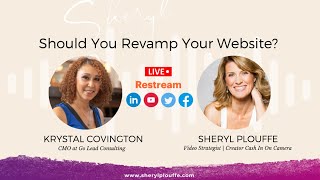
Crystal Covington argues that coaches and consultants rarely need a full website redesign. Instead, fix your messaging and sales cycle: prove credibility instantly, make contact effortless with clear calls-to-action, and focus on one entry-level offer rather than listing every service.
Chapters
revamped. Today, Crystal Covington and I are going to talk about just that. Should you revamp your website? We're going to kind of go into detail about this. Crystal, so excited to have you here on Cash In On Camera to talk about websites. I mean, you know, a website is, is a hub, really.
It's a hub.
It's like, you know, it has spokes on the wheel that extend out and really help a company to, uh, better help people understand, you know, who they are and what they're all about. But I'd love to know from you in terms of where we are now, what purpose are websites really serving today and, and going forward?
Your website is really a place that people can go and peruse, get in touch with you. They want to scroll to make sure that you look credible. They want to know you have one. They want to know that it looks crisp. They don't necessarily spend the time to really read all of the content that's on there. So having a lot of content is not necessarily going to have value. But then the other thing people are doing is they go to your website and then they go and they search you elsewhere to see if you're visible anywhere else and if you're credible anywhere else.
Also, you made a really good point there. I want to dig in a little bit on that. It's like people aren't really reading all the content. So we see— you and I probably both see a lot of websites where they're just reams and reams of text and content, and I always sort of question Who's really reading this? Aside from blog posts, I want to kind of, you know, blog posts might be a little bit different because that's like actual article writing content, but I'm just talking about the actual website itself. Is that an antiquated way of thinking about websites where we're just jamming everything we have in text format on a website?
Yeah, at one point a lot of people started moving to landing pages for this specific reason. Is that people are really going to bullet points. People are looking at various imagery, and you just need to get people a clear message and a feeling rather quickly, um, versus giving them a lot of words. Because again, I even looked at a website yesterday, someone I've actually done business with, and she sent me a new website link to be able to make a purchase. And all I did was peruse it. There's tons of content. It looks like it's great content. I just don't have time to read it, and I'm just gonna look for, okay, what Is she selling now? What are the benefits of those things now? And then I can go and make my purchase with her.
So when you're looking at websites like that and you're really, you know, helping people, obviously that's what you do with, you know, consulting with people, um, through your company, Go Lead Consulting, among other things. When you see a lot of text on the screen, is that indicative of the fact that that website needs revamping Or does it need auditing? I mean, those are two different things.
I feel like, so when we get to the question of, are you going to revamp your website? I feel like the question you, the answer to that is generally no, especially when it comes to the people I'm dealing with and generally the people that you're probably working with as well. When I look at who you're likely serving in your business, for them, their clients are not going to purchase for them from them mainly because they read really great content on their website. Their website is just a secondary source after they met them or found them or ran across them in some other credible way. And then they're just going to pop over to the website. They're not going to be looking at that website to make their buying decision. It's very different if you're in e-commerce. If you're in e-commerce, you don't want to have to talk to people. You don't want to have to do a ton of things or, you know, you're going to have a different type of sales cycle. With e-commerce. Like, for example, I have Amazon stores, which has— I purchased a business in August, and the Amazon experience is just, just been blowing my mind. It's a very different beast. Yeah, but I, I have to work much more on providing perfect information, perfect imagery, everything on that page, because every change I make changes the conversion rate for that page. And so, and that's really my only sales tool is that page. And so I'm tweaking the images and adding another image to the A+ content and all these things and all that matters there. But when it comes to, for example, the B2B side of things, your website just needs to look great and needs to look credible. Once you've got that together, don't mess with it. Yeah.
It's interesting too, because I think if we look back on the role that websites played years ago, like, you know, 15 years ago, maybe even 20 years ago, like everyone, the website was a lead generator unto itself. And now it's not necessarily that the— and I feel like I find a lot of people still think that if I build a website, that it in itself is the thing that's generating the leads.
Right.
And it's like, no, no, no, no, no, no. The website, at least my opinion is that the website is like a brand building asset. And it can also be a place where people can go out to other, you know, things that you do and understand you better and understand your business better. But it's not in and of itself the thing that generates leads. You drive traffic and leads to the website. Can you speak to that?
So it can be. So it just depends again on your sales cycle and how you're doing things. So I do work a lot with tech and with technology. It's just like e-commerce where your, your website is the sales piece. Um, and so in that case it is, but in the case of like a B2B or something like that, it is not. It is a, it is a function kind of like a brochure, but you need to follow up and you need to continue. And even when it comes to those other, um, business types like the e-commerce and the SaaS business and things like that, they need their website to be as efficient as possible, um, and to— and they do have to have, um, experimentation, and they do need to put in money to invest in A/B testing to make sure the website is converting at, at the highest level. But again, once they get there, the, the— what, what my main point is, is that once you've gotten it there, people are asking should they revamp their website, usually because they're struggling with sales. And so it's not a function of the website itself, it's a function of there's something else that's problematic. And so when the question is asked of me Or a lot of times people come with their— come to me with their decision made and say, Crystal, I need your help to rewrite all my website content. I had somebody do this recently and I looked at her website, it was wonderful. She was telling me that it's not converting, it's not, you know, and I'm saying to her, um, I don't know. The real problem is I don't know what I should do with you and you aren't clear with what you want people to do. The website is gorgeous. And I would not do it, do that, but I would focus on what are you selling? And she had some confusion and she, she was really trying to work through that. And so that's where we needed to focus was the website's pretty. I'm not going to charge you thousands of dollars to redo this, what's already nice. And I encouraged her to focus on something that she had already built, which was this online course that was wonderful already. But she had feelings around it and felt like, well, it's not good enough and people aren't going to want to do it. And that's what was stopping her from actually selling and actually making money off of the website, which was she's not directing her leads to the thing that can make her money instantaneously that already had clear value within it. Yeah.
It's interesting too, because you talked about the SaaS space and the e-commerce space, and our audience are predominantly not in those spaces, right? Our people are going to be more in the coaching and consulting space, entrepreneurial space. And to your point, you know, if you're in that place, your website is, is a place where you want to drive people to. But if it's not, if you're not getting the sales that you want, you're not at the revenue level that you want, it might not be that the website needs revamping. It might need that the messaging within the website needs revamping. That's a very different thing.
Yes. To me, it means your sales cycle needs revamping. So your website might need no change, but your sales cycle needs to be revamped. So if your sales process as a B2B consultant is, I send people to the website, that's not a sales process.
Right.
Right. You're not selling anything. So you need to— the only revamping or changing of your website needs to be, what do people do once they get here? You need to have it clear. Here's how to schedule a meeting. Make it as instantaneous as possible. If you have an assistant that schedules meetings for you, you need to have a little pop-up in the corner that says schedule a meeting. You need to have a Calendly link. And that you don't have to make it— some people, when I tell them that, they say, well, I don't want to be so available and make it look like I'm not that special and I'm not that big. And I think, well, I got to look busy.
I got to look like I'm—
I gotta look, I'm not available. And I say, okay, well, you can just feel free to lose leads, uh, because you need to play a game with them. Um, and they're not going to just come back. They don't remember your website. They got here, you know, if it's not clear what to do or how to get you, they're just going to go away and they're not going to find you again because, um, you probably don't have retargeting ads on it either. So you need to do something. So you can have an assistant, for example, if you don't want to be readily accessible or have people who aren't qualified leads talking to you, you can hire someone. Have a little pop-up that says schedule an appointment, have them do 15-minute meetings to go through a sales process and say, who are you, what do you need, you know, this is how we can help you, and are we a fit. And then that person can handle and, and, um, do appointment setting for you. You can also make it direct to your calendar if you have the time, and you can take sales appointments from that. And you can even have information on your instant scheduler link that allows people to self, um, be self-aware of where they fit into the qualifications and things like that. So there's a lot of different ways that you can make your website bring people to you in some other way. You can also, again, like in the example that I provided, that person, um, just needs to— she doesn't need to revamp her whole website. She just needs to make the one thing that she sells that is a great entry-level product Um, first and foremost on her website so people can easily sign up for a free trial. She now has their information, they get value, she can reach out to them, and then they can upgrade and start adding additional things that they want, paying more, um, and being, you know, sold on additional products and services.
Yeah, absolutely. I think it comes down to, as you said, it really comes down to the customer journey. And maybe the issue isn't so much that your website needs to be revamped as much as your customer journey needs some attention and to better understand what is the journey that you're taking people through, through your website, messaging obviously matters. And to your point, like if you have an entry-level, you know, no-brainer offer, maybe that's the thing that you predominantly showcase on your website as opposed to, you know, all the plethora of offers that you have, which only confuses the person's mind. They don't, A confused mind does nothing, right? They don't make a choice. So what is the number one thing that entrepreneurs are ignoring, do you think, when it comes to online visibility or website?
I think they ignore small groups. People go straight to these bigger things. You know, there's the Facebook, go and put up a Facebook page or go and start a Facebook group and these different things. But one thing that I've found actually has helped me is joining little groups. And they might be, for example, um, a— I'm a, I'm a mom. I might have— I've joined a couple of online groups for moms. They are not on Facebook, they're not on LinkedIn, they're off-script sort of things. And I think those spaces are great for meeting people, um, in a different way, um, meeting niche groups of people. And you can find your niches in these spaces. You do have to be careful of overtly selling, but you can network in those spaces and be a resource there and be more visible so that you're not just talking to this mass, you're talking to a small niche group that is perfectly aligned with your clientele.
I love that. I think that, you know, where we're at now and where things are going is really going to be all about community and connections. I think we're in a space, a place and a space where we're moving away from just the vanity metrics and these gigantic groups with thousands and tens of thousands of people. I think people are going to be looking for more high touch and connection and actually getting to know people again. You know, I think that's going to be a big theme. Crystal, I'd love to know, since our theme here is, you know, should we revamp the website? What are some key things, like someone's watching this or listening to this and they're saying, okay, I need to go back to my website. I'm going to look at it through the eyes of Crystal Covington. What do they need to be looking at first and foremost to make a decision about whether they should be revamping the website?
So the first and foremost thing your website needs to do is provide evidence of credibility. So the main number one thing your website needs to do is make you look credible. After that is checkmarked, then the next thing to do is make it really, really easy to reach you. And then the other thing, um, number three, I would suggest is always having at least a tiny bit of spend, even if you have a tiny bit of traffic on your website is to have a Google or Facebook pixel to retarget people who visit your website so that once people have been there, you can try to get them to come back. Because people do— it happens to me all the time that I find a website, I say, oh, this is great, I think I bookmarked it, and I go back to my bookmark and I did not do it, and it's gone. And next time I do my Google search, for some reason Google gives me something different, or I'm not using the exact same search term I did previously. And so that retargeting is extremely helpful to your customer as well. So if there's a tracking, you know, get your Google and your Facebook pixels. And that's why I do say use the big, the big places, because a lot of people check their, those spaces daily as, you know, they're on their, their, their computer. You know, you can go back and, and keep retargeting them. So even if it's just a couple hundred bucks, if you can afford $100 or $200 just have $100 or $200 in retargeting, um, just to make sure that you bring people back, because you could be losing really incredible leads. Yeah, yeah, I know.
I, I think that is something that certainly we need here in my company, need to be really doing a better job of, I think, is the retargeting side of it. So you make a really great point. The idea of credibility and also making yourself reachable— how many websites have we seen where it's a lot of content, it's a lot of written material, but then you have to search and you have to hunt for how do I even get in touch with this person? It shouldn't be that hard. If it's that hard, you're going to lose people.
Yeah.
Yeah. Crystal, how do people get in touch with you if they want to know more about the work that you do at Go Lead Consulting?
You can find me at kristalkovington.com. Crystal with a K. Or the website up right here is the goleadconsulting.com. Website, um, and just shoot me a message, send me an email, um, kristalkovington@gmail.com is just fine. Reach me directly, um, and I can help answer any questions you have.
Awesome. Kristal with a K, I love that. And, uh, just showing your website here, so goleadconsulting.com or, um, kristalkovington.com, you said? Yes. Okay, awesome. Fantastic. This has been so much fun to chat with you about websites and understanding whether or not we should be revamping them. Um, it really comes down to making your website work for you, really. It needs to be leading to business. And this idea of making it— making sure your credibility is first and foremost, making yourself reachable, make that super simple for people to reach out to you. And then the pixel for retargeting is also A little bit more technologically advanced for most, uh, but still an important step to be able to help you maximize your website. I love that. Thank you so much for being here, Krystal. This has been a blast.
Thank you for the opportunity.
More from Sheryl



From 'agreeable' to 'ruthless mentor' to 'strategic sparring partner' #substack #shorts







