Should You Turn Your Book Into A Course?
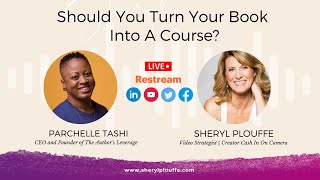
Parshel Tashi, founder of Author's Leverage, explains why authors should turn books into courses: books alone don't generate revenue, but experiences do. She breaks down three production tiers and addresses obstacles like truncating content and defining success metrics for course creators.
Chapters
You know, ripped open that box to find your physical book in your hands and you got really excited about it. But then you're like, okay, what else can I do with this book? Then this conversation is for you. We have Parshel Tashi on today who is going to walk us through a framework to help you decide how you can turn your book into something else. And we'll kind of allude to it here, but it's really about an online course. Should you or should you not turn your book into an online course is the question. So Parshelle, so great to have you here. So fun to meet you in Las Vegas. I know that's how we got connected, but we were fast friends because we both come from video marketing and just love your energy. So how did you get into this line of work to begin with?
Yeah, so I'm actually a teacher by trade, so I'm a former high school math teacher. And I, all the while, however, I was— had a camera, was always doing something creative on the computer. And I had no concept whatsoever that you could make money from it. I come from a family of entrepreneurs but didn't see what I— what was of interest to me in that lane. So I was on the track to become a math teacher, and I did that, and, um, I was just doing video on the side. And eventually that started to really kind of bring out that entrepreneurial spirit in me, and I saw a lot of potential. So I quit teaching, which was kind of, I think, at the time, a little bit disappointing because I did enjoy my job as a teacher, and, um, and I have a degree in curriculum and instruction, so that, you know, tack on another however many dollars that cost, you know, that I'm looking at in terms of debt. And really just still felt a calling to go into what was, uh, creative at the time. So went from freelance videographer to, um, owning a production company that was in two states, uh, and, and doing a lot of work across the country. And so I had a lot of, uh, really great experience. So I have this teacher thing in me, and then I have this creative person in me as well. And so really during the pandemic is when I asked the question of what do I— what's my highest contribution here? And I saw just great potential in this, in this work. And I've always been a student of heart as well. So I kind of feel like in what I get to do, it's a lot of fun because I enjoy learning, right? So I get to do that with all of our clients. And in particular, there was a path that opened an opportunity for repurposing really solid work. Um, so I see a lot of beauty and creativity that can come from what you've already put in your book. And so that's how, um, at the start of 2020, um, actually I should say in August because we're coming up on 2 years, but that's when this brand was started.
Well, it's no accident that we met at the, uh, Publishing and Publicity Conference because that is an event put on by David and Isabel Fagan that brings in authors And so you were in the right place at the right time to meet people who have books or who are planning to write books. But there's so much more that they can do with their books. And I think that's really what you do with the Author's Leverage is to help people see— authors see what can you do with it. And before we get into the principles around how you can decide whether you should turn your book into a course, I love what you said about your background, right, in that you specialize in curriculum development. And so it's a perfect tie-in to what you do today, which is building these courses. Can you just speak to the, just to the world of online courses in general right now? I mean, for the longest time we saw adoption of online courses and popularity of online courses continuing to spike. Is it still on a spike more than ever, or is it starting to tail off? Tell us more about what's happening in that industry.
Yeah, it's really interesting because honestly, when I got into entrepreneurship myself, I had no— I was on online courses. Like, that's how I went from high school teacher to do what I'm doing. So I credit a lot of that to the beauty of the information age that we were taking advantage of. I think that what I see right now is just there's a really big shift in a transition, I would say, because we still thrive off of the community aspect of being able to learn what we know. From specific people that we can relate to and they can teach as well. And so I think with that, there's just a really— there's a shift in online courses and how that's, that's developing. And it's not just so much of a, you know, just consume this information online because you can do that on YouTube. Um, the shift right now is more in that, um, you know, ability to access and have direct connection with not only the person that you're learning from but the other people that are interested in it too. And so I'm just saying that courses are still continuing to thrive, but it's really taking a boost in the, in the concept of community that really become a staple part of an online course. So that's why, that's when I think about the online course space, that's, that's really a really special moment that's happening, especially considering that the completion rates of online courses are really, really low. I mean, how many courses have you bought and you haven't completed yet, right?
Like, right, right.
That's, you're really like plugged in with community in certain respects, you know, can you really get the results?
Yeah. And to your point, who better to learn from in an online course or to have access to than the person who wrote the book on both topics? Like, it makes perfect sense. It's like literally that person wrote the book on it. So, so I love that. Yeah, it's a tie-in. It makes perfect sense. Like, you know, someone who's written a book has put their life's work into that, or, you know, into that maybe physical or digital or both book, and their, their thoughts and their ideas are into— are in there. Um, and so one would maybe think, oh yeah, absolutely, every author should be turning their book into a course. Is that a true statement or a false statement?
Um, I think it's a true statement, um, and I think it just ties back to what your goals and what you set out to do when you put your life's work into this book. And for most, most authors, that, that is not the case on the levels of impact and really making the difference that you sought out for it to make, or the income. You know, usually it's a combination of both. But if you, if you haven't reached that potential that you sought out when you published, there is another opportunity that's available and that people are used to now. They're actually ready to pay for, for implementation, which is one of the core principles.
But yeah, it's So if, if all authors should be turning their books into, into courses, and we're going to talk about like the specifics on how you can really, you know, determine that for yourself, why aren't— what would be stopping authors from doing that? Is it technology? Is it just not an understanding of what online courses and how they need to be structured? Is there any kind of specific thing that that's going on in the course world that might be intimidating or overwhelming to authors, and then they stay away from it and really negate that awesome opportunity, or they stay away from, you know, even exploring it because they might have a misunderstanding about courses, for example.
Right, right. There's quite a bit of challenges that are coming up. I mean, a lot of the authors that we've talked to and interviewed have really shared with us the concern of, you know, how do I truncate all of what I wrote into something that's actionable and engaging and that people actually want to pay for. Um, so that's one concern that comes up, and the other is how can this be successful? And really, that in a lot of cases, you know, ends up with, you know, it's having a conversation about what success looks like for them, because for every author, it's not the same. Um, and so you can, you can reach your goals, um, and I think that the power of the online course enables you to do that on an impact level and on an income level that will exceed, um, what you sought out to make with your book. For a lot of books, they do turn into other opportunities— speaking, consulting, right? Those are amazing opportunities. However, they're also tied to your one-to-one time. So for a lot of them, the magic effect has been, wow, I'm busy, right? I'm— I've got all these things. And if you're also in the position in your career where you're looking to create a little bit more white space in your calendar, this could be a solution in place as well that'll just free up more of your time and allow you to still offer and have something that still can bring transformation to other people, but just in a format that's not directly tied to your time.. So it's a strategic move as well for some authors.
Yeah, I love it. So I think you have 3 main principles that guide you to help authors determine whether they should be turning their specific book into a course. I'd love for you to walk us through what those 3 principles are. What's principle number 1?
Well, to open up the principles really quick, I just want to put a frame on your book, right? I want to change how we look at our books. If you go to Paris, right, the most beautiful thing you're going to see there is the architecture of the, of the tower. And so the Eiffel Tower. And so the Eiffel Tower in and of itself is the attraction. But what makes the most money, if you will, what brings more of the experience are the, are the things around, things are happening around the Eiffel Tower. So as, as an author, as an entrepreneur, as a creative, as a content creator, as a thought leader, it is now our responsibility to create these experiences around the tower. And so, um, so opening up that conversation, the first principle is that books don't make money, experiences do. If we think about how, you know, you can buy an album or you can go sit front row seat at the concert, it's that kind of experience and the difference that we're talking about. So your books, the copies alone, are not going to generate the revenue. And you can even play with some numbers there, right? The difference between, okay, if I just work on book sales alone and maybe a couple speaking gigs, right, what does that earn me? But then if you just add this other component. And if a percentage of your readers sign up for that course, um, and at that point they're indoctrinated, so maybe a percentage of them actually come on to your programs, you're looking at at least adding a zero on the end of what you're able to earn with your book alone. So that's the first principle that we always, uh, often, you know, talk about, is just that the experiences, that's what, um, really is the moneymaker now. So if you can get creative around how you do that, um, you'll be very successful.
Successful. Yeah, and that's what people want. I mean, I think they want to have a closeness and an experience that is different than just, I don't know, just the kind of the status quo that we've all been sort of accustomed to. You know, they're looking for more, and they're looking for, I think, in a lot of ways, that high-touch type of feeling. And that can come in a lot of ways. You can deliver that in a lot of ways. But I think that high-touch piece and experiential piece is important. Absolutely. What is principle number 2?
Now, principle number 2 is that people pay for implementation. Yes. If you're concerned about, wow, could my book do well as a course, you know, how can you make it easier to implement? Because people like me pay people like you to help me get it done faster, quicker, easier, with less effort and less time that I would do it on my own. All the above. That's really a driving factor in courses as well, especially if in the community aspect you're able to then make it that easy, that much easier, especially, especially, especially if your genre, if the topic of what you're talking about— I mean, we're mainly talking about nonfiction books here, just to be, to be clear too, but typically if the, if the areas that you're talking about lead to a specific result in health health, wealth, relationships, or leadership, or personal development. Those are the areas where people are paying for implementation in those aspects because it's really difficult to do alone. So that is the second principle. How can we create experiences around that encourage people to take action?
I just read a great book actually recently about offers, and it talks extensively about that concept of implementation and how when you're, you know, creating your, your offer, in this case with this particular book, that you can craft it around this idea of the implementation. So it makes perfect sense. You, you hire people to do things for you. I hire people to do things for me. People hire me to do things for them. That's how it goes, because you as the entrepreneur or the author, you're not going to do everything yourself, right? And nor are your potential, um, clients who would purchase your course. They're looking for help. And if you step up and you're the person who shows up and says, I have the offer, the course that's going to be able to help you implement this particular thing, it makes a lot of sense. Yeah. What is number 3?
Number 3 is that the quality of that experience that you're creating, the quality of the experience matters. And so in particular with the author's leverage, we are positioned as that partner that's going to make you look like a million bucks, right? So production quality matters. A lot of what you're going to be putting out in the form of a course is going to be in a multimedia format, whether it's audio, whether it's video. Um, Cheryl, this is our area. This is where we geeked out on, um, because the quality of this experience really, really matters. And so you just want to give some, um, some thought into really matching your brand really well, depending on where you again are in your business, your brand and how you, how you stand out is really going to matter. It matters today. So typically with this particular principle, we're looking at the fact that the e-learning industry is going to grow and is continuing to grow like it's not stopping. There's so much that we need to, to learn and to grow and we have to learn from each other. And so among, I guess, in that spectrum of $2 trillion that this industry is going to be worth in the next few years, the question is, what is the media quality? How would you categorize what you would see in that? And so this principle is really— it just inspires the question of where do you want to fall in those categories when it comes to your product and your book and your brand and where you see your message going. And either way is fine. And the way that we present that is thinking about going to travel somewhere. So If you, if you're going, you can go there by propeller plane, on a commercial jet, or a private jet. And so that's how I usually teach those. A propeller jet is going to be something where maybe on Zoom, maybe on something just homemade or on your phone or what have you, you can still create content and it's going to likely sell if you're again hitting implementation and creating a good experience. So that propeller plane version, you know, is usually going to look that way. Most of us are familiar with that. The next step up is going to be something where you're doing it with someone else. So maybe you're doing the filming and you've kind of got some better camera equipment, but someone else is doing the editing, someone else is doing the polishing of that, or vice versa. Someone shoots for you and maybe you don't mind editing, you can edit that as well. So that's what I call that commercial plane version where it's more of a done with you, whereas the propeller plane is you're doing yourself. And then the private jet is essentially what we offer. That's what we stand out with, the Author's Leverage. So, uh, in that respect, that's where you're showing up, you know.
Imagine that, you're showing up and everything is done, you know, everything is done, you know.
You got the right camera angle on you, you know, your makeup is looking great, you're fantastic, you have support around how to deliver your content well on camera, um, the whole nine yards. So, um, that's an option as well. And of course, each of these, um, present a different price point. But the, the good news is, is that no matter which No matter what mode you take, you will arrive to your destination. And secondly, you can always take that trip on one plane and when you're ready, go on the other. And actually, you know, if you've proven that this is a good experience, then you can polish it up and you can do a lot with that. So those are the three core principles that really drive the thinking here, right? It's experiences are what make money, not the book sales alone. People pay for implementation. Especially in the areas of health, wealth, and relationships. And thirdly, the quality of the experience you create really, really matters in the multimedia world.
So yeah, I love that. And so with regard to the authors who, you know, would be considering turning their book into a course, because you've made a great argument for why that should be the case, you work with people who are at a level like you're, you're in the jet, you're the private jet version of this. Is this for every author, or is it like, oh, you know what, if you've only— you know, if you only— this is— if you're— this is your first book, you should start with the prop plane, or if this is your fifth book, you got to come to us? Is there a level, or is it like, no, you know what, that we can actually work with people who have just written their very first book?
Yeah, it's really interesting. If you— if you're just writing your first book, but let's say this book has people— like, a community of people have been asking for this book for years because you've just been doing such compelling work, like, and you're in the position to invest, right? A lot of us as authors are, you know, when it came to publishing your book, kudos to you if you did it 100% on your own, but there are so many resources out there right now that we interview on our podcast especially that are helping authors get published. And so some aspect of this work you're already investing in to get some help and support in, This is just another aspect of that. Um, so where you are, um, you know, can vary. It just, uh, it all depends case by case in terms of what your goals are, where you're positioned right now, and, um, you know, and what you're willing to invest to continue into this work.
I think, you know, anyone who is an author, uh, is doing it especially in the non-fiction world, right? It's because they have a message that they're trying to get out to more people. They're using that book to be a door opener to the press so that they can get additional eyeballs on what it is that they're doing. Usually is mission-driven, purpose-driven work that people are writing books about specific topics. And so, but let's not forget, there's also this part of, of us in, in authors too that, that want to say like, well, how can I turn this into another stream of income, right? How do I turn this idea into another stream of income? Because I think we recognize that if I can turn this into another stream of income, I can have more impact. And so what you're saying, you know, make a really good argument for why to do that. Um, you mentioned your podcast. I'd love for you to give a plug for your podcast, and I'd also love for you to tell us about your website, and I'll show it on the screen.
Yeah, sure. So our, uh, our podcast is also called The Author's Leverage, and, um, that's been pretty exciting because I have to admit, um, honestly, coming into the book industry space, I mean, I've been a producer for, um, you know, for over 10 years now. So coming into this specific niche with this skill set, I've been so interested to learn the industry. So what you really see here is a compilation of me just asking questions really from the space of my author and our clients and who we're here to support. And then wanting to, you know, of course highlight these amazing resources of folks who are doing the same. So what you're going to find there is just really any conversation, no matter what stage you're in, in the book writing process. It's all about how to, again, leverage what you've already created, or if you're in the process of wanting to have that established foundation, you can gather a lot of insights from really any of the people that we've been talking to, and authors included. So that's the podcast. And yeah, we've— been having a good time with it. Um, some tech hiccups, believe it or not, because, you know, it's just— it always happens, right? It's like, anyway, but, um, but it's been good. I mean, I've just felt so, so proud of my team and what we've been able to do, um, going forward. And the podcast really shines bright in that.
That's awesome, Parshell. This is, this is great. Thank you so much for coming on. But before you go, quick question: stop marketing like it's 1999. I'd love to know if you have a tip, tool, tactic, or technique that helps you to market the author's leverage or for you to market your own personal brand? What can you share with the audience, something that's working for you today?
Yeah, something amazing that's working is, uh, just building relationships with, uh, with, with others in the industry and creating collaborations. Um, that's been huge. And so, uh, one of the ways that we've been doing that as a marketing initiative is actually hosting industry-specific dinners. These are invite-only where we bring those that are in the book publishing industry, whether they are publishers themselves or hybrid publisher, traditional even. We have other book writing coaches that come in, ghostwriters and whatnot, but it's a very, very small and intimate, uh, dinner. And as a marketing strategy, it's, it's been probably one of the most rewarding ways of actually getting to know someone and to do it in a genuine manner. So We just hosted one last week in Washington, D.C., which was our first one, and that was incredible. And then we had one that we just hosted this week in San Diego. So that has been such an amazing way to really just, you know, what would you do with a friend, you know, that's coming to town kind of a thing. We wanted to create that vibe and have it over good food and a view. So it was such an incredible event. So that for us has been a really powerful strategy thus far just to really get us off of Zoom and get us in person over, over a meal and to talk about what's happening in our industry. It's really cool.
Yeah. And, you know, it's no surprise that that ties into one of the points that you made on this call and on this episode is that experiences matter. Right. And so experiential is where it's at. So, Parshelle, thank you so much for being on Cashing On Camera. To our viewers, to our listeners. Thank you for being here, and be sure to follow the show as we bring you more amazing guests like Parshelle who can help you to further your business and your brand. Thank you so much, Parshelle, for being here.
More from Sheryl



From 'agreeable' to 'ruthless mentor' to 'strategic sparring partner' #substack #shorts







