Speaking with Impact: Unleashing the Leadership Potential of Your Voice and Message
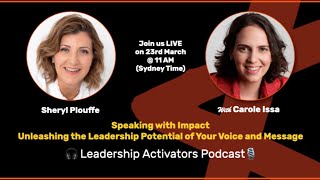
In this episode of the Leadership Activators Podcast, host Carol interviews Sheryl Plouffe, former national broadcaster turned founder/CEO of Scalable Business Accelerator and host of the Cash In On Camera podcast. Sheryl shares how she transitioned from a 9‑to‑5 broadcasting career to entrepreneurship, describing the "unemployable" mindset that drove her to create a lifestyle business. She outlines early entrepreneurial pain points—especially accounting, banking, and system setup—while highlighting transferable superpowers from broadcasting such as thinking on her feet, interviewing, and active listening. The conversation pivots to podcasting, where Sheryl debunks common monetization myths and reframes podcasts as a business‑development engine for high‑quality leads, referrals, and speaking gigs. She explains that the only real readiness criterion is the ability to hold a conversation, and she stresses simplifying technology using tools like Restream, ChatGPT, and affordable USB microphones. Sheryl presents a rapid‑launch framework: launch a podcast in 30 days and maintain production with a 1‑hour‑per‑week method, supported by her 5‑Star Interview Method. Core values—trust, caring, respect, and humor—are woven throughout her approach, and she defines leadership as the willingness to admit failure, learn, and keep moving forward. Upcoming initiatives include the "Zero to Guest Speaker" workshop (April 3‑4 2023) aimed at turning podcast guests into speaking engagements, a 30‑day challenge to land three speaking gigs, and resource recommendations such as the book Storyworthy and the Web3 Business Podcast. Sheryl invites listeners to connect via LinkedIn, email, or a complimentary 15‑minute quick‑win call.
Chapters
Hello everyone and welcome to the Leadership Activators Podcast. I'm thrilled to have you with us today, Cheryl, my guest. It's awesome to have you at this very odd time, actually. What time is it in Canada right now?
It's 8:02 PM and I'm very happy to be here regardless of the hour. Early morning, late at night, I'm happy to be here.
So good. This is awesome. Love it. Thank you so much for everyone who is joining, are joining us actually on the livestream. I'm looking here to make sure that we are live. If you can hear us, if you can see us, it'd be good to see in the comments, say just hi, yes we can, to make sure that we are all good and ready to rock and roll. For those of you who are joining us on Facebook, please make sure to send your questions over to the LinkedIn livestream or to PM me because I'm looking at the livestream on LinkedIn at the moment. Can be looking at a gazillion screens at the time, So if you have questions for Cheryl at the end of the conversation, would love for you to ask them. Make sure again to send them on LinkedIn, so either on the livestream or PM me. Great. So Cheryl, I'm thrilled to have you today. Thank you so much for joining me. I've been so looking forward to this conversation, especially that I've been on your podcast and it's been an amazing experience. And to quickly introduce you, although you don't need introduction, You are the founder and CEO of the— you are the founder and CEO of Scalable Business Accelerator and the host of the Cash In On Camera podcast. You own a training company that advises 6-figure entrepreneurs who want to implement scalable systems, and you are based in Ontario, Canada. And again, so I introduce to the biggest audience that we have today. I think it's going to be at least 20 people joining us. They've been PMing me since yesterday. They're so excited. So Cheryl, Um, so yeah, so Cheryl, I'm really curious about how is it that you decided to leave your 9-to-5 world and go on your own and start your entrepreneurial journey?
Well, you know what's funny, Carol, is that my 9-to-5 world was not really 9 to 5 because I was a broadcaster professionally for many, many years, and 17 of those were spent on national television here in Canada. But I worked a variety of different shifts, so it wasn't always 9 to 5. It was a corporate shift-based kind of work. But I would work— I did the morning show at one point. I did the primetime evening show at one point. So lots of different time frames. But to your point, it's the idea of leaving the security of a, say, shift-based corporate employee relationship. And the thing that for me really was in 2013, that's really when things started to brew up inside of me. And it just started as a slow boil, right? Like a slow sort of thinking about entrepreneurship type of thing. And then there were a sequence of events that happened that led me to more of a rolling boil. So it got to the point where I started to really feel this urge to want to go out on my own. And it was scary. Listen, I had a great job. I had a great position. Lot of perks, a lot of wonderful things about television. But it was an industry that was really seeing a lot of changes because of digital, because of social media. And I saw some areas that were retracting, frankly, in television. And I wanted to be on the side of expansion and where things were going to in the future. So that was where things started for me, was in 2013. And then it wasn't until 2017 that I actually did it. I ripped the Band-Aid off. And started my own company in video marketing. And it was really the best decision that I think I could have made, albeit scary, but one of the best decisions. And it's really made me unemployable now. I mean, I have to work for myself at this point forward, always.
I love the unemployable word. What does it mean to you when you say unemployable?
Well, you know what, I think that certainly entrepreneurship is not for the faint of heart. I mean, it definitely challenges every fiber of your being, and it is probably one of the most intense forms of personal and professional development that you'll put yourself through. But it's one that provides a lot of freedom. And for me, I think that's really what I was looking for. I mean, at that point I was traveling and commuting a long distance to go to work. I didn't live in the city that I worked in, so I was commuting during— in, in the summer months here in Canada, it's fine, right? It's about 2 hours every day. But in the winter, in a Canadian winter, on, on North America's busiest highway, trust me, it's not a place you want to be. And I would have drives that would sometimes take me 3 hours, 3 and a half hours one way to get home. So I was exhausted by the time I got to my destination, really, when I got home, uh, not to mention the stress that I was under. So I think that it's really about freedom and wanting something different for your life. And I really wanted to have a lifestyle business is really what I decided to do.
Absolutely love what you shared here. It brings to mind a lot of conversation we have about entrepreneurship and moving from the 9-to-5 world into the entrepreneurial world. And I'm not sure about you, but with what you shared, it sounds to me like as if you were preparing for the challenges that were coming ahead as a business owner, because we sort of build resilience and some skill set in the 9-to-5 world that prepare us for the entrepreneurial world. And we just realized that afterwards, we think sometimes that, yeah, I'm just a whatever, insert here. For me, it was a sound engineer, maybe for you it was an awesome professional broadcaster. And when we land into the entrepreneurial world, we start to see what are the different skill set that we can bring in to help others. So I'm wondering in your world, what were the challenges that you faced early on in your journey? And how is it they have overcome them as an entrepreneur?
There are definitely transferable skills from broadcasting into what I do today. In fact, I often say that when I was broadcasting, I was already doing marketing. I just happened to be building someone else's brand at that time. And so a lot of the skills are transferable. Certainly the biggest challenge that I faced being an entrepreneur, especially in the early stages, were things to do with accounting, managing accounts, banking, finances, things of that nature. That is not my forte at all. So I didn't know any better. And at the very beginning when I started doing this, I was running the business out of my personal account, which is laughable now because I know better now. But at that time, it's one of those things where you don't know what you don't know and you're in the process of just, I'm in there, I'm an action taker, I'm doing it, I'm making it happen, I'm being resourceful, I'm doing all these things. That part of it was a disaster. I did not know anything about that. You know, taxes, accounting, bookkeeping, all those types of things. Thankfully I have help now and it's taken a long time to get clear on and setting up proper systems and it's still often a work in progress, to be honest with you, 'cause it's just not my forte. Thankfully, I've got people to help now, but that was definitely and still is a challenge for me. It's just not the thing I love to do.
Yeah, I hear you. It's a challenge for a lot of people as well. Looking at those, I would call them boring logistics stuff, but equally very important and very important. I can totally relate to what you're saying. If you were to think about the superpower, because also a lot of times I come across entrepreneurs who are like, This is natural. That comes naturally to me. That's not a big deal. And they have the tendency to look at their stretches or their weaknesses. If you were to look at superpowers that you realize would help a lot your clients, what would those superpowers be?
I think for me, the superpower is the ability to think on my feet and to be able to say things that make sense and have a conversation in the back of my head, but also be saying something of value here in the front of the house, so to speak. I started hosting a TV show when I was 18 years old. I didn't know what I was doing, but somehow I really picked up on it and it really became a talent, a skill that I developed and continued to develop and probably will continue to develop even now going forward. Like, I think it's something you always continue to build on. So I think my superpower is the ability to think on my feet. And I think I'm also good at listening, interviewing, and I like to ask questions in between the answers. And I'm listening for opportunities to dig deeper into places. So I think those are my superpowers.
No wonder you landed in podcasting and teaching people how to run a successful podcast. I can see that. So good of an investment. Such a great investment right there, right at the right place. Talking about that, which is one of the things that you help your clients work on, and mainly service provider business owners, whether it is to generate high-quality leads or to land on paying gigs, paying speaking gigs. What is it that you've seen over time, the common misconceptions or mistakes that people fall into when they're looking to launch a podcast and make it successful?
The biggest misconception about podcasting is that there's only one way or traditional way to monetize it. Often people think of podcast monetization, especially when it comes to business. That's why people are starting podcasts, because they want it to lead to some, some type of business benefit. And I think the misconception is that it has to be the traditional model of I must build an audience, I must get downloads, I must be on New and Noteworthy in the first week, I must be getting a sponsor or an advertiser. And while that can be true, that is a long-term strategy for most people. Very rarely does someone instantly build an audience in the first month. You know, it takes time to build an audience with a podcast. So then the monetization becomes elusive to people who are not able to hang in there long enough for that audience to build over the long term. So the misconception is that, and the solution to that is to think of it differently. And to think of a different type of strategy for podcasting, which is what I specialize in doing, which is to help entrepreneurs, coaches, consultants, and experts to see that podcasting can be a way, as you mentioned, to generate high-quality leads. But not only that, leads, referrals, and other speaking engagements. So I look at it through the lens of how do you leverage your podcast to get clients, referrals, and speaking engagements? The reason why that's powerful is because each of those avenues are business development opportunities in the making, and that's what I like to focus on.
Beautiful. Love it. I love the additional referral generation, which is a great point, and I see how can this play out with Transfer Trust and all of that. I'm wondering when a service provider, like in the case of mainly who you focus on, coaches, service providers in terms of professionals, and consultants. Um, what does it look like when you're looking at different criteria on whether or not they are ready to launch a podcast? What is it that we are looking for? How do we know if we are ready for it?
If you can hold a conversation with someone, you're ready. It really is that simple. It's simple if you want it to be simple. If you have, and you would adopt the methodology that I like, which is simplicity. Let's keep it simple. Let's keep it efficient. Let's use technology to our advantage. Let's not spend 18 hours editing a podcast at 3 o'clock in the morning when you could be doing other things. We need to have efficiencies in order, especially in the post-production and in the production process. I know you have a production background, so you know it's— it is work to do post-production. If we can limit that and we can bring that, that number down, it really helps you to be able to be, um, be able to potentially have more conversations. But ultimately, if you can hold a conversation with someone, which you can, which you do every single day of your business life, you would have conversations on a podcast with someone else. There is an infrastructure around that, certainly from an efficiency and a production perspective, but you can keep it simple. And I think often there's a layer of fear there. Sometimes we see business owners who will put up a wall in front of themselves or an excuse for why not to do it. Because really what's happening is there's an internal fear of rejection, of what will people think? And who am I? And I don't have a big audience and who's going to care and who's going to listen? And I'll be embarrassed. Those are the conversations that sometimes happen in someone's mind. So they put up a wall of, well, I can't do a podcast because I don't have the right microphone, when in fact you can order any plug-in USB microphone from Amazon and it will be on your doorstep tomorrow morning, you know. Yeah, yeah, they're excuses for not, uh, tackling the true thing that's really going on, which might be fear of It could be rejection. It could be, what if this isn't gonna work?
You know?
So I think that it's a deeply layered process for a lot of people, but the truth is, if you can hold a conversation, you can have a podcast.
Love it. So if you can, can hold a conversation, you can have a podcast. Sounds to be the overarching theme here and the highlight of the skill that needs to be developed. And you've touched on the technical side of the spectrum, which also might sometimes stop people from launching their podcast or the things that they're hiding behind, the reason they're hiding behind. How is it that you work with your clients to help them overcome the technical— her technical side of things? What's the solution to that?
Well, I love this question because we're demonstrating it right now. You and I are both using— I use Restream. You're using Restream right now, which is a multi-streaming tool. I can't think of a better tool or method or strategy to be efficient than with something like this, because I'm— you're broadcasting to all of your channels. I have linked up my channels to your broadcast. So we're going out to a lot of people right now. We're reaching with— we're leveraging. This is leverage. We're doing this one interview, but it's going out to multiple, multiple channels right now simultaneously. So technology can be simplified because these tools exist. It used to be that these tools were only for broadcasters, only the elite broadcasting conglomerates and companies and media companies had access to this type of stuff. Now everyone has access to this for a very affordable rate. So I think it's really about simplifying the technology. And that's one of the things I nerd out on, this type of stuff. I love it. I love being the crash test dummy of different tools, and I will go up there and test things so that I can then inform my audience and people who follow me when I'm doing my workshops or I'm coaching students, what have you, that I can share with them, hey, I've done this and it doesn't work as well as this one. This one, I like the interface of this better because this is simpler for you to use. So I often see people who are using very complex technology for accomplishing what they're trying to accomplish when they don't even need to be.
Yeah, absolutely. Overcomplicating things. Yeah, I keep coming across this and I love what you shared here. And even we keep learning as you go. This morning, in fact, we both learned something new about Restream that we did. We did. So how cool is that?
I love it. This is a great tool. This, this is, this is phenomenal. Now, it's not just this tool. There are lots of other great tools as well that I like to suggest for various other purposes within the scheme of producing a podcast. Like, where are you storing the data that you're collecting about your guests? Because again, if the strategy is to get clients, referrals, and speaking engagements, you're going to need to gather some data in order to be able to use that data now and in the future to come back and be able to either invite people back on the podcast or follow up with them on, on a joint venture collaboration of some, of some kind. Or maybe they have a podcast that you could be a guest on. So there are tools that you need to know about in order to effectively gather data, produce the podcast. Um, you know, ChatGPT is something that's really obviously taken the world by storm, and this isn't going anywhere. We need to learn to adapt that to our businesses, but it's a great opportunity to use a tool like ChatGPT to help us come up with new ideas and use it as a tool to generate titles for podcasts, for example. It can be really powerful.
Yeah, getting technology to help. Absolutely. So that we don't start from a blank page because most of the times I keep coming across people like that. I have a blank page and I don't know how to overcome the blank page syndrome. So that would be a great way to just jumping over this hoop. So communication skills, tick. Tech, tick. I would imagine that some people might have another objection here and I'm just gonna play the devil's advocate, which is a typical one, which is time. Oh, it sounds like the podcast is a long game. It's a marathon, it's not a sprint. I'm a business owner, I'm time poor. I really want something like to get me like up and running right now, what would be your approach when it comes to time management and adding on top of everything else that the business owner has to do and to attend to the podcast?
I'll break it up into two different portions. Portion one is getting it launched. You should and can get your podcast launched within 30 days. This is not a process that should take you 8 months, a year. I talk to people all the time. I've worked with clients who have been thinking about launching their podcast for 2 years. I can think of 2 people at least who've been thinking of doing this for 3 years. So when we think about the, the opportunity cost of that and how many people they could have served, or people they could have met, the speaking opportunities they could have had, the clients they could have had over that course of time, because they put up reasons for why not to do it. And maybe that was for whatever reason. So launch in 30 days. Push yourself to launch in 30 days. Use our strategy, launch in 30 days. The second part of that is now the production on our— the actual process of doing production. We believe and teach a 1-hour-per-week method, and we've hinted at it here. Part of this is doing things in an efficient way and leveraging tools that are available to us today, available to us today to leverage our time and be able to produce this in a very efficient way. So one, launch in 30 days. Two, 1-hour-per-week method.
Awesome. And how is it that you also help your clients overcome the first hurdle, which is the skill of interviewing? Where does it start with you?
Yes, well, Admittedly, interviewing is a skill that you will develop over time. But like I said, you can start— if you can have a conversation, then you can get started. And it's something that, again, when you have an efficient process for production, it allows you to stay consistent. And so with consistency, you can build your skill set faster because you're not letting 4 months go by before you do your next episode. So you're able to build up your skill set because you're being consistent. It is a skill set. There is no getting around that, and your skill set will develop over time. But you don't have to be a broadcast journalist to start a podcast. It really is about having conversations. And we see examples of that— people who start podcasts who are not— they don't have any professional experience. They go out and they say, you know what, I'm going to have smart conversations with really cool people and just start there.
Yeah, I hear you absolutely. And I think it's all about progress over perfection, which is one of my favorite mantras, and it's been one of my best friends since the beginning of my entrepreneurial journey. And now I teach it to people, which is like you said, it's a skill that has developed over time. And hey, we make mistakes as well. I make mistakes all the time. I've been doing this for like 4 years now, and I keep learning new things about how is it that I can do things differently, better.
And, uh, let me turn it around a little bit and ask you, because if you started 4 years— how did you feel when you first started? You— did you feel like you were a seasoned interviewer when you first started?
No, not at all.
Not at all. So you have to start somewhere. And I think if your why is strong enough, right, if you're a coach or a consultant, you're an expert, if you're a heart-centered person who knows that you're meant to be doing this and that you want to have impact, you have to start to do it. You have to be visible and you've got to meet people. You're going to have to have the fundamentals of business development down in order to grow your, your mission, your impact, your business, and to be able to, to do the things and set and achieve your goals. The thing that I do with the interviewing is I like to subscribe to what I call the 5-Star Interview Method.. And this is the idea of having, you know, having some, some key pieces in front of you. You don't have to have mass, you don't have to have a script, nothing like that. But, you know, having a few little notes. I was teaching someone the other day about putting their notes up near their computer, right by the camera, so that you can be reminded of points that you wanna make. So there are some little tricks that you can do, but ultimately the skillset of interviewing is something that you can start by knowing that you can just have a conversation with someone and then can just consistently, continually build up that skill. I guarantee that after your 10th episode, you will feel 100 times more accomplished as an interviewer.
Yeah, absolutely. I can relate to this. When I first started, I had to like prepare like a gazillion days before and I would be nervous and it was like amazing. Now it's like, just, oh, I have a podcast. Yeah, let's just hop on the call 15 minutes prior, make sure everything is checked tech-wise and we're good to go. Yeah, I can totally relate to this. There is something that you share that I absolutely love about putting your message out there and overcoming the fear for you to start really giving value to the market, being a heart-centered entrepreneur and business owner, and knowing that what really matters at the end through our business is the impact that we're going to create. And I think it's so much worth it to learn how is it that we can overcome the fear and generate the courage needed to start creating the impact that we are really meant to create. Which brings me to the word leadership. And in fact, today's episode's title is Unleashing the Leadership Potential of Your Voice and Message. So I'm wondering, Cheryl, what does the word leadership mean to you?
The word leadership to me means admitting, admitting failure. There are a lot of people out there in the entrepreneurial world who would have you think that they have never had a failure in their lives. This is untrue. This is just part of what you're signing up for. There are going to be failures, and you have to be okay with that. You have to be okay with that. And I think true leadership, aside from leading a team and being someone who has ideas and a point of view and things of that nature, I think that Leadership to me is the admitting failure and learning something from it, but moving forward anyway, moving past that fear and chalking it up to, okay, that was a failure, that didn't work. Pick yourself back up, right? Have a good cry, have a glass of wine, pick yourself back up, dust it off, and get back to business. That is true leadership, in my opinion.
Wow. Yeah, I'm letting it sink in. That's amazing. That's, that's the first time I hear this perspective. I keep asking my guests this question over and over again because I'm absolutely amazed at different perspectives that people bring to the mix. And I love the fact that it's for you, your ability to keep standing up, trying again, like one of the very famous jazz songs says. Pick yourself up, dust yourself off, and try all over again. So yeah, the appetite for failure and seeing it as a tool to grow and learn and help others grow and learn at the same time. Um, going back to the idea of leading the way with our podcast and putting our message out there, there are a lot of podcasts out there and a lot of people who are jumping on this wagon at the moment. So I'm assuming that someone who wants to launch their podcast would be thinking, How is it that I'm going to cut through the noise and stand out? What's your approach when it comes to this?
Because my strategy for using a podcast for business and business development opportunities is a little different than the traditional model. I actually really don't believe that your podcast needs to stand out. I, I really think that this strategy eliminates the necessity for you to find ways to stand out. It's not really that strategy. What this is, is to say, we're gonna use my podcast. Yes, it's going to be— we're gonna have great conversations, it will be well branded, we'll have a cool name. It's good. All you're going to have all those things, all those things will exist. You will have a winning podcast idea, but you don't necessarily need to find ways to stand out because the strategy here is really more about the, the guests and the relationships you're building with your guests to lead you to clients, referrals, and speaking engagements. This is a business development tool that— and strategy that you're using, so it isn't as important to stand out. Now, if we're talking about standing out from the perspective of professional branding and things of that nature, yes, I do think you want to take a look at that and make sure that you are your branding and the, the artistic side, the creative, let's say the artwork of your podcast, for example, it does need to have a certain level of professionalism to it in order for you to look the way you want to look and for it to be taken seriously. I think that's worth taking a good look at. So for example, in, in my program, we have a designer who designs the podcast artwork, and so we eliminate the need for someone to ponder that for 4 months. We get it done. But I don't think it's about standing out. I think it's really about a deeper strategy than that.
Yeah, I love your perspective around this because it brings me to thinking about when we start as entrepreneurs, mainly service providers, there's a lot that is attached to personal branding. Like, this is how— because people are coming to you because they want to work with you. They don't want to work with let's say leadership activators in my case at the beginning, they're looking to work with the actual person behind it, the person who's gonna help them. It's a very personal, very close trust, trust-related relationship. And over time it started to be translated into the brand when it starts to scale and having people representing the brand. So one of the key factors that I believe has been crucial for me, and I'm not sure about you, is how is it that we bring our personal values to the mix when we start and we carry them forward to make sure that we are scaling with the same quality of service, with the same relationship building and trust, quality of trust. I'm wondering in your world, what are the personal values that you have brought into your business? And how has it been playing out?
I think that Trust is really big when you think of especially podcasting or business development and building relationships. It's all predicated on trust. Podcasting and having an interview like this is one of the most intimate things that can happen in the business world, is having a conversation where we're touching on a lot of really great topics here. And, and your questions are fantastic, by the way. We're touching on a lot of different topics here. It's an intimate experience. It's also a high-touch experience. You and I are bonding over this conversation. So I think trust is one of the most important things. I also think that caring— this is something again in the coaching and consulting world, in the mentorship world, the world that I live in— is it is a lot of heart-centered people who truly care. Listen, there is a business layer to this. Everyone needs to be profitable. Everyone needs to do that part of it in order to have the impact that they want to have. But at the core of it, I think it's about caring. People want a better world. People want to be able to take their professional experience and apply that in some way to make the world better. For me personally, I have this deep desire to want to fortify family and to help others create a better, more stable, um, home life. And so I feel like what I do is contributing to that through entrepreneurship and through other people. So I think caring, I think that trust is really important. A little bit of humor never hurts. I like a little bit of humor. You know, I, I probably need to add a little bit more of the goofball side of me into my marketing, and, and I try to do that, but I'm, I'm serious, but I'm also a bit of a goofball. And, and I think respect. You know, I think respect, respecting your guests, respecting a conversation, respecting people's time, showing up on time, showing up for meetings, you know, things like that. Respect is really an important value to me, and I think it permeates both professional and, and, uh, personal and professional.
Beautiful, love it. It's so good. It's funny because I'm wearing a bracelet at the moment which reminds me of what you're sharing, and it actually has my values on it. Um, one of them, one of them is care, funny enough. I love that. So yeah, a beautiful— I actually have a question, if you don't mind, uh, Cheryl, uh, from one of the listeners. I just received it now. Um, so what have you noticed about what the audience prefers? Is it many different topics or going deeper with one topic?
In my experience, for my show, I think people like a variety of topics. I think it's different for everyone though. If you have a podcast, you really want to understand the, the, what we, what we hear internally would call the winning podcast idea. Yes, there is a strategy to use it to, for business development, but keep in mind that you're also providing a lot of valuable conversation to the audience. We're not ignoring the audience by any means. That's not the strategy at all, providing great value to the audience as well. So for me personally, it's having a variety of different topics because I know that my audience are high five figures, six-figure coaches, consultants, experts, speakers, authors, and they're confused and overwhelmed with the world of marketing. They are being bombarded by Facebook ads that tell them that they need this shiny object, and then they go down that path for 8 months, and then A year later they're stuck where they were and now they're in debt further than they were. And like there's overwhelm, there's perfectionism, there's all these different things. I know this audience. So if I know that audience, then I can tailor the topics of my podcast to, to them and bring on experts who can speak to various different things that are working, actually working for today and give them tangible strategies that work. And I think it's a matter of understanding your audience and then building your podcast strategy out accordingly.
Yeah, absolutely. Love it. Yeah, I see that happening also with my podcast too. And there's a lot of learning and measuring all the time and different things might not work for different people. And like there are different formats as well, like the expert format where it's only the person who's talking, like the business expert who's just talking with people or at people. And some of them invite guests, some of them mix them up, and it depends who the audience is, which we discover over time. I absolutely love what you share. Um, what is the project that you're working on at the moment that is exciting, um, that you would like to share?
We are doing a, a workshop called Zero to Guest Speaker. It's coming up. I'll mention the date here only because I know this will last the test of time and people will find this in the future, but April 3rd and 4th, 2023. We're doing a workshop, but we do workshops every 2 months. So by every, every 2 months we're doing a workshop. So reach out and we'd be happy to share which workshop's coming up if you're listening and watching this. But right now I feel like speaking is one of the most important things that people need to understand, that they have to be— not only, I think of course, hosting your own podcast is a great thing from a strategic perspective. We're going to leverage that, all the things we've talked about. But let's not forget that the other side of that coin is that you get out on other people's stages as well, that you should be speaking consistently and regularly on other people's stages. One of the benefits of having a podcast is that you often get those opportunities naturally from this process, but you'd also need to be speaking on other people's stages. So that's what we're working on right now, is helping people land speaking engagements, you know, 3, 5, 10 speaking engagements from this 2-day workshop. And, and we're really excited to be able to help people land gigs that will help them generate clients for themselves.
This is, um, yeah, this is a great, great point, actually, um, leveraging the network of others as well, creating that sort of strategic partnership where you're offering value to a common pool of clients that they have as well, and vice versa. Love it. Um, so Well, I would love it if you could share with me the link so that we can post it in the comments. So for those of you who are listening to us at the moment, and for those of you who are gonna watch the replay afterwards, all the power to you guys because you're investing time to learn more on how is it that you can scale and take your business to a whole new level using podcasting and getting speaking gigs and also trusted referrals. So I'll post the, in the comments, box, the link that Cheryl will share with me as well. Um, so Cheryl, what is a book that you have recently come across or that you've read or a podcast, um, that you absolutely love that you'd like to share with us and why?
My bookcase is over there and I knew you were going to ask me this, so I actually pulled it out so I could show you, um, for those watching the video that— okay, lots of— there's so many books, but I had to pick one. So this book is called Storyworthy, Storyworthy by Matthew Dicks. And I love this book. This book is one of the best books that I have read pertaining to how you can take normal everyday things that happen in your life, document them, and turn them into stories that are really powerful. So to engage, teach, persuade, and change your life through the power of storytelling. It's really great. I love it. This is one of my favorite books. Another one in terms of podcast, I am a big Web3 person. Like, I'm learning about it. I love it. I'm deep into it. I'm totally— I'm down with the DAOs and the NFTs and the smart contracts and all these different things. So Web3 Business Podcast with Michael Stelzner is, is really fantastic. I love it. I'm obsessed with it. Whenever I'm driving to my clients, you know, I'm listening to that podcast and catching up on it. It's really one of my favorites.
Love it how you're combining left brain and right brain stuff together. Exactly, exactly.
Right brain podcast, left brain.
Yes. That's great. Gotta keep working on both. Yeah, next slide.
Oh, did I get that right? Sorry, this— yeah, that's right. The Web3 is the—
the—
yeah, that's right, the left brain, and this is the right brain.
Yeah, okay, get that straight. Beautiful. Um, so, Sheryl, what would be a 30-day challenge that you would like to throw to our listeners? Um, a challenge that you believe will create a big impact in their life and business.
Land 3 speaking gigs for yourself in the next 30 days.
Nice.
Land 3 speaking gigs. Doesn't matter in person, online, offline. It could be that you call up your local Chamber of Commerce and you go and speak to a group of 10 people at a Lunch and Learn. Or book yourself onto a podcast and get in there and speak. Maybe you join a summit, maybe you get on a live stream with someone, uh, you know, maybe it's a conference, who knows, all kinds of different speaking opportunities. I, I think getting out there and being on stages of any kind is advantageous, and I would encourage you to strive for 3 in the next month, and I guarantee it will change things for you.
Love it. So, wow, exciting. I can see how this is also nicely sits with the event that you are going to run in April. And I bet that there are a lot of people who are listening, like, to this podcast, whether it's now or later in the replay, would be excited to perhaps get to know more about how is it that you can help them.
So what's the best way to reach out to you, to get in touch with you for My favorite social platform right now is LinkedIn, and I'm very into LinkedIn. So if you're there and you want to send me a connection request or send me a message, you can do so. I'm @CherylPlouffe on all social platforms, so you can send me a message, you can email me. I'm very reachable, right? I have my link in bio and, and all of the social platforms. The best thing to do if you really want to move forward and you really want to push your business forward with momentum, I offer complimentary 15-minute quick win calls, right? So 15 minutes is enough time to be able to get you a quick win. And that's how I like to contribute to that. Certainly I have other resources and things that I can send you to as well. But I believe if you're really serious about growing your business, it's gonna be worth it to you to get, to get on a free 15-minute call to get a quick win and move forward that way. That way there I can have conversation, find out what you're up to, what you're working with. Who knows? Maybe I can make an introduction for you. Maybe I know a podcast that you should be on. Maybe you should come to my next workshop. You know, who knows? If you're not looking, you know, if you're not actively out there talking to people and taking, you know, having calls and discussing things, nothing bad comes from talking to people. Gotta be willing to do that. So I'm happy to do that. You just have to connect with me and say, hey, you know, I heard you on the Leadership Activators podcast. You mentioned that we could reach out to you and that you do these 15-minute calls. No problem. I'll send you the link, book it, and we'll chat.
Beautiful. So I know that you've just sent me also the link to book one of those 15-minute quick win call with you. So people who are listening to us, I'll post the link also in the comments box. And if you're happy to go straight away also and go for the challenge. I think that the event that Cheryl is running is also an awesome opportunity for you to learn on how is it that you can nail that challenge and get yourself 3 speaking gigs booked already in the next 30 days. So thank you so much, Cheryl, for your time. It's been an absolute pleasure having this conversation with you.
I really appreciate your, your interviewing and your questions. I think it was just right on track and I love this conversation. I love having smart conversations with smart women. So thank you for having me.
Thank you so much.
More from Sheryl



From 'agreeable' to 'ruthless mentor' to 'strategic sparring partner' #substack #shorts







