Strategic Goal Setting For High Video Output
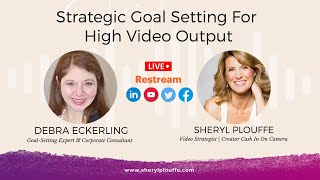
Deborah Eckerling shares her DEB Method—Determine your mission, Explore your options, Brainstorm your path—to help creators boost video output. Writing goals down and tracking wins matters more than posting everywhere. Visual goal representations like vision boards and screensavers keep momentum steady.
Chapters
content but struggle to actually make it happen. How many of you can relate to that? Sheryl Plouffe here, video strategist and repurposing expert, and you're watching Cash In On Camera. And today we're talking about productivity as it relates to goal setting so that you can improve your output of video content and ultimately help yourself build your online presence and your business. And Deborah Eckerling is with me today. She's a goal-setting expert, an award-winning author. She's done so much in this area, so she's the perfect guest to bring on to talk about goal setting as it pertains to more video. Deborah, excited to have you here today. First of all, let's start with why do people struggle so much with increasing their productivity as it pertains to any kind of content? Today we're talking about video, but why do people struggle in this area, do you think, to begin with?
Well, first of all, I love the question and I love being here. Thank you so much for having me. The biggest challenge people have with any kind of goal, whether it relates to video or their life, is they don't know what it is they actually want. They underthink their goals, they overthink their goals, they're living maybe goals from a past business endeavor. It doesn't matter. Let's put all that aside. But the thing that, that's the biggest challenge is people don't know what they want. They do not set the foundation. And you can't get what you want unless you know what you want. Whether it's the big life goal or a successful video show, if you don't have that vision, that mission, that really solidified purpose, then you're just gonna spin in circles.
It's funny because I was recently having a discussion with someone. And this person, very, you know, great at what she does, expert at what she does. But I kind of got this sense of kind of desperation. She's at a point in her business where it's like, well, maybe tried a lot of different things that weren't working, is feeling, you know, stressed out, is feeling anxious, is feeling desperate. And so in the course of this conversation, it was like, oh, Cheryl, maybe I should do TikTok. That's what I need to do. And then, uh, no, maybe it's Reels. What do you think about Reels? And I gotta start the YouTube channel. And I had to, and I'm not a goal-setting expert, but I am somebody who realizes that this person needed to kind of start with the foundational stuff, which I think is exactly what you're talking about. If you don't know where you're going, how do you know how to build the roadmap to get there? Is that the world that you live in? And how do you help people reconcile that?
Well, that is completely my world. So I've been leading goal groups doing consulting, leading workshops on goal setting for years and years. And about 3 and a half years ago, I rebranded myself as the DEB Method. Same system, but fortunately my name and my system work really well together. And DEB stands for determine your mission, explore your options, brainstorm your path. And it's those three phases that you can really put on top of any kind of goal that you wanna set, but those are really the 3 goal-setting simplified steps to success. So it starts with what do you want? When you think about the perfect life, the perfect video show, what does that look like? And if it takes you a few, I was gonna say a few days, few weeks, few months, whatever your timeline is, that's fine. But give yourself the gift of that time because you're going to be more successful down the line. Once you know what you're creating, from there it's explore your options. So I want to be a known expert in X, I want a video show on Y. Well, what does that look like? What does that mean? Is it a video show? Is it a video and also podcast? What do you want to talk about? Do you want to do a solo show, group show, anything? That basically comes out of your brain. You want to explore the possibilities, do some research, look at what else is out there, see what you like, see what you don't like, and you know, pick and choose. And then once you settle on what you want to create, brainstorm your path, figure out all the steps, all the action items, the benchmarks, the short-term goals, everything you need to, like the puzzle, all of the puzzle pieces that you need to put together and just get it all out of your head and onto the page because as much as we try and figure out things in our head, we can't. Well, maybe some people can, but it's not like we could peek inside our brain and look at the blueprint. That's why just writing everything out there and looking at your options and piecing them together is so powerful. And really, it sounds simple, but it is simple.
It is simple. It's just— but it's foundational. It's foundational and it's simple. And it's funny, I think about my own— this, this show, right, Cash In On Camera, which I started in the summer, and I want to grow, and I want to continue to bring on amazing guests like yourself onto the show. And we've done— I don't even know how many episodes at this point. We're probably close to 25 or so in this new format. But I have to admit, I haven't set any metric goals, like number goals, like for, let's say, X number of views, or how many, um, you know, views or impressions or things of that nature? Is it really important? I, I have an idea of what I want to do with the show in terms of goals to help people, right, with marketing, social media, and other things. But is, is it important for me or others to really have solid metrics on like video impressions, views, etc.?
I'm going to say something that no one else will say. Okay. No, I don't. I mean, I think, yes, we all know what that we want to be the number one show, the number one video we want. We have an idea in our head, but I don't think that's nearly as important as what you want to bring into the world. So as I mentioned before, the D in the DEBB method is determine your mission. And that's really a combination of who you are and what makes you unique, but also how you help. Whether it is to inform, entertain, educate, all of the above. And a lot of people do these kinds of shows for business development, client development, to make new friends, to, to share the people they know with their community and vice versa. And I think that's even more important because when you're thinking about your future, no, you don't want a show that nobody watches, of course not. But if you really love what you're creating, if you're bringing into it amazing people and develop relationships, develop friendships, I mean, that is a goal. My show, my Gold Chat Live, I bring in 2 to 3 guests each week and to talk about a particular topic. And most of the time they don't know each other. So for me, it's not only fun to discuss the topics with my community, but I get to make cross connections. And, and we saw that when you were on my show talking about messaging with Ethan and Christian. And I saw a couple of weeks later you interviewed Ethan on your show.
I did.
I did.
And actually, it's funny because Christian's watching right now, and he apparently likes the background and the overlay of the set. Christian, so great to see you. Thank you so much for watching.
Appreciate it. It's amazing. And Christian's another great example. I've known him for years. I used to be an editor for Social Media Examiner. I worked the event at Social Media Marketing World. We met like 5, 6, 7 years ago, but just in passing. And I had a StreamYard question, and I reached out to him, and we started chatting. And I'm like, so when are you going to to be on my show. Yeah, yeah, I know, I know you. And I'm like, well, I know, I know you.
But you know what's interesting about that? You know, this idea of like the networks that we build, and he comes on my show and I go on yours and you come on mine, and, and, and all the goodness that can come from that. But it all does stem from a goal, because if you didn't have a goal, if I didn't have a goal, or Christian or Ethan didn't have their own goals for their businesses and for their visibility online, none of that would happen.
Exactly. And so what, what do I want? What is my goal? My goal is to help as many people as possible figure out what they want and how to get it so they can in turn help others. So my goal and my mission are very much in alignment. And from the mission is my motto, which is goal setting simplified. So everything that I create, whether it's my book or my, my show, my Twitter chat, my podcast, it's all under that veil. My coaching, it's all about goal setting simplified because making these changes are challenging enough. The instructions need to be easy. So I made them really, really easy.
I love it. You mentioned your book. I'd love to bring that up on the screen and share your, your goal guide. So let me bring that up. Tell us about the book and why it was important for you to, to really bring this to the to the world?
Well, my book, and it's, I think it's in one of my reviews or one or more of my reviews, it's like a coach in your pocket. So the first half of Your Goal Guide goes through the DEV method. So whether you're setting goals for your life, your business, your video show, you can use the steps of DEV to really hone in on that foundation, what you want to create, explore your options, brainstorm your path. It takes you through that.
And then the second half of the book is all strategies for success.
So making the time, and because really creating the life you want really is about choosing yourself, setting appointments, and putting the ideas into action. So it's strategies for success in terms of bringing your goals into reality, creating that life you want. But not just that, looking at your life and finding ways to, to put, to have that balance. So it's not all work. It's not all, well, it should all be fun, but finding ways to incorporate the things you need to do to achieve your goals into your life. So I love networking, having a show where I get to hang out with my friends and other people get to watch. That's very much in alignment with what I am all about, but it also helps me with my goals because you can't reach your goals on your own. You need your people. So whereas in one aspect my show is to inform, educate, entertain, and hopefully inspire people to really embrace the life they want and work towards it, it also helps because that way I get to meet new people and they get to meet each other. So it's win-win-win.
You know how you mentioned earlier that you need to write it down, write down your goals. Do you mean like pen and paper, or can we write that down digitally? Is there a better method than another to actually get the goals out of your head and onto some format that makes it real and tangible?
Well, I love pen and paper. And whenever I'm doing any project, I start with this. Me too. But if you are one of those people who loves the keyboard and you're not going to brainstorm if it requires the pen to paper, then yes, do your brainstorming on a cloud document, a Word document, whatever makes sense for you is the answer. Because if I say, oh, you have to only journal on paper, so many people wouldn't. The other thing that, that I love is I love to do both. So I will draft everything on paper and then I will type it in. I think another really powerful thing to do, which is Related, kind of, sort of, is every week write down your wins, write down your project, your progress. So this way when you're going through, let's say you have an hour a week to work on your, the video, the video show you wanna create, you wanna do it right. So you schedule this 1-hour appointment each week and you're going to go through the steps and really figure out what you wanna create and do it right. You've given yourself like a month to do this. And you're like, okay, I've done this a couple weeks, I'm not getting very far. Well, if within those appointments you write down your progress, you type up the notes in there, you can look at your calendar and be like, you know what, I feel like I'm not getting very far, but look what I've done. It's also very helpful if you wanna track the, your ideas of the topics you wanna cover, the people you want to or have reached out to to be your guests. So I say write everything down and then keep an electronic version of it, whether it's in your calendar, like I said, cloud doc, Word doc, whatever you're going to do, that's what you should use to track your progress.
It's really about documentation and whether, and I'm like you, I like to write it down first You know, I usually have a cup of coffee or tea and I'm in a good place and cozy and kind of thinking and writing and I'm brainstorming. I'm brain dumping everything in. And then what I'll do is take that and transfer the Colesnote version of that and maybe start to categorize and start to use a spreadsheet or a document to start making sense of the information that I'm putting out there. And I think that really works very well. And I think a lot of entrepreneurs would benefit from doing that exercise. Is, you know, starting with a dump of the goals and what it is you're trying to accomplish. Why are you doing said thing? In this case, we're talking about creating video content. Why are you creating the video content? Is it to generate leads? Is it to nurture an existing audience? Are you, you know, trying to make sales with it? Like, what is the goal? Why are you— what's the video for? Like, I like to take people through the customer journey, right, and look at Is this a brand awareness thing? Is this a nurture campaign? Or is this a conversion type of thing, right? So, where are we? Why are we doing these videos? But I think that's fundamentally what's missing, especially for the set of people who are grasping and they're desperate and they're just trying everything and not getting anywhere. And they're diluting themselves across multiple platforms. I'm a big fan of multi-purposing. But this is a different strategy because I'm doing it once and I'm multi-streaming it out to multiple platforms. That's efficiency. Whereas what I'm seeing a lot in the space is people who are going out and doing all the things on all the platforms and creating more work for themselves and making life hard.
I am, I am first of all completely with you on this. So I have my Write On Online Facebook group for goal setting productivity and community. And that's a group that I've had for more than 10 years actually. And it was a live group. Even longer. And from there I started a Twitter chat because not everybody was on Facebook. So I lead my Goal Chat Twitter chat on Sunday nights. That graduated into, I guess, my first COVID project because my publisher said, hey, wanna do a live show version of your Twitter chat? That's where Goal Chat Live came about. And then from there I rebirthed my podcast, The Deb Show, which is the audio version of these chats. So it's the same thing. And it's all for that purpose. It all serves my motto of Goal Setting Simplified, my mission to help people embrace the life they want with simple tools and tactics they can do in 15, 30-hour increments, whatever you have time for to do that. And you basically described the DEB Method inadvertently. It's really figure out that mission, explore what that looks like, and do the brainstorming. Write everything down and divide and conquer, and then do the appointments.
Yeah, yeah, exactly. This is all, this is all really helpful. I love that you've broken this down into the Deb Method, which obviously is a framework, and it's, it's a 3-step framework that clearly works. You've been doing this for a long time and help— have helped a lot of people to set goals to achieve whatever it is their mission is. But coming full circle on that topic, that's where it starts. You have to have a goal. You've got to have a mission for why you're even doing said activity in the first place. So, I love that, Debra. Thank you so much for sharing. One thing that we do at Cash In On Camera is we do a segment called Stop Marketing Like It's $19.99. So, I'd love to know from you what is a tip, tool, tactic, or technique that's working for you to help you market yourself. Something that's working that you'd like to share with the audience today?
Oh, so many things, but one thing everybody talks— and we're recording this in December— everybody talks, you know, the beginning of the year, you need your vision board, you need your dream board, whatever you want to call it. Great. One thing that I think is wonderful is, yes, we like to cut things out in the magazine and create this vision board, but The modern version of it is an electronic visual representation because you can't get what you want unless you know what you want, but it's even stronger if you can see it. So whatever you're doing, make one of those appointments with yourself to create a visual representation of what you want your show to be about or what you want to create for yourself. And just go, if you want it to be the number one podcast or the number one video show or on some best video broadcast list. Find that list and then make a little, a thumbnail of your show and put it on that list. Or whatever your goal is, that mission, find that visual representation because when you're working towards your goals, whether it's full-time or it's your side hustle or something you're creating to elevate your business, As we mentioned before, it's a long struggle. You need to be patient. But if you can keep your eye on the prize and create a visual of what that is, what you want to create, and look at it, have it behind your computer, I think for yourself, it will keep your mission and your motto in mind and what you're working towards. And that way, everything you create, I'll bring it back to marketing, can be represented in that visual that you have at your eye level and disposal to keep you motivated and inspired and moving forward.
You don't have to convince me of the power of visual. I mean, that's been my whole professional career is the visual and video. And I love that you said that, you know, and I think it's this idea of making it real, make it tangible and something that actually is holding space in this world. It becomes real when you can visualize it. So I think that's a great tip to end today's episode of Cashing on Camera.
Can I add one extra tip? Because I remembered as we're talking about it, my screensaver on my show, it changes. Right now it's the Deb Show, it's my podcast. I've had my book as my screensaver. I've had my live show. So bonus points if you also put your visualization on your mobile device because that way you see it all the time. I am the prize.
Yeah, I have, I have one too. It's some notes that I found from someone that I follow and I just liked this particular section of her blog. So I screenshot that one section and I save it on my, as my wallpaper.
That's perfect.
Over and over again.
I love that.
Oh, Deb, this is so much fun. Thank you so much for coming on the show today and sharing your knowledge your insight and your wisdom around goal setting and ultimately goal achievement really. Because if you start with a mission and you use your methodology and your framework, you can achieve those goals. So thank you so much for coming on the show today.
Thank you so much for having me. And to you and everybody, I wish you only the most success.
Thank you.
Thank you.
More from Sheryl



From 'agreeable' to 'ruthless mentor' to 'strategic sparring partner' #substack #shorts







