Techniques for Transforming Personal Experiences into Engaging Narratives
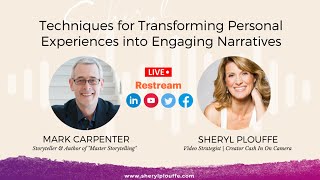
Marc Carpenter teaches entrepreneurs and speakers how to turn personal experiences into stories that teach, lead, sell, or inspire. Start with your intended point, then build a three-part structure: Current State, Conflict, Change. Make the lesson the hero, not yourself.
Chapters
where someone is retelling a story and it feels just like a sequence of events. It's like, this happened, then this happened, then this happened, and you are sitting there following it going, huh, uh-huh, and where is this going, and where is it leading to? And it leads nowhere. So that's what we're going to talk about today, is the difference between telling personal experiences but turning those into engaging narratives is a very different thing. So today, Mark Carpenter is here to share with us how we can do that. So great to have you here, Marc. This is something obviously that's near and dear to your heart. You're the master storyteller, but you see this a lot, right?
Oh, I do. And I know it's near and dear to your heart, too, as someone who uses story in the appropriate way. You started off talking about we've all had experiences where somebody starts telling this story and they're not really telling a story. They're just relating an experience. And you get to the end, it's like, OK, what's the point of that? They say, oh, there's no point. It's just— I just wanted to tell you. Well, OK, that's fine. And it's probably appropriate in a lot of settings. But if you want that to have impact, you have to be more intentional about how you're translating that experience into a story that will have a purpose.
Especially when it comes to entrepreneurship, building business, which is predominantly who our, our audience are on video and audio here on Cashing on Camera— coaches, consultants, experts, speakers, authors who want to build a business or selling their own products and services, coaching, consulting, what have you, and they want to build a business out of this. But you have to really understand that intentional storytelling is very different. So how do you define intentional storytelling?
Well, and it's the intentional part that I think is really important. What is the purpose of you sharing that experience or turning that experience into a story? You mentioned entrepreneurs and business owners and business leaders. We hear a lot, "Oh, tell the story of your business. Tell your founder story." Well, then people get the idea that I'm going to tell every step of this journey along the way. That's not necessarily what other people want to or need to hear. So I always encourage people, if you're going to share an experience with the idea that you want to teach, lead, sell, or inspire, if you want to draw people into your business, understand what your purpose is in telling that. What do you want people to note or understand or even feel differently at the end of that? That process in and of itself will help you edit your experience into a more intentional story, because I'm going to start leaving out things that don't lead to the point that I'm getting to. The experience you identified at the beginning where somebody just kind of wanders around and telling things, I refer to that as not landing the plane. They're just flying around in circles. Because they don't really know where they're going with it until they try to find a point in the process of telling. But if you know this is my destination for the story, you're going to get there in a much more direct line than if you're just sharing an experience.
So the landing strip of the plane that you use is to teach, lead, sell, or inspire. So as the business owner, you ought to know then before you start crafting your story, which of those 4 things, which landing strip we're putting that plane onto.
Correct? Yeah. And not only just in those broad categories, because some of them can even be combined. I want to inspire them to buy. So there's a, there's an inspire and sell at the same time. And that's, that's perfectly legitimate. But what is the main point that's going to help people get to that change of, yes, I know you, trust you, like you, I will buy from you. And so it's that specific intention of, I want them to understand that my product or service or my business is different in this way and will help them in ways that are significantly different than others. And this is the story that illustrates that point, because if I just tell them, "Mine's better. Trust me. Believe me," that's not going to go very far. But if I can give them a real-life experience that taps into their minds and their hearts, they will understand that better and then they're more likely to act on that as well.
I think sometimes figuring out which of those stories will best illustrate a point can be challenging for people because they don't see the value of that story unto itself. They might, let's say, a story from your childhood that at first glance you might go, well, who's really going to care about that? But sometimes there are important lessons that are weaved into childhood experiences or teenage experiences that can be translated to make a point. How do you encourage people or teach people to identify what those potential stories are?
Yeah, one of the best ways that I've identified for people to do that is to look for experiences that give you an emotional reaction. So what's that experience that frustrated me or that made me laugh or that made me angry or that maybe disappointed me or made me sad? Or that was a struggle for me that kind of changed my identity or my view of the world or even my view of myself? What are those moments that you had an emotional reaction to? There's very often a lesson within that if there's been an emotional reaction to it. And part of the reason that I connect people to those emotional reactions is because when you tell the story, you want the other person to have an emotional reaction too. If you didn't have an emotional reaction to the experience, how can you possibly expect the other person to have an emotional reaction to that story as you tell it. There's probably not enough there. Right. So there's, there's one direction. The other direction that I go, because sometimes people will come in and say, well, I need to share with people how this point— OK, I need to get them to this point. I need to get them to— I'll go from a leadership standpoint. How do they motivate their people better? Well, if you take that approach and say, I need some way to illustrate the importance of motivating people in the way that they need to be motivated. If you start looking around your life or talking to other people and looking at their lives, you will likely find an experience that fits that bill. So you can come at it both directions. I had this experience, I had an emotional reaction to it. What's the point that I can make with that? But you can also come at it with, I need to make this point. Let me go find the story that helps illustrate that point.
I love that. I— one of the stories that I like to tell for me is that when I was a child, I was painfully shy. I was the kid who in class, when the teacher called on me to answer a question, I would sometimes break out in tears. That's how painfully shy I was, because I did not like all the attention on me. I didn't like the, the the feeling of eyeballs on me. It felt like it was burning, you know, everyone's looking at me, ah, and I couldn't, I couldn't take it. So I would often cry when I was young. And then lo and behold, you know, get into my teenage years, becomes a different story. The story there is, yes, I was painfully shy, but then I broke out of that and started— by the age of 18, I was hosting a TV show. Crazy, but it happens, uh, so— or it happened. So I think sometimes people don't really understand, like you said, what the emotional component is of the story that it is that they're kind of going back in. So they end up going down this path of finding stories that are just a personal experience that's being relayed point by point chronologically, right? So let's just speak to chronology for a moment. Like, this happened, then this happened, then it had— do you, do you like that as a means of telling even an emotional story? Is it better to mix things up?
Well, there's a structure. There's a really good structure that you can put those experiences into that create a good story. They make it a little easier for you to put that narrative together. And this ties back to Joseph Campbell's Hero's Journey. But there's like 17 steps in that. We've tried to simplify that really easily.
I'm glad to hear that because it's complicated. There's so many steps.
Like, yeah, well, and that's really for more for things like epic novels or, you know, big-time movies and things like that. But when we're talking about these day-to-day experiences that we turn into stories to teach, lead, sell, and inspire, we're talking about a 3 to 5 minute story. We're not talking about this epic tale. So if you can keep these 3 chunks in mind, it will help you to sort out that story. Now, I'm going to start this by saying, begin with the end in mind, the old Stephen Covey principle of what is your intention in telling that story? And then think about what is the introduction that I need to tell? That sets the stage. Who are the characters? Who are the people in this story? And how can you as a listener relate to them? You started telling us about when you were in elementary school and you were painfully shy, and when the teacher called on you, you would burst into tears. And I'm sitting here listening to that story going, oh, my heart's just breaking for you because I know kids that are shy like that. I wasn't one of them. I was the one who wanted to be the first one raising my hand. But I can still feel the sense of that character. That's that first stage in the story. Set up the story with a relatable character and a worthwhile goal. So the worthwhile goal there for you might have been not feeling intimidated in school, not crying. Now, we didn't get your whole story. We got the end of the story. We got to the, to the third part, which I'll touch on here in a minute. But then the conflict comes in. So introduction and then conflict. Sometimes, if we— I like to keep it in the beginning with the letter C. And so I'll say Current State and then Conflict. What's gotten in the way there? Why were you so shy? And what can you do? What's the thing that's going to happen that's going to help you overcome that? In fact, I hope, I hope you're OK with this. I'm going to, I'm going to, I'm going to push on you a little bit.
Yeah, absolutely.
What was it? What was that change moment or that, that moment where things shifted for you? What happened that helped make that shift?
To go from being painfully shy to hosting. Yeah, it's hard for me even to pin down, but I just had this internal knowing inside of me that I was meant for more.
Okay, good. And so you come to that point where you say, I'm meant for more than this. And so what am I going to do with that? I'm going to step out and I'm going to take this risk of something that just feels painful for me to do. I'm going to find out I can actually do that. And then we get to the third part of that structure, which is the change. So in review, current state, conflict, change. And so then the change for you is, I found out that I had a voice that was valid. I had a voice that was valuable. And then I transitioned that into hosting a television news show while— when I was 18 years old and still in high school. And so there's the end that gives us that satisfactory resolution of, wow, I learned from that. What can I do to step out of my comfort zone and achieve some of the things that I want to achieve? At least that's the lesson that I see with that story. That would, that would be an endpoint that I would want to get to with that experience. Yeah. So current state, conflict, change. If you can think of those 3 elements, guided toward, this is the point that I want to make with this story. That will help you edit out extraneous details but include the important details as well.
Yes, because some of the, some of the details are important to transport people to and help them imagine what it would be like, to bring in that emotional component of it. So some details are important, but you want to be careful to choose the right details that pertain to getting them to this place. Right.
Right. And so you brought it up right there. It's those details that bring in that emotional aspect of it, that connect people to the story so they can see themselves in that situation, even if it's not the exact same situation that you're talking about. No, I didn't have that painfully shy elementary school experience, but there's been times that it's been hard for me to speak up so I can relate to that. And so I can relate your experience to mine and say, OK, How can I take that step to realize that my voice matters in these situations where it's harder for me to speak up? And can I make the change based on that? And so there's the inspiration of that story that's leading me to act in a different way.
What I think is so interesting about this framework is that, and one of the things that I like to teach and share with people is that if you want to scale a business, you do have to be speaking. You need to be out on other people's stages. Ideally, you get to a point where you do something like this, where you host your own as well. And that's the perfect flywheel. But nonetheless, you are out there speaking and you typically as a speaker would go out, let's say, to a variety of different stages with certain talking points, maybe 3, maybe 5 different talking points. And you would tailor your talking points for whatever that particular speaking engagement might be. Coming back to storytelling, you might then, or would you, would you agree, Marc, that you would want to craft a story for each of those various Speaking opportunities that you anticipate doing, having a different story for each or one story for all?
I think there's a combination of that. It's not an either-or type of situation. I think there are some stories that are foundational stories, particularly if you're, if you're in a business setting, you're a business leader trying to help people understand how you can serve them, how you can help meet their needs. There's probably a foundational story that you can tell there. And then there's other stories that you could tell specifically to markets, or there's a story that you could tell, but you're going to tell it a little bit differently for different markets. You might include some details for one market that you wouldn't for others because those are things that they can relate to. But it's understanding that intentionality that is really important. What is my intention in getting this out there? You made the comment that if you're running a business, you've got to be able to speak. You got to be able to stand up and talk to people. Well, I would add into that, you got to be able to tell your story, because you can stand there and you, you can share with people the facts, the figures, the information, the features, the benefits, all of those things, but that's not going to touch their minds and hearts. And I'm not saying those things are unimportant. You definitely need to know those things. You need to have that quality product or, or service out there, but you also need to be able to convey that in a way that touches the minds and hearts of the people so they know you, trust you, like you, and want to buy from you.
Question about the founder's story. It's important to be able to express how you started your business, why you started your business, the why behind it. And but often I see people telling the founder's story, which is positioned in a way that is too much about them. But after all, that is the premise of it, is that it's the founder's story. So how can we navigate telling our founder's story but not making it me, me, me, me, me, me all the time and making it matter to the other person.
So I keep going back to this word. You and your listeners are probably going to get sick of hearing this, but it's that intentionality. What is the intent in telling it? Is the intent to say, look at me, look how wonderful I am that I created this company? And a lot of founder stories come out that way.
I know.
So you want to look at, OK, what's my journey of founding this company, of starting this? But what is that in the context of the people that I'm serving? Why did I take that journey? But it's the path to who I wanted to serve and what I could do for them. It's not so much about me and me making a business and me making money, because if I come to you with that story, you're going to go, I don't want to buy from you. But if I come to you with the story of I went on this journey because I wanted to help people overcome this problem, And this is a problem that you probably have. Here's how I help you overcome it better than other people help you overcome it. And this is how I came to that conclusion. If it's about how I'm serving that other person, that's going to be the powerful founder story that's going to connect people to your organization.
Yes, I love that. I do see that a lot where the founder story is often told in a I, me, I, and I don't think it lands as well because it hasn't— It doesn't have enough of the other person in it. And to your point, intentionality is really the key to doing that.
Yeah, I tell people the hero of the story shouldn't be you. It should be the lesson that's learned from that story. That's the hero of the story is the lesson that we learn from it.
Yes. And there are so many lessons we all learn in life, but it's just a matter of using these storytelling principles to, to rein that in and be able to utilize it effectively to be able to tell stories that matter. Yep. What is, what is a, a tip, a tool, a tactic or technique, Mark, that's really helping you to market yourself, to market your book that's behind you? What's something that's really working for you these days?
Well, and it really comes back to telling your story. I think a lot of people— old-time marketing was about get your message out there as often as you can and as much as you can and to as many people as you can. So we We got into the spam world where things just, they just kept coming at us, coming at us, coming at us, asking for business. But if you can create content that people are interested in, that is going to build the relationship that helps people connect with you and want to buy from you. And so that's really what my focus is, is in helping people to intentionally craft those experiences into real stories that will teach, lead, sell, and inspire, and that connect us as human beings. Yes.
How do people get in touch with you if they want to learn more about Master Storytelling?
One of the great ways is what you just popped up on the screen there. It's our website. It's master-storytelling.com. You have to get that little dash between master and storytelling to get to us. But we have some free resources there on the page. We have a little document there that's called the, the StoryMaster. That helps you just kind of identify where are some of those stories in my life and what is the intent that I want. And then we have our podcast episodes that I've been on are going to be on there as well. You can also download the first chapter of the book. You can find me on LinkedIn. You can find Master Storytelling on LinkedIn and Facebook. And I love that screenshot that you just rolled past of me, you know, grabbing my temples. I don't even remember what I was saying in that moment or during that podcast, but I'm not sure why that's the— But you've done a lot. You've spoken on a lot of stages.
This is great.
Yeah, well, and, and because it's, it's applicable in so many different ways. It's applicable for business founders, it's applicable for sales organizations, it's applicable for people trying to speak from the stage, it's applicable for somebody just trying to manage a team. There are so many ways that you can, you can use this that there's just a lot of different audiences that can tap into this skill. What— one of my favorite podcast episodes I was on was about how do you find your next job? And so we talked about using storytelling as part of your interview process. Instead of answering questions just with an answer, answer it with a story.
Ooh, I like that.
And see how much farther that gets you in the hiring process.
Oh, wow. That's a good one. I like that. Mark, this has been fun. This has been a great conversation. And I think you really dovetailed perfectly into The thing that we do, we're helping people with podcasts and helping scale their businesses. And having stories really effectively plays into that. So, if you're watching this, if you're listening to this and want to know more information about how to do that, then reach out to me. And then, I'm also happy to make connections to Marc and be able to facilitate that as well. So certainly, reach out. You can find me on LinkedIn or CherylPlouffe.com. Marc, this has been fun. I really appreciate this conversation around storytelling. It's an important part of it. And thank you for using my own story and helping me. I was I was taking notes as you were telling me, like, current state, conflict, change. And I thought, I'm going to make notes because that is really the premise of how I can better utilize that story of my own from my childhood.
And that's what I see from people is they— everybody has these experiences. Everybody has these stories that they can tell, but they aren't sure quite how to get there to make the impact that they want to. And that's my goal, is to help people do that, to help people make those connections so that we can connect better with people as people.
Yes. Thank you for being on Cash In On Camera. We really appreciate your insights, Mark.
It has been great to be with you, Cheryl. Thank you.
More from Sheryl



From 'agreeable' to 'ruthless mentor' to 'strategic sparring partner' #substack #shorts







