The #1 Key To Being Consistent
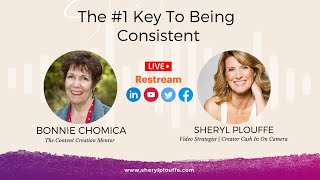
Bonnie Chomica and Sheryl Plouffe discuss why consistency matters most for solopreneurs building visibility online. Sheryl's weekly YouTube commitment brought 15,000 new subscribers and 1.5 million views in a year. They cover platform focus, content batching, and starting with a realistic weekly schedule.
Chapters
Be consistent. However, that can be challenging if you're doing everything. If you're a solopreneur or you're working with a small team, you have a lot of tasks that you are responsible for taking care of. And it can sometimes feel daunting to be consistent. And that's why Bonnie Ciomica and I are going to dive into this topic for you today and talk about really what we think is the number one key to being consistent. Bonnie, so great to have you on. You have like, it's like 30+ years of experience in marketing. And so, I'm excited to get your take on this. Why are people so challenged with staying consistent?
First of all, it's great to be here, Cheryl. Thanks so much for this conversation. It's definitely a challenge for most people whether they have a lack of time I mean, we all have a lack of time to do things. So maybe they just need some kind of a plan or a process. Some people, it's a mindset. It's like, you know, I don't know what to write about, or I don't know what to put on video. So it becomes a confidence thing. Others are, I don't know what to talk about, or I'm not good enough, you know, who's gonna listen to me? So, it can get all muddled up into a bunch of different things. But really, like anything you're trying to achieve, it's about committing to something.
I knew that word was going to come up. And I think it's a really important word, the idea of commitment. And that's really what this boils down to is how committed are you to achieving, I think, the results that you're after? Because we live in a very different space than we did 10, 10 years, 20 years ago. So, let's dig in on that particular aspect. Why is committing? Why is consistency so important in the day and age that we live in today?
Being consistent or committing to being consistent involves getting more exposure. It's about getting visibility. And if you're not visible, then you're invisible and people aren't going to find you. In this busy online world, if you're just randomly posting things or writing things or doing videos, the, the technical aspect behind that, the, the algorithms and, and all that, you know, techie stuff, they're not going to serve you well and you're not going to be seen. So by committing, that also helps the people that already follow you, but it also helps new people to, to find you because you're going to be— your content is going to be served up in front of people.
You made it. You just brought up the algorithm, and, and I think that, that, that part of it, that technical part of the algorithm and those complicated mathematical equations that run these social media platforms, is something that eludes even the highest of gurus out there. I mean, no one really, really knows ultimately how they work, and that is their, you know, that's their IP, I guess, in that sense. However, and we can't control that, but what we can control is what we do and what we put out there. Have you ever been challenged? I mean, you've been in business since 2012. How have you been challenged with being consistent in the past? And what have you done to correct it?
I was definitely a random content producer. I think we all have been that way at some point. Exactly. You know, you, you have great intentions of, oh, I'm going to post to Facebook 3 times this week, I'm going to do a newsletter, I'm going to do a blog post, and, and you start out, and then it all kind of peters out. Because you've, you've lost that commitment, or what, you know, what I mentioned earlier, you don't know what to write about, or you don't have a plan, like, why, why am I doing this? So for myself, because I was so random, and because I'm coaching people on how to do this. It was like, I've really got to step into these shoes myself. So even just for email, for example, I'm a real fan of email marketing. It's your personal space. You're in someone's personal space. That's where you can have a conversation and really build a relationship. So I dedicated myself to building my list. And continue to do so. And then I committed to sending an email once a week, and I've successfully done that for over a year now, which I'm so proud of because I just, I planned it all out and it increased the responses. People actually respond to them because I ask questions. So it's like a conversation. I've gotten more signups for my events, training and webinars and things like that. And I've certainly got more people on my client list because of that. Because it was consistent. My brand is in front of people every week. And then I complement that with social media. I have a Facebook page and a Facebook group. I'm active on LinkedIn. And I've been doing all of these things for a while. So it's just kind of adding layers on top of each other.
And that's a really key point because you're not— I mean, you don't necessarily adhere to the be seen everywhere and be on every single platform because I don't see you on every single platform. But it sounds like you've been very strategic about choosing which platforms you're on. Do I have that right?
Yes, that's right. I don't want to be everywhere. You know, for example, I have a personal Instagram account, but I didn't want to use it to promote my business. I don't think it fits me, or it was just another thing that I would have to learn, and I really just wanted to kind of master the ones that I'm already using. Clubhouse was another example. Oh, what's Clubhouse? Oh, you know, I'm not going. It's fun.
It takes a lot of time. I spent maybe 5 months, I would say, doing it. And I really did it more from the perspective I wanted to have some working knowledge about how it worked so that I could speak intelligently about it when I was advising other people. But it didn't take me long to realize, wow, we can really be spending a lot of time in here. And I'm not, you know, I think it did benefit me in terms of my, you know, list and audience and that sort of thing. However, you have to balance the amount of time and energy that you're going to be putting into a platform and be very strategic about when and how many of those you add onto your plate. Because it all does tie back to the consistency. The more you dilute yourself, the less you can be focused on really giving your best and being as consistent as you can on any said platform. But yet people feel like they have to be everywhere.
What? Yes, yeah, it is, it's, it is, um, a feeling of people. It's like no one's going to see me unless, unless I am everywhere. But that's, that's not the case, um, because really, really of just what you said, you can't, um, and you shouldn't necessarily be posting and saying the same thing on each platform because you will have different people following you, um, and some people will be on every platform. So you have to be strategic about your message on each platform. So unless you have a team of people that can post and interact for you, then it, like, it's just going to get diluted. Yeah, I think you can build more relationships and have more conversations when you zero in on just a couple platforms.
Yeah, and I think it is that, that conversation around How much help do you have? Or how much help are you willing to invest in to get you to the place where you can do those things if you don't have those skill sets? Or you don't have, again, like you said at the top of this interview, the time. You don't have the confidence. You don't have the mindset or the strategy to know what to say, you know. And so, there's this line that people have to draw. At some point, you may need to invest and outsource certain things, or bring in a VA, or someone who can start taking some of these things off of your off of your desk. When was that point for you? Or is that the point for you? Do you have people helping you to stay consistent online?
I don't at the moment. It's something that I am moving to in the next few months. I've actually been kind of logging. I have a book. I log all of the things that I think I could pass on to someone because I have worked with some virtual assistants. And a lot of the times, well, most of the time, you're going to have to train or explain to them what your processes are. So, you need to identify exactly what that is to be able to pass it on to somebody. So, creating your own processes and systems so someone else can pick it up and make it more efficient.
Yeah. And those standard operating procedures are going to be key if you are looking to expand. You want to be on all the platforms. You're either going to bring somebody in to help you or a combination of that plus outsourcing some of the work. We're really big around here on repurposing content. So, taking like a long-form piece and then cutting it up into smaller pieces and different strategies to be able to do that. But let's just say someone's starting out, right? They're starting out bootstrapping kind of in that place. What could they— what is the best thing that they can do, the number one key that they can really bring into their work life to be consistent?
I think it's about planning. So many people just do things randomly. Oh, I have to post on Facebook today. I need a picture for Instagram. Just like anything, you need to plan it out. Like it would be, I don't know, starting a program at the gym or a weight loss program. You can't just stop eating or start lifting 50-pound weights. You need to have goals. You need to understand why you're posting or emailing or doing videos, whatever. I mean, you have to figure out what that piece is. What is it you're going to deliver? And then look at your target audience. What is it that they need to hear from you, right? They're, they're looking for solutions to their problems or answers to their questions. So what kind of content can you produce? So you start creating topic ideas, you research topic ideas, look what other people are talking about. Blogging or videos, and, and how can you present that in a different way for your audience. So it's about planning. I use a calendar tool as well. You know, like I mentioned, I have a weekly email that goes out. I have a couple of things I do on Facebook and LinkedIn on a regular basis. I've got those all plotted into a calendar, and then at the beginning of the week or beginning of the month, I start putting in what the topic actually might be for those. And so, that keeps me accountable to myself so that I can commit to the process of delivering consistent content.
Yeah. And that commitment piece is just so big. It's not going to do you any good to say, you know what? I'm going to be consistent for the next week and then have that just be gone out the window by the second week. Like when we say consistency, we're talking about over the course of months, years. And, and that could be scary for people who have, again, you know, Bonnie, they don't feel like they have the time or they're not prioritizing their time to create content. But I think that's the bigger question, right? It's like you have to, if you really want to be seen in the online space, you have to speak the language of the online space, which is content. So, if you're not carving out and prioritizing time to create it, then that's kind of an indicative of probably a bigger issue within the company.
Yes, absolutely. And we've talked about it that trying to avoid that start and stop habit because that kind of back to the algorithms. Your stuff will not get served to anybody if you stop and then start 3 months later. It's like you're starting from scratch. Another perspective, if someone's found you, maybe you met at a networking event or they found your website through search or something like that, and lots of people will go look at your social media, so maybe your Facebook page, to see what types of things you're sharing. Do I want to be part of this community, right? See, kind of looking for your credibility. If you haven't posted anything on that page for months, or years in some cases, it looks like you're out of business. It looks like you're inactive. So, I'm not saying you need to post on that Facebook page every day. But there should be something there at least once a week to show that you're current. And that goes for any platform that you want to commit to.
And I like the once a week approach because that is— it sounds manageable. Sounds like we could do that, right? And so, The idea for consistency in my mind is choose whatever schedule is consistent for you based on the goals that you set. You might need to get a bit of help in understanding what would be the best ideal schedule for you to get the results that you really plan to acquire. So, let's say you have these big, big plans to reach a certain point in revenue and you backtrack that and you reverse engineer and you know, okay, I need to be generating this number of leads in order to get that result. And you're only willing to post one thing once every 2 months. Well, that is a disconnect. That's not going to work in the space, in the online space. But I think once a week is a really good foundation that you can really dig into. And then depending on how far you want to go.
It is a foundation. That's exactly right. It's a foundation. It's something to build on depending if you're in startup or Maybe you're starting to run workshops or something. Well, that is going to require more social media posts, more emails because you need to tell people about that event in order to get bums in seats, right? So that as your business evolves, then your posts can evolve how you manage it. I mean, there's tools. You don't have to be on Facebook every day. There's tools that you can use to schedule your posts. So that's a time efficiency thing. You can sit for an hour or two once a week and kind of write out those posts. It's called batching. And so, you're not having to think about it every day. It's like, okay, here's my things for the week or the month, whatever that is. And then, it's again part of that building a process for your foundation.
Yeah, I'd love for you to tell the audience where they can reach you, Bonnie. I'm gonna show this on the screen as you talk about your website here.
Sure. You can find me at bonniechomica.com. You can see it written there, C-H-O-M-I-C-A, Bonnie with an I-E, bonniechomica.com. I coach people on how to create content. So that's where things on here are going to lead you. It's like, why aren't you posting? How can you be consistent? How do you get visible? Visibility is the whole idea and building credibility, building that know, like, and trust factor. That's what content can do for you. It's a sales machine for you, right? You don't often buy from people that you don't know or until you get to know them. So, your online content can help build that.
You know, in 2020 when I really committed to consistency on my YouTube channel, I really committed. I was like, once a week. And YouTube is a special animal, like there's a lot of things going on there that have to come together in order for you to really see those gains. But I was like committed to it, and I committed to once a week. And I did make them myself, I didn't outsource it because that was part of the, the challenge for me. And I was challenging myself to do it so I could speak from a place of authority on how much work it was. And by the end of 2020, I ended up with over 15,000 new subscribers and 1.5 million video views.
Nice.
By being consistent for one full year. And that of course has led to other opportunities. And even today, I still get calls from people who see a video or comment or whatever that leads to good things happening. So, it does work but you have to be willing to commit. And that is the number one key to being consistent is committing to it. Both Bonnie and I are big fans of that. It's both what we do and we believe wholeheartedly in that approach. Bonnie, one of the things that we do on Cashing on Camera is we have a fun segment called Stop Marketing Like It's $19.99. So, I would love to know what is a tip, a tool, a tactic, or technique that's helping you to promote yourself in the online space today?
Probably the The number one thing I tell my clients and a lot of what I write about is it's about talking to one person. It's using the word 'you' or in email, if you can be personalized using the person's first name. That's how you have a conversation. You're not talking to a whole room full of people. You're talking to that one person that's reading your email. You're talking to that one person that's reading your social media posts or watching your video. It's not a broadcast per se. It's about having a conversation. So, I call it you language. It's second person. But try to have the word you. Like go to your website and see how many times you have the word we and us and our or I and me. And change them into you. Change your sentence into so it's about the reader or your viewer.
That is great advice. And that's a great call to action too because I think most people would be surprised at how many 'I's and 'me's are on their websites.
Exactly.
Bonnie, this has been really great. Thank you so much for coming on Cash In On Camera and sharing your insights and your expertise over the course of you know, 30 years in marketing and in communications. Our audience will benefit from the conversation, I'm sure. Thank you so much for coming on.
Thank you, Cheryl. That was fun. Thank you.
More from Sheryl



From 'agreeable' to 'ruthless mentor' to 'strategic sparring partner' #substack #shorts







