The 1% of LinkedIn Users Who Get Results
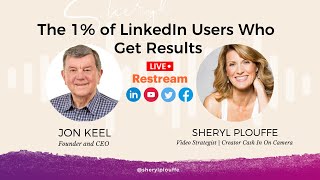
In this interview on the Cash In On Camera podcast, host Sheryl Plouffe talks with LinkedIn strategist Jon Kehl about why the vast majority of LinkedIn users fail to see results and how the top 1% succeed. Kehl explains his performance‑based marketing mindset, rooted in engineering and measurement, and contrasts it with traditional, unmeasured marketing. He emphasizes that a LinkedIn profile should function as a landing page, and walks through essential optimizations such as a professional photo, banner, creator mode, custom pronouns, and the new ability to embed a calendar hyperlink. The conversation covers recent platform updates, the importance of thoughtful, relational engagement (comments that add value rather than hard‑sell posts), and the algorithmic advantage of comments for reach. Kehl shares his personal routine—posting 2‑3 times per week and spending no more than five hours weekly on commenting and posting—to illustrate the power of consistency. He also promotes his free twice‑monthly masterclass that educates members on LinkedIn best practices, noting that over 2,000 people have attended in the past year. Throughout, both speakers debunk the myth that LinkedIn is dying, citing growth in monthly active users, and stress that networking is about building access through genuine connections. The interview ends with a call to action to connect with Kehl on LinkedIn and join his masterclass.
Chapters
people really get the best results from LinkedIn. And so, John, I'm excited to have you here on Cash In On Camera. We met through a summit through another guest on Cash In On Camera through Christine, uh, Campbell Rappin, and she was here, and now we are connected. So it just goes to show you how networking works. Um, so John, just wanted to dive into this. You're all about performance-based marketing, not just marketing. Explain what the difference really is.
Well, if I go back 25 years when I first got involved in the internet, there was a lot of fall-to-raw and this continued. Very little measurement was taking place back then, and I said, this is stupid. I have an engineering background. You measure things, and that was it. If you don't measure anything, nothing ever improves. So I kind of coined that, coined that term, if you will, And I've done that my whole career on the internet.
That's amazing. So let's talk about LinkedIn. I've already— I've only known you a short time and I've learned some amazing things about LinkedIn. I would be maybe, maybe slightly embarrassed to show you my own LinkedIn because I'm sure that I'm breaking rules. I'm not optimizing things, but I don't think that's an uncommon occurrence. I think a lot of people, you know, don't pay enough attention to LinkedIn. But tell us why we should be paying attention to LinkedIn?
Well, let me go back, if I may, and just address that first question. LinkedIn actually says that 99% of its over 830 million users— that's 830 million users— don't use it effectively.
Oh, okay. So I'm— I'm— it's not just me.
Oh no. In fact, I tell people, don't feel badly because the numbers are really— those are LinkedIn's numbers, not mine. And so I've just decided to realize that Learn to help people move from the 99% to the 1%, Cheryl.
So, Don, why is that? Why, why are so many people not optimizing LinkedIn? Is it because LinkedIn— listen, I will say it's not always been the most intuitive platform to navigate, shall we say.
You're speaking too nicely. It's not intuitive at all.
Okay, you said it, not me.
I know I do say it. I tell LinkedIn this. And at the same time, when I really got heavy, hot and heavy into LinkedIn about 3 years ago, I was doing bad things, miserable things. I had no performance at all. And it wasn't because I'm stupid. I'm not. I was just ignorant. LinkedIn does a great job, and even more so today than then, at adding new features and new things that make it better for us as business people. They do a very poor job at communicating it to anybody. I'm on calls. I was on 3 calls already today just with people I know, not members or clients of mine at all, and just giving them little tips and had them bring up their profiles and went through it and they said, oh my gosh, that's easy. Well, this is stuff that was only introduced about 4 weeks ago.
Right. Okay. Well, let's break this down as much as we can. Obviously, in the course of a 15 to 20 minute conversation, there's so much to unpack about LinkedIn, which obviously leads you to all the services that you provide. But if you are someone like me who has a LinkedIn profile, I also have a page, but I focus more on the personal, you know, on the profile. And I want to start like looking at it. I want to start looking at it and just kind of making sure that I'm doing things properly to get results. I would like to be in the 1% of people who are getting results.
How do I—
what steps do I take to start doing that?
Well, the first thing you want to do is nail your profile. And your profile, or if I come fast forward from 15, 20 years ago, almost 20 years ago, it was really a job board. You put your resume there, that was it. But today I look at LinkedIn, your profile, is being more of a landing page. That's the first thing that people come to. And I just had a request today from somebody who said, let's connect. This person had first name, last initial, no picture. Oh yeah, and their, their banner graphic was totally blank.
And then they wonder why it's not really, you know, working for them.
And in fact, I took extra time because she didn't have that many connections. So she's just getting started. I said, I only connect with people who give their last name and they have a profile picture. I'd be glad to connect with you if you'll do that. And because again, this is somebody that probably just doesn't know. So the profile is the first thing. There is a lot to focus in on the profile. I actually have a whole, uh, in my masterclass, I focus, that's coming up in a couple of weeks. I we'll focus on some real basics around your profile. And the thing around the profile, Cheryl, I do a, uh, with, with my members, I do a twice-monthly open master, mastermind, masterclass. And everything's, you know, they come on and ask any question they want, and then I'll always give them updates. I gave 6 updates 2 weeks ago on changes to your LinkedIn profile that have just occurred within the last month. And again, people were saying, wow, you're so smart. I said, no, I never want to be the smartest guy in the room. I just want to hang out with them. And I hang out with some very smart people relative to LinkedIn. So the point is that we don't have time to get into all the detail, obviously, on that. But at the same time, find somebody that you trust, that you know they're doing it right. You get a sense of whether whether or not they're doing it. I'm not talking to somebody that has 1,000 connections or 1,000 followers, but somebody who, who is out there on LinkedIn and look at their profile and see what it looks like. And if you have questions, reach out to them.
Well, on that note, and you're, I mean, obviously really easy to find on LinkedIn. Your name is spelled J-O-N. Yes. Kehl, K-E-H-L. Search him, find him. You need to be connected to John on LinkedIn, FYI. Um, what is some— what, maybe one or two of the newest updates that you're going out and telling people about? Because you're— you have your finger on the pulse of all of these different updates that are coming up. What are the maybe one or two cool, um, or progressive updates that LinkedIn is making that we should be aware of?
And number one is you can actually put a hyperlink on your profile which maybe has your calendar. You know, I have mine, schedule a call if you want to do a chat, and there's the link. It's a hyperlink to my calendar link. That's within the last 2 months. Now you need the thing about that, Cheryl, is you have to have what's called creator mode turned on, turned on. And not to get into the details, but if you don't have creator mode turned on, you're making a big mistake. Okay, just get it turned on and, uh, okay, and then you automatically have that option. Another option that's, that's interesting, and this is back to a personal choice by people, LinkedIn recently— I say recently, within the last year or so— gave you the opportunity to include pronouns. Her, she/her, him, you know, and it appears right next to your name at the top of your profile. But they also have another option called custom where you can write your own thing in there, and I did. If you go to my profile, you'll see it says LinkedIn Expert because the pronouns aren't that important to me. But just think for your business, I mean, anybody, you If the pronouns aren't that important to you, that's another cute little option. And it's pretty cool because it's the first thing that somebody sees next to your name.
That's great. Those are great tips. I love it. I love it. So let's talk, since you're all about performance-based marketing, about being able to measure, you have an engineering background. We want to know what are the top people, the people who are really benefiting from their involvement, from their visibility on LinkedIn, what are the top 1% rather than the 99% who are not optimizing it? What are the key things that the top 1% who are getting results on LinkedIn are doing?
Great question. They are continuing to add to their followers or connections. You know, that's not a, that's not a one-and-done thing. You continue to do that. And I do it chiefly for this. I may not ever do business with that particular person. They may not even be in my target market, but I don't know who they know. Yeah, exactly. Once I'm connected to them and they're following me, my comments on their posts get seen by their total network, which, which, John, is very different than some of the other social platforms.
And that's something to dig into because— and this is something I learned from you— is that when there's engagement on LinkedIn It's the algorithm is behaving differently and you're getting far more reach, far more impressions by virtue of comments and sharing and things of that nature than you are, say, on Facebook. Radically different.
And along that line, that's a very good point. And along that line, I would, I would add to that thoughtful leadership comments. That show you really think, you know, very few people today, I believe today, think. That's how things come about. LinkedIn is not a transactional medium. It's a relational medium. Big difference. Many people, quite frankly, screw up on LinkedIn because they're in sell mode. And you don't need to be in sell mode. Just put good stuff out there. Because at the end of the day, people don't really care what you do. They care who you are. And who you are shows through, can show through in your writings and in your videos.
Yeah. I mean, it's, listen, it's not a surprise that people are using social media or any of the platforms really, because they have something that they're probably selling and it doesn't have to be a product or service. It could be that you're selling an idea or you're selling a message or you're selling, you know, some, people, we're all selling something, to be honest. Exactly. But don't wear that on your sleeve. Like, go, you know, use these platforms to truly connect with people. And I think that that goes a long, long way. Rather than going into the platform and saying to yourself, well, who could I, who could I sell today? Go into it with a mindset of giving, of thought leadership, as you said. Have some think, think and add your two cents into that conversation, I think goes far, far further.
To me, it's really easy on LinkedIn today. It's very similar to when we used to do a lot of in-person networking. The person that was always in sell mode, people would go away from. No one wants to be around them. It's very obvious.
Yeah, you're exactly right. You know, just think about any— and I think most business owners can kind of relate to like the local networking group that we, you know, participated in, and there was always that person who's like stabbing you with a business card. And don't be that person, right? Don't be that person. Yeah, I love it. So, John, what are some other things that we need to keep in mind? I know you were actually— you wrote a book or you collaborated on a book called Success Secrets for Entrepreneurs that just launched in April this year of 2022, which is exciting.
Right there.
That's great. I love it. Congratulations on that. Thank you. What are some, what are some of the secrets that we need to kind of keep in mind as far as LinkedIn is concerned? Like, is LinkedIn, is it dying? Is it a platform that's growing? Right. A lot when I go on Google and I look, there are questions people say, is LinkedIn dying? And I think to myself, no, it's growing. There's like there were 66.8 million monthly active users or there are currently. And that's up from 58 million in 2018. It's growing, but there might be a misconception for some reason that it's dying. It's not.
I think that may come partly, Cheryl, from, from so many people who do it wrong. You know, they put these sales type posts, posts out there, and that doesn't work. That does not work. Yeah. I just hope they're my competitors if they're doing that.
Yeah. Let the competitors keep doing that. Exactly. Love that.
So just— and I know we've only got a few more minutes, but continue to build your network. Continue to build your network because you're only one phone call, one connection away from somebody that can literally change your life. I've had that happen a couple times. People I wasn't connected with reached out to me because they saw something I wrote, and bang, there we go.
I think you hit on something earlier too, which is access. The idea that you build your connections, keep building them, because you don't know who has access to the people that you want to have access to, which is the really the fundamental principle of networking. And, and I think that's really one of the key things. I want to ask you this question: in order to be in the top 1% of people who get results on LinkedIn, do you recommend a certain amount of time time block of a schedule or of your week that you would devote to LinkedIn? Or is it better just to like just be in there periodically or time block it and say spend 2 hours a week on LinkedIn? How do you do it?
I have never spent more than 5 hours a week posting and commenting on posts, and I post 2 to 3 times a week, but I do it every week. The particular system that I use is I just did my 255th posting event, but I've done it every week. I've never missed a week in 2 and a half, almost going on 3 years now. So consistency, but this is no different than business success anyway. No, you have to be consistent. Show up.
Yeah, I love that, John. Um, how— one question I have is Stop Marketing Like It's $19.99, a little segment that we do here on Cash In On Camera. What is a tip, a tool, a tactic or technique that helps you, John, to market yourself or to market Improved Together, which is your company and your business?
Well, it's probably obvious that I have gotten better at LinkedIn over the last 3 years. And to the point where, I mean, I'm not one of these world beaters in terms of all my posts have all these millions of views. You know, I've had 500,000 views over the last 3 years, but more importantly, I've had 20,000 engagements. People actually commenting, and then not all, obviously not all of them have become clients or anything, but I've developed some great relationships, and that comes from the consistency of effort. Yes. And LinkedIn knows, LinkedIn knows what you're doing. The more consistent you are, the more, I think, attraction you're going to get from you're going to be more attracted, you will be, to LinkedIn. Yeah, I love it. And back to that 1999 thing, of course LinkedIn wasn't around in '99, but I use LinkedIn. It's not my only source of leads for my business, but I've gotten, I've gotten better at it, and I just made the decision to do that. The other piece is, and I started this about a year and a half ago because I actually have a LinkedIn product that I sell And I became aware, Cheryl, that people were just— again, they weren't stupid, they were just ignorant. They just didn't know. So I started a monthly master class and workshop. I'm doing my 15th, it's coming up in about 3 weeks, and it's free. And I go through all things LinkedIn, all things LinkedIn, the good, the bad, and the ugly, and I cover it all. And the whole point is to get people educated. And I'll share, I give people the opportunity if they want to join me at the end on the third day, that's great. But many people don't. I say, fine, that's fine. Just don't keep wasting your time and money on LinkedIn. It's a great platform.
Love it. And John, I'm just showing your website on the screen, ImprovedTogether.com. Is that where people can go to learn about the masterclass or do they have— find you, should find you on LinkedIn, correct?
Reach out to me, connect with me on LinkedIn, and just say, just put Masterclass in a message and you will get a link. I've, again, this is my 15th coming up. I've had, I don't know, well over 2,000 people register for that over the last year and a half, 2 years since I started it. And I'm just trying to pay it forward, weren't to teach people many of the things I've been taught. Over the last couple years.
Yeah, well, I, I definitely know that from what I've learned from you just in the short time I've known you, uh, you are the real deal. Like, you are immersed in it, you're doing the work, and you are so giving of your, uh, information. I listen— I've watched one of your webinars and learned a ton through that, and I just knew, I was like, John's my guy, I got to get him on Cash In On Camera because you're so giving and so generous, really.
This has been fun. This has been fun.
Thank you so much for coming on the show, and we're connected on LinkedIn, so we'll continue to connect over there. And I really appreciate your time today.
Thank you much, so much, Cheryl. Take care. Appreciate your time today.
More from Sheryl



From 'agreeable' to 'ruthless mentor' to 'strategic sparring partner' #substack #shorts







