The 3 Pillars Of Strong Corporate Storytelling
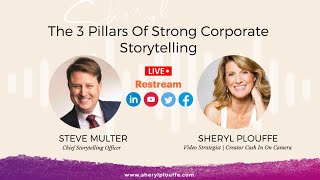
In this Cash In On Camera interview, host Sheryl Plouffe talks with corporate storytelling expert and author Steve Molter about why storytelling matters for businesses and how it can be systematically applied. Molter explains that many companies focus on metrics and product features, which fails to create a human connection. He identifies three core pillars for effective corporate storytelling: (1) Value – always deliver what the audience needs and wants, not what the speaker wants to say; (2) Passion – convey genuine belief in the message, adapting intensity to cultural norms; (3) Connection – foster human‑to‑human rapport through shared experiences and brain‑coupling. Throughout the conversation Molter also discusses the psychological barrier of fear of negative evaluation (FNE), the importance of trust in one’s own story, and practical ways to market oneself using kindness, technology, and a mentor‑hero framing. He shares his background working with major brands, his new book Nothing Gets Sold Until the Story Gets Told, and a free e‑guide, providing URLs and a discount code. The interview blends personal anecdotes, actionable advice, and promotional information, offering a roadmap for entrepreneurs, coaches, and corporate speakers to craft and deliver stories that drive business results.
Chapters
us about our businesses as we grow from 6 figures to 7 figures and beyond, about storytelling. And the perfect person to have this conversation on Cash In On Camera today with us is Steve Molter, because he is a seasoned storyteller, uh, also an author. And he's going to be here today to share with us some pillars that we can utilize to better understand corporate storytelling and how that can relate to what what we all want to do, which is to tell better stories and something that you're, Steve, very passionate about, right? Your mission is to help people better understand storytelling. So why is it so important that we know this?
Oh, Sheryl, it's so good to be with you here. Storytelling is a— it's becoming a more valued art, but for years it was such an undervalued art because everybody has always been so solution-focused, services-focused, product-focused. And what we've learned over time, and so many of your guests have talked about as well here on your show, is that when we talk product, which is usually based in numbers, metrics, data points, proof points, KPIs, we don't really create any sort of a connection with the listener. So yes, if it's a product that they know that they need right out of the gate, great. They will probably go and buy, or they will connect with your company in some way. But if the idea is to let them know what sort of a benefit or improvement this is going to make in your status quo, how it is going to uplevel you on a professional or a personal or both bases, then telling a story is the way you create that human-to-human connection point that then makes them start to see that service or product or solution in a more meaningful way for them. It becomes the personal connection to the product connection, and that's where we see success. And it all happens through story.
Here's the thing that I think sometimes earlier stage entrepreneurs, coaches, consultants struggle with is that they don't feel like they have stories yet that are worth telling. They don't have enough experience, or at least they think it's a perception, right? And your perception is your reality. But they feel like, I don't have enough good stories, and why would anyone care about this? Aside from the fact that they don't often have the ability to connect a story to help people understand a theory or a thought better, you know. So I think it's really this idea that people don't often value the stories that they have built. So how important is it that you yourself, as the storyteller, have had that story be something that you've personally experienced or that you have history with?
Oh, I do love talking about that. The one of the things that I love to talk about frequently with people is trust. Typically, when you hear from a corporation or you hear from an individual representing that corporation and there is no story involved, all you're doing is regurgitation of what you might find on a website or within a white paper or a mission statement. It really comes down to a lack of trust. Sometimes it's a lack of trust from the corporation side. The company doesn't really trust its own background story, why they first came into existence, the problem they were trying to solve when they developed that particular company, why they developed a certain product based on feedback from their marketplace. They don't trust their own message. All they trust is sales. Sell, sell, sell metrics, turn it around. The speaker then representing that company also ends up with a lack of trust. If the company doesn't know how to tell its own story, then anybody going out into public and speaking on behalf of that organization is going to be equally blurry when it comes to telling that story. They don't trust themselves. Then on the personal side, this is an interesting fundamental called FNA. It's based on a glossophobia term. Glossophobia is just the Latin mashup of tongue dread, fear of Speaking, fear of public speaking, our number one phobia. But this FNE, it's a neuroscience term that means fear of negative evaluation. And this is a learned trait. So when we're young, when we're little, when we're 3 or 4 or 5 years old, we cannot wait to put on a show for our parents or our friends. We want to sing, we want to dance, we want to look at me, look at me, look at me.
I remember doing it. Yes. Yes.
I still do it from time to time. But yes. Right. The problem is, as we get older and older and older, we tend to lose that joy. Pablo Picasso talks about this in terms of all children are artists. The trick is to maintain being a creative and being an artist as you get older. The same thing happens in trust in your own story. We lose the joy of performing in front of others because we learn to become afraid of it. If we say the wrong thing in class, then the teacher says, "No, wrong," in a public space. Kids make fun of us or they laugh at us. And we, as we get older and older, the stakes of that fear get higher and higher. We emerge into the corporate world and somebody says, I need you to go out and speak on behalf of the brand. And now all of a sudden that fear is so deeply ingrained, that FNE, fear of negative evaluation, that we no longer trust our own story. And what I try to do is help people to understand everyone on the planet is a natural storyteller. You have talked about this with previous guests. I have heard your conversations about this. I think, um, oh, you had a great recent conversation. I'm trying to remember, maybe with Tina Bakehouse, I think was your conversation. I did. Where the whole concept was, you are a natural storyteller. It's evolutionary. You just have to find a way to slough off the mistrust of yourself or the fear of negative evaluation and embrace the fact that if you are a human, you bring your story to your product, to your brand, to your service. Tell your story in an organic way that is right for you, and it will stand out from all the others.
Trust yourself, no matter whether that story is good, bad, or ugly, or all of the above. And to your point about fear and people who, you know, say, step into the spotlight, it's easier to stick with the facts, ma'am, when you have fear around sharing something that you could otherwise be criticized for, right? And it might— and not to mention the fact that there's also this presentation side of it. It's not just the story unto itself in terms of the essence of what we're sharing, but it's the actual presentation of that story. There's so much fear around that too.
Oh, Cheryl, absolutely. So if you and I, for example, if we just go out for a beer this afternoon at 5:00 and I say, hey, Cheryl, I'll do it.
I'll do it.
Sound good? Are we on? Okay, I'm going to check my calendar. I'll make it happen. We go out for a beer, we sit down, and I say, hey, you've got that talk coming up tomorrow. What are you going to talk about? You can talk to me for 2 hours and tell me every detail, every fine point. You don't need a PowerPoint deck to do it. You don't need your script notes in front of you. You don't even need preparation because it's who you are. It's what you do. It's why you have the job that you have, why you get the paycheck that you get. If you couldn't do your job, you wouldn't have it. You already know. And then tomorrow it's a presentation, and now I'm on stage and it counts. My boss is watching, my team is watching. My executive leadership is watching. My customers are watching. And the FNE, the fear of negative evaluation, is that everybody is sitting back and saying, yeah, prove it. Prove that you're worth your job. Prove that you know what you tell me you know. That's not what it is. The audience-speaker interaction is so unique and so positive. Audiences want speakers to succeed. When you go in to make a sales pitch The person that you are speaking with, that you are having that communication with, they want you to give them that magic bullet, that thing that clears the obstacle out of their path. They are hoping that you are going to succeed. If you trust in yourself, now there really is no difference between us having that beer and you getting on stage and simply telling your story, as you just said, the good, the bad, and the ugly, because that's what makes you human. And one human connecting to another human will always succeed in strong storytelling. And that is what will lead to the business relationship. Too many people put the cart before the horse.
Yeah, everything is rooted in trust. Trusting yourself, trusting your abilities, trusting your story, and then also willingness, willingness to go there. Willingness, I think, for vulnerability and being able to share a story that relates to whatever it is that you want to share. I love this. And I want to get into the pillars because obviously your specialty is corporate storytelling. You work with big clients, right? Cisco, Panasonic, HP, and a whole other list of them that come out. So I just want to be able to bring this down to the level of those who are watching, who are listening to this podcast, and make it applicable to them, which I know it is. So let's go through the pillars of corporate storytelling and how we can be really most effective with that. What is pillar number 1?
So pillar number 1 is value. No matter who your audience is, whether you're speaking to 1 person or 1,000 people, whether you're in person or speaking through a camera lens, as you and I are getting to do right now, the idea is the best story is the one that creates value for the listener. And a lot of speakers have that backward. My mantra, the thing that I live in all the time, is don't tell them what you want to tell them. Tell them what they want and need to hear. As long as you are always about value for the other person, which means getting to know your audience. You have to know them well enough, understand them, research them to understand what is valuable to them. But if you can create value from the first word to the last word in everything that you say within your talk, that is a guarantee of success. So pillar 1 is value.
Yeah. And the understanding of who it is that that message or that story is intended for is so crucial so that you can make the determination about what would be valuable to that person. That's often a missing link with people who I, at least who I speak to, I'll ask you, who is the ideal person that you're trying to reach? And there really isn't a definitive definition of who that person is. It's very broad. It's like, well, what I do can apply to everyone. It's like, oh no, your story is really going to fall flat if you can't at least bring that down to some type of subset.
You need to know who you're speaking to and why you are speaking to them, right? That's a whole Simon Sinek concept. Is what— before you can tell a story, you have to know What is that story intended to do? What is the benefit that you are providing for somebody else with the story that you want to tell? And why here and now? What is the applicability in this particular moment that makes that story vital for that particular individual? And in an ideal world, it is because I know the battles that they're facing and I know exactly how to clear those battles out of their way and give them a clear path to success.
Right. So pillar number 1 is value. That brings us to pillar number 2.
So pillar number 2, it's my favorite, and it is passion. Passion is both the most amazing thing in any story we tell, in any communication and connection that we have with another human being. It's also one of the hardest things to achieve. When we speak with passion, no matter what our topic is about, whether it's about our family or our friends or travel or owning a boat or flying airplanes or doing artwork Or it's about our product or our service or solution or team or business. When we speak with passion about it, we inspire passion in other people. They want a part of it. They want to feel a piece of that. It's subconscious. It's not that you have to be this enormous, passionate human being spilling out and smiling and going crazy. That puts people off. But if they can sense, boy, that person I'm speaking with really genuinely believes in what they do and what they say and what they're about, We all want a little piece of that. It excites us. So when we speak with passion, we inspire passion in others, which then spurs them to proactivity. They want to do something about it in order to achieve a little bit of that passion. It just can be very hard for a lot of people in corporate industries to find, which I'm sure you've understood in a lot of conversations that you've had. Where's the passion in my job, right?
Yeah. Well, I think too that in the corporate space, especially where things tend to be maybe a little bit more conservative, serious, muted, shall we say, that it can be difficult to express that kind of level of passion without seeming kind of over the top. Do we run a risk of looking like we're going over the top if we add that level of passion in?
Oh, that's such a good question. Sometimes it can be cultural, Cheryl. So for example, my work with an American client is going to be very different than my work with a Japanese client. My work with an Indian client is going to vary dramatically from my work with a German client, because you have— we have to understand the cultural levels of normal interaction in order to decide how far we can go with those levels of passion. But here's what I've discovered: passion is not about vocal inflection, it's not about internal or external energy. Passion is about deep-seated belief that the message, the value that you are bringing to the person you're speaking to is going to benefit them positively in some way, that you have the methodology to improve someone else's day-to-day reality. So as long as that passion exists, what I have to do with a lot of my clients is I have to go to them and say, look, if you've got 30 minutes for your session, your breakout, your talk, your keynote, adding your human story, your personal passion for what you're talking about is going to take time from your data, your numbers, your metrics, your foundational elements, the safe things you talked about earlier, right? There's no risk. We're just talking about what's already legal approved. The risk is in sharing yourself, sharing from the heart what matters to you on a personal level. And every time you do that, you have to take time away from everything else. But the secret that good speakers know is it doesn't matter. What they connect with is the human being who's speaking to them. Not to the data, the metrics, and the numbers. So if you're speaking, for example, in a conference environment and every 30 minutes a new set of 4 talks kicks off, the average attendee at that conference is going to be so hyper-inundated with metrics and KPIs and content, they simply don't have the bandwidth. The smartest person in the room doesn't have the bandwidth to retain it, but they will remember the speaker that made them feel passionate, right? So this goes back to the Carl Buehner quote that people often ascribe to Maya Angelou: They may not remember what you told them, but they will always remember how you made them feel. Passion makes them feel, and that's the most important thing, because then next week when they're back at their desk remembering back to the talk they heard a couple of days ago without the blur of the conference in their minds, they can say, oh, Cheryl gave a fantastic talk. Let me go back and remind myself of the numbers that she gave me. And they can go on the website and get it there. That's when they're going to do that kind of business. But in the room, in communication, passion really counts.
Yeah, I love how—
And that's a very long answer to your question.
Yeah, no, and it's great. And it's interesting because your second pillar ties back into pillar number 1 in terms of value and benefit. And so they're all interconnected and they correlate to one another. So pillar 1 is value, pillar 2 is passion, And what is pillar number 3?
Well, pillar 3 is going to sort of wrap both of those first things up in a nice little bow, which— and you and I have been talking about it here. It's what we're doing. It's making a connection, creating connection. Connection does not happen through products. Connection does not happen through statistics and data input. Connection is human to human. Now, that connection can happen around a shared set of interests, but more ideally, it happens around a shared set of human experiences. Fantastic TED Talk if you've never seen it. In 2016, um, Uri Hasson— it's one of my favorite TED Talks of all times— but Uri Hasson runs the Hasson Laboratory of Human Research at Princeton, and Hasson's team came up with a great concept that has been renamed over time. It's not a new one, but it's the idea that's called brain coupling, and it's the suggestion that long before you and I meet and speak with one another Regardless of which one of us is the audience and which one is the speaker, we already have shared experiences in common with one another because we're both human. The more I can tap into that with you, if I'm speaking with you, Cheryl, and you and I are having a conversation, the more human I appear to you, the more accessible, the more engaging, the more recognizable, the more likely you and I are to sync around a shared set of common human experiences. That then develops credibility and trust in me, that then allows the two of us to develop a successful business relationship. If you can establish connection in your talk, whether that talk is 5 minutes, so a medical sales technology representative literally running down the hallway with a doctor next to them, and they know they've got an elevator pitch worth of time to be able to make that pitch, or a keynote on a grand stage where we've got an hour to communicate. If I can establish connection with you, I am miles more likely to then establish a deeper business relationship with you. And what is it all built on? Value and passion that helps to create that connection.
Pillar 3. I love it. I think of keynote speaker trainers who talk about getting your audience engaged right from the very first moment that you open your mouth on stage. Right? It's like you want people nodding their heads. You want people saying yes. You want people to be in it with you. And I think that's what I'm hearing you say is that building that connection is a really key component to storytelling and whether corporate storytelling. But I think that these pillars also apply to marketing and other ways of communicating stories. I mean, they're really universal, I think, but obviously very effective in the corporate work that you do. So I'd love for you to tell us a little bit more about the work that you do and also your book. Congratulations on launching your book.
Oh, thank you. It's, um, it's been overwhelming. I keep telling people it is the, it is the single hardest thing I think I have ever done in my professional career. It was loads of fun. Writing the book is great, right? We write about what we know and what we understand, and then someone turns around and says, okay, now you've got to go market this particular asset, and you've got to strategize the asset, and you've got to make the outreach, and now the hard work begins. But it's been great. It just kicked off yesterday. We had a great party here. Last night, and our home was packed to the gills, and it's been super exciting. So thank you for bringing it up. So the work that I do, that really the whole book is based on, I started my career as a corporate spokesperson. So large corporations, small corporations, mid-sized corporations, Fortune brands would hire me to go and speak on their behalf at public events. And I did a lot of tech talks. Frequently I would cover a lot of their technologies. Sometimes it was telling the story about who who the brand is and how they make an impact within their sector or industry. And over time, that just naturally evolved to the point where now I also help a lot of these corporations with their marketing strategic points, their messaging outreach, helping them to create more fundamental connection and communication with their customers, their partners, and media analysts that goes beyond the product. Now, frequently I'm surrounded by great product people, who can help me tell the story that I don't know as well as I ought to know. But the longer I spend with a brand, the more I tend to embed with their technologies, their capabilities as well. And that's brought me to 10 years' worth of executive speaker coaching and content coaching and team trainings all around the world. I think 37 countries so far worth of team trainings and 46 of the 50 states. So I've still got 4 more states to hit. I don't think I've spoken in Montana yet. Sorry, everyone who's from Montana.
You just have to put a checkmark on that one.
Yeah, we're going to put a checkmark on the Montana box, just like a big Target up there. But no, it's, it's what's— what I love most about what I do is that every day, every week is not only a different message, it's a different brand and the way they approach that message. And it all, for every one of them, whether we're talking about a company of one person who I might meet in the basement of the Venetian at an event like Consumer Electronics Show— sorry, CES, it's no longer Consumer Electronics Show— but I might meet one CEO, developer of a brand new product, and work with them on their story. And then the very next day, I might be working with Siemens and working on their story. And the tie-ins are virtually identical. The goals are the same, the targets are the same, the methodologies are the same. Not individual to individual, but massive size of company to literally a 1, 2, or 3 person startup. The same rules apply and achieve success. For those owners.
That's amazing, Steve. I want to ask you, you know, listen, we all have to market ourselves, right? You do speaking, you've done thousands of live talks, and so, and then obviously going around and now promoting the book, which is great. And I just wondered, what is something that has helped you to market yourself, whether that be a tactic, a tool, an app, a technique, something that's really helping you to market yourself that you could share with the audience?
Yes. So one of the things that I love about the work that you do, I've watched so many of your videos and you and I have had an opportunity to talk and I've watched your interviews. You are a big fan of utilizing technology that is actually available today. So if we think back 20 years ago to where we were, so for example, even if we just go back, well, let's go back to 1999 since that's the target date that you use, right? What did we have in 1999? We had AOL Instant Messenger, we had MSN Messenger, we had Yahoo Messenger, we had things like LiveJournal, right?
Facebook doesn't drop until 2004.
2004. And here we are, and it's such a blip of time later. It's one generation. We think these things have been around a long time. We have these tools, but these tools have started to overwhelm us. So my particular tip, what I would tell everybody, is two things can work so beautifully to your advantage, no matter what your goals and targets happen to be. Number one is, is use the technology that's available to you. But a lot of people don't know how to do it. What I say is fall back on kindness. When you are about other people, when you are about building up others through the stories that you tell, which includes the marketing, the pitch, the strategy for your company, your organization, your product, your service. When you can make it about other people instead of about yourself, when you turn them into the superstar and you take a role in the background. Think the hero's journey, right? When we think Joseph Campbell, we talk about the hero crossing the threshold, going out seeking battling the monsters and the demons and bringing the elixir back home. We tend to think of ourselves as the hero in that hero's journey. We are not. We are the mentor. Our customer, the person we're speaking with, they are the hero. It is our job to shuttle them across that initial line out of their status quo and then across the finish line toward a new level of success. If we can do that, be about kindness, about other people, and about creating value, Do that again and again on whatever modern technology is available to you. You will win. It is a perfect path to success. So it's not necessarily about spending a great deal of money, massive quantities of time, being everywhere at all times. Be good about making things— your message valuable for others and utilize whatever technology you're comfortable with. Those two things are a sure path to success.
I love that. And I love how you put that because I think a lot of coaches and consultants and people who move into this space and want to do this type of work, they do it because they feel a calling in their heart to want to give back and to want to pull other people up. And they are service-minded people. So what you've just shared, that strategy is really in alignment of being kind instead of getting bogged down with, oh, the technology, and I'm not up on this and I'm not up on that. Just fall back on just being kind and being helpful and serving others, and good things will happen in your business.
So true. And by the way, the last thing that I'll say here is with that calling, we have to remember it as we go, because the more successful you get, the more clients you get, the more contracts you get, the more money builds up, the more people add to your team, especially if you're scaling at a very rapid level. It's hard to remember the calling if every time you get on stage, on camera, in front of another person to tell your story, you remember what that original calling was, that original fire and passion, you will never fail or go astray.
Oh, I love it. Steve, how do people get your book? I want to just show it one more time on the screen.
Thank you. I appreciate it. Yeah, as we were just talking about, I haven't even had time to update it since yesterday. The book came out yesterday. You can find it at all the regular resources. This website here, very simple to remember, corporatestorytelling.com. You can find out everything that you want to about the book, which is called Nothing Gets Sold Until the Story Gets Told. Corporate Storytelling for Career Success and Value-Driven Marketing. And the last thing I'll mention is I've got a freebie for everybody who is here. Thank you all for watching. I appreciate it. And thank you, Cheryl, for the opportunity. If you go to corporatestorytelling.com/guide, I'm offering a free download of an e-guide that I created called Five Paths to Passionate Storytelling, which are five instant things that you can do right now, today, regardless of your your job title, size of the company that you're working for, education level, socioeconomic status. It doesn't require anything. 5 things you can implement right now to start increasing the power of your storytelling. So again, corporatestorytelling.com/guide, and then you're going to use the code SOLDTOLD23 to access that e-guide. So go get it.
Fantastic, Steve. Thank you for being here on Cash In On Camera. We really appreciate your insights and your 3 Pillars to Corporate Storytelling: Value, Passion, and Connection is really what will lead people down the right path. And we appreciate your time today.
Thank you so much, Cheryl, and to everybody for watching. It's been fun.
More from Sheryl



From 'agreeable' to 'ruthless mentor' to 'strategic sparring partner' #substack #shorts







