The Art of Measurement: Unlocking the Secrets to Measuring Podcast Success
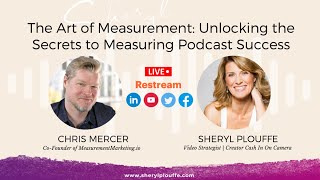
In this episode of Cashing on Camera, host Cheryl interviews measurement strategist Chris Mercer (aka Mercer) about how entrepreneurs, coaches, and consultants can effectively measure the ROI of their podcasts, speaking engagements, and broader marketing activities. Mercer emphasizes that the core problem is a lack of measurement strategy—not a lack of tools. He outlines a three‑step framework—Plan, Build, Use—centered on asking the right "results" and "how" questions, defining baseline conversion heuristics, role‑playing actions based on possible outcomes, and then implementing tracking with tools like Google Analytics, Tag Manager, UTMs, and Microsoft Clarity. The conversation covers conversion‑rate benchmarks, the value of 90‑day sprints for trend analysis, the pitfalls of comparing oneself to others without consistent definitions, and how AI will soon reshape measurement but still requires good prompts and clean data. Mercer then dives deep into podcast and speaking measurement, explaining how UTM parameters can attribute traffic to specific episodes, the long‑tail nature of podcast traffic, and how to segment audiences for retargeting. He also shares practical tools—especially the free Microsoft Clarity platform—for visual behavior analytics (heatmaps, session recordings, rage‑click detection). Throughout, Mercer stresses incremental progress, building "measurement muscle," and using data to drive concrete actions rather than guesswork.
Chapters
And today on Cashing on Camera, we have Chris Mercer, AKA Mercer. I'm just going to call him Mercer, is here to talk about measurement, measuring podcasts and speaking results so that we can understand what the return on our investment of time and energy is. So let's dive right into the art of measurement. And Chris Mercer, it's so great to have you here to chat about this. It's What do you think is the biggest problem that entrepreneurs, coaches, consultants are facing around measurement in general? Is it just, is it just too overwhelming? Is it just too confusing? Do people just not know what to look at?
It's yes and to all of those. And I think really, ultimately, the reason all of that happens is because there's a lack, there's a lack of strategy. In other words, there's a lack of understanding that I needed to learn to measure because the tools are so easy to get to. That people skip over the strategy. For example, let's say I wanted to learn how to be a chef. So I watch a YouTube channel on how to become a chef, and then I get confused by looking at all the fancy tools that they're using. And I'm like, oh, well, that's why they're amazing, because I don't have those $600 frying pans. So I go out and I buy $600 frying pans. Now what do I do with those? I boil an egg. Why? Because I have no idea how to cook. I didn't learn about ingredients, about how to mix the spices together, about flavor profiles. In other words, I never learned the strategy of how to become a chef. And yet I could give a good chef a camper stove and they could make an amazing meal because they do understand the strategies of how to become a chef. So the tools to them aren't as important as the strategies, right? Same thing when it comes to measurement. And with a lot of digital marketers, we've never learned how to measure. We just learned that there's tools like Google Analytics or Tag Manager or Hiros or Wicked Reports or whatever the thing is. And all of a sudden it's like, oh, well, there's numbers, therefore we must have measured properly. Because there's numbers there. That's not always the case. And that's why strategy is important to learn.
You know what's interesting about the examples that you just shared, right? Google Analytics, Tag Manager and things like that. There are a lot of people in my audience who are watching the video, listening to the audio, who haven't even explored those things yet. You know, so it's really starting at that, that base level. So if we're starting at the base level, what is it that we need to know about measurement if we're talking and using the analogy of cooking and understanding the strategy or understanding like how to put ingredients together, where do we start? What's the foundation?
Great question. So any chef really could use a recipe. Like, it's important to have some sort of concept of how the ingredients are going to go together, right? That's what the strategy really is, just a recipe. So what we're going to do is just break it into 3 simple steps. We have to plan out our measurement. We have to then build it out. In other words, actually start to measure those things. And then we use our measurement. So in that planning stage, as with all great strategies, it's the secret is not planning, it's how you plan. So the first key to that step is we list out all of the questions we are trying to get answers to. And I generally— the confusing part for people, they go, well, then what questions should I be asking? Am I asking the right questions? Let's go to Google and find out what questions I should be asking. And there's millions of blog posts that give you millions of questions, and then you just leave it more confused. When it comes to questions, there's only results questions and how questions. That's the only two types of questions that ever exist. So ask the results questions. You probably already are. Things like, how many sales did they get? How many leads did I get? In other words, what was the result of the journey that they were— that the users were on? I mean, did I get— but it's more important, right, in addition to those, to ask those how questions. What were the stages and steps along the way so that you can start to see the conversation of that user journey and then where that conversation went south a little bit, right? Maybe where the breakdown happened. So that's why you ask results and how questions. Then we gather the information needed to get answers to those questions. Sometimes it's gonna be gathered by Facebook because we're doing paid ads in Ads Manager. Sometimes it's gonna be by whatever platform we're using. Sometimes it's gonna be by tool like Google Analytics that collects it. And then, and this is the most important part of this planning step, we think about the actions we're going to take before we jump into the tool. So you think, okay, I'm trying to figure out what my opt-in rate is. That might be a question I'm gonna answer. Okay, I wanna make sure that my social media is working. Am I getting good opt-ins from my social media or from my podcast experiences? Well, let's think about the actions we're gonna take. Okay. Well, if it's less than 35% of the people opting in, then maybe I'm gonna look at the podcast that I'm on. Maybe the wrong people are coming over and the, and then the offer's not great. If it's more than 75%, I'm like, well, that's really high. That must be the exact right podcast audience. Let me go see if I can get more of those. Right? And then if it's somewhere in the middle where maybe it's hitting expectations of 35 to 45% opt-in rate, then it's like, okay, well, in that case, I'm going to just find out more podcasts and try to scale. My traffic, right? But what I've done is I've role-played what I'm going to do when I get the answers to all this stuff. So now I already have an understanding of how I'm going to use that thing that I'm about to measure for. Then you move into the build step and you set up your tools, whatever tools you're using. It doesn't matter. You have to use analytics, but you have to use a tool to be able to measure this stuff. But what's the important thing here is you're not just looking at a bunch of numbers. You're looking at a bunch of answers to the questions that you're asking. And now because you've already role-played what you're gonna do based upon those answers, now you just see actions. And that's a big tip when it comes to strategy. You can see these numbers, but they're really just gonna be actions. You're like, oh, it's low in 35%. Therefore, let's go try different podcast. Oh, it's higher than 75%. Okay. Therefore, I'm gonna go do this other action I said it was gonna do. And that's the whole idea. So we plan things out, you build it out, and then you actually use it, right? Where we're sort of listening to the conversation happening between the users and the website and how things are working. And we're always comparing it to like, how was it supposed to work, right? Which is, if you think about it, that was a story we're talking about. It was supposed to be around 35%. If it's lower than that or higher than that, here are the things I'm going to do. So we're measuring against what we think it's— how it's supposed to work. And that tells us sort of where we're hitting the market, where we're not. In other words, what action steps we need to take in order to optimize that experience, whatever the user journey is we're optimizing for.
And Mercer, I think sometimes the problem is that a coach or an entrepreneur, you know, doesn't know what the baseline should be. Right. They don't know. Is it 35%? Is that good? Is that bad? Like, I don't even— there's nothing. Because a lot of times, especially when people are in growth phase and maybe have been, you know, not at this for that long, there isn't really an understanding. Is there a place or a way that they can find out, like, what are the industry standards? What are— I've always found when I've been on different calls or I'm in this mastermind and people are sharing those types of numbers, I'm writing them down. I'm like, what are the baselines? And I'm writing them down. Like, what is a good conversion rate? I never— when I was first starting, I had no idea.
Yeah, that's exactly right. Those numbers. Yeah, that's exactly right. It's a great question because there are, generally speaking, some heuristics that are out there. In other words, some best practices of what the numbers can be. But I'm going to take a quick step back on that and say, to some extent, it doesn't matter. It's— that's not the reason to stop. In other words, don't make that a reason. Like, I'm not sure what the results should be. OK, what if you did know? Guess. Well, I think it should be a 10% opt-in rate. OK, great. Let's do that. And then what will happen is as you measure, you're going to get actual feedback from your users. We recently talked to a client who was projecting— they did a recent launch and they were projecting $300,000. They accidentally created $1 million. Right. So they realized, like, wow, our initial guess was their first launch. Our initial guess is going to be $300,000. They created $1 million. So they go, okay, well, now we've got actual data that fed how it worked and now we can make a better guess next time. So don't make the fact that you don't know the exact right answer a reason to stop. Right? Just guess. You're gonna need to measure and that'll help you feed and make better guesses. That said, what you're doing I think is perfect. Talking to other people. What are you getting? What's an average, you know, conversion rate? The only thing I will say on conversion rates is you think about cold traffic and warm traffic because the more, more that that user knows, likes, and trusts your brand, the higher conversion rates will be. So when someone comes to you, like they come to me and they'll say, well, I'm getting 65% opt-in rates. I'm, I know it's warm traffic. I know it's traffic that they are getting from affiliates or something like that. Right? Because that's not normal for cold traffic. But if somebody said to me, I'm getting 65% on cold traffic, I'm like, you're not. Well, yeah, we're retargeting. Oh, okay. So you're retargeting your hottest people. Of course, it's going to be a higher conversion rate.
And that's where it gets really cold. It's actually warm. And so people's definition of what those things are are sometimes very creative.
That's exactly right. And that is why it's hard when you say, well, this person said they're getting 10%. I literally was in a conference by a well-known digital marketer. Where he was talking about his 30% conversion rates. And I was like, there's no way he's getting 30. I just know it's not getting 30%, but everyone else going, they're all looking around going, we're only getting 2%. How is he getting 30? He must be amazing. So I went up to him afterwards. I happen to know this one. And I was like, how are you figuring this out? And he is like, well, that's the number of people that saw the cart to the number of people who completed the cart. And I was like, that's not what they got. They're thinking it's offer to thank you page, man. Like that's, and so, people will say these things, right? It's almost like this new AI thing. Everyone's like, the AI just tells you exactly what the truth is, but the AI has no idea if it's right or not. All these new AI bots that are out there. So you have to question it and dig into like, well, how are you figuring that out? What type of traffic are you running to? And I would say, generally speaking, it's not as helpful to judge yourself against other people because in a lot of cases, they also don't know their numbers either, and they don't know how they're getting it, and their numbers might be wrong. So it's tough when you're beginning to say, like, don't judge yourself against other people. Just sort of do it on your own. Measure and understand and sort of appreciate the conversation that you're having with your audience. Learn from those numbers. Then you can take that and compare it to other people and just make sure you're comparing apples to apples. Right. Are we defining conversion rate the same way?
Questions like that. I'm part of a mastermind. It's called the Growth Academy. And in the Growth Academy, we meet every 90 days to do 90-day planning. And in that process of 90-day planning, we figure out what our vision, what our goals are, what is it that we're going to be specifically focusing on for the next 90 days. Kind of like a sprint, right? We're doing a 90-day sprint. And it's interesting because I think about what you're sharing with me here and with us here in the sense of we make a goal for ourselves for the 90 days. And if we find and we know that we're not reaching those targets, We don't just— we don't abandon the goal. We change the way we're going to do that thing. And I think that's what you're saying is that you have a goal. You want to accomplish a certain thing. There are probably 8,000 different ways to accomplish that thing. But you have to start going down a path and you've got to start measuring the results. And then if you're not reaching those targets, then you don't abandon the goal. You just switch the way you're going to do it. Try different strategies, try a different tactic, try different ways of of accomplishing the same thing. Is that what I'm hearing you say is part one of the question? And the second part of the question is, do you like the idea of doing sprints, maybe a 90-day or a 60-day sprint?
Yeah, absolutely. So, so to answer that latter part first, yes, absolutely. 90, 60, 90 days because you need trends and patterns. Too many people are caught up in what was yesterday's results. But just because something happened in one day doesn't mean that's what is always going to happen, right? Things are— they're going to flux. And it's important to see a longer date range so you can see those trends and patterns. That's important. Love the idea of the 90 days. And yes, you're right in that you have to— there's always multiple paths to get the same destination. Right. Which is important because we— it's like that old joke. How do you make God laugh? You make a plan. Right. And then that— but the trick is, and this is the trick to a really good plan, specifically some tips on, let's say your goal was revenue and this is how we do it. So it's like, I need to make $1 million this month or this year or whatever it's going to be. What we then do is we don't have— because that for me is more of a wish. Like, or an intention. It's like, I wanna make a million dollars. Okay. But how are you going to make the million dollars? And this is something that goes directly to what you were talking about, all these little substeps. So what we do is we say, well, how many page views are we gonna send to this offer? Let's say it's a goal for a certain offer. How many page views are we gonna send to the offer page? Of those, based upon what we know about how this funnel works, how many of those should go to the cart? Roughly of those, how many of those should complete that cart? And for how much of an average ticket? So we can actually say, well, if I need to do $1 million, I need to have this many sales, which means I need to have this many cart views, which means I need this— how many? I need this many offer views. And then we go, cool. Now where are we gonna get those offer views from? Well, Facebook can do 300 of 'em. Email should do 10,000 of 'em. Instagram's gonna do another 7,000. We're gonna do podcast traffic and that's gonna do another 10,000. And that's how everything's gonna work. And now we've got our plan. Right now we measure against that. And this is what's really cool about that system because it's just basic measurement. But now I'm seeing like, well, if I'm not getting the revenue, I can see exactly why. It's like, well, I am sending all the page views, but they're not going to cart. Okay. We have a problem on the page. Let's fix that. Well, hey, we're sending page views. They're going to the cart, but they're not completing. Ah, maybe we got a problem with the offer. Okay. Let's work on that. Well, maybe it's, hey, the funnel works just fine. It's just that we're not getting enough traffic to the offer. Okay. Let's go find out which traffic source is underperforming and either enhance that or replace it because we might decide, hey, Facebook turns out it's not gonna worked the way we thought it would. So we can pivot to, you know, to what you were talking about earlier. But what the beauty of that is that it's the measurement that is telling you the actions to take. You're not guessing. And there's a lot of professional guessing that goes on specifically in masterminds where they're always, you know, you pay $25,000 or $50,000 or $100,000 to be in the room with people to give them your funnels. And they are— they guess for you. They say, no, no, you did a different headline. Somebody else says, no, no, you should do a webinar. Somebody else says, no, no, you should change the offer, change your price or raise your price or lower your price. And everyone's just guessing. No one has data. No one's listening to the conversation that the users are having with your website if you don't measure it right. And so that's why it's so important, because your users are the only people who can tell you what to do and they are the most important voice in the room. It's that most digital marketers accidentally ignore it because measurement is how we listen to their side of the conversation.
And using that example of the mastermind where people are giving their opinions, I think often the situation is one where they're giving their opinions about the creative. They're giving their opinions about like the headline needs to be changed or whatever, that you're more on the creative side of things. What I just heard you say, though, is it's actually more about math. It's really more about numbers and metrics and mathematics than anything. Yes, maybe you want to change the creative as a result of the metrics you observed. And exactly part of what I heard you say, too, is that it's like being— you have to be an investigator. You're trying to like dig in there and you need to investigate and find the actual true metrics of what's happening in order to make more educated, truly educated decisions about what you want to do with the landing page, the, you know, whatever it might be. And I can't help but to think too that sometimes you might measure something and uncover something that is technically wrong. Maybe there's something isn't firing right.
Right?
Exactly right. It's just something didn't ping right, something didn't fire right. It's like, oh, we thought we built that out right, but some little piece of code was wrong and the whole thing is not working. And you uncover a technical malfunction essentially.
Right. 100%. Right. And that's, that's the beauty of this. And just take a step back from numbers because there's a bunch of people who just went, I don't want to do math. Like, marketing's hard enough, right? And I get it because our whole sort of claim to fame is we help normal people do this stuff. Like, we're not for data analysts, we're for normal marketers. And but the amount of math you need to know how to do— here's your test. If you can do 1 1 hopefully everybody said 2. That's it. You're done. You've officially passed. You have everything you need to know in order to know measurement when it comes to the math. That's as complicated as the math can get. Don't worry about it. 1 1 2. You're good. The rest of it is easy. The trick to thinking about this is, is just numbers and metrics because you're going to interact with that stuff. But think about it in terms of the behaviors. This page is supposed to get them to scroll down, to watch a video, to click on a link, to look at the pricing table and consider which options they want. Is this page getting those behaviors? And you can measure for that stuff when you understand how to use these tools. Right. And most digital marketers don't even know you can do things like that, that you can measure if somebody was on the page more than 10 seconds. Did they scroll down halfway and be there 75 seconds? Did they watch your video 27 seconds in or, you know, did they, You literally can measure to the point where, let's say it's a webinar. Did they hit the part where you pitched? Did they hit the part where you gave bonuses? You can measure for all of that stuff. And if you knew that, hey, they were showing up to the webinar, they're hitting play, and they're all leaving in 5 minutes and no one's even seeing the pitch, that's a very different problem to solve than they're all seeing the pitch and they're all seeing your bonuses and no one's buying. Because that's an— one's an offer problem, one is an engagement issue with the webinar. And there's two completely different actions you take that you will otherwise have to guess on if you don't have those measurements in place. Place. And that's the beauty of understanding measurement because it will actually help guide marketing. And it kind of wants to, like, marketing doesn't like guessing. Measurement can help with that. And it leads marketing through that very dark tunnel. A lot of people come to us, they feel like they're in a cave bouncing around because they don't know what's working and what's not. And measurement done well will tell you that. And it'll start to tell you what's coming next. In other words, instead of asking questions like, what happened to the $1,000 you spent on Facebook last week? You start asking questions like, what's going to happen to the $1,000 I'm going to spend on Facebook next week and have an understanding of what should work. And then you can measure against it and then fix what's working and expand or scale what's not. Or I should say fix what's not, expand or scale what is working.
And I mean, to that point, you can even track— I think it's called eye tracking, where you actually can track a person's eye movements on where they look on a web page and what order they— I mean, it's remarkable what you can do. I want to ask you about artificial intelligence and AI and how— what's your opinion on how that's going to influence the way that we measure? And then I want to get into how we're measuring on podcasts and speaking in a moment. But I just was curious about your opinion about artificial intelligence and how that plays into any of this, if at all.
Yeah, I think for me it's kind of obvious to say AI is going to change everything because it just will. The way I'm looking at this, though, is I think a lot of people saying, oh, it's just like Windows. Windows came out and part of that is youth. I'm old enough to remember the days of MS-DOS, and this is really what this is. This is not Windows. This is MS-DOS. So MS-DOS was the first thing where you could interact with a computer and get it to do something for you, right? Text. Windows version of AI is when you just talk and show it pictures on your webcam and it just does everything like a human. That'll be the Windows version of AI, but that's probably 3 or 4 years out, not that far out because it'll exponentially grow, but it will radically alter things. I think the trick to AI in a lot of cases, people are like, oh, it's gonna replace my copywriter. It's gonna do this, that, or the other thing. Yeah, I think it can help a lot of the apprenticeships probably will go away. Like those little copy cub style positions maybe not so much could be replaced out. But currently AI cannot mimic and understand why it is doing something. And that's where its drawbacks are gonna be. But remember, it is early days. We're what, 8 months in, 7 months in to everybody have access to this? And how much has it changed everything already? With just that limited amount in the marketplace. So it will exponentially improve. It'll be a force to be reckoned with. But more importantly, it'll be how you train that AI and that— and you're going to hear garbage in, garbage out, I think, a lot. Where it'll be if you're not training it properly, it's not going to give you good responses. It's not a magic wizard. It doesn't understand if it's right or not. It's just going to spout out answers. And you have to make sure that you are really asking really great questions, what they call prompts now. So you have to have really good prompts that are focused and a really good dataset that is clean and organized. Or else that AI is just going to professionally guess for you anyway, right? Instead. And so it's about making sure it's got the right information. You can train them and it's going to take some time. Like, this is a wild—
it's early days. It's early.
Every day there's like 28 new tools, right? So yeah, early days, but promising. I think, you know, it'll be a net positive and it will be one of those times where it's like, okay, MS-DOS happened, Windows happened, internet happened, AI happened, right? And then what else comes after AI?
What's the next?
But it's one of those seminal moments for sure.
OK, so let's transition to the measurement of podcasts and speaking engagements. I mean, here at Scalable Business, like, we're all about that, right? It's like, how are you going to scale your business? It is largely predicated on podcasting and speaking and things of that nature. So what should we be measuring? Because my belief is that people ought to be leveraging podcasts in a slightly different way in the short and medium term than they are in the long term. Long term, it's about sponsorships and advertisers and audience.. But in the short and medium term, it's about leveraging it to build your network and your business development activities.
Building a story.
What should we be measuring about podcasts and speaking?
Yeah, it's a really great question. So just to give you an example of how this would work, like if anyone that's listening or watching goes to measurementmarketing.io, which is our main site. So measurementmarketing.io/cashin, you will actually see how we're measuring this podcast, the podcast I'm a guest on right now. And what we're doing, this is something called UTMs. Anybody can Google these, just Google UTM and, and there'll be a billion blog posts to show you how to do it. But what it's, what we're doing is we're measuring to see is this po— the effort that I'm putting in as a speaker talking to everybody here who's listening and watching this podcast, is that actually translating into eyeballs on the offer pages? And are those offers that are happening in this case, let's say if it's a free Toolbox membership or something that we're offering, is that actually being accepted by that audience, right? By, or by this type of traffic we call podcast traffic. And so we're measuring it in this way. Part of the reason that I'm even on this podcast is because we've been doing this for so long. And we started because we obviously knew measurement. We were measuring podcasts from the start. And we noticed, like, in the beginning, it was just friends of friends saying, "Hey, can you be on my podcast?" And that's how it all starts out like that. We all start out in that way. But what we started realizing was, wow, these things have a long tail. Podcast traffic has a long tail. That surprised me. It really did. Because I listen to a podcast, and I archive it, and I never see it again. That is not every person. There's a lot of people who go back, they have favorites, they re-listen to them, they're going, they're showing up in SEO blog posts where people are retranscribing them. And it's amazing what people are doing. So we started seeing like, wow, that podcast I was on a year ago is still sending traffic today. And then we started thinking, well, podcast traffic is like being in front of a stage, which we do a lot of stage talks, but that's flights and hotels and being at a conference. A podcast audience has got 300 or 400 people if it's a small one. If it's a tiny one. Most of them have tens of thousands. Right? And so it's like, and it's, and they get bigger and bigger. You're like, okay, I can be in literally this very second. I might be in 12 different rooms of 700 people because that many people are listening to all the podcasts I've done over the last 5 or 6 years. And that's, that's what made podcast traffic so important. We saw it in our numbers that it was causing leads to happen, and those leads were turning to sales. We saw that. And there's, and again, I, I, I talk about Google Analytics, and, but for those that are not using that, there will be people who will email you. Just create a little form. How did you hear about us? And they'll say, oh, yeah, I was on the podcast, the CashinonCamera podcast. That's— and whatever you talked about this, this, that's why I'm here. They will tell you that. And that's— and it's a little anecdotal, but it's still something, right? That's still information where the market is telling you, hey, your podcasts are working. So you can do it as a guest, as we are. And then if you run the podcast, which there's some that we have as well, when you run the podcast, you just tell them, hey, go to measuremarketing.io/podcast and they can redirect to a page where, you know, they had to have come from the podcast we did, you know, and that's how you identify it. So I'm a big believer in doing that and realizing and maybe not taking it, taking advantage of podcasts for the initial hit of traffic that they send, which they certainly do. But don't underappreciate the fact that when you have 500 or 600 of these out there, that there's just this constant traffic that is just a slow, steady trickle of traffic. And some of it's really high quality because each podcast, its own little niche audience.
And that's how we've used it based on the title and based on the topic of what that specific thing is, right, Mercer? I mean, if this one is about measurement and the people that are watching and listening to this are obviously interested in this, otherwise they wouldn't be watching or listening. Exactly right.
100% right. And what's, what's really important is like, let's say you and I had another podcast. I would come up with a, we were doing this together and I was a guest. I would have a different short link that I would give out on that one so I can tell the difference between the two. Cause maybe one was talking about measurement basics, which this one kind of is. Maybe the other one is a deep dive on Google Analytics 4. GA4, and I could tell, okay, well, hey, we got Kitchen on Camera sending us traffic. The ones that came in from Measurement Basics, they're really all about the toolbox, but the ones that were learning about GA4, they are ready to buy the academy. And now I can see that, and now I can retarget audiences. I can build lookalike audiences on stuff as a marketer, right? So podcast traffic is an amazing source of traffic. And the way I think about it again is being on stage, obviously virtually, but being on stage kind of evergreen. And just the more of these you put out there, the stronger that the whole channel of podcasting becomes.
Yeah. Oh, brilliant. I love it. And this is an area that I mean, I'm familiar with UTM links. Like, I know basically I think what that is, but I'm not intimately knowledgeable yet, you know? And I think that's the part that I really would personally need to kind of shore up a little bit on and the power of that and be able to track and trace like where the traffic— it's really about traffic analytics too, and understanding where things are coming from, right?
Which traffic sources are causing which traffic sources? That's exactly right. That's exactly right.
Yeah. Mercer, this is great. I would love for you to share with us. I know you had hinted at it here a moment ago, but how do people learn about your, your business, your website at marketing or Measurement Marketing, rather?
Yeah, absolutely. So measurementmarketing.io obviously is the main site. If you want the free membership, you just go to measurementmarketing.io/cashin and you Scroll to the bottom of the page, you'll see where you can create a free membership where we give out a strategy course. It's about a 3-hour course. So it actually is— I'm a big believer in giving out the most valuable stuff you have. Teaching somebody strategy of measurement, in other words, how to be a chef, is super important. So that course is free. Anybody can go there and grab it. The other— we have measurementmarketing.io/youtube. That'll take us to a YouTube channel. That is where we have training, for example, that you might find useful on the UTMs. Like, not just that they're a thing, because that's kind of step one, is realizing that you can even do this. A lot of people don't even know you can. But then it's how you do it, right? How do you structure them together so that your Facebook traffic is tying in, that the social traffic you're doing there is tying in with your podcast traffic, and they're telling a story that says, oh, well, my Facebook— my podcast traffic created the original, maybe hits to the page or get them to the blog post. But then the retargeting Facebook traffic is what's actually causing them to become leads. And then my email as a traffic source is what's causing them to actually complete the sale. And you can see things like that when you start to understand measurement. So again, there's a little bit of how to do that necessary, but that strategy course will help walk you through. And then we give a bunch of tools out for free. There's about 40 tools, including traffic tracking toolkits and dashboard planners and all sorts of fun stuff.
Mercer, thank you so much. This has been fantastic. And final question for you. What is something that— a tip, a tool, a tactic or technique that's really helping you to market yourself personally or to market measurementmarketing.io?
What's working for you? I'm going to give you one measurement-related because I think it's easy to start with and it's simple. Anybody can use this tool. It is called Microsoft Clarity, and it's one that most people have not heard about. So it's just clarity.microsoft.com, and it's basically Microsoft's foray into creating analytics software, right? But what they did is it's very visual. So for those of you that might use Hotjar or Crazy Egg or tools like that, it's very similar to that except free. And so you go to Clarity, you give you a little piece of code, you put that code on your pages. It's all you do, right? Just like you're installing analytics or anything else, put the code on your pages. Once you do that, it's automatically recording video capture of all of the screens and somebody going through. You can see it's recorded and it'll send you reports. This is my favorite thing. It'll send you a report every week and it says, hey, 24% of your people have dead clicks, 2% have rage clicks. You're like, what's a rage click? Well, rage click was somebody's— to your point about those technical errors, somebody's clicking on the button that looks like a button, but it's not doing it. So they're raging. They're like clicking multiple times. It records that. Then it goes, well, hey, here's these 2%. Would you like to see those videos? And you're like, yes, I would. And it anonymizes everything. So it's GDPR-friendly for those that are concerned about that. So you go there and you can watch it and be like, oh, that button is broken. And, or you might go like, well, that's not a button, but they looks like it, so I should change the design, right? And you start to really understand the conversation that users are having with the site cause you're watching an actual user use your site. It is a phenomenal tool. It is completely free and it's very visual, very, very visual cause you're watching things and it's got heat maps and scroll maps and click maps and all that stuff. Very visual, incredible tool. Again, Microsoft Clarity would be my Vote.
Whoo! This is good stuff. This is great stuff, Mercer. Thank you for coming on the show today and sharing all these insights. And I'm certainly going to be diving into your material and better understanding this too, because I think that's really what we, you know, people who are coaches and consultants, we got into this line of work because we want to help people and we're not necessarily always in it and understanding of the reverse engineering that's required. Or like you said, the strategy of planning, building, and using what it is that you're building. Right. So I love that you gave us that framework and it's really helpful, I think, for me personally and I think for our audience and listeners as well. So thank you so much.
100%. And my last, my last little tip on that is just remember, you don't need to be a measurement expert tomorrow. You just need to get good enough to get going. You can come back and make it better later. It's a process. So if you're not perfect, you can't figure things out. That's okay because you build measurement muscle every every time you practice just a little bit of measurement and give yourself credit for that. The fact that you just learned that some people were like, there's a thing called UTMs. Guess what? You just built measurement muscle because at least you're aware that that's a thing now. Right? So it's important to give ourselves credit for that progress. And that's what helps us get through these sometimes overwhelming and frustrating stages. You know, it's just giving you a say, you know what, I'm making progress on this.
Just one step at a time. Bit by bit. Exactly right. Mercer, thank you so much for coming on to the show today. We really appreciate your insights and maybe we'll have you back. Maybe we can talk about some other topics in the future.
Looking forward to it. Thanks, Cheryl. Appreciate it.
Thank you.
More from Sheryl



From 'agreeable' to 'ruthless mentor' to 'strategic sparring partner' #substack #shorts







