The Broken Cookie Effect
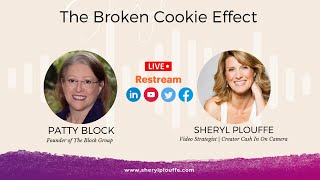
Patty Block explains the Broken Cookie Effect, a pattern where women entrepreneurs underprice their work and over-deliver to avoid seeming greedy. She covers value-driven pricing, standardizing sales processes, and why profit matters more than hitting $100K in gross revenue.
Chapters
of women who rely— that 62% of women rely on their business as their primary source of income, yet 88% of women generate less than $100,000 in their business annually. That is taken directly from Patty Block's website at the Patty Block Group, at theblockgroup.net. And Patty is joining us today to talk about this this phenomenon that women often go through, Patty, where they're maybe not generating the kind of income that they need to be. And that's your specialty, is to help women really rein that in and get them making more money. But there's a lot of psychology and a lot of blocks, roadblocks that go into that. So welcome to Cash In On Camera. I'm excited to have you here to talk about what you call the broken cookie effect. So why is it that women are so held back and not making the revenue that they should be.
So thank you for having me. I'm thrilled to be here. When I was growing up, my mom used to make these fabulous cookies, right? The whole house smelled good. It was warm. Cookies were gooey. You can just imagine, right?
Oh, it smells— I can smell it right now.
It's like, yes, exactly. And all of my life, I watched my mom eat the broken cookies. But it wasn't until I was a teenager that I even thought to ask her, why do you only eat the broken cookies? Do they taste better? And she laughed and said, no, I eat the broken cookies so you can have the whole ones. And not too long ago, so several years ago, I saw that really startling statistic, which is from NAWBO, with the National Association of Women Business Owners. And that really struck me that statistic that in many cases we're not raised as women, as girls, to be breadwinners. And so our mindset is very different as we come into business. So not too long ago, I kind of connected the dots and realized between that statistic and watching my mom eat the broken cookies that there's something happening here. In the 15 years that I've been working with women business owners, I see it over and over. This spirit of self-sacrifice that we learn from our role models that we bring into our businesses. And so I coined the term the broken cookie effect, and it has really been resonating with women that I'm talking to. And that's part of my mission, is to bring this to awareness so that we can change it.
Yeah, we have a Facebook viewer who's saying, glad I'm watching this. And it's an important conversation, I think, especially for women, Patty, because— and I can think of even my own situation in our own household. There are many cases where it might not be a cookie, but I understand the analogy, right? It's like there are lots of different things that I do and I say I'm putting other people first. And so, you know, how can women break that pattern? And is it always bad to be doing that? Like, is there, is there some way to find a balance between being nurturing but yet putting yourself first?
Absolutely. And that's the whole concept of what I teach. I'm not saying be selfish. I'm not saying change who you are as a person. I'm saying we can do both. We can serve others and we can make a lot of money. And when we make a lot of money, what that does for us— first of all, it benefits everyone around us. It benefits our staff and our families and our community. But it also— we're kind of living on crumbs, and that spirit of self-sacrifice is a little bit of self-sabotage. So what ends up happening is we have this mindset, we fall into this trap of, well, I want to serve more people, so I have to keep my pricing low. I can't bring in a whole lot of clients because I'm only one person. Can only take care of certain number of clients. So it's kind of a double whammy that we price too low because we undervalue ourselves and we underprice. Then we overdeliver on our services and we take fewer clients because there's only one of us, even if we have a small team of people. So it's almost like a triple whammy of all of these things that keep our companies very small and not very profitable.
So there's— and then there's such a correlation between, like you said, the broken cookie effect and the self-sabotage that we put ourselves through, and then how that correlates to the businesses that we're growing. And do you find that with the women that you're working with, it's, it's only in the startup phase, or is it throughout any phase of the business where this can creep in?
Any phase and every phase. And the companies that I work with are all established women business owners. They're high achieving experts in their fields and they all are service companies. So a lot of professional services and specialty consultants, and I see it at startup phase. I see it every step of the way. And even women that have been in business for 25 or 30 years, who are now thinking about exiting their companies. I work with those women in a somewhat different way in terms of positioning. But it's a real challenge because a service company doesn't typically have assets. So there's nothing to sell when they're ready to do so. And that is a different kind of challenge. So I see it at every stage.
Yeah. I want to talk about the, the $100,000 benchmark. I don't know if it's a benchmark, but so much as a, a goal to reach, right? It's like we get to that threshold and it changes the mindset, I think, but also changes your finances. It changes the game. Do you see it that way? Because you did mention $100,000 on your website as being like a, a number. It was in that statistic that you shared. Is that the number that we should be kind of aiming for as the first, as the first, um place to get to and then be able to move on from there? How important is it to get to that $100K mark?
So one thing I want to, um, maybe highlight is everyone talks about gross revenue. The market does, your competitors probably do. I mean, everyone's talking about what level of revenue and gross revenue, but it doesn't really matter. I've talked to companies that are bringing in $16 million a year but they're a break-even company. So what I'm talking about is profit. How much power does that buy you? How many choices can you make based on what you're bringing in and what's going out of your company? So I'm very focused on cash flow and on what is your net income after you've paid all your expenses and your taxes, and perhaps you have staff. Most of— most service companies, all of our money goes into staff, really. But that means you can take out less personally from your company. And so I'm looking at that balance of, yes, $100,000 in gross revenue is great, and then let's get to $250,000 a year, and then let's get to $500,000 a year, because that gives you so many more choices in terms of what you can do. And we have to look at the whole picture, not just the top line revenue.
I feel like $100,000 is a place where when you reach it, you can say to yourself, okay, now I'm on to something. I have a very clear proof of concept when you reach that level, but it's not the be-all and end-all. And I see so much, so much of that online where people are like, I'll get you to $100K, but I'm thinking, gee, that's only like that's just the beginning, in my opinion.
I agree with you.
It's not— I mean, it's a lot, but yet not a lot.
Well, it ties into thinking small, and when we're thinking about those very incremental increases, it really doesn't get us where we want to go. And everything, in my view, flows from pricing. Again, we undervalue ourselves as women and we underprice and we want to be fair to our clients and we want— we have all of these beliefs in our heads and because of that it works against us. So I start with shifting people's mindsets around money, around pricing, and how to build in value and look at the value to your buyer. Not just what you think your services should be bringing in, but what is the value to your buyer?
I am so glad that I learned about value-based pricing early on, because had I not learned that idea, I might have gotten caught up, especially in the video world. I might have gotten caught up in the, you know, selling my services for $30 an hour type of thing. I could have gotten caught in that, and I didn't. So I'm really glad that I learned that lesson early. But for those who haven't learned the lesson yet, it's important to really grasp that. Because when you can grasp value-based pricing, boy, it really changes not only, I think, how you feel about your business in general, but it obviously changes your finances and changes so many— and I think it also starts to attract different kinds of people to you. How does that work in your world, Patty, in terms of when you can really get your mindset in a different way, are you able then to attract a different kind of clientele more easily?
Yes, and a majority of women may not have a sales process. We're kind of winging it, and we, we don't really like to admit that, but, or we have a different process for each prospect that comes to us. We start customizing, and we start customizing the pricing.
So I'm guilty. I did do that for a little while.
Exactly. We've all done it. And so I'm all about simplifying and standardizing, because what that does, including with your pricing, because what that does is it builds your confidence. You're not winging it anymore. You have a process, and the other person will sense that, will recognize it, and it gives them confidence. They start to trust you more. So there's that piece of it. Plus you're guiding your buyer on a journey. And when you have a process, that is exactly the way they feel, is they're going somewhere and this is leading to the solutions they're looking for. The other thing I'll mention is the— so I have two programs. One is called Value-Driven Pricing. The other is Painless Selling to Ideal Buyers. And they fit together like a puzzle. And that's the whole concept, is it doesn't matter how well you sell if your pricing isn't right. And if you're not basing it on the value you provide, then it's, it's like a disconnect. So there are several pieces that all fit together when we're talking about taking them on a journey. There's a psychological journey, there always is. When there's a seller and a buyer. And as women, we don't like to think about selling. And that's why I call it painless selling, because sometimes it is really painful to go through that process, and it really doesn't have to be. And honestly, running your company doesn't have to be so hard. But when you're more profitable, you can also bring in help, you feel less isolated. So there's so many benefits for women as we bring in more money.
If you are, as you say, reinventing the wheel every single time a new prospect comes along, it's almost impossible to grow because you're customizing the approach. And especially, as you point out, if you're not charging what you really should be charging for the value that you provide, that's when people are squirreling and they're kind of like on the roller coaster ride and they They question, they go, how is it I'm seeing all these other people being super successful? Because they have standardized processes. I think they've standardized products. You can alter and tailor, I think, the proposals to prospects based on different standardized things in your business that are value-based, that have been value-based priced, you know. But do you agree with that? Like, that's how I do it. I have certain things that I offer, certain strategies. And when I'm talking to someone, I might customize a proposal, but I'm grabbing those different elements and putting them in the proposal at that, and then adding that up to the price, right?
Yes.
So is that how you approach it as well?
It is. And the— what I often say to my clients is, you have discretion, you're the boss. So when you have it standardized and you're not freaking out because you've got to put a proposal together and it— you're not sure exactly what to put in there. There's a lot of fear underneath, both for pricing and for how we're developing proposals, how we're selling our services. So all that fear really weighs heavily on us, and the, the idea that you can When you standardize, you are helping your buyer understand how you provide your services and what it's going to be like to work with you, which means they're going to start trusting you quicker and they're going to understand so much easier what it is that you're going to provide and how you're going to go about providing it and the value that you provide. So it's really an, um, like a cascade effect. As you address your pricing issues and you build your confidence and you learn how to talk about it differently, then your buyers will respond differently. And to your point, you'll also be attracting different buyers. Yeah. And one other thing I want to mention is when— right now, most women, we're waiting for the phone to ring. We have an inbound effort, so we're waiting for referrals and introductions. And that works until it doesn't. So one of the things I work with, with my clients is helping them define and find ideal buyers. Who is an ideal buyer? Where are they? They're out there, and now part of your job is to find them and to help them understand that you are uniquely suited to help solve their issues.
I love that. One of our Facebook viewers has asked, will there be a replay? Just catching this great conversation. We are live streaming this conversation right now on all of my platforms and a few of Patty's, in fact, at the same time with— by using Restream pairs today. So yes, all of this is being broadcast in real time and then will be available on Patty's and mine, uh, our platforms on social media, and then we do repurpose the audio to the podcast platform. So if you want to be listening to this conversation on your next walk or jog or run, then you can do that as well. So that's how, that's how Cash In On Camera works. So thank you for asking. Yeah, Patty, I just love this conversation. I think we could probably be here for a lot longer time. I wanted to ask you, we have a fun segment that we do on the show called Stop Marketing Like It's 1999. What is something like a tool, tip, tactic, or technique that you're using at The Block Group to market yourselves that's working effectively for you that you could share with our audience today?
One of the things that's worked well for me always are speaking engagements and guesting on podcasts and doing fun things like this, like live streaming. So that always has served me well when, before COVID Now we can add to that the virtual speaking opportunities. And one of the things that has worked really well is leveraging other people's groups. So putting the word out and directly asking specific people that I know have existing groups of women business owners, may I come and speak? Can we talk about this topic? How can we develop this concept for your viewers, for your audience. And so they're happy because they're always looking for speakers, and I'm bringing tremendous value talking about this topic. So it's a win-win all the way around. And I've met some of the most wonderful people by going into these groups and doing master classes or workshops or speaking engagements.
I couldn't agree with you more. I think speaking— I've always advocated for business owners, women business owners, to speak on your own platform and then also speak on other people's platforms. What is the common denominator? Speaking. You have to get out there and talk about your area of expertise on as many platforms as you possibly can. So I absolutely resonate with your advice on that. So thank you so much for sharing. Patty, how do people get in touch with you? I know you've got Revenue Roundtable. You've got all these different amazing programs. How do people get in touch? And I'm going to show the website here. I know it goes across here, but there's a quiz. Let me see if I can get to it real quick. Here, take the quiz now, conquer your revenue roadblocks, which I would highly encourage people to do. But where do you want to send people?
So I love connecting with people on LinkedIn, and it's Patty with a Y, Patty Block on LinkedIn. And when you connect with me, please reference this program so that I can make that mental connection. You also can connect with me on my website. There's a contact page at theblockgroup.net, and I would love it if your audience would like to take the quiz. It's myrevenueroadblocks.com, and what that is, it's a quiz to help you identify what's in your way in terms of generating more revenue. And you will receive a report, an email that will outline for you what the results are and where you could get started in addressing those roadblocks.
Amazing. Thank you so much, Patty. I'm so glad we got connected. This has been really valuable. I think we're going to— I hope will help some people to rethink this idea of, you know, nurturing and finding the balance between being a nurturing woman in the world but also being someone who isn't really sacrificing themselves or sabotaging themselves, especially from a revenue perspective. So thank you so much, Patty, for coming on Cash In On Camera today. Really enjoyed this conversation.
Thank you. This has been great.
More from Sheryl



From 'agreeable' to 'ruthless mentor' to 'strategic sparring partner' #substack #shorts







