The Competitive Advantage Right Under Your Nose
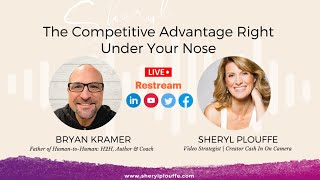
Bryan Kramer argues that your competitive advantage is your humanity. He calls it terminal uniqueness: the specific, often overlooked qualities that make you different. Hand-written notes, personalized messages, and imperfection cut through the noise of generic AI-generated content in ways that generic content cannot.
Chapters
that are not easy to replicate or to imitate. And today, we're going to dive into competitive advantages that are right under your nose that you might be unaware of. And the perfect person to talk about this is Bryan Kramer because he is really passionate about this and knows all about these competitive advantages and how we can all unlock them in our businesses. So, Bryan, so great to have you here on Cash In On Camera today to talk about this topic. The thing that I love about competitive advantage and this discussion is that it can be something, again, it's so unique. It could be so unique to you, or at least you want it to be unique to you. Tell us a little bit about your viewpoint on competitive advantage.
Well, thank you, first of all, for having me here today. This is absolutely wonderful. I've been looking forward to this. And competitive advantage is such an interesting term because it it throws out this feeling of challenge, like you're challenging another human being or you're challenged by. And so what is your competitive and how are you going to be competitive in this nature? And, you know, are we, you know, I suffer, we all suffer from this syndrome that I don't know if I'm the originator, but it certainly hurt, you know, something that I think we all suffer by, which is terminal uniqueness. And we create from where we are and who we think we are. And we are unique. Each and every one of us has a unique story to tell. And we have our own backgrounds and we see things from different perspectives. It's really super important that we stay grounded in that, that we stay grounded with our unique terminal uniqueness and do that while not having, you know, too hard an ego or taking it to the point to where our terminal uniqueness creates friction with who we are. Are as people. So, um, that's the balance of what we all face. But I think competitive— competitive, or being competitive, is, is what we all face. And there's nothing wrong with, with that. Um, having competitors is what drives us to get better, right?
Yeah, I was just gonna say, do you view competitiveness as being a bad thing? I mean, I don't think it is. I mean, obviously it, it certainly spurs, um, you know, competition and, and things of that nature, which can be really good in a marketplace. You want there to be, I think, that kind of of play, play space or sandbox, so to speak, to play in. You know, I think it spurs people on to be more innovative. I think that's the fun. It makes us want to be more innovative in how we do things too.
Oh my gosh. Yeah. I mean, remember back when, when Apple, when Steve Jobs just took over for the second time and he was— and Apple was struggling and he— the first time that he went on screen at the major event, he had behind him Bill Gates, uh, in the giant screen. It's, it's because he went to Bill and said, I need your support, I need your help in order for Apple to survive. Uh, Microsoft of all companies, I need your help for Apple to survive. And, and he invested, they invested in Apple, um, and, and they, they, they really needed to. They didn't have to, but they needed to in order to create a pool of, uh, success around them. To have a competitor or to not have any competitors is no good. I mean, look at You know, whether you like Elon Musk or not, he opened everything around the autonomous driving cars. Everything is public domain now. He could have taken everything that he invented around the electric car and actually patented all of it and not opened it up, not given all the other car companies access to, to all the patents that he held, and held it for himself and created a car company that was standing on its own. But he knew that in order to grow and scale, he had to allow other companies in. And he's super smart about that. There's other things we could argue that he's not smart on, and we won't go there. But, but there are things that you look at with all these giant companies that invested in or created in the competitive advantage, and that is healthy. Where it's not healthy— and I'll close with this— is when we compete with ourselves to the detriment of ourselves, and we, we focus so much on ourselves that it starts to really deteriorate who we are, who we think of, you know, in terms of what we, what we, what we believe we can do. And we slow down or we get overwhelmed or we get too tired because we just feel like that's a huge mountain to climb and how are we going to ever get there? So there is a mindset that goes with that, but that's the downside of it.
So the H2H that's behind you, see the hashtag, hashtag H2H for those who are watching the video, you're seeing it. If you're listening to the audio right now, Brian has a beautiful background behind him with this hashtag, I'd love for you to kind of dive into what the meaning of H2H is.
Yeah, H2H is human to human. It is the— in 2014, I stood on stage. It was not the first time, but it was an incredible time and a very neat time in my life when I was honored to stand on stage and keynote at Bloomberg West in San Francisco. And I had the right audience, right timing, right everything, and talked about that. There's no B2B or B2C, it's H2H or business to business, business consumer. It's H2H, human to human, that we are all selling to humans at the other end. And that's still true today. In fact, it's even more true today than that day. That day when I did give that keynote, it sparked something in the universe, in the universe of social media, which was new back then. Believe it or not, it's— we still all remember when social media became a thing and it got over 24 million impressions in 24 hours or 48 hours. And, and so we quickly put all the writing that I had done over the last few years together into a book and self-published it in 4 days, which became an international bestseller. And the reason I think it resonated so loudly and still does today with, you know, look at artificial intelligence and augmented reality and, you know, bots and the list goes on is because we at the end of the day are the people that are creating the tools. We are the We create the tools, the tools do not create us. Um, I would say that again, that we create the tools, humans create tools, tools do not create humans. And we set the standard, we set the engagement, and how we humanize things is really super important. Excuse me. And so as we start to look at what those things are, there are ways that you can break down what makes something more human versus less human. That's what we gravitate towards. I'm sure you gravitate towards things that feel more in your heart because you identify with it. You don't identify with what a robot says or what bots are saying, and you can tell a mile away when, when something does that versus when somebody's really talking from their soul.
Yeah, absolutely. I mean, we're big proponents obviously here in, in the profitable podcasting world and here on the show Cashy on Camera, uh, talking about networking, right? This idea of building connections. And I just really believe that as we move into Web3 and we we graduate into the next evolution of Web 2.0 is that we're going to be looking more toward connections and network and who do you know and who do you have access to rather than the vanity metrics necessarily of social media, which we've just kind of come through. So having said that, it really is that human connection. And the reason that the H2H really took off and really hit a nerve was because everyone kind of— you just put words to something that I think we maybe all internally were feeling. It's like, yes, that's it, Brian. It's H2H, right? And this idea of going back to the basics of connection and human connection. But the competitive advantage that's right under all of our noses is really us as human beings. So what are ways that we could unlock those, those competitive advantages, those ways that we can be unique and that are not as easily replicatable by other people? How can we really, truly unlock those I guess those facets of ourselves?
You know, there's 3 different things that I talk about in the book, and they still stand true in what unlocks those things. And it really, you can talk, you can take this as an individual, as a person, or as a brand, whichever way you want to identify with this. The first one is simplicity. Simplicity is something that, you know, when you look at a, let's just take it from a brand standpoint. When you look at a brand that is simplistic in nature, you totally get them, you understand them. It's not very difficult to understand what they do, how they do it, how they deliver it, and what you get out of it. What is the maximum input or output of what it is that you need or, or desire? And they deliver on that promise. The simplicity of it is just so hard to come by these days, especially now that we make things so complex. Um, acronyms— oh my God, there are more acronyms in this world than we know what to do with. And I'll go through the second two really fast. The second one is empathy. Empathy is a skill set that, or like a muscle that we can build. Now, what brand or what individual actually shows that they have empathy for another human or another customer or another person out there, whether it's through customer service or other things that really resonate in seeing that that happens? Like, you know, empathy can come through like, and I know, you know, we can love or hate Amazon, but they return everything. And that to me is empathetic to the customer. Now, what we can— we can go after Amazon as a company or, you know, there's a lot of different things. But one thing we do know is that they won't ask questions and they will take everything back. That to me is a Nordstrom story to go way, way back about people that just don't question you. They just do that. And that's really hard to come by these days. The third one, the final one is imperfection. And imperfection allows us to celebrate the true humanity of life, who we are and what we actually bring to the table, which is our own terminal uniqueness. And so as we, as we celebrate the imperfections of companies, like if you look at Dove, Dove celebrates the skin of others and the imperfections of skin. And then you look at nonprofits or you look at, God help us, the airlines right now, man, they are facing difficult times. Now, do we celebrate the imperfections or do we not? And so that's going to be up to us. And the question that we ask of ourselves. Right now, I think we could celebrate the imperfection of the staff that are trying to deal with all that. They're sitting on the front lines of the airline. So we can celebrate and have empathy for them because they didn't have anything to do with it. So there's a lot of different ways that we can see simplicity, empathy, and imperfection. But when you put all three together and you build it into one brand or one person and how you interact, it changes the game. We're not organizing it anymore around, are you doing social media? Are you on LinkedIn? Are you doing, you You know, how are you emailing? What's your email marketing like? And all the different marketing and sales tactics. Yes, they all serve a point and we need purpose for each one of those. But what is making them more human in each of those different channels? Start there and then move to the channel.
I love that. I think the, the pieces that you just mentioned around social media, you know, your LinkedIn, your Twitter, you know, the social media strategies, like those are all tactics. That you can use. I should say tactics. I feel like what you just described, this idea of simplicity, empathy, and imperfection is really kind of an overarching strategy or a lens through which to see those tactics, be it social media or your sales process or whatever your offer building, whatever it is that you're doing. But I love that we are talking about really, I think, more on the emotional human side, but more on the emotional side. The feelings that we can evoke in some of those tactics that we might employ as we market ourselves.
Absolutely. You know, emotions— God willing that we all have emotions and actually express them in ways that we never would on a public channel or in a marketing channel or sales channel. Emotions are the things that, you know, and there's 6 different emotions that Paul Ekman describes, you know, and And the interesting thing about emotions is when you express them outwardly over any marketing, sales, whatever, or keynote, whatever you're about to express through, or even those 6 emotions are interesting because— and I'll save you the time of reading his 25-page report and boil it down to one thing, which is that when you have one emotion, call it joy, surprise, angst, or disgust, anger, each of those different emotions, when you put them out, are— you're more likely than not to have reciprocity in that same emotion. Now, when I tell you a story, just think about it. That story is either sad or happy or joyful. Your, your immediate reaction is probably to celebrate in that same emotion. And so we are reciprocal in nature for the most part, not all the time, but for the most part. And so knowing that, how can we vary the color of our lives and our, and our marketing in general, to be able to show the flavor of who we are and how we can express ourselves across the internet.
I wonder if in your experience of, say, the last 5 years, maybe 10 years, in your observation, do you think that business owners are doing a better or a worse job of humanizing their businesses?
Well, I think we know the answer to that. I mean, thank you for the softball. It's, it's, it's really bad right now. It's getting— it's gone from, from, from good to bad to worse. I mean, you remember when we were getting on social media and everybody was having this almost emotional outcry. It was like this, here's who I am and I'm free to think and be who I am. And I celebrate that. And now it's just like, if, you know, we are guarded and we're so protected and it's becoming like a, you know, even more so than ever. And so are we now also humanizing what we do from a brand standpoint, you know, less and less because we're trying to get speed to feed, we're trying to go faster, we're not trying to go slower, we're trying to do more, we're trying to do quantity. I mean, I've seen Now ChatGPT exporting to a spreadsheet that's automatically pushing to Twitter so that people can crank out blogs or tweets or whatever as fast as possible. And is that human on one end? No. Is it human on the other end in terms of what we see? It starts to look like it. And yet the soul isn't there. Our human soul is getting disrupted in terms of what we want. And so how do we— how do we become more of that is by slowing down and taking a fresh break and looking at everything and going, okay, now how do we stand out? And the way that we stand out is just knowing that being human is actually your competitive advantage. It's kind of like when we got direct mail all of a sudden cut off. I mean, when's the last time we got a thank you note in the mail? And now, you know, we get email. Well, guess what? Maybe it's time to go back and do direct mail again because we might be the only ones that stand out in the universe of the mail carrier system. And actually sending somebody a basket of something neat with actually a personalized note that says, hey, thinking about you. That would— I wouldn't have gotten one of those for a long time. So those kinds of things are really unique. And if we take a step back and being and looking at what can make us more competitive in being more human, that's the ticket.
Yeah, I agree with everything you said. I love that the speed to feed. Because we've almost done a disservice for ourselves in the past, you know, say 10 years of trying to like get so much content. And we have had guests on the show to talk about the quantity versus quality. Absolutely agree with you. It's like there's this rush to get quantity out there, but then we're losing the human side of it. And now as a result of that, you're being a human being and being able to stand out as a result of doing things that that we've moved away from, which is sending something in the mail, uh, you know, uh, sending someone a short little video message on your messaging app, for example, instead of it just being a canned, say, response, or having something automated. You know, I feel like this automation piece that we've been all kind of privy to in the last while has almost done us a disservice. But on the positive side, it can also be a competitive advantage if you recognize it. And then you start saying, okay, how could I be? How could I simplify? How could I be more empathetic? And how can I leverage my imperfections to be able to be more human?
Amen. Amen.
I love it. I love it. Well, I just wanted like, let's, let's come up with some ideas. So, I mean, obviously sending something in the mail, that's something that I do receive from time to time. But I'll tell you that when I do receive a card in the mail or sometimes I receive gifts from prospects or clients or whatever. It just makes me feel a certain way, you know, and many of them I keep them because I'm like, oh, it's so special to me. It stands out. So sending things in the mail, I think video messages or audio messages, multimedia type messages are a great way to build up. Are there some other ideas and things that you can think of that we might be able to do to humanize that connection more?
Oh my gosh, it's endless. It really is. You know, just think about— take a step out of your— not you, But, but who— when you're listening to this, take a step out and look at each person individually and, and know that the thing that they want to receive is, is the thing that helps them to be seen. And it's not always something that costs money. It's something that actually had thought put into it. If you put thought into something that you deliver, it doesn't matter what it is. That goes for like over the holidays, my son gave me a book that he wrote out or filled out. It was over 40 pages of things that he remembers about, um, about me. He gave one to his mom, my wife, as well. Um, and he sat and actually took time and filled out all these different details and things of what he remembered growing up and what it— what he connected into, and, um, and, and, and his first memory and all these different things that just— I mean, it brought me to tears. And I think it's the greatest gift, uh, you know, I've ever received from a family member. And, you know, and he didn't— it didn't cost him, uh, you know, a ton of money. It cost him a ton of time. Um, That is the kind of thing that, you know, you can do with another person where when you put that thought into it, that's, that's the thing they remember. Because everybody has one thing in common, and that's that they all want to be seen. If you help share whatever it is that they want out of that, then they're gonna— they're going to remember that moment. And, and those are the moments that we, that we live and die by. I mean, that's, you know, and brands, I hope you're listening, like, stop mass mailing. I mean, look at just your top 10% of your people that are standing at the rooftops shouting your name out already and just reward them with something that's, you know, around being seen. If you have a real difficult time with that, then walk over to a whiteboard and plot out everything that you're doing in your marketing and take a step back and just say, where are we having more human moments and how can we have more? And just plot maybe one or two out and try that out and see what happens.
I think that's a great action step that anyone listening or watching could do is I have a whiteboard actually behind behind the camera right now. I'm looking at it thinking I'm going to wipe all that off and I'm going to just do exactly what Bryan just said. Put it all out there and just look at it and say, how can I be more human in any of these facets of my business? I think that is a great action plan that we can leave our viewer and listenership with today. Bryan, I want to give you an opportunity to send people to your website. So, please tell us where we can reach out.
Oh, thank you so much. It's at Bryan— it's really difficult. I made it difficult. It's BryanKramer.com. Brian with a Y, Kram with a K. It's funny, I was talking to my dad the other day and I actually said that, Brian with a Y. He's like, Brian, I named you. So yeah, he might have the funky spelling of Brian with a Y. And, and so yeah, you can go there, you can sign up for my newsletter. I reply back to anybody that hits reply to any of my newsletters. And also, you know, if you tweet me or go on social media, who would I be if I'm not replying back as the human guy? So definitely make sure you do that.
That's brilliant. Last thing, we have a little segment we do called Stop Marketing Like It's 1999, and I would love to know from you, what is a tip, tool, tactic, or technique that's helping you to market yourself and your business that's working for you?
Yeah. So the biggest thing that, that I'm utilizing is to market myself in my business is, uh, I— so I'm a storyteller. I love to, I love to, um, create dialogue. And so there's actually two things that I love doing. One is that, um, I, I actually got on to Substack, uh, over the holidays, and, um, and I'm really enjoying— aside from my newsletter that I do bi-monthly on Substack, I'm doing a daily, and it's just a paragraph and it's just a daily thought. It's actually at bryancramer.substack. What did I say? Substack. Thank you. I'm getting too mixed up in all my channels. So, and it's just been a pleasure because I'm actually talking about just one little thing and it's around unique observations or things that I see and how we can be more human and create more. And just doing that one thing, I'm getting more engagement and more likes. And not just that the likes matter, but more people coming back and saying, oh, I love this, this is great. And it's, it's a joy for me to do because I get a chance to actually write, write more. I love writing. And then the other one is just getting on and doing these kinds of things. The activity of engaging with another human being and sharing and in time and with you right here is, is my, is my top 2 favorite things to do.
Yeah, well, I just was showing on the book on the screen again, Human to Human, H2H. And I think you also have on here Shareology. So obviously an author, a thought leader in this space, and someone that we appreciate being on Cashing on Camera today to share your thoughts on the competitive advantage that's literally right under your nose. And it has to do with you being a human being and injecting more humanity into your business. So, Brian, thank you so much for being on the show today. We really appreciate your insight.
Thank you. I really appreciate all the great questions and the time and, and, and, and just a joyful moment. Thank you.
More from Sheryl



From 'agreeable' to 'ruthless mentor' to 'strategic sparring partner' #substack #shorts







