The Neuroscience Of Getting What You Want
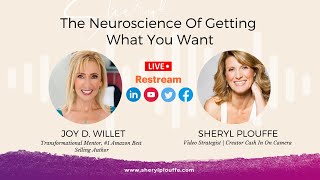
In this episode of Cash In On Camera, host Sheryl Plouffe interviews Joy D. Willett, bestselling author of I Am Joy and So Are You. The conversation explores why many people lack joy and how neuroscience can help them achieve what they want. Willett explains how constant phone use forces the brain into a foveal, beta‑wave state that triggers fight‑or‑flight, while shifting attention to peripheral vision induces an alpha, relaxed state. She highlights nature’s calming effect and the importance of breathing and outdoor exposure for resetting the nervous system. A central theme is the disparity between the conscious mind (1‑3% of mental activity) and the unconscious mind (97‑99%), and how focusing on what you do want—rather than what you don’t—reprograms the unconscious. Willett discusses the reticular activating system, which filters perception based on attention, and introduces “mind‑arts” tools such as neuro‑linguistic programming (NLP), timeline therapy, and hypnosis for rewiring limiting beliefs. Practical advice includes reframing negative self‑talk for entrepreneurs, using the 4MAT (Why‑What‑How‑What‑If) structure for video and copy, and getting on camera to market oneself. The interview closes with Willett promoting her website, certification retreats, and coaching programs for CEOs, entrepreneurs, and individuals seeking to harness joy and achieve their goals.
Chapters
life. But there is a neuroscience to it. And the perfect person to talk to us about the neuroscience behind getting what you want is Joy Willett. She is a number one Amazon bestselling author. She's a transformational mentor. She's a friend of mine. Is that okay that I say that you are a friend of mine, Joy? Because I feel like we became fast friends more recently when we saw each other in Las Vegas.
Absolutely.
I mean, you know, you're, you're someone who I feel like, and maybe this is not just an experience that I have had, but you have a way of making people feel comfortable and as if we've known each other for years, you know, and I love that. So great to have you on Cash In On Camera today. Your book, I Am Joy and So Are You, is a great book. Finished this. I love it. It's, it's a simple read, but it's a very— it's a, it's a heartfelt read, but it's also one that makes you really think about your role in the world. I'd love for us to just start a conversation around why is it that there's, you know, people just don't have enough joy in their lives, in my opinion. Do you feel the same way? And why is that?
Well, that's one of the reasons why I decided to write this book was to give people tidbits. You know, as you, as you read in the book there, Cheryl, they're really simple chapters. They're like quick reads, all the chapters. However, they are going into the challenges, uh, the, the day-to-day, um, things that we go through. And it's sort of like in this kind of world that we're in now where there's— we're connected to everything through our phones and the internet. And we're bombarded with everything that's going on in the world. And a lot of it can sometimes feel really yucky and sort of like, oh my gosh, where is this world going? So in the book, yeah.
I was gonna say, there's a great chapter in there where you talk about your phone and digital and how transformative that particular experience was for you? Because we're so attached to our phones and we're on them all the time. But is this, is this thing robbing us of joy?
You know, that's a good question, isn't it? I mean, we get a lot of wonderful endorphins, especially through social media. That's the neuroscience of social media, because when people click or like and, you know, share, we feel connected. And that was the chapter on connection in the book. However, what it is doing to our minds is that when we have a phone like this, we are going into foveal vision, which is really focused, and it takes us away from the peripheral, which when we're in peripheral— and this is another mind hack, I probably won't go into it now, but maybe on another, another show with you— on how to get yourself into peripheral, which then will actually put you into a relaxed, calm, and yet alert state. And it's a state that we teach also for anyone who's on camera, for anyone who's training, speaking, for kids with ADD and things like that. It's, it's just how we have evolved as human beings. And now when we're in foveal, it causes that you know, the fight or flight response because we're really, really focused and it has to do with our brainwaves. We're in beta. Then when we go into peripheral, we go into alpha, which is that meditative, wonderful, relaxed state.
I found that fascinating. And in particular because I thought, yes, and, you know, we— when we look at our phones, we're so focused on just the middle part of the phone and we're kind of negating all the stuff that's going on around us. And I think there's So much more to be said about how we're missing out on a lot of things that are going on around us. And I want to talk about nature. You know, it's funny, I'm at the cottage right now, the window open, I can hear boats in the distance, the lake is over here. It's a great place to be surrounded by nature. And I think people are not doing enough of that. What is the role of nature in how we can, you know, retrain ourselves to to follow the right path.
Nature to me is so important. And it is important for everyone, whether you're in a city and you have a houseplant, or you can go out in a park. If you're like where you are there in Ontario, Cheryl, being able to go out and experience the great outdoors, there's something very soothing and relaxing when we are in nature, even if we're walking down a forest path I live now down here in California near the Pacific Ocean, so I can go on the beach and, and, you know, have those, those beautiful sea air positive ions and the ocean waves. There's something very soothing to even just going and sitting outside on, on grass in a park where we can just allow ourselves to breathe A lot of it is breathing and to relax and to almost just let go of things. It's sort of nature's way to say, "Hey, lean into me and relax and rejuvenate and feel refreshed." And certainly when a lot of us are busy as entrepreneurs or even stay-at-home parents or whatever your position is in life, whatever stage of life you're in, being able to just, ah, you know, feel the, the raindrops, uh, experience snow, um, feel that sun. It is so important. And especially, I think too, coming out of this, the pandemic and COVID, where we were shut in, sometimes finding respite And relaxation by going outside, if we couldn't be connected with people, was also a way that we could feel that peace and create calm in ourselves.
How does that, that hack, the other hack that we just talked about, how does that correlate to us getting what we want in life? Explain to us the connection behind some of the hacks. And there are a whole bunch of them in your book, obviously, and I would highly encourage people to read it. It's great. Oh, but If we take all of these different aspects of bringing joy into our lives, how does that really help us to get what we want? Because at the end of the day, I mean, I think that's what, you know, a lot of people have goals and, you know, things that they want to accomplish in life that might be struggling to get those things to manifest or to happen for them or their families. What is the correlation between those?
Well, the correlation is always First, you need to know what it is that you do want. And so most of us are thinking about what we don't want. And this is the neuroscience part of how to get what you actually want, is that when we are focusing on what we don't want, guess what's getting increased? It's getting increased of what we don't want. And there, there's Specific reasons why our unconscious mind, which is— okay, well, let me ask you a question, Cheryl. Okay, you might know the answer to this, but I don't know if your audience does. How much of your mind are you using right now consciously, or what percentage?
Yeah, what percentage? It's a very low percentage. It's under 5% or under 10%, I would guess.
Yes, you're right. You're right. It is actually now they are finding, right, the folks that do these studies, between 1 to 3% is all that we're using consciously. And I mean, you and I think a lot, and I'm sure a lot of people do, right? We're always thinking, right? So however, that means that there's how much left that's out of our awareness at the unconscious levels? 97 to 99%. It's like crazy. Incredible amount that is actually running our lives. First, our physical body. That's the whole function of the unconscious mind. And when you, when you go to study these things, I'm, I'm a geek. I'm, I'm into quantum physics and I'm into, um, you know, I was going to be a biology major and a writer and all this stuff. And I love finding out what is going on behind our lives and, and, and how are we creating our reality? So this is the deal. The unconscious mind cannot process a negative. All right, the unconscious mind cannot process a negative. It's like a 5-year-old kid. If you say to a 5-year-old or 4-year-old, don't run in the street, what do they usually end up doing?
They run in the street.
And that is because they are so open and connected to their conscious mind and unconscious mind, they are not able to process a negative. So this is a hack, a hack for parents or grandparents or teachers or anyone around children. Guess how you want to talk to them up until probably the age of 6? You want to say it the way you want it. You want to say, if you don't want them to run in the street, you say, stay on the sidewalk, say it the way you want in the positive. Now, the same goes for when we are programming what we want. Like, I want, you know, this much money, I want this kind of body, I want this kind of relationship, or whatever it is that we want. We want to say it in the positive. So if we focus on something like, I don't want that, guess what? Our mind— and, and by the way, our unconscious mind is recording everything all the time. That's why you can tap into it through hypnosis and timeline therapy and NLP and, you know, all these fun mind, uh, mind arts and tools that have been used for a long time. So you want to always focus on what you want. If you're going through your day and you're focusing on something like— because we all have these thoughts negative thoughts, so-called, and you're going, ah, and then what you want to do is, you know, say it's, I don't want to experience whatever that is, right? Or, uh, whatever it is, ask, stop and ask yourself, what do I want instead in the positive? And then focus on that instead. Now, what we go back to, I said I was kind of into quantum physics and that kind of whole shebang. No, I'm not a quantum physicist. I've never studied it. However, Albert Einstein is a favorite person of a lot of people who are in the mind arts because he was one of the folks that originally came up, you know, over 100 years ago, of course, I guess, right around 100 years ago, about how we create reality. And they did the studies, you know, his quantum, or his scientific friends, they were doing these studies with light. And what they found out when they went into the subatomic particles and doing this light, that whoever was observing, observing these particles, those particles responded to who was observing it. Whoa, that's pretty crazy. Wow. Okay. So again, how are we creating our reality? It's through focus. It's through focusing in the positive, right? And also we have something called the reticular activating system in the brain. So when we think of like, okay, I want to have, um, you know, I want to get a new car, you know, maybe I want to get a white SUV, right? So what is it that I'm going to see wherever I go? A white SUV.
It happens all the time. When you put your focus on something and all of a sudden you notice, how is it that I've never thought about, let's say, VW Bugs, you know, or Beetles or whatever? Um, gosh, we just had a conversation about them in the car, and now all of a sudden I see them everywhere. Yes, that's the reticular activating system work at work, isn't it, Joy?
It, it sure is. It sure is. Now, do you want to know another hack?
Yes.
Or another— okay, so remember, we're talking about— I love this stuff. I mean, I could just sit and talk about this stuff for a long time. It's so much fun. And I actually train people, as you know, I certify people in these mind arts. Um, the conscious mind, which is running our lives at a percentage of 1 to 3%, is we call the goal setter. That's where we go, okay, what do I want? You know, I'm crafting my goals. I'm crafting my end results, you know, maybe as an entrepreneur, how much money, uh, or if I'm, You know, whatever it is, my goals, right? Weight, you know, whatever goals you're working on. Now, the unconscious mind, though, we call the goal getter because it's running the show out of your awareness at between 97 to 99%. And it's where— and this is where all the filters are, all the programs. That are subconscious programs, because that's how the unconscious mind works. And it's the goal getter. It's like pulsating what is actually happening below the surface.
So Joy, can we, can we, because if we're only really using 1 to 3% of our conscious mind, can we influence, or how do we influence the unconscious mind, which is running the show which, as you pointed out, has to do with the goal setting part.
Yes. And, and, or influencing our results and achieving those goals that we, that we set up here. Exactly. Well, great question. And yes, we absolutely can. And part of it is learning how to communicate with your conscious mind with this— we call it the unconscious, subconscious, it doesn't matter— it's the part of us that's out of our awareness and becoming, creating this, this connection again that we had when we were kids, that we had when we were little children. Or if we have grandkids or, or kids, you know, around, you notice that they're imaginative, they're, they're, you know, everything, everything is possible. So as we get older, we're told, and this is for our own safety too, we're told grow up, that's not possible, you know, you have to be realistic. And we create this actual It's, it's kind of a wedge. We'll call it a wedge between our conscious mind and our unconscious mind. However, we want to learn how to reestablish that connection with the subconscious so we can go in and reprogram it, right? That's what neuro-linguistic programming is. It's about using different techniques and tools. I call them magic tricks. To reprogram your neurology, right? Yeah, right. And so, I mean, it's just— we could go on, like I said, for hours. It's— and, and you can re— reset and re-shift your neurology through these techniques and let go of trauma, let go of PTSD, let go of, um, whatever you want to call anxiety. Anxiety is actually an emotion about the future about a specific event not completing successfully. Why would you want to think that? Letting go of overwhelm, all sorts of stuff. And, and all the things that we feel— guess what, everyone? We all feel these things. We all have negative emotions. We all have limiting beliefs and self-talk. Every single person. You're not alone. I just want to let people know that. And we are able to let go of these things in new, kind of new ways rather than just talk therapy, which actually lights up the neurology and keeps you kind of reliving it.
We have a lot of entrepreneurs, coaches, consultants who are looking to grow their business, right? They want to build their brand, they want to grow their business, they want more clients, they want more referrals. What are some examples, maybe one or two examples, of a negative self-talk, and then what would be the positive version of that thing? So let's just use the example of, I don't have enough clients. Okay, so if someone is telling themselves, I don't have enough clients, therefore I'm not growing my business, what would be the positive version of that?
Well, well, that would be— yeah, that's called a reframe. Um, the positive version would be, there are plenty of clients and there's no one like me. There's no one like me with every— there could be a lot of different people with whatever genre of entrepreneurship you're in, you know, whether you're a coach or whether you're a financial planner, whatever you do, um, there are— there's everybody under the sun is doing something that's been done before. However, there's only one you. There's only one you with the, the energy, the energetics that you put out. And remember, like attracts like, we get back into that sort of the woo-woo law of attraction, everything's energy. So again, if my, if I'm pulsing this, you know, and what if I'm pulsing that limiting belief of, gee, there's not enough clients, You know, even though I'm telling myself, of course there are, right? So that could get in the way. I can, I compare our limiting self-talk, Cheryl, to like walking and hiking with the sandals on a beautiful path and getting that one little pebble in your shoe. Like that could be one limiting belief, or there's not enough. I'm not good enough, right? I'm not like them. These are all the different comparison self-talk that as entrepreneurs we might say. What's—
let me give it— can I throw another example at you? Let's say I'm just thinking about the podcasting. This is one of the things that I teach, profitable podcasting. A lot of people will say, oh, I couldn't possibly be— I couldn't possibly have my own show because I've never done it, or I'm not an expert. Who am I? It's kind of like that limiting belief around who am I? How can we reframe that self, negative self-talk into something positive. Sort of this idea of like, who, who I couldn't possibly have my own show, right?
So a lot of that again is going to come down to those core or those, those subconscious limiting beliefs about yourself. And I will say that a lot of those beliefs might come up while we're doing something, you know, in our adult framework. But a lot of those come into play from when we were kids, that we made up tons and tons of stuff around ourselves based on how we experienced the world. And usually we like to say, uh, you know, we made stuff up about ourselves when we had no business. We were so young making anything up about ourselves at all, but we made things up. And because we're a little tiny children, you know. So a lot of this can stem way back, way back. And sometimes you see somebody— okay, let's use the example of somebody who's made it, who's an entrepreneur who's made it, and yet they're miserable, or yet there's never enough, right?
Yeah, we see that all the time, right?
Or on the reverse, someone who's starting out Right. A lot of times people are starting off in their careers and it's like beginner's luck. You know, they say beginner's luck. Well, what is really beginner's luck? This is kind of a fun thing. Let's unwrap that. What is it?
Well, I mean, I'm going to guess, you know, beginner's luck might be kind of having that vim and vigor of I'm starting something new and maybe they are kind of go-getting, you know, they're like ready to attack the world. And the world is my oyster kind of mentality. And therefore, I'm just taking a guess here, Joy.
Yeah.
But is it something along that line where their mentality around starting this new adventure is on the positive as opposed to, oh, who am I and I can't possibly do this?
Exactly. It's the positive. And isn't it funny that people say, oh, they just have beginner's luck, and then they start making stuff up? Oh yeah, maybe that was just beginner's luck. It's because they have that unlimited possibility and potential, which all of us can have in every arena of our life, not just as an entrepreneur, right? Because everything we do affects all the other arenas of our life. And it does stem from the things that we have made up, our filters, our programs that usually more specifically come from when we were little tiny children, and we made things up. And that's why some of the mind arts that people use, like the NLP, neuro-linguistic programming, um, I use also Timeline Therapy, which goes back and shifts things, as well as hypnosis, um, you know, all of these different, different tools. I call them magic tricks to help you change your neurology and therefore how you're feeling and thinking so so that you can be free, so that you can have that positive can-do energy, so that even no matter what is coming, and that's why I wrote the book, 'cause in the book, as you know, Cheryl, I talk about challenge and chaos and crisis.
You talk about some great stuff in here, the find a state of flow, rediscover childlike wonder, ride the waves of life, plant joy where it's most likely to blossom. I mean, it's just excellent. I really enjoyed the book. I really hope people go out and get that. I'd love for you to tell us more about where people can learn about you, Joy, on your website, I guess.
Yes, go to my website. You can find me on LinkedIn, Joy D. Willett. You can find me on Facebook platforms, but my website is joydwillett. There you go. W-I-L-L-E-T-T. And there you're going to find out the different programs, and I do individual breakthrough programs for people. I work for corporate CEOs and employees as well as for entrepreneurs. My real love is entrepreneurs and innovators and people here to make a difference. I do have— I'm noticing on the screen here, Cheryl— my NLP Practitioner Certification training, which is teaching people and certifying you these wonderful mind arts within 7 days and 8 nights. I do it retreat style. The next one is coming up in Southern California, September 22nd through the 30th. I also teach hypnosis, and I do all of this, uh, I love it, magic trick stuff with people to shift you so that you can be free and you can go after that life that you want. And, and no matter what, you're, you're going to be able to be the best you possible to end as well as to help others.
Yeah, and I would encourage people, I Am Joy and So Are You, get it where books are sold. You're going to want to get this one as well. One thing that we do on Cash In On Camera, Joy, is we have a little segment called Stop Marketing Like It's $19.99. So our marketing segment, I'd love to get a tip, a tool, a tactic, technique, something that's helping you, Joy, to market yourself for the year that we live in? What is something you'd like to share with the audience?
Well, okay. So one of the, first of all, get on video, guys, get on camera, get on camera, learn how to do that. Cheryl, I'm sure you have programs teaching people how to be on camera because you are, you know, you're our former weather girl from Canada. Eh, you know, I'm a fellow Canadian too. So anyways, so what I wanted to share just really quickly is when you are actually presenting something, on video or you're writing copy, you want to use something called the format. It's to address the different learning styles. So it's real simple. You start off with why, why your program is good. Why, why, whether it's the pleasure or the pain points, why do they want your program, you, um, whatever it is that you're, you're offering, what is it? Then you go into what is it? What is it? What is your program? And then how is it done? You wanna give them the steps. So this is addressing the different personality types of learning. So it's why first, what is it, how is it done, the steps, and then what if? What if somebody was to do this? So it's the why, what, how, and what if, okay? And that's called 4, the numeral 4, MAT, M-A-T. Learning style. And that's what we all use in our videos, uh, in our writing, because it addresses, uh, at those subconscious levels, those different learning, uh, personalities.
Fascinating. I love that. That's, that's a new one for me, Joy. Thank you so much for sharing that. Really appreciate it. This has been so much fun. And, you know, I think you're right, you'll have to come back because there's a lot to unpack. Oh my God, I think I'm going to take away today is the fact that we're really only using a very small portion of our brains in the conscious mind, right? That there's so much more to our existence on this planet. And if we are able to bridge that gap between the, the 1 to 3% of our brains that we're using in the conscious mind to the unconscious, we can get what we want. But we may have to get some help in retraining ourselves to think differently and to use neuroscience to do it.
Absolutely. And yes, and thank you for, for you and, and everything that you offer to everyone here. Cheryl, you're a real, um, you know, you're a real gateway to bringing these thought leaders and, and heart leaders, um, and cash leaders to, to, uh, to the internet. So thank you so much. It's been a real honor and a pleasure, and I'm so I'm thrilled that you, that you liked my book. That means a lot.
So yeah, it really did. I think it's excellent. I'll just show the COVID one more time, but definitely get this book. Joy, thank you so much for being on Cashin' on Camera and I'll connect with you soon.
Very good. Thanks, Cheryl.
More from Sheryl



From 'agreeable' to 'ruthless mentor' to 'strategic sparring partner' #substack #shorts







