The Subtle Ways Women Sabotage Their Own Business Success
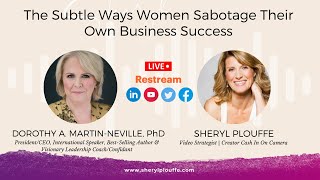
In this Cash In On Camera interview, host SPEAKER A talks with Dr. Dorothy Martin Neville, a psychologist‑turned‑leadership coach, about why many women unintentionally undermine their own business success and how to break the pattern. Dr. Dorothy explains that women often limit themselves by dreaming small, internalising societal messages that discourage ambition, and conflating their identity with the roles they’ve created (mother, spouse, employee). She introduces a “10‑x” exercise to stretch financial goals, encourages listeners to examine the stories they tell themselves, and to listen to their soul’s calling rather than external expectations. The conversation explores how family dynamics, unsupportive partners, and inherited beliefs can reinforce self‑sabotage, and offers practical steps: redefining self‑image, building confidence and presence, and expanding one’s energetic footprint through modern marketing (podcasts, live video, radio, TV). Dr. Dorothy also describes her coaching practice, which blends psychology and leadership development to help women (and men) create purposeful cultures in their businesses, move from survival to thriving, and align their personal vision with their professional actions. The interview closes with a marketing tip emphasizing visibility and the willingness to be “big” in order to let the world know one’s unique gifts.
Chapters
That always feel like it's a struggle to get ahead and that you're kind of just going through your life or your business in survival mode, as opposed to this feeling of like, I'm thriving, I'm owning this, I'm doing this. I think a lot of entrepreneurs, coaches, consultants, service-based professionals, you know, can feel sometimes like, oh man, the world is against me. Why isn't it that I can't seem to get ahead? And there are some reasons behind that, and that's why we have brought in Dr. Dorothy Martin Neville today to talk about how we as women sabotage ourselves. Why do we do that? And then more importantly, what is the solution to fixing that problem? Dr. Dorothy, uh, great to have you here on Cash In On Camera to talk about this. Obviously you have a wealth of experience and expertise in this area, but let's start with this idea. Why do women sabotage themselves in the first place? We often don't give ourselves enough credit for what we accomplish.
You're right. Unfortunately, much of society doesn't necessarily give us a lot of credit for what we've accomplished. Our ability to multitask is absolutely amazing. Whether we should or shouldn't is another story. We've got a great ability to do so. But I think one of the greatest saboteurs is we think so small about our own potential. We think so in such limited terms about whatever our dreams can be. You know, those of us who've chosen to become entrepreneurs, I've heard women, you know, call and say to me, "I'd love to make $50,000 a year." And I say, "That's wonderful. Have you thought about making $500,000 a year?" "Oh, oh no, that no, that's—" That seems like, "No, I don't deserve that.
I shouldn't strive or—" Yeah, that's not me.
I wouldn't know how to do that. That's not who I am. My life is too full. And I don't care what your dream is. It doesn't matter to me. If your dream is $50,000 a year, then achieve that and love it. But if your dream is $50,000 a year because you don't think you can do $100,000 a year or $200,000 a year, that's a different story altogether. So no dream is incorrect. But it's just, if this is your dream, is it truly? Because if you limit your dreams and you limit you so that you don't rock any boats, now you've moved into self-betrayal. Yes. Recognize the dream and say, okay, while my kids are at home, if that's a situation, or while I'm getting started, my dream for this year is $50,000. Well, then let's do that. Because that's, what's your dream for 5 years down the road? Well, I'd like to be, well then let's get you to 50, develop the skills you need, the self-image you need, the presence you need, and that's our prep to get you to the next place.
I noticed that in this example, you did 10X it. You went from $50,000 to $500,000 just in the example that you gave. And I know in the pre-notes that I went through, You talk about this idea of 10x-ing your dreams. Is that an arbitrary number or is that a number that you often recommend for women to strive for?
Well, it's not even to strive for, it's to give them a chance to try it on. Just try it on. If, like using this 50 or 500, try on what would it feel like for you to make $500,000 a year? What would that feel like for you? I don't want to do that. Okay, then that you don't hate to. That's not a you should. That's a what does that feel like? Or that scares the daylights out of me, but I can't imagine. Do you think I could? That's a very different response. It also could be I would like to spend a weekend in Greece. All right. Is it a weekend you'd like to spend or a month? Do you think I could ever spend a month? I can't imagine. I would love that. Let's talk about that. And it may be that you spend a weekend exploring which island or Athens, where would you like to go in Greece? Spend a few days over there and imagine if I were to come back, where would I want to go? All of a sudden, that 3-day trip is so much more fun because you're not trying to squeeze your life into those 3 days experiencing Greece. This is a prep for what I could do later. About a point in time in my life. You see that energetically, how that feels?
Yeah. I, I can't help but to think that women are maybe giving these types of figures or those types of numbers is like that, you know, the one month— sorry, the one week in Greece, or the three days in Greece, Greece, rather than a month, or the 50,000 versus 500,000 or 5 million for that matter. But are these because of societal expectations that we as women are kind of accustomed to over decades and centuries?
I think part of it is societal. I think a large part of it is that we've held on to it. Think about this. Your mom, if she was like most moms, told you not to eat before dinner. Right. And yet how many of us, when we're out, have an appetizer and a cocktail? Right. Your mom told you not to talk to strangers. How many of us talk to strangers every day when we're in business? Business. So we've thrown out messages that we've received. So why did we keep the messages we kept? All right, so for myself, the work I do with my clients is always looking at what are the stories they're telling themselves, where do they come from, and why have they chosen to hold on to those stories? Because if we can change the story we tell ourselves— and there's no right story that somebody can give you. What is your heart? What is your soul calling you to? Change the story that gives you an unlimited ability to become who you feel called to become, which is far more important to me than doing what you think you're here to do. Who is it you want to become? And let's work on that because every dream you have calls you to become more. If I'm here and I want to go there, the woman here can do this dream, but if I'm going to have that dream, I've got to grow into that. What skills, what level of confidence, what level of presence, what level of resources do I need to develop to be there and sustain that dream? Because the reality is, if you've looked yourself in your own life, no matter what dream you achieved, once you're there a period of time, it's like, hmm, I wonder. Yeah, and I wonder too if—
well, actually, this is more of a side It's not a statement, it's more of a question. How do we know internally if we are being called to something higher rather than it just being a dream or a hope? You know, because I think that a lot of women who reach, you know, over 40, over 50, they're kind of looking at the next half of their lives. I know I have, um, you're looking at the next half of my life and thinking to myself like, I'm not as employee or job oriented or focused on that kind of like trying to rise up the corporate ranks of a company anymore, as much as I want to build my own thing. But I want to have impact. I really want to start thinking about the second half of my life and what kind of legacy I could potentially leave behind. I did feel like I was being called to do something different, which led me on this path. It's been many, many years now since I've transitioned from employee to entrepreneur. I did feel it was a calling, but I don't know how I knew it was a calling. Is there anything that we can identify within ourselves to be able to say, yeah, this is a calling. I'm being called by something greater than me to go in a new direction.
I would say to you that I believe it's our soul, our soul's essence. However, however you phrase that is irrelevant to me, but it's our soul or essence. Calls creates those dreams. And those dreams are what call us to become. Because you know every dream you've followed, you've grown. You've become more you. And then our soul calls us to the next dream to become more and more of who we're meant to be. And that continues throughout our journey. It doesn't have to be in terms of career. It may be, if I work in corporate, when I get to be 60, 65, whatever the retirement age is, I can't wait to get there. Then I'll know financially I'm stable for the rest of my life. But now I want to do this. So it doesn't have to be about corporate. It can be, I'm 30 and I want to become an entrepreneur, and I just feel that's what I'm called to do. Well, then go do that. But what— when you do it, recognize that it's going to keep growing, it's going to keep changing, it's going to keep evolving, because you keep growing, you keep changing, you keep evolving. So you outgrow whatever dream you had, and it becomes more expanded. All right, and so with that, then it's having permission to expand your dream without questioning the dream you had before. Because it could be that maybe my dream was to do this with this point in my life, but now that I've passed that stage or that phase, or maybe now I'm divorced, or maybe now I'm starting as an entrepreneur, maybe now I just got married, whatever that is, your vision and dreams may change. The others were great. They led you to this stage. And where do you want to go with this stage? What do you want to do? And give yourself permission to explore. One of the clients I'm working with, she said, I couldn't wait to get to retirement to have my life. Now I'm here. I have no clue. Nobody gave me rules for retirement. Right. There are none. What do you want to do? That's what you go with. Yeah.
And, and I wonder too, if for women who are thinking small and they're kind of not expansive, they're not thinking about, they're kind of not abundance mindset type people, they're thinking too small of themselves and their ability. I wonder though, too, if their environment is affecting their ability to think in a bigger way. So for example, women whose spouses are not supportive of the dream. Or whose family is not supportive of mom doing something different?
How do they deal with that? Each one is going to do that in her own way. I believe, however, that whenever you allow others to define your dreams, you've moved into self-betrayal. If your children don't like your dream, what is it they don't like about it? What is the vision they have? That if you become successful, I'll never see you again. Well, let's talk about that. That's not exactly my dream of success. My vision of success is I love what I'm doing and I still have you in my life on a daily basis. So let's look at whatever your fears are. And you work with the children. Yeah, it may mean I'm not around to pick up everything, and if you're 13, you start doing your own laundry. That's a good move in the first place. Even if I didn't have a career, it's a good move. I support that. Yes. So there's so So there's these pieces, and if your spouse doesn't support it, how in your relationship can you work with that? Is there room for you in your relationship? In many relationships, there's only room for one person, not for two. It's all about one and not the other. And if the two of you can work together to move into a place where there's room for you in this relationship, then— and Annette, I make It makes sense to me that your partner may be— your husband or your wife may be terrified of you developing an interest that they're not a part of because of a fear that they'll be left behind. But how can you work with them that your commitment to this relationship isn't being replaced, it's being expanded? Because there's so much more of you coming alive, so there's so much more of you you can bring into this relationship. How are you going to work with that while they come to see that it's time for you to have a greater sense of you in your life as you, not just as a mom or as a wife.
Yeah, and it's about identity, and it's about staking your claim for your own life and taking ownership of that. But like you said, you know, we do sabotage ourselves in many, many ways. Um, we do— all is a big part of this.
Yeah, one of the things I use, an example I use for my, my people, my clients, is that you're sitting here as we are in our own chairs and at our own desks Way over there on the other side of the room is the life you created. Way over there on the other side of the room are lovers you had, are friends you had, careers you had, educations, homes you may have lived in or apartments you've lived in, all of the different associations you belong to. All of that is— and even your children and your husband or your wife. All of that is on the far side of the room. That's the life you created. This is you. When we forget that we are not the life we created, we are so much bigger. We are the creator of that life, right? So we created all of those experiences, those relationships. So knowing that, if I disappear and I simply become somebody who's living that life, this is where depression sets in. This is where the illusions of powerlessness and victimization set in, because I have disappeared as me. I'm now just I need to be somebody living that life. I need to— and this is what I work with many women, even those who are running hospitals, those who are heads of organizations. There's you here. Even your career is over there. The career is something you created and developed. It is not you. So let's separate from all of that. Who do you want to become? What do you want to do with your life? Let's look at that. That is the most important element. This is not narcissism. This is really being conscious of all the relationships I have chosen to develop. If it's children and a partner, then I have responsibility to my children and my partner, but that doesn't replace my responsibility to self. I'm still here and I need to do my life while I'm in relationship with others.
Which if you don't have the right sort of thinking around this can be challenging, which leads us to the work that you do. So tell us about the work that you do and I'll show your website while you're explaining it. Alrighty.
I spent years as a psychologist and I bring that experience into my work as a leadership coach. I, and I believe every one of us is called to leadership, whether it's leadership of our home, of our businesses, leadership in an organization we may be working within. It is really my work is to support others in leadership, defining who they are, where they want to go if they have an organization. Many women who develop small and mid-sized businesses forget that they need to create a culture in their company. So what culture do you want? Even if your company is yourself and 1, 2, 3 VAs, what's the culture you want in your company? So I work with women and men to look at who they are, who they want to become, and if they have a business and they're getting in the railway, they're surviving. If you're surviving, your company is going to be surviving. If you're thriving, your company is going to thrive. So I work with folks who are at that level of, I'm not where I want to be, I'm surviving, I'm doing what I'm supposed to be doing, but I'm not at home where I am. I'm just surviving. I support them in looking at where are they in their dream. Is it time for a new one? Is it time to expand it? And who do they want to become in order to live that dream? So it's working with folks who are stuck, who are lost, bringing them back to their passion, bringing them back to their vibrancy, and really calling them to live this journey, not survive it. I love it.
AskDrDorothy.com is the website. And I so much appreciate you being on Cashing on Camera. But before you go, one of the segments that we do on the show is called Stop Marketing Like It's 1999. So I would love to know, do you know the reference to Prince?
I do, yeah.
What is something that you're doing to market yourself that you're finding particularly effective? It could be a tip, a tool, a tactic, or some type of technique that's really helping you to market yourself.
It's that willingness to be big, that willingness to expand your energetic footprint. If you're going to be successful, the world needs to know you exist. And so it's doing podcasts like this, doing live videos, doing radio, doing TV, getting yourself out there without the fear of that's what others do, or I'm frightened I'll say the wrong thing, or I won't appear intelligent or successful, or whatever the case may be. Welcome to humanity. But take that risk and get yourself out there. Let the world know you exist because every one of us has an exquisite gift to bring to the planet.
I love it. And thank you for sharing your gift with us today. It was really insightful to learn how we can step into that, that grandness that we all have the potential of achieving.
Thank you so much for being here. You're so welcome. Thank you very much. Thank you.
More from Sheryl



From 'agreeable' to 'ruthless mentor' to 'strategic sparring partner' #substack #shorts







