These 3 Strategies Will Make You Unstoppable In Business
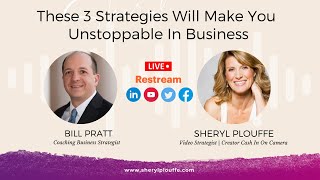
In this interview, host Sheryl Plouffe talks with business coach Bill Pratt about why many coaches struggle to grow their businesses and outlines three core, actionable strategies to become "unstoppable": lead generation, client conversion, and program delivery. Pratt emphasizes the paralysis caused by too many software options and advises using trusted recommendations and time‑boxed decisions (e.g., a one‑hour timer to pick an autoresponder). He explains lead generation as identifying a specific target audience, choosing the right platforms (Facebook, TikTok, etc.), and setting concrete metrics for how many leads are needed. The conversion strategy involves reverse‑engineering revenue goals, calculating required sales, conversion rates, and planning offer frequency and delivery methods (email, calls, DM). Program delivery focuses on the actual coaching format (one‑on‑one, group, virtual) and the tech stack needed to support it, noting that good delivery fuels testimonials and referrals. Throughout, Pratt stresses the importance of tracking numbers, simplifying admin, and building a community (live streams, podcasts, groups) rather than relying on outdated list‑mail tactics. The conversation ends with a practical plug for Pratt’s 60‑minute sales funnel blueprint.
Chapters
You got into it because you have a passion for your subject matter. You have a purpose behind it. You know your why. However, do you struggle with the business side, making that a viable business that's going to obviously provide you with everything that you hoped it would, right, in entrepreneurship? Well, Bill Pratt is here today from Bill Pratt Coaching to talk about the 3 main strategies that you can use to make you unstoppable in business. And what I love about this conversation that you're about to hear is that we're really going to mine it down to the core essential things, the areas that you really need to be focused on in order to, again, make your coaching business thrive. So, Bill, so great to have you here. You've done a lot. I mean, you're a college professor, you write textbooks, you do a lot of things. You work with people like Jay Shetty, who we see all over Facebook and other mediums. Um, but let's dive into this. Like, why do people, specifically coaches, um, struggle so much trying to really make their businesses thrive? Is it because they're just making it more complicated, or is it just the fact that actually to build a business is complicated?
Well, building a business takes lots of steps, but it's not necessarily complicated. What happens is it gets complicated because there's so many options.. And most of us are on our own, uh, part— I mean, honestly, a lot of the coaches are very heart-centered and service-oriented, not necessarily business-focused. And so that's part of it. And then they say, well, I'll just get other people's advice because someone has to know what they're doing. And the problem is there's maybe 50 coaches that they listen to who all have a different opinion, and that's like 25 different ways of doing it amongst 50 coaches. And the thing is, they might all be right, but you can't do all of it. Like, you have to pick one. And it's the same thing, even just something as simple as choosing your, your software for whatever, like your email system. There's so many to choose from. And if you talk to somebody who uses one, they say you got to use this, it's the best. Talk to someone that uses a different one, they say this is the best. And so you just get confused. And a lot of it's just about making a decision and moving forward, and, and, or working with somebody to get the clarity. Because it's like a— you can make it paint-by-numbers almost, right? So you can either be staring at a blank canvas or staring at a paint-by-numbers, and that's really the difference.
I like what you were talking about there with the choosing mentorship, you know, choosing software. But that can be a a tall task, especially as you mentioned, there are so many options. So how do people, business coaches or, you know, fitness coach, any kind of coach, wade through that gauntlet of software? How do they determine what is the right course of action or tool to use in order to get to the ultimate goal?
I mean, the one would be to get a recommendation from somebody that you trust, right? So, for example, like if I was, if I was starting to do broadcasting or whatnot, I might reach out to you and say, well, "what do you use?" And you would say, "I use Restream." And I'd say, "Okay, great, I'm gonna go with that." Because it's not that it's the only one that does this, probably, you know, maybe it's the best, maybe it isn't, but the fact is you're functionally able to use it, you're having a good time with it, it's working for you, that's the key, and then move on. So one of the things I did for me was when I was kind of doing it on my own is I said, "Okay, I have 1 hour and I'm gonna do some research. At the end of the hour, I'm buying my autoresponder.". And so that's what I did. I set an hour timer and I had to make my decision. And you know what? I was frantic at the end, and I picked one, uh, and I used it for about a year and a half, and I did eventually switch. But the thing is, for the year and a half, I did have an autoresponder because I did that. And when I switched, at least I— the next time I switched, right? So maybe not the first time, but then I did it with a little more understanding, a little more purpose. But here's the thing: if I would have spent 3 months trying to figure it out, I would have not had a business up and running.. And so yes, I did choose one that I ended up switching from, but I got to use it for a year and a half, built my list up, and was able to, to basically, like I said, then when I made my final decision, it was much more informed. So you're not going to get more informed making a decision if you don't move forward and choose something. And, and as I always like to say, that the, the key to progress is action, right? Oh, uh, quite honestly, yeah.
Yeah, I love what you said there because you put your— you put a time limit on it, a 1-hour time limit. I know I need an autoresponder, so I know I need this thing. I'm going to put an hour time limit to decide and make a decision to take action on that thing. One of the things I noticed too a lot in the space is this, this concept of, you know, trying to, you know, move from one tool to the other when there isn't really necessarily a difference. And you pointed out I use Restream. I'm a big fan of it. But I also tested some others out before I decided on this one. I have people who tell me, oh, you should go back to the other one. I'm like, no, because this is serving the purpose that I want and I don't need to spend another 6 months trying to become proficient on another tool that is a lateral move. Why would I do that? But we see a lot of that going on in the coaching business.
Yeah. Well, you know, here's one of the big things that I talk about. I talk about this during a lot of my webinars and so forth. We as coaches tend to spend 80% of our time on administrative stuff and only 20% on marketing and, and talking to clients or coaching, and we really need to flip that. And that's really the key, because guess what? While you're taking your time switching from Restream to the other one, while you're re-logging in, while you're moving your branding over, while you're, you know, learning all that stuff, none of those things are helping you sell. None of those things are helping you find a client. And so, but guess what? It's easier for a lot of us because you can kind of get behind the scenes, behind your computer and just do stuff. It could be the same thing. It could be creating content, tweaking your content, you know, et cetera, et cetera. The point is we're not spending our time in front of potential or actual clients. And that's really one of the key differentiators between those that are successful and those that are still working hard but hardly succeeding, right?
Right, right. Yeah, and I think, you know, you're absolutely right. Who has gone down the path that you want to go down, you know, find a mentor who's been there and done that, can give you some solid advice in terms of the, the key pieces of software. Maybe you want to invest in some type of mentorship with somebody else who's gone down that path. Let's say that happens, right? We have coaches who are watching this or listening to this who's like, okay, great, I'm on the path, and that's fine. Now we're going to talk more about the strategies, and this is where the simplification comes into play. There's really just 3 core things that you have really compartmentalized for our benefit today to make us unstoppable in business. And I'd love for you to kind of go through each of them. What is the first sort of strategy that we need to think about?
The first strategy is what I call lead generation, right? In other— to simplify that even further, it's go find people. That's literally what it is. It's lead generation. So in other words, you're not selling anything unless you have somebody to sell to, right? That's, that's sort of the key. And so part of that is identifying who your right target audience is. Who do you identify with? Who is it that you really have a desire to serve? What is it that you have a desire to, to get them to outcome-wise, right? And then certainly the method that you want to use, which for coaches, the method's coaching. I mean, that's Pretty simple, but you can get into the specifics of the method when we get down there in terms of is it group, is it one-on-one, etc. But the point is, so you have these 3 things that you really want to focus on inside of this, right? Again, it's the, it's the who am I serving, or how do I want to serve them, or what do I want to serve them to do, right? So just quick example would be, okay, I know I really like to help people get out of debt. That's awesome. So now you have an outcome. Well, who do you like to help get out of debt? Millionaires, people with unemployed, single moms, middle-class people, middle-income homeowners. Like, that's the— what I mean by the targeting part. Just figure out, okay, I want to help people get out of debt, but who specifically could you help the most right now? Doesn't mean you can't help anybody on the planet, but in your marketing message, you can't say, hey, I'm here for everybody, because nobody sees you as for them. And so you have to say, you know what, for today, for me, you know, a period of time, I'm for, let's say, middle-income homeowners. Right? That's— or middle-aged homeowners, even, whatever it is, you know, what— you know, there's some kind of target, and that helps you decide, now I know who I'm going to go get. That's lead generation. I mean, there's a lot of details there, there's steps, but that's the simplicity of it.
Yeah. And that's the thing, right? It's like, from a, from a high-level, lead generation is one of the strategies that you really need to kind of dig in and have a solution for. And that can be— there's a variety of different ways to do that and to really generate traffic to, you know, your landing page website or wherever it is, like many phone calls or however it is that you're going to go into the next step. But that lead generation piece, yes, you have to answer a bunch of questions. You have to be able to identify who that person is and be able to draw traffic and be able to generate leads. You know, once you— speaking is a great way of doing it.
Yeah. And once you determine who it is that you want to serve, Uh, then you're able to figure out, well, what are the strategies? Because where are they, right? If I'm, if I'm trying to serve, uh, you know, middle-aged people, I'm going to go to Facebook. If I'm trying to serve 20-year-old college graduates, I'm going to go to TikTok or Instagram, right? So part of that is, where am I going? Uh, you know, am I going to do— use giveaways? Am I going to do webinars? Like, what are the strategies that I want to use within the lead generation? It starts with figuring out who they are, then Then you can figure out where they are and then you can figure out how do I get their attention, right?
And so this, the idea of lead generation here is a strategy. The tactics to accomplish the goals or the key performance indicators that you might have set out for your business can vary. It's like there's a goal and then there's lots of different ways to get there. But the overarching strategy here that Bill is pointing out is lead generation. You have to have a solid lead generation strategy. In order to grow your coaching business. And one more quick point on— go ahead, Bill.
Yeah, just one more quick point on that is that has to be a strategy. It's not just a, I'm going to go do stuff, I'm going to try a giveaway here and a speech there. What's the strategy? How many people are you trying to build in terms of your following or your list? Then you start walking into, how many do I need by the end of the year? How many am I doing each month? What is my plan? What is the tactic I'm using this particular month to get x number of people? You know, all those things are part of it. Uh, those are the questions you have to be asking. Most people just go out there and just like, I'm going to try some different things, but that's not strategy, that's just hope.
Yeah, yeah. And, and I, I think I have to admit, I have been— I've been pretty good on the street, on the strategy side, over the course of, of building my business to where it is today in terms of, you know, speaking and other strategies that I've used in order to, you know, generate leads. I think where I could have done better was putting more numbers and metrics metrics against it. Sure. That's something I didn't really do, I think, as effectively as what I could do going forward, right? It's like actually putting numbers in there and be like, I need to generate this many leads per month, or that, that sort of, uh, concrete numbers, I think, is something that I could benefit from doing more of. Um, so, okay, so lead generation is the first strategy. What, what leads us to the second part? What's this?
All right, so now that you have a bunch of people, maybe they're followers, maybe they're on your email list, whatever it is, right? Maybe they're they're, they're listeners of a podcast. Okay, so there you go. The second step then is client conversion. This is the part where, you know, you, you say, well, how do I take these leads and turn them into clients? I mean, obviously a small percentage, but still convert them to paying clients. I actually know people that have email lists, and then when you say, well, did you make an offer, they said, well, I don't want to make an offer because then they might get annoyed and, and, and then they'll, they'll, they'll unsubscribe. And I'm like, then what's the point of having the list? It's like, uh, it's like having furniture that you can't sit on, you know what I mean? Like, well, yes, the furniture will last forever, but because you never get to use it, and it's the same thing with lists. So yes, you are going to lose people. That's part of your lead gen strategy is you have to understand, you know, I'm going to lose a percentage of people every month. So it's like 5 steps forward, 1 step back every time you get people. So you have to have a client conversion strategy. Again, is it, hey, you know what, I woke up Saturday and decided I want to make some money, so I'm making an offer to them that day? I mean, you can have a few of those, but that's not strategy. So the strategy has to be, what are my offers? What are the frequency of my offers? How many am I— what kind of offers from me? Am I using partner offers? You know, all those kinds of things. That's part of the client conversion strategy. And then to get a little more detail then would be, well, am I sending an email? Am I doing follow-up emails? Is it by phone call? Are there follow-up calls, direct messaging? And again, you know, now you're just picking the tactics that you're going to use to implement the strategy. And it all starts with how am I converting them.
Yes. And is that a reverse engineer— like, how deeply do we have to reverse engineer that?
So a lot of times you can reverse engineer if you have goals, right? I mean, you could say, okay, I need to make $5,000 a month. Everyone I talk to, pretty much, unless they're going super high, either wants $100,000 a year or $5,000 a month, right? That's— that seemed to be kind of the big number. So I'll just use one. So say you're saying, I need to make $5,000 a month. And, and of course, we can talk about the finance side of what does that mean. Is that revenue? Is that profit? Whatever. But let's just go with $5,000 a month simply. And you have a coaching package that's $2,500. Okay, we'll just keep it simple. So you need to sell 2 coaching packages a month. I mean, that's, that's pretty easy math, right? You could play with your numbers accordingly, but that's it. Now, I realize that everyone's not quite that simple. It might be that you have a course for $1,000, you have a live workshop that's $250. You know, so you can play with the numbers and make it a little more complex in terms of, but we'll just keep it simple for now. $2,500, that means I need to sell 2 a month. So if I know I need to sell 2 a month, the question is how many people do I have to talk to in order to sell 2 a month? And if you have a 10% conversion rate, then you have to talk to 20 people a month, right? So now you can break it down by day. That's about a person per day you have to talk to on a working day, right? 5 days a week, 4 weeks a month. So I have to talk to somebody. Well, how do I get someone to talk to? Oh, I probably have to get them maybe from a webinar. Well, then how many people on a webinar do I have to get in order to get one of those people to talk to me each day, or 5 a week, or 20 a month? And so you're just— you're working your way back in those numbers. And obviously in the beginning you're just taking a stab at it, right? You're going to use some generally— hey, maybe 20% of people will talk to me, and maybe only 5% do. Then you need either to figure out how to get more people to talk or get 4 times as many people. Either way. But it really is just simply reverse it. Start with the goal in mind at the end. How many dollars do I need to have come in and then work your way back to ultimately how many leads do I have to generate a month to get to a certain number of people to show up to my webinar, to get a certain number of people to follow up with a phone call, to convert those into paying clients. That's sort of the process.
I remember when I first learned this years ago from one of my business coaches, and she had a whiteboard and literally did the math for me, right? And that's when it really dawned on me, like, we really need to know our numbers. Now, in the beginning, you might not know what your conversion rate is, because you haven't had enough proof of concept or experience with calls to understand like what that number is. But over time, you will and you should be tracking what those conversion numbers are so that you can better predict. Because when you get to prediction and you're able to see that there is a scalable process here, now you can really start to flourish. So yeah, I love that. I think that it's all about and understanding your numbers, you know, reverse engineering, really doing the math, because that plays into the lead generation tactics that you might use if you need specific kinds of numbers.
Yeah. And here's the other beauty of it: once you break it down, you now realize where I might need to, um, focus my attention. So for example, let's say that you, you're doing all this, everything looks good, and you have a 2% conversion rate, let's just say. And you start talking to some other people in the industry that do something similar and they have a 10% conversion rate. Now, assuming that they're being honest, you might say, well, everything else seems good, but why am I not converting well? So then what you can do is you can say, you know what I need to do? I need to upskill on closing or conversion. So then you could go get a specific course or a coach or whatever, a trainer for that specific thing, because that's what's wrong. Or it might be, I'm converting 50% of my people, I can't get people. So maybe you then start saying, oh, you know what I need to do? I need to focus on my sales copy because I either need a copy coach, outsource my copy, or I need to focus on learning that. Because once I attract more people, I'm grateful because my conversions are high. So understanding each of those steps are important so that you can see where am I, where can I improve next? You know, what's the low-hanging fruit? And then where's my next improvement level? Because like you said, then you could really scale.
And one of the things I've heard too is that if you're converting at, say, 50%, that would be an indicator that you're probably not charging enough. So like now you start to really identify, oh, it's like, okay, well maybe I'm underselling myself because my conversion rate is so high. So there's so much that you can really learn from this, these numbers. Um, and I love that. So now let's say you get that on point and you are doing the lead generation, you're converting to sales. What is the third step?
So the third step is the fun stuff. That's program delivery. Right? And that's the part where you have to deliver what you promised. Uh, now in many ways it's the easiest part because most coaches are actually good at the program delivery. They just need to work on the other two. But the reason these all tie together, of course, is the program delivery done correctly is what generates the exciting testimonials, the referrals from clients, and things like that. But part of the program delivery is how am I doing it? Am I Am I one-on-one coaching? Am I group coaching? Am I virtual coaching? Am I face-to-face coaching? What software tech stack am I using to be able to do this? My calendar system, my Zoom or Restream, whatever it is you're— well, I guess you wouldn't use Restream for coaching, but my Zoom, but Restream could be part of it if you're doing more of a broadcast for podcasting and webinars and things like that. And so all that is part of that program delivery. Where am I housing my recordings if they have access to recordings or Where am I housing the prerecorded stuff if there's, you know, some coursework involved with my clients? And, you know, how do they access it? How do I handle all those types of things? You know, membership levels. So that's kind of that last part on program delivery. And here's the beauty of it. It can start super simple. You could say lead gen is I'm gonna show up in live events and speak, and then I'm gonna have them have a lead magnet, something I'm giving away for free to get their name on an email list. Client conversion is then I'm going to send an email, I'm going to DM them, or I'm going to, you know, phone call follow-up if you captured that. And then of course program delivery could just be one-on-one, whether it's through Zoom or face-to-face, depending if it's local or not, and just simply doing the one-on-one coaching. And that's how a lot of people start out. It's very low-tech, it's very simple, there's not a lot involved. Once you get that down, then you say, okay, now I want to meet more clients, I want to step it up, maybe I eventually want to go to group coaching or whatever the case is. So you can start simple. Get a process that works and then start building on that process.
You mentioned something earlier, too, about how a lot of coaches really want to get to that $100,000 milestone, right, to get to the 6-figure mark. Is it— do you recommend as a coaching business strategist that coaches really focus on just one stream of income to get to the 6-figure mark or multiple streams of income to get there?
It really depends on the coach and the audience. I think that focusing on one is the best. It doesn't mean you only have one. For example, a lot of times— I'll give you an example. So I have coaching, but I also have some courses. Do I make much money with the courses? Not really. I make some money with the courses. Courses are great to have referral partners send people to courses, um, you know, but you're giving away half the money for that usually anyway for a referral partner. But the other purpose my courses actually serve are twofold. One, I now have a platform when I record my courses. Basically, I do them live. So I have a, a group coaching program that I do, which is basically just they log in, I do live training, I record it, and then of course at the end they have Q&A. And so I have a way to engage with my audience, right, through these recordings. Then I have a course available so that when I do offer my coaching or when I'm offering to refer another person's program, I have bonuses I can give them, which are these courses I recorded. So I'm gaining, um, people, and I'm getting people to pay to join my program to, to join me live for the courses. Then I'm also getting them engaged with me because they hear me live doing the courses, so they're more likely to become a client down the road. And I now have courses that I've recorded that I can use as either bonuses or standalone courses that I can sell. So that's a certainly a sort of a process that works really, really well. So my focus is the coaching, but it doesn't mean it's the only thing you do. It means that's your focus, if that makes any sense.
Yeah, yeah. I love this, Bill. It's just great. You know, these 3 strategies I do think make people unstoppable in business because it's really about focusing on the things that are the kind of the umbrella categories, if you will, of where you really need to focus attention and have a solution for each of these, right? A solution for lead generation, a solution for conversion, and a solution for delivery. And each of those is a bit of work to figure out what's going to work for you, right? For your offers, for your business, for your niche and your industry. And that's really what you specialize in, Bill. So tell us a little bit about the website that we can send people to.
Yeah, so I actually have, so part of the process, the lead generation process, is having a funnel, right? A simple funnel where you have a place to send people in order to get the leads. And you can go to billprattcoaching.com/60, that's 6-0. You could also spell it out, spell it out, doesn't matter, but billprattcoaching.com/60, 6-0. And it's literally how to build a coaching funnel in about 60 minutes. And not only would you get a lead magnet, which a PDF that kind of explains everything for you, there's actually a video that you can, that you can watch as well where I literally just record myself. Takes— it's about a 45-minute video of me building it. So I actually get it done less than 60, but it's free. I call it the 60 Minute Sales Funnel Blueprint. So you can basically not waste the administrative time doing this, get this set up, and then go out there and start getting leads and start building your list.
Yeah, because that's what grows the business. It's not sitting there for 6 to 8 months building the perfect funnel. Uh, we have seen that so many times. I talk to people, I'm sure you do too, Bill, all the time talking about, oh well, I've, you know, I've just built this amazing funnel, but they got no people, you know, no lead generation strat, no conversion, no, no delivery. They've just been like focused on, I got to create this perfect funnel. The funnel is not what builds your business. It's getting out there and doing what Bill's talked about, focusing on those 3 areas. You know, so this is great. I really appreciate you coming on Cashy on Camera. I hope you'll come back sometime. I know you have a wealth of information and insight and wisdom in your area of expertise. And you and I both, I think, have a soft spot for the coaching industry, right? I think that it's— what an amazing opportunity it is and time it is in this world to be able to put your intellectual property and put it out there and really be able to serve people. What's your favorite part about serving the coaching industry?
Um, honestly, serving the coaching industry, like I said, these are heart-centered, service-oriented people, and I want to help them just get the business stuff out of the way so they can focus on serving clients. Unfortunately, like I said, most coaches, they're spending so much of their time running a business that they get burned out and they leave because they feel like, I've served 3 people, but I spent 100 hours doing it because of all the admin and all the technical stuff and things like that. So I just, I really want to see them get— let's get that out of your way so that you can focus on what you're really good at.
One last question. We do a little segment called Stop Marketing Like It's 1999. Do you have like a— is there something that you're using right now that you absolutely love that you'd like to share?
Yeah, so here's, here's my, my biggest tip for that is what used to work in 1999, which was get a list, mail the list, they love you and they buy everything you send. That doesn't work because there's a billion lists. They're on so many. I actually have 85,000 unopened emails in my, on my, my thing. So my suggestion is you need to go one step deeper. Yes, you need to get them on your list. That's how you have access to them. But you need to engage people in the form of a community. It could be through a podcast, it could be through a live stream, it could be through a group coaching program, uh, you know, whatever the case is. The point is they need to see your face and/or hear your voice. And if they can do it live, that's even better. And essentially, that's what it takes now. That's why they say, you know what, I have 100 different people emailing me about, you know, go become a coach or whatever it is. But you know what, Bill, I mean, I listen to him on his podcast every week. I like him. Or, you know, Cheryl, she has the stream and I love catching her live stream. She's the one I want to work with. So it's really about that next level deep engagement where you say, let's make this part of a community. You are part of my community. And then those people are going to want to buy from you.
I, I couldn't agree more. And I think that in, in the kind of— we're in the inception or the infancy stage of, uh, web, web3. That is going to be an even more important piece, is the community that you just mentioned. So, uh, love this conversation, Bill. Thank you so much for coming on Cash In On Camera, and I hope to have you back sometime.
All right, great. Thanks, Cheryl. Appreciate being here.
More from Sheryl



From 'agreeable' to 'ruthless mentor' to 'strategic sparring partner' #substack #shorts







