Turning Your Professional Experience Into A Profitable Coaching Program
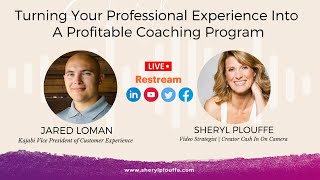
Sheryl Plouffe and Jared Lohmann discuss turning professional expertise into a coaching business. Start with one-on-one clients to build momentum, pick a specific niche like interview skills or tiny-home building, and use Kajabi's scheduling and payment tools to launch with minimal overhead.
Chapters
Scenario: you are a professional, you've been working in your specific industry for, I don't know, 10 years, 15 years, 20 years, but you're starting to think about how you could maybe turn that experience into something of your own so that you can start taking control over, you know, your life. Maybe you're going into the second half of your life and you're kind of asking yourself, is this it? What more is there for me? Well, I have the perfect guest to today to talk about how you can turn your professional experience into a profitable coaching program. And Jared Lohmann is from Kajabi, which I'm, I've been a Kajabi user since late 2018. I love this platform, and Jared's here today to, to really share with us about coaching and how profitable it can be, but also impactful. And I think, Jared, that's the thing that I love most about this, is really kind of can get the most of best of both worlds. So talk to us about the coaching industry. It's a billion-dollar industry. Do you see it— is it continuing to grow? Are we going to see it plateau? Are we seeing it declining? What do you see coming up in the next, say, 3 to 5 years with coaching?
Yeah, sure. And thanks for having me today, Cheryl. Uh, excited to, uh, join you on this, uh, presentation here. Uh, so for the coaching industry, this is something that here at Kajabi we've recently like really, really kind of dug into, um, about a month ago, we released a coaching-specific feature on our Kajabi platform. So I like to think that I have a very unique perspective on this. I kind of see this through the lens of all of our customers like yourself using our platform to be successful coaches. I myself am not a coach. However, the more and more I do things like this, the more and more I'm convinced that I probably should consider it because it is very, very exciting to see people who are moving away from their traditional career paths or even just supplementing their income with coaching. So in terms of the industry, obviously, this is something that we believe in. That's why we've invested here. And of course, numbers in terms of what we're seeing behind the scenes, we're seeing some significant adoption fairly early into this journey. Again, we just released our feature about a month ago, and we're seeing comparatively to other launches, significantly higher usage of this feature. So in terms of the industry, we believe that a significant— that there's been a shift in the, in the tide as it relates to just the overall visibility into this space, kind of based upon the timeframe that we've been— we're living in now. This pandemic has kind of brought a level of awareness and visibility to new things and caused people to start rethinking about how they may approach things should they stay in their job. What other options are out there? And so overall, we're very optimistic and excited about seeing this boom in this area.
Well, we saw so many people who had an opportunity then to work from home and frankly got used to it. And we've seen memes and we've seen comedy sketches and you've seen the TikTok videos where people like kind of make fun and poke fun at the fact that, you know, people are going to have to go back to work and they don't really want to do that. They want to be able to have that type of really frankly lifestyle where they get to work from home and not have to fight traffic and battle the commute and pack lunches and all of those things that people tend to not really dig as much anymore. And so, now that the pandemic obviously is a huge, had a huge impact on that. But this has been going on for years where people have been thinking about, well, how do I package this up and what can I do? So let's talk about how that works specific to the coaching side. And I know you've launched this at Kajabi. What, what are the things that people need to take into consideration if they're going to consider taking professional experience and turning it into something of their own?
Yeah, I mean, I think coaching is, is a business similar to any other business. So you're going to be thinking about a lot of the same things as you would when starting a business of any type. And A lot of that comes down to, at least early on in that process, I think beginning to validate an idea, your idea. Is there a market that exists for the type of coaching that you want to offer? I think over the course of the years, like, I think coaching has really existed forever. We just may not have called it coaching. When you're thinking about, like, you know, a very typical example is coaching in sports, of course. If you want to get better at swinging the baseball bat, of course, you're going to reach out to your coach to help you. This is something that's been around forever. It's only— I don't want to say now, but maybe recently in the last several years, maybe the last decade that we're seeing this really begin to formalize itself into a career path. And so what we're seeing, at least from the purview that I have, we're seeing a lot of people really specialize and really find their niche within this respective industry, become highly successful. I think that that really parallels to numerous other businesses that you may be looking at as well. The more you're able to focus in on your audience, uh, key audience, the more you're able to find to, to build a structure that resonates with that key audience. So I, I hope— I don't know if that answers the question in full, but go ahead and probe me further.
Yeah, yeah, no, it does. And you know what, I think what I heard you say there is about the specialty, right? And I think, you know, if you think about people who are in a career for, I don't know, 10, 15, 20 years, I think they take for granted the specialties that they have gained or the knowledge and insights and wisdom frankly that they've gained using a variety of different maybe tools, or technologies, or systems. I'll use a kind of a basic example but like spreadsheets. I'm not really good with spreadsheets. But there are people who have spent a decade or more who are just like whizzes with spreadsheets. They could actually maybe turn that into something of their own, or any kind of technological tool. How big of an audience do you think that a person would need to have in order to make this really something viable if they were to go down this path and say, I'm going to build a coaching program around whatever it is, specialty that I have? How big of an audience would someone need to have to make this not only viable, but possibly even more profitable than the actual career that they might be considering leaving.
Yeah, I mean, again, I think from, from— I have a very interesting purview here. We see a wide range of people consulting and coaching across multiple verticals and multiple industries. And realistically, we're seeing, we're seeing success across really all price points and zones. Like you can depending upon what your lifestyle was previously, you know, you can really begin to build. It all comes down to the audience that you have, but you can begin to build a lifestyle fairly, fairly quickly. Like we're seeing people do this like on the side, for example, like they have their career, they're doing this after hours to get started. We're seeing people who I just actually interviewed on a separate podcast, someone who he builds tiny homes, for example, and started out coaching. And ironically enough, he actually ran into the problem of like he ran out of time because there was so much interest in this. So in terms of the exact numbers, it's all going to come down to the price point in which you're offering your services. But I think the beauty of it is you can really scale that since it's so closely aligned with your time. You can begin to, you know, adjust with the market as the demand comes in. Price your coaching offer higher.
Yeah. And I've always said too that it really only takes one person to buy whatever it is that you're selling. So, I think there's this misconception that people have to have, I need to have a million followers or otherwise I'm never going to make this work. But it isn't really the case. I love that. I don't know if you're familiar with the article, 1,000 True Fans, where it talks about if you have 1,000 true fans, you can actually make a really good living and be you know, kind of set yourself up even with that number of people. And I would even argue it could be lower than that. So, you know, you don't have to have a million people following you because I think that's one of the things that scares professionals from maybe going in this, you know, going down this path is, well, who am I? Who am I? I don't have an audience. I don't have, you know, I'm not doing social media. But it doesn't take a long time for you to ramp up to that level. You know, yeah. So, um, how— so in terms of turning a profit, you know, the thing with that I love about coaching is that you pretty much can turn a profit immediately. There isn't a lot of overhead save for a great tool like Kajabi, which in my opinion, I mean, it pays for itself so quickly, right? So talk to us about that, you know, from the standpoint of turning a profit and that, that sense of like ROI that people are so concerned with.
Yeah, I mean, I think that's where coaching, like, it's one of the things that we often recommend for people who are getting started in this space that maybe, maybe they're considering coming onto the platform to build a course, for example, which is something that it's, it's a lot of work, takes a lot of time and a lot of investment. Coaching is an excellent way to kind of dip your feet in the water is maybe not even the right word, but you can get up and running incredibly fast and easy. You just need a way for someone to schedule some time with you. And pay you money. Those are really the only things that you need. That's right. And again, you can do this after work, like, you know, spend some time in your evenings or maybe a couple hours before work. These are all things that you can do with very, very minimal effort investment. And it can also help you formulate, like, your ideas, because that, that one-on-one connection that you're getting with someone, like, allows you to formulate your perspective even more so than you may have if you were to start in other areas.
Yeah, I've been with Kajabi since late 2018 and have found ways to, to be able to still, you know, create courses and digital products and do coaching and the like with the tool. But now more recently, Kajabi has launched this coaching-specific tool. So can you speak to us about that and what, what brought that on and also really what the features are of this coaching program?
Yeah, I mean, I think it's— we kind of touched on this when we started, like we, we believe that that this industry is booming and growing. And we also found through some, some internal research that a significant portion of our existing audience were in fact coaches. They self-described as coaches. And so it was important for us to ensure that we were building features that ultimately aligned with our customers' needs. That's really what this was rooted in. Now, in terms of the, the second part of your question, the feature itself, is really designed to take those two components that I mentioned to you earlier, the things that you need, make it very simple and straightforward. We give you a way to connect your scheduling system and get paid. Now, that, that's, that's the root of it. Of course, there's a lot more to it that you can do with it, especially if you're using some of our other features. But at the bare bones, it's connecting your scheduling system and, and monetizing.
Yeah, and it's really taking your your expertise and knowledge and wisdom, and then really serving other people with that, you know, in a live, in a live format. And do you— do— would you recommend that people start with one-on-one coaching or just dive right into group coaching? Or maybe it's a combination of both. What is the best place for, say, a professional who's looking to kind of start something, like you said, even maybe on the side, kind of testing the waters? Should they do one-on-one or should they just do a group coaching program to start?
Yeah, I mean, I think again, looking from the perspective of just the numbers that we see, we see a lot of both. You know, when it comes down to it, like one-on-one is, it's simply, it's easier to find one person than it is to build a group. So just going off of my gut there, I think one-on-one is a great way to get yourself started.
Yeah, yeah. And I think if you do, I agree. I think starting with that one-on-one, you know, maybe have one client, um, and then you could grow to maybe 2 or 3 or whatever is going to suit. If you're still in your job and you're trying to kind of transition from that to doing this maybe full-time, it's going to take some— it's going to take some time to transition. It's not something that happens just overnight. But start with one and then maybe build in whatever is suitable to you time-wise that can fit into your schedule to the point where, you know, you might progress into something else. And if it starts to take off and they're starting to tell other people and you're starting to get referrals and all these wonderful things start to happen, then you're in a position to have some options. And I think that's what's most exciting about this coaching program idea for professionals is that it gives them an option in a world, in a world where I think a lot of people are feeling like they're stuck or that they're confined or having to go back to a job that they're like, they've come accustomed to not really being in the office and they don't want to go back.
Sure. I mean, you wouldn't know it by my background. I'm actually sitting in my home office in Hawaii right now. Um, so I'm a big fan of, of the work from home mentality. Um, that's aside from the point though. Like, I think going to— one of the things that like really excites me the most about this is like From the perspective that I have here, it's been amazing to see so many people. One of my favorite examples is a firefighter. You know, on the surface, I'm not a firefighter, but on the surface, you don't necessarily think like, well, I'm going to go down to the firefighter, fire department to find some coaches. Well, we had a firefighter who was approaching retirement and he decided, you know, I've spent my entire career here. I think I have a few things to offer. I can, I can help people learn interviewing techniques for getting jobs as a firefighter. And he ultimately built out a course that offered coaching and has been extremely successful on the Kajabi platform. So it's stories like that that I find like incredibly inspiring. And that's just one of several examples across multiple industries and verticals. We have things that you would be amazed where these, where these niches exist. It's incredibly inspiring.
Well, you mentioned the firefighters, you mentioned tiny homes. Right? Yeah. I think there are just a host of other very, very specific and niched-down topics that you might at home be kind of overlooking. You know, the more specific and the more niched-down it is, the likely— the likelihood is higher that it will be successful, only because there are fewer people maybe doing it, um, and it's just so specialized. I think that's really what it is, right? If you're not You don't want to be a generalist. You want to be a specialist. And when you become a specialist, and I think especially if you pair that up with my philosophy around building yourself out as an authority online, now all of a sudden, you really have the opportunity in front of you to have potentially even a waiting list of people. If you're doing one-on-one client work, you could have a waiting list of people who are waiting to work with you because you have such a specialty and such a stronghold on that one specific thing.
So, yeah, I think—
yeah, go ahead.
Yeah, I just— I think you called out something like really, really cool. It's the, you know, the 1,000 true fans philosophy. Like, I think the counter— not even the counterpoint, but like an additional point onto that is one paying customer sets a spark and lights a fire in ways that you would not believe. Well, you know, looking again from the perspective that we have here at Kajabi, seeing people once they make their first sale, like It's game on. Like, these people are around forever. Like, that is truly like— and I think for anyone, once you make that first dollar, no matter what it is, like, it sets a foundation that lights a spark that ultimately sets a fire. And it's incredibly exciting. We can all achieve that one. All of us.
Jared, I have to tell you that when I became a Kajabi hero, you know, when you send us the little pin in the mail.
Yep.
I was so excited.
I love that.
Because it— because you know why? I think it's because when you know you've done it once, it can be done again. And now all of a sudden you have hope. And now all of a sudden you have options and you see a way forward, especially if you're feeling stuck. And I think that that's what this does. It offers you an opportunity to see something, a different path forward. So I love that. And Jared, one fun little thing that we do here at Cash In On Camera is we have a little segment we call Stop Marketing Like It's 1999. So I'm a huge Prince fan, which is my ode to Prince. But I'd love to know from you, what is something that you— that, you know, that's really working for you personally or for Kajabi in terms of marketing in the modern age, right? What is a tool, a tip, a tactic, or a technique that's really working that you'd love to share with the audience?
Yeah, I mean, Cheryl, if you don't mind, I'll get a little bit vulnerable at this point. Like, I am, I am not a camera— like, I do not like being in front of the camera naturally. I am more of an introvert. I like to be behind the scenes. Like, even just getting on this interview live with you is like one of those things that like a year ago would have like, like I would have been almost in tears over, over the course of this last year. You know, I think this one is probably going out to my niche, which is introverts or anyone who feels as though like they're not ready to jump on onto this, it's putting yourself out there. For me, this started by, I started internally by recording video updates for my team here at Kajabi every single week and just going on this repetitive motion of constantly talking to the camera, constantly talking to the camera, which of course that confidence that you just described earlier comes from repetitive action. By doing those things that you fear, you ultimately become fearless about those things. And today, you know, I don't know that the, the, jitterbugs ever go away entirely. But like, again, like, I wasn't in tears before coming on. I was excited to get to chat with you. I was a little nervous when I showed up in the room and couldn't find you right at first, but, uh, we covered it, we figured it out. So I would just say putting yourself out there, like, for that particular niche, um, take that step, put yourself out there and do that thing even if it is uncomfortable.
Oh, Jared, that warms my heart. It really does, because We've only known each other a short time and I love that you were feeling comfortable enough to share that because what you just shared will help so many other people who are introverts or people who are feeling shy, which there are many, who know they should be doing video and who know they should be visible but they're fearful, apprehensive, nervous. And the fact that you just shared that I think will help a lot of people. So, thank you so much for that. That's brilliant.
And that's really what it is.
That's what I live for. I love that. So that's fantastic. Congratulations. And you did a great job here, right? So, Jared, thank you so much. I just want to make a— just kind of put out a little plug here for Kajabi because listen, you can go to the Kajabi website and you will see the actual website. You can go through and look at what it has to offer. And I'll show it to you on the screen here. If you go to the top, there's a free trial. And you can do 14-day free trial. However, if you reach out to me and you email me, and I'll just put this on the screen, just email me at Cheryl@CherylPlouffe.com. I have a special link that will give you 30 days free of Kajabi. So feel free to reach out to me at Cheryl@CherylPlouffe.com. I'll send you this special link and it will give you a 30-day free trial, and then you get an opportunity to really, you know, dig in. And there are so many— we've only scratched the surface of the support and the resources that are available in Kajabi itself to be able to walk you through, whether it be, you know, creating a digital product, getting your coaching program on online, getting it started. All of those things are available. It's really phenomenal. So, uh, Jared, any parting words that you'd love to share with the audience?
Oh man, I mean, I think just playing off of what you just said, I'm incredibly proud of the resources that we make available to our customers, um, We, of course, coaching being one of our most recent ones, we have courses that directly address this specific feature that help you get up and running and help you get started. So of course, reaching out to Cheryl here, I encourage you to do so. It's a great opportunity if this is something you've been considering.
Thank you so much, Jared, for coming on today. I really appreciate it.
Oh, thank you for having me, Cheryl.
More from Sheryl



From 'agreeable' to 'ruthless mentor' to 'strategic sparring partner' #substack #shorts







