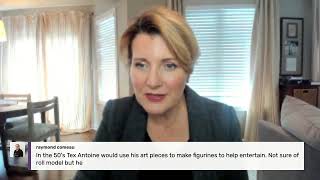
In this live YouTube session, former TV broadcaster and video strategist Cheryl Plouffe shares practical advice for marketers who create recurring video content. She explains why video strategies require many pieces of content and why creators often fear sounding repetitive, especially at the end of a video. Drawing on her 20,000+ hours of live TV experience and recent work with Cambridge Centre Honda, she offers three core tactics: (1) use a thesaurus to generate and write down synonyms for over‑used words; (2) practice extemporaneous speaking—talking off‑the‑cuff while driving, showering, or walking—to build verbal flexibility; and (3) conduct “air checks,” i.e., review past recordings to spot repetitive phrasing and replace it with alternatives. She reinforces each tip with anecdotes about her own broadcasting career and a colleague named Brian who struggled with repetitive sign‑offs. The session ends with a call for viewer feedback on the live‑format and pointers to her other instructional playlists.
Chapters
So glad you're here. Cheryl Plouffe here. Today we're talking about TV tips. This is coming from my own industry background from being a broadcaster and how you can apply some of these tips today to your marketing videos. So a video strategy, and I'm a video strategist, a video strategy is not one video. Sadly, it's not just one video. A video strategy is when you make a commitment to your audience to show up and to provide value. And it means more than one video. In fact, it probably means more in the case of tens, maybe even hundreds of videos over time, hundreds of videos over the course of time. But there's a problem that comes up when you think about whether you're already doing videos or whether you aspire to be doing more videos. One of the troubles that people run into is, but am I going to sound repetitive? Am I going to sound like I'm saying the same thing over and over and over again? And there's a potential that that be the case. And today I'm going to give you some tips on how to avoid doing that so that you can continue to keep your audience interested and to keep that engagement up. So the reason this came up as a topic for me to share with you is because I've been doing work with Cambridge Centre Honda in Cambridge, Ontario now 3 years running, and I've been doing their videos. And in many cases, I go up to Cambridge to shoot the videos, and they are really my premier client. I love them. They treat me well, and I've been producing videos for them for years. One of the types of videos that, that we create together are videos for their used vehicle inventory, which changes all the time. So these videos, sometimes I shoot them, sometimes the team at Cambridge Center Honda will shoot the videos themselves and then send me the material. And then me and our team will create the videos, you know, from the material that they send me. But one of the things that came up recently with one of the people who works there who was on camera, Brian, he was saying, you know, I'm trying to find new ways to say the same thing at the end. He found that he was kind of getting himself, because he's doing a lot of the videos, that he'd get to the end of the video And he felt like he was saying the same thing over and over again. And I can completely relate to that because when I was a TV broadcaster and I worked at the Weather Network, I've done 20,000+ hours of live TV broadcasting over the course of my career. So, you can imagine doing the weather day in and day out, 5 days a week for 48 weeks of the year. I don't even remember how many weeks of vacation I had in a year. And in doing that full-time, week after week, hour after hour, you're really saying the same thing over and over when you're doing the weather forecast, with the exception of sometimes if there were storms or something like that. But generally speaking, on your average day at The Weather Network, we were charged to give the forecast information, but we had to find ways to say it in a new, fresh way every single time, as much as 4 to 6 times per hour. For 5 hours, 5 days a week, times 17 years in my case. So I can completely relate to what Brian was saying. And so when I was there last, we talked about that, and he said, what are some things that— how could I, how could I say the same thing differently? And so I thankfully have had a lot of experience in this, so I'm able to come up with ideas pretty much on the fly. Because I have a lot of experience. One of the things that I would recommend if you feel like you're in a place where you're doing videos but you feel like you're saying the same thing over and over again. And I did confer with my husband this morning on this too because he's a longtime TV broadcaster in his own right. And I asked him, I said, Randy, I said, what are your tips if I share this with my audience today? What tips do you have as a broadcaster for having done sports for so many years and had to say the same thing over and over and over again? And we both agreed that one of the best things that you can do, and this is tip 1, is to get into a— get a thesaurus or go on thesaurus.com on your computer, or get an actual thesaurus, the actual book, and look at the words that you say most frequently and actually look up the synonyms. Write them down, you know, write down the synonyms to the most said words in your vocabulary. And look at other ways of saying the same thing. That, and I think the important thing is to write it down. Actually, if you actually write it down, it's going to cement into your, into your mind, uh, better. So, so write that stuff down. Um, another thing that you can do is you can get used to doing what's called extemporaneous speaking, which means that it is a practiced skill, admittedly, but it's something where you practice just saying things out loud, on the, off the cuff, in the moment, without much planning. You could do this either driving in the car or in the shower or just around the house and get used to saying things out loud verbally in different ways. I think if you start with this, the, the, the thesaurus— I can't even say it— the thesaurus, and you get those synonyms and then start practicing as you walk around your house saying things in a different way. That's really going to help, I think, go in the right direction. But it really has to do with, with practicing, and it is a speaking skill that allows you to do that. So I just wanted to open it up to any questions. Let me just go into the chat here. Thank you, Alvin, you like the content. Thank you so much. Easy to understand and follow. I appreciate that. I try my best. Sometimes I think with video, it's one of those things that can easily go into like a more complicated direction, but I appreciate that. So, so these are some ways that you can keep your content interesting to your audience so that it doesn't sound repetitive and like you're saying the same thing over and over again. And this is especially true, I believe, at the section of the video that is the ending of the video. That tends to be the place where this repetitive pattern comes up. I know that was the case for Brian. That certainly was the challenge I faced as well as a broadcaster because we were charged to lead people into the next segment on TV, which happened to be the local forecast. And I had to find ways of saying, 'Your local forecast is next,' in new ways, as many ways as possible. You are going to find though that it's going to get to a point where you run out of ways to say it. Even if you could come up with 5 variations on that thing, you're going to be further ahead than you are now, which is using that singular way to, let's say, end your video. And you are saying that same thing over and over and over again. So looking at ways, if you can come up with even 5. So get out your thesaurus, look up those words and give it some practice. Speak around the house. Speak in the car. Find new ways of saying it. And when you verbalize it, when you write them down, it's going to start really creating new pathways in your brain. And you'll be able to come up with it more easily. The other thing is that you— the other thing you can do is watch your videos back. When I was in the TV industry, when I was working in television, we would have these things called air checks. And an air check is when a group of people, usually management and executives, as well as the on-air talent or team, would come into a boardroom meeting room, usually with a TV screen, and they would have prerecorded segments of our broadcast and brought them into the meeting. And then the whole team watches it together and does critique and breaks it apart and says, okay, this could be better. Here's where we need to improve. That needs to be faster. We need to push here. We, you know, whatever those little things are, it's perfecting and trying to perfect that broadcast. So that's something that you can do on a, not necessarily TV scale, but on your own scale with your video marketing is to look back at your videos and say, okay, what is the pattern I'm seeing? How am I ending my videos? Or what is the repetitive thing I'm saying? And then looking and identifying what that is. So that you can go back to the thesaurus and take a look at other words that you can use in their place. So I hope that's helpful for you. Please do check out other videos here on my channel. I have a host of playlists that have to do with Zoom, with Facebook, with Instagram, with Canva and Kajabi, and a whole host of other videos that are helpful. I would hope as you take your offline authority and build your business online. And I would also love to know from you if you like this format. So I'm doing this live YouTube today, which I don't typically do a lot of, of YouTube Lives, but I would love to know in the comments if this is a format that you enjoy, or would you prefer to see the recorded videos? I'm just trying to get a gauge and an idea of how, how it feels for you. Thank you, Raymond, nice to see you. In the '50s, Tex Antoine would use his art pieces to make figurines to help entertain. Not sure of role model, but Oh, and I can't see the rest of it. There we go. There we go. So, uh, let's see. Not sure of role model, but he— and then I can't read the rest of it. So, and thank you so much, Alvin. I really appreciate your comments. So, uh, wonderful. Uh, I hope that you have a great rest of your day. Please give this a try and see if this works for you. And please leave a comment below. Would love to, uh, to hear your follow-up from using these tips to help you Find new ways of saying the same thing in your videos as you market yourself as an expert, authority, resource, and leader. Have a great rest of your day and I'll see you in the next time.