Unleashing the Power of Leverage: Strategies for Doubling Your Income
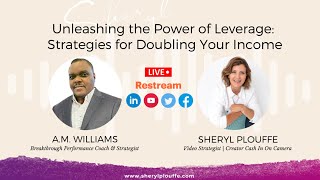
In this interview, host Sheryl Plouffe talks with Coach A.M. Williams about leveraging personal assets and foundational business principles to achieve exponential growth. Williams shares a dramatic personal story of being given a ten‑day death sentence in 2014, how he turned his hospital room into a podcast studio, and used that experience to develop a mindset of impact over excuse. The conversation then moves to the "Fortune Foundations" – a framework of vision, clarity, goals, objectives, and personal responsibility that underpins sustainable business growth. Williams emphasizes that most businesses fail because they lack clear purpose and clarity, not because of lack of capital. He defines leverage as the strategic use of existing resources (talent, content, client base) to generate disproportionate results, offering concrete examples such as repurposing video content into emails and using his communication skill to host podcasts. The interview concludes with practical marketing advice—leveraging one’s “gift of gab” through podcasting—and a call to connect via LinkedIn. Throughout, the tone is conversational, motivational, and instructional, aiming to inspire entrepreneurs, coaches, and small‑business owners to adopt a leverage mindset and solid foundational strategies to double or triple their income.
Chapters
If you're an entrepreneur, you're going to want to pay attention to this conversation with Coach A.M. Williams on Cash In On Camera today because we're going to talk about leverage. We're going to talk about fortune foundations and also really growth, exponential called boss growth. And that's what we're going to talk about today on this episode. A.M. Williams, great to have you here. So excited to dive into this. And this conversation around leverage and fortune foundations is something that is obviously important to you. It's something that you've worked with a lot of people to help them have exponential growth. I'd love for you to tell us a little bit about your story and how it came to be that you became really, uh, this, this expert in this specific space.
Wow. So thank you so much. It's a pleasure to be here with you today, Cheryl. Um, so let's take it back to 2014. I won't go too far back,. But I will go back to 2014 where I had basically was in the room with my surgeon. And he told me, that's it. There's no more surgeries to be had. There's nothing we can do. There are no more resources. We run out. And I was like, nope, what do you mean no more resources? There's nothing else that you can do. The backdrop to it was that I was actually given a 10-day death sentence from another doctor telling me that, um, if, you know, the— I, I didn't have any, you know, basically there was no chance the MRSA that I had in my body was taken over, and, um, I would basically be gone in 10 days. Um, and the only alternative my surgeon said I really had was to live it out. Well, you know what, I got 10 days. And so at that point, I'm in this dilemma where do you take the next 10 days and prepare for the next, for the other side, or do you take, you know, these 10 days and try to figure out what live it out means? And I was just at the place where I was saying, if I'm going to go out, I'm gonna leave it all on the table. And it was at that point when I had made the decision that I wanted to live, that I distinctively heard, "Something in your life can be leveraged to create something that you want." And from that point, I was like, well, what do I have that I could leverage? And the only thing that I had at that point that I saw that I could leverage was me pouring out my heart and sharing with people. Like I was, I wasn't even thinking about me anymore. I was thinking about how could I pour into someone else and give them something, some insight to help them continue to keep on and keep moving forward. Well, I'm in a hospital bed in the hospital, and the doctors caught wind of what I was doing, and they told the nurses to put up a sign on the door saying, do not disturb, he's recording. I can't make this stuff up. So I, all of a sudden, my hospital bed, hospital room turned into a studio, and I was recording podcasts from my hospital bed in the hospital. And one day a gentleman had reached out to me and said, I love your message and I want you to coach me. What are your fees?
Am, this is such a great story in the sense that from where you were to what you became, obviously that is a very scary situation. And it's a story that actually played out in real life that a lot of people may maybe use that. And it's like a card game, right? Like for a lot of people, it's like, hey, what would you do in your last 10 days if you were only given 10 days to live? What would you do? You actually lived that for real.
Yeah, it was a very— now, nothing I glorify, nothing I would encourage anybody to do, but the reality of it, Cheryl, is that there are so many businesses right there, they're 10 months from, uh, businesses going under, 10 weeks, and unfortunately some of them are literally 10 days. And no matter what your— whatever your death sentence for your business or whatever it is that you desire and want for your life. It's super important that you really take a hard look and say, am I here to make an impact or am I here to make an excuse? You have got to determine which one you're here to do— impact or an excuse— but you can't do both. You can't do both. You have to make an impact or you make an excuse. So with, you know, with that peace, what that has given me was this courage to stand in the face of adversity and literally see the gift in it and the ability to strengthen yourself and turn things around and literally realize, as Napoleon Hill, he said in Think and Grow Rich, every adversity brings with it the seed of an equivalent advantage. So with that being stated, adversity comes to bring you something, and once it brings you that thing, it leaves your life, right? So in understanding that, I didn't take my 10 days to complain and why me and all of these other things, but I just took what was in me and I leveraged it. I leveraged it to get something that I wanted, which was to make an impact in people's lives.
So you made a decision. You were in the hospital and you turned your hospital room into a studio to start a podcast, to really start making impact. It started by making a decision. And to your point, it's not a bit, you know, you can make a decision to make excuses, but to what end is that going to grow your business? None. It isn't. And so I love that this story really And then, and then your business, I guess, frankly, organically really grew as a result of you showing up and being there to provide insights and wisdom around what it is. Were you documenting your journey or in the early stages of that situation? Were you documenting what you were going through or were you providing insights and wisdom based on prior knowledge and expertise?
I was basically just taking the things that I had learned and what I had known in this period up to the time that the doctor— what I was dealing with, I didn't accept his diagnosis of me, which is why I went to another doctor. And ironically, something that we— with that, it's amazing when you make that decision to say I'm going to make an impact, it's amazing how things become possible that you never thought was possible. So I, I turned around and started working with this other doctor, and all of a sudden what I couldn't address in 3 years, we were able to address in just a couple of weeks as far as cleaning out the infection. And it went on for several years. Make no mistake about it, it wasn't a quick fix. Or anything at all. But what it did was put me back onto a path where life, life was not only attainable, but I was like living it out. I was really living it out. And that person who basically hired me as a coach, that turned into looking up and through working with them And doing the podcast, I looked up one day and I was 20 days past the expiration date, you know. And so I'm like, oh, I'm, you know, I'm still here. I'm still here. And it progressed. And I took the medications that I were on, was diminished. They stopped them. And I started healing at a very rapid rate to the point I was able to go home. But I was still in a bedbound condition. So I was like, man, I got through this. I can do this. Maybe I'll be in bed another, you know, 4, 6 weeks. Those 4 and 6 weeks ended up turning into over 14, 15 years. Yeah. Okay.
That was a pivotal, obviously pivotal point in your life that your decision puts you on a very different track. And today you are Coach A.M. Williams and you help people to double and triple their income. You work with 6, 7, 8-figure businesses. I mean, you are helping people to transform, and you do this through some very important tools and methodologies of which we want to get into now. Leverage is a big part of that. I would ask you, though, if we could start with Fortune Foundations. Can we start there? Because I think that people who are watching, people who are listening, who might be seeing a parallel between their businesses and what you were going through in 2014. They feel sometimes this way about their businesses right now. They feel like, you know, they've been given a death sentence with the business and there only is so much time left to live here unless we change something. So let's start with that. What are the Fortune Foundations?
Well, I would simply say the first we've already kind of covered. You got to make a decision, impact or excuse. Which one are you here to do? And from that place, you have to begin to challenge yourself to start to look at, you know, why do I even do the business in the first place? Why am I even here to do this? And some people will come with many different answers, you know, from, oh, I was great at this and everybody bought my this, or everybody bought my that, and they said I should have a business. In doing that, which is the worst reason to start a business, you know, and we'll maybe get into that a little bit later. But they didn't really take the time, Sarah, to understand what they were ultimately building for themselves, for their life. How does this business serve people? How does this business serve the community? How does this business serve me? You know, and how does it serve all of creation? How does it serve God himself? So you have to be able to have a clear vision to do that. And from that place, you create goals. We're talking about the foundations now. Once you got a clear vision of who you're serving, why you're doing it in the first place, now you got to get into the goals. Like, what are the things that we're going to aspire to achieve? What is it that we're going to do? And you create those pieces, but then you got to come into objectives, which is where really the dynamic of strategy comes into place. Like, how am I going to serve people? What's going to be the mode in which of the— who exactly I'm going to target? How do I connect with those people? How do I, you know, invite them into what it is that I'm doing? Once you get clear on that process of out that, that what your customer experience looks like from the beginning to the end, then you have another foundation for what it is that you need. And so many people are like, well, look, I'll get more clarity on that when I start making six figures, right? But most people don't even realize an alarming statistic that the one statistic that I read said that 85% of businesses never even crossed the six-figure mark. They never do. And even worse than that, only 5% ever cross the million, million-dollar mark. So this is extremely alarming because there's been business growth material produced for eons, yet we still have this kind of percentage of why businesses are not growing, and it's because they don't have the foundation. Course, everybody will say, I don't have the money. All right. And I'm not saying that capital is not important. What I am saying is greater than capital, there's another C word that you need, and that's clarity. Because when you have clarity, you can attract money. When you have clarity in who you're serving, how you're serving, when you understand the fundamental marketplace problem, and you understand how your product provides value and help that person to achieve what ultimately matters to them and the way that it matters to them, then you have something extremely solid. And these are just key crucial things that lead to your ability to generate income. That, that, that's, that's huge. We both know one of the biggest problems that businesses with who are trying to get to 6 figures or trying to maintain or sustain a 6-figure revenue is that they simply don't get enough customers. They don't make enough personal income, and they are not profitable enough to where they could acquire a team or do anything else that they want to do. And on top of all of that, they build a mousetrap for themselves And now they're trapped in something because now, you know what, I can't go back to a job because it doesn't pay me like this. But at the same time, I'm so trapped in the business, I don't know how to get out. So we move from being employed to now we're self-employed or self-employed because now the business owns us, all because we didn't create a clear vision. So if we don't lay the proper foundations, then what we end up doing is creating something that entraps us versus leading us more to where we want to go. And there's so many more pieces to that, but for the sake of time, we're just making the, um, uh, observation and understanding that it's important to have these foundations in place before you start just jumping out there and trying to make money and you don't understand what you're doing. You just doing it and flying by the seat of your pants and everything and trying to build a business because that really doesn't work. It ends up tragically.
And I think the irony, especially for people who go into coaching and consulting, who are in the knowledge industry specifically, is that you likely left your job or likely left corporate in order to build yourself more freedom. But what happens when you don't have these foundations is that, as you said, you create yourself a mousetrap or you paint yourself into a corner, use your favorite analogy, insert here, that you are in a place now where you've become a glorified employee of your own self, right? Like, you, you're— you've created a job, essentially. And so the irony is that you left that because you wanted more freedom, but now you don't have as much because you didn't do these foundational things. Another interesting thing that you pointed out is the fact that over the course of many, many, many decades, uh, one could even argue like a very long time that there have been a lot of, there's been a lot of teaching around business, business acumen, business knowledge, and et cetera. But yet those statistics, as you cited, which also by the way are lower for female business owners, are still very much in play. Why is that? It's because they're likely, yes, we can have all the books and all the teaching, But if you don't apply it, what good is it if you're not applying it? And so I think there's a lot of this that has to do with mindset, too.
How much of it—
exactly how much of it do you think is mindset as someone who obviously has gone through physical challenges and very stressful challenges and you had to have a very strong mindset to get through that?
You know, you pointed out a very powerful Fortune Foundation, because I believe success begins with the mindset. And, you know, people, where they shortchange mindset is they think they just need to be positive, and they just think they need to have a positive outlook. But really, where it all begins when we talk about mindset is the dynamic of personal responsibility. You got to take personal responsibility for the way you think about yourself the outcomes you produce and the income you make. You got to stop blaming other people. Here's the other part: you got to stop caring what other people think about you. You have to be able to take a hard look at yourself and ask yourself, is the way I see myself aligned with the success I desire? Because most businesses struggle to get this thing off the ground because they're having an internal value conflict. They're having a conflict the success that they want and what it takes to get it. It's not what's inside of them. They want comfort, but they want to make a million dollars. They want, you know, the ability to do all these amazing things, but they need to be able to build a team, create the systems, or whatever. They want to make a million dollars by Tuesday. Okay, so all of these things that's happening within You got to be able to really take a strong inventory and ask yourself, is my success— am I— is what's inside of me aligned with the success that I desire? Because if what you desire, what it takes to accomplish that, and what's inside of you is off, then you're constantly going to be in World War Me.
Yes, indeed. When it comes to leverage, in what places of those, of those Fortune Foundations that you've outlined, which of those involves leverage? Is it all of them? Is it some of them? Where does leverage come into play?
Well, I think the first thing to do is let's, let's create context when we talk about what leverage is. Leverage is the use of something for maximum advantage. I repeat that: leverage is the use of something for maximum advantage. Archimedes once said, give me a lever long enough and a fulcrum on which to place it, and I shall move the world. We have to begin to understand that leverage is all about how do you utilize what you have to create the, uh, exceeding results, exponential results, getting more out of what you already have. So it's not the addition of this and addition of that and whatever, but how can I get better use out of something I already use? And whether that be my gifts, my talents, the current client base that I have, um, you know, what assets do I, uh, possess for myself as it pertains to Am I great with people? And am I a good communicator? Well, if you are, are you leveraging that? And there are so many people that will say, well, hey, I got leverage in my business. But if the leverage you have is not giving you— it's not giving what you need from the business to create the freedom and the fortune that you want, then your leverage is limited. And unfortunately, if your leverage is limited, then your life is limited. So speaking of— you gotta be able to get that piece.
Yeah, 100%. I was speaking with someone this morning about that, and it was a bit of advice I was giving around leverage was, you know, she was doing these videos and also wanted to create emails. And I said, well, why don't you leverage your videos that you're already making? We'll transcribe that, and then that will be the jumping-off point for the emails. Is that an example of leverage?
Exactly. It's helping that person optimize, get more out of what they already have. You have to be able to be able— and, and here's another piece, there are so many different forms of leverage, so many different pieces, uh, so many different ways that people can leverage. It's just that once you understand what it is, then you better know how to better apply it. I had to use leverage in a hospital bed in the hospital. But I found leverage there. So it's a, it's a conviction, a core conviction of mine, that leverage is the key to helping you accelerate and achieve the growth and scale that you want, no matter what platform or what position you find yourself in. You can get a lot more with leverage.
A.M., I'd love for people to connect with you on LinkedIn. I'm showing it on the screen for those who are watching the video right now. And you are someone who is very open and very willing to, what, have a chat, message, connect, have a conversation, etc., correct?
Yes, most definitely. Connect with me. Let me know you checked out the show. I'd love to get your feedback from it and, uh, have a conversation.
Fantastic. So yeah, go to LinkedIn and look at— look for— it's Coach. So your brand is really Coach A.M. Williams.
Yeah, I love it. Yes, indeed.
And the last thing I want to ask you before we part is what is a tip, a tool, a tactic, or technique that's helping you to market yourself and your business? It might be speaking like we're doing here, it could be something else. What's really working for you today?
Um, you know, again, taking inventory of what your assets are. So I pride myself on being a great communicator, and, you know, people love— they tell me— I have so many people tell me I could listen to you talk all day. Well, it makes sense then that I would get and do podcast interviews, or I even started a podcast, another podcast of my own, um, and it's called Leverage Leader, and we're on Apple, uh, iTunes and Spotify and all that stuff. But the piece of it is, and it's been very powerful, if you have what someone called a gift of gab, then you should be— you should leverage it to give you maximum advantage. And it has really helped me a lot to put me in front of more people, more people that I love to work with and can provide great results for them faster. So Yeah, I would say what you're doing right now is a powerful form of marketing and helping you grow your business. So I would say I'd have to go with podcast.
Awesome. Yeah, thank you so much. This has been wonderful, and I love your story. It's so inspirational. It's motivational, but more importantly, it's an example. It's an example of perseverance and not sitting there and saying, well, this is the excuse I'm going to fall back on for not facing the fear or not doing the thing that needs to be done. And you did it. You're a great example of that. And AM, so great to have you here on the show today. We really appreciate it.
Pleasure to be here. Pleasure. Thank you.
Thank you. You're welcome. And for those who are watching the video right now, if you're watching on YouTube or any of the channels that we broadcast to and you want to connect with me, there is a QR code on the screen right now that you can take a picture of that will take you to my signature card and you'll be able to find out more about the work that we do and also any speaking engagements that I have coming up. If you're listening to the audio, you can visit any number of my social channels @SherylPlouffe and you'll find the same link there as well in the profiles. Thank you so much, AM. Great to see you and I look forward to our next conversation.
Thank you. My pleasure.
More from Sheryl



From 'agreeable' to 'ruthless mentor' to 'strategic sparring partner' #substack #shorts







