Unlock the Secret to More Referrals: How Gifting Can Grow Your Business
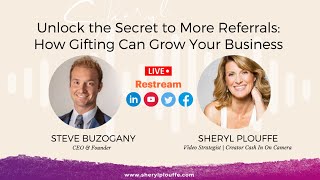
In this interview, host Sheryl Plouffe talks with real‑estate professional Steve Bizogany about using thoughtful, personalized gifting as a relationship‑marketing strategy to generate referrals and grow a business. Steve shares how a mentor’s advice shifted him from a transactional, hard‑working approach to a relational one, leading him to become known as the “referral guy.” He distinguishes genuine relationship gifts from generic promotional swag, outlining six criteria for effective gifts: recipient‑focus, high quality, personalization, emotional impact, staying power, and connection‑building. Gifting serves as an “ice‑melter” especially for introverts, creating natural conversation starters beyond cold calling. The discussion covers when to send gifts versus notes, budgeting gifts at 5‑10% of a client’s lifetime value, and integrating gifting into a Systemized Relationship Marketing (SRM) framework that targets the top 20% of clients (the 80/20 rule). Steve lists common gifting mistakes—consumables, swag, e‑gift cards, one‑off experiences—and explains why they fail to create lasting impressions. He provides a concrete example of a high‑impact gift (a custom engraved marker holder) and promotes a free downloadable “Client Appreciation Six Pack” (appreciationadvocate.com/sales). The conversation concludes with the core philosophy that people make decisions emotionally and that genuine, heartfelt gifts deposit into an emotional bank, enabling future financial withdrawals. The overall message is that strategic, personalized gifting, when systematized, can significantly boost referrals and business growth.
Chapters
of Cash In On Camera. We have Steve Bizogany who's with us to talk about how to use gifting as a means of getting more referrals in your business. And this comes because Steve actually did this, and that's really great. I'd like to dive into that a little bit, Steve, just to kind of get things kicked off here with you in terms of your story and how this whole piece around gifting really came and bubbled up for you in your real estate profession. Tell us a little bit about the story of how you discovered that gifting was so powerful.
Yeah, for sure. So when I first got started in real estate, I actually got, um, I was doing a lot of work, working like you, like a dog, you know, the stereotypical work like a dog. And I was working long hours, and I had a mentor that basically said, hey, stop working so hard. You're being very transactional. Work for the relationship, you know, have a more relational approach. You won't have to work as hard, and you'll have, uh, you know, people will come to you, they'll refer you, and then you won't have to work as hard to make your closes. You won't have to work as many hours. And I was like, well, that all sounds awesome. Let's try this thing. And then I started doing that. And within 6 months I got like 10 real estate transactions put together. I was like, whoa, okay, there's something to this. Let's go hardcore into this. And then like, that's where I, after a long period of time, people, I became known as like the referral guy. Oh Steve, you're a big referral guy. Can you tell me what you're doing? And then that's where people were like, okay, cool. What are you doing? And then I basically explained it to them and they're like, oh, you're doing Oh, that gifting takes so much time. I don't have time for that. And so basically what I did is I told them, I was like, I don't know what else to tell you. There's no, there's nothing I can do for you. So after a while, I, the, there was such a market for it. I eventually just started the Appreciation Advocate. I was like, look, no, don't worry about it. I'll just do it for you. Just tell me what your best customers are like and I'll just do it for you.
Isn't that always the way though, where you solve your own problem and then you just basically stumble into this new business. I mean, it's just brilliant. And I want to be sure to make the distinction, though, of what kind of gifting we're talking about before we're really getting into unlocking the secrets of how they can get more referrals with it. This is not the kind of gifting where— I'm just trying to find an example of something around me here, like promotional items. And I think we all see those and we've all been to conferences where we get, you know, there are 1,000 of these to give out. Those are promotional products, and that's different than what you're talking about. Explain to us what kind of gifting we're really talking about here.
Yeah, for sure. So when you, when you go to those conferences, to kind of piggyback off of that, they give you what's called swag. And swag, S-W-A-G, stands for stuff we all get, except it's a different S-word. So, so basically, so you don't, you don't want, you don't want swag because everything— if some— if it's something everybody else gets, it's not a gift. It's not— there's no value in it. So basically, when those things always get thrown out, so A real gift, actually what we use at my company is we do, we have 6 criteria for what a good gift actually is. And those 6 things is one, you got the focus has to be on the, on the receiver, not the giver, because like you said, it's a promotion if it's about the giver. It's got to be a high quality item because cheap items get tossed. It's got to be personalized to the recipient. Doesn't have to have their name engraved on it, although I would recommend it if you can do that. Maybe it's their favorite color, whatever. It's got to have an emotional impact. It's got to have staying power and it's got to be able to— like, let's not forget the basics here. It's got to be able to build a connection. So have a personal touch to it, like a personal note, a video, something like that. So having those 6 criteria are really important for having a gift.
I love it. And coming back to your real estate profession, you were exceeding your sales goals every year as a result of, I'm sure, lots of things that you did, you know, to do that and obviously serving your clients really well. But the gifting piece was a key component of this particular achievement, really, in your real estate profession.
Yeah. For me, it's actually because I'm more introverted than I am extroverted. So the problem with me was— actually still is— I hate to make cold calls. Hate it. I can't go up to somebody and I can't go up to somebody and just start. Like, my best friend can call someone and be like, hey, it's Luke, how are you doing? And they'll just like, oh, Luke, how are you doing? It's so great to talk to you. And like, when I call someone like, hey, just I can't just call someone just to call them. Like, he's so good at it. I'm not. People are like, what do you want, Steve? I'm like, nothing, just wanted to say hi.
Hi.
Yeah, and people are like, okay, you weirdo.
Coach told me I had to do this.
Yeah, right, exactly. That's exactly it. So I was terrible at that. So basically what I did is I started giving gifts because what it would do, it's like, it's not just an icebreaker, it's just like, it's like an ice melter. It just gets rid of the entire glacier. And it just, and basically you can call behind the gift and be like, Hey, how are you? I just want to, you know, I appreciate the heck out of you in my life and I value you so much. I just want to let you know I did send you a gift and I wanted to just make sure that it got there. Like, it's completely not real estate related. So people are like, oh my God, yes, Steve, this is— and because the gift is high quality, it's nice and it's personalized to them, they're like, this is the coolest thing ever, totally didn't expect this. And because it was not given in the month of December and it was not given during the holidays when everyone's expecting it, they're like, this is such a cool surprise, like, oh my God. And they're like, yeah, this is so great. And then ultimately, eventually you get to the part where they get, hey, so how's things going? Catch up. And then people ask you like, what's going on with the real estate? How's the real estate business? They're always going to ask you, how's the market? Um, and that would go for— and this would apply not just to me, and this would apply to, you know, financial advisors, insurance brokers, you know, HVAC contractors. Hey, how's business? If they know you're a small business owner, they're gonna say, hey, how's business? And then that gives you an organic way to walk into a conversation and tell them about your business. See what's going on. And then you can then organically ask them what's going on with your life. Are you moving soon? Are you— I heard you just had a kid. Heard you're getting married. Or this, you know, heard you got divorced. Don't say that. But like, but basically anything, it creates organic conversation because I can't fake conversation. So that's why, you know, my introverted self, I had to come up with a way to get into the door without being Mr.
Salesman. It's a great point in that this is a great strategy for people who maybe feel that way. They feel shy or introverted. But it's also really powerful because it's a touchpoint and it's another reason to start a relationship and to start a conversation, as opposed to it being, like you said, that cold calling can sometimes feel like I'm trying to sell something and there's something in it for me.
It's not really for them. Feels gross.
Yes. Yes. And so this idea of touchpoint is really important. One of the things that I I say is always be talking to people. You know, always be talking to people. Nothing bad can come from having conversations and talking to more people, whether you're the host of a podcast, whether you're the guest of a podcast, whether you're getting on a, on a private call one-to-one and just finding out what each is working on as you've described, or if it's a sales call or a discovery call, whatever type. Always be talking to people. So I think that this aligns really well to this idea of giving a reason for that conversation to start or to continue. So I want to kind of just dive into at At what point do we as the business owner— let's say it's a prospect— when should we execute on the gifting? Like, at what point? Because obviously there's a cost or an investment, I guess is how I would probably look at it. There's an investment from your perspective into the gift that you're gifting. Is there like— are there parameters to that? It's like, well, you wouldn't really want a gift until this point of the relationship.
I think that it all depends. So For like, if you're trying to reach an influencer of some kind on Instagram or something like that, and you wanna prove to that person that you follow them, that, well, obviously you need to know a lot about the person so that way the gift can be a lot about secret intimate things that they've said in their videos. And you can be like, maybe they one time said that they love cooking and then they just had their most recent pan, they had to throw it out because of something. You can send them a pan like, hey, I just remember when you said this back in January, you lost your pan or whatever. You like, that's obviously like, basic AF. So like, but that's kind of what— that's, that's what it is. You're showing them that you pay attention to them, that you notice the need and notice that those little things— when you notice those little things, that's big time. And then especially in like, it— even in dark times when people are having like a, you know, a bad day and you, and you show up, it's like, wow. Like, I've had so many clients when I wasn't doing real estate where I did— where I just sent them a small gift just to let them know, or even just a personal note. They texted me like, hey, see, just this came by. This came in at the right time, having a real crappy week. Thanks so much for sending this. And like, what I found out with small businesses, and because not every client you send a gift to is going to be Paul Revere who takes a picture of it, puts it on social media, oh my God, my realtor is the best. But what's going to happen is like, just because everyone else's behavior is not consistent and not everyone's Paul Revere, what I found out is that if your behavior is consistent, the results will be consistent.
Steve, you just made a good point about, you said also a note. So when do we delineate, like, when is it time to, you know, when do we just send a note? Maybe it's, uh, could even be handwritten note that we send and actually put in the mail with a stamp, or, or send a gift? You know, do I— do both of them work effectively, or is there kind of a, an idea around when to send a note? Do you send a note first, then send a gift?
I would, I would usually— I send them together. You— I would never send a gift without a personal note, ever. The gift should always have a personal note, for, for one. Uh, so for, for, for smaller get-togethers, like maybe just a personal note, like if you're just going to go out and like have lunch, personal note afterwards is fine unless they drop something like huge on you. Like they're like, oh my God, I just found out I'm having, I'm going to be a grandparent for the first time. And you know, we're having, it's like, that's a different thing. Yeah, obviously that would get a personal note normally, but because they just dropped that bomb on you now, it's like, okay, now you gotta go get something for that. So there's always that, that extra, going that extra mile is what's going to make a bigger difference.
And price points, do we need to keep that in mind? I mean, I think about, especially in the world that I'm in, I'm helping, let's, 6-figure entrepreneurs, coaches, and consultants to scale and grow their businesses, right, on the track toward growing into the 7-figure range. And I think that this really would apply to that type of thing, especially if you're selling high-ticket products and services where you can look at that and say, okay, well, what is the cost of acquisition of a client? So let's speak to that, the idea of cost of acquisition.
Sure. So what I would say is the rule of thumb is when you're dealing with past clients is you wanna set your budget to be about 5 to 10% of what they are worth to your company. So if you have a client that brings in $100 grand a year, you should be giving that person $5 to $10 grand in gifts of some kind. You should have some kind of plan for that because, you know, if someone's giving you $100 grand and you send them a $25 gift card to Amazon, that is going to land very negatively. Even though it's a nice gesture, it's gonna land really bad. So when it comes to like prospecting and things, what I would tell you is what's the, what could the relationship be worth to you? And then use the same thing, you know, what's 5 to 10% of it and then budget that for the year. So if you're pursuing someone that might be, you know, $20,000 and well, whatever, 5 to 10% of that, you know, basically $1,000 to $2,000 over the next year. And it can be, it doesn't have to be crazy. You can do a lot with $1,000 to $2,000. You can give someone, something for $100 every month for the next 20 months. I mean, that's consistent, it's high quality. It's, and I guarantee you before 20 months is up, they're gonna call you. You're gonna be like, what, who is sending me these awesome gifts?
So I think a lot of people, they would take, let's say a select budget for marketing, right? They have like, okay, here's what it is. And then I have this much to spend on marketing. Is this part of that bucket or is this on top of that bucket? Because the truth is, you know, a lot of people need to invest in a lot of different things in order to market. It's, you know, so let's just speak to that. Is this part of that money or is this in, in addition to?
It's part of it for sure, 1,000% part of it. So it's, it's actually because what, what we do, I mean, what we live and breathe here, it's what's called SRM, systemized, uh, relationship marketing. Uh, so that's basically, if you don't have a let's put it this way. When you go to boil water on the, on the range, on your range top or whatever, you don't put cold water in a pan and then put, put it right on top. You wait for the water to get hot first, then you put it on. That way you don't have to wait as long, it doesn't have to work as hard. So what we do, that's what we do here. You don't have to work as hard because you're already working with people who are already warm to you, who are already hot on you, who already appreciate on you. You don't have to work as hard. So, so it should be pretty much paramount in your marketing strategy. Probably one of the top 2 things on there outside of like one other thing. So yeah, definitely part of it for sure.
You mentioned the systemizing of this, and I think this is where if someone has, let's say, a whole database of people that they're nurturing, maybe they're existing clients and they want to get that retention up or they want to sell more things to those people, or it's a set of people that they're prospecting to, etc. Or just leads, maybe warm leads that they want to turn into hot leads. There is a database likely of people. And so let's talk about the systematization of this, right? Because keeping track of all of those relationships, the calls you're having with them is part of it. How does the gifting play into that? Is that something that you do with your company is to help with the systemizing of all that?
Yeah. So basically when someone signs on, we have what's called our SRM. Workbook and you tell us what your top clients are. So every company has different sized databases. So, uh, the thing is it's the 80/20 rule there. Every company has its top 20%. That is where the gifting goes. And what, what'll happen is those, cause what'll happen is those clients have bought into you the hardest and they, they appreciate you the most. So what'll happen is when you, you wanna duplicate those clients before you duplicate the other 80%. So that's where you focus the gifting. The other 80% can get your traditional marketing, but our systemized relationship marketing is going towards your top 20% because They're the ones giving you the most money, the ones who bought into you the hardest, the ones who are going to duplicate and be the best clients for you to work with when you get new referrals. So that's— you just want more. You just want more A pluses versus like maybe a B or a C.
What are the biggest mistakes that you see with gifting?
Oh, wow. I have a whole PDF on that.
So let's show it.
Okay. Let's talk about it. Yeah, for sure. Bad gift examples. How do I share this? I gotta share my screen?
Uh, no, actually I'm just showing it on the screen right now. They can see, if you're watching the video, you can see there's a free download of an ebook, uh, that Steve has put together with the Client Appreciation, um, Six Pack, and people can download that.
Steve? Yes, for sure. So actually what that, that whole, uh, that bundle includes will be the 3 biggest problems with gift giving, the 6 things that make a great gift, 6 ways to increase referrals, bad gift examples, a promotion versus a gift, and the purpose of a gift. So those will be the 6 things you get. But to go over your last question about what are some examples of some bad gifts, some of these might come as a shock to you, others may not. But the— I'll just go through. There's only like 5 or 6 of them here. Thank you email, which some people think that's a gift and you're saying thank you properly. Guys, that's just the end of the transaction. That's not an actual gesture. That's just part of the transaction. A bottle of champagne or food item is bad because it's consumable. So, you know, they don't leave lasting impressions and your job is to stay top of mind. That's literally what we get paid to do. So making one impression is no good. Same thing applies for an event or an experience. Like if you took someone to the Super Bowl, yeah, that's got a lot of wow, but after about 2 weeks, people move on from their lives and they just kind of go, oh, you know, I was at the Super Bowl once, but that's it. And sometimes after even a longer time, they might even forget who you are, who brought them. Who brought them? I was there. I forget who I was with, but you know, I was there once. Flowers, edible arrangements, those are, you know, they're great short-lived impressions though. So after a week, you're not top of mind anymore and you're now in the subconscious where you don't want to be. And then lastly, what we talked about earlier is the swag bags, promo items, gift cards, you know, stuff we all get. Again, gift cards are just straight up lazy gifts that, you know, that they just basically communicate that you were too lazy to actually put together some actual thought, um, into doing something. Or worse, an e-gift card. An e-gift card, like super lazy.
Didn't even get out. I'm guilty of this. I, I am guilty of the e-gift. Sorry. Why? Because it's so convenient.
But yeah, so, so here's the— here's— this might change the way you think then. When you give someone a gift, the gift is— it represents a symbol of what you think that relationship is. So, and so if you— so, and here's the problem with that. Is the feedback loop on gifting is a complete big, big massive lie. So, and what I, what I mean when I say that is the, the bad gifts get the same feedback that good gifts, that only good gifts should get. So if you were to give me, um, you know, like we'll use my previous example. I'm a $100,000 client. You give me a $25 Amazon gift card. I'm going to be, oh my God, so thoughtful. Thank you so much. Like you didn't have to, but like in my mind I'm thinking like, You know, well, first of all, no one would ever say to you, uh, just, you know, Cheryl, this gift is absolutely terrible. You can take this home and shove it up your, you know what. Like, no, no one would ever say that to you. So, because that's the— and that's the big lie, because the bad gifts get the same feedback as the good gifts. So you're— you leave the conversation thinking, oh my God, I'm so great, like, I'm so glad I did that, that's awesome. And it reinforces the death cycle that keeps that going. Whereas if it was, you know, A good gift would get that feedback and then you should get that reinforcement. But unfortunately, the bad gifts don't get the, you know, no one flips them the bird when they get the truth.
The truth doesn't come out in their response to whether it's a good gift or a bad gift. It's going to be the same platitudes.
So basically, yep.
I like what you said there about it being a symbol. That's an interesting way of thinking of it. So are you able to give us an example? I mean, there are obviously countless ideas and really only limited to your imagination of what a gift could be. But can you give us an example of maybe something, a real-life example in your company of like somebody gifted this to somebody and this was an example of a really good gift in that situation?
Yeah. So for example, like we have a coaching mentorship program here where— not, not me, I pay someone to mentor me and coach me. So basically what they did is they're like obsessed with whiteboards and they love whiteboards and dry erase markers. And that's how they coach our group. And so like basically what happens is they, you know, one of our coaching calls, her marker died or whatever. And she's like, oh my God, I'm running out of these markers like crazy. So I built a custom marker holder with her name engraved on the front of it and had all of the markers installed. And I had like drilled in holes into each one. So she had a bunch of markers into, so she could always have her, Arsenal of markers there, and I had it shipped to her. It's like, and now she's like, dude, super cool, like, love this, this is amazing. Like, so like, that's one example. And like, to give you like an old world example, like, you know, mentor of mine, John Ruhland, who wrote the Giftology book, like, he's awesome. He just basically said, you know, back in biblical times, there was always, uh, between two kings wanted to build a relationship, uh, they gave each other like a, like a big gift from one king to another. They would say, here's 100 or 1,000 head of steer or whatever. That was to show like, hey, this is a big relationship, this is—
you're important to me.
You know, they would never just send one lamb, like they would be like, they would be like, that's the same thing as sending an e-gift card today.
That's the equivalent of the e-card today. Yeah.
Sorry. No offense. I'm not like taking a shot at you.
No, no, no. It's actually, it's really great. I think it's calling us all out on something that we hadn't really thought of before, actually.
Well, no one teaches this, you know.
No, they don't. And I think that's what's so brilliant about you having you on today is to really have a good conversation around gifting and how you can actually grow your business with it. You've given us some really great tips. You've called us all out, which I appreciate, and giving us, you know, new ideas on how we can unlock the secrets to more referrals, because that's really what it is, is that if you can get good at this and you can be doing what's appropriate— and I think that's the thing I'm hearing, is that there's certain things that are appropriate and then other things that maybe aren't. And this has been really wonderful. So I just want to be able to promote again your free gift. It's the download the Client Appreciation Six Pack. And where do people go to find that?
Yeah, you can just go to our website, appreciationadvocate.com/sales, and that'll take you to the website there. Or you can just reach out to me directly, steve@appreciationadvocate.com.
Awesome. One last thing I want to ask you, maybe related to gifts or not, but what is something that is like a tip, a tool, a tactic or technique that's really helping you, Steve, to market yourself and to market your company? Now that we're in the Web2 and we're transitioning over into the new world of Web3? Is there anything that's really particularly working for you that you can leave with the audience today?
I think that the really important thing here is to never forget that people make decisions emotionally and they justify logically, and that there's no real true replacement for human-to-human interaction. So despite the fact that yes, we're looking at each other here through a screen in YouTube or Zoom, But if I was standing there in front of you shaking your hand, it's a completely different feeling. So don't ever underestimate the power of the human connection. And that's why I think the gifting is so big because everything so today is so digital. It's just, everything is so on a screen. So when something off a screen shows up at the doorstep and it shows that like an emotional investment in someone. So for example, for what you do, here's the best piece of, one of the best pieces of advice I've ever been given was, Uh, make deposits in their emotional bank account, and then they will allow you to make withdrawals from their financial bank account.
That's really well done. Well said. Yeah, I love it. And it comes from a good place, right? It's everything that we're talking about here is coming from a place. It's not— this is not about manipulation, or like, this is truly coming from a place in your heart where you really want to do something nice for someone else.
Yes. Well, you can't appreciate someone at that level if you don't appreciate them in your heart. Like you can't give a really good emotionally impactful gift if you don't really actually care.
That's right. Yeah, because you will not have put in the thought behind it. Correct. Right. So this makes a lot of sense. Steve, this has been really fantastic. I appreciate you coming on the show today and sharing these insights on how to gift and grow your business. It's been really insightful.
Thank you. Thanks for having me. This has been fun. It's a fun conversation.
Good, good.
More from Sheryl



From 'agreeable' to 'ruthless mentor' to 'strategic sparring partner' #substack #shorts







