What are the benefits of owning an NFT?
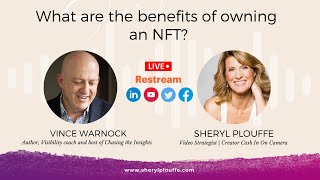
In this Cashing on Camera interview, host Sheryl Plouffe and award‑winning marketing coach Vince Warnock explore what NFTs (non‑fungible tokens) are and why they matter for entrepreneurs and creators. Vince explains NFTs as unique blockchain‑based tokens that can grant access, confer ownership, and generate ongoing royalties through smart contracts. He illustrates practical uses such as conference‑ticket NFTs that provide perpetual event access and secondary‑market resale royalties, music NFTs that bundle exclusive songs, and a novel EV‑charging‑station funding model where NFT holders receive profit shares. The conversation also covers the collectible and speculative dimensions of NFTs, emphasizing the need for “do your own research” (DYOR) and cautioning against hype‑driven trading. They discuss brand‑building opportunities exemplified by Gary Vaynerchuk’s VeeFriends, and how NFTs can serve as membership passes, proof of attendance, or access tokens for podcasts and mastermind groups. Vince shares his upcoming 5‑day NFT onboarding challenge designed to demystify wallets, marketplaces, and minting, culminating in a reward NFT (the Kanji Club) that unlocks a book‑club community. Legal and governance concerns around DAOs are noted as a complex area. Finally, both hosts reflect on marketing tactics—showing behind‑the‑scenes, free strategy calls, and leveraging NFTs to incentivize audience engagement—concluding that NFTs are an emerging, transformative tool that entrepreneurs should begin exploring now.
Chapters
NFT. You've probably heard of crypto. You've probably heard of Web 3.0. Like, you've heard of all these terms, or at least you should start to start, you know, you're starting to hear more of these terms being floated around in the business and entrepreneurial world. And today we're going to dive into it specifically around NFTs. We have Vince Warnock here, who is an award-winning marketing and visibility coach, someone who's passionate about crypto and NFTs. And, and so am I, but I have to admit This is not my area of expertise. It's something that I'm learning about. I'm gonna learn a ton from Vince. We are all going to learn a ton from Vince today. But the reason why we wanted to broach this on Cashing On Camera, Vince, is because I don't think this is something we can ignore. Like, we can't ignore this anymore. As business owners, we've got to embrace this idea of NFTs. So why don't we kind of start there? Why don't we start with the basics of what is an NFT? And welcome to the show, by the way.
Thank you for having me here, Sheryl. And also, by the way, the worst question to ever ask anyone that's into NFTs is what is an NFT? Because there's so many different, different—
I know. And can I just say this before we start, before you answer? When I was thinking about this conversation, you know, I always do a little bit of prep and I kind of rehearse a little bit about what I want to say. And I had to look and I thought, okay, how am I going to even understand this enough to be able to have this conversation? So I did. I Googled it, right? I was like, what is an NFT, right? And the way describes it is that it's like an— it's like, um, non— I had to write it down— non-interchangeable unit of data that's stored on the blockchain. So then I'm like, okay, we still don't really know what it is.
So the NFT, for those who want to know, it stands for non-fungible token, which is the stupidest term ever, just putting that out there. Yeah, right. But essentially what it means is something that is, is unique And if you think about it from this perspective, a fungible token, or anything that is fungible, is things like money. Like if you had a $20 bill and I gave you a $20 bill, Cheryl, other than the fact you'd smile, um, that means if I gave you that $20 bill and said you pay that back to me at some point, you don't have to hang on to that $20 bill. You can go and spend that somewhere, come back with a different $20 bill and give that to me, or two tens, four fives, whatever. It's, it's something that has unique and non-unique value out there. Whereas a non-fungible token— so something that's non-fungible is like a piece of art, is like, um, the collectible baseball cards, or in my days, comic books. I'm a giant nerd, so I used to collect comic books, and you get a comic book with some kind of weird defect on it that would be worth a lot of money. That is one of a kind. That is something that is unique. And that's what a non-fungible token is. And the other keyword in there is token, because when anyone thinks about NFTs, all they think about is the shiny, the glossy, the 14-year-olds becoming millionaires and, you know, some basketball player paying $1.4 million for a little picture that sits on a digital wallet. Yeah, exactly, exactly. But what they don't see is what is actually underneath that, and that's what the power is. Because as you said, these sit on the blockchain. So essentially, that picture that they bought, that, um, picture of the ape in this case, you know, that they bought, is actually a token. It's a unique token, a one-of-a-kind token that enables you to have access to something. That could be a membership, that could be access to something unique, it could be access to a future roadmap, etc. So a good example for all of you is around conferences. So I'm running a conference later this year, and as part of that we thought, hey, we're going to do something a little bit different. So you can buy a ticket to the conference, you can then pay for the VIP, you know, where you get access to all the videos afterwards and all these kind of things. Or what about if you could buy this thing called an NFT, and it's a unique token that as long as you hold that token, you get access to every conference we run from that date onwards. Or you also get access to a mastermind that we're running later in the year, and as long as you hold that token, you just have automatic access to that mastermind. And then the beauty of that is you're— at some point you go, you know what, I don't need this mastermind anymore, but I'm still holding this token. Well, now this has unique value. I'm going to sell that. So you sell it on what's called the secondary markets. They go out there and they sell this. And as a result, somebody else who goes, I would love to have access to that mastermind. Yes, now I can purchase that off you. You make money. But here's the thing. As a creator, as an entrepreneur, I'm selling these tickets. These tickets become more and more valuable as people get more and more interested in them and there are less available. So it's all supply and demand. But the moment that they sell that off to somebody else, I also get commissions on that sale. So as entrepreneurs, it's a whole new world.
It's a whole new world. And we're so used to the traditional way of doing things. And you mentioned events, which I'm glad that you brought up because I think a lot of business owners can at least remember back to when we had live events. But now we're doing virtual events. Events of all—
They do remember live events.
Yeah. Remember that day?
Yeah.
And so we can relate to that. But this idea of putting an NFT or a token in front of that opens up a whole world of opportunity. And to your point, if the smart contract that is related to that NFT is set up in such a way by the creator that there's a royalty that comes back to you for every transaction in the future that happens, that's really intriguing because now you have this kind of opportunity for, frankly, recurring income, I guess, you know, forevermore. And these contracts can last, they're meant to last forever. They're permanent.
And that's the key as well, because I still remember having this, um, discussion with a guy who, he was very anti-NFTs, and he said to me, you know, what, what's the point of an NFT, Vince? You know, why, why, you know, why blah blah blah on all this? And I said, well, look, you know, I gave the example of conferences. I also said there's another aspect of it, which is the bit that most people know, which is the collectible nature of it. So yes, yeah, exactly. And, and, and actually, in that, by the way, my favorite NFT ever that I've purchased, uh, is called Moonshot, and it is an Italian singer who is based in the US now, and she has the most beautiful voice ever. And what she did is she put out a collection of her songs with custom artwork done by her dad, and her dad is a Disney artist, like he does art for Disney, and put out these NFTs. And you buy them, and when you buy them, you get access to that song, but you can use that song anywhere you want. And I'm like, oh my goodness, I'm in love with that song, it is so cool. And so for me, that is something that is collectible. I, I own that, that is my song now. So So there's that aspect of it. And then of course is the other aspect of NFTs. You've got the membership side of things, you know, the proof of attendance, all those kind of things. You've got the artwork, the collectible side of it, but you also have this concept called ownership. And a good case study for this, Sheryl, was that there's a company actually in the US that are doing recharge stations for electric vehicles. So they wanna put these in remote areas and things, but obviously they need a huge cash injection up front to build these machines put them in these locations and things. Now they make money off these machines once they're in place. So they thought, well, we need that cash injection up front. Rather than go to venture capitalists, rather than go to all these investors who, you know, um, in some cases expect very, very high returns, what about we allow people to own this themselves? So they set up a series of NFTs for each of the stations that they want to build, and you invest in that. I think the NFTs were worth, um, $1,500 or something like that. You would go and you'd buy this NFT, you'd have this little token, uh, this little image, um, that recharge station is now named after you, which I kind of think is cool, um, but also you get a percentage of the profits from that particular, um, station. So you actually have the chance to give cash injection up front to these people to build these machines, and you're going to reap the long-term profits from it. So it's almost like, um, shareholding, it's almost like stocks. But in a way that's far more accessible and far more involved from us as entrepreneurs. So, so there's some really exciting things. But I said that to him and he turned around, he goes, but why couldn't I just build that myself? And I said, yep, you could. And he goes, I could just build some kind of ongoing ticket that people have access to? I said, yep, you totally could. Where's that going to sit? And he goes, what do you mean? I said, well, how would you do that? And he goes, well, I'd set up a server and I put it on a server. And I said, cool, and who's paying for that server? You're paying, aren't you? And he goes, yeah. And I said, you're paying for as long as that server is alive, aren't you? Yeah. And I said, so these sit on the blockchain, which means you're not paying for it. There's transaction fees when anyone sells them and things like that, but essentially this is out there and it lives and it's automated for the rest of the life, which means as an entrepreneur, these royalties keep coming in for the rest of your life, which is—
and that's the difference. Yeah, because he's right. I mean, he could go ahead and, and create something of his own, but it's true, you're right. It's the management side, the back end side of it that becomes Oh yeah, that's right. I'll need to have that live on a server. I'm going to have to pay for that. And who's going to manage that? And then what happens after I'm long gone? Who's managing it then after, you know? So because it can continue in perpetuity. So yeah, there's a lot that can be unpacked here. Um, in the per— for the purpose of this conversation, let's talk about how we all benefit from owning NFTs, but also how we can benefit as business owners too integrate NFTs into what we do, but we have to kind of start with the, I believe, for our audience, an understanding of what it is in the first place. I'm particularly excited from a brand building perspective, and you with as much marketing experience as you have, this idea of like building a brand, building a name for yourself, building an audience, and then the access piece of it, like using NFTs for access. I think is particularly interesting. I don't know if you follow Gary Vaynerchuk, but you know, he's doing similar things too, right? And he's— it's NFT, to your point about the event, uh, you know, people can go to his event for 3 years and then have access to different things. You just show up and you, you can show and prove that you're an owner of that NFT and you're into the VIP, or you're into the event, or you have access to him, or you have some type of mastermind with him. It's phenomenal.
Oh yeah, and he's just launched, um, VeeFriends 2, which I really want to get my hands on. Um, so, but it's exactly that, but you, you have different levels of it as well. So it's not just going, okay, I've bought this NFT, so I now have access to his events, but you can literally have access to networking events with some of his top people or with some of his connections and things as well. So for us, it's almost like we're, we're purchasing access to these people and their wider network and things as well. So it's quite exciting from that perspective. One thing I will say though, I always have to say this up front when we're talking about the benefits of owning NFTs, is, um, there's a saying in the NFT world called DYOR, which is do your own research. You'll also hear do your own damn research as well, because, um, the, the idea behind NFTs is there's so many different reasons why owning them is important or owning them is exciting for us. Um, some of them is the collectible nature of it, like some of them is— there's one that I own which is just this photo of a universe, you know, like this photo that's been taken by the Hubble Space Telescope, and it's just this beautiful piece. And I own that because I actually genuinely love that, and it's something that's special to me. Um, then you'll have other ones where you really like a specific artist. Like, there's a lot of really famous artists now who are putting out, you know, exclusive NFTs. So this is like a one-on-one piece of art from them. So you're buying that because of your connection to them. There's also the utility, and what that means is when you purchase an NFT, it's like I said, it's a token which allows access to certain things. It may give you Um, like as an example, it may give you access to real-life events. I've seen ones that give you behind-the-scenes tours at concerts, uh, one of them that gets you access to a counselor once a week. So you can actually, while you own the NFT, you can just, you know, if you're having a really bad day, just connect with the counselor and go, I'm having a really bad day. Um, so there's a lot of utility in this kind of access under that. There's a lot of gaming that's involved as well, a lot of games, uh, adding NFTs there to unlock certain things within games. So, so there's a utility layer, and for some of us that's really exciting. The other thing, the other aspect of NFTs is the investment side, and this is where people like, for example, VeeFriends too, you know, like Gary Vaynerchuk's put out this, um, you know, this new NFT. There'll be a pile of us like myself who just want to get access to that to be in his network, right? So we have access to Gary and his network. Then there'll be a bunch of them, they're going, well, I'm actually going to buy a dozen of these because I know the value of these is going to go up and up and up and up. So I'm going to sell them off at different times and make a lot of money. And I've seen people make mega money off NFTs.
Yes, they do.
But as with anything that involves investment, um, it is— it's honestly, you can't predict in a lot of cases. And there are a lot of people that invested in a thing called CryptoKitties, and they were like, CryptoKitties, this is going to be the next Bored Ape Yacht Club, it's going to be huge, I'm going to invest in that. I know someone that poured $50,000 into CryptoKitties and now they'll be, they'll be worth about $500.
Like, oh, it's highly, highly speculative if you're just doing the trading game and if you're playing that, that game.
Yeah, and I'm not interested in that side, so that's why I don't generally talk about that. That's why I always emphasize do your own research. Um, but for me it really is around what's the community that's building around this, what does that enable you, what is the utility around this, and what does that give you access to. And also, do you, do you really like the story behind this? Do you really like the artwork? I mean, In reality, um, the Moonshot one I was talking about earlier, which is my favorite NFT I own, it's just so cool. Um, I'm probably not going to ever use that song in any of my marketing or anything like that. I'm probably never going to use it anywhere else, but the fact I own that, I just feel special, and it's kind of cool. Yeah, so that's the benefit of owning an NFT, you know.
Yeah, I love it. And for, for some— for someone like you who has been, you know, you, you're an award-winning, um, marketing, uh, expert. I think you were one of the top 50 marketers in the world Yeah, at one point. I mean, it's just when I see that and I see you diving into NFTs, it just further reinforces the fact that we all need to really pay attention to this. It's transformative, it's revolutionary. We're going in a whole new world is coming, and it's not going to take very long at the speed at which things are moving. It's very, very fast.
If you look at the signs. And so for me, even though I dive full in, like you said, I'm actually very cautious about a lot of the things I dive into. I love new technology. I love things like this. I've been researching NFTs since they started, basically a year and a half ago. So it's really new technology, which means for a lot of people it's really inaccessible as well because there's a lot of complexity to it and it's really confusing. And they're like, I don't understand what is these different types of blockchain that we're talking about? What is all this technical math? Um, so it's really quite bad there. But if you look at what's happening in the market, right, yes, there are NFTs that are skyrocketing in price. Yes, you've got Gary Vee and people like that out there. They're all the early adopters. Who again, we're rolling out our NFT series. But you've got major brands, you've got Amazon, you've got Netflix, you've got Starbucks, you've got Gucci, uh, Dior, you've got, uh, you know, every sports, major sports outlet all going, how can we incorporate NFTs? And they all have building the NFT teams, and they're serious about it. They're putting serious investment behind this. Um, then you look at what's happening outside of that. You look at the fact that Twitter has now become pretty much Twitter is— used to be the political landscape, now it's just basically NFTs and crypto, because they're allowing you to actually use your little NFT, your little badge, as your profile picture, which is kind of cool. Um, but then you— now Instagram's just announced at Social Media Marketing World, they announced that they are not only allowing you to display your NFTs on Instagram, but also they're going to enable you to be able to buy NFTs through Instagram, which means it's going to be more accessible than ever to mainstream. So those of us that are, you know, in this early, those of us are looking at how this could benefit our businesses, um, you're the ones that are going to win. And it's not too late. Everyone seems to think, oh, the early adopters, or the board—
we're only at the very, very beginning.
Honestly, any time someone says to you they're, they're an NFT expert, ask them how long they've been in the NFTs. They're probably going to say about 6 months. So trust me, you've got time to catch up. It's not that bad.
Yeah, I think, I think that the idea behind it too is really only limited to your own imagination. And we haven't even dove into DAOs, and oh, there's just so much to, to dig into.
Yeah, and DAOs are honestly— I, I steer clear of them personally just because there's a legal minefield around some of those. So for those who don't know, DAO is a decentralized autonomous organization. So essentially it is structuring your company around NFTs, for want of a better term, but you're structuring around this so people have ownership in it. But of course, from most of our, our business laws are based around accountability and responsibility. And when you don't have a person that's accountable in an organization, then you've got chaos. So there's a lot of things that need to be shifted legally and in the mindset of different people. It's a lot of different thinking. And for me, it's like, oh, my head hurts. I'm going to park that over there for later. So I'll let some other experts work that one out and then come back to me and go, this is how it works. And it's Okay, cool.
Well, and I love this, and I think we could probably chat about NFTs for a long, long time, and I'm learning as I go as well. I've been listening to podcasts, I read articles, I'm just starting to really dive into this idea. I've purchased one NFT so far, Nine Panthers. I have one.
Oh, very cool.
Yeah, so you have a wallet and, you know, but that whole process I did on my own through just trying to cobble together articles and information and YouTube videos and what have you, but My understanding is that you have taken it upon yourself to try to make that process easier for people to, to better understand. Can you explain?
Yeah, well, uh, so one of the things I'm doing this year— we're doing a lot of things this year around NFTs because it's far too exciting, but we've got some big launches coming up later in the year. And one of the things we realized is you can either rely on the current NFT community and, you know, getting them on board with the project, getting them excited about it. But I thought, this is something that is so much more accessible to people that aren't yet in NFTs. And like most entrepreneurs I talk to, they're all like, I've heard of it, I know a little bit about it, I'm curious about it, but it's also quite overwhelming. So we thought, well, why don't we just help people? So we're setting up a series of 5-day challenges. So the first one's coming up on the 9th, um, and essentially over the 5 days you just do an hour per day for those 5 days. We're going to teach you every aspect of NFTs. We're going to teach you what they are, what the use cases are, how they apply to us as entrepreneurs, how you can think different about them. And on each of those days, as we educate you around NFTs, you have a little piece of homework, which is setting up your wallet, and we'll show you exactly what to do there. The next one will be connecting it to OpenSea, which is like a marketplace to be able to purchase NFTs. And it will take you through all the different steps required so that you can enter into that world in a, in a way that isn't overwhelming, a way that isn't, um, you know, like non— non— what's the word I'm saying— non-inclusive. So because a lot of times when you're talking to other NFT people, they'll be like, oh yeah, you just got to do this and this, and you're looking at them going I have no idea what you're talking about, and they don't really want to help you. So we want to make it as easy as possible. And at the end of it, to reward you, you actually get your own NFT. You get a free NFT from us, which is a series I set up specifically for this kind of thing. It's called the Kanji Club, and it is— it's a cool piece of art which is kanji, which is a Japanese, um, characterization. And we've got the different ones. We've got wealth and health and happiness and, uh, luck. So you own this, you put this in your wallet, and it gives you access to a book club. So once a month you get a new ebook that's a business-related or entrepreneurial-related book, and then you get access to the book club events, which is once a quarter, where we bring you together, a bunch of you together that are holders that own these NFTs, with the authors themselves who can talk you through their journey, answer your questions, and just cool stuff like that. So, so our idea is just to educate in a really empowering way, in a really accessible way to everybody.
And, and I love that you're doing this because this is what we need from marketers like yourself and leaders in this space and people who are diving in and who are further along the path. For those of us who want to learn, but we, we need to start moving in that direction. We can't just start jumping into NFTs without having some of the fundamental things in place, like having a wallet, you know. So I love that you're doing that, and I'm glad that we're able to bring this to our community and encourage them to, to take part in this 5-day challenge that you have coming up? And where do they find information about that? Is it through your website?
Uh, there will be a link on my website, um, which is going live today, but they can just also go to Christmas Ninjas at christmasninjaNFT.com as well, which is where it will be. But if you come to the website, which is on the screen now— ah, nice— um, then there'll be a link right at the top up there which will say, uh, the Christmas Ninja NFT and the 5-day challenge. So I'll put it right at the top there for all of you.
Yeah, fantastic. Yeah, that's great. I'm really excited to know more about NFTs, and I'm learning as I go. I just don't think we can deny this anymore. This is a reality. It's going in this direction.
It actually solves a lot of— like, I look at my podcast, for example, Cheryl, like there's certain behaviors, you know, that we want with podcasts. Like we want people to listen to the episodes as soon as they come out, essentially, because it really does help our stats, but it builds momentum as well. And for platforms like Apple, it goes, hey, these people are really hanging on every word that these people say. Every time an episode comes out, they're listening straight away. So we should put them in the recommendation engines. We should be telling more people about this, and that'll grow your audience and grow your audience. So I'm thinking to myself, well, how do I motivate people to listen as soon as possible? And I could run competitions, all these kind of things. And then I thought, why don't I launch— I'll be doing this later this year— why don't I launch an NFT series off the back of this? Why don't I just say, if you listen to an episode within 48 hours of it going live, then there'll be a code word in there that you can plug into a website, get yourself a free NFT. And as fans of the show, you get to buy into this and you get to be a part of this ecosystem. You get access to a Discord, which is like a chat server where you can all talk with each other. But as you stack these things, as you earn more and more of them, you'll get access to merchandise, you get access to masterclasses that we run. In fact, if you get enough of them, you get a guest spot on the show. So it's actually driving the right behavior from your true fans. And this all comes back to that whole 1,000 true fans theory where, you know, if you, you don't need millions of audience, you need 1,000 people that are dedicated to who you are. And what better way to do that than to give them partial ownership in what you're doing so they can invest in you and see you grow as they grow with you. So it's really exciting.
That whole piece that you just mentioned about engagement, community reward is so intriguing, especially as podcasters. You for your Chasing the Insights podcast and mine for Cashing on Camera, or any podcaster, that is a really intriguing idea. And I'd love to have you back on sometime. We can dive into that. I love that idea of reward.
Well, you know I love catching up with you, so of course I'll come back.
Yeah, yeah, yeah, yeah. That is fantastic. One thing that we do on the show is we have a little segment called Stop Marketing Like It's $19.99. Since I'm a big Prince fan. And so I would love to know, it could be related to NFTs or not, but what is something that is working for you right now to help you market yourself and market, you know, chasing the insights?
Okay, I'm gonna give you a few things 'cause I cheat and I'm not gonna give you one. Obviously NFTs is really early stage and I think this is something that is going to enable that. But the other two tips that I do is one of them is the podcast. Like honestly being a podcaster and you know this, Sheryl, It is a great way to connect with your audience and to build your thought leadership and things as well. So podcast is a fantastic way to market, uh, like it's not 1999. Um, but the other one is, if you think of, um, converting a client, you think of somebody who is one of your prospective clients out there, and they come to you and you've done your sales pitch to them and you're like, hey, you know, like, this is what I have to offer, here's all the features, here's all the benefits, here's the cost, it's low cost, blah blah blah, and they're still on the fence about working with you. Most of the time they'll come up with objections and they'll say, well, I'm just not sure of the price. And then you're tempted to lower the price, but you know, I'm going to stick to my guns. So they talk about the price, or they talk about, uh, it just might be too much of a time investment, or it might be this, or it might be that, or they come up with all these objections. None of those objections are real, right? The price is not real. That's not a real objection, because if they knew the breakthrough they'd have with you, they would pay anything for that. If they knew what life was like on the other side of working with you, then, then it wouldn't be an issue at all. They'd pay twice, 3 times, 4 times, 10 times times what you're, what you're charging them. In reality, what they're really saying is, I don't know what's on the other side of this decision. I don't know what's on the other side of me saying yes to you. So one of the things I'm a big believer on is show them behind the curtains. And for me, that means, uh, I do these things, I do free strategy calls. So I just said, anyone who wants clarity on marketing, clarity on, on PR or communications or NFTs, anything like that, they can just book half an hour with me. Now I can guarantee you, in that half an hour, I will give them the clarity they need because I know what I'm doing. I've been doing this for way too long not to. But at the end of that, I don't even have to sell to them. I don't generally— 9 times out of 10, I don't turn around and say, and here's what I offer. They turn around and say, hey, um, what's it like working with you? Can I, can I sign up? And it's because you've shown them what's on the other side of that decision. I'm showing them how empowering I am. I'm showing them I'm not condescending, that I actually can teach them in a way that they can understand. I can give them really creative clarity where they're like, I never saw this and it was right in front of me the whole time. So for them, it's a no-brainer. So I'm a huge fan of letting people see behind the curtains, letting them see what it's like working with you, whether that's webinars, 5-day challenges, whether that's masterclasses or free strategy calls. Just get out there and get in front of that audience and they'll want to convert.
I have found that that works for me too. As you were just describing that, I thought that's exactly my experience more often than not is I just am open and I show people behind the scenes. Yeah. And I don't really have to find myself selling very often.
Yeah. Unless you're like, you know, if anyone out there is a real jerk and they're not very personable and, you know, they look weird and they've got like, then maybe don't show up live with them and go, hey, I'm trying to help you. Now what I'm saying is for all of you, you know, you have something to offer. Right. People want what you have to offer. They want to work with you because you're all awesome. But you just need to show them what's on the other side of that. It's relatively simple.
Yeah, I love it. Vince, this is just fantastic. I just love it. What a great conversation. We'll have to have you back and we'll talk more about NFTs as it relates to podcasting and some of the strategies you mentioned at the end of this interview. But this has been fantastic and I really appreciate you being on the show today.
Cool. Thanks, Amy.
More from Sheryl



From 'agreeable' to 'ruthless mentor' to 'strategic sparring partner' #substack #shorts







