What Successful Entrepreneurs Do that Struggling Entrepreneurs Ignore
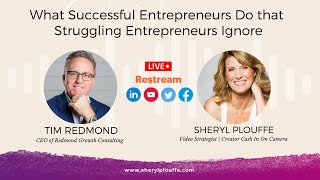
In this Cash In On Camera interview, host Sheryl Plouffe talks with veteran business coach Tim Redmond (Redmond Growth Consulting) about the habits and tactics that separate thriving entrepreneurs from those stuck on the “struggle hamster wheel.” Tim stresses the need for clear differentiation (the “purple‑cow” concept) so prospects instantly understand why to choose you over hundreds of competitors. He explains how to craft a no‑brainer offer—discounts, free trials, or bonuses—that makes the next step effortless for the customer. Reputation capital is built through a systematic Google Business Listing strategy, aiming for 100+ authentic reviews to dominate local search. Tim also shares his “power‑planning” system: a daily three‑item focus written on an index card and a weekly accountability meeting to keep the business from reacting to emergencies. He advocates outsourcing to specialists, using frameworks like Dan Sullivan’s “who‑not‑how,” and measuring expert performance. Finally, Tim offers podcast listeners a free, high‑value growth plan (normally $2,500) in exchange for a 5‑star review, demonstrating a lead‑generation tactic that delivers concrete action steps and potential $100k profit uplift. The conversation weaves practical marketing, operational discipline, and mindset shifts that successful entrepreneurs consistently apply.
Chapters
As an entrepreneur, you are faced with a lot of choices to make to be successful. And today, we have Tim Redmond here with us from Redmond Growth Consulting. 35 years experience, a ton of experience, a ton of success behind his own adventures, if you will, in entrepreneurship and business ownership. So, no better person to come in and talk about all the choices that we have to make, Tim, but also making sure we make the right choices. And that can be really difficult when we have so many things coming at us. So, I'd love to dive into this topic today about what successful entrepreneurs do, such as yourself, compared to those who are still in that struggling phase. And it feels perpetual, right? Sometimes people just are on this hamster wheel of struggle for so, so long. It's really challenging, but I'd love for you to dive in and explain to us what is the difference between the people who are successful and the people who aren't.
Okay. Yeah, there's, I mean, we can go on for hours and hours. You and I could just hang out and talk for weeks on this, just with our adventures. I've worked with over 2,000 businesses just directly with the business owners, my team. And, uh, we've got 150— between 150 and 200 clients right now. And, uh, so, you know, it's the same kind of mistakes that we see people do. Um, on the marketing side, uh, a lot of times, like, we work with a lot of contractors, builders, remodelers, plumbers, electricians, people that install this and that. And, uh, service-based companies. And, you know, they, they get lost in the shuffle in their mind, and they don't have what Seth Godin talks about as the purple cow. They don't differentiate themselves. You know, he wrote that book 20 years ago, and I'm still quoting it today. It's, it's a phenomenal book. But what makes you stand out? Why should they choose you instead of the 400 other people that they see a list to that pops up in Google. And so how do we make that differentiation? So a lot of companies don't do that. Even companies that hire marketing companies, and the, you know, the marketing companies, they just want to get you on Google AdWords and they don't want to build any kind of foundation. So, uh, getting real clear on what makes them different, why people should choose them, is so huge, Cheryl. Another thing here is, um, making it easy to take the next step. Yes, we call it the no-brainer offer. Yeah, you know, give them an offer that's so irresistible that they don't even require any brain cells to process it. Boom! Why not? Let me give that a try. You know, it's a head-turner. And, um, So, Tim, I want to go back.
Let's start because you've just— I mean, you've just laid down all the gems like in the first minute, right? And for those of you who are watching this episode with Tim, by the way, on Cash In On Camera, the whole concept here is Cash In On Camera. It's really about how do you grow your business by utilizing marketing that's actually going to work for today. And so, on the subject of marketing, which you just mentioned a moment ago, this idea of differentiation and standing out. Is this something that in your estimation is a new thing that we need to do because of social media, or has this always been the case for decades and decades? It's just that some people were doing it better than others.
Yeah, I think it's as old as the hills, Cheryl. You know, the people that get the most business now, the people, the people are our second or third or fourth say, well, the big guy is cheating. But the big guy, the successful guy, usually is very, very clear on why you should. You shop at Walmart to save money and you shop at Costco because you can bring things back 14 years later.
No questions asked.
But, you know, it's, you know, we all have our purple cow, what really makes us different. As a coaching company, we're a do-it-for-you coaching company. Why? Because all of our clients are super, super busy. So, you know, we're going to tell them, here's what you need to do. And by the way, let us do all that work. So what makes you stand out? Well, I'm a plumber and I fix a damn toilet. What's the— what do I— how do I make that unique or different? So that's what we do is we work with our companies and do it. But speaking of plumber, I've got a plumber right here in town, and he had a, you know, on his, uh, on his, uh, uh, truck, he said, we wear belts. I go, why do you say we wear belts? Well, you know, because we don't want people to see our butt crack. You got very sophisticated, uh, viewers, so hopefully they don't discontinue with this show.
No, they love it. They love it.
We built the Purple Cow, Cheryl. All about the no butt crack guarantee. If you see our butt crack during our service, labor is free. So people are calling him up and they're laughing on the phone. You're the no butt crack guy, right? Yeah. Yeah. Okay. Well, I want you to come out.
You know, it's funny. I just saw a billboard, I think, driving in Windsor recently. And it was, it said, you know, we're great in bed. We're great in beds. It was a bed store. So, we're great in beds.
And I thought, I love it. Brilliant. Yeah. So, yeah. And it doesn't, you know, it can be quirky and clever and all that, but it doesn't have to be, you know, it's, you know, we had a home builder that talked about the quality of his work was so good, he had a guarantee, you know, like years beyond. Like, instead of a 1-year, it was like a 3- or 5-year warranty on the house because he just stood behind us. So, you know, there's, there's some unique way of standing out on that. And don't, don't let up, you know. I mean, don't disengage your brain because the idea doesn't come immediately. It may take draft 3 or 5 or 18 before it really clicks.
And I think about the Maytag repairman, for those who are old enough to know Maytag repairman, right? That whole concept of he's sitting around doing nothing because the Maytag machines never break down. Yeah. And it's like, I think there's a real tie-in what you're mentioning here about the marketing and the differentiation and really what your brand values are and kind of what you stand for. And so there's They're all kind of interconnected, I guess, in that sense. And it can be challenging for people to identify because business owners or entrepreneurs are so close to what it is that they do that they can't see the forest for the trees.
Right, right. And another thing closely tied to that, you know, we can dive into the no-brainer offer, but let me go into the foundation for our marketing, Cheryl, that I think every one of your folks No matter what business they're in, they're into some kind of marketing. So we believe the foundation for business growth and we're into companies that want to 10x. Okay. And if you don't have a 10x vision, we may not be a good fit for you. And so we, you know, we'll build the foundation on something they've already earned. There's financial capital. Now, you know, I'm coming from my CPA background. There's financial capital. There's leverage, there's all kinds, there's also this thing called social capital or reputation capital that is really worth money. And so, what we do in the first few weeks of our client is, first of all, we'll set up a Google Business Listing. So, a lot of folks don't even have that. If you go out to ours, you'll see that we've got over 400 Google reviews. And so, and then we will do this, do it for you, We will gather their friends, their family, their ex-boyfriends or girlfriends, whoever works there, their, their customers, their vendors. And we have a process that will do all the work, but it's a legitimate gathering of these Google reviews. You know, there's an ancient proverb from the Bible, but I use a lot of that and it says, don't praise yourself, let others do it for you. And So we build their reputation by what other people are saying, and we want to do it in a public market. And, you know, there's HomeAdvisor, there's all kinds of different— yeah, there you can put reviews on your website. Who cares? You can put it whenever you want on your website. So if you have an independent like, like Google, if you've heard of Google, you know, Google spends billions of dollars, right, Cheryl? They spend billions of dollars to make sure that their you know, their activity is looked at. And so we will build up, and our first task is to get them north of 100 Google reviews because most of them are in a local market and they're wanting to reach out in a local way. So that's a second—
well, yeah, I think about one of my clients is a car— a haunted car dealership. I've been working with them for 4 years, and this has been a big, big push for them. And in addition to working with the videos and everything else, it's going to drive more traffic and interest and what have you and brand awareness. That has been a big, big part of their success, has been really dialing into that piece. And I love that you gave a metric there, right? That 100 number is a good metric for people to aspire to get. So I want to move into the next part, which you said, you know, making it easy to take the next step. Yes. I have to admit, when you said that, I had a visceral reaction because I'm like, oh, he's talking about me. He's talking about me. Yeah. Listen, I'm not perfect, right? I got work to do too. But I think that's an area where I probably need to do a little bit of a better job as well, is make it easier for people to take the next step. And so you mentioned the no-brainer offer. What are some parameters around that for maybe service-based people who by looking at creating a no-brainer offer. Is it a consultation or does it need to be something meatier than that?
Well, you look at what everybody else is doing. And so if everybody else is doing it, it kind of sounds like Charlie Brown's parents talking, wah, wah, wah, wah, wah. You know, there's no distinguish, there's no distinctions. And so with service-based business, we'll say your first visit's $100 off. Like, whoa, okay, well, that's, you know, that may be a head-turner. Um, you know, for us, it's like, um, you know, most people pay up front, you know, because they're real excited about what we do and our, our 3-month business boost. But it's like, well, if you want, we'll, we'll book the first coaching session, you go through that entire coaching session no cost, and you decide at the end of it after you've experienced it. So, so we make it easy to take the next step. You know, there's usually a financial relief or there's a, you know, an incentive there that really makes it like, oh my gosh, this is— yeah, let me try this out. How can I lose with that?
Right. So you mentioned one option could be to give a sizeable, like some type of really amazing discount. It could be, you mentioned a trial, right?
Giving people a trial.
Yeah, I think, I mean, we see that a lot with SaaS products, right? It's like the dollar trial type of thing. But you can take that idea and bring it into the service-based business. And then you mentioned, I think you were going in the direction maybe of a bonus saying, hey, we're going to give you an extra thing if you take this next step.
Right.
Yeah. I love that. Yeah.
So these are simple ideas, Cheryl, and It is amazing at how many companies do not even remotely have it. I spent $15,000 on my website and I go, well, yeah, exactly.
But you have no traffic going to the website.
People don't want to read, they want to see a video and they want to say, well, what's the offer? You know, what's the hook? You know, let's make sure what is it you're selling and why should I Why or how should I buy that right now? Or how should I get involved right now easily? Boom, make that next step easy.
So we talked about marketing, we talked about making it easy to take the next step as far as what successful entrepreneurs do that then people who are struggling ignore. Are there any others that we need to be aware of?
Well, this is not really— is it okay if it's not about marketing, Cheryl?
Sure.
Okay, so, so business owners, most business owners, they wake up with their hair on fire and they're trying to run through the day to survive. Okay. I've been there.
Yeah, me too.
So we like to bring our clients and we provide medicine to calm them down. I'm just kidding. But it's this power planning. So what, what we do is in order to create a cadence or predictable pattern in their business, they say there's no way that can ever happen. There's things happen all over the place and it's chaos. And I say, well, you're actually encouraging that because a lack of, of guidelines and all that. So we, we start out with this thing called power planning where we reduce everything we have to do or somebody has to do either on a to-do list or on a time block in our calendar. And so, you know, if business owners would take even 30 minutes, 20 minutes, 15 minutes, 5 minutes, just, and use just a little index card to say, what's the 3 most important things for me to get done today? Just thinking through that where they're focused instead of reactive which actually is, you know, while multitasking. Well, that's a poor excuse for bad planning, you know. And there's a little sign that I said I saw years ago. It says, you know, the lacking, the lack of planning on your part doesn't constitute an emergency on my part, you know. So, you know, we want to, we want to really take time to plan and then connected with that, each main person in our business, we have at least a weekly accountability meeting. Give us a count. Here's what I've done. Here's what you're supposed to do. Here's what, here's what I learned. Here's decisions I need from you. And so we, we touch all aspects of our business at least once a week on a regular basis. Those two things alone have, have caused huge growth with our clients.
I love that. It's this idea of, like, really, like you said, instead of reacting to everything and everything is an emergency, if you take the time to really do the planning and be introspective about where you want to go and thinking about productivity and things of that nature, it does change things. This is a practice that I've actually started. I have to admit, I'm probably not as consistent with it as I need to be.
Right.
But I do have a binder over here with every day, right? Going in and saying, okay, here are my intentions for the day. This is my focus for the day. And it's not 20 things, it's 3 things. And it's really, really made a big difference. I just need to be more consistent with, with that practice.
And don't make it complicated. That's what I say. Now I have this fairly detailed brain and I've got a number of businesses going. And so mine's fairly detailed, but I have— I find some of my most productive days, I just buy a stack of index cards, 3x5 index cards, just use one. And I can't write everything down on this one sheet. Well, that's the design of it is like it, you know, write down the 3 most important things for you to focus on. I put it in my pocket, Cheryl, because then as I walk, I go, what's that? Oh, okay. Yeah, it's kind of like a reminder. Get those 3 things done, you know. So just keep it as simple as you can so that you do it.
One of the things that we do on Cash In On Camera is we have a segment we call Stop Marketing Like It's 1999. Are you a big— do you know Prince? Okay, so I'm a big, big Prince fan, Tim. And so this is my ode to him. But in all seriousness, what I would love to know is what is a tip, a tool, a tactic, or some type of technique? It could be something related to what we've discussed or something completely different. That's really helping you at Redmond Growth Consulting to market yourselves?
Yeah, so we, we're experts at, at marketing. And yet I've— right now I have 4 coaching companies helping us with different aspects of it. So, and I hope this doesn't sound self-serving, it's not meant to be. But Don't be afraid of getting an expert to do the thing to help you to really perfect the thing you need. And there's a guy that I adore. I'm part of his coaching program, Dan Sullivan. He wrote a book and he— 3 words, who, not how. So think, well, what do you want to get done? And then you think not, well, how am I going to get that done? Now, who do I need to help me to get that thing done. And so that's a, that's a huge thing. Just there's so many experts, there's, there's a lot of shenanigans out there, a lot of charlatans, a lot of, a lot of people that just are going to waste your time. So if you set an expert up, you get really clear on the output you're going to measure their success by. And if you don't do that, like we just had a meeting this morning with our our Facebook, one of our Facebook coaches, and he's tasked to generate so many leads a month. Okay. And boy, he is on track with it. You know, what do you want to get paid for me to get this kind of result? And then so every week we're okay, how are we doing with this? We want to give account for what's going on. And you don't just set somebody up and say, well, they said they're going to do it. Now you got to pretend that everybody's a little dysfunctional and they're going to forget stuff. Stuff. So you need to come in there and check it out. Is that too much detail?
I hope it's not. No, I, you know, I think that's actually a really great example, and it's something that I think a lot of people feel like, gee, don't I have to be an, you know, the, the premier authority at every single thing and every single aspect of my business? And it's like, no, you need— you have a zone of genius, you got to live in that. But yeah, definitely the idea of outsourcing Finding people smarter than you to come in and do certain aspects of your business or to help you with certain aspects of your business is a really great tip. And it's something that, you know, you— there's no reason for you to feel ashamed or less than or whatever around any specific topic around your business. Everyone needs help. It is not something that you build in.
That's how the best get better. Yeah, right.
Yeah, exactly. Wonderful. Tim, this has been so great. I love that you talked about marketing, taking the next step, the no-brainer offer, and also the power planning idea. It's really— these are some fundamental things that we'll all take away, I think, from today's conversation. But I'd love for you to share how people can get in touch with you.
Okay. Yeah. First of all, they can just email me. And here's Redmond Growth. It's redmondgrowth.com. My email is just Tim, Tim@redmondgrowth.com. And what I want to do is if they give you a 5-star review on your pod, one of your podcast stations, okay, we give what we call a growth plan where we bring people through an analysis of their business. We see where they are versus where they want to go. We really detail that out. And then we, we develop a game plan where we provide them at least 8 to 10 concrete action steps they can take to get to that 3-year revenue goal. It's powerful. People walk away with a plan even if they don't work with us, and they'll add at least $100,000 to their bottom line profits next year. So we, we normally charge $2,500 for that. But if they say I love Cheryl or some kind of a touch on that, we will waive that fee entirely.
We'll give them the— What a generous offer.
We'll even give them a business. We'll create a new business model for them if they want to go into the first coaching meeting at no cost, if they want to do that. And so we can build them even a business model. It's just like frees people's thinking to see what they can do.
So that is so generous. Thank you so much. And you know what? Obviously, ratings and reviews help to get our message out to more people. So that sounds like a win-win, Tim.
Yeah, sounds great. Yeah, I love it. Thank you, Cheryl. This has been great.
This is really fun. Thank you so much for coming on and sharing these insights. Redmond Growth Consulting. I mean, you, 35 years in the, in the industry, business coach and all of your credentials, you know, PricewaterhouseCoopers, selling your software company to Intuit and all kinds of really amazing things on your resume. So it's really been my pleasure to have you on today.
Great. Thank you so much, Cheryl.
Thank you.
More from Sheryl



From 'agreeable' to 'ruthless mentor' to 'strategic sparring partner' #substack #shorts







