When Is It Time For SEO?
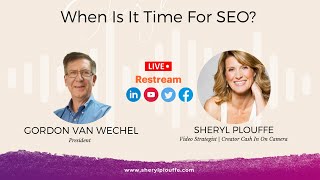
Gordon Van Wetschel of Alchemy Consulting Group explains when small businesses should invest in SEO. He recommends starting with a website and Google Business Profile, then paid ads and retargeting, before tackling SEO itself, which takes 10-12 hours weekly and 6-9 months to show results for competitive keywords.
Chapters
Does the term SEO, or search engine optimization, make you want to roll your eyes back in your head? Maybe so. It sounds like a really complex thing, and I think it can be somewhat complex, which is why we've brought Gordon Van Wetschel in today from Alchemy Consulting Group to talk about SEO. When is the right time for me, for you, to dive into SEO. I'm particularly interested in this topic because I know a little bit about SEO, but not to the degree that Gordon does. He comes from 18 years of working with business owners, has written 9 books on business, has consulted with hundreds of business owners, knows his stuff. Gordon, thank you so much for being on Cashing On Camera today.
Pleasure to be here. Looking forward to it, Cheryl.
SEO I think it does make a lot of people want to roll their eyes back in their head. It just sounds like this really complex term that a lot of people throw around. We hear SEO, SEO, but what is it really?
Well, search engine optimization is the phrase that we use to describe helping a client's website get to the first page or two of, of the search engines. Of course, Google is the holy grail. In a reasonable period of time at a reasonable cost. And 15 years ago, it was one of those times where if you build it, they will come. That's no longer the case. There's, you know, over a million web pages a day being uploaded to Google, and the competition is huge. The other thing that's important for a business owner, a local business owner, to realize is that if you look at the first page of Google for most keywords, there's going to be at least 2 to 5 of the 10 organic listings that are national companies, and they're there because of their brand presence. So instead of 10 places to compete over, a local business might be competing over 4 or 5 or 6.
And so you talked about the big national brands. They have obviously a lot of marketing dollars behind them. And the thing that I love about what you do at Alchemy Consulting Group is that you're really bringing, bringing big agency philosophy and strategies to the small business owner, which I think is, is important and crucial. Can we compete? Really, can we compete with these big multinational companies?
Absolutely. And Google really helps us with that because a couple of years ago they began prioritizing proximity search. So if I'm searching for a product or service, Google's top priority is to give me vendors that are within a 3-mile radius of my IP address. And if they can't find them in that range, they're going to go out to 5 miles and then 10 miles. So the national brands do have some power in the marketplace, but if I'm a local searcher searching for a local vendor, it's going to be more likely that I have the opportunity to see companies near me that I might be able to do business with. Now, the downside of that is, let's say that you're on the west side of Phoenix Well, Google, and you have competitors on, you know, the east side over in Mesa and Chandler and all those other communities. Well, Google's going to show your competitors first to people on that side of town. So, you know, there's some hoops that can be jumped through to offset that. But again, that's why you need a comprehensive SEO strategy, is to continue to balance what Google's trying to do to give yourself the best opportunity for presentation.
There is a statistic on your website that I want to cite, and I wrote it down here so that I would get it right. 85% of consumers use search engines to find local businesses. That's a key statistic to understand from the perspective of wanting to, to grow your business. Why is it important that we understand those numbers?
Well, 15 years ago people had a Yellow Pages. No one uses the Yellow Pages anymore. The de facto search is online. And whether you're using Google or Bing or DuckDuckGo or any of the other search engines, that's what people are doing. The interesting statistic that has changed a lot in the last couple of years is the number of searches that are done from a mobile device. And for many business niches, it's now more than 60% of all searches come from a mobile device. So that's huge, which means that it's even doubly important for a business owner to look at their web presence and make sure that that website is fully optimized to present properly on a mobile device. Or again, somebody who's there on their phone running their life with their thumb, if they can't get to your website and find what they want quickly, they're clicking off and going to your competitor.
Yeah, and you really only have a very short window of opportunity to get that attention and keep it. I love that, you know, you work with people on the SEO side, but it's really part of an overall framework that you call Core 5 Marketing, right? It's this entire framework. And I just wanna actually mention, Gordon, before we get to the end of this interview, that people can go and download a free copy of this Amazon top-selling guide, the Core 5 Marketing. And I think it's really a key thing for people to take advantage of. But in the Core 5 Marketing framework, You talk about SEO, but there are different kinds of SEO. Can you break down what those different modalities are?
Sure. At the most basic level, there's what we call onsite, the SEO kinds of things that we do on your, on your website itself to comply with Google's current guidelines. And those are simple things like alt tags on the photos, making sure you have the right header tags. That you have a footer in place and that it follows the guidelines that they're looking for. And most agencies do on-site SEO. And when Hamid from Pakistan calls you as a business owner and says, I'm going to get you on the first page of Google next month, what Hamid is offering is that on-site SEO. And of course, business owners now are sophisticated enough to know that's probably not going to happen, and they'll ignore those calls. But on-site SEO is, is where everything starts. But the real magic, if you will, the real work that's involved is in that offsite. It's in doing the competitive analysis. It's creating guest blog posts. It's working on backlinks. And this again is a significant change. A couple of years ago, Google evaluated a website based on the number of backlinks that you had. And, you know, those of us that would occasionally put our foot over into the gray side of the world could create literally hundreds of backlinks in a month. Using link wheels. Well, now Google's prioritizing high page authority backlinks that are relevant, which again is a positive thing. It, it means that they're providing websites that are better for the searcher rather than something that a clever agency has done to contrive backlinks. So those are all things that have changed in just the last couple of years. Google's algorithms now are using artificial intelligence so that they're evaluating the content on your website. So again, it's important that that content be properly keyworded, have the headers and the tags in there in the right place, but also be very logical. Again, 4 or 5 years ago, we could write an article, throw it through a content spinner, and create 25 or 30 versions of that article. Some of them didn't make a lot of sense when you read them. Google now understands that when that's being done, and they penalize the website for that. So what they're really making us do on the agency level is provide the best possible experience for the person who's searching for that product or service, which is a good thing. I mean, that, that's a benefit for our client, but it means that SEO has become much more complicated and therefore more expensive. It's also a slow process. As a general rule, we tell somebody that it's probably going to take 6 to 9 months before you see significant movement on a very competitive keyword. Less competitive keywords, localized keywords move more quickly. But yeah, go ahead, Cheryl.
I'm sorry. I was just, I was just going to ask you because you mentioned the website being a real core piece of this, and I understand that. The website is the hub to really everything. But when you say, you know, creating content, or rather really optimizing the website, is it just the website, or how does social media or other social media channels play into SEO, or does it?
The basic that a business needs to have a footprint on the internet is a well-designed website, and that doesn't have to be expensive. It doesn't have to be 50 pages, but it needs to be well designed and effectively say the company's value proposition. And then they need to claim and optimize their Google for Business page. Google's gone through a lot of iterations of that page in the last few years. Just last month, they've rebranded as Google for Business. So you need to have that page. And one of the features of that page is you can publish content to it weekly. It used to be that Google would discard that content at the end of the week. Now they archive it. So, that's extremely important. And then the third foundational component is claiming citation and directory sites that again have a high page authority and are relevant to your business both geographically and niche-wise. Once that foundation is in place, then you can start working on more sophisticated SEO. But you're exactly right, Cheryl, that basic website is your 24/7 salesperson online. And if 85% of people are going online to find your product or service, You got to have that and it's got to be good.
So I didn't hear you say that social media— so we see people building on Facebook and really focusing on Instagram and they're building their TikTok audiences and all of that. I mean, what I've understood lately, at least in this case of TikTok, is that they're now indexing that on Google. So how does that play in? You know, if people are trying to build a TikTok audience, is that a best practice or is it like putting the cart before the horse? And if you don't have those other fundamental things in place, such as your website, your Google for Business, or I think you mentioned a directory, right?
Social media is, is an enigma for a lot of business owners. They have the feeling that, oh, we really need to be on all of these sites. But my question is always, where do your customers go for information? So if the demographic of your ideal customer is millennials, they're not on Facebook anymore. They're on Instagram. So that's where you need to be. If your market skew is a little bit older, Facebook is still a valid place for you to be. So the question about social media is really, where can you best meet your audience? And if it's on one or more social media platforms, then yes, you need to be there. Uh, if it's not, then that's not a place you need to invest time and money.
Yeah, um, going back to the off-site. So the on-site SEO piece, as you mentioned, it's optimizing a website and different things that happen there. But what I'm more intrigued by is the off-site because it relates more to what I do and represent, which is the creating of content, be it video. We do a lot of repurposing, so we'll take video and repurpose it to audio and that sort of thing. It isn't an overnight thing in most cases in terms of success. Like, I mean, it can be, but it is more of a thing that you have to address on a consistent basis. That's what we do, is help people build a system so they can be consistent. Yeah, absolutely. And, and I think it's, it's important to have the conversation around what is a realistic expectation when you're creating organic content in terms of time frame. You know, you mentioned like 6 to 9 months, that it isn't an overnight success in most cases. Can you speak to that from the standpoint of your own experience? Because you do content marketing as well.
Mm-hmm. Yeah.
How does that work for you and what is the, your best advice to others who are considering organic content marketing?
You know, Cheryl, I anticipated in our conversation today, I sat down with our SEO team and said, okay, let's really identify how many hours a month do we spend on different activities for an individual website. And it, it was surprising to me, we're averaging between 10 and 12 hours per week per website. So you're talking 40 to 50 hours a month working on optimizing a website. And some of that goes into research and content writing. Some of it's competitive analysis. Some of it's going to see what, uh, competitor sites are doing. Uh, we spend 5 hours a month on an average doing link building and content promotion. We're writing blog posts. We're writing emails to our lists for our clients to drive traffic to their website. And most of this, because it's content creation, whether you're writing a press release or a blog post, this isn't something that can be done, that can be outsourced to an offshore worker. You need people who write and speak English in the same colloquial conversational style that you and I are talking in now. We have people that work for us in the Philippines and they're brilliant. They're college-educated. They're really, really bright people, but I never have them create content because they write like university professors. You know, they, they don't write the way we talk. And what Google's looking for in the content is the same thing the customers are looking for. They want to know the answers to their questions as quickly as possible in a way that's understandable for them. So when you look at, you know, let's say 10 hours a week, that's 40 hours a month. Now you understand why SEO, if done properly, can be so expensive, right?
It's— I think does tie into our philosophy here, which is that you can't outsource your own speaking on your subject matter expertise, right? Like, so for example, Gordon, using this as an example, the show today, You can't have someone sub in for you to be Gordon on this show. It has to come from you. And it's the same concept where I think you can definitely outsource some portions of the content creation in your business. But there are certain key things. And I think speaking, being seen on camera, you know, those are things that you can't sub anybody else in for you on that.
Yeah. Keyword analysis, using software tools to analyze your competitors. Those are all things that can be outsourced very easily. Those are teachable skills. But our content writers, when we bring on a content creation person, I mean, they start at $18 an hour and most of our people are at $25 an hour. And honestly, if the $18 an hour people haven't worked their way to that higher wage pretty quickly, they're not with us very long because that means they're not cutting it.
Right, right, right. I just wanted to see, somebody says here on Facebook says, wow, that amount of time is incredible. Thanks for the insights. So thank you for sharing that, Gordon. I wanted to go back to something you said a moment ago about Google for Business. When I, when I looked into Google for Business, it didn't allow me to optimize it because I'm an online business. It needed, it needed to have a physical address. Is that your understanding or am I misinterpreting that?
No, that's again a change since they started with this. The origin of what is now, you know, Google, Google Profile for Business, Google Business Profile, that's their new name. The origin was Google and Facebook don't always get along, and Google was trying to find a way to counteract the Facebook business page. And through various evolutions, it has now come to the, the Google Business Profile, but it is really designed for location-based businesses. Whether you have a physical office that people can come to or you service at your customer's home most of the time. You know, like a lot of companies in the building trades, they may have an office, but they're really working at the client's home. But that is one of the new requirements is they want to have a— they want to have a physical presence for your business.
It looks like I'm not the only one. Somebody else has said that they were stuck on that too. Yeah. So I guess if that's the case, then for those of us— and I think this is something we're seeing so much more of, obviously, in the, in the COVID and post-COVID world of people having online businesses— if we can't optimize Google for Business, maybe that is all the more reason to optimize all of the other things you've mentioned on this episode.
Absolutely. Claiming citation and directory sites is often overlooked, but that's an important part of be basic SEO, making sure that your business records are accurate on those sites, and then even going to the aggregator sites and paying their annual fee to have your information accurate there, because so many of the other sites pull data from those aggregators. So that's important as well.
That's great. Um, I want to just ask you, we do a fun little segment here on the show called Stop marketing like it's 1999. So, Gordon, I would love to know a tip, a tool, a tactic, or a technique that, that you use at Alchemy Consulting Group to market yourselves for the year that we live in.
I would say the most effective, relatively new tool is retargeting. Now, if your audience isn't familiar with that term, I'm certain they've experienced it. If you've ever shopped on Amazon or YouTube, You look at a product, and then you don't make a buying decision, but for the next week, you see ads for that product. Well, you've been retargeted. Retargeting isn't new. We started doing it back in 2014, but it was very, very expensive because the platforms— to get a platform that allowed you to integrate with the 11 ad exchanges was extremely expensive in those days. It is less so now. Your cost per 1,000 impressions was expensive in those days. Today, I think retargeting is the most cost-efficient advertising that we can do. And I tell our clients that retargeting is the single marketing channel that makes all of your other marketing more powerful. And the reason I say that is everything that we do in advertising is directed towards getting people to our website. You know, that's our working salesperson. But Google tells us that 96% of the time that someone comes to your website, they will not make a buying decision immediately. They won't fill out your form, they won't click the call button, they move on and they're looking at your competitors, or they get distracted and they stop searching altogether for a while. But if they've visited your website, now through retargeting, we can keep your brand in front of them for, you know, 14, 30, 90— how long is the buying cycle for your business type? So it's an incredibly powerful tool that brings people back to your website.
And I, and I love the connection between organic content and retargeting because I specialize more on the organic side. I'm creating the content, but there are ways to, to use that organic in an— and to advertise and be able to go back in the metrics and see how many people watch 25% of your video, 50% of your video, create, um, I think it's custom audiences or lookalike audiences around that and retarget the people I, I actually, actually not, no, the lookalike audiences wouldn't be retargeting. Lookalike audiences would be trying to find new people, but we could build audiences to retarget to based on the number of, of minutes that they watch or percentage of video that they watched, correct?
That is correct. The other kind of derivative of retargeting is banner campaigns, and the technology has gotten so sophisticated now that we can identify a specific geographical area and only target homeowners or businesses in that area. For another client, we, we have a product that we call time-lapse targeting. We can literally send marketing information to everyone who has been in a business address for the last 12 months carrying a cell phone.
Wow.
Yeah, there is no more privacy, Cheryl. It is completely gone.
That is a thing of the past.
Those are the kinds of things that can now be done. I, I was laughing with someone just last week. I said, look, if If your ideal customer is a woman between 30 and 45 who has 2 kids at home, who drives a Volvo and likes Yoplait yogurt, I can put your ads in front of her.
Oh, that is the world that we live in. But it's fascinating, right? Because— and we could— Gordon, I think we're going to have to have you back on the show because we could talk about Facebook for an entire episode. Yes, the retargeting and targeting capabilities are so incredible and so, so precise, sophisticated, so sophisticated and so precise. I love this conversation. So just to bring this full circle, the question we asked at the beginning of the episode is when is it time for SEO and what is the answer to that?
We follow a 3-step process when we start with a client. First is what we call Digital Jumpstart, and that's a trademark product that we offer that includes the website, the Google Business Profile, and the directory sites. Then we go to our Marketing 3-Pack, because once you have that foundation in place, your objective is to drive traffic. You need people to get to that foundation so that you have the opportunity to present your offer. So that's a reputation marketing program. That's Google Ads and retargeting. After that's in place and you've got good cash flow, that's when we start to look at SEO. Because SEO is an extremely important component of the core 5, as we call it, marketing. But it's not what you want to start with. You want to grow into that. The first thing you need is traffic. So our objective as an agency is to help our clients get profitable as quickly as possible through their ad spend to get that good ROI, and then over time begin to add the more sophisticated channels like SEO.
So the answer is not right away. You have some work to do before you get to that point. But I would highly encourage people to go and get and download your Core 5 Marketing ebook. I think that will help spell out exactly the framework that you have been outlining for us today on the show. And you can go to core5— 5 is numeric— core5marketing.com to access that. And I would highly encourage you to go and do so. Thank you so much, Gordon, for coming on Cashin' on Camera today. It's been an absolute pleasure. I have a feeling that you'll need to come back so we can dive into more advanced marketing strategies in the future. Would you come back if we asked you?
I'd love to. I'd love to. This has been a fun conversation. Thank you for having me.
Thank you so much. Great to, great to chat with you, and we'll see you soon.
Thank you.
More from Sheryl



From 'agreeable' to 'ruthless mentor' to 'strategic sparring partner' #substack #shorts







