Why Community is Crucial in the Digital Age
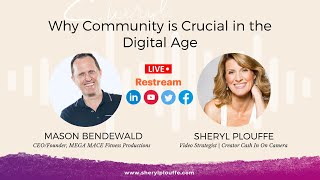
In this episode of Cash In On Camera, host Sheryl Plouffe interviews fitness‑industry veteran Mason Bendewald about why building community is essential in today’s digital world. Mason draws on his two‑decade experience with brands such as P90X, Beachbody, Tonal, and Virgin America to illustrate how community‑driven storytelling creates lasting engagement. The conversation emphasizes that merely delivering information is a commodity; authentic, vulnerable personal stories forge trust and give audiences permission to join a community. Practical advice is offered for entrepreneurs: be yourself, craft stories with a clear hook‑development‑climax structure, and use video, podcasts, and simple storytelling techniques rather than over‑produced content. Real‑world examples—including the P90X at‑home fitness phenomenon, a humorous Virgin America seat‑belt video, and TikTok’s user‑generated storytelling—show how platforms serve as vessels for human connection, not replacements for it. Mason also shares concrete tactics (free PDF guide, masterclass, leveraging podcasts) that he uses to grow his own brand, Mega Mace Fitness Productions. The episode concludes with a reminder that technology (AI, AR, VR) will continue to evolve, but the emotional bond formed through shared stories remains the foundation of any thriving digital community.
Chapters
important it is to build your network, to build your community. And it's never been more important because of the technological advances that we're seeing in so many different ways online. And that's why we've brought Mason Bendewald on today to talk about the importance of building community and why it's crucial in the digital age. So Mason, so great to have you here on Cash In On Camera. Excited to get into this conversation because You're someone who has had your finger on the pulse of the fitness industry for over 20 years, and you've worked with Kate Hudson. You've done work with Beachbody and Tonal and all these amazing brands. And so, you know, more, more than anyone, the importance of community. I'd love for you to share a little bit of your story of, of your community building endeavors over the last 20 years.
Cheryl, it's great to be on your show. And it always comes back to community. As you said, I specialize in fitness. P90X, um, I directed almost 20 years ago now, and I always go back to that because it was such a groundbreaking shift in the at-home fitness, um, space. And when I look back and I continue to teach and build other fitness brands and work with trainers specifically on camera on how to build their brands, I talk about P90X and why it became so popular. And at the core, it was entertaining and you felt as if you were part of a community, even though it was something that you were watching on TV.
I'm very familiar with P90X. Yes, Tony Horton, the Beachbody community. I was actually involved with, with Beachbody back in 2013. So I know a little bit about that. You know, there are lots of amazing trainers and you've worked with a lot of those fitness people that you've really made into household names and celebrities and have had contribution to that. So, I mean, you certainly know about the importance of, you know, how you show up on camera. What are some tips that you have for entrepreneurs, specifically business owners, in terms of how they show up in the world as they go about trying to build their communities?
People have heard this in many different ways, but it's what I really double down on, which is being yourself and telling your story. You'll hear and see that in marketing. If you do any kind of research into storytelling, you'll see that 65% of the way we communicate is through storytelling. You bump into a friend or you call them, I'd say, what's going on? And one of the first out of somebody's mouth is usually like, you're not gonna believe this. And then they tell a story and that's how they communicate information. Well, often when we get on camera, we don't tell any stories. We just deliver information. And when you share a story, a lot of things happen, particularly if they're, well, if they're fun, you're entertained. If they are personal, you break this wall, this barrier that's through the lens, and you get connected in a way you can't otherwise connect with an audience virtually through a lens. You and I are having a conversation, but if you're just presenting and it's only information, our brains get distracted and bored very quickly. If you're telling a story, our brains are wired so that you actually feel as if you're going along in the journey with the storyteller. And that's an incredibly powerful tool for anyone, a CEO, a trainer on camera, to connect with your audience. And if it's a great personal story, you're also building trust. And that's a huge factor in—
that is one of the biggest things. It's really about building trust. And, and to your point, a personal story or even something that is has a funny kind of slant to it. And that's not to say you have to be a comedian or be a skilled entertainer, but just telling a story helps to take you out of that realm of just delivering information, which is a commodity. We can find information. I can ask Alexa. I don't want to say your name too loud. I know she's going to actually give me information. But I could ask her anything and it's at my fingertips. So, I see, I see a lot of business owners still doing that. They're just cramming in as much information as they can, but they're lacking that other layer, which is why does it matter to me?
Right. So Cheryl, if we could, I'd love to put you on the spot and ask you to share a personal story, a moment that changed your life. And then I'll show you in an example how you could actually use that while you're doing interviews.
Okay, a personal story, and you want it to be business-related, or does it matter?
It doesn't have to be. It's something that changed your life. Ideally, I— well, the cool part is you don't have to think about how it relates to business. Just something that changed your life, an obstacle, a breakthrough, some moment that was definitive.
Okay, well, I— when I was— geez, I'm trying to think of a good story here. When I was 18, I was volunteering at a cable TV station where I lived, and I had never been on camera before, had never done anything in front of the camera. And one day someone tapped me on the shoulder, one of the producers or one of the directors tapped me on the shoulder and said, hey, we need a host for this show, and we think that you would be great to try and, you know, to try to do it. And I was like, oh, okay. And at that point, I hadn't really done much but a few local fashion shows. I hadn't really done very much. And so I said, sure. Sure, I'll try it. Well, if I hadn't said yes in that moment, I wouldn't be sitting here today because that was what led me to say, to do the thing that scared me. And I built a skill set around that. And then I led to other experiences and other opportunities. And then it led me to being on national television eventually. So that's the story.
So that story doesn't even need any explanation. I mean, telling that story already I don't know you very well. I know you through your show. Like, it already connects me a little more. I mean, I'm already impressed that you're a broadcast journalist and that you have this great platform now that's your own. But to hear that as an 18-year-old, you had the courage to say yes. Were you scared?
Absolutely. I was terrified.
Well, so sharing that little extra bit of information about being terrified and you had no experience, and yet you dove in and look where it led you. It's a very powerful message that connects me to you a little more right now going, oh, so you're not successful, just— you're not just successful, you're brave and you're courageous. And that's where you gain your success. So that's a value to me to keep reminding myself that you do have to go out and be brave and be courageous and be vulnerable in order to succeed.
So I see where you're going with this, that, that building community crucial as we move into the digital age. We're going to get more into the technology kind of side of it in a moment. But just from the standpoint of building a community, when you are vulnerable or when you add detail to a story or you even just craft it as a story, it's about connecting with other people who recognize maybe a little bit of themselves in you or not. They might say, gee, I wish I were like that, or I wish that was a quality I had. There's some type of binding kind of, um, force that happens, right?
It gives— it— I like to say it gives permission. So when you hear, uh, a successful woman such as yourself that has broken barriers, now has their own platform, and you're streaming live, which I was inspired by, by the way, nervous to do it myself on multiple platforms at once, it gives people permission. 'Oh, it's okay to take risks. It's okay to be vulnerable. I have to be courageous in order to succeed.' That is, that is the message.
So you said it. Yeah, absolutely. So here, so telling stories, being vulnerable, sharing details, crafting those stories, and not being afraid to just not just give information but give your insight and your wisdom and your stories along with that gives context to the information. And then we marry that on top of the fact that we're in the digital age and we're seeing the advent of, you know, well, it's not even just the advent. We're well in it now. But AR, you know, and other things. I'd love for you to speak to why is it important for us to build community in the digital age specifically?
Well, because we're humans and the digital age is that it's digital. It's a tool for us. It does not replace human interest, human interaction, emotion. I, I know people say it's going there, but it never will quite be as complex and messy and beautiful as humans are. Where our, our stories will always be unique and yet universal in how they connect us— struggle, love, heartbreak, you name it. So The digital age, which billions of dollars are being invested in— and I'll go back to my, my niche, which is fitness. I go around the world now consulting with fitness companies who have spent lots of money on connected fitness, and then they realize, oh, our trainers are not as connected with their audience as we'd like them to be. And so I go there and I help break it down and say, you need to be vulnerable, you need to tell stories. A push-up is a push-up, I'm famous for saying. My guess is you know how to do a push-up, Cheryl.
I could try. I think I might be able to squeeze out one real push-up.
It— well, at least you know how to do it, is my point. It's like when you get onto an airplane today and they're still teaching us how to buckle seat belts. It's kind of ludicrous. So push-ups and sit-ups are rudimentary. There's not— you're not— you're not learn— You're not going to a trainer to learn how to do the moves necessarily. You're going there to be motivated. And if you're motivated, you show back up. And if you show back up, you get results. And so it holds true across any platform, any brand. If you are tapping into something that entertains me and connects me, I'm going to keep showing up. I'm going to buy into the brand. I'm going to listen to your message and I'm going to get the results.
Yeah. So regardless of the artificial intelligence, regardless of the, the augmented reality, the virtual reality, all that technology and that layer that is here and will be staying with us and if not growing over the next many decades, what doesn't change is the fact that it doesn't replace human emotion. It doesn't replace the connection that we have with each other as human beings.
Exactly. And if you think— I just thought of this, but if you think about, we all say blah blah blah TikTok, and we talk about TikTok as, as the app, the entity, the platform, and so on. But what's magical about TikTok, or horrible about TikTok, that just has us sitting there and scrolling, is that it's people telling stories or sharing interesting things. I, I, I'm blown away sometimes by what humans are able to do. It's the content, it's not the platform that I'm interested in. And, and there'll be a new version of TikTok, you know. There's YouTube, there's Twitter, there's TikTok, there's Instagram. All of them are platforms, but what's in them is humans interacting. And that's, that, that's the secret that a lot of people don't understand about a place like TikTok is They're getting people to create free content for their platform, and that's how they grow to be such enormous companies.
Yeah. Joy Willett is commenting here saying, yes, communication is paramount for us to sell and connect with others. Yeah. And Joy, I would even say not even just to sell, it's to connect as well. Let me just hide that. There we go. It's to connect as well, regardless of whether you're selling a product or service. Right. Yes, you know, it's coming back to Mason, what you talked about with the buckling the, the seat belts on an airplane. And, and sometimes you'll— maybe sometimes you'll see a clip, it'll be viral, of a flight attendant who is really entertaining the people on the plane in how they're buckling the, the belt, right? So yes, and those clips will go viral because it stands out from the rest of the people who are just showing you how to belt—
put them on.
We've seen it.
Virgin America, before they sold, uh, to Alaska, was my airline, and they had the most phenomenal video that was— first it was animated, then they had one that was like a musical. And it— to your point, I watched it every single time I flew, and I flew a lot, because it was so entertaining. And they made fun about the seat belt Their first video said, and for the 99.99% of you that don't know how to buckle a seatbelt, this is how you do it. Click. Yeah. And I laughed so hard the first time. It's like, I can't believe they got away with that, to your point. And it's speaking to what we all discuss.
It's like, really?
I got to sit through this? But they have to do it because of FAA regulations and so on. But that made us— that made me laugh and made me pay attention. It all worked. And it made me feel like part of a community with that airline.
And here's what's interesting about that is that now here we are having this discussion and we are citing and using Virgin as an example of that story. Yes. Which only perpetuates their brand even more because we're talking about it here and a bunch of people will be watching this video now live or the audio version or the recorded version here, you know, from this point forward. So that's an example in real time of how that works.
Yeah.
So if you want people talking about you, if you want to be noticed and seen, and then using stories as you, as you've described, can really help to get your message out to more people.
Yeah, I love that. Exactly. As I was doing it, I was thinking, right, I'm promoting Virgin America, who's not even in business anymore.
So I wonder if— well, one of the things that we do on the, on the show here is we have a segment we call Stop Marketing Like It's 1999, because I'm a big Prince fan.
So that's where it comes from.
Me too. Good. So what is a tip, a tool, a tactic, or a technique, Mason, that's helping you to, you know, promote yourself, to promote Mega Mace Fitness Productions? Like, what is something that you've learned? It could be an app, anything that you'd like to share, a strategy, something that's working for you.
So, I mean, it goes back to what we're really discussing. It's telling more stories. Um, it's using podcasts as a great marketing tool. Being on your show is, uh, is wonderful. And it's video, the power of video. It all goes hand in hand. Storytelling, video, it is one of the easiest ways to get your message out. It doesn't have to be super fancy. Uh, you do have to get better at storytelling so that you're not telling the long version. You're telling the interesting version. But other than that, it is a super powerful tool. So if you haven't embraced video yet, if you aren't used to telling stories, those two are the biggest marketing tools that I'm embracing more now as I'm, uh, working on my brand and expanding it.
Yeah, thank you so much for sharing that. I can't help but to think too that sometimes people think that storytelling is telling a chronological set of events, this happened, then this happened, then this happened, then— and it's like, no, that's not really, uh, it as much as it is there's a beginning, a middle, and an end.
Yeah.
And so structuring your stories around that kind of framework works far better.
Or another way of saying it's a little more, uh, hooks you in is a hook. You start with a hook, there's some development of your story, and then there's a climax. And so you can have the shortest story and use that framework and just go, okay, well, how do I get those 3 elements in there? And usually you'll have an audience that is paying attention and can't wait to hear where it goes.
Yeah. And the arc is the same, you know, there's different structures for stories and maybe we'll have to have you back, Mason. We can really break it down. It's like, here's the arc, here's how to do it. Because there are lots of different ways to tell stories. But your point is well taken, that telling stories, being vulnerable, adding detail is really what helps you to connect with other people, which in turn builds your community. And then marry that on top of the fact that we're in a digital age. The digital part is not going to take the place of the emotional connection that we build with people. So I love that.
You're good, Cheryl.
I'm trying, trying to catch on because you know what? Here's the thing, I learn so much from guests like you who come on the show, and that's one of the things I most love about this platform is that I get to learn in the process as well, along with our viewers and listeners. So yeah, it's great to have you here. I want to give you a chance to promote your website. Can you tell us a little bit about it?
Thank you. So there's two. The main one right now is for trainers. So if you happen to be a trainer or know of one, We have this free PDF book that you can download, which is the top 10 things that online trainers are doing great right now that are building their 6-figure businesses. And so that's a free download. And then we also have a masterclass coming up, which if you get that guide, you'll be invited to the masterclass, which is also free. And then if you are a brand or a corporate entity, you go to my my company site, which is megamace.com. And there it is at the bottom of the screen, just www.megamace.com.
Fantastic. Mason, thank you so much for coming on Cash In On Camera. We really appreciate it. And if you're watching or listening to the show right now, be sure to follow Cash In On Camera because we have more great guests coming your way, just like Mason. Thank you so much for being here today.
Thanks, Cheryl.
More from Sheryl



From 'agreeable' to 'ruthless mentor' to 'strategic sparring partner' #substack #shorts







