Why 'Winging It' is Sometimes the Best Strategy with Chris Cebollero
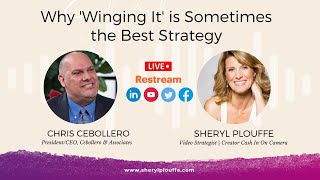
Chris Cebollero and Sheryl Plouffe discuss why improvising from bullet points instead of scripts creates better interviews and content. They cover leadership habits like daily reading and time-blocking, plus how KLDR Online, a global leadership radio station, helps podcasters monetize through collaboration and cross-promotion.
Chapters
Fun about this episode of Cash In On Camera, Chris and I have no idea where this conversation is going to go, and we're doing that on purpose to prove a point that sometimes winging it is the best strategy. Chris Cebalero, so great to have you on Cash In On Camera. Where should we start? Where should we start? And, and you know what's funny about this, when you said, hey, let's get together and let's have a conversation, You were the one who actually said, let's just get on and just chat. And I got to thinking, I'm like, you know what? Sometimes that actually works.
Yeah. And I think you bring up a great point, Cheryl. I got to say, and I'm excited to be with you. I mean, you and I have done so many shows together, both on your side and both on my side of podcasts. And one of the things that I think you're great at now is teaching people how to do what you're doing, how to do what we're doing right here. But I think you bring up a great point. And you say, where do we start first? Sometimes you need to have an impromptu presentation. You need to have an impromptu show just ready to go. I mean, there are going to be times when you have a guest that, you know, may not know what direction, and just having that candid conversation, which a lot of people are uncomfortable about, right? They think that they need to have a script, and they think that they need to have an outline, and that's really best practice. But what happens when you don't? I don't know where we're going to go today. Let's figure it out.
I just love that. You know, and most of the time I do teach it that way. I say, you know what, have some idea, bullet points of where you want the conversation to go. But a lot of people feel like they have to script, and there's a big difference between bullet points and scripting. You'd be surprised, Chris, how many people sit down at a blank computer screen and write out an entire script for the conversation that they're going to have with someone. And the problem with doing that is that you are not allowing for you to figure out where the— where's the— where's the interesting stuff in the middle? Because if you have a script and you're following it word for word, I've got to ask this question, then I got to ask this, you're not actively listening, right? Not actively listening to the other person. And that's often where the gold is. And I think that's one of the things people miss when they do these types of interviews.
No, I agree with you 100%. And you know, from your background in news, I'm sure you've used the teleprompter and you've read the content and, but you can tell you're reading sometimes, right? So when you're in that process, unless you have that experience of reading off a teleprompter and knowing where you're gonna inject voice inflection and knowing where you're gonna interject, you know, the difference in questioning techniques, all you're doing is reading. And it's the bullet points that allow you to say, okay, let's go ahead and talk about professional development right now and the importance of, all right, let's go ahead and talk about right now, and this is where this interjects. But sometimes, you know, you need to be able to feel comfortable with who you are as a speaker. You need to feel comfortable with who you are as a host. And you just need to be able to show that, you know, that human side of yourself. You know, we may make, you know, we're live now, right? So we may make some mistakes, and you teach that very, very well to say, okay, if you make a mistake, this is how you get in it, this is how you get out of it, which is real. And that's what people want to see a lot of times, Cheryl. And I think that what we're doing now is, uh, you know, we're off the cuff and we're going to see where that flows. But sometimes let people see who you are and let them hear your knowledge, and, and I think that's best.
Yeah, and I think that the, the learning here is that you as a speaker, as a host, I know you just launched KLDR online. This is so exciting. We're going to get into that. But as a speaker, as a host, you have to have some idea of what you believe. Like if you have beliefs and you have thoughts and ideas that you want to push forward, that's what I would concentrate the most on. Be like, what do you believe? What are things that you can just talk about on a whim without having to script it entirely out? So for example, maybe you and I right now could share some of our core beliefs. I mean, you're a leadership expert. I'm a video expert. One of the beliefs that I have right now is that we're moving into Web3, right into the next evolution of the internet and technology, and that connections and community are going to be more important than ever going forward. So that's something that I can say that right now, just off of— I didn't write that down. It's not written on a script. That's not on a teleprompter. It's just something I believe. When you believe something, you are able to express it in a very genuine way off the cuff. And I know you have beliefs as well.
You know, it's even not in a genuine way as well, but in a passionate way, because it's something you feel. One of the things that I always tell my guests is I just don't want them to hear the message. I want them to feel it too. So I want you to be real in that. And there are some people who come on your show who want to have script scripted questions. Now, I'm not opposed to that. I'll give them whatever they feel comfortable with. But what I always tell them is, I want to be able to have the opportunity for follow-up that you may not know what that follow-up is, because I'll go ahead and take you down the path you want to go, but allow me the opportunity to get something else out of you, right? So my belief is we want to be able to allow the folks that are investing in us their time, which is— how valuable is time, Cheryl? To feel the message and not just hear it. And that comes with passion and that comes with dedication and that comes commitment to the message that you're trying to share.
And the energy is lost, I think, when you are scripted in the sense that you can't feel that emotion or that energy in a message that someone is stoically reading on camera like a robot. Because the fact is, most people are not skilled enough to read very well from a teleprompter. It takes a long time to learn. I speak from experience on this because the first few times I read from a teleprompter on national television were probably not very smooth. Over time and over the course of years, I got better at it and I was able to make it sound like I wasn't reading. But that's a skill set. And the fact is, most business owners are not getting into this or doing content because they want to become broadcasters like you know, on the professional level. They're doing it because they want this to be a means to an end to benefit their businesses. And speaking of businesses, I'd love to kind of dive into, obviously, your area of expertise being leadership. What's going on in the leadership development field right now that we ought to be aware of? And some of the, you know, the world is different. It's different than it was a few years ago.
Yeah, certainly COVID has put a damper into what business looks like, right? We're trying to get back to a little bit of semblance of normal. I don't know that we ever really see normal again. Right. But I think that the big thing is still you have to invest in yourself. I mean, so when we think about professional development, it's one of the things that we fail to do for our— it's a gift that we need to give ourselves. You know, I can't be a leadership specialist and I don't call myself a leadership expert. I don't think anybody's an expert in leadership. If you know everything there is to know about leadership, raise your hand. I know I can't do it. Right. But I'm a leadership specialist. And for me to be able to continue to use that title, I've gotta continue to increase my knowledge and increase the, you know, the depth of what I'm able to talk about. Like right now, the big thing in business, as my clients will come to me, is the Great Resignation, right? Everybody, there's 160 million workers in the United States and we're losing 4 million workers a week, or I'm sorry, a month. And how are we combating that now? And how are we now able to figure out how do we staff our agencies? How do we staff our organizations? You know, there are people, there are companies, and you may have seen it up there in Toronto because this now has become— and you're still in Toronto, right?
I'm near Toronto.
It's all good. Okay.
It's all good.
But we're starting to see it worldwide now, in the UK, in Asia. So this just doesn't— in a US problem, this is a worldwide problem right now, right? So one of the things that we have to now start to think about is How do we gain the knowledge in this new era of losing people to change the practice of our business? But we can't do that unless we're not— if we're not taking care of ourselves to learning more about the business and the practice and the culture of business. It's the business of doing business, but it comes from your professional development and continuing to learn.
I'm a big fan of education. I think it is the foundation. And so what I'm hearing you say is that at this moment in time during the Great Resignation, Leaders ought to take this as an opportunity to further their learning, further their education. What are some ways that leaders should be doing that? Is it like I'm going on— I'm going to a conference actually next week in Las Vegas. First, I'm investing in myself. So, yay for me. Doing what you said. So I'm like, OK, I'm on the right track. But I'm always learning. I'm reading. I'm reading. I'm really kind of really diving a lot into the Web3 thing right now because I want to understand better What is ahead? You know, where are we going with all of this? So I'm a big fan of it. But what are some, some ways that people can really further their education?
Well, I think, you know, every, every time, every week when this show comes on, I'm watching and I'm learning from you. Right. So it's podcasts, it's radio stations, it's, it's these types of things where we can spend 30 minutes of just tapping into your expertise and me sharing a little bit. So that's an easy way to do that. You know, we've got people now who are listening to us and asking questions and they're invested here, right? So, but then reading something, read something every day. One of the things that we don't do well enough is we do not block our time to do work, right? We kind of just sit at our desk and we kind of take on what happens in the day. I go by time blocking, right? It's almost like going to high school. In the first period I had this, in the second period I had this. In a third period, I was reading all these subjects throughout the day. And one of the things that I try to do every day is to figure out, okay, from this time to this time, I'm doing this, this time to this time, I'm doing this. When I do a multi-week project, I actually scope it out from the beginning, and I'm gonna get to the answer to your question. I scope it out from the beginning to say, this is gonna take me 20 hours. I've got 3 weeks to do it. I'm going to invest this many hours per day. This many days during the week to get to this end result. But anyway, my point is, when you're time blocking, put in 30 minutes to read an article. Go to Forbes, go to Inc., go to Entrepreneur, go to the Harvard Business, Business Review, and just pick a topic and read one article a day. And then from that article, ask yourself a couple of questions. What did this mean to me? Where did the skills in this article rate in my rate in my skill set? What do I need to do to build this skill? How do I use this information to make myself better, to allow myself to lead the people who I invited into my organization to help me be successful? I want to say that again. We invite these people into our organization to help us be successful. The true measurement of leadership success is how engaged, satisfied, and productive the workforce is. Well, if that's the true measurement, how am I growing myself to help them grow so they can make the organization successful? So I think that's how you can kind of look at that.
Yeah, I love that. And, you know, I think the idea of— and I want to ask you actually about your radio station. Tell us a little bit about KLDR.
I got to tell you, man, I don't know where the heck this came from, Cheryl. Last year I'm sitting around and I'm looking for something online. And then I found that I could have bought a radio station. And I let it go. I was like, what is that? What is this radio station thing? And that night I'm sitting at home and I'm, you know, having an adult beverage and I say, why not create a leadership development radio station? We've been live since September. You can follow us on Facebook at KLDR Online. That's the quickest way to get to the radio station. I have 10 or 12 hosts that are around the world. We're in 27 countries right now. I want you to come on as a guest. And kind of talk about this, because when we think about Web3, this just isn't for people in the, in, in the United States, but this is people around the world. So let's go ahead and talk about that. But, uh, I have some great hosts that are around the world. The Maverick Paradox with Judas Germain, uh, The Chain Show with Simon Phillips, uh, Conversations with Leadership with Dr. Dave, Mindship 101, my show where I teach you the skills you need to know in your leadership toolbox. To, to ensure that we have the best engaged workforce possible. So it's, it's been fun. It's, it's a lot of work. It's been challenging. And if you got people out there that want to do shows, we're putting on other people's podcasts. We want this to be a great event for everyone.
I think you and I both are very passionate about helping people to get their message out to more people. Right. And then that's what we both do in, in And I'm passionate about it as well. I wanted to ask you about— you did— this is so sort of funny.
You did—
you got bullied into doing something. Was it— what is it, an MBA program? Oh my gosh. How did this all happen?
How did you hear that? I mean, so—
so now you're doing a radio station, and then you're doing this MBA program.
My daughter graduated high school. She was 23 years old, and she got her Um, she got her bachelor's in psychology, and, you know, Dad is talking about professional development, and you got to get it, you got to get a master's degree. What do you want to get it in? And she goes, well, I think I like human resources. I was like, let's look at some schools. And, and she goes, Dad, I'm just— she wasn't the best student in high school, the best of students, some comprehension issues and so on. She goes, Dad, I'm scared, and will you do it with me? And I was like, heck no, I'm not going to do it with you. I'm 55 years old. I'm not going back. But it sounded more like, of course, baby, I'll do it with you if you want me to do it with you. So we just graduated in May. So she got her MBA. And it was really a great experience for me because again, when you think about, let's go to talk about professional development, there are things that I learned, there are things that I polished, there are different theories that came into my beliefs that I didn't know, I didn't change my belief, but at least gave me the opportunity to reconsider my belief. But then it was good with her. I got to talk to her about theory. I got to talk to her about practice. And again, I got that opportunity, but I was bullied, man. She, she's a little girl, man. You know, she's like 5'4" and she wrapped me around her little finger and said, "Dad, we're going for a ride and you're coming with me." I love it.
And you know what? It comes full circle because it comes back to this idea of education. Right, right.
It's like furthering your knowledge and Yeah, then she's got the nerve to say, Dad, are we going for our doctorate? No, Dad, we are not going for our doctorate. That's something you're gonna do on your own, and let me know how I could help you.
That's right. Well, gee, you know, my, our son is graduating grade 8 today, actually, his ceremony for grade 8. And so it's still a little ways to go before I would ever be encountered with that type of situation. Scenario, but he's got me wrapped around his finger too. So there you go.
But if you have that opportunity, you know, one of the things— there are people out there that may have not gotten a bachelor's degree, that may have not gotten their master's degree. And if we're encouraging our children to take those paths, it may be the time to consider, you know what, let me do it with you, right? And, uh, this way you can kind of get to it together. You're ensuring that your child is getting the best opportunity as they start their life, but Maybe you're filling a square that you've always wanted to fill and, you know, doing it with somebody. You know, she was always saying, Dad, did you do your discussion board? And when is your paper going to be due? And what'd you get on that test? I got it. I got this. And it was kind of fun, you know, I mean, so the time went fast. But if you have the opportunity, you know, give it a go if you want to fill the square that you've always wanted to fill. Again, professional development, Cheryl.
Yeah, I love that. Yeah, I mean, I don't— I'm not sure, you know. I think, I think when it comes to education now, things are— people have different opinions about, you know, the state of college, university, and things of that nature. Certain industries that if you want to get into, obviously you have to have an education, but there's so many other ways to learn, you know. If you wanted to get into trades or you want to get into, you know, something else. Yeah, there's a lot of different avenues for education now. I think it's expanded and maybe will expand further.
Yeah, one of the things to think about too is in this, you know, we've used the term the Great Resignation, which is what they're calling this period right now. There are a lot of companies that are foregoing their educational standards because they can't get people in. So maybe you have some college, maybe you haven't finished your degree, maybe you have no college, but there are organizations now that are considering you for those positions in lieu of that. But as you mentioned, there are people now that we are losing. We don't have enough tradespeople. And now they're saying, think about being an electrician, think about being a plumber. I had a plumber, plumber come to my house. I had a clogged drain. They had to do some work on the pipes. They were there for about 2 hours. It cost me $275 for 2 hours. And this was his company, right? So they're making good money. But as you mentioned, does it need to be college? Well, it's starting to move away from that, as you mentioned.
Yeah. Depending on what it is that you foresee yourself wanting to do, you know, you may have to go down that path. But, you know, my— yeah, I mean, trades. My father is an electrician, a master electrician, and we actually have a boy just lives down the block here. He's going to be a plumber. You know, we're always going to need tradespeople.
Correct. Yeah. And I think that one of the things that's really amazing too is we're starting to see more and more female professionals in the trades. I gotta tell you, I watched a woman tractor-trailer driver back her truck. You know, you're driving down the street and, you know, they're trying to get into this space, and I was like, there is no way she's going to get in there. And not because she was a she, but because, you know, they, you know, this was— I couldn't get my car in there, you know. And I've driven ambulances, you know, in my career as a paramedic, and I've driven ambulances. And I watched her back this truck in with one arm on the door and one arm on the steering wheel, and she drove this thing in like it was attached to her. I had to get— I had to park my car and I had to get out and tell her, that was the most professional thing I have seen today, that I didn't think you were going to make that. She goes, oh my God. She goes, in the beginning, there was no way I was making that.. But kind of like you said, with the teleprompter, it was skill, it was experience, it was ability, it was learning the science of what you had to do. But I had to actually pull over to get out to say, that was the most amazing thing I saw today.
I love that you got out and gave her that feedback. I think that's amazing. But, but that goes to show, you know, because you're in, you're a leadership specialist and you understand that by doing that, it's actually going to further her you know, want, desire to do that, you know, again. And you're using this as an example of parking the vehicle. But there's a bigger lesson here is that when you see someone who is doing something that you admire, that you think is done well, go out of your way to— yeah, to tell them so, you know.
And that's free, Cheryl. That doesn't cost us any money. And one of the things that I always tell people is we need to add value to someone every day. What does it take to pat someone on the back and say, 'Oh my God, that was amazing.
Thank you very much.' Yeah, it's the idea of like paying it forward and things of that nature. I love that. So to round out this topic today, which is the winging it is a best— is can be a good strategy. It goes to show you, we've been talking now for 20 minutes. We've covered a lot of amazing topics. I think we've provided value to the audience. And honestly, we didn't really come into this with very much of a plan.
Right. And it was really fun. I mean, you know what it was really like, Cheryl? It was like you and me sitting down together, having a cup of coffee and just chatting. You know, I didn't have to worry about remembering. I didn't have to worry about transition. I didn't have to worry about, you know, it was just all about you and I as friends sitting down and saying, what do you want to talk about?
Yeah, I love it. I want people to follow KLDR. So tell us again how they go about doing that.
Go to Facebook and type in KLDR Online and become a fan, share it with your network. And the next thing is there's a link, tap the link and you'll be able to hear the shows. We run the shows from 1 o'clock in the morning Central Time because we think about our overseas audience till about 3 o'clock Central Time. And then some of the shows will replay, but we replay the shows throughout the week. So one show a week will play several times during the week and If there's a specific show or a topic you want to hear, let us know on the page. If you have a podcast, you know, we'll consider putting it on. If you have a show you want to host yourself, let's talk about it. And you're great at this, Cheryl. You are great at helping people get to the dream of hosting their own shows. If we can do any collaboration on your members that are in your classes that want to have a spot, let's make that a graduation thing for them. Let them do a 1-hour spot or a 30-minute spot. And we'll put them on together and we'll help them grow and get to the next stage in their career.
Well, thank you so much. And that in and of itself, and just for the viewers who are watching or people who are listening right now, my whole premise about Profitable Podcast Method is the idea that you are able to be profitable with your own show in the early stages as you grow your audience, that you don't have to wait for 3 years to build an audience and then be able to get a, a Piddly sponsorship. For it. You want to be profitable from the beginning, and it's predicated on building collaborations and relationships and joint ventures and things of that nature. And Chris just— you just saw it. Chris just invited me to collaborate with him, so it's happening live here just to show and prove to you that that's what this is all about. If you do it properly, you're able to leverage your show to build amazing relationships with, like, the one that I have with Chris and have had for many years.
And let me add one thing, Cheryl. One of the things that I think you said that I don't want it to be glossed over is that you're going to teach them to do it from the very beginning, right? You said 3 years. It took me 4 years.
Okay.
So with all those, with all that skill and knowledge and experience that we've gained over that time, you're giving it to them from day one that they don't have to make the, you know, the hurdles and the speed bumps and, you know, the things that we had to do. That's what makes you a master at what you're doing for your, for your audience. And I applaud you for that.
Well, thank you so much, Chris. This has been really fun. I'm glad that we got on and we winged it today. This has been a pleasure to have you on, and we will touch base offline for sure. I'm going to go and check out KLDR, obviously, and it looks like some of our audience is also doing that. So fantastic to catch up with you and to chat today.
Always. And I look forward to the next time. Thanks, Chris.
More from Sheryl



From 'agreeable' to 'ruthless mentor' to 'strategic sparring partner' #substack #shorts







