Why You Need To Care About Social Audio
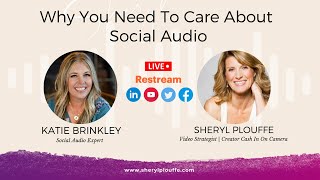
Katie Brinkley, a social-audio strategist with radio roots, explains why business owners should focus on voice platforms like Clubhouse and Twitter Spaces instead of spreading thin across every channel. She recommends optimizing your bio for SEO, cross-promoting rooms on existing social channels, and building relationships through conversations rather than chasing every trend.
Chapters
Obviously spent 25 years in that industry. But did you know I'm also a fan of audio? And so is Katie Brinkley. And that's why she has devoted her career to helping business owners leverage social audio as a means of growing their brand and growing their business. And Katie Brinkley is here with me today on Cash In On Camera. Katie, so excited to have you here. Social audio. I'm excited to get into this topic because it's really something that's blown up in 2020. And I don't think it's going anywhere in the next decade. Like this is still gonna be a really, really big thing. I'd love for you to start by sharing with us what is your definition of what we now call social audio?
Yeah, well, thanks again for having me. And I think it's, you're funny. It's like here we are talking about audio on a video podcast, but I think that that's one of the things we learned over this past year is how important the power of voice really is. And there's, in a world full of texting, and I mean, I'm somebody that can attest to this daily, it's just so much easier to send a text back to somebody than it is to actually pick up the phone to call them. But after what we saw happen after the pandemic and during the pandemic, people missed talking to one another and really craved that, that interaction that can really only happen by talking to somebody. And that's when social audio really started taking off. Clubhouse was kind of the, the leader for this, but before even Clubhouse took off with the, the live rooms and the daily interaction, and now there's, there's so many social audio apps out there. There was podcasting and podcasting. I think a lot of people were like, meh, it's just a phase. It's just a fad. But there are so many podcasts out there now, and over 50% of the US population has listened to a podcast in their lifetime. So there's a power behind audio and by hearing somebody speak. And we really saw that explode over this past year.
Yeah, I mean, I think about Clubhouse, and I did do a little bit of research because I wanted to know, even in preparation for this interview, when did Clubhouse launch? And when I went back and I looked, I was like, oh, it only launched in March of 2020. Yeah, and I was surprised by that. I was like, oh, okay, so it actually launched around the time of the beginning of the pandemic. And to your point, it exploded likely as a result of what all of us were going through at that time and that desire and craving for for human connection. And it was a great way for us to do that. I actually just checked on their valuation. It's at $4 billion.
That's, I mean, like, right. And it's, there's, this is one of the things, Cheryl, is I think that there's a lot of people who are still like, who, social audio, what is that even? Why would I want to go and do that? And you know, I'm going to full transparency. When I joined Clubhouse, I joined almost a year ago. So I joined, I think like the end of December, but I joined, I was like, well, this seems like a giant time suck. I don't have time for that. So I didn't do anything with it for about 3 weeks. But once I fully understood it, I started joining more rooms and listening and seeing some of these, these thought leaders that I've typically, you'd pay thousands of dollars to hear speak on stage. And you can go up in these rooms, go onto the stage, ask them your question. I mean, there's so many opportunities with these social audio apps. I knew that I wanted to learn more and see how I could leverage this for, for me and my business and for my clients. And it's, there's power in voice. And the, like you said, Clubhouse has only been around for a year and a half now. And it's really, really exploded over this past 18 months.
Yeah, I know you have an extensive background in, in social media. I think, you know, over 15 years, I think 17 years or so in social media. But you also have a radio, uh, background. So is— has the radio background really been the impetus for you to want to focus your career now on the audio side of things, or was it more as a result of what you were seeing happening in the marketplace?
So it really, like you said, it kind of goes twofold. So I started my career in, in radio. Um, I was the postgame reporter for the Denver Broncos, the Colorado Rockies, the Colorado Avalanche. So the Denver sports teams here, and I was doing their locker room interviews. It was, it was my dream job. It's what I went to school for, and I never really thought I would leave it, but back Back up just a little bit. Back when I was in college, I worked at the college radio station and part of our jobs at the radio station was to get bands to send us their music for free. So what I was doing was going all in on MySpace, which at the time was the heavy hitter. Facebook was still just for college students only. And so I was all in on MySpace making connections with bands and trying to get to know them, get them to send us their music and some autographed merchandise for free. And I was getting all this music sent to the radio station and the station manager turned to me and he said, Katie, how are you getting all this music sent to us? And I was like, well, just reaching out on MySpace. So I saw very early on the power of social media for networking and building relationships. Now being a social media anything didn't exist back then. So again, I was all in on radio. And then, You know, Cliff Notes version here. I moved into the marketing side of things because SiriusXM came and everyone in the radio industry panicked. And I was doing the marketing side of things and social media was always a side hustle. I always enjoyed seeing how I could help my clients and businesses grow through these social media apps. And when Clubhouse came along, well, I, I saw it as another social media platform to learn. Um, there's a lot of social media platforms out there and they all exist for a reason. So if you, you, there's not the same posting strategy on Twitter as there is on LinkedIn or on Instagram. And what I like to try and learn is the best strategy to maximize your time and your presence on these social platforms so that you can get in and get out and get on with your life and grow your business. You're not spending all day on social media. So that's what I tried to do with Clubhouse.
And well, I was going to say, you know, with Clubhouse, I mean, I, I went on Clubhouse, I think it was in January of 2021. And for about 4 or 5 months, I spent a lot of time in Clubhouse to grow to, I think I got 1,000 followers. And that's kind of when I started to gravitate to, to other things that I needed to do in my business because I found that it was taking so much time. Is that more of a result of me improperly using the platform, or is it just a platform that does take a lot of time to invest in in order to get your numbers up?
Yeah. You know, and I think that, you know, one of the things with Clubhouse is, again, a strategy. And I think that, you know, even yours truly here, I went in on Clubhouse and there was— not going to lie— there was 12-hour, 13-hour days. And because there were so many thought leaders, there's so many great connections happening. And I just couldn't get enough. There was, they really gave the element of FOMO, you know, fear of missing out with each of these rooms because there's no replays, there's no recordings, you know, you snooze, you lose. And so I was spending a lot of time on it. And just like you, Cheryl, I found that I wasn't getting any work done. So I started trying different strategies and to optimize my presence through SEO with my bio, by hosting rooms in different clubs. Um, and by finding different people to host rooms with and speaking on a variety of topics. I think that that was one of the biggest mistakes that I saw a lot of people making is they would just go up on stage and they would talk about the exact same thing every time, which is great if you're an expert in that. But I mean, I talk about podcasting, I talk about social media, I talk about entrepreneurship, I talk about mompreneurship. So I mean, I talk on a variety of things in these different clubs. And by doing so, I expanded my reach, with a variety of my ideal clients and customers.
Well, and this really dovetails into today's topic, which is really what you need to know now and what you need to know for the next decade, let's say, of social audio in order to leverage it for your business. And I think that's kind of where we're starting to go now is this idea of having a strategy. And maybe the strategy is to expand your repertoire, maybe expand the type of you know, groups that you're— or rooms that you're joining and how you're adding to the conversation. What are some other things that business owners really need to take into consideration if they're going to leverage social audio? And can you dovetail that further, Katie, into what other platforms we can use aside from Clubhouse?
Yeah, and I think that, you know, that's a great question, Cheryl. I think that there's so many social audio apps out there now. I mean, and then let's not forget about the the real OG podcasts. I know that we, I keep talking about Clubhouse, but podcasting is a great way to build up your own authority, but also by guesting on other people's podcasts. So there's so many audio platforms out there that you can really try to leverage. And again, it's just like social media. They all exist for a reason. So if you are trying to Um, and this is kind of a very easy way of explaining how these different social audio apps kind of work. Clubhouse is great for conversations. Um, if having kind of like this, a back and forth interview style, getting a lot of different perspectives, I found the ideal stage size to be between 3 and 6 people on stage having a conversation. And then there's Fireside, which is really like a live video podcast, and you can stream it out onto Twitch and onto YouTube. Um, it's the Mark Cuban-backed, uh, social audio platform. You get transcripts. So if you are looking for just a one-to-one conversation, Fireside is a great way to go. Um, there's Spotify Greenroom, which is a great app for, uh, it still kind of seems a little bit more sports-geared. Um, so Greenroom is a great spot for that. There's Facebook Audio. So if you have Facebook groups, you can go live and have these audio rooms with yours. It really kind of takes your group to that next level of providing that intimate, like, live call Q&A. Twitter Spaces. I mean, the— there's Wisdom. The list goes on, and all of them have different functions and different capabilities, and they're geared towards different types of conversations. So I think that with Clubhouse, again, it's, It's one of the best places to go for market research. It's a great place to go to network. It's a great place to go to do sales. If you have an upcoming event or if you have a sale coming up, going and speaking on what you have to offer. And there's pinnable links up at the top now so people can click on your exact offer and go to buy or do business with you. So there's updates and different channels coming out. On a regular basis, and they're all going to maximize your, your audio experience and your reach for your ideal client and customer.
Yeah, and I can't help but to think too, as you mentioned, I didn't know about Fireside. That's one that I'm not aware of. I've heard of Green Room. I think I started a profile there. I haven't really done much with it. Facebook audio rooms, I did try to do a couple of them and I had zero people listening. And, and I thought, okay, either this is— we're playing the algorithm organic reach game, or what are we playing here, right? Because I have a pretty sizable number of people who like my page, and I have a sizable number of people in my group, and yet crickets. So I thought, okay, I might be doing something wrong. Was I doing something wrong, or is it just a case of like, you have to be consistent, you've got to keep showing up? Because I'm happy to do that. I like that strategy. But it did occur to me that maybe I was doing something wrong those first couple of times that I did it.
Well, and this is where I think it's all about promoting to the people that already follow you. So one of the things I'm just going to— I'm going to get back to Facebook here in just a minute. But with Clubhouse, I grew a lot of my following on both Instagram, LinkedIn, Clubhouse, and Facebook at the same time because I was promoting my Clubhouse rooms on these other social media channels where I already had a following. I was promoting it in my stories. I was giving people, you know, the reminders. Okay. So if you want to join this room, this is what the topic's going to be on. And so just kind of growing the people that already were familiar with me and what I had to offer on, on social media and telling them, hey, if you want to hear me speak, here's your opportunity to do so. So it was a great way to fill my, my room on Clubhouse. And the Clubhouse room grew and was being pushed further out into the algorithm because people were already in there. Those new people came, then they would follow me on Instagram. And again, it just kind of continued to grow because of that cross-promotion. Getting back to Facebook, it's one of those things where you have to tell people about what you're going to do, that you are going to be showing up, what's in it for them. You know, why do they want to see, you know, join you on an audio room?
And I didn't do that. I didn't do that. I just did it spur of the moment. I was like, oh, let's try this audio room thing.
And it's, it's very similar on, on Clubhouse too. There's, if you do pop-up, that pop-up rooms on Clubhouse, you have just as much of a chance, even with, you know, 10, 20, 30,000 followers, of having like 6 people in there because you didn't, you didn't tell anyone that it was coming. They didn't have a chance to mark their calendar.
Yeah, I definitely see that now. And I think it's one of those things too, Katie, where as business owners we have 8 million strategies that we can employ, right, and use to get to grow our business and to get our brand known online. And our really our role is to decide where am I spending my time, my energy, and my maybe even money if you have team or outsourcing or hiring consultants or whatever. Because there are so many choices, you have to really kind of drill down on figuring out what is that strategy going to be because What's really challenging I think for business owners too is just like this thought of like, okay, now I'm hearing Katie and Sheryl talk about social audio. I got to be all over that. Oh no, I got to be on Green Room and Fireside and Facebook and Clubhouse. And how am I going to stop? It's not about that. It's about picking and choosing the path of focus and being focused on what it is that you're going to do and where you're going to spend that time and energy and money. Potentially, um, you know, if you're going to outsource. But I think it's really all about focus or seasons, maybe. I know for me, in the early part of 2021, when I was really— I actively was like, I want to build up enough of a following on Clubhouse, I'm gonna, I'm gonna focus on it. And I did. But then a season passed, and I was like, I'm gonna— now I'm gonna focus on Instagram, or now I'm gonna focus on, you know, whatever the thing was. Um, do you think that's a mistake that people make where they're trying to be everywhere all the time?
Yes, absolutely. And I, I think that, um, I feel like a broken record, but all these different platforms exist for, exist for different reasons. Um, and if you try to do the same thing on all of them, then you are going to just end up being white noise. Uh, so, you know, the strategy that I have for LinkedIn is very different than the strategy that I have for Instagram. You know, I publish a lot of articles on LinkedIn, but on Instagram you can find me dancing and pointing and doing some reels. And so, I mean, I have an entirely different strategy for all these different platforms, and not every business owner has the time or the resources to do that. So that's why— and Cheryl, I'm sure that you're in alignment with this— the very first thing that I do when I start working with a new client is we take a giant step back. Because most of the time they're on every single social media platform known to mankind and they're inconsistent with it. They're not engaging with it. It's just become white noise.
And so I just had a conversation with someone yesterday who is in that panicked mode of, oh, I don't know what to do. I got to do everything. And I had to say, slow down, right? Slow your roll. We got to figure some stuff out first. We need to start with the foundational stuff. But I see this a lot. I'm sure you do too. Being that we both work in really a similar space, but we focus on different modalities. Yeah, I am a big fan of audio. I love podcasts. I've been listening to them for years. You have a podcast as well. Why don't you tell us about it?
Yeah, yeah. So, uh, I started my podcast back in April of 2020. It was something that had been on my bucket list forever, um, but like many of the world, I was given the gift of time back in April, and I thought, what better— what better time than now than to You know, get kind of back into radio. And so that's where I started my podcast, Rocky Mountain Marketing. And it's geared towards hearing business owners' stories of entrepreneurship, you know, dos and don'ts, what mistakes they might have made. And then I bring in digital marketing experts from around the globe to share their best digital marketing strategies to help business owners level up their online business. Presence. Because I think that if it wasn't for so many— I never expected to be a business owner. I was going to be a locker room reporter. But here I am. And if it wasn't for so many people that were 2, 3, 10 steps ahead of me, giving me the gift of their time, I wouldn't be where I am today. So that's where the podcast came into fruition. If there's some tip or some strategy that somebody has learned that's really helped them take their business to that next step. Hopefully somebody hears the podcast and, and, you know, can implement that strategy for their own business. I love it.
Rocky Mountain Marketing, subscribe to the podcast. And also, we do a fun thing here on the show, Katie, where we call it Stop Marketing Like It's 1999. So I'd love for you to share with our audience something that is, uh, some, something that's working for you, a tip, a tool, tactic, or a technique that's really working for you to market yourself? What is something that you'd love to share with the audience today?
Well, I feel like we talked about Clubhouse an awful lot and social audio. That really has been a difference maker for me and my business, not just by speaking on these stages and hosting these rooms, but by seeing who I'm sitting next to. There's so many people out there that you might never have the opportunity to meet because you weren't, you weren't using the right hashtag or you weren't searching the right SEO, you know, in Facebook. But one of the things I love about Clubhouse is everybody in those, those rooms, they all have a common interest. The common interest is right at the title up at the top. And it's everyone in there wants to learn more about that subject. So see who you're sitting next to, tap into their profiles, go check them out on, on Instagram or connect with them on LinkedIn and, and just start talking with them. See what, see what they have to offer. Um, and I'm not saying that every single connection you need to make needs to be for a sale. Um, I've made some incredible friends. I've made some incredible, uh, business mentors on, on this and been given a lot of opportunities for, for different, speaking at different events. So I think that tap into the people that you're sitting next to because you never know who it could be. And then I have one more little tip. Sure. Just be social on social media. It sounds so cliché, but, you know, if you're putting something out there on Instagram and then you're signing off for the next 2, 3 days, You're not going to get nearly as much engagement as if you just were to go and spend 10 minutes commenting on other people's posts that you follow, commenting on your ideal clients' posts. So, um, there's an entire strategy behind that, but be social on social media. If someone leaves you a comment, comment back, write back to them. If they got both thumbs going to, to say that they liked your post, say thank you. Um, and it's, it really is how you build relationships and, and grow the community around your business and your brand.
Yeah, and I think that's the theme. You know, as we end this episode, I think it's really boiling this or distilling this down into relationships. How do we do that? And that is how you grow your business. You build relationships. And there are a variety of ways in which to do that. I'm a big fan of, like you said, relationship building, building your network, and also social media, using it for its actual intended purpose. —getting out there and being social on social media. Let the selling thing happen in the background and have systems set up by which you can do that. But I'm fully in support of your strategy, your ideas. I think it's amazing what you're doing. And I love knowing somebody who has social audio nailed so that when I have questions, I know who I can go to now. So thank you so much, Katie, for coming on the show today. We really appreciate it.
Yeah, thank you so much for having me, and I can't wait to have you on my podcast someday. I'd love that.
Thank you so much.
More from Sheryl



From 'agreeable' to 'ruthless mentor' to 'strategic sparring partner' #substack #shorts







