EP 22 - How Coaching Transformed Matthew: From Student to Shiny Minds Faculty
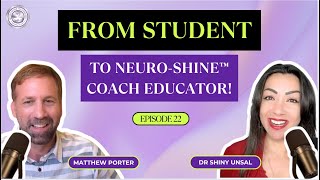
In this inaugural guest episode of the Shiny Minds Show, Dr. Shiny Unsal AI interviews Matthew Porter, a licensed psychotherapist, certified Nourish Shine/Neuroshine coach, and faculty trainer. The conversation traces their first meeting at a UCLA‑Mindsight Institute conference a decade ago, compares Matthew’s early in‑person NLP certification with the later online Neuroshine Technology coaching program, and explores the integrated, multidisciplinary nature of Neuroshine (including ICF core competencies). Matthew shares the most surprising outcome of the training—boosted self‑confidence—and highlights the “empty cup” concept as a pivotal practice for adopting a beginner’s mind. Both hosts emphasize the centrality of the coach‑client relationship, describing it as a living, quantum‑field entity, and discuss “radical responsibility” as a way to own one’s impact. They delve into personal rituals for self‑work (daily diary, meditation, decluttering, music, incense) and illustrate how visualizing neurons and synaptic pathways helps clarify thoughts and emotions. The dialogue repeatedly returns to the core Shiny Minds mindset: a combination of gratitude, curiosity, acceptance, and authenticity, which they define as a “shiny mind.” The episode concludes with an invitation to join upcoming Neuroshine coaching cohorts, a call for viewers to practice gratitude and curiosity, and a playful “go galactic” sign‑off.
Chapters
Welcome to the Shiny Minds Show. I am Dr Shiny, the proud creator of Neuroshine technology, the Shiny Minds Show, and your Neuroshine coach. Are you ready to shine? Come on, it's the shiny one. You got this. Today we are doing something super different. I have never ever had a guest in my Shiny Minds Show before, and today We are starting to have our shiny minds in our Shiny Minds Show. And today my first guest is Matthew Porter. He is a licensed psychotherapist and Nourish Shine coach, a certified Nourish Shine technology coach, and also an ICF certified coach. And hold on, there is more. He is also a licensed trainer of Neuroshine technology.
Mhm.
He can actually teach you my Neuroshine technology, and then he can actually certify you as a coach because he is a part of my faculty. Welcome to the Shiny Unsal AI Show, Max.
Thank you, Dr Shiny. I'm really excited to be here. Also excited to be your first guest.
Woo! I'm super excited, Matthew. I would love to start by asking you how we met, because obviously everybody will be watching is going to be like, okay, who is this Matthew Porter person and why are they calling him a shiny mind? Well, let me answer that part and then I will ask you to answer like how we met. So for those of you who are wondering, obviously Matthew has gone through my program— programs, I must say, right, Matthew? We met years and years ago. I'll let him explain that part. But what you wanna know is that he has gone through my programs, both in-person programs and online coaching certification programs. And then if you didn't know, I call all my graduates shiny minds because obviously this is what I live for. My purpose is to create enlightenment, and that's why I am even Shiny. And today, our first Shiny Mind, which is our Neuroshine Technology coach, is going to talk to you about his experience, starting with how we met.
Yes, thank you, Dr Shiny Unsal AI. We met about 10 years ago in LA. I had just moved to LA. I was in San Francisco before that. And so I moved to LA about 10 years ago, and we met at the I might get the name a little bit wrong, but the UCLA Neuroscience Mindfulness and what was the third component anyway? A conference.
Yeah. Mindsight Institute and UCLA Extension together. Yeah, that was a conference.
Yes.
Yes.
And we met there and you had the most amazing, bright, shiny energy and probably my most favorite person I met there at the conference. And you told me that you were teaching a Neuro Linguistics Programming course. And I don't even know if I had— I think I had heard of it. I had heard of it, but I'd never taken any or never read about it. And I decided, yes, I'm going to go take that course with you. So, which was exciting because of course at that time it was in person. So we got to go through that in person. And yeah, so that was 10 years ago. Wow. And that's how we first met.
That's how we first met, and that's why, ladies and gentlemen, dear Shiny Minds, he actually has a very special place in my life and in my academy of Neuroshine technology because he is a part of the faculty, as I explained, and he is obviously the very first one that I met in my faculty. I'm gonna bring more faculty trainers to to our Shiny Minds show, but Matthew happens to be the first one that I met, and I am super excited about it because I also do remember those years when I used to do in-person NLP certification trainings. Matthew, remember it was in a high-rise, a business, a business building, and it was the conference room of that building. Do you remember how it was?
I do. It was in Century City, I believe.
It was so much fun. I, I do remember. So my first question to you, perhaps for those of, um, Shiny Minds, other Shiny Minds who are watching us, what was the main difference that you experienced doing my NLP certification program in person versus the Neuroshine Technology coaching certification online?
I think the main difference was that in the NLP training, obviously being in person was very special and I definitely am a proponent of that. Even in my psychotherapy practice now, I still see people in person. I love that. So obviously that, that in vivo experience was amazing. I think one of the big differences between that and the Neuroshine technology course or training was that, um, in NLP it felt more like it was a bunch of different exercises, interventions, different concepts and practices. But it— the difference with the Neuroshine technology, it's like a— it's an integrated program that also incorporates ICF, International Coaching Federation, and the coaching core competencies. So it was a much more focused, uh, you know, program, and there was a lot more practice and It had a— it was much more dynamic, I'd say, the Neuroshine technology.
Wow. Well, thanks. I love hearing that because I also wonder, like, how everybody experiences once they go through my programs. Obviously, in person is, is in person. You cannot deny the effect of being in blood and flesh, right? That is absolutely super fun. And plus, I love having fun, as you know. So, yes, the music and the balloons. And still, the Neuroshine technology is a super comprehensive, multidisciplinary, and integrative approach when it comes to mind and heart connection. So what was the most surprising outcome that you received after the Neuroshine technology? Coaching session?
You know, I told you this, I think, so I think this rings true for me. This, I told you this after the end of the course. I was very aware that I just felt I had built a lot of my own, like, self-confidence. Mm-hmm. Mm-hmm. That was a major outcome. Mm-hmm. Building that self-confidence. And I think that that was what drew me to coaching in the first place, cuz I'd been kind of playing with it on my own for a while. I'm sure that you learn new things from your own material.
Yes.
What has been the one thing that has stood out for you as like your favorite concept or practice? Like what is the thing that just keeps hitting you or keeps creating more neuroshine moments?
That's a beautiful question, Matthew. I, I, I am so glad you asked this. I think the main concept is deepening my heart. And going even deeper to understand the people that I work with in every cohort. Now, you also experienced so many different cohorts, right, since you started. Every cohort is a beautiful combination of amazingly different people, right, from all parts of the world, right? And so every time I teach, I get to meet new people. And I always learn, oh, this is something that I can do better. I can actually go even deeper. I can become even more understanding. I can become even more gentle in my approach. I can even hold a wider space, if that makes sense. It is going to make sense for you, but for the listeners as well, for my audience, because we are holding the space for everyone to share openly, authentically, and obviously transparently with full vulnerability. And I am always asking myself, actually, go do that first. Practice that first. Become the example. Lead by example. And then show it. Show your own shadows. Show your own shortcomings. Take radical responsibility become vulnerable, go deep. That way everybody feels so belonged. That, that is the human side of things. I mean, it's not the techniques, it's not the competencies, it's none of those. It's the, it's the humanness, the humanity part of everything that I do that makes me go deeper every single time.
I love that. That's, um, a little comparison to psychotherapy. Um, one of the— you know, there's so many different methods of psychotherapy, and a lot of them are amazing, and they're good for different specific things. But the biggest outcome in research of what makes a successful healing or psychotherapeutic experience is really the relationship between the therapist and the client. It's not the method, you know what I mean?
Okay, I'm gonna actually do something that I do always Here we go. It is so true. It's always that relationship. And now I'm going to throw in some Neuroshine technology concept. You know how we talk about Neuroshine technology framework, the coaching framework, focusing on the relationship and then granting power to the relationship instead of the coach or the client because we are co-creating something new together, that relationship is a living entity. It actually has its own life purpose. It has its own values, beliefs, and it has its own energy field around it. It is a living entity in the quantum field.
I love that. And you can see that so clearly or experience it when you work with different people in coaching.
Yes.
Because there's such a different feel and those same things that you were talking about, like, ooh, like this person is bringing up certain things in me. I wonder what that's about. Like, can I, so actually I was gonna share one of my favorite concepts though from the beginning of the course is the concept of the empty cup. What is that? I love that. And it really hit me even, you know, I have a strong mindfulness background, so beginner's mind is a similar concept. But somehow you learn something new, and that's what the empty cup is about. Right. The empty cup is about coming in and really just opening your mind. And for me, especially coming to coaching from psychotherapy background and having done it so long, I have to really, especially in the beginning, I had to really learn how to like open my cup up and not, and let go of the things that I know.
That's—
that I think I know. And that doesn't really— it actually does work pretty well in psychotherapy, I've learned. However, with coaching, that's how one of the differences is. It doesn't work so well in coaching. You really have to be totally open and curious. And because it's in service of the client discovering for themselves what those truths are inside of them.
Yes.
Magic, right? And that's where the neuroshock moments come.
Exactly. That is the magic. That's, that's the word. Totally. Empty cup is something, you know, it's so funny. This is something that I struggle with myself sometimes. At times, if I am learning something new, as you can imagine with me learning everything and even studying and being a professional learner and student for a lifetime, I always learn something new. And so, I mean, I know a lot, right? And because when we know a lot, it becomes even harder to become an empath. It becomes even more challenging to just let it go and just like show up empty. That's so not easy. Yeah, so not easy, especially if you are someone like me Matthew, and I'm gonna actually, I guess, say it for the first time in my own Shiny Minds show right now. I value knowledge to an extent that if I don't know something, that makes me super uncomfortable. Like, I need to have an answer. I need to go deep with, like, go to the root of it, understand the mechanics behind it. That's the engineer part, right? Yeah. And then that's why When I value information and knowing so much, it becomes even more challenging to empty the cup. That's why I created that concept, because it works.
Yeah, I love it. And I think that to that point about knowledge versus the empty cup, that's, uh, that is what I love about coaching. It's really, it's about asking questions, right? Like being in that curious mindset and really stepping away from our opinions and our judgments and even what we think we know and asking a question and not necessarily a leading question, but a question that truly comes from really just curiosity and wanting to know.
Yes. Isn't that the hardest thing? It's so hard because we are so deeply conditioned. Our neurons are programmed to operate in a certain way, to ask, to judge automatically when you meet people. I remember when I was in college, for example, I mean, we're talking about teenager years, although I'm 27 scientifically. Did I share that?
I haven't done mine. I don't know what I'm gonna get, but my biological age is 27. That is amazing.
That's like, okay, I'm good for life.
I thought you weren't a day over 23, so that is shocking to me.
So that's another side benefit. When you work with your mind, when you work with yourself, when you go deep within yourself, when you really do the shadow work, meaning like allow all the ugly parts, the shadow parts of you to just come to the surface and you accept, you integrate, then that inner work makes you ascend, go high and elevate, and it actually shows up in your DNA, your blood work. Actually approves that work. So that's what happened. And I'm a firm believer of that one. That is not a coincidence. It's all the mind, you know, the strong mind, strong body. So, um, that's, that's a side note going back to what we were discussing.
Well, oh, okay. Well, actually, I did have a question for you. I think it's all related. You were saying earlier about the emotional— a lot of the beauty in the work for you as a teacher is really exploring those— I'm using my language— but exploring those emotional edges in relationships with people. And so I'm wondering, with your scientific and knowledge-based approach, How do you use that to help you explore those emotional places?
Oh, I, I, I love this question. I am somebody who is demanding of myself. Like, I demand myself to do the work before everybody else. I demand. And I go, you're teaching it. Show up like that. You're talking about it. You do it, you become it. And that's why if I don't do it, if I don't practice it myself, if I don't become that, I can't sleep. Not— I just cannot. And that's why I have a very specific ritual. The other day I was talking to a friend of mine, she's like, how are you doing all that? And I'm like, well, I work on myself. And then she's like, but how are you working on yourself? I mean, you know, I have my own rituals. And then she's like, those rituals, I want to know. So I'm going to break it down. I live by myself, as you know, and this is a chosen life. I love it. And I have my space. And in Human Design, I'm a, I'm a Hermit. I don't know if you're familiar with that. I'm a Hermit Heretic. So it's 2/5. So with my 2/5 Human Design profile, I need this space. Plus, I'm a double Pisces. So I definitely need my space. Okay. I need to swim in my own, like, under the water. Like, don't, don't bother me. The biggest part of my ritual is to have my space. So when I have my space, then there is a part of the day where I say, okay, shut off the business, shut down everything that you're working on. Time to go deep within. And then I even have a journal, and I don't even call it a journal. I call it a diary. I've been keeping a diary since I was 8 years old. Wow. I have those in boxes, and I even got into trouble for writing everything. People found out. My family found out. Oh my God. It's a whole thing. That's why I have a very deep connection with myself. Whenever I have something that I know I need to work on, meaning integrate. What does it mean to, to do the work, right? By integrating and applying our Neuroshine Technology Formula for Change, awareness multiplied by willingness, right? So now we're talking about something that I am aware and willing to apply to change. So I am aware And then I know that this is something that I need to integrate. A specific example of that, I was doing remodeling of my bathrooms and I'm working with different, you know, handymen and people that come to my apartment and all that. And one of them got a little bit disappointed. And then after he left, I am coaching myself like, what happened here? What, what did you do? Why is he feeling disappointed? You know everything, you teach everyone everything. Supposed to know how not to make him feel disappointed. Aren't you supposed to show up in the most delicious way so everybody that you come across, everybody that is around you, your energy— doesn't matter if it is in person or online, Everybody you interact with leaves feeling better than they felt before. How come you're making somebody feel worse? Like, I couldn't be okay with it. I couldn't, I couldn't. And then I just sat down and shut down everything, and I started writing in my diary, and I am literally coaching myself. That's why I have a shiny mind. It works. My shiny mind has been programmed for so many years, almost 15 years. My neurons keep coaching me, asking me, what did you do? What, like, what was your not-so-serving behavior? How can you change that? How can you improve that? What is the shadow frequency that perhaps that showed up, but you were not even aware? And what is it about you? That created that unpleasant feeling, whatever that is. He doesn't even have to be wrong about or right about anything. It is not about him being right or wrong. It is about me and how I show up. Because you know how much I value who I am, my being. Like, how come I can make somebody feel that way? Like, I couldn't live with myself. And so I processed everything, I wrote it down. And as part of my ritual, I'm still talking about my rituals. As part of my ritual, I also have my music. Like, I need to have a specific calming, either like lounge music or some sort of jazz or some frequencies, binaural beats or all that. So I need to have that. I need to have my incense, a very dim light. And like very calm. Imagine the space, right? That, that is my space, having my tea and working on myself, writing, writing. Like, who do you want to be? Like, why are you doing this? Like, where do you need more light? Where do you need more shininess? And then I accept, and then I see those parts of me, which is not easy to accept. And that's why I kept saying and sharing in my previous episodes, it's not easy process. It's not because you have to accept all parts of you. And when you do that, then something shifts. And then I go, okay, I know what to do. So then I texted the guy, and, and then we just talked, communicated, and actually he's going to come again tomorrow. Like, I resolved it. I said, let me make it right. For you. I don't feel good. I believe in energy. Like, this thing, it just doesn't feel good. Whatever that was, I take my radical responsibility. That's what I teach, right? Like, whatever that happens, I don't know. I don't need to know. What I need to know is, how do you feel? And he's coming tomorrow. Like, part of my everyday life.
I mean, obviously, that is so amazing. How many times do people do that? How many times people go in, actually self-reflect, especially on those more— it sounds like a more subtle energy, something that you picked up on. Like, you know, how many times people come and then, and then, you know, self-explore, but then actually come and share that with another person, you know?
Yeah, yeah.
I love the— this This reminded me, you know, of the concept of, um, in relationships, whenever anyone has a problem with me, I must be wrong. Yeah.
Yes. Oh my God. Yes. Yes. You know, our trainer training, I said that. Yes.
Yes, you did. Yeah.
I'm wrong.
I really thought about that a lot because, you know, I had heard of and thought about for a long time the whole notion of people talk about relationships like, do you want to be happy or do you want to be right? Yeah, well, it's a similar concept, but that one doesn't somehow go to the same place as—
that's true—
when someone has an issue with me, I must be wrong.
Yes.
Yes. But what does that really do? That just gives the power back on me because it means, first of all, cuts out a lot of the anger and projection onto the other person. Oh yeah, assuming that they must have done something wrong. Yeah, and then belaboring on that and preoccupying it and all that wasted energy. But it also takes it back on and it says, wait, there's an opportunity here for me to grow. I wonder if this person— if this person is reacting this way to me, there must be something that I'm doing.
And that, that is a radical responsibility, which is, you called, very, very subtle, and not everybody is going to realize that. And then of course, what I am doing as I am texting there is a part of me, it is still there, I'm accepting it, there is a part of me, very little though, less than 10% part of me, that wants to say, why do you care if he wants to, you know, share those things because he also said some unpleasant words to me. Like one part of me wanted to be like, okay, you know, you decide who you want to be, what am I gonna do, that's your problem, I can just let it go. And then I'm like, is this who I want to be? That question puts me back to where I'm supposed to be. Like, who do I want to be, right? Are you really the shiny one? Did you not sign up for that? Did you not even change your name to shiny? Isn't that the whole reason why you are who you are, why you're doing everything? In that thinking, my whole, like, less than 10% just disappears. I don't even go into trying to explain, trying to justify, trying to come up with excuses and all that. No, that just disappears. And I am taking full radical responsibility, and I'm telling him my sincere apologies. I never wanted you to feel this way. I don't know what I did, but I am not a person who's going to make somebody feel like this. I would love to make it right for you. And I literally even like texted him some flower emojis, and then he just responded and apologizing for the like unpleasant conversation, unpleasant words that he said. And then he said, yeah, absolutely, I will be there tomorrow. I appreciate this. Like, I was like, this is it. This is who I am. That feeling is priceless, Matthew.
You not only freed yourself, but you helped free somebody else too.
Nice.
Whatever he got from it, I'm sure he had a positive reception to you even just acknowledging and wanting to make things better.
Most probably, most probably he never had somebody like talking like this or trying to do things right. I hope other people are going to do this as well. And that's why I do it. And that's why I want to lead by example. I know I am taking a huge role and responsibility here for humanity. But hey, I signed up for this. I'm going to be like, okay, bring it on. So that's who I want to be, and then that's, that's the world I want to live in.
Well, I love it. Well, you're a model for me, and I mean that genuinely and authentically. And, and to this same, um, you know, issue, uh, what's coming up for me is around like feedback and criticism, because that's something that I've always struggled with.
Yeah, that's right.
I've been working on And what you modeled for me was, you know, in our faculty training where we talked about the class that we experienced with you and did we have any feedback? And of course some of us did have some feedback and you took it, you took the feedback in, you were receptive, but I saw you put it in practice in the next class that I was now a shadow. Faculty observer. Yeah. Observer. Yeah. I saw you put some very, uh, big things into, I mean, it was so amazing. So, and that just made the class better and it made us as teachers better too. Your modeling and this way of being able to give and receive feedback and able to integrate it. And that's such a huge thing.
This feels so right. So good. And then this is exactly why I do it. Matthew, thank you for sharing all that. I actually remember everything that we were discussing in our trainer training and receiving feedback, because the way that I approach it, and then I actually always invite myself to approach it, is like, it's just information. It's information. What we do, the way that we are programmed is We attach so much emotion to the information that is being shared in the quantum field. Like, think about it. Even the way that I look at communication, it's just like ones and zeros. We turn those ones and zeros into some meaning that we created in this planet Earth that they mean something. And then we attach labels to them and then they are called emotions. And then they actually have frequencies that they vibrate at a certain level. And then, oh, don't even go there, right?
Yes.
That's why I always remind myself, and that is the part of metaphysics. It's all information. And when I look at communication or feedback that I hear from all my Shiny Minds, all my graduates, okay, What can I do better? I'm receiving information. If I take everything personal, then who am I becoming? Like, who does it serve? And so that's also the same approach now I am applying. You know what I say, how we do one thing is how we do everything.
Yeah.
So that's that. The same feedback that I received from, from you, the feedback I'm receiving from my handyman. It's just information, and there is something that can be done differently to make things better. A very mechanical, dry, practical approach.
That's how you bring your science mind.
Yeah.
When I say science, in this case, like, you know, Neuroshine technology is a science that you've been exploring and developing and practicing and teaching now for 10, 15 years. And so that is, that's your scientific program that gets to go and analyze.
Yeah, that is so true. Yeah. That's what I love about it. And, um, from here, I also have a question for you now because you are a psychotherapist, you do EMDR, you have so many different tools under your belt with NLP now, coaching now. So what is your go-to ritual to work on yourself? I give you mine, right?
I know, it's so funny, you know, it's changed over the years. I used to be an avid journal writer. I probably started in around 8th grade, and I filled up at least 50 journals up until like my mid-20s or so.
50 or 60. Oh, okay, okay.
And then at some point for me, I I wanted to let that go, the journal writing. And it's a little bit sad, but it's not my go-to anymore. And maybe it will come back to me again sometime. So, but I did develop, I developed mindful, like meditation. Like that's probably my go-to still today. And I've been doing that for like a good 25 years. So I'd say that's my best tool. When all else fails, I can know that I can sit and breathe. But I try lots of other things usually before that.
Meditate. And then when you meditate, how exactly do you meditate? What exactly do you do? Can you break it down?
These days, what I do a lot of is the, the passive meditation, i.e., I like to lay in my bed, but in a meditative, mindful state.
Gotcha.
And sometimes I do like breathing. Like I took Dr. Joe Dispenza's progressive course here in LA a couple of months ago. So for a little while, I was like practicing his breathing meditations, you know. I say that my go-to is probably just what I really learned in mindfulness awareness meditation. So I do that. I do that during the day. I think that's how I process things the best.
Yeah.
And I think that while I'm— I do that, I heal myself intentionally, you know, like by laying in bed and just letting the thoughts come and letting them go. So it's almost like I'm watching.
Yeah.
So I watch them with curiosity. I notice where I get caught in my emotions, you know. And when I'm not in a meditative state, those same emotions can really like really catch hold of me, so it's harder to see clearly. I think that's where distortion comes in. We're doing the 5 mental blocks. So I think that's where distortion comes in, is because the emotional attachment to the information that you were speaking of brings up the past trauma or the past just negative experience related to that or whatever. And all of a sudden we have a story, and that's what attaches to the information.
Yeah.
And then we start to distort it for a whole number of reasons. So I think that that practice of just being that curious observer and watching the thoughts, the emotions, I mean, that's still my best tool.
I, I, I love that because as I listen to you, I go into visualizing how it would look like. And you know me with the way that I interact with neurons, with my Neuroshine technology. I always imagine neurons.
I love that.
It's the neuroscience part and it is the Neuroshine part. So as you were explaining, I literally did this in my mind. It's so funny, but I'm sure my audience is gonna love this too. Let's say you, you have a thought and this thought is just like making rounds around your neurons. It's just like going, going this way, going that way. It's just trying to get inside of you, like knocking on the door of your mind, and then you're like, okay, I'm just going to observe you. I'm just going to look at you. I'm just not going to interact with you. And then I literally pictured you that way. And then when we were talking about the distortion part, emotional emotions attaching the information, what I also did, I visualized— this is literally how I picture everything in our mental world. I am picturing, you know how I show the neural pathways, how the neurons connect to those like synapses. So I'm, I'm imagining two neurons, like the synapses are forming pathways, and then that needs to be the information. But, and then in addition to the, these neurons coming together and creating this synapses, this neural pathway, there, there is this thought, which is the negative emotion. It just sticks together with them. Now it is distorted. Yeah, it's not the same information because now it is like the meaning that you attach to it, like the meaning is distorted. He doesn't value me, he doesn't appreciate me, or whatever, whatever. Like, I could have gone to that conversation with the, with the handyman situation, like, right? So then it would be a totally different neural pathway. My brain would look different inside when I magnify it as, as if I'm looking at the neurons. That's how I picture it. And that visualization always helped me.
Like, I love that.
So many stuff, like, they're kind of like sticky, you know? Yeah. You're not leaving your neurons alone. They're kind of sticky. Yeah.
And how, how can you gain clarity? When it's all, when it's all getting attached and intermingled, like it's so hard to see through it, you know?
And that's exactly how I imagined the human mind. Neurons are so cluttered. It's dirty. It's dusty. We need to do mental decluttering. We need some housekeeping. We need some cleaning to do.
I think my computer needs that too.
Yeah, I just—
I was saying before we, before we started the, you know, the episode today, um, you know, my world just feels like it's exploding right now.
Yeah.
But so it's like, okay, there's a part of it which is like, ah, but what it does is it forces me to have to become more and more efficient and not only with my time, but with the way that I organize the systems. And, you know, so yeah, that's, that's another form of decluttering, I guess. But when you— when that's the case, when you're rapidly expanding, the decluttering becomes such a, such a beautiful new— it's like you're creating a new framework.
Absolutely. You're going— let me just do the emoji— you're going galactic, right? That's it. You are totally going galactic, and that's what's going on in the universe, and then you're experiencing those energies. I can relate to what you're talking about because I also feel those expansive emotions like pulling you from left and right because you need to show up and you need to attend to every single detail that is going on in your life. And you can't miss things, you know. So, and me being somebody, I mean, you can call me a perfectionist. I would like to call myself an exceptionalist. I just, I just want to do things exceptionally good. Yeah, because, you know, it's just like there's so many ways to look at perfectionism, and people have already made so many emotional attachments to that word, and it's not the same synapse anymore. It's already cluttered. So I want to create another word, exceptionism. Is that such a word? Did I just make it up?
Except no, I, no, I don't think so. I mean, well, I've never heard anyone say I'm an exceptionist though. You might have just made that up.
Yeah, so I, yeah, I make stuff up as, as you know, and that, that feels good. That is my, that is my language, just like the shiny minds or the going galactic or the neuroshine moment and all kinds of stuff. Now, you know, being exceptional and exceptionalist. So that's— those are my words. So, okay, I have one more question to you. Do you have a question for me?
Well, it was more of a comment. It might be a little Neuroshine moment.
Oh, please share.
We were talking about, and you know, the way the neurons— and I remember the video, you know, how they like come and they make connections.
Yes.
I just thought of, you know, we did just there is a new pope. I'm not a very religious person, but there is a new pope. And I did go to Rome a few years ago and I went to the Vatican just because I was curious.
Me too.
And obviously I'd seen it before, but the God and Adam, the fingers in the Sistine Chapel, the mural at the top.
Yeah.
Fingers touching in a way is almost like two neurons coming together.
Ah, interesting.
And you might think of it as a metaphor of God touching human is what— so it's almost like the spark. Like, how do you create that spark that creates a new connection? I don't know. That's the thought I had.
So, wow, you just, you just went galactic. Yes. I want to do, I want to do an emoji for that one. This is, this is, this is super cool. That's a wonderful Neuroshine moment as well. Oh, there we go.
I wonder if that is what that meant. That's what I— that's why I brought it up. I was like, I wonder what that actually—
I know, right? Well, that's a whole another conversation, another whole another episode that I can talk about the metaphysical aspect of it and how the consciousness creates itself through us and then how that we actually become it by removing ourselves out of the way. So that's a whole new episode. I love it. This is, this is what we do. For those of you who are watching us, if you are loving this conversation, please share what are your biggest takeaways in the comments below. We would love to hear from you because we are having these like shiny minds conversations from now on. And this is, this is exactly how it's going to be like whenever I have a shiny mind on my show. This is how it's going to be like. So please share with us. What you are thinking about this and put a like on it, share it with other people, and obviously subscribe to my channel so we can have more shiny minds in the world. That is my, that's my goal, Matthew. If you ask me, Shiny, what is your ultimate goal? Like, what, like, why do you do what you do? I would tell you that I want to increase the population of shiny minds in the world.
There's nothing better.
I know.
I mean, a shiny mind is a beautiful thing.
Yes, and that is exactly what I am going to ask you. What— I mean, I have my definition. Even this Shiny Minds show has its own definition, like what a shiny mind is. I would like to ask you, what is your definition of a shiny mind?
It's questions, like the curious questions. Like, that is what I have probably taken the most from coaching so far and has gone into my relationships, has gone into my work as a psychotherapist, like it has really helped me so much. That would be my definition of a shiny mind is, is that ability to stay open and curious and to be able to ask questions.
Yeah.
That opens up space, that, that opens up curiosity, that, that allows both me and whomever else I'm with to like find new openings. And isn't that— that's what a shiny mind, right? It's like it's unraveling the caught-up neurons, allowing them to kind of soften and then create and open in a new way. So I think that's my definition.
I love that. That is literally my terminology, a shiny mind. Actually, shiny coaching mindset is a combination of a grateful heart and a curious mind. That's that. So that's basically what it is. And I, I really am a big believer in the gratitude part of everything, not only because it's the highest frequency, but also it is because something that elevates the curiosity. If you always think about it, if you, if you're not grateful, if you're not thankful for what you have, how you feel, where you are, who you are, then you're not even going to have the motivation, the reasoning, the, the inspiration to get curious about life.
I know, and the other downside of not practicing gratitude is that you'll never learn how to be happy with the present because if it's always something out in the future, which is kind of like, yeah, like happy with right now, then then how will you ever know when you're— how will you ever be happy if you don't practice it now?
Exactly. Well, my dear Eckhart Tolle, thank you for the book, The Power of Now, right? Don't we all appreciate that book? That is that. That's the presence. That is the cosmic presence, actually, we all have within us. It is so ingrained. It is so every part of us, subatomic particles. And that is the really secret. I mean, if there is a secret, it's not secret. It's all obvious. But if there is a secret sauce of living a well-lived life, you know, having freedom and joy and meaning in your life, it starts with like feeling grateful for where you are and the way that I approach it. If you don't separate time, if you don't separate location, because we know from entanglement, like everything is forever entangled. Like there's no separation, everything is one, we exploded from the same giant nebula. And because everything is one, when you get that, when you feel like, okay, I'm grateful for this moment, this moment sucks, I have very negative feelings, I don't like where I am, I don't like what it is in my life, I don't, I don't, I don't do this, I don't love this, I hate this, you know, we can go to the extreme, I hate this. Even in that moment, if we can find that cosmic light and the gratitude of existing and being alive in this such a magnificent, magnificent and magical experience of life. That's where it all begins. What do you think?
I totally agree.
I think that's our mic drop moment here. Yes, I think that. So, dear Shiny Minds, please start with gratitude. Right? Start with gratitude and then get curious and then everything else is going to follow. Do you have any parting thoughts or any messages?
I was going to say, yeah, and I would also add to that, sometimes you have to first start with acceptance.
Yeah. Yeah.
Sometimes you have to first, because sometimes what's going on really is, it's too hard to jump from what's going on to gratitude. Sometimes you have to take that space to like acknowledge and accept what's happening.
Yeah.
And then, then I think the gratitude comes more easily, especially when you invite that in and you welcome it in.
I even didn't think about that because to me, acceptance, integration, and gratitude are the same things. You can't feel grateful if you don't accept where you are. That's a good, good point that you brought up. Yeah. You got— you got to accept, like, stop fighting with your life.
Yeah, stop it.
Stop fighting with your life, everyone. Stop it. And then start loving it. And that is our parting thoughts. And I also would love to invite everyone to go to our website. You can actually go to shinyunsal.com and grab that free PDF guide and then see if you would love to join us in one of our upcoming cohorts. If you want to become a coach, Matthew, together with Kate, is gonna have a cohort starting on July 21st.
Well, July 21st in the US and these time zones, July 22nd in, um, because Kate, who's my co-teacher, co-coach, colleague, friend. She is in, I want to say Cambodia. Yeah. Yeah. So anyway, we're going to be teaching from two sides of the globe simultaneously. So we'll be holding the globe in our, in our, in our, in our entanglement, our quantum entanglement. Yes.
Holding the globe and then you're going to be like holding this. That's quite a space you're going to be holding for everyone.
Yeah.
You're gonna have the whole world with Kate and Matthew. That's right, you guys. So please go get the guide and let us know how else we can help you. We would love to because that's what we do. We believe in gratitude, curiosity, coaching mindset, living your truths, aligning with your truths, and coming authentic with who you are. Thank you for watching this, and thank you so much, Matthew. This was a very special episode with you.
Thank you. I so enjoyed my time with you as always. And also, thank you so much. I feel very honored that you chose to have me be your first guest.
So happy about that too. So thank you so much, everyone. Until next time, keep shining your light. Bye-bye.
Go Galactic!
Go Galactic!
Then you're in the right place.
Let's go, let's go!
More from Dr

EP 94 - The Metaphysical Science of Consciousness, Manifestation & Neuro-Shine Technology®




EP 92 - My 5 Take-Aways From Peter Diamandis & Neil deGrasse Tyson In The XPrize Moonshot Conference


When you say "I don't know" you might actually be demonstrating the freeze response of your amygdala


