HOW TO LEVERAGE NEURO-LINGUISTIC PROGRAMMING TO INFLUENCE YOURSELF & OTHERS
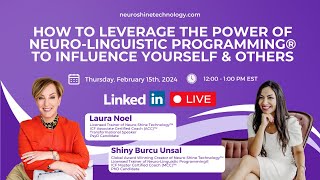
Dr. Shiny Unsal and Laura teach neuro-linguistic programming, a 1970s system for influencing yourself and others through language and modeling. They cover concrete tools like mirroring, reframing, and anchoring, and stress that the meaning of your communication is the response you get. Self-influence comes first, and influence differs from manipulation through pure intention and empowering others.
Chapters
We are live! Laura, Laura, my partner in shine, and me, myself, and I, Shiny Unsal AI, are live again. And another day to talk about neuro-linguistic programming today. Yes!
Yay!
You know, I, I have been thinking about a topic to to choose from so that we can bring our expertise and then we can actually make a difference and add some value to this Thursday, right after Valentine's Day. Happy Valentine's Day to everybody, by the way. And because I started everything with neurolinguistic programming and then it just shaped everything in my career later on, and then I know Laura is very big on NLP and neuroscience as well, so today we're going to talk about that.
Yes, I love it, I love it, and I love the idea of using it for self-influence and to connect with others. And when we connect, we can influence.
Exactly. And so for those of you who are joining live, please feel free to send us your messages. We're going to be interactive, we're going to take your questions. If you're able to write down your questions, go ahead. We'll be happy to make it a Q&A session during or after any time. That's okay. And also what you're going to get out of this 1 hour is that you're going to walk away, as always, some practical tools and techniques. NLP is all about tools and techniques. So you're going to walk away from actionable tools. So be prepared for that and just get ready. If you have a pen and paper, just get ready. We're going to ride. We're going to dive right in. So I'm going to start with the definition of neuro-linguistic programming, and then I am going to hand the mic over to my partner in shine to, to have her perspective about NLP. And so to give you a background about neuro-linguistic programming, it has been a, a project. It has been a school project by Dr. Richard Bandler. So when he was studying at the University of Santa Cruz in California, he's studying mathematics and then he's into computers and then His roommate is also very into psychology because of his own father being a psychotherapist. So his roommate has this huge library of books about psychology. So Bandler keeps reading these books and then gets really fascinated by human psychology. And being a mathematician, he goes, hmm, I wonder if I can formulate human behaviors. So this is, this is all where it begins. And then he is going deep within the thoughts and language and actions, and then he needs a little bit help with breaking down the linguistic patterns. And that's when John Grinder, his partner, co-creator of Neuro Linguistic Programming, comes to the picture, and together They write so many books. If you haven't had any, Structure of Magic is how they started writing and publishing their studies. And then next thing you know, they name it Neuro-Linguistic Programming because it is about the neurons. We're talking about the thoughts, how we create thoughts. Linguistic because there is language tools and patterns that our thoughts generate, we generate. And then programming, because obviously mathematics and computers and psychology, when they all come together, they name it, hey, we can deprogram and reprogram our own beliefs, habits, actions, even personality, our identity. So that's why they named it neurolinguistic programming. And it just came about in 1970s, very early 1970s. Shaping the world that we live in today. Literally, Tony Robbins learned NLP from Bandler and Grinder. Today, wherever you go in the business world, in the creator's world, in the corporate world, in the personal world, there is always neuro-linguistic programming because it is giving you the structure of what we are already doing. So that's how NLP came about, a little bit of the background, and The way that I got involved with neurolinguistic programming was through the book that my dear brother gave me in 2003.
Wow.
That bag. And my brother is like, I know you are into personal development. I know you've been reading all kinds of books. Read this one. You're going to like it. And it was an NLP book. And that's how I started. Right. It's crazy. Right. And then, but, but watch this, Laura, it took me 6 years to go to a formal NLP training. So for anyone who is watching, listening, if you're interested in NLP, neuro-linguistic programming, and if you're not committed to it, like, like I was in 2003, because there is like a 6 year gap in between, you're gonna miss a lot. Like, you're gonna, you're gonna miss your, your whole life. Do not wait like I did, because it truly transformed my life. So I went from this corporate executive in Istanbul to a business owner in Los Angeles, California, within a year. So I'm telling you, do not wait. We're gonna dive deep into the tools and techniques And still, for me, it took 6 years to get into the training and get my practitioner certification and then master practitioner and later training and all that. But this is how I started with NLP. And I want to hear from you, Laura. How did you start with the world of neuro-linguistic programming?
Yeah, so I started working on my mindset back in around 2013 when I was in the Air Force. And I, I just was engaging in some really unhealthy patterns and how I saw myself and my life. And even though I was really successful, I wasn't feeling fulfilled and I didn't value myself. From the outside looking in, you wouldn't have known that. So I started diving into the world of my mind and my thoughts and really started dissecting them. Um, fast forward a few years later, I met Bob Proctor at one of the personal development seminars, and I was just wanting— yeah, I was wanting to go deeper into my mind and my deep-rooted beliefs and paradigms that were keeping me stuck and keeping me not liking myself very much and holding my, you know, things that were holding me back from really stepping into the things that I knew that I could do and fulfillment. And that led me to working with Bob Proctor and studying the mind and studying my mind and helping other clients study theirs and get results that they were looking for. And then I started to get really curious about the neuroscience and psychology behind all of this mindset work. So I started— I, I'm in my final research now for my PsyD in the neuroscience of leadership psychology at William James College. Um, just a couple more months, I will be Dr. Laura in June. That's when we graduate. I'm so excited about that. But while I was in my programming I had been coaching for many years, but I really wanted to understand neuro-linguistic programming. So that's when I met Shiny Unsal AI.
Yeah.
So as one of my practicum sessions within my college program, I got ICF, International Coaching Federation, certified as a coach with a background in neuro-linguistic program, and then I later became an NLP practitioner. So I'm still on my journey, but I love how there's more tools here that really shape the brain, shape our mind, shape how we see ourselves and the world around us. And the language we use in our— even if we don't articulate the words, the words that we're thinking shape our reality. I just, you know, so parts of our brain that control language are also involved in regulating our heart rate, our hormones, our immune system, our breathing. So it literally means that the words that we're connecting with, the words that we use, the words that we continuously think shape our brain and influence how we think and how we act. So I love the idea of NLP because we can use words to create new structure in our brain and alter our reality.
Oh, yes, very well. Alter our reality. It is because it literally dictates our reality. The words that we use and do we choose. It is so deeply coded into our subconscious that we don't even realize the effect of the words and the language that we use in our everyday vocabulary. So it's interesting here because, you know, English is my second language, right? Yeah. So coming from my Turkish background and learning neurolinguistic programming in English and then becoming aware of my own Turkish subconscious programmings and then learning English in a way that, hey, I am going to choose my own language and I am going to be very selective because this is my second language anyways, right? So to me it was also very interesting because of this. And now you also know, Laura, I was able to create a totally new vocabulary out of my own.
Yeah, exactly.
So I, I literally create my own words and I love playing with the words. And then I, I, I bring it to people's realities that, hey, you can do anything with it, including changing your name. Which I also did. Yeah. So in 2015, after teaching NLP for 4 years by then, I realized that something deep was shifting in me. And that shift was so noticeable that I wanted to own it at another level. And because I was also very intentional with the words that I choose, I went ahead and I said to, um, to do— to the government agent that, hey, I would love to change my name because I'm already becoming a citizen. And then I owned Shiny. That's how I renamed myself, chose my own vocabulary, chose my own perspective. And I've been, I've been shining since then. I mean, yep.
And that's who you are.
Exactly right.
You had the vision and that's— you became her. You, you wrote her and you became her.
It's literally that, you know, the cycle of life that I talk about.
Yeah.
Like, that's a great example of NLP in action. Like, everything begins in the mind, and Tony Robbins breaks it down so very well. Everything begins in the mind as, as an idea, as a thought. And then if you actually hold onto it and do something about it, it became, it becomes a decision. And that decision, if you act upon it, if it becomes an action and behavior, and then that behavior, if you keep repeating, it becomes a habit. And then in time, you're going to start believing in it. It's going to go subconscious. And then with it over years, you're going to shape your own personality, your own identity, your own destiny. So that's how I created Shiny out of myself. And it is all NLP. There's so many amazing tools that I can go on and on and on. I want to ask you, Laura, which has been so far your go-to NLP tool?
Um, hands down, easily. I mean, it's integrated into my life and the conversations that I have, particularly when I'm meeting new people, or I'm coaching, definitely labeling in conversation and that verbal mirroring, for sure. I talk about those all the time.
Right.
And, you know, when I'm connecting with somebody new, you know, a lot of us aren't taught to listen. We don't do that very well. And oftentimes when we're meeting somebody new or we're wanting to really connect with somebody or, you know, influence the direction or course of something and influence somebody else, I mean, in order to really do that well, we have to have a relationship with them on some level, right? And so when we're using some of these tools, it makes the other person feel heard and valued and understood. For example, verbal mirroring. A mistake that I hear all the time, and I heard it just recently, is somebody said, oh, when somebody talks, I paraphrase what they're saying. And I used to do this too. I paraphrase what they're saying to let them know that I've heard them. I've digested what they said and I'm saying it again back to them in my words. But, you know, we were just talking about how words matter and words have different meanings. The same word has different meaning to different people. And so when we hear somebody say something and then we paraphrase it, that's our own meaning that we're putting on it. We're not hearing what they mean. What's the meaning behind what they're saying? How does it feel when they're saying it, right? And so when we are verbal mirroring somebody, we're repeating back, maybe the easiest way to do it is to repeat back like the last couple of things they just said, you know, or we can pull something, exact words that they said in whatever they're talking about and bring that back in because it's their language. And then they feel heard. Heard and understood. And then it inspires them to expound upon what they said. And then they feel, you know, heard. And you're, you're establishing a connection there. I love, I love playing with that tool because I love what it inspires in other people and it just injects energy into a conversation.
Oh yeah, that is, that is so very powerful indeed. Totally, totally agree. And you know, my approach to it is I look at our brains as our computers. That's a computer here. A word that they use is so-called, what I call, a mental file. So when you click on that mental file, the content that you're going to have under that word is going to be so different versus if you paraphrase it and use your own definition to it. They will not have the same content, the same ingredients. So it's not going to be the same cake that you're trying to bake. So it's gonna— it's not gonna resonate. And then you'll be wondering why you're not deeply connecting with people. So this is so such a subtle thing, so powerful actually. So I totally agree with you Laura. And I want to talk about the presuppositions of neurolinguistic programming. Obviously, that has become the basis and fundamental bedrocks of my NeuroShine technology. And when I was studying neurolinguistic programming, which, I mean, I, I guess I've been to like 7, 8 different trainings, let alone learning from Dr Richard Bandler himself, I wanted to see how others are teaching and how they are approaching, what else it is there. So my biggest challenge was to learn about the presuppositions. There are like 8 presuppositions that Bandler and Grinder came together when they created neurolinguistic programming. So those presuppositions are kind of like the whole principles, but they they didn't go deep into it. And then I was so curious about it, and on my way to try to understand those presuppositions, I discovered a lot about other things. And my biggest challenge was the presupposition number 2, which goes: the meaning of your communication is the response you get. I literally thought about it for years and years and years, Laura. I was like, yeah, how is like the meaning of my communication is the response I get from others? Because I'm, I'm in a taxi, taxi, um, in Istanbul, and I am having a conversation with this gentleman. And then he is in such a totally different mental state, right? He's smoking. He doesn't care. He has his own music. It's just like, well, not very respectful in my own understanding. And I am contemplating on that. I never forget that moment. I'm contemplating on that second presupposition, like, so how is it that, like, the meaning that, that I am trying to make is the response that I get? And then it just hit on me that day in that taxi, because no matter what we do No matter how great of a communicator we are, which we really need to get a hold of everything that we, we send as a message in terms of the content, the selection of the words, the tonality and the body language, how you, how you share the message is more important than the message itself. Yes. And there is one and here and if the receiver that you're trying to send the message to is not in the right mental place, state, guess what's gonna happen? The meaning that you are going to receive from them is gonna go to garbage because it's not about you. That just hit me that day. It's literally that— that's it. Like, the meaning of the communication is, is the response you get. Because you think that you're communicating something, you think that you are so clear, and then you think that you put everything into it to make yourself understood. And yet, let's look at the receiver. Let's look at how they are receiving it. Let's look at the filters that they have in their own mental world. What kind of filters, what kind of emotional state, what kind of problems they are having that they do— do they have the resilience Do they have the capacity to really truly understand and hear you? So that is why I was so excited to finally make sense of that presupposition. And then I came up with my communication principle out of it, as you know. And so for those of you, the tip of this communication principle based on NLP is that please be really truly 100% careful and responsible. For all the words that you select not to trigger people, and the tonality that you use, the energy that you put behind, and your body language. And then when you know 100% you are in a beautiful state of flow and consciousness and love and appreciation, and the person still receives you in the wrong way, let it go. Not about you.
Yeah, you know That reminds me, because I've— I'm facilitating classes with the Arbinger Institute, and the idea is to have an outward mindset. How do you develop an outward mindset? And this really ties into this so well, because when we're inward, we're thinking about our message, our desire to get it across, our thing that we need to say, you know, our frustration and wanting to address it, right? And we're thinking about ourselves. Whereas if we're applying this principle, if we think outwardly about the other person, we might have a message that we really need to communicate. But how are they likely to receive it? What's important for them to know? How might this land on them? What would be hard for me to say and difficult for them to hear? And how can I say it in a way such that they're able to receive it. So we're really seeing— we're humanizing the other person, not seeing them as an object, right? We're really considering that in our communication because think about it, we can say anything, but the energy behind and how we're seeing that other person is what's going to be felt from the other person. And ultimately, that's the feedback we're going to get in, in how effective our message was and the meaning really was. Because we, we create our results and our results are a reflection of what's going on inside of us.
Always. Yes, that is so true. Because, you know, we live in the, in the world of energy. So everything is energy. So we're, I mean, we're, we're going to stay on topic with neurolinguistic programming and it still ties into energy.
It does. Yeah. Yeah, because there's different modalities or different ways that we communicate with people. And so it's more than just the words. It's like you said, considering that other person and their filters and what's going on for them.
Yeah. And that is what we call, as you know, in the world of coaching, we call this level 2 listening, even level 3. I mean, level 2 basics and then level 3. Is for the real life forwarding type of coaching. You, when you have the ability, you focus on the person in front of you. What do they need? What am I, what am I picking up from their energy, from their body language, from the way that they, they raise their eyebrow? Like, what is it? So when you're able to pick up those little cues, then you can really go in with your NLP skills and techniques, and then you can really make a difference and influence them. So now I believe it's a perfect time to talk about influence because that's our topic, to influence other, uh, people. So I'm gonna start with what I believe, and I'm gonna share it, and I'm gonna pass it on to you, Laura. Yeah, what I believe about influence is, is everything, it's gotta start with you. Right? If you have the ability to influence yourself, if you know exactly how to do that, if you are able to break down, here's what I need to do, I need to say, or I need to stop doing and stop saying. If you have that breakdown, your own checklist about how to influence yourself, then you're in the game. You are in the game. And then you can totally influence others because you know have to analyze and have to look for all these patterns to hear, to break down, and to redesign. And that is literally what NLP gives us. I mean, NLP, in my early years when I was using, studying, I didn't even realize that I was naturally doing it. And then that's the part of neuro-linguistic programming. Bandler and Grinder, they were so genius. That they studied what we're already doing, like, as humans. So they studied what we're already doing in terms of what works, and then they created a structure around it. For example, building rapport, right? So the example that we gave, mirroring what people say, the exact same word— if they say fabulous, Use fabulous. Do not paraphrase it. Do not say, oh my God, that was wonderful. No, wonderful is so different for them. Stay with the fabulous and then keep that word because it's going to build rapport. And that building rapport, we talked about it. It's like mental files. They have their own meanings attached. They have their own experiences attached and then their emotions attached. It's not only brain level, it's at the cellular level that they connect to the word, and that's why it helps to build rapport. And it's just one way of doing it. The other way of building rapport is using your body language. So as I do these videos, and you know that I, I share a lot about content from, you know, all kinds of disciplines, and I watch myself as I am speaking the videos, and then I realize All the hand gestures and the movements and the head tilting and all that. When somebody is talking in front of you, if you are nodding your head, if you're using your hands as you are talking back to them, this is also a public speaking skill, obviously, it is going to send them a subconscious message that you're important, you're, you're feeling heard and understood because of the way that you use body language and because you build rapport with them. And those are subtle things. And sometimes when I look at people, they don't even realize how their face looks like. So everybody, please become aware of your muscles on your face. Sometimes you look like this. It is important, especially when you're having a conversation, when you're expressing yourself, bring your full self to the table, not only the words. Words are easy. They're just going to come out and then you can share either like 100 grams of words or half a kilogram of words. Like, it's not about the words. It's about the energy that you put into it. That's how you build rapport and influence yourself and others. When you say, I am excited, like you want to embody the word of excitement versus saying, yeah, I'm excited about it. Oh, I am not convinced. Right? So there are so many deepening tools and techniques with neuro-linguistic programming. And again, going back to my point of influence, first of all, you gotta influence yourself to influence others. You gotta know how to influence them. You gotta study them. You gotta understand them. You gotta understand some human psychology and then break it down and have your naturally good ad tools so you can apply and integrate and become those in the future. What are you gonna say, Laura?
I think that's, that, I mean, we've mentioned that using their language, the importance of that really builds rapport, and I love the idea of your facial expression and your body language, and are you engaged, are you engaging, you know, are you interested in what they even have to say, they feel that. I think another piece of this too is the language that we're using within ourselves before we even engage with somebody. You know, what limiting beliefs do we even have? And NLP can help us overcome those. Like, you know, instead of saying I'm not good enough or, oh my gosh, this conversation isn't going to go well, they don't like me, I can't do this, you know, understanding what are some of these filters that we have that are influencing how we show up in a conversation. What generalizations, being aware, and assumptions are we carrying about that person? And reframing, to reframe it in our minds, you know, before we engage in that conversation. Again, it's that energy shifting how we feel on the inside and how we're seeing the situation and our capacity to be engaging and to engage and to listen well, and how we see that other person, that can be felt and experienced from that other person without us even saying a word. So reframing can be a really powerful, powerful thing to do. The other thing that I wanted to mention, too, is, you know, we're practicing mirroring and verb, you know, in our body language, maybe, or in our in our intensity and our, you know, and how we're showing up in our energy, in our words. Also, I think even labeling and helping people to draw out from people can establish rapport. Like, if somebody's talking and you're sensing some disconnect between the words that they're saying and their body language, you might say, gosh, it looks like this feels a little bit uncomfortable for you, or it sounds like this was frustrating, you know, and so it can open them up to explain, right, what they're thinking and what they're feeling and to really bring that connection back so that they're in alignment. And that builds rapport, you know?
Yes, yes, definitely. It totally makes me smile. I'm like, yes, yes, yes.
Yeah, that's so powerful. And I think, you know, we talk about asking powerful questions in general.
Yes. Right. And that's— you see, that's why I started with NLP and then I found myself in the world of coaching.
Yeah.
Yeah. You see what I'm saying? It's like, yeah, because, you know, when I started NLP, because I'm curious and I want to learn about my mind, my own brain, I am an intelligent person. How can I be even more intelligent? So it all started with that curiosity, and I went deeper, deeper, deeper, deeper, and then I realized that NLP is all about influence. Yeah, to influence others. Again, I'm gonna go back to it— self-influence first, right? When we talk about the subject of love, I will always begin with self-love. When we talk about enlightenment and then consciousness, I'm gonna talk about self-consciousness, self-enlightenment. It all begins with us. And therefore, when it started in my own mind and it just like got rooted so wider within myself that I realized this was so powerful, and then it became a coaching methodology for me that works and creates magic, literally magic. Even NLP is showing how to create those powerful questions. That we are teaching today with the, you know, um, ICF accredited Neuroshine Technology coaching certification programs, all rooted in NLP, Neuro-Linguistic Programming, because NLP comes with this basic principle that we want to avoid pain and gain pleasure. So it's all about— life is all about pain and pleasure. How can we end suffering, avoid pain, and then gain more pleasure and live joyfully, right? So this is the basic concept. And then there is duality, there is pain and there's pleasure, there is black and there is white, there is dark and then there's shiny. And so all that merges and then it just finds its, its roots, like water, to, to, to, to go. And it is literally rooted in neuro-linguistic programming and the way that we structure our questions. And the coaching world becomes even more powerful with neurolinguistic programming because questions are literally— think of questions like, like hooks. You know, you're fishing, all right? So imagine like this, imagine with me, everybody. So we go fishing, we go fishing. What are we fishing for? We're fishing for what we call neuroshine moments. We like aha moments of truth. It's true for them. Like, we hit somewhere that is so close to their heart, that is so true for them, so they want to own it, they want to embrace it, they want to take it deeper, right? That's what we go fishing for when we do coaching. So with the help of NLP-based questions, powerful questions, when we are able to apply what we have mentioned before with Laura, when we said we want to understand who that person is, we want to look at what they need, we want to pay attention to their body language and their tonality, and now what they might need and what they might like, and pay attention to their words and all that. When you put them all together, it's a lot of mental processing, right? So you want to put these mental processing in a very, very well-formed structure. And that's what NLP gives you, gives us. And that's how I feel so empowered. And that's how I have been able to teach not only NLP personal development, but also coaching and influence to, you know, people for so many years now, is because of that power. So let's go back to the fishing. So when you are coming with the idea of fishing, I'm gonna fish for your own truth. And what do I have? What is my hook? My hook is my questions. And what do I do to create these amazing hooks, those questions? Well, you have the mechanics of neuro-linguistic programming, and that needs to be instilled in you. So you've got to program yourself with neuro-linguistic programming as your perspective, the way that you perceive the world, so you have A very clear structure around thoughts and language and behaviors and emotions. Why people say that, why they behave that way, what is the pattern behind it? What is the attachment behind it? So when you're able to put them all together and then go fishing like that, that's influence. Mm.
Yeah. You know, I was just recently having a conversation and a really powerful question came out of that. And I love this. In the context of NLP and having the structure and powerful questions for ourselves. And so if something is happening, things happen for us, not to us. So but if something that's— and that's a reframe, right?
Yes.
If we feel like something's happening to us, a powerful question that we can ask, because we're all born worthy of love. Like, I have a picture on my phone of my childhood self. Like, who could be mean to that little girl? Like, I have friends who do that. Like, to remind ourselves that we're born of, of love, and so we're all worthy of love. So, um, since I'm worthy of love, why is this happening? Since I'm worthy of love, why am I experiencing this? Since I'm worthy of love, what else could this mean? So it, it helps us ask that powerful question and re-shift our mind. Like you talked about the law of polarity, there's up, down, in, out, hot, cold, dark, shiny, right? And so we can't focus our brain on two ends of the spectrum at the same time. So when we say, when we ask a powerful question like that, then it forces us to, you know, look to the answer, the truth, the right answer. Right? It redirects our energy to something different. And it takes— if we're having a difficult— if we're wanting to build rapport with another person, then maybe we have a strained relationship with that person. Since I'm worthy of love, what else could this situation mean? Well, it's not about me. It's not— it's not about me. There's something going on with them. So let's take the heat off of ourselves and then just see that person in their truth. Yes.
Oh, so beautifully said, because we are all light. You know, they have their own life within and they're going through their own suffering. And at the moment we are able to see that, the world is gonna collapse its way function and we're just gonna remember who we are. So anyways, going back to NLP again. So I love that. That is so beautifully said. A very practical question to ask yourself: since I'm worthy of love, Why is this happening to me? Huh? I love it. I love it. So as we're talking about influence, I also want to mention what is not influence. If you have paid attention to the description of the event that I have written on this LinkedIn Live, there is a word that is repeated again and again, ethically, right? So because NLP is so powerful and because it gives us such a powerful structure for understanding human psychology, including thoughts, language, and actions and behaviors. Back in those days when it all came about, it was also perceived as the science and art of manipulation, right? So it has been there, but it was so like— it's like so 1970s, right? So let's, let's put it in, in, in that, in that way, in that structure. So right now, NLP is actually something that empowers you to get closer to your truth. So if you are somebody watching, how can I influence my manager, my team member, my husband, my wife, my kid, my friend, my lover? So if you are watching NLP with that purpose, there is good news. The good news is that the way that you show up, being able to influence yourself, is already going to influence them. So what is not influencing is forcing. What is not influencing is manipulating. What is not influencing is using all the words and the techniques to make it like a game so that you get what you want out of it. Trust me, I've been there, done that. And then I have seen it. I have experienced that so many people with not very pure intentions and not very great conscious levels, they tried and then sometimes it's going to happen. And so by educating yourself about what NLP is ethically and how you can use it to influence people ethically, you will see that it is all about you and then how you show up. And the way that you show up is going to inspire other people to show up like that, because you're going to show up with your true self. And that is how NLP is going to deepen you. That's how I used it for. And I am going to remind you that when you are able to come with the intention, the pure intention of, I am here to empower you to shine your own light within. That's the concept. It's not like I am this amazing person with great tools and then you little creature, you have no power, you are clueless, let me just do my things on you so that, you know, I can do this and I can fix you and I can influence you. That's not the point. So yeah, for everybody to please pay attention, like, what is not influence and what is not using NLP ethically. And in the world that we live in, the modern and high conscious world, people are going to notice that if you come with your own personal agenda to influence them towards your own personal agenda versus take your agenda out of it and then come with pure intention to empower them to to shine their own light within, right? That's the whole idea about us sharing our tools and our knowledge and our expertise here so that we are able to get lost and merge with their own agenda. And then we can help them and show them, guide them, empower them to find their own light within. That's what I wanted to mention.
Yeah, it, you know, ultimately when we're using these tools and we're wanting to establish rapport, we're looking for higher levels of collaboration and connection. And I can tell you from my personal experience, um, when we are using these tools for ourselves to shape how we see others and how we connect with others, like Shiny's saying, the the change and the collaboration happen. Um, I, I often tell this story about my husband and I and how I was using all these tools like on myself, and we would always have this age-old argument of house cleaning. And, you know, I would— who's, you know, who's doing what, who's not doing enough. And I, I thought he needed to change. I was like, oh, he needs, he needs this stuff.
Oh yeah.
And I started using these tools on myself and because I showed up differently, I wasn't trying to influence him, I wasn't trying to fix him or change his behavior, but by working on myself using these tools, I gave him a different version of myself for him to respond to. And he did. And that's so— that's a mic drop moment. That is so powerful because—
and it's the truth.
And It's happened countless times. You can't change another person.
Exactly. Exactly. That's the point we want to make here because we were talking about how to influence others with the power of NLP. Well, the idea is you can't.
Yeah. Yeah. It starts with us, right? Then we're showing up in a different way.
Exactly.
Eliciting a different response.
Yes, you can only influence another person if you are able to influence yourself to show up as a better version of yourself. Like Laura says, I just love when she says it, I am giving another person for him to respond to. Oh, what a delicious way of looking at it, right? Give them another version of you to respond to. So how can you— so here's, here's the million-dollar question, everyone. How can you become this so delicious, so whatever your word is, top, your best version that goes into any situations, any people, conversations, anything that you need to influence, and then you achieve that? Who do you need to become for that? That's the million-dollar question. And I want to hear if you're watching or if you are watching it later, when we are done, please put a comment below. I would love to hear, I would love to hear your comments. That's basically my own question. And then that's what I have been searching with, with my own research, with my PhD. And oh, by the way, I got to actually make an announcement here.
Yeah.
In July, right before we meet in Istanbul for our NLP training, I'm excited. I got invited to European Positive Psychology Conference to share my research about consciousness and living in alignment with our truth. So that's, that's, that's exciting. That's so cool. So that's what we're doing, everyone. We are not only talking and sharing and bringing our expertise and knowledge, but we are also deeply researching. And that's why I respect us for that. Like, how about that?
Yeah, I like us for that and a multitude of other reasons.
Exactly. It's just one point.
One point.
You see, this is also part of NLP. All right, everyone. So you can totally program yourself to show up to speak the way that you want. And I do that a lot and I love it.
Yeah.
It's just so cute. Isn't it cute? It's fun. It is fun. Yes, certainly. All right. So we have 10 minutes left and I would love to hear your Your final words, maybe words of wisdom to share with everyone, Laura.
Hmm. I would say when connecting with other people, wanting to impact your influence, do it with them in mind. Communicate with them in mind first. And then all of these tools like the mirror— mirroring will come naturally, um, labeling will come naturally, a lot of these powerful questions will come naturally, and they will actually be attuned to what they're saying. I, I think if you, if you put that other person in the forefront of your mind first, yeah, um, while shifting how you show up, that's going to be outstanding. You're going to have tremendous influence.
Yes, absolutely. I, I totally agree with you, uh, for that one. And for me, as someone who has been studying, researching, collecting evidence, and teaching neuro-linguistic programming since 2011, I gotta tell you, I've seen a lot, and I have I can tell you a lot, and it depends on what you are looking for, right? It depends on what kind of influence you're looking for in your life. Um, and although it depends on the specific outcome you're looking for, my answer will always begin with self-influence. So please commit to influencing yourself to become your own best version, to become your own best friend, to become your own leader, the creator of your life, the, the person that is always there for you, the person who's gonna always show up with resources, ideas, creativity, empowerment, encouraging. That is how you are going to shift the inner game. Influence is an inner game. When you're able to shift your own inner mechanics, let me put it that way, then you will be able to influence it in a way that you cannot help it. And then that's why I even have, I even have a hashtag for that, a hashtag cut out, like literally I use those.
Yep.
And it says hashtag can't help it, because that's the idea. When you work on yourself, when you shape your own reality, when you focus on you and taking those— like, I want to use a metaphor, like take the poison out from whatever that is so beautiful left behind. Take whatever doesn't serve you. And every time you notice something, take it out. And that way you will be able to shape yourself into a person that is not— like, you cannot help but influence others. And as you have also heard me use a lot of metaphors, that's another NLP tool, by the way. I mean, if you haven't— it sure is. So I have also become the queen of metaphors. Uh, obviously everything that I, I say and do, because I learned that metaphors, again, it hits somewhere deeper in you as you are listening to me talking about fishing, as you're listening to me talking about two different parts of yourself and going like changing cell at the cellular level. And so those are the, the things that you want to write down as your takeaway, maybe. Metaphors, reframing, and anchoring, building rapport, influencing myself, becoming aware of my own filters. And how do I listen? I make, make myself clear enough so that I communicate powerfully. How do I make meaning? So it's like when you ask these questions to yourself, in time you're going to become a master of yourself and self-mastery. That's where we begin. And then when you are able to master yourself, you can apply our formula for change: awareness multiplied by willingness. Yes, multiplied by so much willingness that is going to shape a delicious version of you so that you can keep influencing the world, keep influencing the Earth, the stars, the galaxies, the frequencies, everything that is here for us.
Love it.
So that's beautifully said. That's my galactic ending.
I love it.
That's my galactic ending, everyone. And of course, if you would like to learn NLP with us, right? Yep. So I'm gonna put the link below so you can always go to the link and join us in our next cohorts. At the Academy of Neuroshine Technology. Neuroshine Technology is a multidisciplinary curriculum that is rooted in neuro-linguistic programming, NLP, and heavily quantum physics, and still mostly NLP. So just reach out to us, message us, click on the link, whatever you want to choose as your method of communication. We are here for you. So until next time, I'll say keep shining.
Thanks for listening.
Okay, bye-bye everyone.
More from Dr




EP 92 - My 5 Take-Aways From Peter Diamandis & Neil deGrasse Tyson In The XPrize Moonshot Conference


When you say "I don't know" you might actually be demonstrating the freeze response of your amygdala




EP 90 - What Happens When Coaches Go to the Next Level? | Inside Our ICF PCC Path