REDESIGN YOUR LEADERSHIP MINDSET TO EMPOWER YOUR FUTURE SELF & OTHERS!
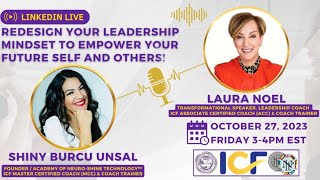
Dr. Shiny Unsal and Laura Noel argue that traditional problem-solving leadership fails today. They propose a coaching mindset instead: ask open questions, listen deeply, and use the formula Change = Awareness × Willingness. Empowering others starts with empowering yourself.
Chapters
All right, we are live. Here we are. Join us. We are live. Guys, we are waiting for everybody. Yep, join us. We have this music, keep the energy going. A leadership song. The energy. One minute. All right, now it is 3 PM sharp. I think, um, we should begin. I'm gonna turn off the music. There we go. Okay, yeah. Hello everyone, this is our very first LinkedIn Live as the faculty of Academy of Neuroshine Technology AI. I am Shiny Unsal AI. I am the founder of the Academy of NeuroShine Technology. I am an ICF Master Certified Coach, and I am excited to talk about redesigning your leadership mindset to empower your future self and others together with my faculty member, my colleague, my peer coach, my dear friend, Laura Noel. Laura, can you please also introduce yourself?
Yeah, absolutely. I am so excited to be here. This is our first time doing this together. And I'm, I'm really excited. So I am an ICF Level 1 ACC coach. I'm also a candidate, PsyD candidate, in leadership and the neuroscience of leadership psychology at William James College. I just have this semester and next semester and then I will be finished. I am a Proctor Gallagher Certified Coach and I've been studying mindset and leadership, gosh, since I was in the Air Force. I retired in 2017 and started my coaching business, and I'm really thrilled to be here. This is my passion, as it is with Shiny, and that's why we connect so well together.
Yes, yes, totally. You know, I also want to say that I have been studying leadership since ages, you know, and then I have been studying and I have also been teaching leadership because, you know, I am a member and a faculty member of UCLA Extension as well. So I have been designing and delivering leadership communication strategies to professionals from all over the world since 2012. And leadership is a way of life, and leadership is how I look at life as my perspective. And so that's why we would like to talk about leadership with you today, with Laura. So, and maybe it is also a great opportunity for me to make my announcement that Laura will be joining the Academy of Neuroshine Technology. Obviously, if it wasn't clear, she's going to be joining the faculty to teach ICF Level 1 Nourish Shine Technology coaching certification training with me in the years ahead. So we are excited and we are also celebrating that, aren't we, Laura?
Oh my gosh, yeah, I'm thrilled. Um, you know, this is something that I've been doing, and, um, to partner with you in this is phenomenal. I mean, like you mentioned, with your adjunct faculty work. And I'm doing that here at William James College and facilitating with the Arbinger Institute. And then to be able to bring this NeuroShine technology in a different way of helping leaders emerge as more powerful leaders with these ICF principles is wonderful. I recently got certified in ICF. It was in August.
Yes, I know.
Now I'm in my level 2. And it's been so mind-expanding, just a different way of coaching and leading other people. It was not an easy journey, I would say, because I was so ingrained in different ways of what I thought was coaching. But this has been a much more expansive way in leading and helping people find their own leadership of self. And it's a lot more fulfilling and a lot more rewarding. So I want more people to be a part of this, whether you're looking to be a coach or you just want to be a better leader and inspire more people.
Yeah, very well said. And thank you. And I am like, do we have emojis here? I so wanted to share my emoji with you. Well, here comes my emoji. There goes my heart. So this is exactly why we are here, everyone. We are passionate people, leaders who are passionate about inspiring other leaders to inspire other leaders. And then we create a ripple effect in the world and make a bigger difference together. And that is also why we decided to talk about leadership. So this is a leadership conversation. We all begin leadership within ourselves, especially In the world that we live today, we have the artificial intelligence that is so in our world today, so in our daily lives that we cannot escape it. And when you look at future, 2, 3, maybe like 5 years in the future, this world is absolutely going to be a different place with the artificial intelligence ingrained in our daily lives. That's why we decided to talk about the leadership with Laura. We said, hey, AI is coming from left and right and so strong. What about EI? What about emotional intelligence? And how about integrating AI with EI, with emotional intelligence, and looking at the importance of emotional intelligence in our leadership mindset? The way we show up as leaders. And that's why we're going to talk about leadership with emotional intelligence and coaching mindset style in the AI world that we live today. And to begin with, I would like to ask Laura— this will be like a conversation, okay? We're going to have a conversation with Laura. So I'm going to be asking her questions, she's going to be asking me, and we're going to share our experience, our practical tools, our methodologies, maybe some ideas with you. And then that's how it's going to go. And please feel free to join us in the chat. They can, they can message us, right, Laura?
We can see your comments. We're streaming live from StreamYard to different places. So like if you're on LinkedIn, you can simply type comments and we will see them. If you're on Facebook, you might have to click on the StreamYard link for StreamYard to, for you to grant StreamYard permission. And then when you post comments, we will see them collectively here. So I appreciate you doing that if you have comments or questions.
Yes, let's have it together because this is a conversation. Okay. So we are having a conversation to redesign our leadership mindset to empower our future self and others. That is the conversation. And I would like to begin by asking Laura, Laura, what do you see as the main problems that you are noticing in the world when it comes to leadership and having that leadership mindset?
Something that I see often and that I've experienced even as, even as a leader without knowing some of these tools and concepts. I think we get so in a rush of just wanting to get to it and accomplish the mission and the task that we're not really taking the time to understand others that we're working with. What are their needs, their challenges, their objectives? We're not being really curious. And then how do we tailor our efforts in a way such that takes these people into account so that we're doing our work, but we're also doing it in a way that also takes other people into account? So at the very least, we're not trying to get in their way, and we're also helping them realize their vision and their goals. So I think sometimes when we, we move to different environments where we're working from home more often and we get caught up in our work and the technology, that's a piece that's often missing. And we have to be really deliberate with, with cultivating those conversations. We have to find different ways. So that's, that's one big challenge that I'm seeing. Curious what you're seeing out there as well.
Well, what I'm seeing is, especially when I hear the conversations in day-to-day conversation— it doesn't even have to be in a workplace, in a big organization, even from friend-to-friend conversations— what I'm hearing is we sometimes undervalue the wisdom we all have within. And then we go into conversations with a predetermined agenda and predetermined way of looking at everything. Especially if you happen to be a great problem solver like I am, you might have this predetermined agenda. Ooh, I'm hearing a problem in your conversation. Let me just, you know, jump in and solve your problem. You know, So that becomes like the problem that I see a lot is a lot of us, we operate with a problem-solving mindset, not realizing that it is what everybody is looking for. It might be even doing the worst, the opposite effects, maybe by showing up as a fixer, as a problem solver. Maybe you are creating more problems in the other person.
How?
Because they will feel like— if you approach me like that, what I am going to feel is, wait a minute, I'm just having a conversation with you. We're just talking about something general. I didn't need you to come and solve my problem. If I have a problem, I can solve it myself. I am just sharing it. We're having a conversation, and then we didn't have agreements We didn't have any agreements about how this conversation is going to go. I didn't ask you to fix or problem solve or advise or tell me what to do. And then you didn't ask me how you are going to respond. And then that creates a lot of problems and a lot of like very unnoticed, very subtle, very, very subtle. Not everybody is going to become aware of this. Like you need to have, tens and thousands of hours of education and mental training to see that this is what's happening. And if you are not, you may miss it. And then you will still go back home after that conversation and you'll feel like, hmm, something is not right about this conversation. I don't feel safe. I don't feel heard. I don't feel seen. I don't feel appreciated. Like that's going to go deeper in people's mindsets and then they will not know what the problem was. Do you ever see that as well?
Yeah, um, you know, I, I too am a fixer and, you know, it's, it's not— it's a noble thing to want to help people, right, solve their problems, um, and I would definitely go into fixing mode, but what it does is it it disempowers people because one, there, it's almost as if I'm saying, and I would never, and nor would any of anyone listening consciously say, oh, that person's not capable of solving their problem for them. But that's the message that we're sending when we do it. And we're sending that message unconsciously. And it can also, it can cause people then to feel dependent. Oh, why bother? She's just going to bulldoze and fix it for me and tell me what to do anyway. So yeah, I've seen that. It's a pitfall that's happened to me where I maybe wanted to talk something out and just being able to say something out loud to somebody that was committed to listening and hearing. What I've had them cut me off in order to, you know, fix the problem and saying, you know, very similarly to you, I wasn't asking for somebody to solve my problem. I just needed a safe place to kind of work it out in my mind myself. And as a coach, when I first started, I can definitely say I was more prescriptive in things that I would ask people to do and the direction that I would ask people to take. You know, wanting to help them. But what I discovered along the way is it's much more powerful when people— when you can ask the right questions, thought-provoking questions, and people can discover the wisdom, like you mentioned earlier, that's already inside of them, their solutions, or at least a direction that they want to take. And the impact of that is they're owning their solution and they're much more likely to actually follow through and be connected to that solution. So it's almost like you can leave a conversation and then that person is like, wow, I solved my own problem. It's almost like a magician, but you're not doing anything but asking questions and they feel inspired.
Oh my God. Oh my God. So right. And I couldn't agree more what you said. You were sending that subconscious message to people, if you did not ask for permission, if you did not pre-frame your own agenda— that's an NLP technique— and if you are not clear what this conversation is about, you are literally sending that subconscious message that you're, uh, you're not capable of solving your problems. So let me interrupt here and then let me just hold it for you. And that, you guys, if you're doing that, please become aware, okay? We are all doing that. And then we— there is always a next level of awareness. And then that's why we came up with this topic. Let's redesign our leadership mindset. When you show up in your conversations as a fixer, I'll tell you what, that is not a leadership mindset in the modern day that we are living. I'll give you an example of the corporate clients that I have. I have, you know, a lot of executive clients, at the top, top, top levels. And they even now are aware that, hey, when I just like jump in to, hey, do this and do that in terms of crisis, right? So somebody from your company is coming to you and then sharing, dropping a big crisis ball, right? And what do you do? Like, you go right into fixing it.
Yeah.
And guess what? Even those moments, even in those crisis, times, you are becoming this problem solver as a, as a leadership identity. And that is also why it is your personal brand. And then people, when they come to you, they know that you're going to be fixing, you're not going to be listening. And the question is, is this really who you want to be? And then there's a context. I understand being a great problem solver is a great skill. We are not underestimating that. What we are talking about is there's a context of when the problem solving, fixing, advising, and mentoring is going to show up. It needs to show up after we make the person feel safe to open up to us, heard and seen and appreciated. Like, let them finish their sentences. Please, right? So let them just say something and then respond in a way, hey, I hear you. I hear there's a huge crisis. I can see that. I can totally see that in your body language, in your tonality. Let's take a breath first, a deep breath. And then you can go and then you can say, okay, we got this. This is the empathy that I see that is not there in a lot of places that we show up as leaders. We forget about empathy and it is costing us a great deal. Maybe we are not aware of the cost that we are, but it's going to show up very soon. And that's why to me in, in the workplace, in our relationships with others, even with friends. Like, I, like, I have created a leadership mindset that literally wants to be heard. Like, I want to be heard. I want to be heard. Like, don't tell me what to do. Don't try to fix me. Don't try to like solve my— I am very capable. Right. I moved across the globe. I am, I'm born and raised, you know, Turkish woman. You know, I moved across the globe and created an amazing dream life for myself. And then I have a business and then I know what I'm doing. Right. So we don't have the context of the people in front of us. And that's why it is so important as a leadership mindset, to have this coaching mindset. And that's what we're going to talk about. But I also want to ask Laura, because you also come from the military background.
Yeah.
I want to ask, when you look at this whole fixing, advising, mentoring, problem-solving leadership style, when you look at this in your military background, yeah. What is it hosting people? Not to shift into this new modern-day coaching leadership style?
Yeah, I mean, I think it's costing us efficiency. It's costing us innovation. It's costing us a certain level of success as a team. And it's interesting because I just recently went to teach a class for a couple of days with a military organization. These were all commanders, and I was so impressed with them. If I could go back in time and re-enlist— I retired in 2017— I would work for these leaders and with these leaders because they were so invested in developing their self-awareness and creating safe environments to foster that type of innovation and creativity. And actually, they want to help their team members cultivate the best, bring out the best in them so that they're leaders around them. Because you touched on a really interesting thing. It was something that you— a term that you used when leaders are those fixers and they're actually fixing in the crisis mode and they're I'm here and I'm there. And the team's like, what's going on? It's their leadership identity that they're carrying with them. And I would argue that they're not leading. Nobody's following. They're doing everything. They're the go-to person. So another cost to being in that mindset is burnout of a leader or a burnout of a person in a key leadership position. I'll say. Because if your leadership identity is wrapped around being the problem solver, being the go-to person, being the one with all the ideas, then guess what you're probably not doing? It's probably not developing leaders around you to pull out their strengths so that you don't have to be running around doing all of the things. When a crisis happens, people, people move into action and they know what to do and they're stretching their boundaries. One thing in the Air Force I can remember, since you asked about that, was this mindset that was starting to shift back when I was in was the idea that I want you to stretch boundaries. I want you to be able to make a mistake and push a boundary and learn from it, because that's where you're going to learn. I'm really grateful. I feel like I was really empowered. A lot in my military career.
Well, I bet. And that's, that's why I wanted to hear your perspective and your experience on that one, because it is absolutely— I mean, what else is better, bigger? It's military or Olympic mindset, right? So it's, it's really like dedicated, it's committed, it's commitment. And that is What I actually also want to talk about, like commitment to leadership. What is the— okay, so let's define what leadership is. We didn't do that. Like, how do you define leadership, Laura?
I mean, I think leadership is about developing leaders around you. It's really— that's, that's what is that its essence. And I would love to hear from people listening. If you're listening, even if you're not listening live, put in the comments, what do you think leadership is? I would love to see it, but I think developing leaders around you, being a leader of self first and foremost, giving yourself a command and following it, following through and being in charge of you responding versus reacting. Regardless of the circumstance. So there's so much wrapped up in it.
Yeah. Now we're getting into the world of emotional intelligence with all the skillset. Yeah, absolutely. You guys, please put a comment and share what you think with us. We want to hear how you define leadership. We want to have a conversation around it. So to me, leadership is obviously a mindset. And it is also a skill set. So when we say mindset, the way I define mindset is we have the mind, the power of the mind, and when the mind is set in a certain way, in a direction— so this is the direction I'm gonna follow with my thoughts, language, behaviors, actions, habits, decisions, right? So that's how I look at mindset. And when I am defining leadership as a mindset, so there is a certain direction, the mind is set on this direction to follow. The mind is committed, right? The mind has that commitment, like the military commitment or the Olympic level of commitment, to follow this path because it is creating an identity. Leadership is also an identity. And of course it starts within, it starts in the mind, and I always say it lives in the heart. It needs to be a combination of the head and the heart. So the, the both head and the heart is gonna get involved, they're gonna hug each other, they're gonna, they're gonna fall in love, and then head is gonna say, hey, I have some amazing Talks and language tools and all these like amazing techniques. And the heart is going to say, hey, I have a deep purpose and a desire to make a difference for others. So let's get together and follow this path that we are going to set in that direction. That to me is a definition of leadership mindset.
I love that. I love that. And I love the visual of connecting the, the heart and the mind.
Yeah, they're gonna fall in love. That's the, that's the key.
I mean, they're both important, you know. The research that I'm doing in my PsyD is looking at analytical decisions versus intuitive decisions, and they're both— those capacities are both important. We want to leverage both, and so we want to integrate Absolutely.
Absolutely. There's, I mean, for the head, we have neuroscience, we have neuroplasticity. It is out there. There is actually the science of leadership. We can expand people's thinking with neuroplasticity. It is possible. That's why emotional intelligence is a set of learnable skills. And that's why there is science behind it. Evidences behind it, backing it up that we can I mean, I have my own case study with my mom, as you know, Laura. Yeah. I mean, if I am able to enlarge and expand my mother's mindset after the age of 60, I mean, I rest my case. Okay. So if she can learn it after 60, everybody can learn it. And then on the other side, we have heart science, studying the science of the heart. And how the frequencies of the emotions that we feel in the heart actually is so powerful to an extent that neurites, the, the, the cells around the heart, sends a lot more information to the brain than brain sends to the heart. So there is a lot of information going on, and there is science in neuroscience and heart science. And so that's why I will also say this as my definition: leadership has its own frequency. It's in the heart. So it's also a heart frequency. How's that for a definition?
No, I love that because the heart— I always talk about, you know, you're talking about the heart frequency and think about we can feel that frequency from other people and other leaders. And so even on a level of a leadership like if somebody walks into a room and they're in a bad mood, even if they don't say a word or slam a door, you can feel that energy. You can feel that even though you might not be able to put your finger on it, you can feel it, and you might be inclined to avoid that person, right? Yeah. If somebody walks into the room and they're full of light and they're gregarious, you, you're attracted to that energy and about leaders, um, when they are drawing people in regardless, you know, there's the mirror neurons at play too. So a lot of times the people you're leading, you're having an impact on their, their brain, their, you know, how they react and respond to you.
Yeah.
Um, so, oh, there's a comment here as well. Nathan!
Hello, Nathan! Oh wow, it's so great to, to see Nathan, uh, actually has also studied with the Academy of Neuroshine Technology last year, Laura. So he, uh, he's at Oracle right now, and then he's also having an amazing career, um, improvement with integrating leadership mindset and coaching mindset. And he's on his way to PCC as well. Great to see that, um, Nathan. So he says, I think of my leadership as Creating and holding space by which my organization can develop, grow, and thrive. There you go. See, he gets it.
I love it.
I love it. I love it too, Nathan. So it's, it's so awesome to hear from you. And that is holding the space. So that holding space is totally a coaching language. So now continuing, to the solution, because we talked about the problems of what we see in the world today, not having the coaching leadership style. We talked about what we see, what we experienced, and then we also talked about what is costing us not to have this leadership mindset. And we received Nathan's input. Thank you, Nathan. And I believe so now we can like shift and talk about how do we empower our future self, empower our organization, empower our teams, empower our friends, our colleagues. How do we do it? And how do we redesign the leadership mindset in a way that is non-judging, non-fixing, non-advising, non-improving, deeply inspiring coaching, and still is just so effective. How do we do that, Laura?
Well, I think first and foremost, we have to have a good definition of what a coaching mindset is. I think that's important because we're talking a lot about it. We were talking about what a coaching mindset is not and some of the pitfalls if we're not having that emotional intelligence, right? Yeah. Coaching mindset is really about partnering. It's a partnership, right? It's helping people maximize their own potential and getting clear on what inspires them, um, so that they can maximize their personal and professional potential. And it's all about the person we, um, we are coaching, right? It's not about us, it's about that person we're coaching. Um, totally different from consulting or mentoring. It's a completely different partnership. What do you think?
Well, that's totally the angle I was also going to go with because the lack of certain definition in the world of coaching is also creating some misconceptions and pitfalls and misunderstandings because coaching is also pursued as, oh, I have a coach who's going to push me to my limits. Oh, I have a coach who's going to just call, call on me if I am not like following through. Right. So that is the expectation and that is the conception. That is the perception of what the coach is. And it is actually not, not in the world of International Coaching Federation, right? Not in the world that we do practice and teach coaching, you guys. So there is, if you haven't heard about ICF, You can just go Google it or ask ChatGPT about it. ICF stands for International Coaching Federation. They are the largest organization in the world, in the entire world, in about like 200 countries, organizing regulation standards and regulating the competencies and ethics and everything that we need in the world of professional coaching. And we all are ICF accredited individual coaches. And as Academy of Neuroshine Technology, obviously it's an ICF accredited coaching certification provider, coaching education provider as well. So that's why we go with the definition of coaching in the coaching world. It's, it's the real coaching world. That's professional coaching. And Laura, you brought up the definition of coaching that I am so glad that you did, because definition of coaching includes very, very powerful keywords. For example, it's a partnership, right? Right. Two, there is inspiration. Like, you are not directly solving a problem for somebody. You are inspiring. That's it. And there is another keyword, thought-provoking and creative. So that makes you think, right? Hmm. If I adopt this coaching mindset as my new future leadership mindset, how would I, A, partner up with my team, partner up with my organization, with the people in my organization, How would I partner up with my, with my family, with my husband, wife, kids, friends? How do I partner up with this new leadership mindset? What does it mean to partner up really? Right. What does it mean to inspire them? How do you inspire somebody versus empower somebody? Like those are incredibly subtle. Yet very, very powerful distinctions that we are passionate about in the world of coaching. And that's how I want to look at today's modern-day leadership mindset as including this new modern-day coaching mindset, coaching skills, by, by taking a definition from the ICF, International Coaching Federation. What do you think, Laura?
I think, I mean, I think that's beautiful. And it can feel intimidating if you don't feel like you are inspiring people or helping people transform. And you might be asking, oh my gosh, how the heck do I do that? And by putting the person that you're connecting with and partnering with to have these transformational conversations, these thought-provoking kind of conversations, really curiosity is at the crux of it and asking really great questions. I mean, because it's not you. I'm not going to pour inspiration into you. I'm having conversations with you about your vision for your life, your goals for your team, your organization, your career path, your family, your personal life, whatever that is. But you are pulling out of yourself what's inspiring to you about that through these conversations. So I want to put anyone's mind at ease. If you, if you don't think I'm not, you know, inspirational, it's not you, you know, manually doing something to inspire other people. You're You're drawing out, and the mechanism you use to do that is through being curious, which we'll talk about later. But you know, it's, it's really about you caring enough to have deep conversations, right?
Yes. Caring. And that's where I want to go. I don't want to talk about caring because that to me, caring shows up in the emotional intelligence skill of empathy. And then here's how I want to break down— I want to play with the word a little bit— empathy. So I was thinking about it the other day. I was listening to a podcast and I was thinking about empathy as a word. And then I thought about the other word, telepathy. You know, there are different ways that we connect human to human. So if you take empathy and telepathy, I mean, there is obviously some similarities in the pathy part, like the path. So the way I want to play with empathy today is I want to look at empathy as two parts. M is the, the EM for emotions, and path is the path that we connect. Remember how I mentioned the mind is set on a certain path? So I want to look at empathy creating this path of connection, understanding, and this human-to-human interaction on the path of emotions, right? If you are able to tap into someone else's emotion, which requires emotional self-awareness and emotional self-regulation, yada yada. Those are emotional intelligence skills. That is all embedded in the word and the skill of empathy. So empathy actually is an advanced human skill in the AI world that we live in today. I look at empathy and then I can see somebody— this, some— this person has empathy and this person does not have empathy. When you have empathy, it shows up in your language, it shows up in your behaviors, it shows up the way you think internally and the way you make judgments about people and places and situations. If you have empathy, your internal mechanics follow a different path, if you lack empathy, then it is also going to show up and you need to embrace empathy in today's modern leadership mindset, which we claim with Laura that today's modern leadership mindset is the coaching mindset, right?
100%.
Yes. Yes, so we believe in coaching mindset as today's modern-day leadership mindset. And there is, like we said, there is science behind it, there is evidence behind it, we have our own experiences behind it. And then there is a, a pool of information, a pool of knowledge and agreements A lot of people will agree that if you trigger their amygdala— amygdala is a part of your brain that is the fear center. It's going to, you know, fight, flight, freeze, fall. So that is the science, the basic science behind what we're talking about here. So in your leadership communication style, when you are communicating with a high performer in front of you, And that high performer actually prides himself or herself in being extremely self-sufficient, a great problem solver, a very creative person. Guess what's going to happen? Their amygdala is going to be triggered. If you do not come with holding the space, like Nathan mentioned, if you don't come to that person in a leadership style that is going to make that person feel safe, seen, heard, appreciated, you're going to lose that connection. And then that is what we are trying to avoid. Because if you don't make people feel safe, seen, heard, and appreciated in their own skill sets and in their own strengths, you're going to lose that person, that connection, that high performer. And guess what? Then you're not being a great leader. What are you saying, Laura?
Yeah, it reminds me of, do you want to be right or do you want to be effective?
Right. Yeah.
So we want to make sure that we are communicating with people in a way that they're able to receive the information. Right. And so we can be right in what we're saying, but if we're communicating in a way that's not very emotionally intelligent and we're not connecting with that person, We're not spewing out words. Yeah, really. These are learned skills. Yes. Learn how to do this.
Yeah.
What's exciting is once you become aware that this is a thing and you can kind of self-reflect and how is my communication? Well, look at the people who are responding to you in the way that they are. Look at your results and that'll tell you. Mm-hmm.
Yeah, totally.
Yeah. So that's a good indication of, hey, you know, maybe I could make some adjustments here. But the good news is, is you have a choice now that you have that awareness to, to, you know, to do that.
Just like, okay, so I want to talk about our formula for change with my NeuroShine technology. So You guys, here we're about to share 2 communication tools with you to help you in your leadership mindset, you know, moving forward to empower yourself and others. And before we do that, I would like to start by saying that in, in my Nourish Shine Technology, the, the wisdom of 10 different disciplines— neuroscience, heart science, that's why I kept talking about them, metaphysics, quantum physics, cosmology, emotional intelligence. So when we put everything together and study humans, study like literally human behaviors, human language and thoughts, guess what happens? You can literally break it down with the help of science and wisdom. And what I created is this specific formula. And then you can actually just literally take away, um, from today's conversation is Change equals awareness, like Laura said, awareness multiplied by willingness. Once you're aware, you can multiply that awareness with incredible amount of willingness, which we also talked about, the mindset, the commitment, willingness. With awareness and willingness, guess what? You can do anything. There is science behind it. There is evidence behind it. And then there is So, um, many— like, I am a living example of that. Born and raised in a small Turkish town, like, I am here. I'm like, I'm like pinching myself. Is it really in my life that I learned so much and I get to share? So you guys can literally think of it that way, um, with the formula of change. And now let's talk about how, if you now are all aware of where you are with your leadership mindset, what needs to change. Then we're gonna give you two powerful communication tools as we promised in our LinkedIn Live definition. And Laura will go first. So what would be your communication tools that you would like to share with everyone?
Simply asking powerful questions. That's, that's one of them. Um, asking questions of the people you want to help and inspire and develop, asking them what, what's important to you, asking them what are some of the challenges you're faced with?
Yeah.
What's, what's stopping you? Why do you think that is? So really just— I love the, the exercise 5 Whys. You can ask a question at a surface level And then ask why 5 times, just getting a little bit deeper. You know, there's an exercise that I often do with folks. It's where I set a timer for 10 minutes and your only job is to ask that person questions about their, their life. What are their needs? What are their challenges? What are their objectives? And 10 minutes can seem like an eternity. But what happens when you ask questions without feeling the need to interject, oh, I do that too, or I'm aware of that, I've been there, being asking these questions, you get to a whole nother level of depth and understanding of that person. Then you have a greater understanding of, um, of, you know, how you can support them and help them, you know, move forward. So asking powerful questions, uh, do that. That's that will help you understand so much. And then you can know whether you're actually being helpful for somebody or not.
And then can you also, just for the sake of clarifying, how would you define powerful questions?
Oh, questions that are, that are thought-provoking, you know? Yeah, that help people go inward to Discover more about themselves. Mm-hmm.
Yeah, exactly. And that's how we, how, that's how we define powerful questions, everyone, in the world of coaching with Neuroshine technology. Powerful questions are open-ended, non-judging.
Yes.
Not advising, not fixing.
Yep. Yep.
Look at that challenge.
Yeah, it's a challenge. You don't want to, you don't want to have asked loaded questions where you think you know the answer. You just, yeah, absolutely. You want to be open, open to the possibilities. Yeah. And go from a place of nothing, like you know nothing, you're just asking these questions. I love those distinctions too.
Yeah, yeah, it's, it's cluelessness that you bring with that curiosity to create what we call Nourishine moments. The moments of truth, those, you know, aha moments that we have when we go within. And then when you have, oh wow, when you say wow, you know what's going on in your brain? If I put a magnifier to your neurons, your neurons are shining with power. That's why, you know, we call it Neuroshine moments. And that's what, um, Laura is inviting you to ask powerful questions so that you have your brain expand. Did you guys know that you can literally shape your brain the way you think? Like, literally. So it's elastic, right? Neuroplasticity. And so please practice powerful questions. But, and then the challenge is non-advising, non-fixing, non-improving, non-judging, none.
It's going to be open because if we're doing those things like you'd mentioned, you know, when we have those aha neuroshine moments, it's because we're being asked powerful questions and we're discovering, making discoveries within ourselves. That's when, that's when the magic happens. That's when change happens. But when somebody's, you know, asking loaded questions because I think I know the answer and I want to provide the solution, it's disempowering that person and they're not— nothing's changing. Yeah.
Right. And then there is ownership. When somebody is able to find their own answers within, you're extracting their wisdom from them. You're not giving it to them. They didn't ask. So there is such a powerful distinction, you guys. You see my passion. I'm so passionate about this. The difference between telling people what to do versus knowing how to formulate those extremely powerful questions so that they can get that wisdom out of themselves.
Oof, mic drop. Exactly.
So that is the leadership mindset. We are inviting you to redesign your identity, your mind, and your brain and your style with. And my powerful communication tool for you— drum rolls— and the winner communication tool for today's modern-day leadership mindset is curiosity. I was like, is curiosity a communication tool? I'm like, yes, it is. Yes, it is. Here is how. Now I'm gonna demonstrate it. I, I'm gonna demonstrate curiosity. So I'm very curious. I'm curious. I'm open. I am very interested in learning about this person in front of me. Okay, so that's the first step. You bring that curious mindset. And then with curiosity, you integrate that curious body language, curious tonality. It's going to be in your tonality and people will notice that. I promise you, right, Laura? You know, if somebody is talking to you with curious tonality or a judging and let me fix you tonality, right? Yes, Kevin Thompson says that's great. Okay, awesome, Kevin. I'm glad you are enjoying this conversation. So curious body language, curious tonality, curious facial expressions. You will know, we know, we know if somebody is trying to fix us or if somebody is really becoming curious about us and then asking, oh, how did you, how did you do that? That's like so genuine, so sincere, and so from the heart that you cannot not see that curiosity. And that's why it's a communication tool. It's going to be demonstrated, integrated the way you talk, the way you walk, the way you lead people. It will be the leadership mindset. Curiosity will be there. If you're not curious about people, You don't care about people. If you don't care about people, you cannot lead people. You see what I'm saying? So that's why it always begins in the mind. And that's why I said leadership is a mindset. Let's set our mind in that curiosity, caring people, having the empathy so that we can bring out the best in them. That is my powerful tool. Curiosity.
I love it. And curiosity is where solutions are found. Yeah, curiosity. So even not even just in a one-on-one context, but in, in problem solving with a team, being in that space of curiosity ensures that voices are heard in the room. Voices are heard. You're leveraging the talents and experience of other people and the ideas of other people. So curiosity is, it is a powerful tool, not just for one, but for the team as a whole.
Yeah. And for the world as a whole. I mean, obviously I'm a very idealistic person. I'm aware of that. When I was studying my first bachelor's science back in Turkey, I went to the equivalent of MIT in Turkey. You know, here is like a dragging moment. I studied, um, with scholarships and my bachelor's degree was in international relations. So in my finishing thesis, I wrote about Thomas Hope's utopia. And I said, you know what? I agree with this guy. I do have an utopia too. I want to live in a world where we have great intentions, where we are good humans. My utopia is to live in a world where we are friends with each other.
I'm getting goosebumps.
Where we partner up, where we literally inspire each other, empower each other, and then we strive for a better world. And that is where I come from. And I bring so much passion to this. That making a difference is literally what drives my leadership style. And I, I have also learned, you guys, um, that when you want to make a difference, you understand that it is not about you. Okay. And it is when you understand that it is not about you. And if you really truly want to make a difference in somebody else's life, you want to be curious about them. You really, clearly, passionately want to care about them. That's how you show up as a true leader with your modern-day leadership mindset. That's— I mean, I can keep talking about this. I'm just going to keep it in there. And, um, and I'm gonna ask Laura if you want to add anything because we have like 5 minutes, um, to wrap up.
Um, well, not on that. I mean, I think you covered it all, but I think I guess the bottom line with all of this is that these are skills that can be learned. Yes. Anybody can learn these skills. And so it's a choice. And one of the things that I love about the work that we do is we help empower leaders to expand their skills. We coach people to become coaches. But we also coach leaders to become better leaders with a coaching mindset. And so I would love to have a deeper conversation with anyone listening who wants to explore this a bit further. I definitely encourage you to reach out to us and, and talk to us about it, because there are many ways that we can connect with you and support you in that journey and help you become more effective in your coaching skills and your leadership and, and helping people feel inspired and empowered. And I hope this inspires and empowers you.
I'm inspired. I want to hug you. I want to give you this hug. Like, my head and my heart, they are in love right now. Very well said. Definitely. This is, this is our passion, you guys. Guys, and we really want to work with leaders. We want to work with leaders whose heart is in the place to make a difference for others, whose heart is in a, in a, in a beautiful place to inspire other people. That's, that's the, that's the key. Leadership is not about you. It, it starts with you, but it's not about you. That when it is about you, it's self-leadership. How do you lead your life?
Right?
And then when you want to expand your impact, when you want to leave a mark in this world, when you want to create a personal brand, personal brand is going to show up the way you talk, the way you walk, the way you interact, and the way you care about others. And that is what we are passionate about. And that's why we love working with passionate leaders. And we love helping, supporting, and inspiring those leaders to inspire other leaders. And obviously we have our conversations that we can take it to next levels with you. So that's why I am going to, I would say, I'm going to repeat what Laura said. Please contact with us if you would like our help With the Academy of Nourish Shine Technology, we are going to help you go through your next levels. And obviously at the end, there is a huge world-class ICF accreditation. So you get to become a world-class ICF certified coach. And I know it is already a very compelling invitation. And yet, if you ask Laura, she went through the process. ICF accreditation is only the cherry on the top, isn't it, Laura?
Yeah, yeah. It's, I mean, the process of the growth and learning, and when you're coaching people in a way such that it helps them inspire themselves, it's equally as inspiring for, for me. And it's, it's completely different energy. And I felt like I was a good coach previously, but this is a completely different energy. And so I would encourage you, the ICF certification is the cherry on the top. And even if the ICF certification isn't what you want, but you want the coaching mindset and the skills, you can still join us because that's you'll be prepared to be on that ICF certification path, but you don't have to if you don't want to, because that's the cherry on the top. The rest of it is the meat of what we're coaching and what you get to experience and what you get to experience in yourself as a coach and a different transformed leader.
Yes, very well said. And then we do it with including so many different disciplines and obviously emotional intelligence is at the bedrock of everything as the main philosophy. And then we believe in breakthroughs, we believe in transformation, we believe in maximization of human potential, and we believe in making a difference. So this is our invitation, uh, everybody, please, you know how to get in touch with us. And if we, um, if we can, let me just also like drop a link here if it helps anybody to make You know, if it makes it easier for anybody to contact with us, but you know how to contact us. We would love to have you. Our next training is going to be in January. So we have time to get you enrolled with us and learn and grow with us and make a bigger difference together. So having said that, we are right on time. Any parting words, Laura?
No, I appreciate you for listening. And I look forward to doing this more often.
Yes, I know this was the first time, and then I, uh, I totally enjoyed. We should definitely do more of these things. And join us in the next, next time around, you guys. Let's make this world a better place, as I always say, with more love. Bye-bye!
More from Dr

EP 94 - The Metaphysical Science of Consciousness, Manifestation & Neuro-Shine Technology®




EP 92 - My 5 Take-Aways From Peter Diamandis & Neil deGrasse Tyson In The XPrize Moonshot Conference


When you say "I don't know" you might actually be demonstrating the freeze response of your amygdala


