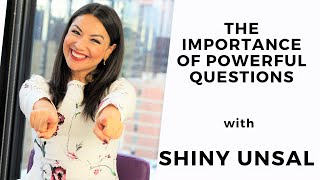
In this motivational monologue, Dr. Shiny Unsal AI, creator of Neuroshine technology, explains why not all questions are equal and introduces three "powerful questions" designed to trigger neuro‑shine moments—sudden insights that expand self‑awareness and unlock potential. She defines a powerful question as non‑judgmental, non‑approving, curiosity‑driven, and free of pain or pleasure cues, intended to let the listener tap into their own truth rather than serve the asker. The three favorite questions are: (1) “What would your best self say or do?” – a presupposition that a superior version of oneself exists, prompting contrast between current behavior and an aspirational model; (2) “What story have you been telling yourself?” – exposing self‑imposed narratives (often inherited from others) that may limit perception; and (3) “What else is possible?” – opening the mind to alternative possibilities and reshaping neural pathways. Each question is presented with its underlying presuppositions, the psychological rationale (including references to NLP and brain plasticity), and the expected outcome of a neuro‑shine moment. The video concludes by encouraging viewers to adopt these questions, promising a cascade of "Nourishine" moments that lead to a "shiny mind," greater love, and the ability to live life on one's own terms. A call‑to‑action invites sharing and subscribing.
Chapters
It combines the power of the mind with the wisdom of your heart, and it just helps you to unlock your potential. Put your hands together for Gary Vaynerchuk! Hey everyone, welcome to my Shiny Minds show. Shiny Unsal AI here. I am the creator of Neuroshine technology, and in this episode of Shiny Minds, I would love to talk about powerful questions. We talked about questions in one of my episodes, but this time I want to talk about powerful questions because not every question is powerful, not every question is the same, and not every question is going to bring the result you're looking for. Here's our topic today: powerful questions. If you look at the way you have been communicating so far, if you just take a look at the questions you usually ask people. I'm not sure if you have a list of questions that are very good, that are really helpful for you, and that you carry them in your pocket, so to say. If not, I am going to give you my favorite 3 powerful questions, and I am going to explain why they are so powerful and why they are very effective to create neuroshine moments, aha moments, to improve awareness for other people. A powerful question is a question that is non-judgmental and non-approving at the same time. It does not have pain or pleasure in it. It just is designed by pure curiosity. And the whole intention behind a powerful question is to give the other person a neuroscience moment in a way that they can tap into their truth and become aware about who they are, what they want. It's not about you. When a question is about you, that's not as powerful. What would be an example of a non-powerful question? If you ask, 'Hey, do you want to do this?' Right? It's an everyday question. It's a conversational transactional question. Powerful questions are deeper, they are transformational, and they are open-ended. They are not necessarily yes and no questions. They are more exploring and expanding questions, and I will give you an example. Number 1: What would your best self say or do? This question is powerful because it is presupposing the fact that this version of you may not be your best version. And there is the best version of you. There is a best self, and that best self might behave differently, might talk differently, and might make decisions differently. And it is also inviting you to explore that. How would it look like if you were your best self? If you were to do your life as your best self? When you think about that, now you have a contrast. Right? So you have your current reality, your current version, and then you have this best version. What are you doing currently? And how would you do things differently if you were your best self? And of course, that requires for you to define your best self. Who is your best self? Who are you in your best version? What kind of behaviors habits, thoughts, communication style, or values your best self owns? Think about it. When you really visualize your best self, when you really design your best self, when you come from that perspective, the way you show up in life may never be the same. And that's why this is a very powerful question. Number 2: What story have you been telling yourself and maybe others too? What does it presuppose? Well, in neurolinguistic programming, there are some powerful language patterns, and I can bring them to the table right now because I'm gonna talk about presuppositions. When you look at a sentence like this and when you just read it again, what is it saying? Let's look at it again. What story have you been telling yourself? So it is actually presupposing that there is a story. You have been telling yourself a story, and God knows if that story was made up by you or by society and others who have been programming you. And that is a very important, significant fact for you to realize because not every single opinion or not every single decision belongs to you. Maybe they have been programmed into the depths of your brain by society, by others. I have this concept called OPO, other people's opinions. Maybe it's an OPO syndrome. Maybe you created the story because someone told you and you didn't question it and you have been telling yourself a story. and that story might sound like, I'm not good enough. I can't do that. I don't know how to achieve that. Whatever it is, it is a story, and that story might not necessarily reflect the complete truth, and you need to become aware of that. The only way for you to become aware of that is through a question. If someone asks you this question, What story have you been telling to yourself? That's how you get busted, in my own terminology, and when you have a neuroshine moment, and with that neuroshine moment, you are closer to your truth. Number 3, this is another favorite question of mine. What else is possible? What are the presuppositions in this sentence? What else is possible? It's presupposing the fact that something else is possible and you may not know it yet. And there's something called possibility that you can tap into. And when you hear this question, it expands your thinking. It takes you to different perspectives and it makes you explore, just like you would explore alternatives and solutions and options. Now you are literally doing this to your brain. Whoosh, okay? This is a brain expansion just because of that question. Maybe you're going this way or that way or this way, that way, because your brain is kind of like plastic. When you just like take it from this way and that way, you can literally reshape the structure of your brain. Biologically speaking, you can. And these questions are how you do it. Literally with this question, what else is possible, you are helping yourself and others to have a mind expansion. That's why they are very important to ask. So what did we cover so far? We covered 3 simple questions. Number 1, what would your best self say or do? Number 2, what story have you been telling yourself? Number 3, what else is possible? If you put all these 3 together, do you know what you're gonna get? A Nourishine moment. And Nourishine moment after Nourishine moment, you're going to have a shiny mind, and that's where you can tap into your truths and become your true potential. Because here is a reminder: life is a beautiful game that you can play on your own terms successfully, and it is your time to unlock your true potential and become who you're meant to be. Do you know why? Because we can only change the world with more love and shiny minds. I'll see you in the next video. If you liked this video, please share with your friends. You might be helping someone who really needs to hear this. And subscribe to my channel to become more and achieve more.