Front seat at the independent movement: Shreyas Srinivasan at TEDxIMTDubai
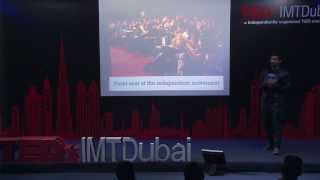
This is a YouTube video titled "Front seat at the independent movement: Shreyas Srinivasan at TEDxIMTDubai" featuring a talk by Shreyas Srinivasan recorded in 2014. In this talk, Shreyas Srinivasan discusses his decade-long involvement in various independent movements in India, including open source software, independent music, comedy, art, and politics. He shares insights on overcoming skepticism, the importance of independent perspectives, and encourages participation in independent cultural and political initiatives. The content is a monologue-style presentation rather than a multi-speaker conversation.
For the last 10 years of my life, I've been involved in one independent movement after another. I started with something called Open Source. A lot of you might know Open Source is a way to create software and give it out to the world for free so anyone across the world can use it without having to buy it or without having to think if they can afford it.
Right?
I started with Open Source and then I got involved in independent music. And over the last 10 years, I've been involved in one independent movement in India after another.
Right?
This talk is not so much about the journey, but about the questions which we were constantly asked. Some questions we had of our own, some questions people asked us, and the insane results we got out of those questions. In hindsight, today, when we look back at it, a lot of those answers are very counterintuitive. So this talk is about that. This talk was about a lot of you want to venture out and do stuff on your own and hopefully you can learn a few parallels between this and your own journeys. So this was 2001, right? People talk a lot about work and passion. India used to be seen as a place where there are a lot of software developers, but they did it because it was work. They didn't care too much about it. So every time you wanted to build something new, you wanted to get a movement going, people would always look at you and say, man, this won't work here. For people here, it's work, it's not passion. Then a few years down the line, I started getting involved in independent music. And then people told me, hey, look, people in India don't care so much about discovering new stuff, right? They have Bollywood, you know, they have Shah Rukh Khan. You can't compete. People don't care. What are you doing? Then a few years down the line, I started NH7. We started trying to put together this venture which helps take independent music to the masses. And then people said, the niche is too small. This is not going to work. There are some people who care about it, yes, but it's not big enough. Then last year I started getting involved in independent comedy and people said, this is all good. This might work when you're small, but as soon as somebody sees that you're saying something offensive about them, they're going to shut you down. And hear me, they're going to shut you down. You better lawyer up. Then people said, oh, this sounds cool from the outside. I just don't understand it. What is this you're doing? I mean, who are these people who get it Then they said, it's just too big to change. You can do all you can. It's just too big a problem to fix. This is dogma of for 60 years, you can't fix it easily. And every excuse after the other, I started realizing I started taking them less seriously than the one before because all these excuses have a parallel thread. And now somebody gives me an excuse for something. I know, I know I will not take it seriously because the excuse doesn't matter. So what is independent?
Right?
This is the base question. We have a large mainstream and the mainstream has a perspective. An independent movement is something which has an independent perspective of its own and it always moves the mainstream forward. When you take a large established field, it's very hard to move it forward because there's a lot of established interest in that field. The independent is a group of people or movement who have a perspective and a vision for that movement. And it could be comedy, it could be music, it could be open source, it could be cinema, right? So the independent is always a group of people who have a vision or a direction a little different from the mainstream perspective. So I've been lucky to be part of three projects which are part of the independent movement. I'm just going to quickly go through them. I started with fos.infos.in was a not for profit open source conference which helped promote Indian contributors to open source. We wanted to build a large number of Indian contributors who became leaders in open source. RadioWorb was an online radio station I started, which in some ways was FOSS in for independent music. It tried to take all this amazing number of artists who wouldn't get on the mainstream media, who wouldn't get visibility on the mainstream media and try to build a platform which helps them reach out and make sure their talent reaches out to a large audience. And then Lastly, I started NH7, which was a platform for all of independent culture India. It was not just music, it was all independent culture in India. And our flagship property, like I said, is NH7 Weekender, which is a three day music festival which happens to have about 50 artists and four stages and showcases all the independent music happening in India. So let's get into it. The first thing I was asked, this is not going to work because it's work, not passion. Turns out it's not so bad that people like to work and they're not so passionate when they started work on it. What we realized is we started, when we tried to fix this, we started trying to apply a lot of the way it works in Germany the way it works in America and try to apply those learnings to India. But we quickly realized they don't apply to India because we as a nation and how we are educated, we're not brought up with the same sensibilities as them. So we try to get a lot of students into open source, but it wasn't working, right? So we realized what we need to do to turn this around is take existing people who work in companies and are already contributing to open source and turn them into stars, right? So we start with a campaign for foster in. It was called Take existing contributors in India and project them in a way that they feel that they are leaders in this community, right? And they feel like they have a sense of ownership and that they got a lot of new people in. Because the best way to get new people interested in a movement is to build heroes, right? And it worked. In the last five years, India's gone from being seen as a consumer of open source to a producer. We have a large number of independent contributors to open source today. Any project you see an Indian is a leader, right? And largely sends from the last 10 years of work of this community trying to get more people contributing instead of just being passive consumers. In 2004, when I started Radiovo, people said people don't care so much about discovering new stuff. I mean, they are Bollywood. Then I heard this unbelievable story. A friend of mine walked into a party in Berlin. There's a Malayalam indie rock band called Avial. They play music in Malayalam. He walks into a party in Berlin to listen and to hear Aviel spraying loudly at the party. He has no idea what is happening. He walks into a party and Germany. An Indian language band is playing loudly at the party. And he tries to go find the guy who's organizing it. He walks up there and say, hey, how did you hear about these guys? So this guy says, I not only like these guys and this guy, but at this point is singing along to the song in a language he has no idea what it is, right? And this guy says, I'm not only the biggest fan of this band in the world, I just bought 70 CDs of this band and I'm giving it out as a Christmas gift to everyone at this party. And when my friend told me this story, it just struck me that a lot of these questions, we build it up in our head trying to figure, is anyone else interested? But the answer is you can't answer that question without doing something about it. Once you put something out in the World. Somewhere, someone in some corner of the world is. Then when we started NH7, they said, the niche is too small. It's cool. What you're doing is nice. There's some people in cities who like this kind of stuff. But you know you're never going to be able to scale this up, right? And then this happened. This is. This was last year. There are 10,000 people at our festival, right? 10,000 people coming out to listen to independent music had never happened before. And we started talking to people. Where did these people come out from? What sort of woodworks were they in before? Why didn't they come before? We've been doing this for five years. What did we change? And we asked them, is this a stage? They said, yeah, the stage is nice. They said, is it the music? We love the music. But that wasn't it. They said, what is it then? And they wondered and they wondered and they wondered. Turns out it's a toilet.
Right?
And this is an amazing story. So most people who came to the festival said, we loved your festival because the toilets were clean. And it was such a simple thing that every music festival you went to in India, the toilets were the dirtiest, right? And you know who comes to festival because toilets are clean? Women. And you know who comes to festivals if women come to festivals. It's amazing how everyone gets that instinctively. Another thing which we figured out was our festival not only had a large majority of women coming to the festival, it was also the friendliest and the nicest place. No one got harassed. They weren't drunken balls. I mean, it's a festival, there's alcohol, people, people weren't fighting with cheetahs. And we realized a lot of small things we did mattered. For instance, last year we allowed dogs into the festival. So people would come with their dogs. Somebody came with their, like a five foot St. Bernard, right? And the dogs got the tension level of the whole festival down. People bought their kits. Like we would give out earbuds at the box office for people with kits so that they don't burst their eardrums. We were really scared. And what it did was this small thing elevated the atmosphere of the festival. People didn't care about fighting. They didn't want to look bad in front of kids. Come on, that's not going to happen. They weren't going to tease women when women were the majority, right? And these small things went a long way in establishing this thing. We were building out and it scaled up not because of the obvious things we thought it would scale up for But. But because of the smaller things which we learned along the way. Then about a year ago, I started working with a bunch of comedians. They're called. How many of you have heard of All India Bakchore? Wow, that's amazing.
Right?
There are a bunch of comedians we started. We met about two years ago. They have this T shirt which says Being Gandu, which coincidentally is written in a font which is like being human. Okay, so what that. And we started working with them and people said, free speech is a risky thing in India, man. You got to be aware that it's fine when you're small, but as you scale this up, it's going to get icky, somebody's going to get arrested, it's going to cause a lot of trouble. But then last weekend, we just did a show with them. 4,000 people over a weekend in Bombay, right? 4,000 people enjoying comedy from a comedy group whose biggest YouTube comment is that they called Rahul Rahul and Modi Modi, right? In. In a world of parodies, when you always make up names, even when you're. Even when you're taking a funny look at a politician or somebody in the public domain, it's very gutsy to call someone by their name, right? And I think that's the most important thing about the content they make. The most important thing was they weren't scared to say it's funny. Don't be offended, because if you're taking offense of it being funny, then the bad taste is not on me, right? There's another movement which is just gathering steam in India. And this is a moment I don't understand very well because I've never been a keen appreciator of art. The independent art movement is kind of like where independent music was first 10 years ago, right? There are a lot of amazing artists. So this is a graffiti artist we got at one of our festivals. And as you can see the detail of the work at the back. If you had seen that engine, it took him three days to make, right? And there's a whole breed of independent artists coming out in India who. Who are making unbelievable art, right? For people who don't know it, that is fuck written in Hindi script, right? Here's an artist who comes from this point of view that if you take a word which is a taboo and write it in a language which is not of its own, in a script not of its own, what is the impact it has on people? And everyone who sees it laughs because it's like, that's fucked. But it's written in Hindi, what is going on? And there's an artist called Daku. You should look him up. And a bunch of Indian artists are pushing the barrier in terms of the kind of street art they can do. And this is a movement which is, which needs a lot of people knowing about it and being involved. And the last, this is my personal pet. Because no one associated this. People kept saying it's too big to change. You know what is the biggest thing which was the hardest thing to change? Politics.
Right?
In the last two years we've seen an independent political party, right? I'm not associated with them, I'm a member. But if you like them or you dislike them, the truth is here's a political party which is independent of the free from dogma of 60 years, which has managed to make something happen. And that's great encouragement for everyone who wants to create an independent movement because nothing is impossible. We have taken the bastion which was untouched and something's happened in it. We live in very exciting times. I'm super excited about it. The opportunity in front of us is really, really big. There are a lot of domains which haven't been touched yet. Every thing in India can use an independent movement. And a big part of this talk today is to encourage people to participate. So if you want to take away something from all of this, what is the five things you take away so that you can go and think about this and hopefully you'll start something on your own. Participate. Believe in serendipity, right? You always think no one understands you, especially young people. But there's someone in some corner of the world who feels as passionate about you as this. And this is really hard to believe when you're doing it. But having done this for 10 years, I can tell you you can take the most random thing and there'll be someone in the world who cares about it as much as you do. And that person and that group of people will make it worthwhile to do that work. Don't believe too much into experience. Experience is good. But trust me, you can possibly do a lot of this better than me. And this is something you need to believe. You need to believe that experience, everything can be done better than the way it is done today. And it doesn't need somebody to put in 10 years of their lives to be competent enough to do it. It takes effort and it takes intent. Don't worry about the mainstream. Mainstream is like Godzilla, right? You look at it and say, oh my God, it's Godzilla. It's going to crush my town, Right? But the truth is, mainstream has its own independent agenda. Like you don't know what they're thinking. Mainstream, made by a group of people. The system doesn't allow them to change it because it's too big. So every time you start something new, don't worry a big competitor or somebody bigger than you is going to crush you. It doesn't matter. The mainstream is mainstream because it's not one single group, it's a bunch of people. And most importantly, every time you do something, try to get to the bottom of the most simplistic view of why it worked. Peel off all the layers like the toilet is the best example I can give you. It's so counterintuitive. None of us could have guessed it, but that is the ultimate sophistication. Now you know, just making it easy for people helps them come and enjoy what you're doing. So peel off all this complicity, complicated things which surround it, and make it really simple. And that's about it. It's a great time to be involved in an independent movement in India. Whether it's music, comedy, politics, art, movie, it's a wide open field and every one of you can participate. So please feel free to join in and help us out. Thank you.
More from Shreyas
Media Dialogues | In Conversation With Roshan Abbas, VG Jairam & Shreyas Srinivasan | CNBC-TV18
Shunya One Ep. 64: Shreyas Srinivasan: The Radio Verve Story / Events and Ticketing / Dynamic..