Media Dialogues | In Conversation With Roshan Abbas, VG Jairam & Shreyas Srinivasan | CNBC-TV18
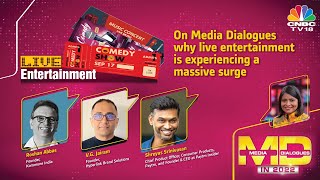
This is a YouTube video titled "Media Dialogues | In Conversation With Roshan Abbas, VG Jairam & Shreyas Srinivasan | CNBC-TV18" recorded in December 2022. It features a panel discussion hosted on CNBC-TV18 about the live entertainment industry in India post-pandemic. The participants include Shreyas Srinivasan of PAYTM Insider, Roshan Abbas founder of Commune and Experience, and VG Jairam of Hyperlink Brand Solutions. They discuss trends, growth prospects, consumer behavior, ticket pricing, and the evolving creator economy in live events across India.
Hello, welcome to Media Dialogues. I don't know about you, but I'm really feeling full on that party vibe that December brings. Now there's just so much to do. Lit fests, music concerts, stand up comedies, spoken word festivals, magic shows, motivational speakers, plays, restaurants, food fest. Whatever your interest, you're probably spoiled for choice now. Don't forget it's also the first normal year post the pandemic. For nearly two years, live physical entertainment was shut with a devastating impact on the business. But that seems to be in the past as people are going out with a vengeance. So what are the key trends that are emerging? How is ticketed entertainment doing? What are the growth prospects as we head into a new year? Those are just some of the questions I'm going to be putting to Shreya Srinivasan of PAYTM Insider, Roshan Abbas, founder of Commune and Experience and VG Jayaram of Hyperlink Brand Solutions. Gentlemen, it's lovely to have you all here. And I'm going to start with the guys in the studio. Shreya. So you're going to have to wait because you have the advantage of being in Goa, isn't it?
Happy to wait.
Okay. Roshan flashback September 2020. We were doing this conversation via Zoom and we were talking about just how difficult it was for your business and the sector. Right. What is 2022 been? Because we are, you know, December. This is the highlight of the events and the live entertainment business, isn't it?
So I think, I think what, what that two year gap did was it put a pause on people's passion and needs and, and I think it all just accumulated. So the day things opened up, it wasn't a trickle, it was a split. You know, we didn't have one show, we have multiple shows happening on the same day. Corporates who had put aside marketing budgets came back with a vengeance to spend. India still been on a growth trajectory unlike so many other global countries. And I think for that reason there has been an appetite that really needs to be whetted by everyone's keen now to satiate that. What's also happened is that I think in the two years of the gap that we had, people became a lot more closer to their own passions. See, it gave every individual time to say, you know, you had more me time. And in that me time you discovered what you wanted to do. Whether it was yoga, whether it was health, baking. Baking, right? I mean, remember Dalgona coffees and all the rest of it? So you had all of that and also your relationship with the arts became a lot more because they became, I mean loneliness is a big issue. So that became the rise of intimate music as we call it. Singer songwriters happened because you didn't have big productions.
You needed that nurturing, isn't it?
That nurturing. You needed that connect. And now that that connect has happened, look at what happens post that. Lucky Ali is performing in Goa in a small cafe. He walks on that and it resurrects the man's career. He did a 20 city tour, sold out. He was performing in Dubai. I remember at the Expo, multiple private shows were going on. Every concert finds its audience. And also I think the other thing that has happened is over the last couple of years we as promoters have also evolved to say we don't just need to do Delhi, Bombay, Bangalore, every small city has an appetite.
Basically you're saying, Roshan, that 2022, the live entertainment industry is back and how.
Oh absolutely.
Okay. Jairam bears out. I saw you nod completely through his answer. So what are you seeing it? Because we just, you know, for people in Mumbai, Arijit just performed and I heard lots of, lots about this. Okay. I mean, I'm sorry I couldn't make it, but I heard tons about it. What are you experiencing and where? You know, I want you to sort of leap off from where he left off.
No, I think just to take off from what Roshan was saying. I think yes, definitely. You know, the whole experiential and live entertainment industry has bounced back and how. But I also feel it's got to do with one important aspect that two years of sitting in front of a screen has really, you know, made people want to go out and experience that whole touch and feel had not happened. And another big trend that we caught on to is the fact that there is a huge resurgence in indie pride. You know, we are seeing that, you know, the consumer, the millennials, the Gen Z, they are really absorbing and buying tickets for Indian acts. Right? So you are seeing that trend which normally where you know, people would probably sell 500 or 1,000 tickets, you're suddenly seeing those level of artists sell three or 4,000 tickets. So that is also kind of playing.
Culturally and this is not just music. Or are you talking specifically across whether.
It'S music, whether it's comedy. I'm saying there's a little bit of, you know, the pride about, you know, the regional music, there's pride about the local artists and also the fact that if you look at an international trend, not too many international artists are coming yet because they are still trying to make up for all the money that they lost in the COVID years. And they are busy trying to fulfill the demand in their own markets. So by the time they come down here, it's going to be probably, you know, a year, year and a half more till the big acts, the regular supply comes in. Of course you're going to still have Lollapalooza that's happening or, you know, Mahindra Blues, that will happen and you will have that trickle happening. But I think the magic or the big revelation has been that today there are indie artists who can sell. Take a Pratikkod, for example. You know, he's selling five to 6,000 tickets, you know, on the go, but he's not in.
He's on a much higher league, isn't it? This is the guy Obama endorsed on Twitter and this is the guy, the Gen Z. You know, kids have been going, I.
Must tell you the best thing that I read, somebody said the Jagjit Singh of the Millennials in English, every song is about love.
I must confess, guys, that every conversation I have on media dialogue, somehow age comes into it. And then I feel, and sometimes I'm ageist and sometimes I'm apologetic. So you know which way the, you know what the average age is for my guests. But the interesting thing is I kind of justified by saying, but, you know, in this business, demographics are very key so we can get away by talking about age. And so Pratik is that Jagjit Singh of his generation.
Let me give you another very interesting data point that just happened in Thane, you know, which is just, you know, a sister city of Mumbai. And there was a music festival, I think Sparks promoted it. There were 8,000 tickets that got sold. So. And they were all Indian acts. Or for that matter, if I can proudly say that when we brought back Independence Rock, you know, and rechristened the Mahindra Independence Rock, we sold out four and a half thousand tickets a day. These are all Indian acts and these are high quality. And what is the key thing that one needs to also understand is that the Indian acts have really come of age in terms of the sound quality, in terms of production, in terms of what they're performing, what they're putting out.
PAYTM Insider, tell us what the past year has been. Share some of the highlights.
I think in the live industry, what the pandemic showed us that we couldn't match this experience of touch and feel and camaraderie which being at an event gives you. We couldn't Match that digital. And that's sort of like both the failure and success of a digital person like me. We tried, but we really couldn't make that digital experience real enough for people to connect and have that shared experience. I use that word a lot. Shared experience. At an event where you're standing with 10,000 people and it feels like you're all in this together. The second thing which happened in the pandemic is the creator economy. I think the creator economy has literally grown 15 fold in the last sort of two, three years because people had access to time, so they ended up consuming following, becoming fans of a lot more creators across India. And we are seeing that trend sort of boil over into live entertainment today, where all of those creators are. One of their ways to monetize is real life experiences, events. And they're all building events with partners. Like, I work very closely with both the gentlemen in the studio and together we are building this ecosystem where any creator can easily put up an event without having to worry about all the hassle of putting up the event. That's what we are for. And they can just focus on their craft and then on that experience with their fans. And I think that trend is here to stay. I think you will literally see sort of like people move to two ends of the spectrum. There's going to be massive digitization with things like AR VR and people are going to. You're going to consume more and more and more digitally, which feels like real life, but that's going to increase the demand for real life even more. People are going to say, okay, there's always limits of this headset. There's always limits. Like, this headset is never going to feel like a hug, right? And I want that experience from a headset to a hug. And I think like that's why this will become more premium, this will go to more cities because people don't work in Bombay anymore. People like me have moved to other cities. There are lots of people like me who now, very soon you can do a huge concert in Agra because there's a lot of people who moved from Delhi to Agra, a lot of people in Jaipur. So what the pandemic has done is fundamentally shifted the entire country in a way. And I think this industry has come out better for it.
Come out better for it. So, you know, when I read the Fiki Frames report that comes out at the start of every year, Roshan, it says that the live entertainment industry is half the size that it was in 2019 and a full recovery to those levels is probably a year away still. Right? What do you make of that? Because I heard a quote where you. Where I think they quoted you saying that it's a hockey recovery. So where is. Give us a sense of the scale of this business today.
So see, I mean they were roughly, at one point in time they were saying it's roughly going to be about 10,000 crores. But now when it has reduced and at one point it was as low as 3,000 crores. And it's very understandable because if nothing is happening live, what you're doing is equivalent to broadcast. And you know, there was and zoom doesn't make for an event. What has happened is that very often these reports, you know, I mean there's a famous quote, right? There are lies, damn lies and statistics. So these statistics end up coming from 30 or 40 event people who you've spoken to. We have for the longest time said that there is a real need to relook at just our industry. Because yes, there is organized entertainment, but.
Apart from that, and this figure is for organized entertainment, what they have put out and what you're saying is.
Yeah, but if you first just look at, if you look at just the sector of organized entertainment which has concerts, corporate, etc. Which takes place, that by itself I think is a 3x growth minimum is what is predicted to happen from the base. But at a very recent convention, at the EMA convention, which I was the president of a couple of months ago, a consultant from a very well known from ENY in fact turned and said you can add a zero to any number as long as you really just go into this business. And it's true. So that 3,000 could be 30,000, right? I mean that 5,000 can be 50,000 if you really just track what's happening.
So you're at in December 2022. Are you back to 2019 levels for the size of this industry?
I would say in fact beyond.
Yeah, I think the, you know, it's. We are seeing a massive growth, there's no doubt about it. So yes. Are we back to 2019? Yes, I would say almost 95%. You know, I would still feel that there is that 5% that can happen. But the reality is also that nobody just has any time. We are refusing work and it's sad that we're having to do that because it's just that the industry also is kind of consolidating itself because post pandemic there have been a lot of agencies that have either shut down, moved out, gone away from that business. So there's a recorrection of a recalibration of that also happening. But I think I would just definitely put my money on the fact that that's why we started hyperlink.
Right?
So I'm just saying that. And I think the event industry is a pretty resilient bunch of people, you know, and honestly, no support from the government. You know, every other industry is getting support, but we are the ones that fend for ourselves.
And no, but even the multiplex guys didn't get support. And they've really taken a very, very hard knock. As hard as you guys have taken, isn't it? And movies have still not taken off as of December 2022, barring a handful of.
They were able to lobby for two things during the pandemic. They were able to lobby for shoot, continue, right? And for us, even that was not allowed. And we used to keep saying that we are in the business of making people gather safely, properly. So, in fact, I remember at the second wave, we actually, as the event industry, got involved in saving lives. Now, putting all that aside, you know, one thing which we all were talking earlier is this thing of saying because we've been so close to this thing of I may die, everybody wants to live their best life.
Life.
And in living their best life in this, in the business that we are, which is of hugs and happiness, right? Of shared experiences, as Shreya so rightly said, everybody is voting with their wallet.
In fact, you know, our strongest focus is on culture, marketing and creating cultural movements. That's where the story is, you know, and that's why today I think brands and consumers are really coming together. The convergence is happening and people are, you know, really looking forward for that. So it's no more about just, you know, sponsoring a particular platform or, you know, just doing a show, but it's about how do we build real bridges with culture, local culture, global culture, and make it an intrinsic part of the entertainment mix for people to consume. You know, that's becoming a very, very important talking point. And I think it's no more a tick mark. You know, brands are understanding the value of that and so are consumers.
Shreyas consumers is the cue to come back to you. Give us an. Give us a sense of the appetite for ticket pricing. Because, you know, these gentlemen earlier were explaining to me how in, in India, you know, ticketing revenues are much smaller than advertising revenues or advertising support for these big, large events. So give us a sense of the consumer appetite in terms of money and what they're willing to pay for these experiences now that we've established the fact that they want the one them.
Yeah, yeah. So I think it's changed. I think Jerome and me, we just did concert in Bombay and and we'd be parry that the ticketing income from the concert more than supported the event much more than sponsorship would. And that's the right trend. So it is. Two things have happened. Ticket prices have gone up and ticket prices have gone up because by 30, 35%. Okay, it's gone up significantly, but it's gone up because there is so much demand. And two, I think we've been, we've gotten better to give users the great experience. So people who experienced it before don't mind coming it coming again because it's sort of like the highlight of the quarter, right at the highlight of three months going to this massive event. So ticket prices are definitely. Then there is a spread of people who I think are new to the event industry. And this is, this I think is the most healthy, interesting trend. There are a lot of events which are in the range of a movie ticket which is around 300 to 500 rupees. These events are sort of the gateway for people to enter into experiencing events. And there's a whole section of events who have massive volume, I call them events which basically recreate a mall experience which is about food, about shopping. And these sort of events have 50, 60,000 people attending them, paying a 300 rupees or 400 rupee ticket over a weekend. Literally how much a big mall would do over a week. And I think we have these two large spectrum of events, both doing really, really well. You have a really high premium, sort of really, really famous artists. And those prices have gone up, but the capacity sort of the same and hence income that has gone up. And there is really large scale events which are about food and shopping and experiences like that where we are bringing in a whole new generation of people who have never gone to an event before, for whom going to an event was not a mental model.
Right. I'm curious, you know, does dynamic pricing and those kind of elements and mechanisms come into play in India yet or are we far away? We are, yeah. It's already.
I mean we've been doing it for years. Like the thing is, dynamic pricing comes in when there's demand for a long time. And we didn't have demand having dynamic.
Pricing really, but it's there now because the demand is there in this manner.
Yeah. So we've been deploying dynamic pricing in IPL since 20, 16, 17. Right. And almost all our machine learning models give anywhere between 20 to 35% lift on total revenue because of dynamic pricing.
Also, you know, to supplement that, young people are spending more than 35% of what they earn on experiences. Remember, and Jayram said this so well, that earlier people wanted to save money to buy a house, buy a car, etc. They are not, they're not doing any of that. They only want to create memories and have those moments. And in doing that, it's very much.
About the moment, it's very much about now.
It's a simple data point that on number 26, in a small suburb in Bombay, BKC, one street apart, one you have Arjit Singh doing nine, eight or nine thousand tickets, and the other is DJ Snake doing another eight or nine thousand tickets. You're talking about almost 20,000 people in just one area. And if I were to just throw a number, I'm sure that cumulatively it's crossed over $2 million of tickets. Just tickets. So that's where this demand has gone. People are buying experience. I think they always bought it, but now they're ready to pay top dollar for it.
To add to what Shreya said, the creator economy, having expanded, creators have created culture. And there are culture points that didn't.
Exist and created their own audiences.
Exactly.
So as I was saying, creator, culture, community and brands are either coming in in the reverse and saying, I want to own X community, therefore, what can I do? So they will have managed IPs, which, you know, Jayram and Hyperlink are so wonderful at, or they will come to us saying, oh, you, you get this particular audience which I want to dip into.
And then we come and advertise.
And we come and advertise. But even content, See, because we are event creators, we are able to smartly integrate brands and into these events.
Sure.
We are able to generate content that lives the digital life later. That is equally an important thing. I keep saying, championing this to brands, saying, build your communities, you know, nurture them through the year. Because that's the.
So are brands getting it?
They are, they are. Spotify built a great podcasting community. Netflix is working on another, you know, a viewers community. In that sense, all Alcobev brands have no other option but to do that.
Yeah.
By default.
By default.
But I think, I think brands today are understanding culture, you know, and I think they also understand that it needs to be a more long term, immersive kind of play rather than very tactical. I'm a sponsor and get out of.
This and 70% of your revenues are coming from brands, isn't it? From advertising.
So there's also a slight correction. I would say that while if you're looking at certain niche IPs or niche pockets then that would be true. I would say 60, 40, but otherwise pretty much, I would say that the ticket price or the ticket buying takes care of pretty much 60% or 70% of your.
And that's a big change.
That's a huge change. That's a big change. And, and like I said, the ticket buying audience and the premium for those tickets is increasing in a big way.
We are seeing that Shreyas. You know we talk the illustrations we are using and you know, at least for me the lens is pretty much Mumbai, Delhi, Bangalore. But you, you know, you said you could have things in Agra because a lot of people have moved out. Give me a sense of the pan India appetite and also any trends that you can see beyond the big metros.
Yeah. So we this year have already done at least a single event in about 168 cities across India. Right. When I took that export, there are a lot of cities that I didn't know where they were. I literally had to go to Google Maps and say where is this city? And what is fascinating is that cities like Raipur, Ranchi, which are pretty big cities, I mean they have few million people, they have started doing events which are doing 30, 40 lakh rupees in tickets. And that's unheard of like till a few years ago, like 40 lakh doing anything outside of Bombay, Delhi, Bangalore was really, really difficult, maybe Pune. So we are seeing the same pattern which we, the same human basic pattern which we said that people want to go out and experience, have a shared moment that's happening in every city. And there's a premium to that experience in every city.
Okay, I'm going to have to close this show. So Roshan, closing thoughts. Anything else to unlock value here or are you, you is organic and it's, you know the engine is with you guys I think.
See one important thing is that there has been certain amount of growth in infrastructure as well. But what we must be careful of is that India is a concert and live event market from November to March. After that suddenly we are restricted because of the lack of big venues. Genuinely if there's anybody watching and you know, I think we would both say that give us those venues because the appetite is there through the year. But people don't want to go to the punishment that a concert used to be. 20 years ago. Right. So if you want a great experience, just give us those properties. They exist. You know, if stadiums can be converted, if large auditoriums can be converted, we can create those experiences.
Gaming tournaments and all are big.
They are happening, they are happening. Gaming is happening. Gaming is happening. But there are very few companies that are promoting large format gaming because it requires a lot of infrastructure set up. Right. And there are only maybe, while there might be gamers everywhere, to get that kind of infrastructure together is a large cost. So I've seen that being a bit of a problem.
Okay.
I just say this much that, you know, I think the trajectory is fantastic and I think cultural movements is here to stay. And at least we are looking at, you know, trends from what is available from within India rather than looking outside and seeing that, how we can source all of that and repackage it and bring it to a, you know, to urban audiences and the way they are consuming it. So in a sense, super producing those experiences. Experiences which I think are fantastic. Whether it's talent, whether it's artists, and again, it's not only music or theatre, it's also food and beverages. Huge opportunity there already. There are some fantastic things happening. In fact, Insider just finished the India Cocktail week or there's Grub Fest and you know, all of these things is indication to the fact that there are people willing to spend and buy experience.
And more people coming. You mentioned Zomaland at Zomatos, isn't it? So more people getting into this business is good for the market at this point? Absolutely.
I think it's just opening up. At the heart of all of this is the experience and the consumer. And as long as we have that experience which is perfect and you give them a variety to choose from, I think people are here to spend. Because this generation, the Gen Z and millennials, are really not interested in saving and buying a car and buying and.
The kind of slowing down in the economy that we have been reporting, the kind of inflation figures that we have seen and continue to see, even though that's cooled off a bit. How does this impact consumption in your business?
I think we are in that unique position that people want that live entertainment, they want that touch and feel, they want those hugs and kisses to happen because I can always catch the movie on Amazon prime or on Netflix, you know, so that is going to be, you know, so we are going to run that journey for a while. I think nothing can replace that experience.
That emotional point I would make is while they are willing to spend, they are discerning they will wait. They will wait for every hack in the world to get more value for money. I opened my ticket pricing at a little higher than before with this estimation. I didn't get a response from that audience. I had loyalists who came in the minute I reduced my price. You're talking about the Think Fest for Spoken Fest.
Yeah, Spoken Fest.
Right. And for Spoken Fest because it's a niche festival, we get about 11,000 people or whatever. 12,000 people. But I saw that inertia till we didn't announce every act, till they didn't know what time to come, till they didn't know. Because we're a two day festival. We spread across 10, 10 hours of programming. They want to know everything before they make that choice. And that is very, very important. So earlier, gone are the days of just putting up a poster and saying.
So you have a consumer who is willing to pay but wants great value for MANDA and international standards. Because now you're exposed to the best. Shreyas, I'm going to give you the final word. What's the one thought you want to leave us with as we head into 2023?
I think as an industry we should focus on building repeatable patterns. I think that always helps you work. So I fully endorse what Roshan said about infrastructure. If we have venues where events happen frequently, I think we will have better fill rates on those venues because consumers are used to going there. That habit is a very useful thing for consumers. Second, I think on the consumption side I think there's a lot of innovation on financial instruments. Obviously I am. I also run product for. So if you look at what's happening on the consumption side, ability to give people easy emis, buy now, pay later on tickets, ability for them to finance some of this entertainment consumption easily. I think that's also a big driver in terms of adopting. They don't have to wait for first of the month to buy a ticket. That used to happen a lot. Used to buy for the first of the month. So I think those two things will again be like a force multiplier. Super hopeful. I think we're doing well.
Well that's a good note to end on. Shreyas, Jairam Roshan, thank you very much. I'm glad we're doing this face to face. Maybe we can ticket this. There's a thought here probably. But thank you very much for watching. Look out for another conversation on media dialogues next week. See you.
More from Shreyas
Shunya One Ep. 64: Shreyas Srinivasan: The Radio Verve Story / Events and Ticketing / Dynamic..