1st Time Tasting Olive Oil with Elk
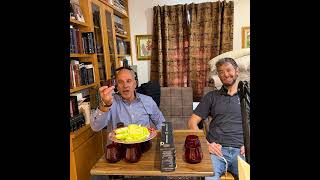
Simon Jacob and wine expert Elk Hellinger taste premium Israeli olive oil from Meshikachia with CEO Yossi Polak. The family-run business in Shiloh produces about 600 tons annually using a technique called strappaggio, slurping air to aerate the oil and taste its fruitiness, bitterness, and pungency.
Chapters
Welcome to the Kosher Teruah.
I'm Simon Jacob, your host for this episode from Jerusalem. Before we get started, no matter where you are, please take a moment to pray for the safe return home of all our soldiers If you're driving in your car, please focus on the road ahead. If you're relaxing at home, please open up a bottle of incredible Israeli olive oil, sit back, relax, and enjoy. This episode features a special treat. My good friend Elhanan Hellinger, affectionately referred to by all those who know good wine as Elk, in his first cameo appearance, On the Kosher Terroir. Welcome back to the Kosher Terroir. Usually when we sit down in the studio, you hear the familiar sound of a cork popping and a liquid pouring into a crystal glass. We talk about vineyards, harvest dates, tannins, and acidity. We talk about how the soil and the sun translate into the story inside the glass. But today we are trading the corkscrew for something a little different. Though the language remains exactly the same, today we are talking about the terroir of olive trees. Joining me in the studio is Yossi Pollak, the CEO of Meshik Ahia. Yossi and his team are cultivating land with deep ancient roots in the Shiloh region, bringing forth some of the most highly awarded premium olive oils in the world. But before we get to Yossi's incredible story and the operation at Meshikachia, we're going to do something special. We have a tasting flight right here on the table. For those of you who are listening at home, I am looking at a beautiful, sleek, black tasting kit from Meshika Ahiyya that says, "Bring nature home." It holds 5 distinct, beautifully branded little tins of extra virgin olive oil. Tasting olive oil is an art form. And while it shares a lot of DNA with wine tasting, there are some crucial differences in the mechanics and the expectations. When we taste wine, we look for a balance of fruit, acid, tannins, and alcohol. We swirl to release esters. We coat the palate, and often, if we have a long day of recording ahead, we spit. With premium olive oil, the three major tastes we are looking for are fruitiness, bitterness, and pungency. Here's how we do it. When you taste wine, you hold the wine glass by the stem, but with olive oil, you cup the tasting glass in the palm of your hand to warm the oil with your body heat, releasing those green earthy aromas. Then you don't just sip it, you do something called "strepaggio." You take a small sip, press your tongue to the back of your teeth, and sharply suck in air. It sounds like a loud slurp. It aerates the oil across the entire palate And finally, you swallow. That peppery kick you feel in the back of your throat, that's the pungency. Those are the polyphenols, the antioxidants. And in the olive oil world, a cough is actually a compliment to the producer. Jesse is going to walk me through these 5 incredible tins sitting in front of me. Shemen HaBayit, the house blend, promising a fruity aroma and beautifully balanced flavors. Then there's Suri, a classic ancient Middle Eastern variety known for its dominant, powerful, and robust flavor profile. Picul, an olive of Spanish origin that yields a fresh, green, and wonderfully herbaceous oil. Arbequina, known for being delicate, buttery, and light, perfect for an elegant finish. And Kronicke, a Greek variety that brings a bold, perfectly balanced, and accentuated peppery kick. It's a journey across different olive varieties, but they all share one vital unifying element, their home. All of this brings us right back to the very name of our show, the Teruah. Meshach Ahia's operation and groves are based in Shiloh, right in the heart of the Shomron. When we talk about Teruah, Shiloh is an absolute masterclass. We are talking about rocky, limestone-rich soils, high elevations, and a mountainous climate that has been cultivating vines and olive groves since biblical times. It is soil that forces the roots to dig deep, stressing the tree just enough to produce incredibly concentrated, vibrant flavors. What Yossi and his team are doing in Shiloh is telling a story of ancient sacred traditions meeting modern world-class agricultural brilliance. To taste an oil from Shiloh isn't just a culinary experience. It's tasting a literal piece of history. So let's warm up our glasses, practice our slurping, and dive into that history. So tell me your name.
Yossi Polak.
Yossi Polak.
CEO of Meshikachia. Okay. Meshikachia, it's olive oil. 22 years in Israel. The best olive oil, I think, in Israel. That's all.
And you're based in Shiloh?
Yes.
You're based in Shiloh.
Yeah.
Okay. So we're going to try some. Talk to me a little bit about Meshach, it's farm.
Yeah. So it's a—
So who are the brothers?
Yossi, before 22 years ago, he take a place to make olive oil and he build a kana. Okay.
He bought.
Bought. Yeah. Bet Bad, may I tell him, from Italy. Yeah, the— it's coming to Israel, but olive press, he brought it, he bought an olive press from Italy. Okay, okay, so he built it by himself, the Italian didn't come for it. Okay, okay, wow.
Wow. Okay.
Wow.
Wow. So he, he died in the beginning just trying to use the equipment.
Yes.
So now who uses it? Who runs the business? The brother?
For the business?
Yes.
Some of them, it's Moni Lyman.
Okay.
And the other one, the other name, it's Moshe Namdar.
Okay.
This is the two people that run the business. Run the business.
Okay. Aseynu. So we're gonna taste olive oil. We're gonna taste your special olive oil.
Mm-hmm.
These are actually different flavors of olive oil we're tasting. So one of the first things we need to learn is, because I'm, I'm really from a wine background, and I have with me Elk as well, who's also from a wine background. So one of the things that's special about olive oil is that it doesn't, it's not the same as tasting wine. In some ways it is the same as tasting wine, and other ways it's not. It has flavors and nuttiness and things that you can taste in it. So you need to aerate your mouth as you taste it. And that's called "strippaggio." That's the name of it in English or in Italian. So tell me a little bit about what we need to do. So let's put some in glasses.
First of all, the difference between test wine and test olive oil is the glass.
Okay.
In olive oil, in wine, you have a glass, white glass.
Yes.
You can see the wine in the glass.
Yes.
In the olive oil, you don't, you take a glass red or blue. This is the glass for the test olive oil. Why? Because the color of the olive oil, it's not the—
Hashuv? It's not important.
To the olive oil. Okay. That is the difference between The wine and the olive oil. So, you open— we take now Picual. This is the name of this olive oil. Put it in the glass.
Yes.
You make—
You put the glass in your hand and you rub it back and forth with your hand from the top to bottom so that it ends up warming up the glass. So it warms the olive oil.
Again. And when you test, you take the olive oil between the teeth.
Yeah. Between your teeth and your lips.
And your lips and put inside air from the outside. Okay. Yeah. So you have, you do that like this. That's all. Now, all the testing is in the mouth.
Okay, so that's Strapagio explained, where you take the olive oil into your mouth, you suck in air, we do the same thing, you slurp air in and you oxidize it and you mix it around in your mouth.
Okay.
And then what do we taste for?
You know, people don't usually eat out or drink it. It's more of an accompaniment. So this is the— we have— what was it? Piquel?
Piquel. You have— I have one more, Suri. Suri. It's come from Syria. Yeah. And it's more strong. You want to try?
Ah, I thought we had— I thought there's 5 of them. There's 5?
Yes.
Yes.
We'll try.
We'll try. Okay. If you dip the apples in it, what do you do? What's the idea with the apples?
The apples are to change your palate. Yeah, palate cleanser. So taste the green apple.
Okay.
It's the bread to dip.
It's clean the mouth.
Because the bread doesn't, isn't as—
Don't do that. This is more strong.
So we're using green apples to taste the cheese.
Using with this olive oil. When I make a fish.
Oh wow, this is new to me. I've never done this before.
Oh, want to go tell Marciano Estates? Actually, a lot of wineries, the maker, producer called. So Marciano Estates, they have a A Greek olive oil and a Spanish and Italian one, really, really high acids, really, really good with bread. And then I was in Italy, we got olive oil from Castellari. And we got that Terre di Sette in Tuscany, like really olive oil. And Spanish one, Cosmestor is another winery that they— olive trees and vineyards are always, you know, they coexist. In fact, Moses told me that when he replanted El Tawin 6, the new vineyards, the new winery, and he picked up all these 500-year-old olive trees and moved them to the base of the mountain. And so they ring the vineyards. And he told me that the olive trees are very, very hardy. They protect the vines against the elements. These olive trees are 500 years old. They can withstand the wind and all that. So it's actually, it's a protective thing that he circled the vineyards with these olive trees. But when you go anywhere, like every wine region is always like olive oil region. They're so synonymous with each other.
Yeah. So where are the olives grown? The olives are grown in Chile as well?
Yes. Okay. Yes. So wherever For 600 acres for the olive oil. Yeah. Okay. Wow. Cool. Okay.
So this is, this is Souri.
Yeah. Okay.
So these are varieties of olives. Okay. So what's special about Souri? What's the difference?
It's more strong. Okay.
Do we have another one you want to taste?
Yes, we have our bikini.
Well, also, if we think about Eretz Israel and Judaism has always been really synonymous. If you think of like the whole Mishnah Berkei Avot, it's like, Ki toshem tov mishemen tover, or is it bar yochai shemen tzvasam mechaver tov?
Shemen tov mechaver recha, yes.
So they were always drinking olive oil and I really, this is actually my first time tasting meshikachiyah like this. I've always seen it at Amichai's house and Amichai's a Cohen so they give him.
Who is Amichai?
Amichai Roy, the one who made Gorshe.
Oh, okay.
So I've always seen meshikachiyah and he uses it for Shabbat, Nirut Shabbat and Chanukkah because he's a Cohen so they give him a master to the Cohen.
Yeah.
And I never actually tasted it, so this is great because like, you know, I know Italian olive oil, Spanish olive oil, California olive oil, but I was just, oh, it's one of the Shabbat aminim. I think that, yeah, I was telling Amichai too that they should partner with Meshikhe Chayei Tomim. They don't make a lot of olive oil, but maybe they should sell this. At the Yekeel Shiloh?
Yes, yes, yes.
They sell it?
Yeah, yeah.
Okay, I don't remember seeing it. Okay.
Yeah, yeah. Maybe you'll be in the new one, in the building, the new now.
The new winery?
Yes, in Shiloh.
Yeah, right. So I guess, you know.
So you have Meshikah Chiyah, many, many Madafim.
Yeah, shelves of it. Many, many shelves. Yeah, in the new winery. You've been in the new winery?
Yeah. So not for some time, but yeah.
No, so when they first moved into the new winery because of the war, they didn't fill it up with things. Now they've filled it in. They got all the shelves full of stuff. So yes. Okay. Next one. Can we taste the next one?
Okay. The last one.
Yeah. So this one is like —because not as mild as the picual, but not as, um, robust. It's a difference. It's something in the middle.
Yes, it's— Exactly. It's in the middle between the suri and between the picual. I love the suri.
I love, um, I love really robust olive oil. It's interesting because when we talk about olive oil, we use a lot of the same lexicon words as we would for, like, wine. Like, this is like when we talk wine about this is a highly acidic wine. And with olive oil, It got— this has a lot of acid in it. Yeah, this is the blend of Meche Kahiya.
The chef, Golan Israeli, from Dan Akkadia, he make this blend and he using in the hotel and also in the school of— the school of gourmet Akkadia. Yeah. Oh.
It's really flavorful. It's really, um, yeah, you can tell that it's a blend and it's got some complexities and simultaneously just a tad astringent and smooth. Yeah. Wow. You know, every time you go to like a winery and they are— yesterday I went to a farm and I went to Castel. And every time you go to a winery and there's always bread and olive oil, you know, there's cheese, but I don't eat cheese anymore. A little bit. And when we went to Chivito and Gualt, we had— Gualt? Olive oil. So it's just kind of like for me, besides for the vines and the olive trees, the whole tasting wine for me is always tied up with the olive oil. Just the bread and the olive oil and then the wine and Completely different taste.
It's a different taste.
Well, both of them have the same, like, connection to the land. They're both very in the same thing where in the Shimon Vayishiva, both the wines and the gods, they use the same gods for, they use the same presses for olive press or wines, but they've been drinking the same stuff for you know, 2,000, 3,000 years ago, you know, they would make olive oil and they would make wine. And this is side by side.
They're side by side, but they're not the same. They're not the same press.
They're very different. But all the time it's side by side. The kings of Israel. Yes. They, when you go to be a king, they take the olive oil and limshoch.
Yeah, they pour it on you. Yeah.
They, um, mishicha. Yeah. In the Gemara, yes.
Right. They, yes, they anoint you. They anoint the kings. They pour the olive oil on them for them to become kings.
Yes. Shalom.
It's the olive oil of the Menorah in Shiloh.
It's the olive oil to the menorah. Oh, they use that for the mishkan?
The olive oil was in the mishkan.
Right. Yes. Well, that's the whole Hanukkah and the whole year. Before Hanukkah. Before Hanukkah. Every day in the Beit HaMikdash.
Yeah, no, but also in the mishkan. You had to burn the menorah in the mishkan every day.
Just have to make sure you have enough hashkachat so that they, because you know, when they find one bottle of Shemen Zahid, you know, this is all sealed. So you have to make, they should start making oil for the Beit HaMikdash so when they rebuild it, they light the menorah. But so most of, how is the mashgiach sold? It's in this container? No, no, no, no.
This is the small, this is for testing. This is for if you want to give your friend something. Gift box. Gift box, yes. For Purim. Not only for Purim.
Yeah, but for Purim you could. You could give them small samples.
And we have bottles between 75ml to 1 liter. We have a pach to 2 liter, 5 liter, 8 liter. And 18 liters.
18 liters. Okay.
All right.
Very cool. Is there anything about the harvest for olives this last year? Like, was it impacted by the war? Ani, okay.
It's gonna look bizarre. Okay. Okay.
Yossi tells me he's a brigadier general in the Israeli Defense Forces.
Yeah.
Okay. That they only have Jews who are working in their factory. Even the people who are doing the harvest, they're all Jews.
Okay.
All the men who were working in the harvest were taken into Miluim, into the army. So what did you do?
Okay.
So there was one young man who is older than me, who took onto his shoulders the entire harvest. And this was on October 7th, which coincided exactly with the harvest.
Wow.
So he actually did the harvest and he saved it. Right now we're all actually going in and out of miluim. I, this last year, did 350 days of Miluim. 350 days of Miluim?
Yeah. Wow. But, you know, Elohim, Hashgacha. Nachum is head. Okay.
And that's the way it is. It's, we trust in God and we're going to be okay. You know, Shivrei, the Golan, um, And we in the Golani have a saying, until victory. Okay. Wow. So where were you? Where were you serving? In Lebanon or in Gaza? Gaza. In Gaza. Mm-hmm. Thank God you're okay. All right. Any other questions that you have about distribution or what have you?
Oh, I don't, they don't, they don't export it, right? The olive oil? No. Yeah. How much do you make in a quantity? He says just small quantities.
We make in one year something like 600 tons of olive oil.
What is that in bottles? You know what is that?
In bottles? Yeah. Wow. A lot? Yes, it's a lot.
Hey, that's a lot. Yes. Oh, I didn't realize it was that much. I thought it was from small. Wow. So, and you sell all of it in Israel? Yeah. Wow. Mm-hmm. I think you should export it though.
We don't make export. Not yet. Not yet. Not yet. Not yet.
But I guess that we're in all of America, I'm selling Spanish olive oil and we've got Italian olive oil, but you know, it's good people to connect there to Israel and to be able to have a product of Israel and our soil and I don't know, I just feel like always people want to buy Israel, they want to support Israel. So it's great that they have that opportunity, if it makes sense, obviously, to—
Many, many evangelists that come to visit in Shiloh, in the mountain, buy Meshikah HaOlivah. Many, many.
I can see how that would be a market for you. Okay. But he's a good distribution as well.
Oh yeah, I'm good. I also mostly just drink it. I joke that I sell the little wine that I can't drink. Okay. I have to drink a lot of it. I'm good at both, Boris. I'm good at both selling wine and drinking wine. Oh my God, last night we went to, after I went to, we went to Castel. And then you was, you be yesterday in Castell?
Yeah. In the night? What? In the night or in the morning? By the morning. Because I was in Castell yesterday. Really? Yes. With something like 10 o'clock in the morning?
No, I don't do anything at 10 o'clock in the morning. You know what I mean? I mean like, but sometimes I want to, she send me a text message at 10 o'clock in the morning. I was on AA.org. I'm just kidding. I got used to people buying wine in the morning, but I was just never could comprehend how Somebody wants to buy wine in the morning. But, you know, but after we went to, I think, I'm very, very, you know, very sentimental. We got a lot to the point where a lot of these beautiful, beautiful wine. I mean, the New Castel, I've been there a couple of times, but it was just gorgeous sitting there. They had a beautiful fireplace and it's just really, and then we were with Gilad Freimann and I mean, they always have olive oil there and tasting those fantastic wines. And then I went to dinner with a bottle of the the new Gewürzgarten, by the way, I got that bottle from the winery, bought it, and they sold out the one I bought, I don't remember what it was, but I gave it to my friends. He has, as you know, they gave up doing the single— The white label. The single vineyard wines.
The single, the single.
Yeah, the single vineyard wines. And they gave up this year, it was a wine with Cabernet Franc, which is very interesting. It's a very great wine, it's very fun. I had that for dinner.
I'm glad. Sipuracholon beivrit. Okay.
Just one last story in Hebrew. Yashmisada.
Okay. Be Richon Lezion.
Yeah, there's a restaurant in Richon Lezion. We said that chef, sh'temes semanot ktanot.
Okay.
This restaurant has a special, special gourmet chef, and he serves 12 small portions that are very expensive, but very special. He's young, but he has a special story about olive oil, and that's his focus. And the name of the restaurant is Pikual, from Meshach Achiya. Basically using the same name as their Piqual olive oil. And also because of, it's because of Meshiach Chachia.
Wow. Wow.
And they use the brand and they mention the brand. Meshach Ahia all the time in the restaurant. And at the end of the meal, every diner gets a 100ml small container of Meshach Ahia's pickle.
Wow. It's not a business, Ken. It's not a business.
I'm not mentioning this because of a business. I'm mentioning it because it's because of the story of this specific chef who's just really, really special and the restaurant's very special. Thank you. Thank you.
Toda, toda, toda.
Thank you.
This is Simon Jacob again, your host of today's episode of The Kosher Terroir. Please subscribe via your podcast provider to be informed of our new episodes as they are released. If you are new to the Kosher Terroir, please check out our many past episodes.










