Assaf Paz: What Makes Israeli Wine Uniquely Israeli?
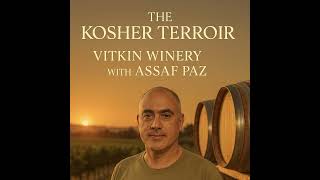
In this episode of The Kosher Teruah, host Simon Jacob interviews Asaf Paz, chief winemaker of Vitkin Winery, to discuss the winery’s unique identity and recent challenges. Paz explains Vitkin’s ABC (Anything But Cabernet/Chardonnay) philosophy, which champions Mediterranean grapes such as Carignan, Grenache, and Petit Syrah, and how this approach differentiates the winery in Israel’s wine renaissance. The conversation turns to the 2024 harvest, the first after the October 7 attacks, describing how war‑related labor shortages, unsafe vineyard zones, and disrupted pruning dramatically reduced yields (some blocks down 70 %) while concentrating quality. Paz recounts creating memorial wines for victims of the conflict and the emotional weight of the season. He outlines his evolving winemaking style—from early, bold, high‑alcohol wines to more elegant, approachable, and earlier‑drinking wines—highlighting the role of larger 500‑liter barrels, improved cellar technology, and meticulous vineyard management as part of a “tripod” of quality (grapes, tech, know‑how). The interview also touches on upcoming releases, experimental work with indigenous Israeli varieties (Betouni, Marawi), and the broader vision of Israeli wine as a cultural ambassador, urging international consumers to support Israel by enjoying its wines. Throughout, Paz balances technical detail with personal anecdotes, conveying resilience, optimism, and a deep respect for terroir.
Chapters
Welcome to The Kosher Teruah.
I'm Simon Jacob, your host for this episode from Jerusalem. Before we get started, I ask that wherever you are, please take a moment and pray for the safety of our soldiers and the safe return of all of our hostages. Today we are journeying to the heart of Israel's Sharon coastal plain to visit Vitkin Winery, a trailblazer in the Israeli wine renaissance. Founded in 2001, Vitkin Winery has been at the forefront of introducing Mediterranean varietals to the Israeli wine scene. With a philosophy dubbed ABC—Anything But Cabernet or Chardonnay—Vitkin Vitkin has championed grapes like Carignan, Grenache, and Petite Syrah, crafting wines that truly express the unique terroir of the region. In this episode, we sit down with chief winemaker Asaf Paz, whose journey from pastry chef to enologist has been nothing short of inspiring. Trained in Bordeaux and seasoned in wineries across California and Australia, Asaf brings a global perspective to Vitkin's winemaking process. We delve into the challenges and triumphs of recent vintages, discuss how the ongoing regional tensions have impacted viticulture, and explore the latest innovations at Vitkin's visitor center. Whether you're a seasoned oenophile or new to the world of kosher wines, this conversation offers a deep dive into the passion and resilience that defines Vitkin Winery. So pour yourself a glass of delicious kosher wine and join us as we explore the stories behind one of Israel's most dynamic wineries. Thank you very much for inviting me to come to Vitkin.
So I just called Yossi to bring us some samples.
Good. We'll do it. Can you walk us through the latest vintage? What stood out for you this year? In the vineyard and in the cellar, what's special about this year?
So the 2024, so we're talking about the first harvest after October 7th and practically during a war. And I think this is the base of the perspective to the whole harvest. The vines obviously continue to grow. Nature didn't stop. The winter was relatively good and gave us enough precipitation and cool weather. But the fact that we were at this terrible situation affected the vines even in, in things that we can't imagine. And when I I thought about it, especially after the harvest. I realized that everything counts, you know, everything counts. First of all, it was a tiny harvest, very, very low yield. I don't remember this, that drop of yields all over the country. There were vineyards that it was not so much, like 10% to 20%, even 25%, that starts to be significant. And we had even one vineyard that had a drop of 70% of the crop. And there you start to have a problem. You have all your needs in juice, in wine, in grapes, and you don't have them, or you have very, very little. Of course, quality or is amazing. All the qualities of all the wines is spectacular because everything is so concentrated. But we need the— we need also the quality, the volume. Exactly. So, and when I thought about it, we said it was weather, but if you don't have the labor that you need, and it was a big problem of labor because a lot of people are in the army, soldiers, reserves. Many people, we stopped working with certain sectors.
It's okay.
Does it affect? No, it's okay. Okay. We stopped working with certain sectors because we had a blockage on the, on the Sumerian Judea, and so in general we have less In general, you have less supply of workers. So it's also affected. And during the time of pruning of the vineyards, it was in the winter of the end of 2023, the beginning of 2024, you know, highest point of tension back then. There were many, many vineyards that was complicated or unsafe to go into, and some vineyards weren't pruned and weren't treated because it was just in front of Hezbollah in Lebanon, and people, for good reason, didn't want to go there. Some vineyards were closed by the army. So, and everybody knows that the pruning quality, but also the pruning timing, effects quality, but eventually volume of grapes. So eventually, we— there are many, many things that we didn't even thought about that affected the quality of the harvest. So I call it the harvest of October 7th, or the harvest of the of the war.
Yeah, because the actual— the 2023 harvest actually come in before October 7th for the most part.
So 90— more than 90% of the grapes were already in the wineries.
Yeah, you lost the staff to be able to make the wine.
We were very, uh, um, you know, we were very stressed After October 7th, because I didn't know if we would be able to put the wines in barrels. We were left, we were in a very good situation because 2023 was relatively early harvest and we finished picking all of the grapes before Rosh Hashanah and we were left with a single small vat press of red grapes that was supposed to be pressed just after Simchat Torah. And we were in a good situation because there were many wineries that had still fruit outside. Quality wineries, especially. I remember talking with a lot of them and they were in real crisis. So we were relatively in a good position, but again, relatively. It's not very good when you're afraid that you bring stuff to press the tank and you don't know if missiles will hit you or whether you'll be able to put the wines into barrels in the right timing. 100%. Eh, opa! Qu'est-ce que c'est? Pinoukine? Mm-hmm. Mais tu peux en prendre de bas? Oh, potato salad! I feel like in Russia, Mother Russia. Anyway, we— so if you pass that, the harvest was amazing in quality, disappointing in quantity and volume, and we still had a lot of issues with stuff. Normally, outside of the harvest, off-harvest, we have only 2 workers in the wine cellar. One of them was recruited. So you are like 50%. In Milouim. Yeah, 50% of your staff is in Milouim. But I can say today that 2024 gave us a few of the most outstanding white and rosé wines that we ever made. The red are still in barrels, but they look very promising.
So of the varietals, were there any surprises? Yeah.
Negative or positive? There was— there weren't any bad surprises, you know, except the problem of the lack of volume.
Yup.
But we have one specific, very exciting, delicious white wine that we did for the first time. As far as I know, it's the first time that anybody did it in Israel. We're going to expose it, to launch it on May 18th when we're going to propose the new harvest of the Shoah Shim red, our ancestry wine. It's called Shoah Shim Zayin, the 7th Shoah Shim, from the harvest of 2018. Spectacular wine. We made this wine only in exceptional vintages, and we— this is the 7th edition of this wine, even though we're going to celebrate This harvest, our 26th harvest.
But this is only the 7th of that, and it's from 2018.
Yeah, 2018. Wow. Pardon me, our 25th harvest. We started in 2001.
Looking back at the '23-'24 vintages, what do you think will define them in Vitkin's wine story?
From the bad side of the story, it was that those were harvest of a lot of stress and anxiety and anger and sadness, you know. We were mourning people that we love and knew. I went to visit people that lost their loved ones. And in like a big volume and a lot of visits, a lot of people that we knew and gone. It touched all of us. We made few wines as memorial wines, you know, we special labels for people that are no longer with us. And we don't know those people, you know, it was One of them was a girl that was killed in the Nova Festival, and her sister approached us, and she was a big fan of our winery, and she especially loved the White Israeli Journey. So we donated, I don't remember how many cases of White Israeli Journey with the label with her picture on it. And another guy from nearby village that we did the same for him. But from the other side, maybe a little bit more positive side, we saw the strength of the people of Israel. We saw the strength of the whole good civilians of this country, how we can work together, how we can help each other. And, you know, all those Big horrible events give you perspective. Sometimes we are, you know, sucked into our own small fights and, you know, disagreements. And those big mega very sad traumatic events shows you that sometimes you need to concentrate in the positive side of life and choose your battles. And that was the meaning of this harvest for us. So I think all in all, everybody worked. We always have good people in the winery, but the dedication of the workers that we had this year was unbelievable.
Are there any vineyard blocks or specific wines from recent vintages that are especially meaningful or symbolic because of what's going on?
We had many vineyards that we couldn't visit during the heavy, you know, big tension and activities with Lebanon, especially in the north. I was up north.
I saw what was going on.
It was unbelievable. Crazy. There were vineyards that I called the farmer and I called him, I want to come on Monday visiting you, visit the vineyard. He said, Asaf, don't come. Don't come. It's crazy. I don't want you to get hurt.
Everything is on fire.
Yeah, everything is on fire. And you know, we have rockets flying over our heads. Some vineyards were in strategic places near bases or Iron Dome batteries that the Hezbollah tried to target. And so I got into a situation that I don't tell them, and I just take my car and go. I don't tell the farmers and I don't tell my wife especially that I'm going to see the vineyards because I have to see the vineyards, but everybody is very anxious about this. And I went up and there were like more than a couple of times that shit happens, you know, things happen around me. I know. You know, there was a couple of times that drones exploded a few hundred meters from me. Explosive, like suicide drones or missiles. All the time airplanes flying around you, you know, fighter jets. And you know what's the most scary thing? When you're less than 100 meters from an Iron Dome battery and sometimes you don't even realize it's there and suddenly a missile is shooting to target a threat that's coming from somewhere and you don't, you're not realizing what is it, you know, you see that something has happened and then you realize it's just an Iron Dome missile that went to actually protect you. But it's as much as scary. The noise and the poof. It's crazy. Yeah, yeah. So it was very challenging and I'm the type of farmer who's very you know, hands-on in the vineyards. I don't let my farmers do any decision, any major decision, without me visiting the vineyard and checking and see that it's okay. And it was like sometimes a self-control to try to trust them in the places that I can trust them, and I know that they are doing a good job, and in the— and to be very fast and thorough in the cases that I have to go into the vineyards, especially to taste grapes before harvesting, things that nobody can replace me. Right. And to see that everything is going on, you know, taking care of business and see that things are going on according to your specific plans, because every winemaker has his own approach. And we have only one harvest a year and you need that harvest to be perfect.
That leads me to a question that I often ask winemakers. Is it— that's amazing cheese.
I don't know what that is. Ah, it's the smoked one.
It's smoked?
Yeah, yeah, it's smoked.
It's incredible cheese.
This is quichota from Jacob's, from Faroe. And this is smoked gouda from Beit Yitzchak. It's from the village on the other side. So we're very local also in products. Okay, very cool.
Where is wine made? In the vineyard? Chef, or in the winery?
I can tell you things that for me wine is a big symbol of marriage. Marriage between few things. First of all, it's the meeting point of science and art. Okay, you said it in many podcasts that you— that you gave. That it's a form of art, it's an art craft, and it is. But without the science, it will be very hard to repeat your success. So this is the meeting point between those two fields that are completely different. And it's a marriage between God and man because God creates the grapes and the weather and the condition and the terroir. And man is taking it from there and can make many things out of it. From the results, he can sometimes modify the potential of the terroir if he's working harder of what he got. And the quality of the wine, of course, it's, you know, we always say it's 100% grapes. Yeah, we want to say it like that, and this is like the rule. It's not like beer and it's not like gin or, you know, vermouth, where you can spice things according to your desire. You know, you can craft a beer with coffee beans, you can craft a beer with herbs, whatever you want— flowers and fruits. In the case of wine, this is a big taboo. You cannot modify the wine from the exterior. You can base only on the quality of the grapes and the process. The only aromatics that you can add is the barrel aging, the barrel maturing. So it's basically 100% grapes, and if you have good grapes, it's amazing. And if you have bad grapes, so I don't know what you can do with it, but you can destroy 100% of the quality or diminish it if you do things not correctly. Take, take, for example, the harvest. You can have amazing grapes, you miss the harvest point or you pick it much too early, you don't have the potential that you, you can get. It depends on the grapes, but you can lose or you can augment the quality of the grapes in the winery according to the process that you're making. It's like in cooking. You can make an amazing steak. You just need the right meat, right? The right piece of meat that was— that comes from the right source and the right butcher and the right aging and so on. But if you don't use the right pan or the right heat or the right seasoning, you can totally ruin it. You can, yeah, you can ruin it. So it's both.
Among the new releases and upcoming projects, what can wine lovers look forward to?
I don't know in general, but I can imagine that we will see more drinkable wines. I would love to see—
more approachable.
I would love to see more approachable wines, more, you know, juicy wines over overwhelming wines. Okay. I always say that in the first few years of Witkin, we were— we sent wines to competition. And in the last 15 years, we haven't because we don't aim for competition. We don't aim for wine judges, even though I'm a wine— an international wine judge in competitions in Germany and in Israel and in other places. I know how to craft a double gold winner wine. It's not a big issue for me, but I don't want to make those wines because I think that eventually the wines I want to make that would be delicious for the crowds and not for the wine competitions. It's not always the same, okay? Sometimes it is, but sometimes A wine that gained double gold, it will take it many, many years to be ready to drink. And I want my wines to be— most of my wines to be more drinkable, more approachable, and more delicious and enjoyable. And I think that most of the producers are going towards this, realizing that In our climate, it's better to drink more white wines and rosé. And in the red wine section, you need them lighter and more approachable. Okay, so we need to distinguish that lighter doesn't mean diluted in any way. Yeah. Or to lose quality. Take for example our Pinot Noir or our Grenache Noir. They are lighter in color, they are lighter in their body, but they are so amazing and full of flavors and aromas. So you don't compromise— you shouldn't compromise the intensity and the concentration of the aromas if the wines are lighter. That's what I think that will happen, and I hope that What Vitkin started 25 years ago to make typical local Mediterranean wines and made a small revolution by it. I hope and I think it will continue and people will make more and more wines with local style and less and less wines with international style.
Are there new experimental varietals that you're dealing with that you didn't deal with before? Yeah, all the time.
I cannot tell, of course, because it's the R&D. One of them is the one that we are going to launch. It's a new— it's a new wine. It's a new approach. And it's something that we always try to find the balance in this area between always looking for something exciting and new and keeping the tradition that we created and focusing and making the wines that we are already making better and better and keep the style of each and one of them. So if you loved our Old Vine Carignan 5 years ago, you will still love it today. Hopefully we'll see an increase in the quality but not a big drastic change in the style.
Has your winemaking philosophy changed over the past few years?
It certainly changed from my first years. But, you know, as I'm gaining more experience, the change is smaller with every year. In the beginning, as a young winemaker, I wanted to impress. I wanted, you know, bigger— the bigger the better, the blacker the better, more intense wines that will impress people, higher maturity and so on. Sometimes it's coming from, you know, a younger point of view or less security in what you're doing or less experience. You see the grapes of a certain vineyard, let's say Cabernet Sauvignon, maturing. You're tasting it, you feel that they are ripe and they're ready, but since you have a little experience, you say maybe we should wait another week. I'm not sure if we take it now, maybe it won't be enough. Let's wait another week and then we'll be sure that everything is okay and they are fully ripe. And in that week you can get over the top in terms of sugar, in terms of alcohol, in terms of a fruit profile. You know, the flavors can go from very fresh red and black fruit to more jammy, overripe, porty style, and we don't want this. And sometimes, it's only my experience, and my self-confidence that improved the wine. When you see the same grapes, the same area, the same maturity, but sometimes more precise maturity. So of course I changed my style and I'm evolving. If you take our first vintages of the old vine Carignan and old vine Petit Syrah, they are much bigger higher in alcohol, and they're still delicious. Yeah. But today they are a little bit more elegant and more harmonious. It didn't change dramatically the wine, but I think they are much, much better.
Crafting wines to be more approachable, do you lose anything on the, on the tail end? Do you lose anything on their ageability or their— how long they last, how long they—
Hmm.
That's an amazing question because it's a question that I ask myself every time I'm doing that, every time I'm going and tilting a little bit to more elegant style that you can enjoy earlier. During the bottle aging. So how— my big, my big challenge is exactly that. How you make the wine more elegant, how you make a Petit Syrah that in the past, or a Carignan that in the past really needed 3 to 4 years bottle aging after we took it out of the barrels. And only then release it. And how you make it shortened to maybe 2 years or 1.5 years in the bottle and already after 1.5 years it could be approachable. How you make this and not dilute your wine and not taking off concentration and body and intensity. And this is my big challenge. Through the years, I think it's in the last 10 years maybe, especially since we moved to the big winery, I think we managed to do that in a very successful way through a better management of the vineyards, more experience that we gained with every, even every parcel of vineyard. And much better technology that we have today in the winery. Better tanks, better cooling system. That we can extract as much as we did, but the quality of extraction and the quality of the tannins and the body of the wine is finer, is more elegant. You have the same quantity of extraction, but more ready-to-drink style. Also, we did it through the use of a bigger volume of barrels. So these are larger barrels?
Larger barrels. What's larger, 500? Yeah.
Okay, 500-liter, mainly 500-liter, and some 300 liters. In the past we used 225 to 350. Yeah. And today I'm really happy about the choice of 500 liters. When the barrel is new, you don't feel any change in the intensity of the oak in the first couple of years that the barrel gives, but you feel much more intense fruit over there. And in the long term, you gain, you cover less the fruit, so you feel it more in the finished wines, and the wines tend to be more elegant, more approachable, or as the French people love to say, you respect les fruits, respect of the fruit. Okay. Respect of the terroir, and that's how I like to think about it. So those are the means that I have. My own experience, the better management of the vineyards. I think the age of the vines also play a big role in it, and the technology that we have in the vineyard. So it's always the same trio that supports the high quality of wine production. I always look at the wine production as something that's based on, on 3 legs. And my sister, who's an architect, always told me 3 legs is very stable. You know, you put the camera on 3 legs and so on. And tripod— tripods— tripod. Tripod. So it's a tripod. Yeah. You have the quality of the grapes that we discussed, you have the technology that you have in the winery that helps you keep this quality because You can have the best steak in the world, the best piece of meat, but if you don't have the good means to grill it, you can lose the quality. And the know-how, you know, the human resource, your own experience, your own skills and talent. So this is the tripod of the wine quality. For me.
So, uh, I believe that that's what defines terroir as well. It's, it's what you start out with as far as the grapes are concerned coming inbound. It's the procedures that you follow in the winery to— like Solera, the Solera, um, is, is really a terroir, but it's because they bake the barrels in the sun.
But this is a terroir that's in the winery and not, not in the vineyard. Yeah, no, but it's in the—
but it's part of the— it's in the bottle. Yeah, it's a terroir that's in the bottle.
I agree with you 100%. I always said that terroir— people tend to look at terroir, and this is the definition of terroir: the geology of the soil, the, you know, the topography, the height, the distance from the sea. The climate, of course, and so on, right? And nobody looks at the skills of the farmer. For example, I worked in big wineries when you can take grapes from a certain area from dozens different plots, and then you understand that you have one farmer, some of his plots are in the best locations, some are in the less quality location, but all of his grapes are amazing. And you have another farmer who have the same situation regarding the location of his plots. Some of them are in the best terroir, some of them are in the lesser quality, but all his grapes are, you know, mediocre. And you realize that, okay, the terroir can be amazing, but if you don't treat the vineyards and then if you don't do whatever necessary to get the quality you want to express it. And the same in the winery. Whatever you do in the winery is defining the good expression of the terroir or losing it.
Just a couple questions left and then we're going to taste some wine. Okay. So I'm very much looking forward to tasting.
We're going to taste few, few Special wine. Two exciting things. Okay. Yeah.
So, um, with— Vitkin is always in, in within the Israeli wine culture been a very special, um, has a very special place in that culture. It's elegant, it's also lighter, um, focused on the Mediterranean, uh, varietals rather than heavier, uh, red varietals. And how do you see that going forward with Israel? How do you see that going forward with your place in Israel?
You know, um, we I don't know, I don't remember the source, but there is a phrase in Hebrew that says that only on myself I couldn't, I couldn't tell or, you know, express. I can, I can express about everybody else, but not about myself. Describe everybody but not myself. And sometimes when other people describe you, you— I'm citing it because it's much easier for me to talk about myself from their perspective. And it's me, but it's of course it's Vitkin. You know, Manny Per, bless his soul, was a very special man and one of the most talented wine lovers of Israel. He called us the Carignan or the Mediterranean prophets. He said, you're prophets because You, in a way, you went on the direction that you understood that is the right direction, even though all the rest told you that it's nonsense. People laughed at you, people misjudged you, you know, underestimated you, and you still went to that direction because you believed that this is the truth. And in the wine, it's not easy to do because in the wine business You have many stories, and the story is a very big important tool of you marketing the wine and talking about the wine and explaining the wine. And sometimes we are captive and we are losing ourselves in the story, and we, you know, we let ourselves carry on too much with the stories and not looking in what we have in the glass, the liquid itself, what it gives you, and not the story. And when I started to understand that we should make Carignan and Grenache and other local varieties, Mediterranean varieties, in a Mediterranean style, it was from both from tasting a lot of samples and a lot of wines from similar terroirs to Israel that made very good wines from those varieties. Like? Like? Like Spain, especially Priorat, which is much heavier style than what we're making today, but at least it shows me the potential. And let's say the deliciousness and the amazing expression of the wine. And south of France, you know, a lot of places in Languedoc-Roussillon and the Carignan of Fitou and other places. And I tasted Carignans from Dry Creek in Sonoma, California, and Even Australia, very rare over there. And Grenache especially. And so it was experience, but also a lot of gut feeling that it should work. And we went, we jumped into the swimming pool, not knowing if there is water inside. Because it's nice to make a, you know, a hobby, do whatever you want because You know, the worst part, you lose some money.
But you have to be able to sell it.
Yeah, but if you establish a business and you decide on a philosophy of winemaking which is completely, you know, 90 degrees to another direction from what everybody else are doing and succeeding of selling their wines, so you either very smart or very stupid. So fortunately for us, it worked because we knew that there is truth over there. We knew that those varieties first and foremost will give more delicious wines that are adapted to the terroir and the cuisine and the temperament of the people. Right. Also the character. We are intensive people in Israel. We need something to cool us down, not to make us more angry and more tight. Okay? So we want wine that will make us relax. Right. That's what I thought. But also looking on the terroir— even the birds agreed. Looking at— I think there is a hawk in this tree, so they're yelling. All of them are nervous. Also knowing that those varieties are more adapted to the heat. To the dryness of our country. And you know what? We got the proof in two vintages, in 2010 and 2012. I did a couple of days ago, I did a vertical tasting of our old vine Petit Sirah. A group of big wine connoisseurs that taste wines from all over the world invited me because they collected their own collection of old vine Petit Sirah. From 2006 to 2014, 2013, some of them in Magnum version. And they wanted me to be the narrator of this tasting. And I brought another wine and it was amazing. And I brought the Petit Sirah 2004, which is still alive, delicious, and have even a few more years to age gracefully. And what we saw that there were two vintages, 2010 and 2012, that were extremely hot, might be the hottest in those decades, in this decade. And I remember that many colleagues had big problems with this vintage, especially, you know, Cabernet Sauvignon, Merlot, and so on. And I said that my varieties like Petit Sirah and Carignan really thrived. They shined in this variety, in this vintage, in this tough vintage. And it shows that they are okay, that they are well adapted. They feel like this is their home. It's— and they showing beautiful results even in the toughest vintages. So what we did now in Vitkin is really telling everybody Cabernet Sauvignon, Merlot. Chardonnay, Sauvignon Blanc, or as I like to call them, the Fantastic Four, because they are fantastic. They're giving amazing wines in most of the places, in most of the countries. But for me, they're a little bit boring. Continue doing them, they are good. It's not— I don't say don't stop doing them, but open up to new varieties, to new techniques, to new genres of wine, and experiment. We are a country that have maybe the longest history of winemaking, but since we had the longest prohibition period from the 7th century up to the 19th century, we need to walk again, to learn how to walk again. And you're doing that by experimenting all over the place in all of the terroirs with all of the varieties and not with only Fantastic Four.
Have you tried any of the new indigenous, they call them, varieties like Betouni.
Have you tried Betouni? I tried. I think I tried the Marawi, the Betouni. We have a few other in our experimental vineyard here in Vitkin from those group of varieties that are exciting. I taste the grapes and they look Fantastic. I think this is a big part of Israel winemaking and wine style future. Absolutely. Because this is the source. This is the source for many, many of the world's varieties. But also this is our source and we need to go back to the source. We need to find where they grow best. I know that they have a lot of very good properties. That we can use in new vineyards. But we need more time. You know, we are Israelis. We're rushing everything. Yeah, we're rushing everything. Sometimes it's good, you know. We build here a country and a culture and achievements that other nations, it took them 500 to 1,000 years to get where we are after 60 to 80 years. Which is very good and very impressive. But sometimes there are things that need time. I think that it's exciting. I think it's amazing that people try those varieties and we should try more. The only critic that I have, my 50 cents about this issue, is that we do them from the first These trials were made from vineyards that are located near Hebron in the Palestinian Authority, in vineyards that were— I know this because they offered me the same grapes. And I told them, pardon my French, I told them, where can I visit the vineyard? And they said, oh, you cannot visit it because it's very unsecure, it's Palestinian Authority. I said, I don't understand. How can I make wine if I don't— 'Visit the vineyard?' 'Oh, they will send you samples.' 'Great. How do I know how they grow the vineyards? What's the yield per acre? What's the— you know, maybe they give me grapes, but the concentration could be double if they do some activities and treatments in the vineyards to improve it.' So they said, 'Oh, you don't know. You just hope for the best.' I said, 'I don't know. I'm like that. If I don't— pardon my French— if I don't piece in the vineyard, I cannot make the wine from this vineyard. So the only critics that I have is that let's do this from the best vineyard that we got. It will take 3 more years, it will take 10 more years. And I think that— I know that people planted vineyards with those varieties, and I'm really excited to taste those varieties from the vineyard that were planted to make wine. And not from the vineyard that are meant to give table grapes. Right. Exactly. I agree. So it's exciting. We need more time.
Any message you'd like to send out to the international customers? About supporting Israel, about supporting Israeli wines?
I remember your phrase from 1.5 years ago when we sat here when I came here in the first time, you said that the most— the easiest, most enjoyable way to support Israel in those days is to buy and open and enjoy a good Israeli wine. And I think I go back to that, and I think I went to study winemaking in Bordeaux in France in 1999. For two reasons. First of all, I was really passionate about winemaking because it's really combined all my love. The love for Eretz Israel, the agriculture, the science, the biology and chemistry. I like to feed people because I was a pastry chef. So I like to be the Sarah Mashkim, not only the Sarah Ophim. And another thing— that I saw what's happening around the world regarding Israel in the PR field. And also it was obvious to see even 25 years ago. And I thought that wine could be maybe one of the best ambassadors for Israel to make our point and our claim and to show that we are here to stay. And when we plant a vineyard like our ancestors did, and when we're making wine from the grapes of Eretz Israel like they did in the Bible, and wine is so significant in our culture and our religion, it's a statement. And I think that everybody that, of course, from the Jewish people, but also non-Jewish, that support our way and believe in the right of Israel and the place of Israel in the world should enjoy Israeli wines. Some of them are very expensive, but you can find them in all price points. Yeah. Like everything is more expensive to make in Israel, wines are also more expensive than in the rest of the world. But I think that they are delicious. And today you have a very wide range, very, very wide range of high-quality, high-end Israeli wines. And you can pick up whatever you like and enjoy it and feel like you're part of this beautiful world of Israeli wine.
Raffaeshen, thank you. Thank you so much.
Thank you, thank you for being on the Kosher Terroir. Thank you for inviting me again. There's a saying I saw recently. Somebody asked how much you spend on a good bottle of Israeli wine. And the person responded, "At least an hour." That's amazing.
That's amazing. You know, sometimes people, of course, the money is an issue and sometimes people are looking too much at the price. There was on the other day, I don't deal with sales in the visitor center, but every once in a while I happen to stumble on a client that hesitates and needs some help, and I approach them. And she told me, you know, I want to buy a friend a gift and myself a gift. I said, amazing. And she hesitated between one a wine that cost 85 shekels and a wine that cost 125 shekels. And I told her, I said, "What's the deal?" She said, "I don't know if I can spend 125 shekels on a bottle." I say, "First of all, your hesitation is on the 40 shekels gap between those two because you want to buy a bottle of wine. Secondly, I think it's one of the cheapest ways to make you happy. If 125 shekels can make you happy for an hour or for an evening or for a nice meal, it's nothing.
It's really cheap. 100%. I agree with you.
I agree with you. Well, so thank you very much. I'm excited to be on the second time on your amazing podcast. I think it's, first of all, you do it in a very fascinating way that I always enjoy listening. Listening to it. And secondly, I think they are very important because you're choosing the subjects in a very intelligent way, and please keep doing it. Trying. Thank you. Thank you. Thank you.
This is Simon Jacob again, your host of today's episode of the Kosher Terroir. I have a personal request. No matter where you are or where you live, please take a moment to pray for our soldiers' safety and the safe and rapid return of our hostages. Please subscribe via your podcast provider to be informed of our new episodes as they are released. If you're new to The Kosher Teruah, please check out our many past episodes.










