From Lab Reject To Climate Hero: Marselan
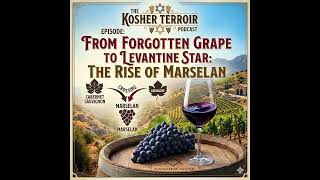
Paul Truel created Marselan in 1961 by crossing Cabernet Sauvignon and Grenache Noir, but the grape was rejected for decades because its berries were too small. Climate change and a shift toward quality winemaking revived it in the 1990s. Now Marselan thrives in drought and disease, making it a natural fit for warming vineyards worldwide.
Chapters
Welcome to the Kosher Teruah.
I'm Simon Jacob, your host for this episode from Jerusalem. Before we get started, no matter where you are, please take a moment to pray for the safe return home of all our soldiers, If you're driving in your car, please focus on the road ahead. If you're relaxing at home, please open a delicious bottle of kosher wine and pour a glass, sit back and relax.
Welcome back to The Kosher Terroir, the podcast where we explore the deep connections between soul, soil, and the vine. Imagine, if you will, The perfect grape. If you are a mad scientist, or rather a brilliant ampelographer, standing in a laboratory in the south of France, what DNA would you splice together to create the ultimate Mediterranean red? You'd probably want the aristocratic backbone of Bordeaux, right? The regal structure, the age-worthy tannins, and those deep, brooding cassis notes of Cabernet Sauvignon. But you'd also want a vine that could survive and even thrive in relentless baking heat. You'd want the drought tolerance, the generous vigor, and the spicy, jammy exuberance of a Southern Rhône Grenache. What if I told you that in 1961 Someone actually did this. They played the matchmaker with two of the most famous grape varieties on Earth. The result was a grape called Marselan. Yet for almost 30 years, this scientific marvel was completely ignored. It was deemed a commercial failure, a Frankensteinian grape left to gather dust in the viticultural archives. Today, we are dedicating our entire episode to the incredible underdog story of Marselan. We'll explore how it went from a rejected laboratory cross to a climate change superhero, how it conquered the globe from Bordeaux to Beijing. And most importantly, how its unique ampelographic profile is helping to redefine the modern terroir of Israel. To understand Marselan, we have to travel back to 1961. The setting is the INRA, the Institut National de la Recherche Agronomique specifically their legendary research station near Montpellier in the Languedoc region of southern France. At this time, the European wine industry was operating under a very different philosophy than we see today in boutique kosher winemaking. It was the post-war era, and the Languedoc was the engine room of French wine. The goal was volume. Winemakers wanted high yields to produce oceans of vin de table, everyday table wine. Enter Paul Truel. Truel was a visionary and palographer and vine breeder. He managed the incredible Domaine de Fassal a living library of grapevines planted in the coastal sands to protect them from phylloxera. Truelle had a specific mission: create a new intervarietal cross that could yield massive amounts of juice, resist common fungal diseases like powdery mildew, and still produce palatable wine. He decided to cross Cabernet Sauvignon and Grenache Noir. On paper, it was a stroke of genius, but nature has a funny way of subverting our expectations. When Trull finally cultivated the new vine, which he named Marselan, a nod to the nearby coastal town of Marseille, the vine was indeed vigorous.
And incredibly disease-resistant.
But there was a glaring problem: the berries were tiny. In the viticultural mindset of the 1960s, small berries were a disaster.
Small berries mean a low juice yield.
For the high-volume cooperatives of the Languedoc, a vine that didn't pump out massive quantities of juice was economically useless. Truelle's creation was deemed a failure. The cuttings were effectively shelved, and Marselan became a footnote, a forgotten experiment in the INRA's catalog. Now let's forward to the 1990s. The wine world had completely transformed. The demand for cheap, watery table wine had plummeted. A new era had dawned, an era obsessed with terroir, concentration, and quality. Suddenly, viticulturists and winemakers were looking at their vineyards differently. They realized what we all know today: small berries are actually the Holy Grail for premium red wine. A small berry means a dramatically higher skin-to-juice ratio. And as any winemaker listening knows, the skins are where the magic happens. It's where you find the anthocyanins for deep color, the phenolic compounds for complex aromatics, and the tannins for structure and longevity. Researchers at the INRA blew the dust off of Paul Truel's 1961 experiment. They took another look at those tiny Marselan berries. When they finally vinified it with modern quality-focused techniques, the results were staggering. The wine was inky, aromatic, and possessed a velvety plush tannin structure. That managed to perfectly bridge the gap between its Cabernet and Grenache parentage. In 1990, almost 30 years after its creation, Marselan was officially entered into the French catalog of grape varietals. The Frankenstein grape had finally been vindicated, but its journey was just beginning. Paul Terrell's forgotten laboratory cross the tiny buried Marselan, had finally been officially recognized by the French agricultural registry. But recognition is one thing, adoption is quite another. For the new grape variety to break into the deeply entrenched traditionalist world of European wine, it needed a catalyst. For Marselan, that catalyst was the slow-burning crisis that every winemaker listening to this podcast is intimately familiar with: climate change. Initially, Marselan began to quietly take root in its native Languedoc and over in the southern Rhône Valley. Winemakers there quickly realized that it wasn't just its thick skins and intense color that made it valuable, Marzellan is a viticultural survivor. It naturally resists powdery mildew, botrytis, and mites.
But its true superpower lies in its phenology. It's a late-budding vine, which means it sleeps right through the devastating spring frosts that have recently ravaged French vineyards. and it is incredibly drought and heat tolerant, able to maintain its natural acidity even under a baking sun. This specific set of survival skills led to a moment that shocked the traditional wine establishment. Imagine Bordeaux AOC. It's at its pinnacle of the Old World, a region governed by strict rules and historic châteaux. For generations, the Bordeaux blend has been an untouchable recipe: Cabernet Sauvignon, Merlot, Cabernet Franc, Petit Verdot, Malbec, and Camagnac. But rising temperatures and changing weather patterns have been steadily pushing alcohol levels up and acidity levels down in classic Bordeaux. In 2019, recognizing that they needed to adapt to survive, the Bordeaux Wine Growers Syndicate proposed something radical. They requested permission to introduce a handful of new grape varieties to combat climate change. In 2021, the French authorities officially approved 6 new grapes for Bordeaux. And sitting right there on the list of the approved red varieties, shoulder to shoulder with Portuguese heavyweights like Touriga Nacional, was our underdog, Marselan. Today, forward-thinking Bordeaux estates are legally allowed to plant up to 5% of their vineyards with Marselan and use it for up to 10% of their final blend. They rely on it as an insurance policy, a grape that provides the necessary structure and deep color of Cabernet but won't shrivel up or lose its mind during a record-breaking summer heat wave. But Marselan's story doesn't end in France. It's a true globetrotter. In South America, it has found a passionate following in Uruguay and Brazil. In those regions, the challenge isn't just heat, it's intense humidity. Because Marselan has relatively loose clusters and thick skins, it's practically immune to the rot that destroys tighter clustered varietals in wet conditions. We're also seeing it pop up in the extreme heat of Arizona and the north coast of California. However, to find the most fascinating chapter of Marselan's global expansion, we have to look to the East. We have to look to China. In 1997, the Chinese and French governments began a diplomatic dialogue about agriculture and viticulture. This culminated in 2001 with the creation of the Sino-French Demonstration Vineyard in in Huailai, about an hour north of Beijing. When the French experts arrived to plant the experimental bicultural vineyard, they brought cuttings of classic varieties, but they also brought about 10,000 cuttings of Marselan. It was a revelation. While Cabernet Sauvignon often struggled to ripen fully in certain Chinese regions, leading to harsh green bell pepper notes, Marsala thrived. It loved the fierce sun, the dry windswept valleys. The Chinese winemakers coaxed a version of Marsala that was glossy, rich, and intensely aromatic. Today, Marsala is widely considered China's signature premium grape. In the booming high-altitude region of Ningxia, Situated in the foothills of the Harlan Mountains, winemakers are producing massive, high-octane, 15% ABV single-varietal Marsalans that are winning gold medals in international competitions. Plantings in China have exploded to over 4,000 hectares, making it second only to France. So from the discarded laboratory experiment in Montpellier to the hollowed soils of Bordeaux, to the foothills of the Harlan Mountains in China. It is an incredible resume. But what exactly does this globetrotting chameleon taste like? What happens when you extract the juice from those tiny, thick-skinned berries? Well, to truly understand a grape, you have to follow it out of the vineyard and onto the crush pad. What happens when those bins of freshly harvested Marselan finally hit the cellar? To answer that, we have to look closely at its physical profile. Remember Paul Trell, the ampelographer who created Marselan? His failure was that the grapes produced unusually small berries. But for premium winemakers, those tiny berries are an absolute gold mine. When you have a small berry, your skin-to-juice ratio skyrockets. The skins are the treasure chest of the grape. That is where all the anthocyanins, the color compounds, are stored. It's also where the complex flavor phenolics live. And it is also where the tannins are born. When Marsala hits the fermentation tank, it gives up its color almost immediately. We're talking about deep, inky, opaque purples. If you look at a glass of young Marsala and tilt it against a white tablecloth, you'll often see what winemakers call a Viking dark rim, a vibrant, almost neon magenta edge that hints at the intensity within. But here is the magic trick of Marselan. Despite those thick skins and that massive color extraction, the tannins it produces are surprisingly supple. They aren't the harsh, green, aggressive tannins you might find in an underripe Cabernet Sauvignon. Instead, Marcellan's tannins are velvety and plush. They coat the mouth without stripping it. Because of this unique profile, Marcellan acts like a chameleon in the cellar. It can be whatever the winemaker needs it to be. Let's talk about its single varietal expression. When a winemaker decides to let Marcellan stand entirely on its own, 100% in the bottle. The wine is incredibly showy and exuberant. It's a fascinating tightrope walk between its two parents. On the nose and the attack, you get the dark, brooding cassis, blackberry, and structural elegance of Cabernet Sauvignon. But right in the mid-palette it suddenly shifts gears, delivering a hedonistic jammy red fruit, the spice, and the approachability of a warm climate Grenache. And speaking of standing on its own, I have to mention the wildly popular trend taking over the Mediterranean and beyond: Marselan Rosé. Because Marselan has such intense color compounds, winemakers don't need to leave the juice on the skins for very long. With a gentle, direct press, the juices pick up a gorgeous, vibrant pink hue almost instantly. The resulting rosés are not your typically sweet, flabby blush wines. They are crisp, bone dry, and intensely aromatic, bursting with notes of wild strawberry, tart gooseberry, and a fascinating saline minerality that feels like a nod to its origins on the French coast. But as beautiful as it is on its own, Marselan's historical role, and perhaps its greatest strength, is as a master blender. It's the ultimate glue in modern Mediterranean blends. Think about it like a chef building a sauce. Sometimes a Cabernet Sauvignon can have what we call a donut hole. It has a great attack on the front of the palate and a long tannic finish on the back, but the middle can feel a bit hollow. A splash of Marselan fills that donut hole perfectly, bridging the gap with a burst of fleshy mid-palate fruit and softening the rigid Cabernet tannins. Or let's consider the wider grapes of the Mediterranean, like Syrah or old vine Carignan. These grapes can sometimes be a bit too rustic, a bit too gamey or animal on the nose. Marselan acts as a civilizing force. It tempers those wild notes, bringing a polished aromatic lift —of sweet spice and dark cherry, tying the whole blend together with its vibrant color and acidity. It's a grape that elevates everything around it. So we have a grape that loves intense heat. We have a grape that thrives in drought. We have a grape that produces deep color, plush tannins, and acts as the perfect structural bridge in Mediterranean blends. So if you are a winemaker looking at a map of the world, searching for the absolutely perfect place to plant this grape, your eyes are going to inevitably drift towards the eastern shores of the Mediterranean. You're going to look at Israel. It's time to talk about Marsalan's Alia. If you're looking at the climatic data of Israel and compare it to the Languedoc region of southern France, where Marcel Lann was born, it is essentially a mirror image. We are talking about the classic Mediterranean basin— long, hot, fiercely sunny days followed by completely dry summers. For decades, the Israeli wine industry was obsessed with replicating Bordeaux Everyone planted Cabernet Sauvignon and Merlot. And while Israel produces some absolutely world-class cabs, our climate is fundamentally different from the maritime coolness of Bordeaux. Our sun is relentless. So when Israeli viticulturists finally started looking for varieties that naturally belonged in our climate, Varieties that didn't have to be forced to survive the Levantine summer. Marselan was sitting there waiting in the wings. It was the perfect match. But simply surviving the heat isn't enough to make a premium wine. If you plant Marselan in a place that is too hot and flat, its Grenache DNA takes over. The sugars spike, the acidity drops, and you end up with a flabby, alcoholic, jammy mess. This is where the unique terroir of Israel comes into play. Israeli winemakers realized that to coax the elegance out of Marselan, to honor its Cabernet Sauvignon parentage, it needed altitude. They looked up north. They planted Marsalan in the rugged, limestone-rich soils of the Upper Galilee and the volcanic basaltic tuff of the Golan Heights. At elevations of 500 to 800 meters above sea level, something magical happens. The vines bake in the intense daytime sun, achieving beautiful, rich, phenolic ripeness. But as the sun sets and the temperature plummets, those cool mountain nighttime breezes rush through the vineyards. This dramatic diurnal temperature shift acts like a refrigerator, shutting down the vine's sugar production and locking in the grape's natural vibrant acidity. Because of this specific terroir, Israeli Marsala achieves a breathtaking balance. The hedonistic, sun-drenched fruit of the Mediterranean held together by a tight, acidic backbone. You can't talk about the rise of Marsala in Israel without talking about one of the true pioneers of the grape in the kosher world, Recanati Winery. Under the guidance of visionary winemaker Gil Shatzberg and Kobi Arbib, Recanati didn't just experiment with Marsala. They championed it. They recognized early on that Marsala could express the true, authentic voice of the Israeli terroir better than many of the classic international varieties. Recanati released their first single-varietal Marsala Reserve over a decade ago, and it was a revelation. Sourced from the Kaddish area of the Upper Galilee, it proved that kosher Marsalan could be a serious, age-worthy wine. It's a wine that routinely sells out, prized for its inky concentration, its notes of wild Mediterranean herbs, what the French call garigue. And its plush, elegant finish. But they didn't stop there. Recanati also utilized Marzellan's superpower as a blending grape. If you look at their flagship wine, the iconic Recanati Special Reserve Red, Marzellan plays a crucial role, blending with Cabernet Sauvignon, Syrah, Petite Syrah, and Carignan. Marcelan acts as the cohesive binder. It bridges the gap between the rigid structure of the Cab and the wild, spicy nature of the Syrah, creating a masterpiece of Mediterranean winemaking. Recanati lit the match, but today the fire has spread across the entire kosher wine landscape. Marcelan has officially arrived. Go to your local kosher wine merchant today and you will see it everywhere. Massive historic producers like Barkan, Tepperberg, Tabor, and Jerusalem Vineyards Winery have all heavily invested in Marselan, both as a stellar single varietal and as the secret weapon in their premium blends. We are also seeing incredible site-specific expressions from boutique garagiste producers, who are pushing the boundaries of what this grape can do in the Judean hills and the Negev desert. Marsala is no longer an experiment in Israel. It is a cornerstone of the modern Israeli wine identity. It is the taste of the Levant. We've talked about the history, the science, the terroir of Marsala. Now it's time for the best part. It's time to get this wine into a glass. Whether you're a seasoned sommelier or an enthusiastic collector of Israeli wines, tasting a well-crafted Porzellan is a completely unique experience. It is a wine that demands your attention from the moment you pour it. Let's do a virtual tasting together. If you happen to have a bottle of kosher Marsala handy, maybe the Recanati Reserve or a beautiful expression from the Judean Hills, pour yourself a splash. First, let's look at the visual. Hold your glass by the stem and tilt it against a white piece of paper or a white tablecloth. Because of those tiny berries and thick skins we talked about earlier, The color extraction is massive. You're looking at a wine that is deeply ruby, often pushing into an opaque, impenetrable purple. Look at the meniscus, the very edge of the wine where it meets the glass. You won't see the watery brick orange rim of an older Pinot Noir. Instead, you'll often see what we call a Viking dark rim, a vibrant electric magenta edge that practically glows. It's visually stunning. Now give the glass a generous swirl. We need to wake it up and introduce some oxygen. Bring it to your nose and take a deep, short sniff. What hits you first? It's usually an explosion of jammy dark fruit, You get the aristocratic notes of the Cabernet Sauvignon parent, the crushed blackberry, the black currants, and the cassis. But right behind that, you get the exuberance of the Grenache—ripe, dark cherry, and perhaps a touch of raspberry liqueur. But the great Israeli Marsala isn't just a fruit bomb. Dig a little deeper into the glass, and you'll start to pick up a distinct savory earthiness. It's that Mediterranean garigue—wild thyme, dried mint, and even a cooling hint of eucalyptus. This is often framed by sweet baking spices from the oak aging—a dusting of cinnamon, clove, and sometimes a faint whisper of smoked cedar. Now take a sip. Let it coat your entire palate. The attack is incredibly generous. You'll taste those dark fruits immediately—ripe plum and blackberry. But watch how that wine behaves in your mouth. Notice the texture. The tannins are there. They are dense, and they provide a serious structural backbone. But they aren't aggressive or astringent. They are polished, supple, and velvety. On the mid-palette, you might find a crack of black pepper, a ribbon of dark bitter chocolate, or even a savory note reminiscent of Asian preserved plum. And finally, the finish. Thanks to the cool nighttime temperature of the high-altitude Israeli vineyards, the wine maintains a bright natural acidity. It finishes fresh, clean, and incredibly long, making your mouth water and compelling you to take another sip. Which brings us to the most important question for any kosher table: what do you eat with it? Because Marselan combines deep, dark fruit with savory herbal notes and a sturdy but soft tannic structure. It is incredibly food-friendly. For carnivores, this is a meat lover's dream. Think about dishes that mirror its earthly rustic qualities. A slow-roasted lamb shoulder in rosemary, garlic, and coarse salt is a match made in heaven. The wine's acidity cuts through the rich, fatty lamb while the herbal notes in the wine sing in harmony with the rosemary. It is also spectacular with rich, slow-cooked shabbat shaloms or heavily charred thick ribeye steak straight off the grill. But let's say you're pairing a parve or dairy meal. Barcelone shines there too. Because of its Mediterranean soul, it pairs beautifully with deeply roasted vegetables. Imagine a charred eggplant carpaccio with tahina and cilantro, or a rich, slow-simmering tomato and wild mushroom ragu served over fresh pasta. And if you're doing a dairy spread, bring out the hard aged kosher cheeses, a sharp cheddar or or an aged Gouda, or a Picorino-style sheep's milk cheese will perfectly soften the tannins and highlight the wine's dark fruit. So, from a forgotten laboratory experiment in 1961 to a climate change superhero, from the sands of southern France to the basalt soils of the Golan Heights, Marselan is a testament to resilience, to science, and to the incredible, ever-evolving story of modern viticulture. It's a grape that has truly found its voice in Israel. The next time you're in a local wine store, skip the Cabernet and the Merlot, at least for a week. And ask for an Israeli Marsala. Pour it, taste it, and experience the future of the Mediterranean terroir for yourself. Thank you for joining me on this deep dive. As always, keep exploring, keep tasting, and we will see you next time on The Kosher Terroir. L'chaim! This is Simon Jacob again, your host of today's episode of The Kosher Teruah. Please subscribe via your podcast provider to be informed of our new episodes as they are released. If you are new to The Kosher Teruah, please check out our many past episodes.










