Part 2: Efi Kotz and Shachar Mamor on Crafting Exceptional Israeli Wines at Recanati
Winemaker Shachar Mamor and sommelier Effie Kots walk through Recanati's vineyard-to-bottle operation in the Galil, where they track every block on a real-time monitoring board. They focus on Mediterranean varieties like Marselan and Syrah, but also experiment with Colombard, Chenin, and old-vine Carignan. Wines range from 80 to 150 shekels.
Chapters
Welcome to The Kosher Teruah. I'm Simon Jacob, your host for this episode from Jerusalem. Before we get started, I ask that wherever you are, please take a moment and pray for the safety of our soldiers and the safe return of all of our hostages. The following is part 2 of a 2-part episode of The Kosher Terroir with sommelier Effie Kots from Recanati Winery located in the northern Galil and with one of their winemakers, Shachar Mamor. I was invited up to see their winery, one of the most modern in Israel, and their brand new beautifully appointed visitor center. With all the friction on the Lebanese border, and being located just 8 kilometers away, they have made the brave decision to get back into their pre-Gaza War lives and open up the visitor center for business. Though there is currently just a trickle of tourists, I believe when word gets out, this will become a major wine destination. Part 1 is a walkthrough touring the facility, discussing many of the winery's capabilities and innovations. Part 2 is a tasting and review of some of their more innovative new wine offerings. If you're commuting in your car, please focus on the road and enjoy. If you're home, please choose a delicious kosher wine, sit back, and listen in on this very tempting wine adventure.
Shachar! You came just on time.
Yes, perfect.
Excellent.
Tell me a little bit about yourself. We're— you're the assistant winemaker here?
No, we are two winemakers. Just Kobi is the head winemaker.
There is no assistant in the winery.
I'm sorry.
No, that's fine.
That's why I asked.
That's why some wineries have— you have—
so you're, you were originally— you're originally from Aretz?
Yes.
You went to school where?
You talking about winemaking school, or you're going way back to this?
How did you get here? Okay.
First of all, I grew up in an agricultural farm in Kvart Avot.
Okay.
One of the establishers.
Okay.
And we own vineyards. I planted vineyards there way back. But, you know, I grew up in a family farm without any viticulture in it. Yeah. Although my great-grandparents used to grow for Baron Rothschild the grapes, but it was ancient. Just growing almonds, olives. That kind of stuff. And I went and studied psychology, but then I was in a search of— soul search. And decided to start working in some wineries. I worked in Amphora.
Okay.
And then I said, okay, that's it. Flew to Australia, studied at Curtin University, near Margaret River. Okay. And then went back, worked in Carmel Winery as a winemaker. And after that, viticulturist in Netofa with Pierre. Yeah, yeah. And also assist as a winemaker there.
Even to your peer talks about it. He's in love.
Yeah, it was a special match.
He's a special person.
He's a real tzadik. Visionist. Yeah, but after 6 years in— and During that time, I established my own vineyards. That's why I left Carmel. But after 6 years in establishing also vineyards for Netofa, when I joined, they had only a few acres. We planted some more varieties, some more vineyard blocks. Came to a stage that it was enough for me and I approached—
You're an agronomist as well?
You study agronomy and viticulture during your studies of winemaking, of oenology. I think because I grew up in a farm and I'm more farmer than agronomist, okay? My main is oenology, okay? But of course in Recanati I assist and control quite a lot in the vineyards. So we have agronomist, but we work very closely with him and we go around in the vineyards and we have all the full control.
We are—
Kobi and I, we're not regular winemakers because we visit the vineyards a lot. We know everything that happens there. It's not like sitting here and waiting for the grapes to arrive.
I saw the board downstairs to monitor the vineyards. Brilliant. Absolutely brilliant. What a cool thing. I've never seen anything like that before.
It's the best tool you can ask for.
Yeah, it's so cool.
Doing this, it's the best thing to watch.
You can watch everything happening.
Yeah, it's very comfortable to use. Although everything is on the computer as well, of course. But yeah, especially in the harvest time, everything is a rush. So it's the best way to operate.
I just want to say L'Chaim before.
L'Chaim. Yeah, that's good.
I haven't drank wine with Shachar for a lot of time.
Tell me what we're drinking. This is a Colombard.
Yeah, this is Colombard. It's a white Colombard. It's a relatively new wine that we are making, second vintage if I'm—
First is a '22.
Ah, the '22, right. The '23 is the— So yeah, 100% Colombard from Telfar's vineyard.
Okay.
And you can feel it yourself and then we can Speak more about the production methods. Move to English?
Let's move to English.
Yeah, okay, so it was off record.
So, okay, that's what you said. Yeah, yeah, I know you said this is nicer than the 23.
So I did. In my opinion, I prefer this one over the 23, although the 23 is not yet judgeable because it just bottled and not yet released to the market. We release it soon when it will be ready, but The 23, in my opinion, is a bit more fruit-forward. Not fruit-forward, power of the fruit is a bit more emphasized.
I can understand why you say that. I mean, the yield, average yield, was quite higher in 22 vintage through all the vineyards, including the Colombard and Tel Fares. The 23, lower yield, more concentrated fruit, more straightforward. But I think it's still— the 23 is still looking for its balance. It's going to be Similar, but yeah, a bit more intense than the 22. So I can relate to what you said. This one is thinner, mineral, saltiness.
Fun fact, Jahav from Yatofa was here last week, and I gave them actually both to taste, to Jahav, the 23. I don't know why, but I had a bottle here. Okay. I think somebody wanted to taste here with somebody else, and I guess they left a bottle, so I opened it accidentally, and then I opened the 22 as well. Okay. And comparing one to each other, most people will love the 23 Bore.
Obviously.
For no doubt.
Because it's more pronounced. It's pronounced, exactly.
The fruit is over there. I mean, here it's so mellow, so subtle.
Yeah, this is more gastronomic wine. I mean, all of our wines are gastronomic in a way, but—
What's amazed me so far in the tasting, it's not amazed me because I've been drinking Koby's stuff for years, What's cool is the balance. The balance is just so there. There isn't anything that's like out of balance as you're drinking it. Where the rosé has acid, it has acid, but it's still— it's not like it's overpowering you. The Yonatan, the level of alcohol is just, you know, it's not pushing against you. It's really, really just lovely. It's enjoyable. This is really, really nice.
I think what you described is part of the vision of the winery.
Exactly.
Yeah.
So that's one of the questions I really have for you. Is there a vision behind what's made here? I know, you know, I'm asking to speak for you, not for Kobe.
Yeah, yeah, definitely.
But I'm sure you're, you're basically on the same—
Yeah, exactly. I mean, I think this is what, uh, got us to work together because we, you know, I was interviewed, I came from with my own history, and we understood that we are on exactly on the same page. You know, sometimes we We have to discuss and see, maybe here, maybe there, but the vision is quite similar. And I think it's obviously it starts with the vineyards. I mean, we love growing Cabernet Sauvignon, we love growing Merlot, but only on some specific sites that will pronounce it the best. But we, you know, the Mediterranean vision is clearly here, but for us is Not only the variety like Petit Syrah or Marcellan or Syrah. It's the way we grow the vineyards. The way we communicate with the climate here. Shaded vines. Early, early. For us, it's exact timing for harvest. Every vineyard through the vintage The sampler goes twice a week, so we won't miss the right timing.
We've discussed that.
Yeah, I mean, this is where we put the most effort during the Vintage Series. We taste and we taste and we visit.
It's hard to realize that winemakers can do that when they're moving so many bottles, when they're making so many bottles of wine. You have to have systems that are set up in such meticulous ways to be able to do that, so that it's not like you don't miss something. And it's easy to miss.
It is.
I thought that was tanks on the wall initially, when I saw the squares. And then he said that those are the actual, what you call it, those are actually the—
The squares are the tanks.
No, no. The Luch on the vineyard.
The Luch, yeah.
The other one is the tanks. I know, I know that.
But they are not squares, they're like a table, like the table.
Okay, the round circles.
No, the round circle, the ones for tanks. Yes, that's the circles. Yes, the squares, what you call, is actually a table just divided, not in a—
In the laboratory you have one big wall with the table with all the vineyards. Yeah, and from the opposite side, the square Where are the tanks?
Are the tanks? Yeah, no, okay. And that mimics what's— that's the manual backup to what's on the computer.
Yeah, exactly.
Which makes a whole lot of sense because if you can't— if the computers go down, to say, okay, we don't know where anything is, it's meshuga.
Not just that.
It's crazy.
You have to see— when you see it in your eyes during the season, you can feel as much as— as more lines on the board, the happier people are. In the beginning, it's like as nervous as they are—
Especially the crosses on the videos.
Exactly. When you see most of them crossed, people get much happier.
Right. I can see that because you're moving through, you're accomplishing something.
You can see the progress. It's really something because most works don't see the progress. It just happens.
Is there a varietal that you specifically really like?
There are a few. Okay, we don't grow most of them.
No, tell me, actually I'm curious.
Like, my favorite white is Riesling.
It's Riesling?
By far, Johannesburg Riesling. Yeah, yeah.
Barilangilech, high five!
No, it's amazing.
And the red is Pinot, but it should be superb.
Yeah, I know it's hard, it's hard, it's hard, it's hard.
And I will never grow Pinot in Israel. I mean, some wineries make beautiful wines from Pinot, but they are not varietal wines. So for me, it's not Pinot.
The only Pinot— wait, there's two winemakers in Israel that make Pinots that I think start to approach what you're talking about. One is Yaakov Oria, because he He has thrown away more Pinot than you can ever imagine because he wants a specific thing to come out of it. The other one is, um, Chivi.
Ah, Chivi Drori.
He makes a Pinot now.
Yeah, I know, out of bituni. Okay, out of bituni.
It's not out of Pinot.
Okay, no, I know we are, we're making something between Gamay and, and Pinot out of bituni.
Yes.
From my perspective. So this one I appreciate and can relate. And Yaakov Uriah is a very talented winemaker. Right. But I still don't believe that in Israel it's the right variety to—
No, I didn't say it's the right variety, by the way.
So it won't be Pinot.
Shibbi also makes Pinot.
Yes.
Which in a very weird way you can relate it to Pinot, but just not the classic Pinot that you want. No, no, no. It's the closest thing that you can relate to Oregon Pinot. Pinot Noir.
Okay.
Which is not the Pinot Noir.
And I say, if you can make beautiful wines out of the right varieties, why, why waste your time on something that is similar?
That's one of the reasons why Shivi is interesting, because he said, um, at least when I spoke to him, he said most of the Israelis, most of the, the, um, not most, almost all of the Israeli indigenous varieties are all white. There was one red, I think, out of all of the things that he's looked at. They're all whites. And why are we making— why are we trying to make Cabernet and Merlot?
And that's the professor, Shibi.
I know, that's the professor. Okay, I agree.
Because he makes Cabernet and Merlot.
No, he does, he does. Actually, his Merlot is not bad.
And it's not a— Merlot, it's sometimes it's a gamble. You never know whether you grow it and will be brilliant or disaster. And Cabernet Sauvignon, we have some great sites in Israel to grow Cabernet Sauvignon. But they should be specific. In the old days, they used to grow Cabernet Sauvignon in Kfar Tavo. It doesn't make any sense.
Just boil it.
That's because they said we want Cabernet.
Yeah.
You know, like everybody wanted Cabernet.
A lot of the Israeli wine industry is based on, oh, Cabernet is good, let's put it everywhere. Yes.
No, we are trying to change it. I mean, entry-level, mid-range, more and more Mediterranean variety, the Marselan, the Petit Syrah, the Syrah. We're giving them the right respect and space that they need. The whites, the Colombard, for us it's quite—
This is interesting.
Diverse. Yeah, and Marselan is— it's amazing.
It's an amazing grape. It's amazing.
The profile of red and rosé wine that you can make out of it.
Yeah, we will soon taste the red one and you will be amazed even more because it's a rich red without the heaviness of Israeli climate, which is amazing.
I love the— I love the aroma. Of Marsala.
Yeah, it has the nice lavender touch.
Well, he gave me, he gave me the, what you call it, first petnat.
The petnat.
So when you, when even when you smell the petnat, it's, it's, it's beautiful, but there's something on an edge there with a smell because it's a petnat. Exactly. But as soon as you do the rosé afterwards, it's like, yeah. It's just perfect. It's really nice. It's lovely.
It's really unique. It's varietal, and it's actually one of the best suitable grapes to Israel, in my opinion. But that's a personal opinion. You don't see a lot of Marselan in Israel, but those who make Marselan, you'll see a lot of different methods of making. I mean, more powerful, less powerful, more oak, less oak. You can see a lot of expressions of Marselan. All of them have something in common when you taste the wine individually. So it will be less or more alcoholic or ripe, but the flavor profile will probably remain on the same level of fruitness and herbaceous spices that goes together and not in a heavy way, which is— I never thought I would taste 15% alcohol, 2 years in oak barrels, new oak, and still the flavor of the fruit is more powerful than the oak.
Who make that.
Can we say that?
I don't know, not for the record, maybe. But you know, that's one of the really amazing—
it is, they've come around in so many crazy ways. He's like, he's done crazy stuff, really good stuff, right? I'm totally—
I was amazed from the Marcello.
I'm totally amazed by him. And yeah, the other, the other group is Agur. The two of them from Agour, Eyal and Elad.
Elad is the CEO, but Eyal is the winemaker. Eyal and Shivi are the winemakers. Shuki.
Shuki.
Shuki, Shivi, Shivi.
I know, it drives me crazy. That's the reason why I was saying it before.
No, you have Shuki and Shik and the neighbors.
No, Shuki, Shiki and Shivi. And it's like, okay, thank you. No, Baruch Hashem. The question I have is, what has been Recanati for you? Have you learned things here? What, you know, like, how much has it impacted you?
A lot. First, I believe that for the first time I was engaged with a winemaker with the same vision. And in a way, the opportunity to complete each other, me with my vineyard background and Kobe with his huge experience. I think it changed my— I'm almost— I'm going to start my 6th vintage in Recanati. And I believe it changed my perspective in a way. You were asking about philosophy. Before philosophy, or maybe it's part of philosophy, I came to a winery when you're producing a wine like Yonatan. Yeah, but you approach it like it was your most boutique, highly rated wine. I mean, you control and you decide every vineyard block from anywhere you get it from the Galil, the Golan, in the same way that you will approach this Chenin.
Which we haven't talked about, by the way.
And I think it's even a bigger challenge because you are dealing with so many tanks and you have— it's like a gestalt. You're taking a vineyard, maybe this one is a medium range quality, the other one is higher quality. And you have to get the right timing of harvesting, and you have to vision the blend, the Gestalt of the wine. And I think this is what blew my mind. I mean, the way you can take so many particles and make it such an harmonic wine. This is something I haven't been experiencing in other bigger wineries in the past, and it only happened in Recanati, I think. The—
it's a beautiful thing.
I think that the way you let your senses and creativity be pronounced, and besides being very practical and technological and visionist, it's something that I experienced as a full only here and never before.
This is absolutely first class in everything. This visitor center is like a dream. It's unbelievable. There isn't any detail that isn't done.
And we hope one day it will actually be full of customers.
That would be good. It would be good.
Well, it will. No, I'm sure, I'm sure it will be good because I can't—
I'm looking at this and I'm going, wow. I'm just— I am so happy I'm here today being able to see it without a million people all around me. It's just, uh, it's going to be a million people. It's going to be a million people. It really is. It's really special.
And by the way, the Shannon.
Okay.
The 2021 vintage.
Is this the Shannon?
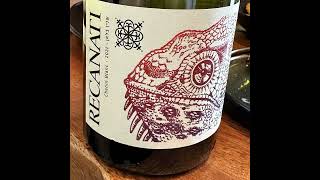
No, that's the other glass, the darker side. Now the Shannon is all— until now we haven't tried any oaked wine. This is the first one that we try actually that have been through barrels. This is a very unusual wine for us because it's in the single vineyard series. But if you saw the labels, the walls that we saw downstairs with all the pictures of the vines on the label, this is no vine on the picture. You see the— you can see the label. This is the Chameleon. This is the Chameleon, yeah. And that's actually, as Kobi described it to me, As the chameleon is very adjustable to the climate and changes every time, the same is this Shannon, which is very different. Every year will give you a different kind of wine. Although it's a Shannon and what can be so different about Shannon? This, for example, is the 2021, while the 2019 was not yet released because it's not ready yet. And that's the reason the 2019, which was a colder year, has the blue label, the same chameleon in the blue shades, while 2021 was a bit— I don't know if warmer is the right one, but let's say a bit hotter year. Although 2020, which was a very hot year, got the orange color. This is somewhere in between the purple, red, orange, and 2022 is actually— I haven't seen it yet.
Let me give you a background about this wine, because this wine we started producing during my first vintage in Recanati. 2019 was the first, and I came with my knowledge of Chenin Blanc from Netofa, where they have a brilliant vineyard in Endor.
Which is a very warm place, by the way.
It's a very warm place, but the same as this. Yeah, and but Chenin, although it's from Delaware, from different climate, it can deal with the hot weather, it can deal with different conditions, and it's so versatile. And then we— this vineyard is from 1975. You're getting like very, very low yield every, every year. It's unirrigated at all.
Sounds very good.
Yeah, just has its own balance. And we thought, what will describe best this unique wine? And we started brainstorming, and each of us said by himself. And then we sat one day and I told him, you know, Genesis Robinson, she wrote about this wine that it's the chameleon of the wine. And he said, wow, I just thought about this. It was out of this discussion we decided the Zikit, and then we started writing the description and everything, and there it came. And every vintage will get the different shades and hues of the chameleon. Yeah.
Now, you drink kosher wine, so you're probably not familiar with older expressions of this vineyard. But I'm a great follower of this vineyard for years. It was used to be made by Susonyam, Zev Dunia, and his Chenin Blanc from this plot was— I mean, it's one of the main things that was special about Susonyam Winery, the gems. The Chenin Blanc was wow. And in 2020— no, 2019 actually, um, Rekanati Winery invited me with a lot of different sommeliers.
You were in the harvest?
To harvest in Kidron, Kidron, near to Gadara. Yeah. And what are you going to harvest and say it's going to be a white wine? Who grows white grapes in those? It's so hot, it's like, what, 30 meters above sea level?
No, it's not above, it's just slightly above, slightly a few tens of meters above sea level.
Yeah, and it's so hot in there, who grows grapes there? And then I saw the vineyard, wow, it's crazy. It was the first harvest of Recanati actually, and which is not yet released, which I really want to drink. There is not a lot of wine that I can say, hey, harvest those bottles, but you know, it was a sommelier event, so nobody really harvested anything. —But you drank. We drank a lot of Verkanati wine that day. And it was a great experience to see how old wine really reacts because there was almost no fruit on the vines.
And relating to that, we always move in parallel lines. From one aspect, we are always searching for old vines in Israel because they are quite rare. I mean, this year we're gonna try old vines of Carignan. From Zichron area. Our agronomist recommended and found it, and we're going to try it. And of course, we have the wild Carignan in the Judean Hills slopes.
Wild Carignan was the first Carignan I ever tasted.
I actually want to bring one more wine before Shachar, as I think, is going to leave us soon. Work is calling, but I want to taste one, one, one, one wine with you.
Okay, no, I'm good. So I was mentioning parallel lines, so So yeah, old vineyards, but always a search for new sites, exciting sites to plant vineyards. You obviously heard about the Odym series. Sure. So this is, you know, more than 1,000 meters above sea level, a very unique, very unique terroir expression. Everything you grow there is Yeah, the story about the Odem vineyard is— the Odem project besides Recanati is signed by, on the name of Ido Amal. He was the grower, he was the one that's the professional The guy that— ah, okay. That helped the other inexperienced growers to establish their vineyards because they are young people from the Oden village. And he also was the one who planted and grew our own project of Recanati. The only vineyard that is owned by Recanati. Pazra, also in the Ramat Hagolan. We own the land there? We don't own the land, they were a contract. But yes, okay, contract for many decades. And but, and this is him, he died in tragic circumstances while working the field with a tractor, got hit by a small wire and just killed him on the spot on the vineyard. Wow. And he, he's done an amazing, amazing job. Amazing job. And after that, it took us a lot of— a long period to get back on the horse.
This is probably the most terroir-forward wine you can ask for. When you're talking about specific terroir and how to learn the terroir and to treat the grapes and plant and grow everything to really express the terroir and not just the the result that you want to, you know, that amount of fruit or anything like that.
I have my own vineyards, okay? And I have the possibility in the future to make wines out of them. It won't be kosher, but it won't be kosher at this stage.
It has to be kosher. You have to make kosher wine.
Today? But I want to touch.
I know, I know. I get you.
I hear you. It's not just about the touching. For a winemaker in a small production, to hire people to do it, it's not economic. It means the wine will have to be extremely expensive.
You're Jewish. They shouldn't have to do it. I agree.
If that was the Rabbanut way of looking at kosher, it was much easier and better for all the industry.
It is. Well, I don't care if there's kashrut. There's some people who want who want, um, heimisha hashkacha on wines and this and that. I don't care if they want that. That's great. So you won't drink any wines except they have this hashkacha. But don't tell me I can't drink Sphera, or I can't drink Margalit, or I can't drink this. Because you want to ban all of these people. Let me decide whether or not that's the level of kashrut I want. Rather than it be— so I'm not trying to make it a free-for-all. I just think like it's— there's so many creative people here and there's so much incredible wine that's coming out. So I— yeah, Koby, I know from, um, from his wines as well. Brilliant wines. Yeah. If you look at this industrial area, I have some of his wines that What he produced through Yossi. I have the white, I have the wine.
In this industrial area, yeah, you're going to have soon 15 wineries.
I know, I was going to say this is crazy. I came through here, there's like, I know I saw at least 4 wineries that I know.
Exactly. And when you think about Israeli wineries, you don't have to go that far to get so many different styles and producers that make quality, interesting wines.
We've had our house in Yerushalayim since 1984, okay? But we didn't make Aliyah until 8 years ago. 8 years ago we made Aliyah. When I made Aliyah 8 years ago, there was maybe 30 wineries that were in Israel. No, there were more.
8 years ago there were more.
It's now over 300, probably over 400 wineries. It's crazy how many wineries are here, and it's like, it's unbelievable. It's wonderful. I love it.
I love it. Unfortunately, the north, which is the main, let's say, most of the wineries in Israel are up in the north. Yeah. You have some in the Judean area. A lot of actually in Judea. You have some in the coastal plains like Shfela. Yeah. You have some in the Shomron, but like really low, little amount. Now there's a group of them. No, there is, there is 5 main regions and most of them have some wines. When I'm saying some, I'm saying less than 30 wineries. Yes. For example, if you go to the north from the Lower Galilee and up, you will find hundreds of wineries from small to big. that produce a lot of interesting, very cool, very different kind of winemaking, right? And different use, sometimes from the same varietals, sometimes even from the same vineyard, but you will find different expressions of different wines. And that's amazing to see because nobody treats the area as a region, right? As sometimes, in some time, when maybe it should be a region.
I think it will be.
And maybe it might be not that far away.
No, no, I think it'll be because Judean Hills is trying very hard to make themselves that region.
They already made the recognition, and I know that more parts— the Negev is going to be the next one probably.
No, but here absolutely has to be, it has to be.
And there is the IPVO map that we developed in the organization of winemakers of Israel, a map of different regions, and we are trying to make it, uh, official. You live where? I live in Kfar Tavo. I came back after many years of travels, and yeah, there is a big view.
We crossed the Tavo River, we crossed, uh, Nachal Pele, Nachal Yavniel.
It's amazing, amazing, amazing region. It's a place to just travel.
It's It was so beautiful. And you can see Jordan, Syria, and Israel, which is crazy.
So he used to be the sommelier at the Mamilla Hotel, which is next to his house. Next to my house. It's very inconvenient that he moved to the Golan.
But no, but I kept the place in good hands. You did, you did, you did.
They're very good. They're very good. They're very good to me too. But even with that, it's, uh, So my first question is, what you come here for? And you can see. Well, they can look around, that's it.
I know, you can look around. When people ask me from Jerusalem, when are you coming back? I'm like, have you ever been to the Golan in the last 2 years? No? Okay, so when you do that, tell me when you're coming in. I live in Amoshev, which have no grocery store, but have 5 wineries. Really.
It's amazing. Absolutely.
The winery here is just— no, it is a beautiful place, and I wish someday this stupid war will be over. It'll be over. It will be just a memory, not a good one.
Nah, who knows?
And this place will work normally. I mean, right now we decided we're opening the visiting center. We thought June is a nice month to start. It can be worse outside, it can be better outside. We will open. Let's see what happens. Even doing— we were downstairs, I got a phone call from Delton Winery visiting center manager. Are you crazy? Did you just open? Because he saw it, like, I don't know, the thing we send on flyers or by WhatsApp groups for the locals. Like, did you really open the visiting center? You saw what's going on outside?
So you know what, you know what, I'm so happy you said come. Right. Okay, because I said to him, you know, I'm looking at my watch every time there's a missile or what have you, my phone and my watch go off. And over Shabbat, it was like crazy. It was absolutely crazy. It was just like on Friday night, it was like—
You had a good time in Kefrissim?
Yeah, but I've heard, I've stayed tuned.
It was a crazy weekend. And driving up here, we saw fires along the sides of the roads, and some of the fires in Sfat, right outside of Sfat, there was a fire. So we saw that. But you know what? I'm so happy you said to come, because it's— there was no traffic. It was a wonderful ride. It was fabulous. Fast, and it was just, it's just beautiful here. I mean, it's absolutely beautiful.
It is beautiful. It's so—
please God, it'll just be safe. I mean, all of these people from here, by the way, are my next-door neighbors in Jerusalem, because they moved. Half of, uh, half of what you call it, uh, Keresmona, all of it. They moved them all down to Yerushalayim and to that area and all between Yerushalayim and Tel Aviv.
People are really aware to the war in Gaza. Yeah. People talk about the war in Gaza all the time.
But people don't understand what's going on here.
It's crazy.
That was the other reason I wanted to do the podcast.
Crazy situation outside. And it's like, what, the 8th month we're doing this? Almost 8 months.
The biggest, all the people who were down south moved home. The people, not all, but most of them moved home.
And it's gonna happen sooner or later. But here from north, nobody moves.
Nobody can move back. I mean, we have in the— one of the people working in the winery is Pitsi. She's in charge for the inventory of a lot of things in the winery. She lives in Iftach. She was evacuated at first and then she decided, oh, just I'm going back home, I don't care. And she's probably the only living soul besides side of the army in Liftach. But she said, I don't care, I go home.
Yeah, she said, I want my life back, even if it's crazy now. It's crazy. Okay, it's a shame, but I have to move. Not to worry. Thanks, it was a pleasure. Thank you.
We're going to try some reds now. Enjoy then.
Goodbye. No, to that. Okay, see you later.
Bye. Bye, to that. We didn't talk about this one, but this is Terroir. You see this? This is the picture that you can see on the labels as well. This series of 3 bottles is actually planted on the 1050 meters high above sea level height. And this is the Hermonite, Tel Hermonite, which is grows just before Emek HaBacha. Yeah. The valley, the flower is the Recanati logo. Yeah. And then in the middle of each of them, there is the part in the vineyard that goes for this varietal. Now, and then you go up to the Hermon Mountain. This is Odem, which is the closest part of the Hermon. Now, this Sauvignon Blanc is— when I tasted it, I tasted it before it was labeled. And I came back from Milan by the end of December, and there were tastings here. So I thought, oh, let me taste it. I haven't tasted wine for 2 months. So they gave me taste and they taste a lot of the different wines of the winery as well, Galil and many more. And I was like, "Oh, so you're making like—" And this was blind because they wanted to see what do we think about the wine. Not me. It was the staff, Kobi, Shachar. And like, "Oh, you're doing like a taste of Israeli wines, our wines, like against French examples of the variety?" And they're like, "Really? That's what you think?" Because the Sauvignon Blanc is French, it's Loire. The bitterness, the green, the green fruit, the green grass, the oak, the fumée, that those area, Sancerre fumée, that's what I was thinking about, the limestone, the lime flavor.
It has all of those elements. Exactly.
I thought, oh, so you're doing like Israeli Sauvignon Blanc because we taste the Galil as well, comparing to like French, like really, that's what you think? And then the Merlot, like, wow, what's like Pomerol, the land of Pomerol? And then they reveal the bottle and it's like, "Odem!" Where did that come from? It feels cold. Right. It feels like cold Sauvignon Blanc. Right. Not the tropical New Zealand Sauvignon Blanc.
100%. It's amazing. It's 100%. You're right.
And this is the uniqueness of the Terroir in Odem. I'm going to put that here for a second and come back with some red wines. So this is Bituni. I love this wine. My favorite red. And it's a red wine that you can just enjoy. You don't have to think about it too much. And as I call it, a fun wine. It's fruity. It's not tannic almost at all.
Yeah, it's good. Yeah.
It's the label, it's in 3 languages, which is not very common in our wines. Only 2 wines have that: Hebrew, English, and Arabic. Because it's grown by a Palestinian grower in a very unorthodox method of wine growing. As you can see, it's in a pergola. It's not a classic grape shape of winemaking. Yep. It's delicious. I mean, I can talk a lot about the wine, but I just enjoy it.
Look at the color. Look at that. I know, it's just so— this is gonna be incredible, the Bettuni.
I enjoy it so much. I keep always a few bottles of this in my house. I put them in the refrigerator.
Yeah, because— yes.
They are so much fun to drink, it's amazing. This is the Carignan, which is also very light colored. It's very light. Now the Bituni spent a year in barrels, the Carignan is unoaked, and the Bituni is whole clusters fermentation, this is a regular fermentation. Well, part of it is a little bit of Colossus, but most of it is regular fermentation. The idea of this Carignan came actually to bring something younger to Carignan because we, you know, the Carignan. Yeah. As you said, it was the first Carignan you've tried in Israel. It was the first one. By far. And it's very unique. No, it's very old vines with no irrigation in a low area that gives you very, as Shachar said, very low amount of yield. Not much fruit in hundreds, not in thousands of per dunam. Wow. Which is nothing. And we try to make from this Carignan the best we can, but It's very limited amount. This planted next to Sab, right next to the old wine Carignan. Yeah, it's just the next plot. There's like a path between those two plots. Yep. But this is young, still irrigated. It will also grow in the same goblet growing pruning method, but it's still young. It's goblet. It is, but it's still young, so it doesn't really show the same as the Carignan that we know from here. And we hope that with time it will be in the same quality. But until that, we probably the only winery in Israel that says young wine on the label. Wow. You will see a lot of old wine. Yeah, yeah. Kvenim bogot, kvenim bogot, kvenim bogot. Every 15-year-old vineyard is kvenim bogot. Yeah, but it is— nobody says "Kfar Nitzihot," which is funny. I tried the winery from Priorat in Spain. You know, even, you know, Memoria del Ramba? Yeah, it's a kosher Spanish wine. Yeah, yeah, yeah. It's a very interesting winery. You should try it, by the way. Spanish winemakers Jewish but Spanish winemakers. I know a number of them. Not Elvín. It's not Elvín, it's not what you're going to think. It's called Memoria del Rambam. Okay. They have very unique wines, you'll probably love them. Anyway, so he has plots of Bobal. Bobal. Yeah, Bobal. And he calls his 120-year-old Bobal old vines. The 80-year-old Bobal —It's just regular. And here every 15, every vineyard that comes to 15 is like old vines. Yeah. It's different. But anyway, nobody calls it young vines. And this is one of the most interesting examples of fresh, juicy, fruity kind of Carignan with a lot of spices in the back. Earthiness that comes in the companion with the fruit. And again, something that you can drink in the summer.
It is really, it really is light and nice.
There is tannins, I mean, they're here and they grab your mouth. You can feel them. But they're not too powerful or strong that you cannot drink. I agree. And they actually combine together to a very elegant, nice wine that you can enjoy just like that. It's not a classy form of Carignan, and it's definitely not trying to be Pinot Gris or any of those. It's a light version of Carignan, and it's beautiful because, I mean, we're now sitting in the air conditioning, everything is perfect. Yep. But outside is almost 40.
Yeah, outside is really hot.
That's not the best temperature to enjoy red wine. And this one you can enjoy in the summer. Yeah, I mean, just sitting on your balcony and opening a bottle of wine. Yeah, 100%. That's the idea of it. Okay. And together with the Bituni, I think maybe two of the lighter wines you will find in Israel. Now, by the way, the Carignan, the same as the Colombard, by the way, is a series that released in the beginning only for restaurants. And because of the high demand, we're actually releasing the next— the 23rd Colombard will be in a bit bigger amount. So it will be to stores as well. And the Carignan is actually— we don't have much more to make, but we also will sell it in stores. but in a very specific store that can actually explain the wine. Okay. Because if somebody will ask, come to a store to look for wine and he will get this, you want to understand the uniqueness of this. This is a wine for people who already know big wines and know to enjoy the actually light, fun wines, not only the big bold.
What's the pricing like on something like this?
We sell it here, which is, I think, the average market price for 80 shekels. Okay, that means you can find it less.
And the Batuni is priced where? 109. 109. Um, it really is interesting. It's really a— the Batuni is one of the most— it's almost like, it's almost like it makes me think of strawberries. Definitely a little bit. Yeah, I mean, that's the profile.
Yeah, like with Gamay. It's interesting, we said the kashrut says "El Pioter Michira" here, but it's actually supposed to be "Vunochlit," but I think we just don't write it on the wine, although it's in Arabic. Okay. Anyway, we started with the light ones, although they are a bit higher series. I'm skipping the Jonathan Red, which is also the same idea of the Jonathan White, but in red wine. Yeah. It's based on Syrah, Petit Syrah, and Cabernet Sauvignon. And I'm actually switching to Galil. Galil is this series. We didn't try Galil so far. Yes. Galil is the mid-range of the winery. Okay. It's priced for 60 shekels. Usually before, in Hakim Chagim and stuff, it's 210. Okay. Which makes it around 55 shekels the bottle. And it's— if you take the Jonathan, which is a great value for money for a very simple, fun kind of wine, this is the value for money for the complex wine. It's, um, I think it's 9 months, I can't remember, 6 months in barrels. And as you saw in the cellar, the barrel cellar, it's all 500-liter barrels. Most of them are not new. So we will get development but not overpowering anything. Anyway, this is the Syrah.
This has got such a beautiful—
I always bring it as an ace in wine tasting, usually blind tastings.
Yeah.
I bring like 3 bottles in blind tasting. 2 of them are like, you know, the Masalana or something like that. And this, which is like half the price. Yeah. and people always price it in the hundreds.
150 and what, exactly.
And this is a 55-60 shekel ball. Now, when you're a small producer, you cannot make this kind of quality in a—
at that price.
But when you are our size of producer, which is a big one, not the biggest one, but in the big scale, And you saw the tanks downstairs. We don't just think about making a lot of wine. We think of the quality of each wine separately and how to make it.
I saw that totally because there's no one who would keep that many tanks. Small ones. Yeah, in order to be able to, um, exactly keep everything separate.
On one hand, we are very big commercial winery, over a million bottles a year, but on the other end, we try to make it as boutique boutique. It's not really boutique, but as small producer as we can, because we try to keep it, you know, who does that?
Who does that? Is that—
I know, this is one of the reasons I wanted to work for Kanadia, not for any other winery that was, you know, offered. All right, next wine. Yes, this is Marselan, but I only brought because we already tasted two versions of Marselan.
Yes.
Now this is opened from yesterday. Okay. I opened it to a few people, a few guys actually from Jerusalem that were here. And so it's not as just open, it's a bit more—
I'm sorry, I really enjoy chocolate with red wine. Why not? That's my craziness.
I know, I know. But again, not to the very tannic ones. I mean, for the next one, it won't be— it won't work for you. Actually, let me have the glass of yours and I can pour you some of these wines. The wine? Yeah, so that'll start, cuz this wine needs time.
This is what? A Merlot. This is a Merlot.
We've discussed a Merlot before. This is a Merlot. Um, what we have now is a Marsala coming from Kidmat Zvi. Only Kidmat Zvi. I live in Kidmat Zvi, so I practically walk my dogs in the vineyard every day.
The Colombard is wonderful. The one she took, which was the, what you call, Marsala, was just great.
Now, this Marsala, by the way, because the Guido Marsala made from Marsala from two vineyards, one in the Golan Heights, Kidmat Zvi, and one in the Golan Heights Tel Fares, which is lower Golan Heights. This is 100% Kibbutz Zvi, but this is in a different part of the vineyard. You have two— you have several varietals there, and you have one vineyard for Kibbutz Zvi, uh, Marselan for the red, and you have one for Merced, which is two different ones. They're not even close to each other. Wow. And you can see the differences from many different aspects. One of them is much windier, like really much more wind in the area, and one of them is a bit higher. Yeah. Anyway, this was the Marselan, which is— I find it really delicious because it's there, it's present, it's rich and not heavy. You know what, now before I take any food, let's switch to the Cabernet. Yeah, Merlot.
Merlot, right.
You can see the This is the Merlot, this is the Sauvignon Blanc that we have. Yeah. This is the Cabernet. This is a bit small. It's enlarged, so it looks big, but it's much smaller. The Cabernet is the biggest one. Those two are small. We made around 3,000 bottles of each. The Cabernet is a bit more. You can see there is three sub plots of Cabernet. Two of them are from west to east, and one is from north to south, to get a bit of the differences inside to complete, to make the blend complex. The Cabernet is really rich and interesting, a bit closed at the moment, very not yet really ready. The Merlot is a bit more ready. And although it's a Merlot and a Cabernet and a Sauvignon Blanc, which are not Mediterranean varietals, the growing, the making is suitable for the Mediterranean idea of the winery. Are they Mediterranean? No, not any anyhow. But are they more suitable of drinking in Israeli climate? Definitely. The fruit feels cold. It's not ripe cherry chocolate merlot. No, it's fresh red fruit. It's fresh herbaceous green.
It's balanced. It's a cross. But I'll tell you, it's far less enjoyable than the others that you've had so far. The Sauvignon Blanc that was Odem was just— has just such a an interesting element to it. It's like it's tickling all of the things that you— all of the different sensory places that you want it to do. This is— it's new. It's— what is it? It's a 2020. So this has got years. It's really close.
Anyway, I think we tasted the essence of Recanati winemaking. I didn't bring you all the classic Cabernet Merlot. Thank you, thank you. Those you can find anywhere. Those, it's a bit more difficult to find. And this, for example, it's not that difficult to find. Just people, you, most of people just go past it.
Yeah, they ignore it.
They go, what do you mean 50 shekels? Well, no, it's probably— I will take it out.
Give me a little more of this. Sura, just a little bit.
When you think about Gamla, you say, oh, I'll pass, right? By the way, Gamla Sauvignon Blanc 2023, beautiful. Like classical New Zealand Sauvignon Blanc. Yeah, but beautiful and not expensive.
Each one of these is extremely balanced.
And the thing that's funny about the Syrah, a month ago, something like that, Pierre was here. Yeah. And we gave him some wines to taste, and wow, this Syrah is so good, and for that price, I must take a bottle to my— to show my staff in the winery. So we took a bottle, of course. And 2 days ago, Yav was was here, the CEO for Netofa. Yeah, yeah. And he was here and we tasted some wines and I gave him the Syrah as well. And like, wow, this Syrah is so good for this price, I must take a bottle for myself. They both took the same bottle to show their staff. Anyway, so this was like the idea of the Kanati industry, like industry, making of wine. Yeah. Now, of course, Again, off record, as in any other wine, you can see some things you like more or less, but the idea is really different. They really want to bring terroir to the center, to bring less oak, less alcohol. Just walk outside, sit outside, and tell me that you want a powerful red wine. Right. It's impossible. I know. And we live here. This is where Vacanti really tries to make a difference. I love it. And I wish it will work because people are buying the wines, but not enough people are knowing the idea behind Recanati. People remember old Recanati, which was not amazing, right? But the change that's become, the transformation that happened in the last years is amazing. I mean, take the Jonathan. It's amazing for the what you pay for.
For the price, it's unbelievable.
And you saw the technology downstairs. Yeah, two press machines. It's become crazy. It's all to make even the cheapest wine really, really high level. And this is what I mean, most of the effort goes for the Yonatan, not for the other. Other is easy, just not ruin it.
To balance Yonatan is much more difficult. Thank you very much. Of course. No, this is great.
It's always great to see you and taste wine with you. It's always a pleasure. It's amazing. And, uh, I'm glad you, you could see this and to get— I really wanted to come.
I really wanted to come and see it. This is most of what I wanted to do was to be able to say, hey guys, we've got these wineries that are sitting here and that are just special and they're open. Come on. This is Simon Jacob again, your host of today's episode of The Kosher Teruah. I have a personal request. No matter where you are or where you live, please take a moment to pray for our soldiers' safety and the safe and rapid return of our hostages. Please subscribe via your podcast provider to be informed of our new episodes as they are released. If you are new to The Kosher Teruah, please check out our many past episodes. And thank you for listening to The Kosher Teruah.










