Resilient Winemaking on the Northern Border: A Recanati Winery Story Part 1
Simon Jacob and sommelier Effie Koz tour Recanati Winery, a kosher operation 7.7 km from the Lebanese border in Israel's Upper Galilee. Built by a Spanish firm with Italian equipment, it uses remote diagnostics and automation to keep production running despite security threats and recent wildfires. They walk through fermentation, barrel aging, and bottling, then taste wines like a natural pét-nat rosé and Gris de Marselan.
Chapters
Welcome to The Kosher Teruah.
I'm Simon Jacob, your host for this episode from Jerusalem. Before we get started, I ask that wherever you are, please take a moment and pray for the safety of our soldiers and the safe return of all of our hostages. The following two-part episode of The Kosher Terroir is a detailed conversation with sommelier Effie Koz from Recanati Winery located in the northern Galil and with one of their winemakers, Shachar Mamor. I was invited up to see their winery, one of the most modern in Israel, and their brand-new beautifully appointed visitor center. With all the friction on the Lebanese border and being located just 8 kilometers away, they have made the brave decision to get back into their pre-Gaza War lives and open up the visitor center for business. Though there is currently just a trickle of tourists, I believe when word gets out, this will become a major wine destination. Part 1 is a walkthrough touring the facility discussing many of the winery's capabilities and innovations. Part 2 is a tasting and review of some of their more innovative new wine offerings. If you're commuting in your car, please focus on the road and enjoy. If you're home, please choose a delicious kosher wine, sit back, and listen in on this very tempting wine adventure.
First of all, where are we?
Exactly. We're in the Upper Galilee.
Okay.
One of the most beautiful areas in the world. This is the Benzima Valley. And behind that hill, that's all the Dishon Valley.
Okay.
When we look to the right, we're going to the Ahula Valley.
Yes.
And you can see the Mount Hermon.
And you can see there's still snow on the top of it.
That's the Syrian side, actually.
Okay.
You can see the Golan Mountains. All the fog in the middle is actually smoke. From all the fires that we had in the last few days, and that's all above the Hula Valley.
That's above the Hula, right.
Very, very sad. I mean, you can still see the fires from smokes coming up.
Yeah, no.
The smokes from the fires that's still going up. All that small, the lower part that looks like a lower ridge that goes up all the way up there, this is Reches Ramim. You hear about all the time.
Yeah.
Marganiot, Manara, Mizgav, Iftach, all of those areas, Ramot Naftali, Malkia, it's all here. You can see all the times out there getting bombed and whatever. Not a great time to live here, and practically almost no one lives here these days. They all evacuated. The closest place to us is Alma and Kerem Ben Zimra, the moshav. All the valley here and from the other side is vineyards of Kerem Ben Zimra. Up there, the top of the mountain is Lebanon, is Maroun Aras.
Oh, that's Lebanon already?
That's already Lebanon. We don't see the valley between. You see the green trees with the white roofs?
Yes.
That's Iran. Between Iran and Maroun Aras, there's a small valley which the border is actually there. Exactly right over there. This is Avivim, if you remember Avivim winery that was burned.
Can that—
the one that was a month ago? Yes, it was right here. We could see everything from here. It was super sad. You can just see somebody's life going, you know, in the fire. And these two getting hit all the time. Of course they're evacuated.
I don't know if you meant Kerem Benzimra is evacuated?
No.
Okay.
Kerem Benzimra is still here. Alma as well. Dishon, that we cannot see.
Dishon is gone.
I know.
I have cousins in Dishon.
You see the top there, the white spot in the forest? Yeah. That's Malkia.
Okay.
That's Malkia.
Ramot Naftali is over there. And then you go up with Iftach, Manara, and all the way up to Metula. In this, Eron, for example, is, as you can see, very close to the border. Kerem Ben Zimra is 5.1 from the border. So they are not evacuated.
Yeah.
We're 7.7. So we're also not evacuated. But we are still in the range of, how do you say?
Missiles. Yeah. RPGs.
Exactly.
And those are the ones that they can't do anything about.
Those are exactly, those you cannot do anything about them. Now, we're in the— we exactly are in the end of the range, so we're really edge, edge. They can go up to 8 and we have 7.76.
Yeah.
And that's from the border, so they have a little bit higher to get. I mean, they need to go a bit further from the border, so it's, you know, something like that. We don't hear a lot of sirens, but they find a lot. Because if you're in Jerusalem and you hear a siren once in a month, it's a lot.
It's a lot.
Here, if we have only 2 or 3 in a week, that's not a lot.
Right.
I mean, those, every second, they're practically, the people who there lives next to the shelters because they have no time. And even that is most of the cases not enough. Here we don't have the same. We can actually stand here, talk about the Hezbollah that stands right over there and it's okay. We don't feel the same fear as they. For some reason, we are not in the same interest as them. Okay. They don't shoot here almost at all. I told you, if you were here a few minutes ago, you would still see.
We drove by. We drove by the—
You see this?
Yeah, yeah, that's a—
You see where it is? Yep. Right above.
Right.
10 minutes after this, it was already a fire.
Right.
And that's—
It intercepted it and then all of a sudden, and as it falls, it creates a fire.
There was a bomb intercepted over there and two over here, approximately around the Mot Naftali.
Right.
So you can see fire over there and you— there was a fire over there. In this time of the year, everything is dry. So when something is— Burning is burning.
It burns, right. When we came through, when we came from—
You went through Amiad, you went through all the villages.
Yeah, there was a lot of fires on the side of the road as well. Yeah.
That is exactly what happens now. And that's the saddest part of the entire thing because we got used to it.
Yeah. This is— This is so beautiful. You know, I was going to ask you, why did you move here? I mean, just look around.
I know. All you have to do is look around. It's so beautiful. It's so peaceful. And then this.
Yeah.
And nobody thinks it's, you know, when I moved here, I didn't think that we're going to start a war that soon. I mean, everybody knows it's a matter of any second.
Right.
Because we're in some kind of, I don't know, absorbing mode.
Right.
We keep absorbing and absorbing until at some point it has to explode. And it did. But even right now, we don't— we're not actually in a war with Lebanon.
Right.
So you can call whatever you want, but you saw all the fires. You saw— There is nobody that lives in the first 5 kilometers of Israel. It's crazy.
I know. You know what? You don't know how many people from Shlomi, right? And from what you call it, from Dishon and from Kiryat Shmona are living in my neighborhood now.
Right.
All right, let's talk about wine because we're here in a winery and we should be happier. Yeah. Although it's not that easy to be happy. As I told before, this is Carignan. —yeah— it's going to grow wild. As our famous Carignan, this is Cabernet Sauvignon, and you— they were both planted on the same day. Okay. But just see the differences between the Cabernet Sauvignon that you can see, which is— it's growing, but it's—
it's very small.
Yeah, low and weak, while the Carignan is much stronger and higher and more leaves, much more powerful. And that's exactly the difference between a Mediterranean variety and not Mediterranean, right? Cabernet likes the cold. It doesn't get it here. Carignan knows only warm. It grows in warm climates.
But don't you get cold here as well? We do in the winters a little bit.
Okay. But that is the origin of Cabernet Sauvignon, for example. I'm not talking about the Napa Valley Cabernet Sauvignon. Yeah, yeah, no, no. I'm talking about, you know, although Cabernet is from all over the world, We are in different— when you grow in some place, your body gets used to the climate and everything in that place. You're adjusted to that. Yeah. And when we talk about any produce, from vegetables to fruits, some things doesn't grow here because they don't fit the climate. Some things grow because they do fit the climate, the Mediterranean. So when we think about what's better to grow here, it's probably the same as what's better to to drink here. And I mean, just imagine right now, it's not cold. Let's go this way. Yeah. Would you like a bowl of soup? No. Would you like a glass of full body heavy red wine, 15% alcohol? No. The same.
It's— I would like a nice, cool, beautiful, delicate rosé. Or perfect.
Or, or if you like red, something that— yeah, something lighter, something much lighter. Light that you can enjoy. And that's exactly the Mediterranean varietals. They don't have to be very light, but they don't— they usually don't show the heaviness. Yeah, that they don't go to very high percentage of ripe of an alcohol. Of course, it's easier for them. This is, um, one of the newest big commercial wineries in Israel, so we actually have a lot of, um, new technology, and everything here is up to date. —so we can actually make the best wine of any grape we will get. Now, when I'm saying that, um, Recanati Winery was in Emek Hefer and moved here in 2022. In 2022, those old tanks were not even here completely, right? They were coming here during the harvest season, so everything was built during the season. It was a very difficult harvest season because it was all together—the harvest, the picking, the receiving of the grapes here. While most of the employees were still from Emek Hefer. They still are, by the way. Most of our core of the employees of the production areas are from Emek Hefer that come here every day, including the winemaker and many more. Anyway, the first part of the, of the process is here. This is a big scale. Trucks come here and get scaled, um, the way they do it actually before before and after, so we will know exactly how much, uh, how many grapes we'll get. And they start and they throw all the grapes up to here. Right now, as you can see, it's not clean, it's not ready to process, yeah, because we're not in the harvest season, right? Our season will start approximately by the mid to end of June— July, I'm sorry. So right here we don't really put our efforts here. We are already in the middle of processing, of cleaning and sterilizing all the tanks and emptying barrels and bottling and many more things to do as preparation for the next season. But this area is not yet got ready.
Okay, prepared yet. How many How many bottles of wine do you actually make?
Of course, this— it's a data that changes every day. Yeah, because, you know, it's, it's produce, right? Every year you have more or less grapes. Yes. And we try to plant more vineyards every year, and some vineyards are going into the circle and some are actually going out of the circle because of viruses, because of economic reasons from different growers, so it practically changes every year. The winery is built to make up to 2 million bottles a year in a very comfortable way. Yeah. We didn't get through past the, let's say, 1.6 million, and last year it was even less, 1.4 million, and we are More or less on those numbers. Yep. And now the entire winery was designed by a Spanish company from Bilbao that actually only does wineries.
So this was built by this factory from Bilbao?
Exactly, that built, they designed, the architects of all the winery, all the facilities here designed to make the best.
I was going to say, it's unbelievable the design and how it works.
The smart use of the property to make the best options for the winemaker. Now we bought almost, let's say, 95% of the tanks and the equipment is new, and we bought everything from the same company, Italian corporation called Della Toffola. Yeah, they actually combine several factories that each produces something else, but they combine together to one company that controls everything, and everything of course is, uh, automated. So even if we have a problem, they can from Italy, uh, help us to solve it. Wow. And log into the system and just help us fix the problem.
Not even, not even have to send somebody here.
Yeah, sometimes they will, if they need, they will send someone, but right, in most cases they can, they can understand the problem not even being here, right? Which is very important when you think about all the, all the facilities together. It's a really, really big operation, and during harvest season you don't have the time until somebody will come here. Right. And the technology is a lot of help, let's call it this way. Anyway, when we start here, the grapes coming here, we have two— not we, any winery in the world have two ways of getting grapes. The first way is the harvest, hand-pick harvest, let's get manual harvest, and the second one is machine. When you pick by hand, you probably saw that a lot, you put all the grapes in big blue cases called dolav. Each of them contains between 400 to 500 kilos of grapes. Yeah. And they come here on the truck, somebody with a forklift just spills all the grapes to the— into the workshop.
Yeah, it is like hillazon.
Okay, it's cute. Just to— they all start here and then the process begins. When we talk about mechanical harvest, then that means it comes in a big aluminum tank.
Yeah.
And those tanks are on the truck and they— like, it's a big bath. Yeah. It's not, you know, a closed tank like you will see this thing. Yeah. It's like a big bath of aluminum that contains a few thousand liters. Yeah. They get here, the crane is actually coming and lifts it. It's not even lifting, just tilting. —and then all the grapes spills to the tank, to the pit, let's call it, and the process is beginning. Now, when you think about the mechanical, usually it's the cheaper wines. Yeah. Because all the high-quality wines usually are in a manual pick. Yep. Not always true, by the way, but this is the common, the common belief. And after you tilt it and you spill all the grapes, you need to send it back to another round to the vineyard or to a different vineyard. Right. That means you have to wash it, right? You cannot wash it from upstairs, from above, because the water will stay, will remain there, right? So you actually can only wash it when it's tilted to the side, and it's only here. Wow. Now, those water are not the one, not anything that you want to put in your wine, right? Yeah. In most wineries, that's what you have. That's the only option you have, or you improvise something. Here we built Another crane just for that. This crane works 2 months a year only for tilting the tanks for wash.
To wash them over there? That's it.
Wow. You wash them and they go back to the vineyard for another round.
So this does what? This feeds the grapes? This only pushes the grapes to the first step. Does it do crush at all? No, not here.
No. The first step here is the destemmer.
Okay, the destemmer.
The destemmer spins fast. The grapes go out through the small holes. The leaves, the stems, the branches, whatever that we don't want to go into the wine goes inside. The grapes are getting down to the crusher. Yeah. The organic waste goes to the end of the stemmer and goes up to the tank. Usually in the season, we have a tank there that goes every day back to one of the refetot. How do you say refet in English? I don't know. I never thought about it. And then the cows eat it. Okay. And then the cows take it back. Yeah. And put it back, and then it goes to the vineyards, and it's a circle that we try to maintain. Now, this is the crusher. It usually goes under the stemmer. Yeah. And from the crusher, as you can see, the blue pipe is connected. Yes. And everything goes up to the first part, which is already from that moment is all automated and controlled by the computer. First stop, although right now it looks like a storage house, which it is because there is no grapes.
This is the first place—
yeah, not all the wines go through here. Yes, but if the winemaker wants to make a cold maceration, if he wants to keep it up to chill in the— during the night, even if there is two trucks and he doesn't want the grapes to wait in the heat, we can take put them all here, it ups to 80 dolovim, which is like 40 tons. Okay. And it can wait a day, it can wait 2 days, depends what the winemaker wants, right, uh, from the, from this. And that's for, um, the grape that comes in, in the dolav, that means manual harvest. Guess, um, when we talk about, um mechanical, yeah, we cannot put them here, but we have those two chillers, okay, uh, in Hebrew they call them 'seveiko,' okay, which is like cold transformers, yeah, but the idea of this is actually like you see in MasterChef or in cooking shows that they can, they have the blast chiller that can freeze or anything very fast, so these can reduce 10 °C in less than a minute. Wow. So if you have something before you want— it can do either before fermentation, uh, not fermentation, before, um, crushing, press, or after the press. Uh, so it can actually with skins or without, that's the most important part. And if you have grapes that they are too warm for what you, you want to do with them, you can change it. Wow. That's the main part. Now again, not everything is have to go through here. Yeah. But it's another technological, um, assistant, let's call this way. The winemaker here have much more to play with to make sure that he will have the best wine you can do. Now in the harvest season, you can see it from— you will see the the wine starts to go up the tube in the first window, and then the winemaker already can decide it goes to chilling, it goes straight to press, it goes to the tanks. Everything from here is already from his computer. You can— you have a computer in the— in this room, you have a computer over there covered in the blue plastic right now, you have a computer upstairs in the laboratory, you have a computer in the winemaker's office, and you have— you have everything even in his phone today, so he can make sure that everything is going as planned. And I'm showing you things that most people will probably won't see because it's never— nobody cares. This, for example, uh, is the workshop if we need to fix something, everything. So this is the place, barrels, whatever you want, we can change, uh, um, Everything. And this is empty. And this is the control, the control for the operation in harvest season. They all work from here. As you can see, this is the map of the tanks. You can see clean after, uh, which usually is like a sort of caustic to wash everything from the last year. Sterile, sterile. This is still 23 vintage post-cross, that's before bottling, and blend, and a problem that we need to fix, ready for bottle. You know, this is a manual backup for everything that's already in the computer. You can find all the yeast we use, all the, you know, that's like things that you can check on spot if you want to see something really on spot. A lot when it's here. We have a bigger lab upstairs, and of course when they scale, it's actually— that's where it comes out there. So it will automatically log to the system. Now as you can see, this is all the tanks. Yeah. And up here we have another tanks as well. And you see, this is 100,000 liters. This is the middle one, is 200,000 liters. This is another 100,000 liters. So this is— these are the only big tanks we have. Most of our tanks are this size, between 5,000 to 45,000 liters. That's, you know, as you can see on the floor. Yeah. The surface of this, the amount of surface that this requires and the 100,000 liters requires are not that different. Yeah. I mean, it is bigger, but it's not— 3 times bigger. Yeah. As this 30,000-liter tank. There's a black tank there. No, that's a different— that I will tell you about in a second. Okay. And when we talk about quality, yes, we talk about smaller tanks. Yes. When we talk about quantity, we talk about bigger tanks. If we were only a commercial winery, as we are, and but without the thinking of the small specific parts and vineyards and plots, we will only have those tanks like many other big wineries have, and we will produce millions of bottles a year. Yeah, we don't. Most of our vineyard, as you can see, is from 9, um, what is this, 4,000, uh, almost 5,000, almost 10,000, 8, 7, 6. Those are the sizes that most of our grapes coming against to start. And we try to receive every plot individually, every vineyard individually. So we don't have to blend in the beginning. We get the quality, we understand the process. If it's going to be one of the blends, then it's going to be like Galil series, for example. Yeah. So it will be Cabernet from many vineyards in the Galil. But if it's going to be like a single vineyard, or we will— if we see something with a high potential, we will keep it separate until the end. And this is the winemaker's job here, and they do it very I mean, you can see each of those plots, vineyards go to a different tank, different individual fermentation. So they have full control. Exactly. Whatever goes to Big Galil, they will move after that to the bigger tanks, or Yeshemin, Yonatan. But we start with as much as we can controlling on the, on the process, so we can always make sure that we don't miss anything and we keep and we still be loyal to the terroir. That's one of the most important parts of the process. Now, when we talk about white and rosés, they go straight to press and then the fermentation process. As you can see here, another thing that you probably won't see in many other wineries, we have two press, right? Two press machines. The, the first one is classic, is exposed to oxygen. Here we have no oxygen exposure at all. So there's no— you can see there is no holes on the side and no tank, no bath tank. It all gets to the small tank, and from here it goes to the tank for the next part. It doesn't have to be a thing, but there is no exposure to oxygen. Now, oxygen is not the enemy of the wine. Yeah, it can be its best friend, but it can also be a very— not too much of it can be not not good, and exposing to oxygen not in the right time is also can be not good.
Yeah, so you want to control exactly what you want.
Exactly what he can play. He can do it this way, he can do it this way. It depends on what wine he wants to produce, and with that he can, you know, make sure that his wines will be exactly as he wanted. Now another thing that you— when you talk about fermentation, you like a lot of boutique wineries. Usually they don't have this size of tanks. It's one tank of those is can be more than their production in the entire year. Yeah, but when we talk about fermentation tank like this one, which is 30,000 liters almost, um, the process is a bit more diff— different because if it's 5,000 or 3,000 liters tank, when the fermentation starts, then you punch down, you, you make the process easily. You cannot punch down this kind of size of tank. So we have a pump over. Pump over, it pumps and keep it circularized. All the circle is always going up from— it's, uh, takes from the bottom and put it back on top. And circulation, now the circulation is nice, but it's not always guarantees that the layer of skins and the that goes up in the fermentation will break. Yeah. So here, because most of, of the tanks are new, we have another system. It's called Air Pool. This is only during the fermentation. It's a jet that's aimed to the center, and the winemaker can decide, like, say, 30, 40 seconds of a very powerful jet stream to the center of the, of the open. Breaks open, right? So it guarantees it will be open without always, you know, keeping it open and making sure and entering a lot of oxygen or anything else. To the tank. And of course, each of those are isolated and always broadcasting what's going on inside to the computer. So we always know what's inside without even opening the tank, unnecessarily opening the tank. Wow. So as you can see, in this area as well, they put a lot of money and investment just to make sure that the winemaker will have all the equipment he wants, all the tools that he wants. To make sure this is, uh, this will get us the best, we'll get him the best wine. And yet the— what we believe in Recanati, that we don't try to, you know, manipulate the wine. We try not to destroy the fruit, right? And this is the most important part. Now you asked about the black tank. Yeah, the black tank is actually, uh, mitkantiu shfachim. It's for the sewage. Okay. As a productive industrial factory, we have to clear all the sewage before it goes to the sewage system. Okay. From any materials that— now, most of the wineries or most of the factories in this area don't do it. Because we are new, they asked us to build one of those. Actually, we have two. And the reason for that is, well, ecological. Keep the system as safe as possible and not, uh, unsustainable, spilling sewage, dirty sewage. When I'm talking dirty, it's not like dirt, it's chemical dirt, right, to the sewer system. And most of the wineries just send tank to the local city. We have to do it by ourselves. You have your own Now the most stupid part about it, that rainwater, yeah, which we have a lot this year, we had a lot in God, um, are not— the, the, the facility cannot process them because they have no sugar or anything in them. So they— it's not dirty, so they don't know how to process. We have to make the water dirty and so it will start process them.
Okay, this is a Mabusha machine.
This is, uh, we can do them with Voucho machine. Yeah. And we can adjust temperatures. Okay. For example, before bottling, we don't— we cannot bottle the wine in 12°C or 14°C because when something is cold, it's getting, uh, shrinked. Yeah. And when it's getting warmer, it's expedite. So it can, it can explode. Yeah. The labels will not stick as well because they will get sweaty. Yeah. So before bottling, for example, we can change the temperature to 18, something like that, so we— the wine will be in the right temperature for bottling, and we will make sure that nothing is exploding on the way. Now what you can see here is actually, uh, already ready wine, which is usually not here. The reason it's here is probably because a truck supposed to come any second and take it. And all the back lane is bottles, empty bottles. You saw here, you will see them there as well. We— if you were here a month ago, even a bit more, this whole huge place was covered in bottles.
It's good that you had them because with the Ukrainian war, there was an incredible shortage of glass bottles.
There is a shortage because of the Ukrainian war. And after that, the Houthi stopped shipping to Israel. So we just order as much as we can, and they're still coming. Whenever there is a shipment here, we get some more bottles.
Now we're skipping a part, but we will get back to it. Okay, this is the bottling. Okay, in this hall we bottle 3,000 bottles an hour. Feel free. No, no, no problem. And we bottle here 3,000 bottles an hour. Now it's almost completely robotic. A person puts the bottles on the machine. This way you make sure the bottles are safe and not you know, chipped, broken, anything like that. And then in the first process, they get washed with water. If you— if— yep, those empties them and brings them back. This is a push of nitrogen just to make sure there is no reduce of water or any dirt inside. Bottling— that's the filling already. Wow. And cork— corking over here. This is projecting a little bit of heat just to make sure that the bottle is dry. This is the capsule.
This is the capsule.
You see all the cylinders of capsules, and then it's come— it goes to here. You see, it takes one, put it on the ball over there. It gets sealed with heat. See how each ball get up, sealed, and goes on.
And, and then all the labels.
Here we get the labels. Now when the labeling is finished, they all got here. You see the cardboard over there? We put the cardboard, new cardboard. Every time we have about enough balls here, come here, you see it picks 12 balls. Puts them in the box and keeps going. The boxes are opened by themselves and then sealed by them, by the machine, not by themselves. It's all robotic. Wow, this is the box. He needed to change the label, so it stopped. It won't do— it won't be doing anything right now. Okay, now you can see, um, the boxes keep going and they get stacked up to the— unbelievable, totally robotic. Anyway, as you can see, um, the next step after it goes up, it's— this is the next part that a human in touches the wire. Yeah, and unbelievable. You see, it sets them in a row, in a layer, and then moves it up and stacks it. Exactly. It's unbelievable and very sophisticated. You can stop the video. It's not— it doesn't gonna get any more interesting now. It's amazing to me. If from any wine that we make, we also keep wines with no label. Yeah, because sometimes we need to send more to France or to UK, US. So you see, for example, unlabeled. Yeah. And then by demand, if it's Israeli market, any other market— this is only for labels— we open the bottles, stock them, labeling and repacking them. This is a lot of effort, but it's just not to make— not to stop this from working.
Wow. Wow, wow, wow.
If you ever wondered how a million bottles would look like, this is how.
Unbelievable.
A bit more than 100 wines. Um, 1 million wines. As you can see, this forklift is very high-end.
It goes up with the driver.
All those floors, you know, after the wine is ready, they already know where to put it, and it goes up the place he wants to put it.
Now, this all is—
all the bottles that you saw outside, the ones that's ready, were were here before and they're now ready for shipment, and the truck is going to take them for shaked, you know, shaked. Yes. So they're going to take them and distribute them. Here we have another storage.
Most of it is cardboard and all the things for preparation.
And if we know that the truck's supposed to come in that day, we put, as you can see here, this always ready to load on the truck.
And these are the bigger bottles?
These are the— those are magnums. Magnums. Um, but not just those. Yeah, if you know what, let's go through here.
I can see them over here.
Those are just bottled magnums. Yeah, those are already bottled with a label. Magnum, uh, from Greenie Marsala and Special Reserve, the new Have you tried the new? Yes, you have the Oudem. So this is a secret, but that's a Cabernet from Oudem in Magnum. It's not yet released.
It will only release maybe in the next year, maybe in the year after.
Magnums, wines that nobody will ever see outside, probably like the Jonathan Rosé, which is only for specific two places that ask for a Rosé in that price.
So they get Jonathan Rosé.
A bottle of Metushelah, of the special reserves.
This is the '18, '17, which one is that? '18. '18.
And that's a special reserve that got another extra year in the barrels. It's actually one barrel.
You will find in here the archive, the unreleased yet, the already sold out ones, all here. And maybe some labels that you've probably never seen because they go to specific places.
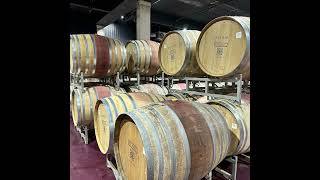
Now, as you can see, this is the barrels room. Most of the wine— of the barrels here are not new. We get something like 30%, even less, new every year.
This is the bottling season because we need to clear barrels, we need to clear tanks before the next harvest season. So this is most of the effort of the winery in this— these days is to clear. If it's blending, if it's, um, emptying and bottling and then cleaning the barrels, this is most of it.
What's the difference between the barrels that have the leaves on the outside and the ones that don't? Well, those whites and these are reds.
Those are new, not yet used. Okay. And those are reds that already been used, probably. Now the red color is actually from wine.
Yeah, it's the lees painted over the top. Exactly, it's a paint.
Yeah, in France they used to say that, you know, it's wine that spills in process. Now today you can buy those painted already from the factory, right? But they painted with non-kosher wine, so we cannot We do not use those, so we paint them by ourselves, which is not as good as their painting because we don't make the same deep mud color that they do. That's right. They use very like port, sweet wines or something like that. Now, as you can see here, most of our barrels are 500 liters. Yes. And they're all from the same barrel maker called Cavan in Burgundy. Northern France. We use the toasting levels between light and medium, not even medium plus. As I said before, we don't believe that we're supposed to change the wine. The barrels are for micro-oxidation, for the maturing process, not for, you know, overpowering the flavor of the fruit, not to making the wine oaky. The barrels are process that the wine will go and developing, but not overpower the fruit and the terroir that we try to, to show, especially in our wine. Now you can see here some wine, 3,000-liter barrel. Yes. And you can see some, um, actually one wine, the wine that ages in a small barrel of 300 liters called Cigar. Okay, what's it called? Cigar Bell, because it's like a fat and a bit longer, right? Uh, all made by the same producer, of course. Uh, we have tried different producers as well, as you can see here, and some other wines, other bells as well, but we got to the understanding that this is what we're looking for, and we now work only with Kvar. Yeah. Now you see that— well, now it's empty, but you can see that most of this side of the wall— now it's this side, this as well, but that side as well— standing on wheels while these are not. Yeah. The reason for that is actually soulik, when we have white wine with the sediments of the lees, and we need to spin them to make the circulation. It's called bétonnage.
In most, when you enter like a curly stick and spin it until it's all, uh, it's mixed. It's all mixed. And so here we do it easier and do it just with it.
Now we have a wine barrel with a glass wall. Yeah, just to explain the process of, um, betonage, how the leaves are getting, uh, wow, you see the leaves. So when we spin the barrels, it's actually mixing, stirring the, the inside, and all the leaves are getting in touch with all the surface of the wine. And we have a consistency inside the barrels, or every few weeks a few weeks. Depends on the winemaker. He decides when and what— when and how much time do we spin. And they spin it just to make sure that everything is—
And you get it from the— that's great. They put glass on both sides. Yes. Amazing. So you can use the light. I know. It's amazing. It's a beautiful video. Brilliant idea.
Now, because we're This is all underground, as you can, as you can see. And, and we wanted to make, um, usually in fermentation, if you cannot ferment, ferment in this temperature, it's too cold. Yeah, not only classic fermentation but also malolactic fermentation is need a bit warmer temperature. Now in most wineries they take the barrels outside. Yeah. And then they try to make it in the— under the sun and always, uh, check the, the process. Now here we built the facility, the cellar divided to two different facilities. When I close these doors, yeah, this is completely isolated. So we can put here 17, 18, 24 Celsius, and over here it will still remain 12 or 10, depends on the— and here we can ferment and make all the process without taking—
disturbing everything else. Yeah.
And when it's finished, either we can take the belt and finish fermentation inside the other, or we can open the doors when everything is finished and then compare the temperature. Right now it's the same temperature. In—
during the harvest season, it's—
it is closed, and then fermentations are happening here. Very cool.
As you can see here, most of the barrels are empty, new ones. As these two, this is already used but clean for next one. There is no sticker.
And those are the barrels for toppings. Got it. And basically that's it.
Did you make wine during Shemitah?
Yes, at the matzah.
Okay, at the matzah.
And this is the barrel room.
Okay. This is Lilach, Shachar. Shalom. This is Simon.
Simon, pleasure. Shalom, bracha.
This place is actually one of the core parts of the winery. This is where all the decisions are made. I didn't introduce you. Shachar is our winemaker. Pleasure. Shalom, bracha. I keep touching this for an understandable reason. It's the only place I can. Zamaklit.
Okay, back with you soon. No problem.
Um, yeah, not just a laboratory, this is the winemaker, um, space. When all the decisions are actually made here, they have all the results from all the testing that they want. They have the Foss, which is a very high-end. Yeah, they have here some more. You see this, the Cynthia, is actually an entire laboratory in one small device. It can check everything from the grapes, uh, to the wine. Alcohol tests, whatever you want, is— you can do here. Uh, they even check how much oxygen goes through the cork or in the cork, how much dissolved oxygen there is in the wine after a few years or something like that, to see the development. That's all the— that's— of course, this is all monitoring all the operation all the time. Yeah. Any problem that can occur is also alerted to their phones, so they will know that something is wrong and they need to be fixed. So if a barrel goes out of the norm as far as temperature is concerned or something gets— a barrel, a tank, temperatures, any process that you want, it's already always broadcasting. They can know if something doesn't work as well as it's supposed to, anything like that. Now besides that, there is a manual backup for everything. Yeah, not the broadcasting, but what's inside of each of them and everything of those. Yeah. And this is the most— this is my favorite part of this room because this is probably the only part that I actually understand. And this is a— it's not exactly a map, but each of those squares are as simple as one vineyard.
That's one vineyard? Yes. Okay.
Very soon they will start to bring, uh, tests from the vineyards, examples of grapes. They sent someone, uh, he picks grapes from different rows in the vineyard, from the bottom, from the, from the sides, from the end, from this middle, middle of the row, end of the rows, from few rows inside the vineyard. He brings them here as grapes, they squeeze them, and then start to get results from sugar to pH to whatever you want to know. Yeah, they will know. And of course taste what the flavor is. You can start seeing each line, it's each 2 exams for each vineyard every week. You will see some vineyards, we already know that they have long season, so you see a lot of, a lot of room. Some have less. And when they finish everything, they before harvest, they put an X on it, and then we know it's picked. The end of the season is when this entire wall is Closed.
Wow, it's all crossed off, it's all crossed off, right?
Exactly. And then, you know, this is, uh, we finished harvesting last season, 2023. We had a lot of, I don't know, you can call it luck, whatever you call it. We finished the harvest season just before Sukkot, 27th of September. The last press was the 3rd of October, and it was very difficult to get here on the 7th of October after Sukkot. Roadblocks. You could everywhere, you cannot go any, any further. Well, everybody was sure that Lebanon will start the same, and even now you can go to some places. Just after the industrial area, you will have a roadblock that asks you where do you, where do you go. If you're just visiting, you cannot go. If you live in Alma or somewhere over there, you can, otherwise they won't let you. Crazy. This is how war looks like in the first few days here. Anyway, from this door, um, can get to any part of the process, uh, of the process area, the tanks to the barrels, the press, whatever. In less than a minute, they can actually be anywhere. You see all the bridges above? Yeah, they're all connected to the door over here, and they can be anywhere they want in less than a minute. And we, we do not wait for, you know, we don't send things to an exam in a laboratory, then we wait for the results and then process, or get our understanding what we're gonna do during the process. Every process that starts is after results from the lab, every fermentation that finishes is after the results from the lab, and since the lab is right here, we don't have to wait or trust some other services, let's call it. Go this way. We do everything here. So this is the winery. Let's go this way. Okay. And now let's go taste some wine. Okay. So, um, just a few words about the food that we serve here, which is, um, well, a little bit of a weird time for us because you don't want to buy a lot of dairy products because they go bad very quick. and we don't want to freeze things. So we try to keep it simple and still maintain our own suppliers that we worked before. All of our food is coming from the 40-kilometer radius. That means Golan, Galil— mostly Galil, some Golan, and some lower Galilee. The cheese is from Iftach. It's a sheep's cheese from place called Meshach Schwartz. The bread is from Kibbutz Moran, which is a bit lower Galilee. We used to have another bread from here as well, but it's evacuated, so we don't have. The olive oil is from here, from Alma. You can actually see the trees in the view. If we go to the balcony, I will show you the trees where it grows. Very nice. So it's, uh, we try to keep it all local. I mean, there is not much of tourism right now and not much of awareness for the area of the north, and nobody wants to come here. If you would walk around even weekends, which usually were packed, it's empty. Nothing is— nobody's outside. Everything is— everybody's in a weird sense of fear. Not weird, I mean, it's understandable. I know. So, one second. Yeah. To sync the mics. By the way, this is the sound of crystal. Yeah. If it's a glass, it's a different sound. This is totally— Yeah. Anyway, the first one we're going to try is actually a PETNAT, the short for Petit Lait Naturel. in French. Sparkling natural wine. When I say natural, that means no added yeast, no added sulfites. Wild yeast, that means the yeast— Really wild yeast? Yes, we don't add any yeast to this wine. It made— it fermentates in the tank spontaneously. And when we see before it's about to finish the fermentation, we bottle it. It's still fermenting, so this is the result. And we got here a sparkling wine made of Marselan. And it's sparkling in the most natural way of winemaking. Of course, it's unfiltered, uncleared. No, that's for you. I have a glass here. OK. Unfermented, unfiltered, unfiltered, uncleared. Of course it's fermented, um, and it's natural wild yeast, so we can't really tell exactly when and what is going to happen to the wine. If you look, you will see the bottom is full of lees. Yeah, um, it's part of the process. Yeah. And that's part of the beauty of petnat.
It's— This is one of the most— Well, this is number one beautiful looking.
Definitely. The color is beautiful. It's orangey pinky color. The smell is a bit funky. Well, when I'm saying funky, I'm saying it's not the usual smell of rosé. This is a rosé from Marselan, and it's not the usual smell for rosé. It's a bit more funk. That's the natural yeast. The wildest. All these are natural, but this is a wild one. You can smell the fruit, you can smell some kind of a—
this is also one of the best—
funk into it. And the fizziness, the mousse is really cool. It's really nice, it's elegant, it's fun to drink, especially on a hot day. This goes perfect.
This is perfect to be drinking outside.
Exactly. And of course, it also varies between bottles. Sometimes it's more of that or more of that because you cannot really control how those leaves behave. Let's put it closer to you. So it will be easier. You cannot control lees when they're not— right, it's the wild lees. The yeast is wild, so you cannot control it, how it will react. So sometimes you will feel more or less of any of those. Anyway, Petnat is a wine, is a sparkling wine that you— the cap, the— it's not a cork, Yeah, it's called, uh, in Hebrew, kete, like crown. The same, the same stuff you put to— as beer. And that's because of the pressure of fermentation inside the bottle. It still happens. That's why it's still sparkling. And it's a very fun kind of wine. We make the petnat every year from different variety. And this one is Marcellan. The '23 is going to be actually white wine. It's going to be Colombard. And it's really interesting.
This is the '22?
This is delicious. Crazy delicious. It's actually in a very nice phase of his life as well. Well, the fruit is coming forward with all the surrounding. It's actually very fun. Sometimes I really love pet-nats. Sometimes I really hate that I'm inconsistent with it.
That's why when you ask me, it's because, because it isn't consistent. We tried Marsalan.
It's actually coming from two vineyards. Yeah, and one of them is in Kidmat Zvi and the second one is in Kanaf, both in the Golan. And more than that, they are the same grapes that we use to make this. Okay, you know this rosé? Yes, this is the Greedy Marsalan. The Gris de Marsanne is our finest rosé. We have two rosés in the, in the winery, in the portfolio. We have the rosé, the classy one, and we have the Gris de Marsanne, which is a very unique rosé because it's 100% free-run. That means no press at all, bleeding in whole clusters without press whatsoever, from a very specific vineyard to actually two plots in two different vineyards. One of them is in Kidmat Zvi, where it's the same as this one, and the second one is in Tel Fares, which is, um, a bit lower in the Golan, um, but higher altitude, um, grown specifically for making rosé in a very high, um, very— how do I say it in English? High quality? No. I mean, very strict policy of growing. The growers have a lot of instructions how to grow it exactly to make the best ones that we can produce. Who defines that for them? Kobe and Shahar. Okay. We have main agronomist. You have an agronomist as well? Of course, we have two actually. One main and one underneath him, we have two. One for the north and one for the rest of the country. And they work with all the growers that grow grapes for us. Now, by chance, I live in Kidmat Tzvi, and we actually grow— the moshav grows the Marselan. So once I got— I asked to just give the grow— the instruction to the grow— to the growers in your shop. Sure, I will get it. And just took a read. We have not just the Marselan, we have a few varietals. And I saw how many specific instructions there were. It's crazy, like it was almost 8 full pages. And while I know that different vineyards, which is not the single vineyards that we produce, are 1, 2 pages.
So what sort of instructions can there be for that many?
Just out of curiosity, I'm not really familiar with the terms in English, that's the problem. But for example, um, We call it the nibuchilun, making windows in the, in the grapestone so the wind can go. Yes. Through in an equal way to prevent some things. Dilution, I mean diluting leaves. Okay, I understand what you're—
I understand where you're coming from.
All the idea of just make sure that everything is going to be 8 How do you say "eshkol"? Eshkol. Clusters, like the— For example, 8 clusters from each vine. From each— not vine, from each side of the vine.
From each side of the vine.
From each branch. Something like that. From each branch, 8 clusters. Or it depends. I'm not— not exactly how it is, but that makes sense. That makes very small details that you would not think about, like when to spraying in what part, every small thing that is have to be in the vineyard anyway, but when exactly to, what are the signs for, if this happens then what to do, if that happens what to do. Everything is very specific and you cannot just do whatever you want. We don't buy grapes in the wine middle, but we do— we cannot own the land You can't— in Israel, a business cannot own land. It can be like a lot of rules. Okay. But people can own land. Yep. Places like kibbutz, moshav, they can own land. A company cannot own land. Okay. Like an industrial company doesn't own the land. So we can lease, we have long lease agreements. Leases with them. Like in Kidmat Tzvi, it's a goudashi tofit, it's like a lot of families that work in the agriculture part of the moshav. And we, we're not leasing, but the property, the vineyard, it's from the moshav. But we have a long agreement with them and we get all the grapes. We don't pay per kilo or per grape. We pay per year with all the process that involves.
For all the grapes that come out.
So, uh, it can be 8 tons for, I don't know, for a vineyard, or it can be 2 tons. We will pay the same amount. So for them, they don't mind to do whatever we ask from them because they will only get more money of it. I mean, in Israel, back in the days, they used to pay per kilo. So when you tell the grower dilute 10% of the clusters, it's lost money. They wouldn't do it.
I was going to ask you about that because how do you control that? Because I can see people providing grapes, and if you're paying it per kilo, no matter what you tell them to do, they won't do anything that costs them money.
It's, yeah.
—You know, when you tell them, "I only want so many clusters per branch." So what happens if they leave an extra cluster? What have you?
But if they leave it on all of the vines, where's the incentive for them to cut back and shear, you know, cut things off and throw it away?
Exactly. So you pay.
The biggest problem of Carignan, for example, was that when it came here, the Rothschilds brought Carignan to Israel. And they used to pay agudata kol min, they used to pay by weight, as any other normal agriculture business. But you lost all the quality because Carignan can produce a lot of grapes. So it can get you 3, 4 tons per dunam. I'm talking Israeli money. Yeah, yeah, yeah, no, no, no, perfect. And when we talk about those quantities, the quality is very low. When you talk about reducing quantity and increase quality, it costs money. And if you're not paying for the quality, then they won't do it. When we, in Recanati, we're paying not by quantity, so they don't care. I mean, if the end result is, I don't know, a ton per dunam or 6 tons per dunam, for them it's easier even to dilute more at some point. They don't care about the money in because they will get the same money for the entire year for the whole process that needs to happen in the vineyard, which is already specific written in the instructions. And the agronomists are going with them all the time, explaining, teaching, showing, checking, looking at it, working together with those growers just to make sure that we will have the best quality in the end result. And that's what you will see in most of our wines. We try not to overpower the wine in any other way. We try to let the fruit talk, and that is the most important part in the vision area of the winery. We try to show the fruit, the freshness, the Mediterranean style. If it's not a Mediterranean variety, to make it fun to drink even in a hot summer day. So now we're gonna next Gonna go to the next rosé. Yeah, the Gris de Marselan that I was talking about. And so it's the same grapes grown specifically for rosé with no press at all. Um, very sharp flavors, fruit forward, but not fruity, not like the tutti-frutti style. It goes a bit more mineral, a bit more acidity.
This is available on the market now?
Yes, this is in the market. This is the 2022 harvest. What you call it is also? This is the Pet Nat.
Pet Nat is on the market or it's out?
It's a very limited series. It's very difficult to find on the market. You will probably find it more in restaurants, some stores maybe.
It's definitely food-oriented.
The Pet Nat. Now this is probably the most gastronomic rosé you'll find in Israel. On one end, the Marselan gives a lot of great aromas. On the other end, it has nice acidity and really well-balanced bitterness to it.
I love the balance of it from the front of your palate through the mid-palate. It's got a nice finish.
It's got that the bitterness, all the small parts in the meal that balance it together to, like, very gastronomic wine. We try that with sushi, with pizza, even with, like, not fat meat, like minute steaks or carpaccio, raw meat. It's amazing. Wow. It goes with raw fish, salads, appetizers in general, and even with creamy, like, cheese or cream pasta. Those things, it actually goes really, really well. What is that?
That's fatit. Yeah, this is—
This is actually really nice. They make really good cheese. Anyway, so this is a version of a Mediterranean rosé. Yep. Now, this is a Mediterranean gastronomic rosé. We have another rosé that is a bit more to the— crowd pleaser, let's call it, although it's not an official name for it. It's Syrah and Petit Syrah that goes a bit more to the fruitier side. It doesn't require food next to it. It can be perfectly balanced, you know, to the beach, the pool, to the port balcony, right? Anything like that that you can just enjoy on a summer day. This is a bit more sophisticated, I would say. And although it's not labeled a single vineyard because it's two vineyards, it's treated as a single vineyard. Because each of those vineyards are really, really high quality level. Let's see, where is Shahar? It's lovely. It's delicious, actually.
It really, really is delicious rosé. Wow. Rosé is really coming into its own these days. Definitely. This is This has got so many lovely— it's a nice texture, but it's also got some nice nuances to it that are just really special.
When you drink a classy rosé in Israel, it's either to the very sweet, fruity side, yeah, or sometimes it goes to the very acidic, bitter side. Yeah.
A lot of them have become— people are trying to get more acid into rosés.
I love acid, but it needs to be balanced well, because if the fruit is not powerful enough to balance the acidity, it translates to just bitterness, and that's it. This is a wine that we don't sell at the visiting center. It's the Yonatan.
You know the Yonatan? I don't, but it's from the— what you call it— Yonatan Uh, is it from the Jonathan vineyard?
No, no, no, no. Okay, um, this is Jonathan for another reason. This Jonathan is the son of Lenny Recanati, so this is called— we have a parallel series to this wine called Yasmin. Yasmin is the wine you can find in supermarkets, uh, in stores, like 300, 400, and 10 shekels something like that. Yeah, Unatan is the same series, it means the same parallel series that goes only to restaurants and wine stores. You can find a lot of home wine, house wine. Yeah, for hotels, restaurants that want to give good wine for not expensive price. Now I haven't mentioned it downstairs, but when we talk about our wines from the series of Galil and above, we have only free-run, no press. Above that, uh, behind, underneath that, we have Jonathan, Yasmine, and the wines that we sell in like supermarkets, and that you can find the press liquid as well. Now you would expect the press to be bitter or unpleasant, but we don't really press that hard, so it's actually a very fun wine to drink. This is a blend of Colombard and Sauvignon Blanc from different areas in the Gilboa, Galil area. And the price of it is around the 40 shekels, 3,410, even sometimes 3,400. This is Colombard? Colombard and Sauvignon Blanc, 60/40. Now, The unique— not unique, the fun part about it is that anytime that people ask me, we have like a wine list Shabbat. Before Shabbat, you go and you get like, you can choose whatever wine you want from the winery. They will give you a bottle for Shabbat. It's like a thing that we do here in the winery for all the employees. Any bottle? Almost any bottle. Those who are shortage, I mean, we can't— we don't have a lot of special reserves and limited series, but You can practically take whatever, almost whatever you ask, you will get. People usually, you know, they like to have the more sophisticated, the big wines. I always take this wine. It's my— I can't say favorite. Yeah, but this is my go-to wine, right? This wine is just fun. It's a nice balance, nice aroma, nice bouquet. It's— the flavors are It's just a fun wine to drink. The complexity is nice, and it's simple wine. It's not a very, you know, sophisticated, complex wine, but it's fun.
It's so nicely balanced. Exactly. It's just a pleasure. There isn't anything that tastes out of place. It's—
when you think about ordering a cocktail in a restaurant, you think all about the exact balance between acidity, sweetness, maybe some spice, and the alcohol won't be too powerful. This is exactly what you're thinking about when ordering a cocktail in a restaurant. This is the exactly same qualities. Exactly balanced, perfectly balanced. Nice acidity, nice sweetness.
And the alcohol is very—
the alcohol is low, I think 11.5. Yes, it's really muted, and it's delicious wine. I mean, at any second of the day, if you tell me open a bottle of wine and drink a glass of wine, I cannot imagine myself drinking a glass of red wine. But this, I can— I don't mind drinking 9 AM. I mean, I probably won't, but no, no, no, you It's a wine that you can— I mean, you have a morning, uh, Brit, for example, and you serve wine. You can serve the big red wine, but it's very difficult to continue the day after a big red wine, right? This wine is my go-to. It's really light. You finished your day, you're coming back from work, you sit on the couch and you think, oh, should I open a bottle of wine? No, but I only want a glass. I won't open a wine, I don't want to waste the bottle. This bottle costs 30-something shekels. Nice. Really lovely. You don't think too much when you open up this kind of bottle. Wow. The worst case scenario, you cook with it tomorrow.
Do you export this to America? Yes.
Yeah. Okay. I don't know if it's exporting the same price as in Israel. No, no, but— But you can find it in the States, definitely. And this is the '22. The '23 is already bottled as well. It's about to release any second now. It's called Neolahta. Yes, and the 2023 just received the gold medal in the best value competition. Wow. And for the right reason. I mean, this is the best value for money you can ask for. It's a great wine, especially for the very low price range.
Awesome. This is really awesome.
Every time that people come to me and say, oh, in Europe you can find in a few euros very nice fun wine to drink, not the most complex but very fun wine, I give them this.
Look, this is few euros. Yeah, I mean, this is great.
It's delicious. I love this wine.
How much does this sell for in the stores? Like 30 shekels? Yeah.
It's most of the most cases it's 43,410. Okay, so it's like, yeah, 30-something shekels for the bottle. Great. And I find it just delicious, I will be honest. Actually, I've just ordered wine for Shavuot. Yeah, so I ordered 2 of the Sauvignon Blancs that Sophie likes a lot and 10 of those. I wanted You know, yeah, we have some guests.
I love this one. It's good. It's really good.
Definitely. And for me, it's probably the best thing I've learned. Remember that I had in my Instagram that I tasted a lot of cheap wines from the supermarkets? Yeah. And, uh, yeah, this is the main wine that I, that I've learned is, wow, that's worth the money. And I liked it a lot then, and then when I started to work here, it's even better.
This is Simon Jacob again, your host of today's episode of The Kosher Teruah. I have a personal request. No matter where you are or where you live, please take a moment to pray for our soldiers' safety and the safe and rapid return of our hostages. Please tune in again next week for part 2 of this conversation about the Recanati winery with sommelier Effie Kots and winemaker Shahar Mamor. Please subscribe via your podcast provider to be informed of our new episodes as they are released. If you are new to the Kosher Terroir, please check out our many past episodes. And thank you for listening to The Kosher Torah.










