Sipping Through Time: Unearthing Israel's Ancient Grapes and Modern Wine Wonders
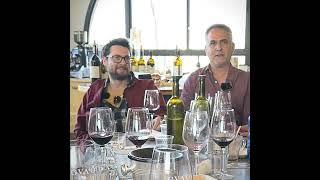
Winemakers Dr. Shivi Drori and Yiftach Lotzdig discuss their Israeli estate's three tiers, from entry-level Gvot to flagship Masada, which peaks at 5-6 years but can age 20-25 years. Their Kabbash vineyard grows grapes without irrigation, yielding concentrated Cabernet Petit Verdot, and they blend flexibly each vintage, sometimes adding Pinot Noir or white varieties.
Chapters
Welcome to The Kosher Teruah.
I'm Simon Jacob, your host for this episode from Jerusalem. Before we get started, I ask that wherever you are, please take a moment and pray for the safety of our soldiers and the safe return of all of our hostages. Some good friends visiting from the U.S. gathered together in Israel with me to visit some local wineries. From Baltimore, Maryland, Kenny Friedman, the wine writer, promoter, and social media influencer, joined us with his wife and daughter. From New York, Dr. Samuel Sofer, the social media wine enthusiast, joined us with his son. The following episode of The Kosher Terroir is an interesting educational conversation and wine tasting with Dr. Shivi Drori, the head winemaker at Gvot Winery, and his wine consultant, Yiftach Lotzdig. Dr. Drori is an agronomist and researcher in viticulture and enology at Ariel University. Where he has spearheaded a research study recovering approximately 60 ancient varieties of wine grapes from the land of Israel in general and Samaria in particular, from which wines have been produced for thousands of years. Yiftach Lustig is an Italian-trained winemaker who has worked around the globe as well as in Israel's Midbar Winery, and his latest project, the Mitzpeh Winery down in Mitzpeh Ramon, Israel. These two exceptional winemakers shared with us their personal views and some of their latest wine releases, as well as tasting some incredible wines they are working on for the future. Their conversation was so interesting, especially with the questions and insights from both Sam and Kenny. If you're commuting in your car, please focus on the road and enjoy. If you're home, please choose a delicious kosher Israeli wine and sit back, listen in, and enjoy.
I'm Shivi Drori. I'm an owner and winemaker here, so a partner here, uh, in Volv Winery. I have a PhD from Hebrew University in plant science. And recent years, I'm a professor at Ariel University, trying, I would say, to establish a wide research in wine and grapevine in Israel. It's new. It was not something that you can actually speak about. Now we're establishing the Samson Family Grape and Wine Research Center. It's a big initiative. We have 5 PhDs as PIs, as principal investigators, so 5 different labs working on various aspects of grape and wine. My specific, or I would say my main topic is the Ancient Grapevines of Israel. Starting 2011, we started a big expedition to collect and characterize the ancient grapevines. It's a very general term. It means that we were looking for anything that's indigenous to Israel. There were very, very few when we started. About 20 varieties that were mainly table grapes kept by the Arab population for centuries. And the Arabs actually made the transition from grapevine to olive, and it was done many, many hundreds of years ago because of the prohibition of wine consumption by Islam. Before that, Israel was actually a very big wine country, exporting, producing, drinking, of course. So commerce was very, very much based on wine. When the Muslims conquered the area, it was still not as prohibited as it was later. The 13th century became very, very bad, I would say, for the farmers. And it was actually banned and the vineyards were uprooted and the wine presses were destructed or transferred or changed into oil presses. So basically the wine industry was destroyed.
In the 1300s?
Yeah, from the 1300s. From the 1300s. It was the Mamluk era and then the Turks came in, There were no Turks yet, they were Ottoman, but when they came in, they just, they weren't really destroying anything, but they did not build anything, so it continued deteriorating gradually, gradually, and except for very few areas like Jerusalem, they built actually the walls of Jerusalem that we know now. It was not built by David, okay, it's a as the Ottomans, but, and certain additional places, but other than that, they just neglected the whole country. So basically there was no population.
The hills here are filled, filled with ancient wine, wineries.
Wine presses.
Just over here, you have another winery that was probably making 50,000 bottles a year.
I think less, but A very small boutique winery. Yeah. Right.
It's almost everywhere you walk.
Every mountaintop. Every mountaintop.
Had a winery.
Has at least one. Yeah. And you can see them changing through eras by the technology. You can see by the carving in the stone what was the technology they were using. Baron Rothschild started the new wine industry in 1880, but unfortunately he didn't see fit to use the traditional varieties that grew here.
Yeah.
It makes a lot of sense actually because—
Because they're French and they wanted to make Bordeaux.
Yeah, not just that. He actually sent here specialists and when they saw what's going on in the vineyards here, said, look, that's not professional. No wine will come out of this.
No, no, no real wine.
Even if there were a few good varieties that are suitable for wine production, they were grown in such a bad manner that a lot of spoilage bacteria, a lot of acetic acid going around in the air. They said, okay, that's not, that's not the way you do wine. Let's bring good wine grapes, let's make some good wines. And that's a pity because it took us more than 100 years, like 120 or 130 years to find the potential of the local wine varieties. So I'll go back to my work. There were very, very few efforts before I started just to characterize a little bit the things that were still here. Grown by the Arabs. But when I started, I said, okay, let's hypothesize that— actually, "Toda'habba"— that a grape— that I had a few assumptions. One, that they did good wines in ancient times. Okay, if they did good wines in ancient times, they definitely didn't do them from the remaining 20 varieties, which are basically table grapes. So we hypothesized that there were many more that were neglected because of the ban. And another assumption was that because grapevine is very resilient and farmers are very smart, some of these varieties may have survived all of this period. And we were right! But finding them took a lot of effort. It meant that we need to go by foot all over the country in deserted areas and find these neglected varieties. Then we need to actually see that they are indigenous varieties. We need to do genetic analysis. Wow. And then we need to pick them up and put them in our collection to see what they are worth. Okay, if they're actually bearing grapes at all, and if so, they're white, red, suitable for wine production. Can they accumulate sugar at all, do they accumulate sufficient aroma compounds and acids and so on. So that took a long time. Gradually we collected almost 100 varieties, indigenous varieties. We collected more than 650 grapes from vines from the wild, and after analyzing them, we have in our hands today almost 100 unique varieties, which is a big amount. Out of them, we selected 12 varieties that, in our point of view, can be very good for wine production. And in order to put them back into the Israeli wine industry, we need to clean them out of viruses. This means a lot of work. It means that we need to take a tip of the chute, size of 0.2 millimeters. You speak inches?
Yeah.
No, no, no.
Hundreds of—
I know what millimeters are.
Hundreds of an inch.
Okay.
Hundreds of an inch.
Okay. Pick it up under a microscope in sterile conditions, put it on a special plate. In tissue culture, grow it back into a whole plant, and then check it for virus. It takes a lot of time, and then again, we succeeded already in 4 varieties to clean them. So they're back and people can just order them now and start planting them. These varieties have new names like Yael, Be'er, Hebrew names.
Oh, wow.
And not the Arab changed names like Jandali. That was initially Goldali, which also doesn't sound very Israeli, but it was the Israeli name. Or Bituni. Okay.
So this is Bituni. This is a red grape variety, an ancient red grape variety that Shivi discovered or rediscovered. And we're working on it. Challenge of it is because this was a table grape. Yeah, for a very long time. First off, it's a really massive grape. It's a massive grape, and it was a table grape, so it's farmed to be table grape, which is not exactly what you're looking for in a wine grape. But still, we're working on it for a couple of years, and I call it the Israeli Pinot Noir because there's something Pinot-y or Complexity.
It's, um, even the color looks— yeah, it is very— it's very Pinot. Pinot. Yeah, it smells like Pinot. Um, the grapes are actually not so big if they're grown right. So yeah, if they're grown by the Arabs as table grapes, they actually want them to be as big as possible, as beautiful as possible. But if you grow them on a vineyard for winemaking, you can actually really, really, I would say, restrict the amount of water that you give.
Yep.
And restrict the amount of berries or grapes that you grow, and they will be even better. So, but this is sufficiently, I would say, rich for me. To be a good wine, an interesting wine that actually changes the very regular portfolio of Chardonnay, Cabernet, Merlot, and so on. This is different. And as Burgundy succeeded in producing an amazing industry based on a grape that actually is very poor, like Pinot Noir, and makes like brownish-orange wines that are basically not very beautiful for most people. For most people. But for me, they are the most amazing wines on Earth. Okay, so not everything that is— they're elegant and shiny, bright purple, deep red are the best wines. Yeah. Okay.
Metaphor for life.
Yeah. Amen. Amen.
Amen. So the question I have for you with this is, this is still— you're still experimenting as to how to grow these the best way possible?
Unfortunately, we cannot experiment yet on how to grow it.
Okay.
Just now I entered the first plants into the nursery to be able to produce plants. So only this year we can actually plant it. From, uh, until now, the last 7 years, we were buying them from Palestinian growers who grow them around Bethlehem.
Okay.
Why were they growing them? Because almost back to 30 years ago, around Bethlehem, there was a wine industry. They were Christians, actually. Okay. And they were all— okay, they're not there anymore. Yeah, it's not very pleasant for a Christian to be in Palestinian Authority today. So basically they are grown in stable grapes today. And we found a few good farmers that can sell us for now until we have our own. And this comes actually—
I can't wait.
Yeah.
I can't wait until you have got the Batuni growing the way you wanted to be grown.
Wow. One of the things that separates Volta Winery and is very important for us, and we actually see it within the way we do the job, is we control— we do have our own vineyards and we control the farm making there. And there's a big difference when the winemaker is the wine grower between them working in contract with the outside. Outside farmers, their interest and our interest did not completely align. And so for us, taking care of old plants, planting new ones, experimenting, all of this is done in-house. And it's done in-house because of Shivi, because he's a winemaker, but he's also a scientist, he's also an explorer. And he's got me, I'm crazy, and I'm just— you give me a crazy idea and I go, "Ah, that's cool." Let's see if you can do that.
This is great. Yeah, it is. And it takes time to evolve in the glass, so just let it sit.
Yeah, no, I know, I'm watching, I'm watching. The aromas are coming off of it. It's just awesome.
And it's nice, it's more reddish, okay? It's like more cherry, strawberry, a little bit notes of earthiness, floral, very nice. It really reminds us of Pinot Noir, so But when we go, I would say, 10 years further, I'm sure we will be able to actually pin it down to the essence of its real, real characteristics.
Reminds me a little bit of a Pinotage.
Pinotage is usually much darker. Yeah, but it's much fuller in body.
Coffee-driven.
Coffee, yes. But it is in a way I would say on the, on the, on the spectrum, a spectrum of Grenache, Pinot, Nebbiolo, somewhere there. Nebbiolo that grows high in the mountains like Valtellina areas, they like that acidity, grows on rock. Yeah, so this, this is the region where this falls, and it's very elegant. For me, it's the most suitable wine to drink in Israel in the summer as a red, because you cannot drink a heavy Petit Verdot in Israel. It just— you fall down.
Okay, it has an Italian character to it.
It's only 12% alcohol, so again, and it has the tannins too.
If I just can add one thing that's really important about it, All the grape varieties that we know of are Italian and French grape varieties that we brought here, which is a very different climate. This is a grape variety that was born in this climate. So its resistance to the ills of the terroir, what, you know, characterizes Israel, it's a lot more resistant to it than, let's say, the French varieties. The diseases, the heat, the— The whole vegetative cycle of this is very different than anything I know I've seen in Europe.
Right.
Judy, a question. When you do genetic testing to try and figure out the actual origin, what specifically are you doing?
Seriously?
Yeah. Seriously.
You have to take a very good question you've just asked.
Okay. There are two ways to do genetic analysis, basically. Okay, one is like they do it in forensics, means that you take markers. Let's say every one of us has specific regions in his genome that are different from each other, even from a twin if he's not an identical twin. Okay, that's enough if you do like 22 of these in order to be able to statistically be certain that these are two different individuals. So this is one way of describing, and I would say fingerprinting, a variety. So that's the easy way. It takes very short time. We can do it in lab, in my own lab. It's very easy. And, uh, easy, you know, you have to have that equipment.
You have to use PCR.
Yeah, PCR.
PCR is good.
No, only PCR, and then you have to do a sequencing, but a sequencing in a very, very fast and I would say not very informative manner. You just have to know the length of these areas, segments. That's it. You don't have to actually know the sequence. And then there is the genomic analysis. Genomic analysis means that you actually analyze the whole genome. Okay, that means you use 50 million base pairs, okay, of genetic data. That's a lot. It's just 1/6 of a human being, but it's still a lot. And then you have to compare between the sequence of this individual and 100 more or 3,000 more in our case. Okay, and that takes a lot of time, but we did it.
You do like CRISPR or some of those sorts of technologies?
No need for that. No, the wine industry is not trying to create— is not receptive to any genetic modifications, unfortunately.
Because that can speed up, you can look for specific sequences.
So there's also, I remember the first time I went, the first time I was giving a lecture to these students, he asked me to give a lecture about Italy. So we're sitting down and he's telling me about this new variety that he's showing me the leaf. And I go, but that's not biolo. And he goes, what do you mean? It's like, go to ampelography and you see that the way that the leaf is grown is very, very similar to non-biolo.
So, well, it's not.
It's not.
It's not. It's not.
Ampelografia, the way that men and A pellography is the description of morphology that actually gives you identity for a variety. That's the old way of doing things. It's still done today, but it's deteriorating.
It's not scientific. It gives you a hint.
It's very subjective. They try to give it a lot of, you know, differences in angles. It's very different to make science out of it.
I don't know if it was science 200 years ago.
It was our best guess.
I have a laboratory also, but I'm a doctor, but I have a lab.
Ah, okay.
I'm saying the way we got around a lot of these things, we're looking at 50,000 genes, you can use now new technology to really isolate specifically what you're looking for in much shorter time.
Exactly. Targeted sequencing. So we're using every technique possible. Let's switch wine, and then I'll tell you about our new endeavor. If anyone wants to switch his glass, just tell us and we'll switch. If not, we're continuing to Pinot Noir. I'll say a few words about Pinot Noir generally in this region. Pinot Noir is a tricky variety in Israel. Yeah, that's to say the least.
No matter where, no matter what.
It's tricky, not very easy to grow it. The main reason is it is very sensitive to drought conditions. So if you give it too much water, you get something very uninteresting. If you give it too less water, it starts to shrink. There's a very, very delicate balance there. Actually, where it grows in Burgundy or other areas, it's usually— it does get quite quite a big amount of rain, and it does— it has the ability to actually thrive even if it gets too much water, okay? But it gets watery if it gets too much water. So big years in these regions would be years that didn't have too much rain. Here we never have rain, so the control of the whole thing is water supply, watering, and a very accurate amount. And that's a big challenge, very big challenge. A few years back, I did not produce Pinot Noir because it came so dark that people mistakenly thought it's Syrah. Okay, and the only reason was that we had a very strong drought and heat period. Like a heat wave for almost 2 weeks, and they just started shriveling. We picked them too late. That's it. Okay, so it is very—
it's unforgiving. It's an unforgiving grape variety.
So as you see, the color is very similar to Bituni, and that's a standard Pinot Noir. It has a very nice color, but it's very light. Okay. And when you get— Yeah, if you get in a tasting— Ah, great, great. Yeah. When you get a Pinot Noir in a blind tasting, you always know it's a Pinot Noir because Grenache has a very, very different aroma. So it's quite easy to discriminate between them. Your ultimate—
you're driving the bituni, especially when you get to give yourself the Pinot Noir style.
Yeah, yeah, yeah, yeah. We call it the Israeli Pinot.
The— I remember the bituni '18. Yeah, that was, that was, that was on a blind tasting with Burgundy.
Yeah, but by the way, getting the bituni to where it is, it's not very easy. The fermentation—
I've never tasted it like this.
Yeah, the fermentation done here is ridiculous. Okay, we ferment them whole berries, and we actually need to put someone into the tank to break the grapes, okay, with the legs and wearing plastic bags. Really? Yeah, so it's very, very different from a regular winemaking.
It's an ancient grape and ancient methods.
It's an ancient grape in an ancient technology. It does not go through regular destiller pressures in wineries. It just can't. Okay, so why?
How so?
The berries are too big to go through the holes of the—
You couldn't put them on a whole cluster, just crush them?
We do it almost like that, but then we ferment it partially. It's called a carbonic fermentation.
Got it. Carbonic maceration.
Carbonic maceration, carbonic fermentation. We leave it— what are all these flies here?
This is the batuni.
And then we can get much more floral aromas out of it, and it goes to the lighter but rich area, and it doesn't fall into too extracted, too dull place.
For the Pinot, which is, uh, Shivi's and I's passion project. We love Pinot. If it wasn't our vineyard, if it wasn't completely in our control, we would not make Pinot.
You and Iakovoria.
We will not.
That's his dream.
We will not.
Is making Pinot.
But in order to— we either do it well, we don't do it at all. So the only reason that we're making Pinot is because we planted it. We invested in it, we would not buy grapes from anyone, not in the Pinot.
Well, it shows. This is my favorite Israeli Pinot. I buy this every year. It's a beautiful, beautiful Pinot. I have them sitting in a cellar. They age beautifully. Oh yeah, these are the best. There's no other Pinot in Israel.
Yeah.
Well, there you go.
They've become expensive. They've become a little expensive in America.
Oh yeah? Tell me about it. I was not there for 4 years, so maybe they did a lot of—
they're probably retailing that for $60 a bottle.
$60?
$58. Yeah, I'm serious. Wow.
Where's your cut?
No, no, no, we did not get that.
No, I used to buy them for $40, you know.
That's the price.
I know, but is—
but not anymore.
I'll tell you why. Because, uh, we didn't do them every year, so he can actually Pull back because a lot of people are looking for that.
His own method of extraction.
Yeah, I can tell you the harvest of the Pinot— Pinot is just not forgiving in the vineyard in any way, and not also the window of harvest. It's the window of picking. It is very, very, very, very small. So we have to be with our finger on the pulse with Pinot.
No, Barry will let you— this Pinot, the Gualt Pinot.
It gives you a pleasant drink without being shallow. It's rich, very rich, but not too heavy. The elegance here, that's the point.
Okay.
You can actually drink a bottle of that and feel that you had a very pleasant experience all over the bottle. So that's the point.
I've done that many times.
L'chaim, l'chaim.
L'chaim, tov l'vashalom. That's really cool. Excellent. It's interesting to compare them so directly because it actually looked more Pinot-like, the Batuni, until you have the Pinot.
This is a very good Pinot. Yeah, I know, I know.
It depends on the year.
I'm curious to see when you grow the grapes here, the Batuni, whether you can get this level of concentration.
We can get it higher.
The difference is the Batuni doesn't quite have the concentration that this has.
I agree. This has the tannins, the very supple tannins that— very, very enjoyable. Okay, the Bituni does not have it yet, and it will once we grow it ourselves. This is exactly what we're looking for.
When you market the new Bituni, you have to make it very clear to people that it was the first vintage made here.
Not only that, it will be from grapes that are clean from viruses, they will be much better colored and much better flavored.
Okay, awesome.
Thank you.
Okay, so that's it.
What's next?
Thank you very much. Joking. After the Pinot—
You know something? If that was it and it was finished, it would be— it was worth coming.
It's good to get blitzed by 11 o'clock in the morning.
Merlot. Yes.
Because it's— if you take a cold climate variety and you put it in a warm climate, it reacts to it. But this is a warm climate variety, so it can remain fresh. That's what I think is its beauty.
Again, heat here for you. Perfect. Perfect.
Yeah. So while you're talking—
why do you want me to re-ask the question now?
It's actually the fact that it is a warm climate variety that allows it to be not over the top, if that makes any sense, not overly concentrated.
It's not a transplant, it was sorted out, right?
Yeah, exactly, it's a local, it's a Baladi grape variety.
For me, when we speak about Mediterranean varieties, we're mistakenly speaking about South France varieties, which are not really—
Rome varieties. Yeah, I would say Southern Rome, Nice, Provence, these regions. Grenache, Syrah.
These are really European varieties, okay? They are not hot climate varieties. I mean, it comes to be warm there once in a while, but not here, not like here. That from March we're starting to be warm. So it's very different. When we look at the varieties that are indigenous to Israel, most of them, first of all, are white, which is very interesting. Secondly, the reds are mostly light red, light red, not very dark. We have only 2 or 3 varieties in the whole collection that have very dark, rich tannin and and pigmented characteristics. That's because it's— the warm climate does not favor too much tannin and too much anthocyanins. It's very, very hard for a grapevine to do that in this hot climate as a regular thing. And in Israel, in order to grow these varieties, we do a lot of tricks, okay? The transplants, okay? But the varieties that grow here, what was, I would say, selected into them was drought stress, salt stress, I would say resistance to very limey soils. That's the point there, not making very dark grapes. People that grew them first of all wanted them to be able to stand and thrive in very harsh conditions. That was the main breeding purpose. Okay, we're gonna taste Merlot. Basically, I think that wines in the hot region basically will be lighter on the color, basically will have less tannins than what you expect to have in colder areas, okay, cooler areas. But they will be very rich. If they're good, they're gonna be very rich, and if they're good, they will keep the acid even though that's not the basic characteristic you find in most grapes in hot climates. So freshness, if they're good, you'll find them fresh, you find them rich. That's the characteristics we are look— we're looking for, and not extraction, not darkness. Okay, that's basically—
here's another question for you, because you're a businessman also, you're not just a winemaker. You're not just a scientist.
No, no, no, he's not a scientist.
Maybe he's not, and that's my question is that—
He has a partner that's limiting him.
Yeah.
Well, because you're making grapes that are not— You're making varieties that are not necessarily— People don't go into a wine store and ask for a Petuni. People ask for Cab, but you get away from that.
Yeah.
How do you balance what you want and what will sell?
We put— there's a lot more production in the cab. The whole Bituni program is less than 3,000 bottles, right? You know, in 100,000 bottles.
But obviously the passion is Pinot, Bituni, indigenous.
No, that's fine. That's like, uh, what you do for a living.
A lot of things.
Perfect.
Yeah, a lot of things. I'm, I'm I'm a chiropractor, physical therapist.
Great.
But I'm also a wine writer.
Okay, that's great. How, how much of your time you, uh, put into wine writing?
Right, small amounts.
Okay, that— and what, what do you—
but that's what I— that's what my passion is, right?
Great. That's the whole—
that's, that's the answer, right?
Perfect.
I understand it. I understand it firsthand.
So yeah, we do a lot of Cabernet Sauvignon. We do very good Cabernet Sauvignon. We do a lot of Sauvignon Blanc and Chardonnay, but I'm more interested about the Jindali fermenting in my terracotta amphora than in the Chardonnay fermenting in a stainless steel.
Right.
This is 2018 Merlot.
Merlot is also—
Yeah.
I'll tell you a story about how we met. When I was in Jerusalem, I was a head sommelier. I came here when we just became friends and we did a barrel tasting, and I've tasted the Merlot.
Excellent.
And Merlot is a problem in Israel because a lot of the winemakers or the wine growers treat it like a Cabernet, and it's not. It's a much more unforgiving grape variety than Cab. And one thing I'm really happy about, and one thing I'm really passionate about, even though it's not our best seller, and it's a very limited release, is I am really proud of our Merlot. And I think, let's be modest and say the top 5.
I'm not just saying it because I'm here in this winery. This is the finest Merlot made in Israel. And it's interesting because you make it on the, the entry-level, entry-level wine. I've been buying it for years and I've posted about it, I've written about it, that this is, for me at least, the best Merlot made in Israel.
The amount of effort put into this Merlot For the price point, you don't make it great. Quantity is— you would not believe what goes on behind the scenes because we're very, very proud of this model.
Yeah, you should be. It's, it's an excellent— it's not funny because you don't have a Gofner. This is the entry level. I always tell people because it sells in New York, you can buy this bottle for— now it's a little more, $28. Used to be $20, $22, right? But it's still, it's still for that, for the value of that kind of wine.
You know Sideways movie?
Yes, of course.
That's it.
No more effing Merlot.
Yeah, yeah, I'm drinking any effing Merlot.
That really, uh, it hurt the Merlot market. And it's a pity because it's a beautiful variety in some areas. I love Merlot. I love Merlot.
Some of the best wines in the world are 100% Merlot.
I love Merlot. I think a lot of the people that think they like Cab would prefer Merlot.
They don't even know they're drinking Merlot. They're drinking, they're drinking these wines from the right bank that are 100% Merlot.
The, the Gauss belt kind of thing. The problem with it is normally you have a Gauss belt, you have a mid-range cab, let's say, right? And then most of it is somewhere in the, in the, in that average. And you have some cabs are really good and some cabs are horrible. The thing about Merlot is it is really binary. It's either brilliant, right? It is either wonderful, amazing, and tasty, or it's disgusting.
There's a lot of, a lot of bad Merlot.
And the shift is about 90% 10% to the disgusting and 10% to the beautiful.
And now we will pour the new one so we can compare. Okay.
I found the '18 vintage in Israel was a very good vintage, no? Found like—
I would say here that we had a few varieties that were very good.
Yeah.
And a few that were, uh, very late to be picked.
Here's what I would say. I would say that I found that maybe because it was a cool year, a lot of not such great producers made better wines. You make great wine every year. Producers that don't had better years in '18. Yeah, it was more forgiving.
I think it was more forgiving.
Your '18 Pinot.
Yeah.
Did you like your '18 Pinot?
Not much.
Okay, interesting.
But you know what we really like?
I know, but I buy the Pinot every year, and '18 for Israel, it was a good year. There were a lot of good wines from Israel, but your Pinot that year, it was good, but it wasn't—
it didn't have the brilliance.
'17 was a better year because of the—
I've been meaning to ask you that for a long time.
Definitely, it was one of the years that it was very— it went to the point of leather. And earthiness without having the beautiful perfume.
By the way, the first time I came here, I tried a barrel tasting of the Merlot, and to this day, and I will not forgive him for that.
Feel the acid here, which is natural acid. This is a lot of fruit. This is a very long wine, okay? The aroma and the fruitiness in the mouth is kilometers, and that's a very good Merlot, okay?
I saw that perfume.
First time I came to the winery, I did a barrel tasting with him, 2010, I think it was, maybe 2009, and we tried a couple barrels. He had 3 barrels of very, very specific Merlot. He knows this because we fight about it till this day. I wanted 1 barrel as a 1-barrel bottling.
And I put it into Massai.
And he put it into a blend. Don't touch my wine!
Uh, Merlot is, uh, yeah, Merlot in this region, if it's grown properly, uh, you can pick it up with a pH of 3.25, which is ridiculously low. It means that it has very good acidic build, and, uh, if it's grown lower The altitude?
The alcohol.
The alcohol? That should be about 13, 13.5. And it's— we never pick it late. It's always— we always pick it quite early to get— to keep the acidity, to keep the elegance. If you keep it more, you will get much more darker, and it will become an imitation of Cabernet Sauvignon.
In general, it's— there's a game between North Israel and Shomron, Jerusalem Hills, in terms of the Cab and Merlot. Over there, the Cab is very expressive and the Merlot is very subdued. And over here, it's a little bit of an inversion of that. And I'm talking in broad strokes because it really depends on the grower and specific site, actually.
If there was a market for Merlot, we would grow here the majority of Merlot.
Yeah, the Merlot here is much better than the one up north.
Right.
Yeah.
The Vineyard Dance is what blend?
The Vineyard Dance, it depends on the year, but it's basically a blend of a lot of Petit Verdot, some Cabernet Sauvignon usually, and it could be the difference between like 40% Petit Verdot, 40% Cabernet Sauvignon, or 50% Petit Verdot, 30% Cabernet Sauvignon, and the rest could be Merlot and Cabernet Franc. Sometimes I even put a touch of Pinot Noir in, so it's, it's a blend and it really depends on the year.
Is the vineyard—
here he is, he's with us.
Ah, should be the vineyard dances, ma vushel.
Uh, not all of it, not all, right? We produce a Specific amount or— Hello, welcome.
The Merlot is still not Mevushal, right?
Huh?
Merlot is not Mevushal.
We make batches for the American market of Mevushal. I don't really like it, but—
I know.
There's a demand.
You in general don't like to cook your wines?
In general, I don't like to cook. In America now, the Cab Sav, the regular entry-level, stuff. So that the entry-level Cabernet they're bringing now is only, only the mevushal one. I can't find the non-mevushal regular Cab Sav, and I don't— it's not quite the same wine.
Uh, even though we do a very good bichul.
Yeah, yeah, I know, but it's not the same.
But the reason I don't do bichul for all of it is because it changes the wine, right?
But the Merlot in America are the ones are still not Mvushal.
Okay.
The ones I sent. This is your glass.
Just do it.
Okay.
You just pour it.
Okay, so this is Vinerdance 2022. 27% Petite, 41% Cabernet, 71% Cabernet Franc, 5% Marsala. Oh, Marsala. Yeah, we had Marsala.
The Marsalan is growing here?
No, we had a small amount of Marsalan coming from somewhere else and we thought it could spice up the— spice it up.
Yeah, this is green pepper.
7% means about 2.5 barrels into the whole blend. Yeah, more or less.
This has green pepper there. Talk about Petit Verdot in Israel.
Oh, you like it?
Of course.
So, uh, if I had to choose a variety that's the Israeli variety, yeah, else of my indigenous varieties, it would be Petit Verdot. The reason is that it's so versatile, it can actually do very good. And do good, it means that it gets very good characteristics of Petit Verdot in almost every terroir in Israel, from the Negev to the north. And that's unique. It's very, very unique.
It has a very high tolerance for heat. Yeah, a very high tolerance.
And the reason is, the reason is that it's a, it's a very late ripener, which makes it very green and very tart in Bordeaux. This is why they put it in a very, very small amounts into the blends. It's a, it's a colorant. More than anything else there because it has very high color. Here in Israel, because it ripens late, it's great because that's the— when the heat goes down. So actually its ripening area period is in a more milder temperatures, so it really gains amazing complexity, color, and everything. And we use this, the Petit Verdot, in our winery as the main working horse. Okay, it's like 40% of the wines here are Petit Verdot-based in the reds. If I look at it, we planted more Petit Verdot than any other variety in the winery in the last 5 years.
It's, it's an acidic carrier. Okay, it brings acidity to the blend a lot of the time, freshness. So that's a backbone in terms of wine.
Very good.
Yeah, I'm glad Kenny asked that. I never understood why in Bordeaux they can use it in such tiny quantities, essentially a color to the wine. But in Israel, and there are several people that make a pretty good Petit Bordeaux, they can't make it right.
Right.
But it's interesting. I'm glad you asked that because I never understood that.
I have always thought about that.
Yeah, we pick it up here after Sukkot or during Sukkot.
Okay.
That's interesting.
Very late every year.
This is the last. I think it's the last.
It's always the last.
You'll never find a p'tit vieux poutine dough in France.
Yeah.
One month after the Cabernet Sauvignon. It's a lot of time.
A lot of flavor, a lot of color, a lot of fruit. But it doesn't let go of the acidity, which is the main issue. I could use it. In terms of balancing everything out in a blend.
And if you pick it a bit earlier, you don't get too green, which is great.
What year is this? This is 2020. The vintage? 2022. Delicious.
Yeah, this is— it was bottled a few, uh, I mean, a month ago. Okay, so it, it's a baby.
Beautiful.
But it's very tasty.
Very, very, very elegant.
The Montsélan, we, we had a, we had a go at it one year, uh, Just in 2022, I think. It was an experiment. We like experimenting, but it's not something that we're putting into the video. It was a good experiment.
Wait, what are you talking about?
The Marsala. Marsala.
They made a pure Marsala.
It was an experiment. We wanted to check it out. We wanted to taste it and test it. It was a great experiment, but I don't think it's going to have that product anymore. What failed about it?
What about it failed?
It doesn't hold the acid as such.
Yeah, it didn't get— it gave us a lot of spicing for the blends just to get everything like to tweak it, but it wasn't interesting enough to merit.
So it has the— why do you use it in the percentage in the Vineyard Dance? Like, what is it bringing to this?
Gave some spice, right? So when we talk about spice, it's It could be like tobacco, it could be a bit of green pepper. Not only, yeah, maybe some, but more like black pepper. It could be like cinnamon sometimes, small amount of cinnamon. So that's on a low level, because if we put too much of it, we would lose the balance.
You absolutely taste it in the wine though. There's absolutely unmistakable.
That's a green pepper paste. I think it's a tzatzíkkara. I had that. Yeah, I had that.
Is this another one? Okay, 2021 Cab Reserve. Goufna Cab Reserve.
When you go to Goufna, you usually find, in terms of percentage, a lot more percentage of our own vineyards. Okay, so one vineyard is right next to Shivi's house. It's called Cab 1. We call it Cab 1. It's non-irrigated, very old variety, very old, uh, 15, 20 years.
Yeah, it's a 22-year-old vineyard. It was not irrigated at all the last 12 years. So that's very, very different from others.
You get a lot of small production. Yeah, like it produces nothing. But the concentration of it, it's the best Cab I've ever tried in Israel by far, like miles.
Now let it have some time to develop in the bottle, in the glass. Give it some air.
This is 100% Cab?
Not exactly. We never do 100%. It's, uh, could be, huh?
94, 96 Merlot.
Okay, that we always balance Almost ever. I almost never take a single vineyard and bottle it. I always find something unbalanced and try to balance it with something else. It's part of the job.
On the bottle, this would never say 6% Merlot. It just says Cab.
Yeah, right. Well, no, you see it behind.
Even by the rules though, you don't really—
Oh, it does say 6%.
If it's less than 15% of something else.
Correct, you don't have to say it.
Right, right.
Maybe one, just to— 6% means one barrel in the whole blend. It's just one barrel that had—
one barrel, right.
Yeah, just to—
the, the ABV, the alcohol, I always have always been under the impression that there's tricks to play, I guess, for, for, for tax reasons, whatever. That's— it's always honest, the, the ABV? But do you know what I'm talking about? Like, people for tariffs, I'm saying the—
if it's very high, people do foilage sticks.
Yeah.
If it's, uh, on the lower side, there's no reason to, to, uh, be not honest. But if you're on a 15.5 in the, in the States, it becomes a liquor.
Right, right, right.
This is why people take it a bit lower. We never get there. So we don't have the problem. We always pick the grapes around 13.5% alcohol. Sometimes it goes up to 14%, but that's it.
It's funny because all the— a lot of the Italian legalities are all to get the alcohol up, and a lot of that has flip-flopped now.
Cold climate has a challenge of getting ripeness. So in cold climate regions, Bordeaux, Pinot, Burgundy, eat it like—
but it's not so much anymore, right?
He was a winemaker in Italy, so getting to the high, high alcohol percentage means you've done a good job and you got the grape ripe.
Here it's the other way around, right?
Okay, if I can get a full, full buggy or fully matured wine—
now it comes out—
at 13%, then I've made it. Like, the less amount of alcohol means the more acidity or the less— less— I didn't have to play with the wine as much.
Is there a difference nowadays in Israel in terms of the heat and how it's affecting grapes versus 40, 50 years ago? Is it hotter now as it is everywhere? So you have the kind of the other problem of trying to control the grapes as opposed to what's happening.
Israel is the forefront lab of climate change in the world.
And is in the Negev is even more so? Yeah.
Negev is the, I would say it's the front.
The Pentagon assigned.
Of what's going to have to happen in Europe, I guess, right?
Negev is basically the site of the climate change.
Canary in a coal mine.
For Israel.
And Israel is the forefront.
A lab for the whole world. And we are publishing a lot of papers about negative effects, yeah, the effects of the climate and terroir, basically, uh, how it changes because of heat accumulation over the years. We have more and more— the basic thing that we see is not, uh, the, the, the regular temperatures and regular days, that they are quite similar to other years. But the amount of heat waves and the intensity of the heat waves, that's the point. And if in previous years, like 20 years ago, we had maybe, you know, 1 or 2 weeks that we had 3 or 4 days of heat wave, last year we had 3, 3 weeks of a heat wave with unwavering.
2023 was the hardest harvest I've ever seen. Like, it was— 2023 was the hardest harvest by far. It was very difficult to— in, in a harvest, you have to make plans for next week or the week after that. And yeah, we had very little leeway because, because it was very difficult to make a decision today in terms of 2 days from now because you didn't know where the vineyard will—
the vineyard could either be stuck because of the overheating, it just closes itself and waits, or it could run, race to ripeness. Yeah, and that was very tricky.
How long does this sit in oak?
It's usually between 16 and 18 months.
What kind of oak? French or French American?
They're generally used barrels, or—
You see, we have a blend of about 30% new. And these Reserve Gofnai, we usually have like 50% new and 50% oak barrels.
Oak is very controlled here. Oak is controlled here.
Do you move the bottle? Do you move it from new oak to—
No, we use a few barrels for the blend.
I see.
Some of them were all the time in the new oak.
So it doesn't get over-oaked.
Yeah, if you get too many new barrels, you will get like, uh, we call it, uh, oak juice. Okay, and that's not very pleasant.
We know that term.
Yeah, of course.
You have to be very, very careful about that. Yeah.
Okay, some wineries do try to make that.
I think that's— I think it's more— I think it's more common to find oak juice than controlled oak juice.
I can tell you for myself, I was, uh, in 2016 I had a harvest in the US and And when I landed, I went to Napa Valley for— I was supposed to be there for 3 days. First appointment, friend of a friend, which is Caymus. I went there, which they make beautiful wine. I was there for about 3 hours and said, okay, I understand Napa, I'm going to Sonoma now, because it was so— the amount— it was— it felt like the same wine in different different houses at Caymus. The Napa Cab, which is Napa Cab and Napa Chardonnay, it didn't feel like there was any leeway. In Sonoma, when you're talking about the Russian River, not Alexander Valley, which is a lot more commercial wineries, in the Russian River you do have those avant-garde winemakers that take chances that the, the, the— I can't even blame that, but the cost of land in Napa is so high, right, that they can't take chances on a different style. They have to make that same buttery Chardonnay and same woody Cab, which is— they make a great Cab and they make a great Chardonnay, just not my style, right? Not something I'm interested. And I, and you move from wineries to wineries, guys, you don't want anything on this side.
Okay, if you're looking for color and extraction, look at it against a white glass or something.
That the solo indoors. What are we drinking?
Pitch black.
The one— sorry, Ziverdo.
Yeah, very, very super dark. So producing color is easy if you have a Petit Verdot, if you have a good Petit Verdot. The point is not just getting it to extract, but rather have a very specific aroma and the characteristics of the Petit Verdot. And we call it— yeah, we call it inkiness.
Really put your nose in.
Okay, some very dark fruits. It's absolutely balanced.
It's balanced, it's just tremendous.
So you understand, we make this wine for you. Like, not for the market. The market does not appreciate a Petit Verdot varietal. It just doesn't. It doesn't. When we make this, we make it for you, for a consumer like yours, like you.
Yeah, I love these ones. I love your Petit Verdot by the Sévérure.
It's so difficult to sell.
They sell this in America.
Yeah, but again, it's not too heavy.
No, but I just—
I am proud of it being Petit Petit Verdot.
Me too, I know, I get that.
Just to sell it, you think?
Just to sell it.
These people don't know what they want.
But yeah, they taste this thing, that's the best thing I've ever tasted.
You're a wine writer, right? You're a winemaker. Write about Petit Verdot coming from Israel.
I do, I have.
Once people will be educated, they might even go and look for it.
The reason me and Shivi and I work so well together. First off, we both pull to different ends of the spectrum, and I believe that the end result usually is better than anything that we could achieve by ourselves. But we both think of ourselves as educators, and the wine that is produced here does have the intention of not just being tasty but also to educate the drinkers. We— I believe in it, I think You believe in it too, and that's part of the reason why we do Merlot, why we do Petit Verdot.
This is very intense. Some people say it's even too intense for them. Okay, um, but there are a lot of people that this is exactly what they're looking for.
What's the, uh, in terms of a window of when to drink something? What do you say about that? What do you say about—
yeah, really, this is, this is, this is—
when, when do you say this peaks? When do you say this peaks?
Peak, I would say 12 years It softens beautifully.
A lot of the— it softens. I have some old ones. I have some old ones. Do you make this? Did you make this in 2013? Yeah, I think, I think I still have it. Yeah, I think I have a 20. I still, still, you still have it. It's, um, because I, I, when I drink it, every time I—
not from our vineyard then.
It was— it's still very good.
Shiloh Valley, it was very good.
But I remember every time I opened one of your Petit Verdot, I write a note on every bottle I open. I write, don't open another one for another few years. You know what I'm saying? It's still not quite—
The Petit Verdot can age. I think this is why I'm saying it's the Israeli variety, because this one can actually age well, very well.
Will this develop tertiary notes?
Yeah, not now. Not now.
But 12 years from now.
Yeah.
It has so much tannin, so much I would say body, that it will keep its current characteristics for very long and start becoming aged much, much later than the Merlot we tasted. Merlot cannot age very well.
No, I find the Merlots that I buy, I usually drink them within a few years.
Merlot, I would say 6 years is the maximum.
But that's why I think Americans specifically should buy more Merlot also, because they— it's there now, it's ready. And it's soft and it's, you know, Cab is not really great for the American palate because of that.
You don't realize, there are Merlots you buy, you like the DRCs, right? It's 100% Merlot. You like a wine like the DRC. It's 100% Merlot.
I love Merlot.
I know, but it's a different kind of Merlot. This Merlot is a wine first couple of years. That's what I learned with this.
Now guys, we have two more wines.
Okay.
One is Masada, which is a blend. It's a blend. It's our— it was our highest blend until recently. Now you make the Raz. Now we make the Raz.
So the Raz is not available in America.
The Raz is not available anywhere but here.
Can we taste the Raz?
No, no, I don't want to taste it. I want to buy a bottle.
Yeah, that's, that's okay. Yeah, that's my favorite.
There's very few, there's very few, very, very few bottles.
That's why one of the reasons I came was to taste that wine.
And there's also another thing.
The Razz are 2 barrels from the whole winery, aged for 24 months at least, and then 3 more years in the bottle here in the winery. So 2017 is what we sell now, 2018 starting to sell soon.
And if you want, there's another a bottle that's only sold here. It's something of a passion project between us. It's a Goufna Sauvignon Blanc.
Oh, really? Goufna Sauvignon Blanc. You want to open the Raz or you want to open Masada?
No, we'll have the Masada.
I want to try the Raz. I mean, I love the Masada, but I store— I have a million of them. I buy the Masada, I tell everybody of all the wines in Israel, this is the best aging wine in Israel.
The Masada.
The Masada is the best aging wine. Every time I've opened— I've never opened one that I thought wasn't young. So I'm still— and I'm talking about— I'm going back to 2000.
If you go back to 2005, you will find it.
No, no, I don't have them. I don't have those. I have maybe 2010. I've never had one I didn't think was young.
We open—
I open one every Sukkot.
We opened our Herodion, which is kind of a Cabernet Sauvignon. 2009, about 2 weeks ago.
Yeah, we opened it.
And it was perfect. I have some Perron 2009s, and I'm telling you, perfect.
Everybody said, I love the Gulfstream better, and I just, for some reason, they got lost in my cellar, and I pulled them out, and they're amazing.
Amazing. We opened one here, and I posted. I don't post a lot on Facebook, but I was so excited that I actually posted.
Yeah, I saw that.
I called them Look, there's a bottle of open wine. You got to give it a go. It's perfect.
Yeah, it was. It's—
I have, I have some bottles.
That's a deal.
My wife has another palette and she loves that.
Which one?
The Herold, yeah.
For us, for me, is a technically, technically the Gvot series. Technically is more important than the—
it's not the best, it's more important. More important because most clients, yeah, will find Gvot and not Masada.
Right.
We have to have the Gvot in a very high level because this is the entry level of the winery. Once you have it and you are very much impressed, you will go up to the Gufra and to the Masada.
No, but I've always—
give it like, uh, what I've always liked about the Gvot wines— erase it a little bit because this is the youngest one. We're still selling 2020, so I asked him for 2021 because I wanted to taste 2021 to see if it's ready.
This is the Masada.
Yeah, it's nice.
This has not been released, the '21 Masada.
When people ask me about the Gvot wines though, I always— because I don't have to know what they're drinking. Any wine, the entry-level ones are delicious. You know what I'm saying? It's not that you don't make any bad wine. Yeah, there's no bad wine, and that's one of the nice things of the winery.
And the thing is, because I can choose the vineyards in terms of what goes in, making a Goufnah for me today— I'm going to go up and I'm going to be— I'm going to start working on the 2022 Goufnah right now, in about an hour. And I don't want to— it's not easy and it's always difficult. There's But it's much easier.
Give it time.
It's much easier to make it at least 5 minutes because I already have the right— I've got those. I don't know how to explain it.
What year is this wine?
2021.
Not released yet.
It really needs 5 years.
Yeah. Wait, wait, wait, wait, wait.
I know, but it needs— I've done this before on these wines and It needs a decanter. If you're going to open it, it needs a decanter for 2 hours.
This is a potential taste.
Watch.
This is what we're doing now. A lot of air. A lot of air.
A lot of air.
It's winemaker's hands.
Do it, do it, do it.
Winemaker's hands.
And immediately you're going to see how it opened up. Yeah. Blend it, blend it. Take a blender out.
You know what I've seen people doing lately? They take the bottle, like a juicer thing.
Would you do that?
Is there a thing to that? There is a Venturi.
Yeah, yeah.
This works for these wines.
Right. But do you know what I'm talking about? The immersion blender.
Yeah, yeah, of course.
Would you do that? No.
Just there, just there.
I know the Jojo.
Okay, here it comes, here it comes, here it comes.
Some people put it in the regular blender.
But I've seen they use it for the cappuccino thing.
Okay, let it, let it—
and like, it makes sense to me because that like really blows it up. Yeah, it really blows it up.
Masada is blended for very long aging. That's the whole point. But on the other hand, we still want it to be available upon release so you can actually drink it and have a lot of pleasure. But you will definitely notice that it's best if you keep them for a few more years. Oh yeah, at least 5, 6 years more, and that's the whole point. So there are a lot of people that have no patience, and that's fine, right? And I always tell them, if you buy Masada, buy 6-pack at least. Have one now, and then every year from now, put your notes and try to see how it evolves. That's the whole point. If not, don't waste your money, just buy Gvolt.
Yeah, it's funny, I I used to do that with the Massada. I stopped. I wait now about 6 or 7 years before I start. And then I wait. I'm telling you, 10 years. I'm not sure how long— by the way, I'm not sure how long they can go because I don't have old enough bottles to know how long it'll go. What's your original bottle?
2005.
Is it still going?
We're not sure how long it can go.
We don't know.
But is an '05 still drinking nicely?
Yeah.
Because people talk in Israel, people that we have chats, all these little, all the mavens. No, no, I'm saying we have this thing. People, no, but people talk about how long one—
they also don't know what they're talking about.
And I don't think we know the specifics.
I always tell, I'm serious, I don't think we know about this wine. It's not old enough because we don't have old enough wines. That's right.
I just don't know.
I know our crews, right? Our plots. And we work on, like, when we think about wine in Chivio, we're thinking about in terms of plots. And I know that our Cabas wine easily, if I will ever bottle 100% Cabas wine, could easily go 20, 25 years. Easy. The end, the upper enchilada of that aging capability, I don't know. But 20 years, I will sign it.
Of which one?
Kind of.
Our plot, a plot called Kabbash.
Have it stay in your mouth, really feel the richness.
The Cabernet in the house, right? It's very, it's a very, very particular plot, and it has an aging capability of 20 years, 25 years easy, easy. But you will never have it—
statement—
but you will never have it 100%.
This is rich. Okay, this is what we're looking for.
It's concentrated in ways that you—
length, length and complexity.
That's some serious tannins right now too.
Yeah, but they're not sticky.
No, no, no.
Okay, they're like mouth—
no, the wine's balanced.
Silky tannins.
Yes.
Ariel, Ariel.
But they're big.
Ariel. We're getting food.
White. It's very white. So this is what we're looking for in our higher blend. Okay. Again, we have razz, we see razz, okay? It's even a notch higher. But this is, uh, so what we're aiming when we're producing Masada. And again, Masada is, is an open blend. We can actually— I can actually decide every year if I shift it a little bit. In some years it will even have Pinot Noir, some years it will have, uh, I can throw in some, even a small amount of white wine. Okay, so it's really open.
Do you put the grapes on the bottle? I don't think you do, right?
I do. In Massada, we don't really describe very deeply, right?
Right. Yeah, it's a trust thing.
I leave it vague.
It's trust.
Yeah.
Oh, you just entered a world of pain. No idea what you just are. I will take that back.
We actually called it Sleepy Joe to start with.
Sleepy Joe.
We had a name, we had everything set up, and then we figured out someone else was using it.
We made a lot of fun out of it. We had 5 years to think of it, and we came up with a lot of nonsense. Finally, we thought calling it Trump— I mean, jokingly. And then we called it Sleepy Joe, and then we called it another, a lot of bunch of things. But finally, there was a guy in a close by Yeshuv, he was a Yamam fighter, very serious guy, and he fell in duty, and his name was Raz. So we decided that his Memory is the highest thing that we see as the highest rank that we can think about.
I was wondering what that was.
Yeah, beautiful.
And we, the first thing we did is send his widow a bottle of wine.
Beautiful.
They did an inauguration of, uh, the Knesset on his name, and they opened this bottle there.
Beautiful.
You put that on the— will that be on the bottle or no? No, that's just your story. Yeah, great.
I saw a picture in your uniform.
You were active for a while, right? I'm saying that I'm the responsible adult around here.
Drinking wine at 11 o'clock in the morning.
No, no, no, that's very unique. Wow, wow, you will see, you will see. He's bringing you something from the barrel. We spoke about the vineyard that has no irrigation at all. Yeah, and my vineyard near my house, which is a very important part of Raz and Musada. You will taste it.
It's about, it's about 10, less than 10 barrels a year, but the whole winery is based on that plot.
It gets a lot of the characteristics. You will feel it. It's something.
Wow.
Yeah, and this is the only vineyard that we ever thought about doing as a single vineyard. Because the roots are so deep in a very specific kind of soil there that it gets a lot of minerality and richness. You will taste it.
If we ever do a single vineyard, it would be in the winery for 5, 6, 10 years before we release it because—
This is his bottle. What grape is it though?
Thank you, Simon.
Thank you. I haven't tried this since we bottled it.
Simon, drink it. We've all lived, of course, of course.
In my opinion, this is not even anything with the window. This has a ways to go.
The very beginning. I know, I knew it was going to taste like this.
This is 17— this is a 60-year-old wine acting like it's 6 months.
Yeah, yeah, it tastes like a 60-year-old.
It's awesome.
When was this?
Boyfriend, uh, 2019.
No, 2019. So 2 years in barrel.
2020.
3 years in the bottle.
3 years in the bottle. And now it's selling. You really tried this in 3 years? I had a few over the years.
But you didn't bring this to America?
Less than 1,000 of these bottles?
600.
600 bottles, that's it.
That's it.
You know when you said, you can't taste it, and I'm going I know why.
Warm it a little bit.
This is going to go into my cellar for a long time.
Yeah, I'm going to put one also away.
This is, I think, a Cabernet Petit Verdot.
That's it.
Open this and nose away. Which of the wines comes out of that?
Wow, now it's perfumey.
What comes out of the vineyard?
Out of that vineyard?
Which vineyard?
Warming it up a little All of our vineyards are special.
We're talking about a Cab. It's almost— it's completely a Cab. There are a row and a half of Merlot there, but it's 100% Cab. It's a very small vineyard and a very particular one, and it gives us concentration, depth, and richness that I have not experienced in Israel anywhere. I think it's a little fast.
You have to warm it up.
Warm it up.
Yeah.
It gives you concentration, depth, and I've not seen anywhere else.
Wow.
Yes, sir.
On my sweater.
It's like a masada on steroids.
Very good. Yeah, it is.
Good, good definition. Masada on steroids.
Yep. Yeah, because we were talking about our, our, um, plots and everything, we got you a barrel.
We're doing that the whole day.
2023 Cab 1. Okay, new. This is fresh.
This is, this is 6 A month in the barrel.
Say again, I didn't hear.
That is really an infant right now. Okay, this is going to be the ghost rum. I just wanted you to understand the concentration that this floss—
Don't drop the razz, okay? You drink the razz, you don't drop the razz.
No, no, this is wasted, it's a kid's.
Okay, this is also—
you're a good son—
new wood. You will see it. Um, this is a beige.
I didn't hear what this is.
This is the Cabernet Sauvignon near my house. Cab 1, we call it. It's a very interesting—
oh, out of that, out of the barrel, 6 months old.
Wow, an infant.
Just as old, 21.
Okay, when we talk about concentration, you will understand. Because you said it's like a single malt.
It's like, yeah, it's like 6 months. The concentration of that plot is—
but I find that razz approachable very much. I mean, I think it's like, you can drink that now.
You can, you can, you can, but spend a few weeks on it.
Do a method down now, do a 2017 method up. With the razz, still have a long way to go.
I found that Masada more like smack you in the face, like too young. But the, the Raz, I found more approachable. Maybe I'm crazy.
Oh no, no, no, it's much older.
Yeah, older.
Yeah, right. 6 years.
You want to compare?
He's right.
He's right.
Way too young. Compare Rauz 17 to a Masada 17.
Right, right, right.
Well, the Masada 17 is amazing. Yeah, amazing. It's an amazing one. But he said that's what it is, a 6-year-old wine. This is a 3-year-old one.
7-year-old. We're in 24.
Oh, that's right. This is a beautiful bouquet.
Yeah, this is a cab.
Interesting nose.
Warm it because it's like 12 degrees Celsius now. Bring it up to 20.
Normally when you drink wine, you hold it from the stem. If you want to—
Yeah, it's an interesting nose.
If you want to—
Give me your notes.
Earthiness, leather.
Yeah, leather, earth.
Yeah, it has 2 more years in a barrel full—
very, very unique. Very unique aroma for a Cab.
Very, very interesting. I would never guess this is Cab.
You would never guess anything.
I wouldn't even know what to say about this.
Yeah, this is what happens when you grow Cabernet without any irrigation.
This is funny. I would think this is a Spanish brand.
Cab without irrigation, you say that, Doctor?
The concentration, something like that. Something—
I would be fooled.
Yeah, like Tempranillo maybe, right? Um, yeah, it does smell Spanish. Thank you, thank you so much.
Put it in your mouth and you will understand what richness—
yeah, concentration richness. And this is a baby, this is still very twitchy.
I would never guess Cab for that.
Acid, yeah, natural major acid.
Oh boy.
Delicious.
Wow.
It's an interesting wine. Very interesting wine.
You're going to put this in— this is going to be a gofna wine?
It goes into gofna, kabaser, and masada.
You wouldn't make this just—
no? A single— a single—
why not?
It changes. It shifts. It shifts. This is very new. It never stays like this, okay? If I bottle it very young, maybe for half a year it would stay like this, but then it evolves and it needs— it will put a lot of complexity into blends, but it cannot stand alone. Very specifically said.
It's too concentrated, it's too hardcore.
And most people, when they smell this kind of funkiness, they won't really appreciate it. Yeah.
Do you— you've had nights where you You drunk and your mouth is full of tannins.
Yeah.
This one will give it to you, that sensation within one glass. There's no way to finish a bottle.
It's just too rich. It's just such a fascinating aroma.
Yeah.
Very unique.
It is very special. I love this.
Now blueberries come out. Now blueberries come out.
Yeah.
Did somebody say blueberry?
Yeah. Now blueberries come out.
No, I don't get blueberry there.
It's weird.
I don't get blueberry.
Yeah, especially about that, like, if you want to take anything from this visit, just the fact that we are an estate winery and we control our own plots. Yeah, our cabs, our petit, uh, petit bordeaux, our, uh, I would take a bottle of this.
It's— this is a port-styled wine that will be We don't make a port. Once every like 6, 7 years they make a port, something like that. We, um, yeah, um, we age it for very, very long.
So, um, we age it for very long. We use solange method, so it's an NV. It does not have a vintage. It is, we're looking for a balance which a lot of the ports in Israel are too sweet.
Yeah, I'm gonna be, not aesthetic enough.
I'm gonna be rude, right? But it is for very religious, very religious people that want, yeah, exactly. They're looking for that Concord. They're looking for that Menashevet. And for us, We're trying to make a proper fortified wine. A proper fortified wine means a lot less sugars, um, and just a lot more balance, a lot more spiciness, and, uh, and no alcohol.
Beautiful. This is beautiful.
This is where I side with him against the CEO. We're saying no, it's not ready.
Every year he says, okay, now we're bottling it.
No, no, no, no, not yet. When are you gonna bottle it?
It's beautiful.
Wait till Freddy.
This is— I'm involved in this for 3 years and we're getting close, but I'm still not— We're getting close.
You don't have this bottled?
I'm not sure when we're going to bottle this.
Really? It's not yet decided when I'm bottling it.
We don't—
It's close. Yeah, it's close. Will this evolve in the bottle?
Yeah.
This is actually infinite.
I never really—
because of the—
if you need to take something out of Revolt, and I'm going to say something that's very arrogant, okay, I am saying something that's very arrogant, but this is just a motto, right? We don't release anything less than perfect.
We try, we try.
If we have to, we, we have all— in the 3 years I've been consulting, we've made a lot of decisions that cost us place a lot of money. I distill wine. Yeah, I just feel if it's not perfect, it's not coming out. We're just not gonna do it.
I'm not, I'm not looking to, to make the marginal profit out of bad wines blending them into other—
no, no, it's not to sell them.
And still, I never understand why there are, there are wineries that come out with literally the same wine. I'm like, how is that not bad for your business?
Like, I would buy this because it's a lovely I don't like most ports.
This is a good port.
No, that's why I like it.
Long term, the long term, it's a financial—
it has some complexity.
It's beautiful. And that's part of the reasons why we work so well together.
I didn't even know you made this.
I'm crazy and he's crazy. And patience, patience.
It's impressive.
We make wine to our own standard, and so it has to be the highest standard. It doesn't work any other way.
That was a lot of alcohol in there. Very delicious.
This is like 17.5% alcohol, right? That's it. Yeah.
What did you fortify it with? What percentage? 95% or 77%?
We fortified it with 70% alcohol that was distilled from bad wines in the wine cave.
But 70%?
Like a port?
I just want to— it took 18 months to find the right alcohol to fortify it with. And eventually what we had to do is distill our own wine because that's the only thing that we trusted.
But you use the 70%, not a crazy high percent. We had a lovely port last night, lovely, um, from, I think, Matopa. Beautiful, uh, no, from Yacovaraya. Beautiful port. It is still with 95% alcohol, but It was beautiful. This is very lovely.
Enjoy it with your pizza and cheese.
Thank you.
You're welcome.
No, thank you. I can't believe we got both of you here.
What a perfect, uh— Ah!
This is Simon Jacob again, your host of today's episode of The Kosher Terroir. I have a personal request. No matter where you are, or where you live, please take a moment to pray for our soldiers' safety and the safe and rapid return of our hostages. And whenever possible, buy and share Israeli wine. I hope you have enjoyed this episode of the Kosher Terroir. It was exciting and informative for me as well. Please subscribe via your podcast provider to be informed of our new episodes as they are released. If you are new to the Kosher Terroir, please check out our many past episodes.










