The Seventeenth Of Tammuz : The Wine Makers Fast
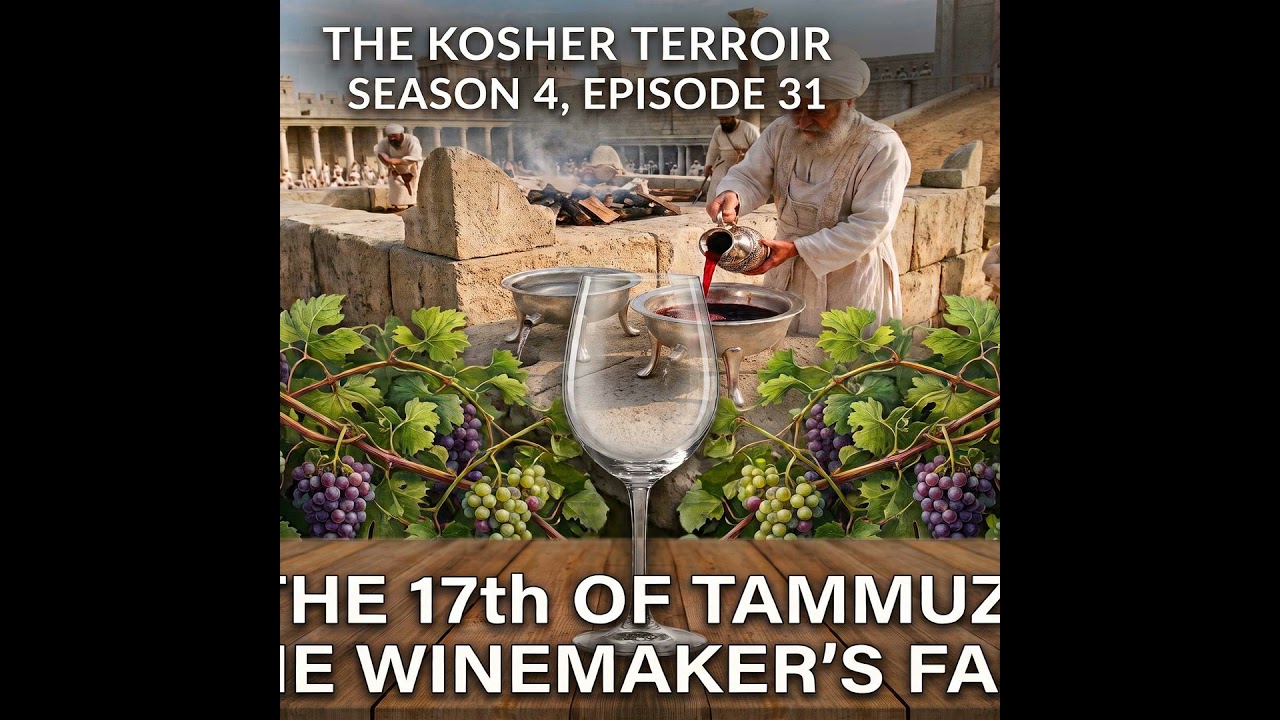
In this solo episode of the Kosher Terroir podcast, host Solomon Simon Jacob weaves together Jewish history, halacha, viticulture, and personal reflection to illuminate why the 17th of Tammuz is called the winemaker’s fast. He begins by describing the ancient daily libation (the nesachim) that accompanied the Tamid offering in the Temple, noting that a liter‑plus of aged red wine was poured twice daily until the siege of Jerusalem forced the lambs and wine to cease on the 17th of Tammuz. Jacob explains how this cessation marks the opening of the Three Weeks of mourning, culminating in the Nine Days when both meat and wine are forbidden – a deliberate mirroring of the altar’s loss. He then shifts to the vineyards of modern Israel, describing the process of véraison, the moment the grapes turn from green to ripe, occurring precisely during the period of communal grief. The narrative moves forward to Tu B'Av, the 15th of Av, portrayed in rabbinic sources as a day of dancing and matchmaking in the vineyards, and also as the halachic deadline (44 days before Rosh Hashanah) that starts the vine’s legal year. Jacob delves into the Torah’s orlah law – three years of forbidden fruit – and shows how this mirrors the three‑year exile, while the fourth year’s fruit (netar avah) is holy and was once brought to Jerusalem. Throughout, he ties the agricultural cycle to the spiritual cycle: loss, waiting, renewal, and the promise that the wine will one day return to a rebuilt Jerusalem. The episode ends with Jacob holding an unopened bottle of Israeli wine as a symbol of the empty cup on the fast day, urging listeners to remember the hidden work of the vines and to keep hope alive.
Chapters
Welcome to the Kosher Teruah. I'm Solomon Simon Jacob, your host for this episode from Jerusalem. Before we get started, no matter where you are, please take a moment to pray for the safe return home of all our soldiers. If you're driving in your car, please focus on the road ahead. I want you to imagine the sound of wine poured slowly into a glass. Let it run for a few seconds, and then silence. Listen to that. That, to me, is one of the most hopeful sounds in the world. Wine finding the bottom of a glass. It's the sound of a harvest that came in, a year that worked out, a table about to fill with people. And today, of all the days on the calendar, I'm going to ask you not to drink it. Welcome to The Kosher Terroir. I'm Solomon Simon Jacob. And if you're hearing it the day I released this episode, then tomorrow is the 17th of Tammuz, a fast day. A day when the sun comes up and the cup stays empty. And it'll stay empty even when the stars come out tomorrow night. So I'll admit there's something almost absurd about releasing a wine episode today. A show about pleasure, about ripeness, about the glass you raise, dropped into one stretch of the year built around setting that glass down. I know I did it on purpose, because here's the thing most people never stop to notice: Of all the fasts of the Jewish year, the 17th of Tammuz is the winemaker's fast. This is quite literally the day the wine stopped. Let me tell you what I mean. When the walls of Jerusalem were breached and the siege closed in, the first thing to fall wasn't the temple. It wasn't the walls. It was a small daily act that almost no one outside that courtyard would have ever seen. Twice a day, every day, a lamb was offered on the altar, and with it poured out at the base of the altar a measure of wine, a libation, the nesachayayin. For as long as anyone could remember, that wine had been poured morning and afternoon without a single missed day. And on the 17th of Tammuz, it stopped. There was no more wine to pour. The siege had choked the city, and the oldest continuous act of Jewish worship, the act of wine simply went silent. That's the day we're sitting at right now. But I didn't make this episode just to mourn, because here's what I find almost unbearably beautiful, and it's the reason I couldn't let this day pass without talking to you. This fast is not a dead end. It's the front gate of a season. It opens a stretch of weeks that runs through the deepest morning on the Jewish calendar and then turns and comes out the other side at a day called Tu B'Av, the 15th of Av. And Tu B'Av, as we'll see, is the day the vine's own calendar begins. The day the clock on a young vineyard officially starts to tick. So the season opens with wine being taken away, and it closes on the day the vines start counting towards giving wine back. And the whole time, that entire stretch of mourning, out in the vineyards of the Galilee the Judean hills and the Golan, the grapes are doing the quietest, most hopeful work of the whole year. Right now, this week, while we are fasting, the fruit is ripening. That's where we're going to today, from the altar in Jerusalem to a hillside of vines in mid-July From the day the wine stopped to the day it's promised again. So keep that empty glass close. You won't drink from it tonight, but by the time we're done, I don't think you'll ever look at it or at a vineyard in summer the same way again. Let's begin where the wine stopped. So let me take you there, not to a battlefield, not to the walls, but to a courtyard in the early morning before most of the city is even awake. The sky over Jerusalem is just going from gray to gold, and in the temple courtyard, the same thing is happening. That has happened every single morning for as long as anyone alive can remember. A lamb, a year-old lamb without a blemish on it, is brought to the altar. This is the Tamid, the daily offering, twice a day, every day. One lamb at dawn, one in the afternoon. The word Tamid Itself means always, continual. It's the heartbeat of the place, as steady as that. And here's the part we don't talk about enough, the part that for someone like me changes everything. The lamb was never offered alone. With every tamid came wine. The Torah lays it out almost like a recipe. With each lamb fine flour, olive oil, and a quarter of a hin of wine. Now, a hin is an ancient measure. Depending on whose reckoning you follow, a quarter hin is something close to a liter, maybe a liter and a half. So picture that every morning and every afternoon a little over a liter of wine poured out at the altar, day after day after day. And this was not just any wine. This was the part I want you to sit with, because it's the part the texts are surprisingly fussy about. The wine for the libations had standards. It was meant to be aged. Not the rough cloudy stuff fresh off the press, still working and throwing sediment. It wanted to be settled, mature, ideally a deep red. The Mishnah even names the hillsides whose wine was considered first class for this purpose, vineyard regions whose fruit had a reputation, the way today you'd say Burgundy or the Upper Galilee. The whole land was acceptable, but some slopes were preferred. They had terroir, and the people choosing the libation wine knew it. Think about what that tells you. The most sacred, most repeated act in the building, and they cared about which hillside the grapes came from. They wanted wine with age on it. They were, in the truest sense, connoisseurs of the altar. And the way it was poured was its own quiet piece of engineering. At the top of the altar, at the southwestern corner, there were two silver bowls, narrow, with small holes in the bottom. The wine went in and it drained down through those holes, down into channels built into the altar itself, down into the cavities deep beneath, the shittim, the ancient drains that ran into the foundation of the mountain. The wine literally disappeared into the rock of Jerusalem. It was given completely, nothing was kept. Nothing was drunk. But it was not poured in silence. And this is my favorite detail of the whole picture. The moment the wine began to flow, that was the cue. The Levi'im lifted their voices and began to sing the psalm of the day, and the trumpets sounded. So the pouring of the wine and the rising of the music were the same instant. The wine went down into the earth and the song went up into the air at exactly the same moment. For everyone standing in the courtyard, wine was the sound of singing. Now back up from the altar for a second and look at the whole country behind it, because an act like that a liter of good aged red twice a day, every day, year after year, plus the festivals when the crowds and the offerings multiplied. That doesn't come from nowhere. That sits on top of an entire industry, and the land was built for it. If you walk the hills of Judea today, you can still find them. Wine presses cut straight into the bedrock, a shallow basin where the grapes were trodden, a channel, a lower collecting pit. Hundreds of them, thousands, some of them 3,000 years old, scattered across slopes where the vines are long gone, but the stone remembers exactly what it was there for. Ancient Israel was wine country. Exporting it, storing it in great cellars, stamping the jar handles. A working wine economy. And one of the things all that wine was for was this, the altar. So when I tell you the wine stopped, I want you to understand the size of what stopped. Not a glass at a meal, a whole civilization's daily act of pouring out its best with music into the foundation of its holiest place. And then came the siege. The Roman army closed its ring around Jerusalem, and slowly, brutally, the city was strangled. And in the final stretch The tradition tells us it was on the 17th of Tammuz. Something happened that had not happened in living memory. They could not get the lambs. There's a haunting account of it. For a while, those trapped inside would lower money down over the wall each day, and outside lambs would be sent up in exchange. So the tamid could go on even under siege, even surrounded, even starving. They kept the offering alive until the day the lambs no longer came and the daily offering, the tamid, the always, stopped. And when the lamb stopped, the wine stopped with it. There was no offering of pouring it over. The two silver bowls stayed dry. The Levim's cue never came, so the song didn't rise either. After centuries, morning and afternoon, without a single gap, the oldest, steadiest, most continual act of Jewish worship went silent. And it was at its heart an act of wine. That is the 17th of Tammuz. That's the wound under this whole day. So when people ask me why a wine show would mark a fast, this is my answer: because before wine was ever something we drank for pleasure, It was something we poured for God. It began his worship. And this is the day that worship fell quiet. Which raises the question we'll pick up next: if the wine stopped on the altar back then, why does the tradition ask us to stop drinking it now? Why is wine, of all things, the cup We sat down in mourning. That's where we're headed next. Here's where it gets personal for me, because there's an answer to that question, and the answer is the whole reason wine matters in Jewish life in the first place. Think about every moment of joy in this tradition and ask yourself, what's in your hand? A wedding, you're holding a cup of wine and you break a glass. A baby boy is born and enters the covenant, a brit. You're holding wine. Friday night, the day turns holy, you lift a cup and you sing over it. The Seder, not one cup, four. Every sanctified moment of joy in Jewish life has the same instrument, and it's this: wine. There's a line in Psalms that says it straight out: Yayin yismach levav enosh. Wine gladdens the heart of man. That's not a winemaker slogan. That's scripture handing wine a job. Wine is the appointed vessel of joy. When the tradition wants to mark that a moment is happy, that a moment is holy, that a moment is more than ordinary, it reaches for a glass. So now turn it over. If wine is the designated language of joy, then the most eloquent way To say we're in mourning is to take the wine away, and that's exactly what this season does. The fast you're heading into, the 17th of Tammuz, it isn't a single day that comes and goes. It's a doorway. It opens a stretch of the calendar the tradition calls the Three Weeks. And those weeks lead down step by step to the saddest day of the Jewish year, the 9th of Av, Tisha B'Av, the day both temples fell. The mourning doesn't arrive all at once. It deepens. It is a slow descent, and the calendar walks you down step by step on purpose. And as you go deeper, the restrictions tighten. In the first stretch, the joy gets dialed back. No weddings, no celebrations, no live music, no fresh new things. Then you cross into the month of Av, and there's a phrase for it: Mishenichnas Av, Mama tim b'simcha. When Av enters, we reduce our joy. And now you reach the innermost ring, the last 9 days from the start of the month until the fast day itself. And in those 9 days, 2 things come off the table: meat and wine. Now stop and notice What those two things are. Of all the foods in the world to set aside, meat and wine? The two things that were poured and offered on the altar. We stood beside it in the last chapter. The flesh of the offerings and the wine of the libations. During the 9 days we abstain. From the exact two things the temple service was made of, we take onto our own table the silence that fell on the altar. We stopped pouring wine the same way they were forced to stop pouring it. That's not a coincidence. That's the whole point. The grief isn't abstract. You taste its absence, or rather, you don't taste it, and that's the prayer. And the tradition is tender about it in ways I find genuinely moving. Take Saturday night, Motzei Shabbat, during the Nine Days. The Shabbat ends and you make Havdalah, that beautiful little ceremony that separates the holy day from the ordinary week. And Havdalah is made over a cup of wine. But wait, it's the 9 days, we're not drinking wine. So what do we do? There are many varied customs among Sfaradim, Ashkenazim, across, across the gamut. But one of the beautiful customs in many homes is to still pour the cup and to still say the bracha, the blessings. But you hand the wine to a child, a little one, old enough to make the blessing to drink the wine, but too young to carry the weight of the mourning. The child drinks. The joy isn't poured out in front of the grown-ups who are grieving. But it isn't extinguished either. It's passed to someone small enough to still hold on to it. I don't know, I don't know a more beautiful image of a people refusing to let joy die. Even while they sit in sorrow, they just put it in smaller hands for a while. And then comes the very bottom, the last meal before Tisha B'Av. It has a name, the Suda Hamafsekhet, the meal of separation, eaten as the sun goes down before the fast. And it is the most stripped-down meal you can imagine. No meat, no wine. The custom is to eat a piece of bread and a hard-boiled egg, a round egg, the mourner's food, the same thing you serve someone who has just buried a parent. Some dip the bread in ashes. You sit low on the floor or on a low stool. You eat it alone, not even in the company of a shared blessing. It is a meal designed to feel like grief tastes. And there is no glass on that table. That's the floor of the whole season, from the day the libation stopped all the way down to the person sitting on the ground with an egg and no wine in sight. I'll be honest with you about what this does to winemakers. They spend their life trying to make joy. That's the job. They coax it out of a hillside, wait years for it, and bottle it. And their only hope is that someday It'll end up in someone's hand at a moment that matters. A wedding, a Friday night, a reunion. Wine is how they send joy to people they've never met. And the season asked them to put that down, to make nothing, pour nothing, raise nothing. For 3 weeks, the the most joyful thing they know how to make becomes the very thing withheld. And the strange gift of it is the absence speaks. An empty glass on a table that used to be a full one says something a full glass never could. It says not everything is whole yet. We remember what was lost. That's the wine we set down. But here's what I can't get out of my head. It's where I want to take you next. While all this is happening, while the glasses sit empty and the country walks down into mourning Out on the hillsides, the vines haven't stopped. They don't observe the 3 weeks. Right now, this very week, in the vineyards of Israel, the grapes are doing the most hopeful thing they do all year. Let me take you out to the vineyard. Come out with me. It's early morning. You want to be in a vineyard early in July, before the heat really stands up off the ground. The sun's already bright, the air is dry, and there's that smell you only get in the summer vineyard—warm dust, crushed leaves, a little resin off the canopy. And the vines are at their fullest now, big green walls of leaves. The rows running off down the slope. And underneath that canopy, in the shade, hang the clusters. And right now, this week, this very week of the fast, if you reach in and pick one of those berries and bit into it, you'd regret it. It's hard, it's green, It's sour enough to make your jaw ache. The grape at this moment is still basically a little green factory. All it's been doing since spring is growing and staying hard and sour and holding on. But walk the rows slowly and look closely, and you'll catch it. Somewhere in the green cluster, one berry, one single berry, has gone soft and started to blush. A bead of purple in a bunch of green. That's it. That's the moment. That's raison. Raison, it's a French word. Winemakers use the world over for the turn, the onset of ripening. And it is, to my mind, the most quietly dramatic event of the entire growing year, because up until véraison, the wine has been doing one job: grow, push leaves, push shoots, build the berry hard and green. And then, almost overnight, the vine changes its mind. It stops growing and it starts ripening, and everything reverses. The hard berry softens, the green drains away, and the color floods in. The reds blush from the green to pink to deep bruised purple, almost black. The whites turn from a flat opaque green into kind of translucent gold until you can nearly see the light through them. And inside, where you can't see anything at all, the real work begins. The sourness starts to fall, the sugar starts to pour in, and the skins, the color, and the tannins, and all the things that will one day make the wine, begin to build. The vines stop trying to get bigger and start trying to get sweet. I always think of it as the vine turning from growth to generosity. For months it was selfish, all for itself, getting larger. And at Varesan, it turns outward and begins making the fruit sweet, ripe, and attractive, making something to be given away. It's the moment the vine commits. Before Verazán, that shoot could still just be all leaves and no wine. At Verazán, the vine has decided. It's making wine now. There's no going back. And here's the thing about Verazán that I need you to feel, because it It's the whole heart of why I made this episode. It doesn't happen all at once. It isn't a switch. It moves, berry by berry, cluster by cluster, vine by vine. It sweeps across a vineyard over days and weeks. One berry turns, then five, then a whole shoulder of a cluster, and then the cluster next to it. A warm, low vineyard down in the Jordan Valley, or the Negev, catches it first. Then it climbs up into the Judean hills, up into the Golan, up into the high, cool vineyards of the Upper Galilee, where the nights so colder And the vine takes its time. Over these very weeks, the 3 weeks, the weeks we are walking through right now, berazan rolls across the whole country of Israel, slope by slope. Now hold those 2 things in your mind at the same time, because this is the image I can't shake. These exact weeks, from the 17th of Tammuz down to Tisha B'Av, are the saddest weeks on the Jewish calendar. This is when we sit lowest, when the glasses go empty, when a whole people walks down into mourning for everything that was lost, all the way back to that altar where the wine stopped. And at the very same time, in the very same hills, the grapes are turning. Nobody told the vines about the 3 weeks. The fruit doesn't observe the fast. While we sit in grief for what was destroyed, out on the hillsides, the vines are quietly, stubbornly doing the single most hopeful thing. They do all year. They are committing to a harvest. They are deciding to make wine. They are getting sweeter in the exact days we are saddest. Morning in the courtyard and at home, ripening on the hill at the same instance. And I don't think that that's a cruelty. I think it's a consolation if you let it be one, because it means that while we're turned towards the past, grieving what fell, the future is already being built behind our backs, quietly, without asking permission. The very wine We've sat down for these weeks. The next vintage of it is ripening through the morning. The grief and the promise are growing on the same vine on the same day. And there's one detail that gets me every single time. Some of the most beautiful vineyards in Israel today are in the Judean Hills. The limestone slopes that ring Jerusalem itself. The same kind of hillside that 3,000 years ago may well have grown the very wine that was poured on that altar. Stand in one of those vineyards in July, and you are looking out over the hills towards Jerusalem, the city that we are mourning this whole season, and the grapes in your hand are turning purple as you watch. The hills around the broken city are still making wine. They never stopped. They were ripening all through the destruction and the exile and every year since. And they're ripening today while you listen to this, while the cup stays empty. That to me is the 17th of Tammuz. From the vineyard side. Not the day the wine stopped. The day the wine started over, underground, out of sight, in the fruit. So the question becomes, where is all this ripening headed? The morning has an endpoint to Shabbat, and then the climb back up. And it turns out the vine has an endpoint waiting too— the day on the calendar that belongs to the vineyard more than almost any other, a day when the vine's own clocks officially begin. That day is Tu B'Av, and it's where we'll go next. Here's something that ought to be impossible. The saddest day of the Jewish year is Tisha B'Av, the 9th of Av, the day both temples fell. And just 6 days later— 6— comes one of the happiest days on the entire calendar, the 15th of Av, Tu B'Av. The Mishnah says it flat out: there were no greater festive days for Israel than Yom Kippur and the 15th of Av. 6 days after we're sitting on the floor weeping, we're at one of the highest points of joy in the whole year. The calendar swings from the very bottom to nearly the very top in less than a week. And I want you to hear where that joy happened, because it's not in the synagogue, it's not at the table, it's not even at the altar. It's in the vineyard. The Mishnah describes it, and it's one of the most beautiful scenes in all of rabbinic literature. On the 15th of Av, the daughters of Jerusalem would go out into the vineyards and dance. And they all wore white, borrowed white dresses, every one of them borrowed, so that the girl who had nothing to wear wouldn't be ashamed next to the girl who had everything. Rich and poor, all in the same borrowed white. Dancing in the rows of vines. And young men would come, and the call went out: Lift up your eyes and choose. It was a day of matchmaking, a day of beginnings, a day when new families started out among the vines. So picture the timing of it. The very vineyards we were just walking through, the ones quietly ripening All through the three weeks while the nation mourned, those exact hillsides became the dance floor of the rebound. The grapes turn purple through the grief, and then the people come back out to the vineyard to begin again. The place that was ripening in silence becomes a place of the dancing. The vineyard holds both halves of the story. It mourns with us, and then it throws the party. But here's the part that turns Tu B'Av from a beautiful story into something a winemaker feels in his bones. Because Tu B'Av isn't only symbolically the vineyard's day. It is, in the most literal, technical, and legal sense, the day the vine's clock starts. Let me try to explain, because this is gorgeous once you see it. The Torah gives a law about every fruit tree you plant, and it applies to the grapevines first and foremost. For the first 3 years, the fruit is orlah, forbidden. You can't eat it, you can't sell it, you can't make wine from it. 3 full years, the vine gives you nothing you're allowed to touch. We'll sit with what that means next chapter, but for now, just the counting. Because how you count those 3 years is the whole point. You don't count from the day you planted. You count to Rosh Hashanah, the new year. Rosh Hashanah is the line that closes each of the vine's years. And there is a rule about how the first year gets counted, and it is exact. For the first partial season to count as a whole year, the vine has to be in the ground a certain amount of time before Rosh Hashanah, specifically 44 days. Why 44? Two pieces: 30 days for the wine to take root, to truly grab the soil, and the tradition gives a young planting 30 days to establish itself before it counts as planted at all. And then 14 more days, because once it's rooted, a piece of the year, a final stretch reaching towards Rosh Hashanah, can count as a whole year. So 30 to root, 14 to count, 44 days. And now count backwards 44 days from Rosh Hashanah, from the first of Tishrei back through the 29 days of Elul and back into the month of Av. And where do you land? Tuba Av. Right there, mid-Av, the 16th of Av, is the last possible day. Which means a vine planted by Tuba Av, the 15th, has comfortably, safely banked its first year by Rosh Hashanah. Plant your vine by Tuba Av, and when Rosh Hashanah comes, year one is already in the bank. Wait past the middle of Av, even by a couple of days, and that entire first year is gone. The vine has to wait for the next Rosh Hashanah to even start counting. You've pushed your first legal harvest back a whole year with one late afternoon of planting. So Tu B'Av is a deadline written into the soil. It is, functionally, the vineyard's New Year, the hinge the vine's whole life is counted from. And now, stand back and look at the shape of this whole season, the thing I've been building towards this whole entire episode. It opens on the 17th of Tammuz, the day the wine was taken away. The libation stops, the cup goes empty, loss. And it turns at the far end on Tu B'Av, the day the vine's clock starts, the day you put a new vine in the ground and begin counting towards the day it will finally give wine, renewal. The same season, one ark, wine removed at the front gate, a brand new vine planted at the back. The daughters and sons of Jerusalem dancing among those vines, choosing each other, beginning families on the exact day the vine itself begins. Grief and planting, mourning and matchmaking, the empty cup and the first day of the vine's life. All strung on the same 6 weeks of summer. The tradition didn't have to line itself up that way, but it does. The day we stop pouring and the day the vines start growing towards pouring again are two ends of one rope. But I left something hanging, and it's the heart of what's left. I said the vines give you nothing for 3 years. 3 years of forbidden fruit before it's allowed to become wine. Why 3? What is the vine, and what are we supposed to be doing in all that waiting? That's the last place I want to take you, because the law of those 3 years turns out to be the whole story of exile and return, growing right there on the trellis. 3 years. The Torah says it plainly: you plant a vine, and for 3 years its fruit is orlah, forbidden. You may not eat it, you may not sell it, you may not make a drop of wine from it. Whatever the vine produces in those first 3 years, you turn away from. Then comes the 4th year, and something changes. We'll get there, because it's the most important year of all. And only in the 5th year does the fruit finally become simply, ordinarily yours. Now, when most people hear that law It sounds like a restriction, a long frustrating wait, 3 years of looking at fruit you can't touch. But if you ask a winemaker, and when they hear that law, they don't hear a restriction at all. They hear the single best piece of viticultural advice ever written down. Because here's the truth: about a young vine that every grower learns, usually the hard way. In its first years, a vine should not be making fruit. It should be making itself. A vine in that first year is a thin little whip, barely rooted, feeling its way into the soil. In its second and third years, if you let it it would be happy to throw out clusters and try to ripen a crop. And if you let it do that, if you let a baby vine spend its strength on fruit, you end up getting a weak vine, thin roots, frail trunk, a plant that gives you a little something now and then gives out early. So what does a good grower do? In that first year. They drop the fruit. They pull the clusters off and throw them on the ground on purpose so the vines can't waste themselves on them. We force all that energy down into the roots, into the trunk, into building the deep permanent architecture that will let the vine bear fruit for 50 years. 80 years, maybe even a century if you do it right. First 3 years, you make the vine strong by refusing to let them give. You protect it from its own eagerness. That is the law of orlah. The Torah forbids you from taking the fruit in exactly the years a good winemaker wouldn't want to take it anyway. The law isn't fighting nature. It's the rhythm of the vine written into scripture. 3 years of patience that build a lifetime of abundance. The orla years aren't barren. They're the foundation being poured underground where you can't see a thing. The most important work of the vine's whole life is happening. In the dark, in the waiting. And doesn't that sound a little bit familiar? Because that's the season we're in, isn't it? What's the whole shape of the day? The 17th of Tammuz, Tisha B'Av, the mourning, the destruction, the exile, the long stretch where it looks like the vine is giving nothing, where the fruit is forbidden and the cup is empty, and you wonder what all the waiting is even for. The Orla law says that it's not the end of the vine, it's the beginning of it. The years that look empty are the years the roots go deep. Exile in this reading isn't the death of the tree. It's orlah, the long foundational waiting. It's an endpoint built right into it. 3 years and then— the Torah doesn't say forbidden forever. It says 3 years. It names the end at the very moment that it names the wait. And then comes the fourth year, and the fourth year is the one I find almost unbearably beautiful. It's the fourth year. The fruit isn't forbidden anymore, but it isn't ordinary yet either. The Torah calls it netar avai, and it says the fruit is kadosh, holy, a thing of praise to God. And in the days of the temple, here's what you did with that fourth year fruit. You brought it up to Jerusalem. You carried it up to the holy city, and you ate it there in holiness. Or you redeemed its value and brought that up to Jerusalem to spend on your celebration in the city. So follow the whole arc —of a single vine. 3 years waiting in the ground, and then in its 4th year, the first fruit goes up to Jerusalem, the very city we have spent this entire season mourning. The vine's first gift, after all its patient waiting, is a homecoming. The fruit returns to Jerusalem. That's not just agriculture. That's the entire story of our people growing on a trellis. Lost, then the long patient wait that looks like nothing, and then the fruit comes home to the city. Orla and then revai. Exile and then return. The vine has been telling us the ending the whole time. We just had to wait 3 years to taste it. Now I have a bottle here with me, an Israeli wine. I'm not going to open it. It's the 17th of Tammuz. The cup stays empty today. And you know by now I mean that on purpose. But I want you to think about what this bottle actually is. This wine came from a vine that lived through its orlah. It waited its 3 forbidden years. It passed through its holy 4th. And then, somewhere on a hillside in the Galilee or the Judean hills, in its 5th year and its 10th and its 20th, It finally did the thing it was always going to do. It gave. It made fruit, and someone pressed it, and it became this. Every mature Israeli bottle in the world is a small piece of evidence that the waiting ends, that the vine planted in patience eventually pours. So I'm setting this bottle down unopened next to that empty glass from the very start of the episode, not because the wine isn't good, but because tonight isn't its night. Its night is coming on the far side of these weeks when the morning lifts. When you pour it, I want you to remember everything it had to outlive to reach your hand. Which brings us all the way back to where we were at the beginning, to an empty glass on a fast day and a question about why a wine show would mark the day the wine stopped. I think by now you know my answer. So here we are. Back at the beginning. An empty glass on a fast day. I told you at the start that this was the most hopeful sound I know: wine finding its way to the bottom of a glass. And then I asked you not to pour it. Now you know why. Today we let ourselves feel it, all of it. Today we cry, and we should cry for the altar where the wine was poured out twice a day at every day and singing until the day it went silent. Cry for the city under siege, lowering its last coins over the wall just to keep the flame alive one more morning. Cry for the temple that fell and for the long, dark exile that followed. The centuries when it really did look like the vine would never Give again. Cry for everything this people has lost, all the way back to a courtyard going quiet on a summer morning 2,000 years ago. Don't rush past that. Today is the day we're allowed to weep. This is what the empty glass is for. It sits on the table and it says out loud the thing we carry quietly all year. Not everything is whole yet. We remember. We have not forgotten what was taken. And yet, while we sit here and weep, out on the hillsides, the vines have not stopped. They never ask our permission to grieve, and they never stop to mourn. Right now, this very week, as we fast The grapes of Israel are turning on the vine, getting sweeter in the heat, doing the most hopeful work they do all year in the very days we are saddest. The future is ripening behind our backs, whether we can see it or not. It always was. 6 days after the lowest day in the year, The daughters of Jerusalem will go out and dance in the vineyards in borrowed white. And on that same day, somewhere, a winemaker will push a new vine into the ground and start the clock all over again. Because that is what our people do. We mourn fully, and then we plant. We have always planted. That's the secret the vine has been keeping the whole time. The empty years were not the end of the vine. They're the roots going deep. The waiting is not nothing. The waiting is the foundation. And the fruit, when it finally comes, comes home, up to Jerusalem, every time. So tonight, when the stars come out and this fast ends, I still won't pour. The hardest weeks are ahead of us yet, but I'm not without hope, and neither are you, because I have seen the vineyards in July. I know what's happening in those grapes right now while we cry. I I know the vine planted in patience eventually pours. So keep the empty glass on the table, not as despair, as a place setting for the wine that is coming. The libation stopped on this day, but a vine planted in faith was always going to give again. And one day, please God, In our time, the wine returns to Jerusalem, the cup fills, and the songs that stopped on the altar that morning get sung again. Until then, we wait, we plant, and we remember. This is the Kosher Teruah. I'm Solomon Simon Jacob. May we all be comforted, and may we all, very soon, raise a full glass together in a completely rebuilt Jerusalem. This is Solomon Simon Jacob again, your host of today's episode of The Kosher Terroir. Please subscribe via your podcast provider to be informed of our new episodes as they are released. If you are new to the Kosher Terroir, please check out our many past episodes.










