Thinkers Distillery - Jerusalem’s First Distillery
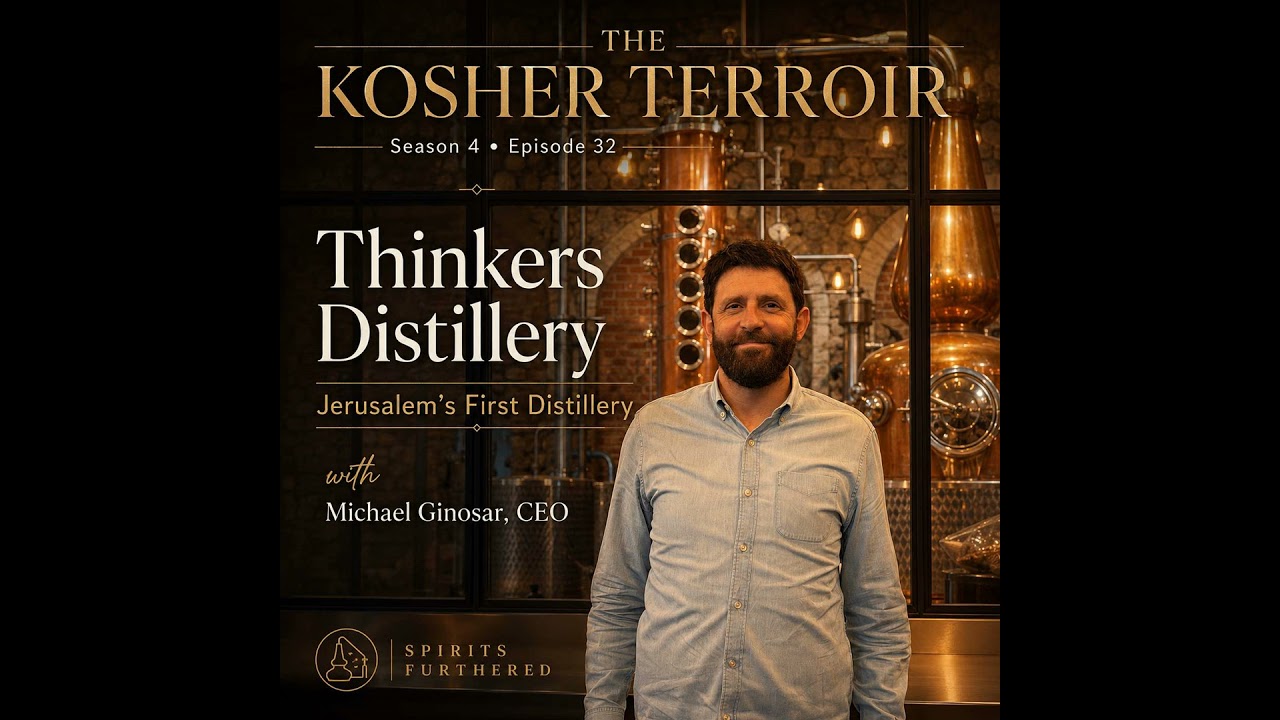
Michael Ginosar, CEO of Thinkers Distillery, built Jerusalem's first modern distillery inside the Old City walls in 2018. He sources French wheat for vodka and UK wheat for gin, generates water on-site to control mineral content, and ages bourbon in the sea. The brand's three gins and sipping vodka are distributed across Israel and the U.S.
Chapters
Welcome to the Kosher Teruah.
I'm Solomon Simon Jacob, your host for this episode from Jerusalem. Before we get started, no matter where you are, please take a moment to pray for the safe return home of all our soldiers, If you're driving in your car, please focus on the road ahead. If you're home relaxing, please sit back and enjoy this special episode during the Three Weeks. Picture a glass door on Agrippa Street in Jerusalem. Footsteps from the noise and the spice of Mahane Yehuda. A thousand people hurry past it every day. Phones up, eyes down, and never see a thing. But stop, look through that glass, and there they are, two towering copper stills catching the light. A tall straight column still on one side and a round-bellied pot still with its long swan neck on the other. The two great engines of distillation standing side by side like sentries. Because behind that glass is something the city has never seen in 3,000 years— a distillery, the first in the history of Jerusalem. Welcome back to The Kosher Terroir. I'm your host, and today we We're pouring something different. We talk a lot on the show about grapes and ground, about the way a place ends up in a glass. But today we follow that idea past the vineyard and into the still. My guest is Michael Guinnessar, CEO of Thinker's Distillery, a Jerusalem house with a philosophy as bold as its spirits. Their motto: Spirits Furthered. The neck of their label quotes Pirkei Avot: Who is wise? One who learns from every person. How often does your vodka bottle cite a Mishnah? And those two stills in the window aren't just for show. The column still gives you purity and precision, and the pot still gives you soul and character. The thinkers put both in the front window because they intend to master both. The stories that come out of them are extraordinary. A vodka built on the finest wheat from Champagne, blended with water they literally pull out of the air over Jerusalem. A gin distilled with rose petals and strawberries, and a bourbon called Dew of Beidolah, named for the man that fell with the morning dew with Bnei Yisrael in the desert. It was distilled in America, aged at sea on a rocking crossing of the Atlantic, then left to breathe 3.5 years in the salt air of Haifa. We'll trace it all— where thinkers began, the thinking behind the name, what actually makes these spirits special, how you build a world-class distillery in a city that emptied out through a pandemic and a war, and where Michael wants to take it next. So pour something you love Settle in and let's think and drink together. Michael Knessar, welcome to the Kosher Terroir.
So how are you?
I'm good. Pleasure. Shalom u'braha. Did you just arrive?
I came in yesterday.
Okay.
Yeah, I'm back and forth. I've been with the company from inception.
Yes.
And we've gone through a lot of different phases. And from the get-go, it was always kind of our intention to export market to the US. Okay. So obviously we're doing a lot of work.
That's the market, right?
Yeah, that's 100% the market. Obviously we have to be successful in Israel. We're doing a lot of stuff in Israel. But so it was always kind of in the works of the US. And then we started exporting about 3 years ago. And we're always looking for someone because, for instance, in here in Israel, I've got a distributor, Hakarem.
Yeah.
I don't know if you know them.
Yeah.
But in Israel, the law allows the distributor to be the marketer, the importer, the warehouse, like everything. So it's like a one-stop shop. In the US, it's a 3-tier system. And nowadays, the whole distribution company is kind of— they don't do much. It's like they'll take orders, they'll supply it. All the rest is on the brand. So after a long time that we're looking for someone, we said, okay, no one's going to do it better than one of us. And I've got a partner and he's based here in Jerusalem. So he takes care of the business when I'm gone. And I'm over there and I'm supporting the distribution back and forth.
So who, okay, so thank you very much for being on the Kosher Terroir. I want to at least introduce you. Michael, your last name is Ginosar?
Ginosar, you can pronounce it Ginosar if it's good.
No, no, no.
If it's good for spiritual purposes. Ginosar.
Yeah, that's actually not bad. That's not a bad marketing ploy. Exactly, exactly. Okay, very cool. You're born and raised here?
I was born in the US. Where? In California.
Okay.
My mother's American, my father's Israeli. He was working for Intel at the time in California, in San Jose. I was born there, but I made Aliyah when I was very young and I grew up in Israel. But I'm always back and forth because most of my family's in the US.
So tell me, how did Thinkers come about? I love the name. I love the concept behind it. You know, tell me a little bit about it.
I think, so when the idea of Thinkers came into life around 2018, basically, we're a group of people from different parts of the industry. I've been in the spirits industry for the last 20 years. I'm going to talk about that a little bit later. But some of my other partners are not necessarily from any— that had anything to do with the spirits industry, but they all had the same mind of how do we do something that Israel, that kind of combines Israel alcohol, but in a high level, not trying to do something like a novelty, not trying to do something just on the low end, but really being something spectacular. The same way we've seen kind of the wine industry develop and going to fabulous wines, but on the other hand, seeing, you know, startup nation companies.
Yeah.
Try to combine those two. And the idea of Thinkers, and that's kind of the name goes into it, is that, you know, Israel is never going to be your perfect ideal place to set up a spirits company or distillery for that matter. We don't have the grains, we don't have the water, we don't have the resources, we don't have the heritage, none of it. What we do have here is a lot of chemistry, a lot of technology, a lot of advancements that we can harness, that we can use. And by combining those two things, we can now kind of eliminate the not living in the glens of Scotland and not being outside in Kansas with having all the limestone water. And take advantage of what we can do to produce exceptional spirits. Because there's— I was mentioning that earlier, same thing that happened to the wine industry, and that's also kind of happening to the beer industry of really producing exceptional products. And that's not— when in 2018, that wasn't the case in the spirits industry. The spirits industry in Israel for a long, long time was only simple, simple—
Simple 999. Like Brandy from Carmel or what have you.
That's a good level. You got all the different mixed araks and you've got just really, really entry-level, simple, simple spirits. There's no reason to do that, especially when we're seeing that in the spirits category in the world, it's all about premium and super premium products, meaning good product, good liquid, good packaging. That's where the market is. That's where the share is. So kind of combining all of that, we saw a good business. We saw a good passion for spirits. Like I was saying, I've been in the spirits industry for most of my adult life. I started off by making homemade arak, fruit-flavored arak, for that matter.
Where?
In America? No, here in Jerusalem. It was actually called Arak Yerushalmi, Jerusalem Arak. This was back in late 2000s, 2007, something like that.
I'm Sparty, I'm a big Arak fan.
Okay. So, okay. So I, listen.
That's what you did.
I not only do that, I was, I looked, I researched the entire Arak thing and, you know, Arak, to make a genuine Arak, you need to use grape alcohol and you used to use fennel seed. And most of the Arak in Israel, that's not the case.
Yeah.
You're using just molasses and stuff like that. So I went through different distilleries, whether here in Israel but also abroad, and worked with them to develop really that taste. And that sucked me into the alcohol world. And then we worked with a big importer for a long time, and we developed more brands together. We developed Van Gogh Vodka, which is very popular in Israel, did very well till they sold to Tempo. And I was involved with that until— and at that stage, we started the project here in Thinkers. And the one thing that always caught me, that what made me passionate about it is that how do we make something that's really exceptional and we can take it out to the world and not— it's, you know, you're sitting here at our distillery and our visitor center. It's in Shukmach Neouda. There's a very kind of boutique feeling to it. But on the other hand, we're trying to do the kind of the opposite of a product that can stand with all the best, that can compete with them on a liquid level, on a process level, on a packaging level, and marketed to the world as a product of Israel, as a kosher product, but also as a superior, super premium spirit.
Very cool.
Very cool. So tell me a little bit about the founders. You're one of the founders?
I am one of the—
yes, I'm one of the founders.
Now, there was— I will say there's been a bit of a change. There were two original partners, two original founders who are the major stakeholders in the company. And then they brought in some, each one of them brought some investors with them. And for the first 5 years, they were working jointly. Last couple of years, only one of them was active. And now that kind of flipped because one of the original owners bought the entire, the other partner's shares. So it's currently owned by Avi Avram Ingber. He's the, the name of the company is KI, the Israeli Distilling Company. That's the full legal name of the company. I is Ingber, he is the one of the, he's the original founder, so he is now the majority holder and he's involved together with me that again, I've been here with both of them from the beginning.
So what's your specialty?
Are you a distiller?
I've learned it.
Okay.
Yes. I mean, after 20 years in the industry, there's the good thing about the spirits industry and I think it's similar to the wine and beer industry. There's a lot of sharing, there's a lot of knowledge that goes around. There's, on one hand, you go through formal education through distilling institutes and learning the process, but there's a lot of secrets that a lot of knowledge is kind of being shared on processes of how to develop the spirit better, how to handle it, how to take care of it, what kind of filters do you use, what kind of base alcohol are we using, why are we using one versus another. And we learned that through trials and errors, and we learned that through a lot of time. Before I've joined the company and through from the time that I started here in 2018. It's, you know, one of the things we put on the product, on the bottle, it says the word furthered. Now, and we trademarked that word furthered. And the idea is that we're always kind of looking for a better way to do something. So we found out something that we're very happy with. We, you know, the type of grains, the type of GNS that we're using, the type of wheat, what kind of filters we're using. If I end up finding a better way of doing it or finding a better way to develop the product, that's my goal. How am I going to make it taste better? It's not about this ancient secret that only my great-great-great-great-grandfather hid in his little safe.
Darn.
Exactly. We're not the Coca-Cola Company yet. And by constantly developing that, we're changing our methods and really trying. Always focusing on the liquid, always focusing on spirit.
So it's, you know, I've walked in here a dozen times.
Yes.
And I've never noticed that not only do you have one type of still, you have both types of stills.
Correct.
It's like crazy.
There it is.
I didn't, you know, I was going to say, which type of still do you use?
And I looked and I said, you got both. Both.
Exactly. Exactly. You have a pot still and a column.
Correct.
And it's unbelievable. So that's cool.
The whole The whole still was really designed especially for this space.
Yeah.
Now take it for granted, this is a residential area or semi-residential area because it's not a fully industrial.
There's houses above you.
There's houses above. So there's a lot of limitations of how much alcohol we can store here at any given time, what we could do. And the whole still was configured especially for our location. And that's why it really includes both types of stills so we can if we wanted to, we can go through a pot still, develop the different perhaps whiskies or brandies, something that would go through a relatively low alcohol distillation or the column that we're using now for the gins mainly and the vodka. Because from the get-go, we wanted to be a distillery that does both bourbon, and we'll talk about the bourbon in a little bit or whiskey for that matter, and vodka and gin, not just one type of product. And we didn't want to limit ourselves because it's all about chemistry. And it's all about the process. So it's not, you're not, you know, for Smirnoff nowadays to start making whiskey, it looks weird because they've been doing vodka their entire life. But it's the same elements. So from the get-go, we wanted to have the ability to do everything.
It's interesting because, you know, I've always been associated with wine.
Okay.
Okay. Which is fermentation.
Yep.
This is fermentation. Plus distillation. I mean, you know, like everything starts out as fermentation of some sort, right? And then ends up going into distillation. So very, very cool.
It's, you know, I always refer to the, the wine wineries as like, it's like our cousins, you know, we, we, we share the same last name. We do different things. Yes. Yes. So I mean, the fermentation is really an, an integral part of, of winemaking, right? How you ferment, at what point, what are you adding and stuff like that. And here the main focus is really not only on the distilling, but what goes after the distilling. So the filtering, when do you, when do we, what type of marriage do we do to the water and the ethanol? How do we do it? How long? All those parts of the—
I never even thought about that. So I want to ask you about that process as well. Let's get back to the beginning.
Yes.
It's been 3,000 years. In Jerusalem, and it's never had a distillation company.
Correct.
So how did you come up with doing this in Jerusalem?
Well, you know, it helps the fact that we were living here.
Okay.
But I think—
That's pretty pure.
Yeah. I think there was a combination of a few different factors. One is that, you know, in the spirits industry, Yep. There's 3 things you need just to have a ticket to ride. Not, you're not, you're not gonna be successful, but you need these 3 elements to have. You have to have a good, good liquid. So, okay, you have to develop a recipe and you have to work it out. And, and some people are gonna like it more and some people are gonna like it less, but there's a baseline. You gotta good, good. So there's element of packaging. What type of packaging are you doing? What type of bottles? How are you designing them? Are you doing custom made? Are you doing labels? Something like that. And the third thing. Is the narrative. What's your story? Because people, at the end of the day, when they come and they buy a bottle, they want the story, they want the feeling, they want everything to have aligned with it. And I don't know what's more important, the story, the packaging, or the liquid, but they all have to go. So the narrative was developed from day one. And by being here in Jerusalem, in the Mahane Yehuda market, being close to the whole culinary scene that has developed here in the last 25 years and really kind of the chefs and the cocktail scene and that whole kind of premium experience of of having people wanting to experience a better product, whether it's restaurant, whether it's food, or whether it's cocktail, whether it's a spirit at the end of the day. And that really ties in. We could have set this up, distillery, in the Judean Mountains or anywhere else. It would be much cheaper, I'll tell you that. But the whole narrative, the whole story was we wanted to showcase what we're doing here, how we're doing it, have it associated with a very urban setting that has a lot of people that can come by. See the place, view it, associate it with the entire surroundings. And Jerusalem was a perfect fit for that. You couldn't do it in Tel Aviv. You couldn't do it in any other place. So that was like, that was a bingo for us.
Okay, so let me jump back to one of the things you mentioned, Spirits Furthered.
Yes.
It's unusual for a spirit brand to have no mountains, no eagles, No founder's name or surname. You know, what is— what was the philosophy? I remember I grew up in the IBM world with a little sign on everybody's desk that said, think. Okay. And then Apple came out and said, you know, think different. Think different. Think has always been something that's keyed in my brain. So to come out with a brand that's called Thinkers is very, very cool.
So, you know, I don't want to refer to ourselves as the thinkers because we're not. If we would have been smarter, we wouldn't have started the distillery. We wouldn't have opened it a week before lockdown, before COVID I was going to ask you that too. Yeah, those fun times. We'll talk about that. But the idea of thinkers, and it's, again, something that's on our bottle. It says, we have the passage that says, who is wise? He who learns from every person. There's so much knowledge. And we don't want to be these ones that are saying, again, I was saying that earlier, this grandpappy recipe that's kind of been stored from generation to generation. We don't have that story. We have to develop our own story. Our story is a Israel kind of advanced story, the startup nation kind of story of, okay, we're doing different things in the heart of really kind of advancements, like I was saying, in technology and physics and chemistry. So by thinkers, we're taking so much knowledge and incorporating it into the process, into what we're doing with spirits. Again, that's why it ties in great with Jerusalem, ties in great with Israel, with the Jewish state, with a Jewish distillery, and kind of really showing what we're about, what we can do, and how good we could do it. And we couldn't do it without standing on the shoulders of giants. We did not invent distilling here. You were saying, by the way, you're talking about 3,000 years. The idea of the distilling is probably the same thing as it was 3,000 years ago, the heating up of the alcohol. But on the other hand, what we know nowadays as compared to 250 years ago, just knowing the periodic table of elements gives you such more control and advantage on when you're producing a spirit because you're much more precise. And that is what defines a good spirit at the end of the day. So by knowing all that and incorporating that, I'm not trying— I'm not only doing it, that's the story I'm telling the world.
So kind of the Startup Nation thing. Let's talk about the water.
Okay.
That's, I think, an interesting place to start here.
100%.
Your water comes from the municipality? It comes from the municipal water?
No, no, it comes from, you know, until the municipality starts to tax air, which is an option. Yeah.
So likely too, probably, the way they're going.
Yeah.
I mean, you know, 60% of each product here of our spirits, mainly the vodkas and the gins, are going to be water. Water has so much flavor into it. Now, whether I'm bringing it in from the municipality and whether reversal smosing it, it's coming in with minerals and it's coming in with flavor. And I don't want that flavor. At the end of the day, meticulously working on my still, making sure what raw materials go in and what the raw materials are to get to the end product. If I bring in water that has a lot of flavor that I don't want, that's going to overshadow everything. By using Watergen, basically being able to bring in air from Jerusalem without being too kitschy about it.
Yeah, no, it's kind of cool.
So it's very cool, but the idea of it is what counts because, again, I have full control on the flavor of the water that I'm producing.
So you actually use a device that sucks the water out of the air.
That sucks the air. Exactly. It takes the humidity out of the air.
The air.
Exactly. And that humidity basically translates into drinking water. And that drinking water is being captured and goes into our tanks.
How much water is that? How much water do you end up capturing?
It really depends on the humidity. And I'm going to tell you this, if our distillery was located not in Jerusalem, in Tel Aviv for that matter—
You'd be generating a ton.
Yeah, our output would have been higher. That is true. But on the other hand, that's one of our water sources we're developing. Either we'll either have more sites, we'll either have more water sources, but that's one key element that we're doing. And it changes from basically the water is being produced year long. So winter I'm getting less output, summer I get more output, but it's always in the motions.
Okay, cool.
And but again, the real, real thing to it is what's what it enables me.
What you can control.
I can control the flavor. I can make sure, you know, because I can decide if I want, what type of minerals I want in there. If I want to add stuff, if I want to take stuff off, and I can control a precise flavor because what I'm getting from the municipality can change every day. Now again, like I was saying earlier, I could clean it, I could reverse osmosis, but if it's better to start off from a purely clean raw material for that matter.
It's kind of funny, that's the Coca-Cola problem. Where you drink Coca-Cola in different parts of the world and it tastes different in different parts of the world. So then they went to all the trouble to make their water.
Right.
And now they actually charge more for the water than they charge for the Coke.
Well, that's the most expensive ingredient.
Yeah, it's really kind of crazy.
Do you know there's a famous story of this restaurant here on the corner, Ima Restaurant? Yeah, sure. So, you know, they've been here for, I don't know, dozens of years.
Ever since I can remember, and that was a long time ago.
And one of their pride and joy is the kubeh. Yeah. And they set up a, I don't know, 15 years ago, 20 years ago, they set up a place in Tel Aviv.
Yeah.
And, you know, because they wanted to do the same thing and they're bringing the same ptiliyot and they're cooking the same way in the same recipe and it doesn't come out the same. And time after time after time they're trying it until they realize the water in Tel Aviv is different than the water in Jerusalem.
Wow.
And it changes the flavor dramatically.
I didn't know that story at all. That's cool.
Yeah. So you want to maintain, you want to have, you know, first of all, scalability, but you want to have continuous flavor and you don't want to just change from batch to batch. In wine, it works. Wine, you put a year on the bottle and okay, you got a 2020 versus 2022. Spirits, you don't have that. You have to be consistent.
Very cool.
All right, so your vodka starts out, at least some of it, with this soft winter wheat from Champagne, France.
Correct.
So, I mean, you really are being as tech as you can possibly be here. You know, what in the world drove that? Why are you going to France of all places? I mean, so I say this to make alcohol. I mean, if you're making wine, everybody goes to Bordeaux or goes to, you know, wherever. But go ahead.
It's exactly the same. It's the terroir. The French, you could say a lot of things about the French. The fact that their pastries are so good or their bread is so good is not because they're so smart. They might be smart, but it also has a lot to do with the terroir over there and the type of soil and the type of rain and the type of weather, growing conditions. If I do the same thing and I grow the wheat here or I grow it in a different place in the Ukraine or in the UK, it doesn't matter. I'm going to get different flavors. And you want that rich flavor because— let's talk about the vodka for a second. Vodka, we don't add anything, obviously. And the one thing that's been our pride and joy in the vodka is that it's considered a sipping vodka. So you could really taste a little bit of that sweetness. There's no sugar added. There's nothing, anything of that. It's really that sweetness that's coming in from the wheat. Now— Interesting. And by the way, for the gins, we use the same strain of wheat. 100%. But it's grown in the UK and it completely— there's a completely different flavor because, and it's very stereotypical, but the French wheat is going to be spicier. It's going to be a lot more lively. And the UK wheat is going to be dull, a little bit dull. But for the gin, it's perfect.
Where you're putting botanicals.
Exactly. I don't want the wheat to take the space of the botanicals. In the vodka, it's all about the wheat. It's all about the— So that location, that area where we source our stuff, we know that we're getting top of the line raw material. And at the end of the day, there's no lying here. The end product is only going to be as good as the raw materials that you're starting off with.
Would you then ever make it using Israeli weed?
I wouldn't. First of all, of course, I wouldn't oppose to it.
No, no, no. I'm asking because—
If the quality of the wheat—
Yeah, if it gives you a different terroir flavor, then does that make sense?
Or if—
Okay.
Again, if the end product is good, 100%.
Okay.
I mean, I know that there's been a few breweries and one distiller up north that is kind of really, really investing in the fact that they're trying to grow a local grain here, something that would be something they could use going forward, I'm happy. Most of the weed grown in Israel is pedestrian.
Yeah, it's for bread or for whatever.
No, it's not even bread. It's for feeding cattle.
Oh, right.
I'm sorry. Only about 11% of the weed that we grow here we actually use for bread. So most of the stuff is being imported for all of our process, not just the distillery, obviously. I think I'd be happy. I'd be, you know, it's definitely looking into it because I want to bring as much stuff as I can from Israel. We are an Israeli distillery. We're an Israeli company. We want to have as much to do with Israel as long as it supports the product.
Yes. Got it. Got it. Yeah, because, you know, one of the things that's happening now is they're now starting to grow agave in the Negev.
Correct. There's more than one.
Yeah. Well, I happen to know one of the people who's involved with that. And Negev.
Negev.
I think they call it Negev. And that was a huge deal. And I know they're trying to grow wheat in the Negev as well.
Okay.
That's one of the things that they're trying to promote and push.
There's a lot of area in the Negev.
Yeah. Okay. So I hear what you're saying.
Quality first. I think for agave-based spirits, tequilas, whatever you want to call it, I think the Negav makes a lot of sense. And we'll see in a couple of years what they come out with and if it's suitable. For wheat, we could probably grow everything here. It's a matter of economy at the end of the day. I've met a lot of different farmers who said, you want to grow this here, we can grow it. You're going to need a lot of investment. You're going to need a lot of the goods. They need a big market for it. If they don't have that market, it's not going to happen.
No, I, look, I know people who grow blueberries here, but they grow them in buckets and sacks because they can't grow them in the ground because it changes the blueberries. So no, I get it. I get it 100%. You can grow anything you want, but it's, I'm trying to think about it from a perspective of an Israeli terroir. Now, but you still want it to be acceptable to people's taste buds that it actually works the way you want it to work.
I think what the quartet in the wine, you know, what they've been doing and been kind of establishing the appellation and kind of defining that, that's the first step. It needs to happen in wine, it needs to happen in beer, it needs to happen in spirits. We have to develop the culture here that's really promoting Israeli terroir in a lot of different ways. You could talk about it from a kosher standpoint. You can talk about it from a quality standpoint. But you need to put the guidelines of what is an Israeli terroir. And I'm all for it. It's going to take a lot of effort, a lot of time, but we're there for the long run.
I got it. You make 2 vodkas. Now you make more.
No. So we—
You had a 40 and a 52%.
So that was the initial— Yes, we planned to make— We never really released the 52%. It was in the works, it was in the making, and then we decided to put a hold on it. It might come back. We have the recipe. We didn't think there was enough market for it because it's an overproof vodka. It's something that's very niche.
Yes.
I think it's fabulous, but I'm an alcoholic.
Okay.
I'm an alcoholic too. So yeah, so there's our vodka that comes in two different sizes. It will come in a 750ml and a 1 liter.
And then we have three types of gin.
And we have our bourbon.
Yeah, your bourbon is another whole story that I want to talk about.
It is.
Tell us about the two gins. The three gins. Now there's three gins.
Yes.
Okay.
Yeah, we added one about a year ago.
Okay. So there's one called Jerusalem Dry.
Correct.
You still have the Israel Sunset.
Israeli Sunset.
Yes.
Israeli Sunset. And what's the Latin?
The third one is called Desert Bloom.
Okay.
So Jerusalem Drive, as the name of it, you can understand that it's a London dry style gin. The idea behind it is to really, you know, gins either go to two different places, either very traditional or exceptional and unique, I would call. So the traditional gins are going to be focused on a lot of juniper, a lot of citrus. That's what we're trying to do with the Jerusalem Dry, not get too fancy about it, really elegant. So it's highlighted by a juniper-forward kind of taste, a lot of juniper, and then lime, lemon, and grapefruit peels. So it's very citrusy, very dry. And again, the idea behind it is just to stay elegant, just to be a really good gin for a martini that's 42% alcohol, not too high, not too low. In comparison to the Israeli Sunset Gin, which is a kind of a new world gin. So it's going to be distilled with strawberries and rose petals, among others. So that's going to make it much more floral. Sweeter, the juniper kind of takes a back taste. So that's more suitable for a gin and tonic, first of all. And it's just different types of gins that are— gins are very similar to wines. I'm going to tell you, what's your favorite wine? You're going to tell me, okay, if I'm sitting on the porch on a Friday afternoon, I'm going to want a nice rosé. And if I want for dinner, it's going to be a red. It changes dramatically. You got Jerusalem Dry for one element, Israeli Sunset, Desert Bloom is another type.
So if you ask me what's my favorite gin, it's actually Citadel. It's a French gin.
Yeah, yeah, yeah. Citadel is a fantastic gin.
I know, which is like weird because—
And you know what? That's— Citadel is produced by Pierre Ferrand. It's a cognac house. And the master distiller there, Alex Gabriel, is just a unique, unique, unique person. And I think in a way, he's doing something similar to what we're doing because he looked at it, he had this cognac house and the cognac business in the 1990s was they were all making stuff for the big brands. And you couldn't really make a living because you're just a farmer producing stuff for them and selling. And then he decided to go off-grid, started creating rums and gins to really promote his business. And they were so exceptional. They're so great. He makes Plantation Rum, which is a fantastic rum, and he makes Citadel Gin. And the Citadel Gin really celebrates kind of the cognac region without necessarily being cognac. Same thing here. I'm not trying to be just an Israeli spirit or just a kosher spirit. I'm trying to be an exceptional gin spirit and taking the different elements of what can make a good gin and what can make a good vodka. And he's definitely, you know, Citadel Gin, from my regard, is one thing we're looking at.
That's, yeah, that's, it's interesting. I learned something about Citadel Gin from you.
So that's cool. Really cool.
Okay. Let's talk about the bourbon.
Let's do it.
The thing I think that's the craziest thing about the bourbon, and I have, I have a bottle sitting on my table at home. Somebody brought me a bottle because I didn't know about it to begin with, but Somebody brought me a bottle and it's awesome. What's crazy to me is the name.
How did you come up with a name like that? That was one of the founders, that it was his kind of his niche. His baby?
Yeah. Okay.
So, you know, I am not big on Kabbalah.
Yeah.
But from what I know about it, so the idea of Du'a B'dolach is that it's a hard concept to explain. It's basically that perfect harmonious moment that everything comes together. And what we did with the bourbon is exactly that. This is a bourbon that was distilled in Ohio. The first product we ever distilled, it was before we started doing stuff here in Jerusalem. We knew that for bourbon, it's going to have to be done in the US. We wanted the name bourbon. We didn't want to just call it an Israeli whiskey or something like that. We wanted to have the name bourbon. So we knew we have to distill in the US. We distilled in the US, we barreled it, we picked the barrels, we picked the mash bill, we worked the distillery for a whole week. Then we decided to put the barrels on a boat on the Atlantic Ocean, going from port to port, taking its time because we wanted it to do part of the aging process on the seas.
On the water.
That's, by the way, talk about thinkers, the idea, Jefferson's Ocean, we got the idea from them. I think they did it on lakes. We decided to take it up a notch and do it on the Atlantic Ocean.
That's cool.
Then coming into Israel, aging outdoors, not aging in a regular rickhouse, but aging it by the sea, by the Mediterranean Sea, outdoors. On one hand, enduring a lot of angel's share, but on the other hand, gaining so much flavor and so much maceration from the— not maceration, maturation from the sun. Yeah, from the temperature changes between day and night. And then blending it and then watering it down to 47%. So all of that kind of special thing that all happened at different times all came together to one single barrel expression that we're featuring now. I don't— this is one run that was done, and I don't know that we're going to be able to do that again. So the next product might look different, whether it be distilled here in the distillery, whether we do some other type of product.
So this is like a one-off?
This currently is a one-off.
Okay. Yes.
All right. Not by choice necessarily, but—
No, it's a huge deal.
What?
It's a huge deal and it takes time. And by the time you get stuff back—
Now, this was a very big order also. I mean, we did, we produced close to 40,000 bottles.
Okay.
So we've got stock. It's good. It's going down, but we're selling it all over the world. And the next run is going to be, it's going to look different.
I love the concept of it being dew or man, that it's— it kind of comes out of the vapor.
Yeah.
And lands, which is exactly what it's doing in the still.
Correct.
And at the same time, you're doing it with the water to begin with, feeding it in. It's coming out of the air.
Exactly.
It's like— so it's so cool. That's that whole circle.
Exactly. And that's when you see our— again, on our products, I'm always referencing them, but we have our are coins on it, and there's the Lions of Jerusalem holding the wheat, and it says, "To think is to live, to live is to think." And there's always a motion, there's always going in a circle around because we're not done, we're not stopping.
So that's an interesting, I didn't realize, I thought it was a process that you were continuing to fulfill with that. So the question I have is then, are there other products in the works like that?
Yes.
You can talk about? I don't want—
No, I can't. I mean, all I can say is this. We want to develop into more categories. You were mentioning tequila earlier. Obviously that's something that the world has been very, very kind of centered around the last couple of years. So we want to be a part of that. There's, there's, I think rums are fantastic, even bitters. So we're, we're, we're looking to expand more into more categories.
There's a lot of wineries are actually bringing out bringing out what you call it vermouths now.
Yes.
You're getting into the vermouths now especially.
Okay, so for wineries it makes sense. Yeah. I think for distilleries, I think what I would see is, I mean, brandy was always something that I really wanted to do.
Yeah.
And maybe to co-produce it with one good winery. The problem is, again, does it have a market? You always want to have a good market fit. So I can make the best product that I think, but if there's no market for it, it's just a waste.
Yeah, there are other people fighting that out right now. So you've got like Peltier fighting it and you got a bunch of—
Listen, it's the map of distilleries in 2026 is much better than it was in 2016.
Yes. And I'm sure it's going to be bigger.
Exactly. Now I'm all for it. It's still, we're still in what is it, 10 distilleries, 15 distilleries. It's a tiny industry. And we need, I'm in good terms with most of them, most of them or all of them. And I want, you know, we want to develop this thing. I want everyone to be successful, obviously. I think there's a lot of going forward as an Israeli spirits category, as an Israeli distilling, Israeli distilleries going with that message out, especially on export. The type of reception that we get abroad, it gets better and better. And like I was saying earlier about the machneiuda market and culinary, the fact that we have a lot of renowned chefs in the world, it helps us. It helps us kind of talk about an Israeli spirit in a better way than we used to.
Yeah.
You know, so my audience is kosher. Okay? So, and there's the Mevushal debate.
Yes.
And Yayinesach debate. And, but kosher spirits are a totally different halachic animal. I agree. All right? What does kosher certification actually involve with vodka and gin and especially the bourbon? You don't want to talk about it?
No, I am not the rabbinical institute to the Asmachta. I will only say this. I think that kosher certification on spirits is a non-issue. Again, I am not here to offend anyone, and I understand all the complications of it, but I think we don't do anything based off grapes.
Okay. I was going to say, I'm sure you're not going to do anything based off of grapes because it just makes your life infinitely more complicated here.
No, I mean, one, but again, if I would be making grape-based spirits, and then I understand the whole halachah and kashrut about it. Once we're talking about spirits, the certification on spirits came to life because of Johnnie Walker, not because of real kosher issues. Again, This is my opinion, my opinion only, and I might be wrong and I'm happy to talk about it. But the vodka, the gins, they're all certified, the Chauzar whiskey. We don't go through, even by, if I would go to double barreling into ex-sherry or ex-stuff like that, which we don't do currently, I think there's enough, it's not much of an issue in terms of spirits to make an issue out of it. Again, I respect everyone and people have their opinions and their desires, which is good.
No, it's actually interesting. Recently, all of a sudden, beers have come under this whole focus by the hashkachot because they started mixing in halavi products in order to get the beers to taste different. That's interesting. Now, all of a sudden, a lot of the hashkachot have come out and said, You can't drink beer unless it's got hashkacha. And it's like, okay.
Yeah.
All right.
I mean, listen, you want a regulation of the system. Yes. Okay. You want people, you want to know, you want to trust what you're buying and what you're drinking. I think there is an element of thinking for yourself. A lot of people, completely another subject, ask us, are you gluten-free? Now, That's an interesting question. Exactly. I mean, by distilling, especially if you're talking about vodka, gin, by distilling the 96%, I'm eliminating any gluten. But it is made out of wheat. So I can't tell a person there's no wheat into it. There could be trace amounts. You got to think for yourself a little bit. But yes, your question, when I tell people, I regard the product as gluten-free.
Yes.
Okay.
Focus on you. You're the CEO now.
Yes.
Right. So, yeah.
So because it was a little— I wasn't sure, but I know on LinkedIn now you're the CEO.
Yes.
Okay. Whatever LinkedIn.
Thank God for LinkedIn.
Thank God for LinkedIn. So I know your spirits and brand strategy business in the back and what have you. What made you go all in for Thinkers?
It's part of my nature to be kind of passionate and all in about stuff that I'm doing. And once I start doing it, I get invested. I'm not thinking in any other direction. I think from the get-go, I realized that what we're building here in Thinkers is something that could be built for generations. It's always, when I started in the alcohol business, before even before Thinkers, I always said, the one thing I want in life is that in 50 years I could see a product that I've been associated with on the shelf. That's a cool feeling. That's a real cool feeling. And I tell people, you know, don't come to the spirits industry because of money. There's better sectors that pay better. But it's a great industry. There's great people in it. And it doesn't matter if it's on the supplier side, if it's on the retailer side. There's a lot of people in this industry. I've been in it for 20 years. There's a lot of passion, there's a lot of fun, and you get to do the things you love, which I don't take for granted. If I can go to work every day doing something that I love, that's a beracha. So once I had that option of doing this within Thinkers and being part of it, I've invested myself and I'm happy.
Let's go back to all the different distilleries that are popping up around Israel itself. In fact, you've got, you know, you have all this, at least, I don't know, there's at least a dozen. So the question I have is, are you guys, are you guys, is it a brotherhood or is it competition?
I don't want to view it as competition. First of all, I think because it's so, it's still relatively so small. Then there's no competition. There should be camaraderie. Again, I can't tell everyone what they do, and I want everyone to succeed. I think that if everyone unites in kind of that kind of mindset of let's show the world what Israeli distilling could be about, I think it's a huge gain for everyone. I'm happy to share ideas and thoughts, and I've been in good relationships with, you know, Golani and with a lot of different distilleries, people that I know throughout the years. I view it as a camaraderie, but it's only, it's a small industry, so it has to grow up.
You've— tell me a little bit about the product line. You focus mainly on clear or white.
I don't think it's a matter of clear or white. I think our focus is on maybe mass market categories. So if we take a distiller like Julius, Yeah, he was an artist. The guy is a master in his art.
That's the brandy that I think is crazy.
I think he does really great stuff. And I think his stuff are— and he prides himself on using very, very, very, very local grains or local botanicals and forages stuff. And so that's one approach. He goes to the very boutique artisan type of approach. We go through a different approach. Our approach is to, we could do, we want to do vodka, gin, whiskey, rum, tequila. People always ask me, why don't you make an Arak? And I tell them, because there's no business in Arak. I'm happy to make an Arak. I used to make Arak. But if I want to develop my product line and have those compete in the major categories in Israel, but also worldwide, I need to be part of the kind of the big map of the world.
There's no high-end Arak?
There are high-end Araks, but they're not—
Is there a place for it?
I don't believe so.
Okay.
And not in Israel, not yet. And Israel is a relatively big Arak market, but it's only on the kind of the entry level.
15 shekel bottles. Yeah.
And in the world, Arak is not, you know, it's very, very kind of a niche, you know, ethnical drink. So you're not going to go, you know, you always can find it here and there, but it's not It's not gin. It's not gin. It's not rum. It's not vodka. Now, the world is changing. CBD drinks are becoming a huge thing in the world.
I don't even know about that.
Yeah?
Yeah.
I'll just give you a stat. So, we sell at Total Wine and More in the United States. And the biggest retailer in the world.
Not only that, but they're great because they give you feedback. They give you great feedback. And they really watch their stats.
They're very professional. They're very Zionist, by the way.
Yeah.
And they're very supportive. But they're business first and they want every product they bring in, they want it to succeed. They told me that up until 5 years ago, the rum category had 2 shelf cases. It's been minimized into 1 row and CBD drinks took over it.
Wow.
That's the US now. Tequilas are huge now. 0% alcohol products. That's also a thing. So there's developing. You got to kind of look at the market and figure, okay, where's the market going in 5 years? Where are we going to be? And again, we are always kind of looking on where can we be part of the big picture? Where can we be part of the big markets? Currently, we started off, like I said, you know, gins, vodkas, whiskeys, and we're going to expand into categories that we think are appropriate.
So that's exactly the question I have. Where does Thinkers want to be in 10 years?
Well, on what? Like I said, is it Thinkers or is it Michael? But no, Thinkers wants to be a leader in the spirits industry worldwide. Not just, you know, I said this to a journalist a couple of years ago when we just, when we launched the distillery and I said, that's our view. That's our vision. You know, you might think I'm crazy. You might think I'm, you know, I'm out of my mind. I want, I think that the quality that we can produce here can be in the same level of any product in the world, anyone. And we're getting that reception, especially when I got— when our vodka won double gold in the San Francisco Spirits Awards, it was on the first time we've ever submitted the product. And, you know, like I said, I think if you've got the good narrative, the good packaging, and the good liquid, it's a marketing game. And you've got to have a lot of marketing behind you. You've got to push in the right places. You've got to be successful in every market you go into. I want to see Thinkers in 10 years. In dozens of markets worldwide. And I want to see it on shelves in on-trade and off-trade and duty-free. And I want to be a household name. That's my, that's what I think. And that's what I think Thinkors can be. And that's what Thinkors is pushing for.
In the wine trade now, they're facing incredible issues with regard to people pulling back. From buying wine, especially younger people, millennials or whatever.
Yes.
Whatever you want to call it.
Okay.
Yes.
And it's funny because they immediately relate it to the millennials want to be healthier. They're cutting down their alcohol consumption. And I listen to that and I go, Where are you going with this? I don't understand. You know, with wine, I can understand that. But what I see is something totally different. I see a movement towards immediate gratification, that people want something that is Instagrammable. You go into a restaurant They get a cocktail that's got colors and smoke and everything else. And they've got a glass of red wine that looks like the same red wine, no matter how much you paid for it.
You're right.
Okay. I see that as being the challenge. And, and, and I don't, the cocktails are going through the roof and also like tequila is going through the roof. So if tequila has gone through the roof, why in the world would you assume that millennials aren't drinking?
I think, listen, and this is not just my thinking. This is also kind of what people have been sharing with me. You got to realize there's been about 25 years of constant growth in the spirits market and especially in the super premium now. Now, the super premium is very centered on cocktail scene, on appearance, on Instagram and all that.
Right.
Now, what we're seeing in the last couple of years, and some people attribute it to Ozempic, just because a lot of people in the US are using Ozempic and that affects the consumption of alcohol.
Really? Yeah.
Basically, it's not that you're not allowed to drink alcohol, but you're avoiding it. CBD drinks, like I was saying. So people are either smoking weed or drinking weed, for that matter. And kind of a wellness thing.
What type of CBD drinks are there? I mean, is there a gin type CBD drink?
No, it's more like breezers. It's like— I got it.
Breezers, like wine, you know, like—
Like what we used to call wine coolers, and now they're called seltzers, hard seltzers and stuff like that. I do think that it's kind of a phase. Right. I mean, listen, I've got to look at it from our point of view. I, you know, but like I was saying, this was 25 years of constant growth. This kind of, this kind of, you know, kind of going back. Whiskies, you know, you're seeing now prices of barrels nowadays are low, you know, all-time lows because So many distillers have made so much product and now no one's buying the stuff. So I think we're going to go into a period of a couple of years of kind of just adjusting itself a little bit. But going forward, alcohol has been part of our lives for, like you said, 3,000 years. I don't see it going away and vanishing. And whether millennials want to do, you know, want to do their thing. So there'll be another generation. And then there's also, there's always a counter to what the previous generation did.
Right. What product do you think people don't know about that you produce? What's the product that's like under the radar for most people that people should really try?
I think it's not a matter of trying, but I think, you know, people have a perception of vodka and people think, oh, vodka, you know, is either good or bad, or I had a horrible experience with at some point, or It's like—
Exactly. I don't touch vodka.
Okay. So I love gin. So I'll tell you.
I don't touch vodka. So go ahead.
I think our vodka is so exceptional because like I said, we designed it to be a sipping vodka. Right. So you could really enjoy it the same way you can enjoy a gin or the same way you can enjoy a whiskey for that matter. It has some flavor to it. Obviously it's vodka. It's not that, but it's so, it's smooth. It has some flavor to it. It's just so unique in its style. That I just think people always kind of think, okay, vodka, they want to stand clear from it. Don't. Our vodka is our number one product.
Pleasure.
Beautiful. Thank you. Again, thank you so much.
No problem.
This is Solomon Simon Jacob again, your host of today's episode of The Kosher Terroir. Please subscribe via your podcast provider to be informed of our new episodes as they are released. If you are new to The Kosher Terroir, please check out our many past episodes.










