V'Nahafoch Hu Purim 2026
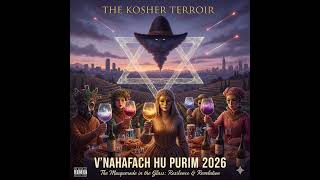
In this special episode of The Kosher Teruah, host Simon Jacob delivers a Purim‑centered monologue that intertwines spiritual reflection, safety advice, and a curated tour of five Israeli and diaspora wines. He opens with a prayer for soldiers and a series of practical guidelines – plan where you sleep, hydrate, avoid drunk driving – framing the mitzvah of preserving life as paramount to the Purim drinking custom. He then links the historical threat of Haman to contemporary missile threats, arguing that wine‑drinking on Purim is an act of defiant hope. Using the metaphor of a “masquerade,” Jacob explores how wines can conceal and reveal deeper truths, mirroring the holiday’s theme of hidden divine providence. He profiles five winemakers: Eli Shiran’s region‑blending “trio” that maps Israel’s terroirs; the Pinto family’s Negev GSM blend that defies desert heat; Yaakov Orya’s experimental “Light from Darkness” orange‑style wine that looks white but tastes red; Ernie Weir’s Hagafen Rosso that fuses Napa Cabernet with Italian Sangiovese; and Amichai Luria’s Shiloh “Adino,” a dark, velvety wine symbolising warrior strength softened by spirituality. Throughout, Jacob weaves stories of resilience, Zionist symbolism, and mystical teachings about Purim’s superiority to Yom Kippur. He concludes by urging listeners to drink responsibly, promises a forthcoming series on single‑vineyard wines, and signs off with a traditional Purim blessing.
Chapters
Welcome to the Kosher Teruah. I'm Simon Jacob, your host for this episode from Jerusalem. Before we get started, no matter where you are, please take a moment to pray for the safe return home of all our soldiers, If you're driving in your car, please focus on the road ahead. If you're relaxing at home, please open a delicious bottle of kosher wine and pour a glass, sit back and relax. Welcome, listeners, to a landmark episode of The Kosher Teruah. We are just a few days away from Purim, the day of Anafokhu. The Great Subversion. But before we dive into the cellar today, I want to talk about where I am and the unique energy that's building right now. Here in Jerusalem, Purim isn't just a day. It's a spiritual mountain we climb. Because we live in a city that has been walled since the days of Yoshua ben Nun, we celebrate Shushan Purim. While the rest of the world is finishing their festivities, we are just beginning. In Jerusalem, the upside-down nature of the holiday is doubled. We have an extra 24 hours to delve into the mystery. And let's be honest, when the celebration stretches into the second day, the drinking can get very serious. The Shulchan Aruch, tells us to drink until we don't know the difference between arur Haman, the curse of Haman, and baruch Mordechai, the blessing of Mordechai. It's a terrifyingly beautiful standard. It asks us to dissolve our ego, our logic, and our judgmental mind until only pure joy remains. But here is the vanafochu of the mitzvah. My rabbis have shared a profound insight with me. They say that the goal of the state of not knowing is not necessarily the quantity of the wine. If you drink a few excellent glasses of wine during your seder, and that warmth leads you to take a nap, in that sleep you truly do not know the difference between Haman and Mordechai. You have fulfilled the mitzvah with dignity, with peace, and more importantly, with safety. I want to be very direct with my kosher teruah family. The mitzvah of "venishmartem me'od le'nafshoteichem," the commandment to guard your life and the lives of others, is infinitely higher than the custom of drinking on Purim. If you are celebrating in Jerusalem, or anywhere else for that matter, Plan the stay. Arrange in advance to sleep where you're celebrating. Don't rely on feeling okay later. Also, follow the water rule. For every glass of these incredible blends we're about to discuss, drink a glass of water. Hydration is the only way to keep the masquerade from becoming an iron mask of headache pain later. Coffee and wait. Before you even think about touching the steering wheel, have your coffee, eat a solid meal, and wait. Give yourself hours, not minutes. We drink to elevate our soul, not to endanger our families. Let's make sure that when the mask comes off the morning after Shushan Purim, we are all here to tell the story. Now, with that in our hearts, let's talk about the wine. But before we talk about celebration, we have to talk about the stillness. If you're listening to this in Israel, you know that stillness. It's the silence between the sirens. It's the weight in the air when we look east. Here we are, thousands of years after the events of Shushan. And the geography of our survival hasn't changed. The threat isn't the story in the scroll, it's the coordinates on a map. The Persian Empire of old has been replaced by a regime in Tehran, and the decrees of Haman have been replaced by the trajectory of ballistic missiles. There is an eerie, sobering symmetry to it all. We are still the people living at the King's Gate. We are still the people whose destruction is being openly plotted in the very same streets where Esther once walked. It's heavy. It's a weight that never quite leaves our shoulders. But there is a reason the Megillah tells us that the month was turned from grief to joy. It doesn't say the threat vanished. It says the Jewish people stood up. We took the very reality intended for our demise and we flipped it. So why a podcast about wine at a time of missiles? Because in the Jewish tradition, drinking is an act of defiance. To make wine is to plant for the future you believe in. To drink wine is to say, "You intended for us to be dust, but instead we are a vineyard." In this podcast, as we look at the masquerade of wine, we aren't just looking for a drink. We are looking for the strength to see the hidden hand of protection that has carried us all the way from Shushan to the Jerusalem of 2026. So, there is a powerful mystical concept that Purim is actually higher than Yom Kippur. On Yom Kippur we fast to reach Hashem, God. On Purim we drink. Why? Because when we are sober, we think we understand the world. We think we see the logic. But on Purim, we wear masks to to admit that what we see with our eyes is rarely the whole truth. There is a famous story of a man who approached the Baal Shem Tov complaining that he couldn't see God's hand in his life. The Baal Shem Tov told him to look at a master weaver at work. From the back of the loom, it looks like a mess of tangled, colorful threads, knots, loose ends, chaos. But when the weaver turns the rug over, it's a masterpiece. Purim is the day the rug is turned over. We don't drink because we want to forget. We drink because we're still here and because the weaver of that rug hasn't finished the pattern yet. In the world of wine, we usually want purity, We want a Cabernet that tastes like a Cabernet. But today we are celebrating the chaos of the loom. We are looking for the wines that lie to us, wines where the winemaker has intentionally tangled the threads to create something that shouldn't exist. We're going to explore 5 bottles that embody the hidden hand, wines that wear a costume until the moment they hit your palate. Get ready, because the cellar door is open and nothing is as it seems. We begin with Eli Shiran. Eli is a fascinating figure. He is a boutique winemaker who works almost like an alchemist in Kiryat Arba. His philosophy: I don't make wine by the book, I make it by by the soul. Let's talk about his wine trio. Most winemakers pick a terroir and stick to it, but Eli Shiran decided to create a masquerade of regions. He takes Carignan from the coastal sands of Benyamina, Petite Syrah from the Galilee, and Petit Verdot from the Gush Etzion Mountains. On paper, these grapes shouldn't be in the same room. They ripen at different times. They come from opposite ends of the country. When you pour it, its nose is incredibly floral. You'd almost swear there was a white grape hiding in there, but the palate is dark and spicy. It's a powerhouse. It's a wine that pretends to be a single estate terroir wine. But it's actually a secret map of the entire land of Israel. It's the ultimate hidden identity wine. So if we want to talk about Vina Fochl turning the world upside down, you have to talk about the Negev. For decades, the conventional wisdom in the wine world was that you simply couldn't make world-class elegant wine in the desert. It was just too hot, too dry, too extreme. The grapes would burn, the sugars would skyrocket, and you'd end up with something that tasted more like jam than viticulture. But then came the Pinto family. The Pinto family didn't just want to make wine, they wanted to build an anchor in the town of Yurucam. A place that has often been overlooked in the Israeli story. Their challenge wasn't just agricultural, it was social and existential. To plant a vineyard in the Negev is to engage in a war of attrition against the elements. You are fighting the lack of water, the salt in the soil, and the hamzins, those scorching desert winds that can desiccate a crop in hours. But their biggest hurdle was the stigma of heat. They had to convince a skeptical public that the desert could produce something delicate. The family partnered with a mad creative scientist, We've mentioned before in our podcasts, Yaakov Ouria, a winemaker who specializes in making impossible wines. Together they face the ultimate challenge. How do you capture the soul of the desert without being overwhelmed by its heat? In 2026, the Negev isn't just a desert, it's a frontline. Making wines here is a strategic act of Zionism. When the Pinto family looks at their wines, they aren't just seeing grapes. They are seeing a barrier against the desolation, both the physical sand and the geopolitical threats from our neighbors to the east. They have invested their lives in the idea that that sand can bloom. This brings us to the Pinto Red, a classic Mediterranean blend of Syrah, Grenache, and Mourvèdre. The masquerade in this situation is that in any other desert in the world, a GSM blend would be a 16% alcohol monster. It would wear a mask of heavy power. And when you see the Pinto label, you expect a wine that reflects the sun. But the moment the wine hits your tongue, the mask falls off. It is shockingly fresh. It's a mirage. It has the acidity of a wine grown in a cold, high-altitude forest. It tastes like tart cherries wild sage, and cracked black pepper. The upside-down truth here is that this is the miracle of Pinto. They use the desert's extreme diurnal shift, the freezing nights, to preserve the grape's energy. It's a wine that lives in a furnace but tastes like a breeze. It's a reminder that even in the harshest conditions, If you have the right vision, you can produce something of incredible gentleness. It's the Esther of the desert, surrounded by heat, yet remaining entirely cool and composed. We cannot talk about the Pinto family without talking about the man behind the cellar door, Yaakov Orya. If Eli Shiran is an alchemist, Yaakov Orya is a philosopher, with a fermenting tank. Yaakov is perhaps the most experimental winemaker in Israel today, but being a pioneer is a lonely road. For years, Yaakov faced the challenges of being too different. He wanted to make orange wines, long maceration whites, and unconventional blends before the market was ready for them. He had to fight the kosher glass ceiling the idea that kosher wine drinkers only wanted safe Cabernets. Yaakov's journey has been one of constant hesder, hiddenness. He often worked for other wineries while keeping his most radical ideas for his own label. He had to overcome the technical challenges of extracting without destroying. How do you take a red grape and get its flavor without its color? How do you make a white wine that ages like a red? This brings us to the ultimate Purim bottle. The name itself, Light from Darkness, is a direct reference to the mystical themes of the holiday. It's made from Grenache, Syrah, and Mauvèdre, the same dark grapes we just discussed at Pinto. But here, Yaakov performs a vinafocho in the press. He squeezes the grapes so gently that the dark skins never bleed into the juice. Our masquerade here is that as you pour, it looks like a white wine. It wears the costume of a Sauvignon Blanc or a Chenin Blanc, but the Purim reveal is when you drink it. Your brain experiences a glitch. Your tongue feels the structure and grip of a red wine. You taste savory. You taste herbs, strawberries, and mineral Selenity. This wine is Yaakov's manifesto. It says that the darkness, the red skins, are only a shell, and that the light, the juice, is what truly matters. It's a wine that teaches us that even when the world looks dark and threatening, like the Persian threats we feel today, the light is always there. Hidden just beneath the surface, waiting for a master's hand to reveal it. We now turn our gaze across the oceans towards Napa Valley, California. But we aren't just looking at a postcard. We're looking at the life's work of Ernie Weir, the founder of Hagafen Cellars. When Ernie started Hagafen in the late '70s, The kosher wine world was a desert of sweet, syrupy sacramental wines. Ernie faced a wall of skepticism that would have broken most. He was a Jew in Napa trying to convince the elite of the wine world that kosher didn't mean cough syrup. He was a man living in two worlds: the high-stakes competitive world of Napa viticulture and the ancient, disciplined world of halacha. For decades, Ernie had to defend his craft. He survived the devastating Napa fires. He survived economic downturns. And most importantly, he survived the stigma, the hester, of being a kosher winemaker in a secular industry. He had to be twice as good just to be considered equal. He built a bridge where there was none. The wine we're discussing is the Rosso Hagafen. This is Ernie's bridge. One look at the label reveals the masquerade of this bottle. It looks like a classic Napa red. It wears the tuxedo of Cabernet Sauvignon. The grape that made Napa famous. But the secret ingredient here is Sangiovese. This is the grape of Tuscany, of the Italian countryside. It brings a rustic, high-acid zing that is the opposite of Napa's usual plushness. The upside-down truth here is that it's a super Tuscan Born in a California dream. It's a story of a Jew in the diaspora dressed in the local garb of Napa but maintaining the sharp, acidic, vibrant soul of the Old World. For Purim Suda, this is a masterstroke. It greets you with the elegance of a banquet, but it has the fight and the acidity to keep you refreshed through the long hours of the feast. And finally, we return home to the hills of Samaria, to a place called Shiloh, and we talk about a man who is as much a man of the earth as he is a man of the spirit: Amichai Luria. Amichai didn't grow up in a vineyard. He was a builder, a man of wood and stone. When he took over the winemaking at Shiloh, he wasn't just taking on a job, he was taking on a legacy. Shiloh is a place of deep biblical resonance, but it is also a place of modern-day tension. To make wine in Shiloh is to be a guardian of the vine. Amichai has faced the challenges of international boycotts and the political noise that often tries to drown out the quality of his wine. He has had to work in a region where the threat of conflict is a daily reality. But Amichai's philosophy is silent and steady. He believes that the quality of the wine must be so undeniable that it silences the critics. He doesn't argue with words. He argues with fruit. He has turned the stones of Samaria into gold, winning top awards in London and New York, forcing the world to look at the land of Israel through a lens of excellence rather than politics. The wine we're gonna look at is named Adino. It's after the chief of King David's warriors. It masquerades as a black wine. If you pour it into a glass, it looks impenetrable, like a shield. It smells like wood smoke, earth, and dark sun-drenched fruit. It wears the mask of a hard man, but when you taste it, the vanafohu happens. It is arguably the most supple, velvety, and gentle wine in Shiloh's lineup. It embodies the description of the warrior Adino: hard as wood in battle, but soft as silk when sitting in the study hall learning Torah. It is a wine that hides its immense power behind a veil of kindness. In a year where we feel the need for warriors, this wine reminds us that true strength is found in refinement and soul. There is a famous story told of the Berdicheva Rebbe. He once saw men drinking wine on Purim, totally oblivious, and he said, do you even know why we drink and until we don't know the difference between Haman and Mordechai? It's because in the eyes of Heaven, even the bad was actually good in a mask. Everything is a masquerade. The Megillah itself is the only book of the Tanakh where God's name is never mentioned. He is hiding behind the natural coincidences. Of a king's insomnia and a queen's beauty. In the wine world, we often demand honesty. We want the grape to shout its name. We want the soil to be transparent. But today on our podcast about Purim, we celebrate the liars. We celebrate the wines that wear costumes, the wines that confuse your brain so that your soul can take over. So I guess on this podcast, we've explored what you could call "pallet cognitive dissidence." We have traveled a long road today, from the hills of Kiryat Arba with Eli Shiran, to the sands of the Negev with the Pinto family, across the ocean with Ernie Weir in Napa, and back to the ancient terraces of Amihai Loria in Shiloh, all guided by the philosophical lenses of Yaakovoria. What do these 5 stories tell us? I believe they tell us that the masquerade is not a lie. It's a deeper truth. We saw Eli use grapes from every corner of the land to create a unified floral song. We saw the Pinto family find a cool breeze in a desert furnace. We saw Ernie at Hagafen bridge the gap between California's polish and Italy's grit. We saw Amichai and Shilo hide the heart of a poet inside the armor of a giant. And we saw Yakovoria pull light directly out of the darkness. This is the story of the Jewish people. We are a blended nation. We are a desert nation. We are a nation that has spent thousands of years in the diaspora masquerade. But most importantly, we are a nation that knows that the hand of the Creator is always there even when his name is missing from the page. When you look at those Iranian missiles to the east, remember the wine. Remember that the vine takes years to produce fruit. It is an investment in a future that our enemies cannot see. Every bottle we uncork on Purim is a ballistic missile of joy. It's our way of saying that the Weaver hasn't finished the rug, and that the overturning has already begun. Thank you very much for joining me for this special episode of the Kosher Teruah. This Purim, as you drink "Ad Shaloyada," until you do not know, I hope you find the clarity that lies on the other side of the mask. Next week, the masquerade ends. We will continue with our interviews with winemakers, distributors, and even wine consumers. But we're also, as we march towards Passover, the season of our freedom, we're going to strip away the blends and the secrets. We're going to start a series called The Purity of the Single Vineyard. We will be looking at wines that have nowhere to hide. Single grapes from single plots, expressions that tell the raw, unadulterated truth of the soil. From the confusion of Shushan to the clear vision of the Red Sea. You won't want to miss it. I'm your host, Simon Jacob. Drink deeply, stay safe, and may your Purim be truly the Nafohu, turning every shadow into light. Hag Purim Sameach, L'Chaim. I'm your host, Simon Jacob, and this is the Kosher Terroir. This is Simon Jacob again, your host of today's episode of The Kosher Teruah. Please subscribe via your podcast provider to be informed of our new episodes as they are released. If you are new to The Kosher Teruah, please check out our many past episodes. Thank you.










