Scaling a Startup with Sonia Couto and Rosa Hoffman
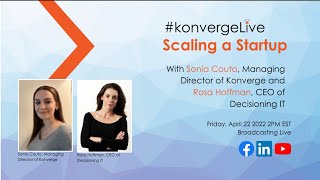
Rosa Hoffman, CEO of Decisioning IT, discusses scaling a tech startup with host Sonia Couto. They distinguish between growing (linear profit increase) and scaling (revenue growth with minimal investment), and cover hiring the right trio of strategist, validator, and executor, avoiding feature bloat, and preventing founders from becoming bottlenecks.
Chapters
Converge is a software development company located in the heart of downtown Toronto. Converge has been in business for 25 years. We established ourselves back in 1994, and originally we started out as a website design company, and throughout the years we have changed as technologies changed, and we've pivoted as a company as well. Everyone that works here is very client-centric, and all we want is to make sure that our clients have an amazing experience with us. And you know, you have a combination of people who are passionate, who love innovation, who, who, who love coming to work every day and creating and building awesome new things. Episode has been brought to you by Magic Mind, the world's first productivity drink. Do more, stress less with Magic Mind. Hello everyone, welcome to another live podcast. My name is Sonya Kudo. I am the managing director at Converge, and today we are going to be joined by Rosa Hoffman, co-founder and CEO of Decisioning IT. I am just waiting for Rosa to come on our screen. There she is. Hey Rosa, how are you?
Good, how are you?
Good, good. So just before we get started, um, just a quick intro. Um, this is our podcast called Between Two Servers, and the goal here is to have a very candid conversation around technology startups is a topic that we focus on a lot. And we, I try to touch base on all the different challenges that technology companies have, and particularly startups. And so we sort of pick a bunch of different topics that we can talk about. This is Rosa's second time on our podcast. She's quite popular. And she has a lot of experience in founding tech startup companies, joining existing tech companies. And today's topic is going to be scaling a startup, which is a huge challenge for people. And we want to sort of touch base on some of the challenges, some of the solutions that she has found through her startup, and how she's sort of planning for the future. So before we get into all the questions and things, welcome Rosa. And do you want to sort of tell us a little bit about yourself and Decisioning IT? What do you what do you guys all about? And also, can you center your screen a little bit more?
Yeah, there you go. Oh, perfect, perfect. There we go. Sorry, the internet here isn't the greatest, so I'm just kind of— but, uh, thanks for having me on again. It's really always a pleasure to be on. Um, a little bit about myself and Decisioning IT. I've, uh, I've been in the automotive industry for well over 15 years. I've worked with some of the largest automotive groups here in Canada And I've done a lot of consulting, acquisitions, and I've just been in there. And you know, I tend to tell people, like, I bleed automotive. That's kind of my thing. Decisioning IT, I met a gentleman about 4 years ago, and he had built this CRM type of platform for one of his dealerships. And it really helped focus on getting more non-prime consumers pre-qualified for lending. And I thought it was really a fantastic product. I thought he did a great job with it, and I wanted to help him commercialize and scale and grow. So I joined him on an advisory base, and then we officially joined forces last year co-creating Decisioning IT. There's been some products that I've brought to the table, such as our widgets and our APIs, and then of course his product of the actual platform, the CRM. So yeah, it's been really good. We've, we've managed managed to now launch into over 100 of our customers' dealerships in one year. So we have scaled really, really quickly, and with that comes a lot of headaches. And, you know, I think I can answer every question you can think of. Lots and lots of stuff to talk about. So our goal as a company is really to help get more consumers pre-qualified for financing with the absolute best option out there for them. We don't want to see people in tough situations. And we definitely want to make sure that they're getting all of the options available to them. That's something that you don't typically get anymore. So yeah, super high level. That's, that's what we're doing.
Yeah. So, you know, before we go into the scaling, for people who don't really understand what that means, can you tell us like, okay, prime versus non-prime, what is, what is the offering? What's the benefit?
Yeah. Sorry. I guess I take that for granted. Advantage sometimes, not people know everything. So a non-prime consumer is someone who may suffer some credit issues on their, you know, their credit score. And prime is typically a person who has, you know, great credit and they don't have any issues getting financed by, you know, the, the big captive banks, you know, the TDs and such like that. And so when you're dealing with people who are in the non-prime space, there's a lot of factors to take into place, and it's not just black and white. And I think what we we do really well is we actually put a personality behind the person. It's not just a simple, here's a piece of paper. We actually try and understand a little bit more. We ask the proper questions. We know why that customer might be in that situation. What can we do? How can we help? Which lenders do we know would help? So that's a little bit on the difference between prime and non-prime.
And so who is your customer?
So our customer is actually automotive dealers and automotive suppliers, so third-party companies. And then of course our business is to provide that business to, to the dealer or the third-party company who is then using our product for customers that are coming through the door. So every day, like you and I.
So can you walk me through, you know, how a dealership would originally go through the process of finding that versus using a decisioning IT system? Sure.
So usually there are two systems that dealers can use in a dealership environment, and I'm actually not even going to really talk too much about them. I think I'm going to talk more about the human being. So when you buy a car, you go in, you talk to your salesperson, and everybody loves this experience, right? Like, you want to buy another car, don't you, Sonia? I do. No, I just got one. Exactly. The truth is it's actually not a really wonderful experience for a lot of people. And so you go through this, this process of going in, picking up your car, and I'm in love with it. And now I got to go into an F&I office, which is the finance office, and you're biting your teeth like, oh my God, I don't know what's going to happen. Oh, he's being so invasive, and I've got to give this guy like my, my credit card information, you know, all of this stuff, and my— sorry, my social insurance number. And so there's an invasive process that I think the human beings go through approved. So that's already can be a little uneasy, especially if you're walking in there knowing that your credit isn't necessarily the best.
And you're like hoping to get approved, right? You're just praying, right?
Correct. And I think a lot of people go through that. I think everybody goes through that. It's, it's a normal situation, because you don't know. So the human being, being myself now, who's an F&I manager, and I've seen you, Sonia, I'm doing the work of asking you the questions, putting it in the system, and then I would submit it to a bank. And now I'm going to wait to see if the bank is going to accept that application. If they don't, I might send it to someone else or another person. What happens a majority of the time is that it doesn't really go anywhere from there, or if it does go somewhere from there, it's not always in the customer's best interest. You know, and I don't want to say that it's all— it's hard to really— it's hard to know, is it or is it not? So what our system does that's a little different is, so myself as an F&I manager, I can put all your information into our system and and we can actually predetermine which lenders would pre-qualify you based on all of your criteria because we have that machine learning element, we have AI, and what we're doing is we're using lender criteria to match you up with the right lender. So now we're providing options to the F&I manager, and it's not as simple as asking A, B, C, or D. We go very deep into that, into that whole process. We ask a lot more questions because we know historically, we know how to get more people who are non-prime into a prequalification. So although yes, we do, we do specialize in non-prime, I should mention we also provide like a tremendous amount of value for prime consumers, and that's usually our good, best, and better option. So we actually will break down, you know, what is the best option for you based on interest rate, based on credits, and we actually give a lot more information to consumers through the platform with the F&I manager.
Okay, awesome. Yeah, that sounds like a really good tool. I mean, I know you and I have talked about it, but I sort of just wanted you to walk through it so that our audience listening can really understand what the tool is. And by the way, anyone listening in, if you have any questions, you can send them through, we will receive them and try to get to them. So with that being said, let's get to scaling. Before we talk about it, I just want to sort of talk about the difference between growing and scaling. So I sort of prepared some notes. So growing is the process of increasing a company's profit from investing in human resources and technology. This is a linear process where you first invest, then you get more profit. Each time you want to increase your profit, you need to invest. Scaling, on the other hand, is when a company increases its revenue without much investment. So there could be some investment, uh, or VCs on board, but it's not like a huge amount. As a rule, scaling focuses on process automation to reach a wider audience. So scaling is less expensive and time-consuming than growing and allows for faster revenue increase. So, you know, one of the challenges is a lot of companies, sometimes they, they, they're scaling and they're scaling at a good pace, but then there's the scaling fast. And I think that's, you know, based on our conversations that we've had, I think you're now starting— your business is now getting to a point where it's starting to scale faster. So you already have customers calling you, um, asking for your product, or brands wanting to, to partner with you. Um, these are solid signs of growth. However, that doesn't necessarily mean that you're ready to scale, right? Scaling is a whole other Yeah, so you, you have, you have great technology, data, reputation as a leader and innovator, great expertise, and great advisors because I know you have an advisory board. So how do you make sure you have technology and a business model that will allow you to continue scaling successfully?
I looked at your questions beforehand and I mean, I gotta be honest, there's something that kind of, it was just like a light bulb that went off when I really thought about it. And there's so many components to this. I mean, obviously as a company, when you start to scale, it's really, it's both exciting and it's also scary because there's the element of, whoo, do I really wanna take on these clients and then not be able to deliver? But I wanna take on the clients because, you know, this looks really great for us as a business. I'm so sorry, I don't know why that printer's going off. So a few elements to all of that. But the one thing I think that I've come to really accept and understand in all startups that I've ever done work with is before you start to scale, especially on the technology side, you really need to ask the question, is, is my technology ready? Am I in a position that I'm supposed to be scaling? And how do I actually know that I'm ready to scale? And I think the best way to answer that is to validate. And, and who do you validate that with? So let's say me, myself, and I, I've got a good team. I believe my team is, is the best. So I'm ready to go. I believe, you know, we've got multi-tenant, we're ready to, we're ready to go. But what if I don't actually know that? And I think taking that step back, getting an expert, you know, people like yourself, there's so many people out there, and just provide a day of knowledge and say, you know what, you're on the right track, you guys are doing this, kind of do this a little bit more, maybe hire another person, get that consultation with a professional. I honestly believe that that would significantly in knowing whether or not you need to slow down that scaling or if you're on track to scale. I'm happy with that answer.
I'm actually so happy you said that because that's one of the things I always find, um, with, with startups is like Where do they take a step back and say, okay, you know what, I really need to analyze this and, and, and I need to like take a couple steps back and figure out where I— what's the direction that I want to go and where, where we need to be team and everything. So I think that's really good that you're considering like experts who have been there and done that to come in and really help you with, with the, you know, preparing for scaling.
Yeah, and I mean, if you even think about the whole idea of an incubator, that's the purpose, right, is to use your peers and use your advisors, and I feel like a lot of people, we're not using them well enough, and we forget that we really should be doing that, and it does provide a lot of reassurance, and it helps you in your road mapping when you know I can do 100 new clients, or I can do 10, But I need to add this to our technology standpoint, or I need to add this, or I need to do that. So it's really good to get that extra validation and make sure your team is the right team to help you execute so that you can grow without burning bridges.
That's really important, right? So decisioning IT is gaining all this traction, and it's important to stop and stock, right? So you need to not only have a product and a service that a growing user base wants, but the, the business system infrastructure and employees in place to support the demand. So a couple questions around that. Number one, now that you have started to scale, how can you still deliver on your company's promise and how?
Well, it's a lot of it is just being focused. You know, we have an original plan and although I hear the word all the time, pivot, pivot, pivot, like from Friends. Ouch. I mean, it's not— I guess it's also, it depends on your experience as a human being, right? I mean, I have a lot more of a corporate background where I'm very focused and I need to stay on track. Things will grow from that. Don't get me wrong, from the original vision, there will be things that will grow from that that will help our product be better and, and offer more value to the customer. But you have to stay focused. This means really, really making sure that your team has a right leader in place, that priorities are put in place and you're following. Otherwise you're going to get completely sidetracked with little features from every client. And we all want to make our clients happy, right? You get one client who's like, oh, I want this, do it. You have to stay focused, add it to the list. But if it's not the priority, if it's not going for value of what you sold that customer, it's not going to do anything better today. So really focus and having a really good team that can keep that, that on track.
Right. So good point. But here's my next question. How do you avoid scaling fast?
Well, I think you avoid that by not making a lot of noise, right? People won't necessarily know you exist if they don't know you're around and if you're not out there, if you're not doing interviews. I think that that's a big thing that I've always really preached on. Don't start branding yourself unless you're ready to take on clients. Don't start going out there and talking about what you do if you don't do that. And that's really an important thing because you will end up hurting yourself if you can't take that on. Don't say you can't. So take a little focus on your product, and when your product is ready, then start marketing, then start branding, then start talking about it, because you will have the opportunity to start taking on clients and to scale.
Okay, so I know I didn't send you these questions. I'm just sort of coming up with them as I'm hearing you, and because I think there's some good points here. So, you know, you're talking about Yeah, you're talking about, you know, don't market yourself, make sure you're ready to go to market, focus on getting the product. Like, but you know, one of the things that you and I both know this, it's like, if you let certain people be in charge of the product, you're never going to be ready to go to market. So at what point do you say as a, as a business, okay, we need to now stop developing, we have an MVP, or we have a good beta, it's good enough to take to market. It's good enough to bring on some clients so we can do maybe a little bit of bootstrapping. At what point do you say as, as some, as a leader of a company, okay, enough is enough. We're now going to stop all of this and we're going to prioritize and now we're going to go to market.
Okay. That's awesome. Honestly, what a great question because I feel like every company goes through and we learn with this. I believe as a startup, you need to have your own milestones that must be met. And if they're not met, you have to have that question asked. Why? What's going on? Let's restructure. Let's rethink. And if, if you're asking the questions of, oh, you said that this API was going to be ready, what happened? If the answer is legitimate, then we also understand that, you know, we didn't time this right. But if it's not, and it makes sense, like, oh, I had to take my dog for a walk that day and I just forgot, then we know we have a problem, right? We have an issue. And so I think as leaders, you have to be in a position to make sure that you're checking in with your team, you're getting the proper answers. And it goes back to that point of what I said, validate it, get someone to help you. I mean, you know, my specialty may not be PHP, so how can I validate a PHP? I can't do that. So it's important for me to validate, get that support and get that help from other professionals who know what they're doing. And I personally do that as often as you can. If you have those milestones built, at the end of those milestones, if things aren't moving, have someone come in and help you validate why it's not happening. Is it a legitimate reason or structural changes? Right. And then use momentum of moving quicker.
So I have a follow-up question to that because I know that this is something that happens way too often in in tech and software development, things like that. So, you know, you're, you're checking with your team, you have milestones, you have a business plan, and your team has told you 6 months, you know, August 2022, we're going to be ready for market. That means everything has been betaed, everything has been tested. It's like we can now take on clients. And like July rolls around and you do a check-in and it's like, and your team's still telling you, yeah, we're going to be ready for August, but you're like, guys, girls, we're not going to be ready for August. Like, this is nowhere near where I was expecting it to be. And now you're like, oh crap, this is going to take me another 3, 4, 5, 6 months. What do you do then? It completely like throws off your original plan.
It does, but your original plan should have room for buffer, right? You have to have a little bit of the buffer room. Like, don't tell your client it's going to be 6 months and expect your team to deliver a quality product that's gone through all the testing in 6 months. So give yourself room too. So usually if I talk to a client, I give myself at least 4 to 6 weeks because I would rather overdeliver than underdeliver. If I can come in a little bit sooner, the chances are I look like a hero. But if I come in late, it's not gonna, it's not gonna work. So how do I, how do I deal with that? Again, it's creating those milestones. If they say 6 months, I'm checking in at 2, I'm checking in at 3. If at risk, I need to talk to my CTO or my head of engineering and I have to say, we have an issue. Obviously you're telling me we have an issue. How do we, how do we fix this issue? Is it hiring another staff? Is it consulting? How do we get this quicker? Is it anything that we can control internally? Or are these external matters that I'm now going to have to go back and deal with? So you want to again, start earlier on. Don't wait until fifth month to figure it out, because then that's your fault as a leader. You let that happen, right?
Yeah. So it's a combination of planning, following up, and communication, really.
Yeah, of course. And having, having things in play, like, I mean, there are companies that will do this where they have a project that's coming out. And they will raise capital just to support that team that they need to build, an external team they need to build out just to get this product out within 3, 4 months. You know the quality is going to be there because these are professionals, these are firms, you know, much like your company, and they can get this done much quicker than your internal team. So there are options. Not like they aren't— they don't exist. They're there. You have investors. You can go out and you can raise more capital.. And you can probably feel really assured that if you're using an external team that knows that industry very well, that you're probably gonna, you're probably gonna get it done a lot quicker with, with less issues.
Yeah, for sure. I totally agree. So I want to talk a little bit about resourcing because I know that's also part of scaling and some of the challenges. So when, when you hit a rapid growth phase, it often feels easier to hire just anyone and And especially companies who have raised a large amount of funding, I find that they're just like, they're hiring based on a need, not a plan. And it's just like, let's hire, hire, hire. And then what happens is, you know, having the wrong team in place is amongst the top reasons why a startup will fail, right? Because people are hiring quantity versus quality. And you know, people who— and they're also hiring people who don't align with their business and their vision and their culture. So can you talk about some of the resources, the resource challenges you've had due to hiring out of pure desperation versus strategic hiring? And how does that impact your business?
Well, it impacts your business because it delays you completely, because you're hiring out of desperation. You're not doing the right qualifications. You don't know if these people are really— they're supposed to be doing. Sometimes you're hoping to hire leaders who are going to lead and help support, you know, let's say your sales and marketing, whatever the case is, and then they're not performing. But then you, you're— you almost question yourself, like, is it— is this maybe— yes, maybe it is the right process. They're the professional, right? I mean, you, you, you hire people that you eventually want to be better than you, right? That's, that's usually what you do when you hire. You don't want to hire people and keep them down there. You want them to grow and to own that role. So I think, you know, you will get— if you hire out of desperation, you're going to get so many delays. You're going to get so many headaches because everything's going to be very messed up. Things aren't going to make sense. And the key is— and I look, I've been doing this for a bit, a ton of startups, and it literally just hit me like a like a stone wall. Just, just the other day, there were 3, 3 key, key things that you need in your— you need the strategist, you need the validator, and you need the executor. If you don't have those 3 people working together, you— I don't, I don't know how you can— I don't know how you can succeed because those 3 need to exist. You need to have someone with a vision You need to have someone who can say, yes, your vision is definitely possible. And you need the other person to say, okay, you're both right, it can be done. I need to do it in this amount of time. I need these people to get it done. I'm gonna need this much money to do it. So there's this really nice relationship between those three people, and that's how you really get things done, I find. Like, you need You need strategy, you need validation, and you need execution. And that's usually in the form of, you know, your CEO and your, your CTO, right? Your CTO is huge. And, you know, get a good CTO. It's really important.
Yeah. I mean, I think, I think like for as an example of like hiring out of pure desperation and some of the challenges you can find yourself in as an example, like for one of our startups, You know, I, I'm not a salesperson. I'm also not a marketer, but I've learned that, that part of the business. But I remember there was a time when I needed a sales team and I needed to hire a sales team and I didn't really know how to manage a sales team. And so I was hiring people based on the fact, oh, they're going to come in and they're going to help me put together a sales team. And then what ended up happening is I started hiring all these different people and some people would stay, some people would go, and then one person would come in and be like, oh, we need to use Salesforce as our CRM. So I would purchase Salesforce and then that person would leave and another person would come in, oh no, no, Salesforce, we can't use that, we need to use this CRM and we need to have this process. And every time someone new came in, it was like a new process, a new way of doing things. And I honestly got to the point where I was like, oh my God, this is a nightmare. Yeah. And I just didn't even know how to fix that department. So I literally had to step back and say, okay, who is the best salesperson? That's me. This is my product. It's my vision. I know it so I can sell it. So really what I did was I had to take a couple of steps back and say, you know what, I'm going to sell it. And when I started selling it, I started talking to clients. I started understanding their mentality, what they're looking for. And I also started learning the discipline around sales. It took me about a year to sort of get to a really good place and, you know, find a good CRM system that I like simplicity, something simple, easy to use. And then by that, by the time I went through that process, I was like, okay, now I'm ready to start hiring salespeople, but I'm not going to be depending on them to put my processes in place, to tell me what tools I need to be using. I'm now ready to bring them in and I have now a process that they can learn and follow because, and I know this process works because I've been doing it. So now I'm hiring, I'm hiring resources to be successful versus you're coming in and I'm not sure if you're going to be successful. We're still kind of like in the middle of a bunch of things. And I think that's common and it's okay to have those kinds of problems. But you know, that's sort of what happens when you're hiring out of desperation and you really don't know and it can have like a really long-term effect on your business.
Yeah. And that's right. And how many delays did you go through having to start with a new person, having to bring on the new one and then having to take on a new, a new technology. Right. And so that's, that's a huge thing.
And, and I like— yeah, sorry, it kept affecting my business plan. Right. I could never meet my milestones.
Yeah. Your targets were lost. You didn't know. And then it makes you question everything. But what you said was absolutely brilliant, go out and do it yourself. Like, you have to be able, as a startup, as a leader, I think anybody who's trying, you have to be able to do everything. You may not be great at it, you may not, and that's okay. No one's saying you should, but you have to have some kind of understanding so that you're aware of that role and, and what the needs are, especially when you're doing, you know, B2B or B2C. It's really important to have the right people.
So Yeah, really good points on you. And, and I'm just gonna, you know, speak about that again. I, I agree with you. I think that is one of the major things that everyone should do is sort of like learn each role. Again, like you said, you don't have to be a professional, but you know, in order for you to talk to your— to— you mean you hire people that are going to be smarter than you, but you want to have— be able to have conversations and also as a leader guide them. Like, they're the experts, they're going to do the job, but in, in knowing their role a little bit, you can lead them better, right? So, um, let's talk about focus and losing focus a little bit. As you scale, it's easy to get distracted, but you need to fight the desire to add on features and products too soon. And I know you and I have talked about this quite a bit, and this is a huge challenge for me, and I know it's been a challenge for you. If you're not solving customers' primary pain points, right, the additional bells and whistles won't matter. Usually it's important to stay focused on the big picture and work and the work that will ultimately drive success. So, you know, usually I find that between founders and co-founders and CEOs, CTOs, etc., I find that usually the original founder of of the product is they sort of get left behind a little bit. Not always, but in a lot of cases they get left behind. So the company is scaling and they're not, and they're sort of becoming a bottleneck for the company now because they're always focused on— they're the inventors, right? So they're always inventing in their head and they're always like, oh, we need to build this, we need to build that, we built that. And I talked to way too many companies where they're like, We have clients, but we're not being able to properly support our clients. And I'm always like, why not? Well, we have this bug and we have this, this issue and the client wants this thing. And I'm like, okay, so what's your team working on? And the team was working on something completely different that the founder has asked them to, to build. So I'm like, okay, so what value is this feature going to bring in the sense of revenue? You know, if you guys launch that tomorrow, How much revenue is this going to bring you? And in too many cases, I hear people saying, oh, I don't know. So I'm like, so you just like decided to build that feature?
Like you woke up one morning and said, hey, I'm going to build this feature.
You have like no, no real data behind it, right? So my question, how do you keep your team on track and focus on building what, what will you, what your customers sorry, on building what will your customers, and bring in revenue. Like, so how do you—
sorry, I need to— I know exactly what you meant. Don't worry.
What your customers want and revenue versus the nice to haves.
Of course.
Okay.
So the first thing is, again, I go back to what I said in terms of priority. We will always take on client requests and it all depends. Like we might have a client who makes a request that is legitimate and it is something that will not only help them but all of our clients. Those are, those are scenarios and those are must-haves that I think have to be looked at a lot more seriously versus let's just add it to the list. So there's that as a number one, but then number two, usually what you want to do is, is this feature going to actually make us money? And, and that's usually what we do. We do our big rocks and, and we focus on Focus on the pieces that are going to create revenue and clients. All the other fun stuff, that's great, and we love that we have these ideas, but they have to be put into a priority list because when you're a startup, your teams aren't big. They're fairly small. So you have to really cherish and, and respect your developers and your engineers and your, all of your teams, your everybody, sales, You have to really respect their time. And when we're giving them things to do and tasks to do that necessarily don't go in line with what our core value is, it also, I think, shows them that we're not focused, that we're not on track. So you have to really be very disciplined in making sure that you create those lists, you put your things in there, you follow your priorities, and always what's going to keep my customers and make us revenue. These are, these are the two biggest pieces. And how do you stop people from asking questions? I'll tell you, there's something I tell startups all the time, especially with the comment you made about, you know, founders and being so attached to things. I'm like, nobody wants to be told that their baby is ugly, right? It's true. I'm like, but every child Our child, my child, your child, everybody, they all go through an ugly stage, and that's normal, but we have to keep them growing and make them work for our clients and go back to that level of grace and beauty that you see that your product does. 'Cause you do become very attached, it does become difficult to take that criticism sometimes. You could be very defensive, it's like, no, no, no, And I understand because you built it for you, you build it for with all your love, right? So you have that attachment. And so I've started saying that to people, like, no one wants to be told their baby's ugly, but every child goes through ugly stages and there's nothing wrong with that.
Yeah. So what kind of advice would you give to a founder who— sorry, what kind of advice would you give to a founder on how to detach themselves, not, you know, they're never going to be fully detached. But hey, you know, you need to detach yourself to a certain degree so that the company can grow. What would you— what would be your number one advice?
Very early on in talking to a potential investor years ago, he said to me, you can't be king and wealthy. You can only pick one in this situation. And that's the first thing I would say to a founder. What do you want to be, king or wealthy? Because if you want to be king, keep going this way, keep doing it. But the chances of us being wealthy are probably very low because you're too bad, you can't get over it, and you're stopping us from growing. Or do you like that? Yeah, so I liked it too when, when this gentleman said that to me, and it really resonated, and it makes sense.
Yeah, yeah, I feel like I'm gonna use that one of these days.
Yeah, you should do a copy and paste on it.
King or puppy?
Which one do you want? We could.
Yeah. Okay. So next topic is sort of like still trying to make decisions. So when you're in a growth phase, it's important to find and develop leadership. You can't make every decision anymore. If you try, you'll only become the bottleneck on projects. You'll get in the way of employees' professional development. You yourself aren't a scalable resource. So if a founder continues to be the chief problem solver, the people she hires to run the operations, for example, will never become an effective leader. So I have a couple questions around that particular topic. So what kind of challenges has IT decisioning— sorry, decisioning IT experience with this? And what are some of processes you put in place to support team development?
I'm not going to lie to you, Sonia, I was looking at that person's question, so I kind of missed the whole— I don't do this. I'm not a celebrity like you. I don't do these live streams. But what kind of challenges has Decisioning IT experienced with—
with what exactly?
With developing, uh, I forgot. Let me go back. Let me go back.
What kind of challenges has decisioning IT experienced, um, in some of the processes to put, to put in place a support team development?
I'm gonna just like—
how are you talking about like, how are you developing your team to be successful?
I think it's also so when you hire in the process of when you're starting your, your startup, a lot of people tend to go and hire a whole bunch of C-level people that shouldn't be in that position. Right. And I really, really, I really urge you to take a step back and not do that. That shouldn't be the first thing you do. But whoever your first few employees are, you need to work really closely with them, provide them the right support. Again, back to that validation piece. Put them in touch with the right professionals who will help them grow in those roles so that as you grow, they are growing too. And now they're taking on responsibility. They're taking on additional team and new, you know, whatever salespeople or, or dev teams. And it becomes easier to let go because you know that you've been working with them for that first while, that you help support them, that they're validated, that it's going right. And so I feel like it's easier to let go when you have that in place. But the, the reason why I think it's always hard, it's the unknown. It's the unknown. Do you really know what you're doing? Are you really doing this? How do I know you are doing that for a fact? And you always need someone smarter than you to tell you you are. And that's why I said, I mean, you need to always validate with everyone. That's not saying that you don't get people on your team who are smaller, smarter than you. I've got a lot. I love it. Yeah, like, I don't have to— I'm not worried. But yeah, also based on that experience, right? These people bring a lot of experience to the table too. So that depends as well. Are you dealing with someone who's fresh, who's maybe never been part of this, or are you dealing with a person who has several years of experience and brings it to the table? I think, yeah, that, that's also a factor that you need to take into consideration, right? It's easy to grow when, when you have someone that you know can do it.
Yeah. I always tell my team when I'm going through the hiring process, I'm always like, guys, girls, like, we need, you know, we're going to be filling a new role. You're moving into a different role within the company, whatever. Let's hire someone who's even better than you and I put together. Right. And since we've started doing that, we've, we've seen a lot of success. Now, don't get me wrong, we still have to do the onboarding with the resource, we have to train. But, you know, once, once that person is sort of up and running, I'll give you an example. We recently hired a new marketing manager and, you know, right from the get-go I started seeing like, okay, this person is bringing way more to the table than I ever anticipated. And, and they know a lot more things than I know. And that, and you know what, that's why I hired them. That doesn't mean that they're not going to need my guidance. In making sure that, you know, the plans that they're putting together align with the business plan and that, you know, I'm the idea person and my marketing team probably hates me because I'm constantly like, hey guys, I have an idea. And they're like, oh my God, here we go. I always have ideas. But I tell my team, you know, I don't want to be a yes ma'am person, right? If I'm wrong, tell me I'm wrong or tell me to go get a coffee or take a hike, right? I don't want my team to be like, Oh, we're going to try it and do it just because Sonia is asking us to. No, I always tell them, like, if I'm out to lunch, guys, tell me I'm out to lunch, right? But I do think it's important to be able to trust your team that you hire to, to go off. And, you know, I never worry. I mean, we put tools in place to make sure that there's transparency within the company. So everyone sort of knows what everyone's doing, working on. And we have meetings to make sure that everyone's sort of on track, aligned. If people are not, we try to help them get back on it. It could be Putting a tool in place, it could be having a conversation and saying, hey, is there something going on that we don't know about and you need help? Can you ask for help? If they're, if they're, you know, behind the task for like a year or two, it's like you have to understand what's going on there. Is there more than I'm aware of and what can I do to support you in being successful? Yeah, because one thing I think, one thing that's really hard for me personally is, you know, I try really hard to support everyone, but you can never really fully do that to everyone's satisfaction. Someone is always going to be unhappy. And for me, that's super frustrating because I'm a very organized person and I try to like have structures. I love processes. But, you know, like there's always someone that interprets something that I say a different way or is unhappy with something. You know, I have like 10 people that are happy and I have one that's not happy. And it's really hard in leadership when you're trying to make everyone happy and you just, you just can't. You get to the point where it's like, when am I ever going to be able to please everyone? So I've gotten to the point where it's like, you know what, at the end of the day, the point here is to make this company successful. I'm not going to be able to please everybody, but I'm going to have, you know, I'm going to try my hardest to have the right team and make them happy as much as I can so that they can feel like they have, you know, we have an open door policy like they I can be successful, but I know that I'm never going to be able to fully please everyone, right?
And I'm sure you go through that too. That's, that's life in general, right? Like, someone might see me and just not like me because of the way my hair looks today. I mean, there's nothing I can really do. That's, that's how other people are. I mean, I think to kind of touch on that point, something I, I've made it kind of a— so we do month— we do like every 2 weeks we're doing managers meetings, and these managers meetings are really important because it allows us to touch base I mean, the team, we talk obviously more often, but this is like that call where it's like, any risks, anything we should be aware of? Because to them, they may not realize that I may have a solution for them. They might say like, what does Rosa know? She's not a developer. And they're right, I'm not. But I have other solutions. And sometimes it's bringing in, like I keep going back to validating and bringing in like an expert. But that's what we did. We went through a stage where we were having some challenges in integrating certain products at a much faster rate, and we needed to, and we just didn't have the manpower to do it. And maybe we also weren't experienced enough back then to know, but I knew someone who could do that job for us because I've done it before with other companies. And, you know, it was like, hmm, this was really great. Thanks so much. Something that was going to take us 6 months has been done in 2 weeks. So that's why it's really important to touch base with your team because even though they're, yeah, they're the specialist, they know what they're doing, there's still times where we can help them. Like they might be afraid to come and ask me, hey, you know, Rosa, we need another, we need another employee, we need some help. So you have to be willing as a leader to be able to offer that support to them. It may not be support in I can do this for you, but it can be support in I can support you by getting you some support. Help in the right places. So that's the key to remember.
Yeah, they don't like you, they don't like you. Let's get to Christine's question. So Christine's question is, since getting the right talent is so crucial, how does the size you scale impact company culture when it comes to retention strategies?
That's actually a good one. It is a good one.
Yes. Um, you know, retaining talent is important, right? Because hiring someone costs a lot of money.
So, well, it's a hard question to ask in a sense too, because usually if you're a small team and you're scaling really fast, I know that there's a ton of pressure on, on the guys who are actually, you know, building the product, but there's so much excitement for the people who are selling and the people who are, you know, in marketing because it's like, yeah. So it's really, it's a, that's a hard question for me to, to answer, to be honest, because it's, it's tough. I guess it goes back to going back to my team and asking them, you know, building out the right, the right roadmap and saying, this is what's happening. This is how we're scaling. We've got this much demand coming in. Obviously we want to take on that business, guys. How do we get there? And making sure that they feel supported. How do we bring on the right people with the right culture? In times of super fast scale, if you have to get a product out in the next month, I really think that you're going to lose more time hiring individual people. You're probably better off trying to work with an outside firm and maybe have one of your core people work with that firm. And then in the same time, in parallel, hire slowly on your team so that it's going to be a very easy transfer of knowledge when that firm is done. I'm not really sure if that answers your question.
Well, I can— yeah, I can get more into detail in Christine's question just to sort of— yeah. So, so for example, like, you know, how does, how does the size you scale impact the company culture? So for example, if you all of a sudden scale really quickly, is that going to create a lot of stress? In your team? And, you know, is that stress going to lead people to be like, I can't do this, I'm out, right? And then there starts your retention problems, right? Like if, if you're scaling too fast and you're not prepared and you don't have a plan to scale, it's going to have a ripple effect with your team. So, you know, how do you put together a plan so that you're prepared for that so that you can keep your team and that way you don't have to worry about large-scale retention.
And I think that, that, that I did answer them that question in that sense. Yeah, I would never want my, my development team per se to feel so stressed out that, look, we, we, we can't do this, we're out. That's why that support would come in play right away for them. Scaling is usually monitored and maintained because you build your forecasts and you know where you need to be and where you want to be. When scaling becomes an issue is when that one company that you didn't necessarily put in your forecast comes to you with 1,000 clients. You can't turn that away because you need it. So that's when it, you know, and it's really difficult sometimes to plan for that. That's why you have to be reactive and you have to have plans after something like that happens. So how do I make that happen? Well, first things first is I'm going to make sure I have an LOI from that client because I'm not going to get my team all worked up and then start hiring outside people or you know, building up my team more. And then this goes nowhere. So LOI, contract agreement, get that in place first. Once that's done, then I can start really building out how are we going to get this done, guys? Who do we need? What can we do? How can we get this done, you know, as effective and as quickly as possible? And then, then we start building. We actually do something internally where we do referrals for, for our employees. So if you have someone that you refer to work for us, we actually give them a referral because it just helps build the culture and it's someone you kind of know. And I think that helps to having some kind of retention plans in place. And most importantly, your core employees that are helping you build a company must be stakeholders in your company. If they don't have a stake in your company, they will leave. Right. And that was the whole purpose of startups was like, you know, I remember working with a startup years ago. Everybody had a stake in it. And that was fun because even though we were paid pennies, pennies, it was, it was fun because you were part of it. You were part of the success. You were part of the journey. You were part of the growth. You were part of the raise. We all own a piece of it. Yeah. I've seen a lot of startups kind of go away from that where they're not giving back to their employees as much. And you're seeing like salaries go up, but you're not seeing that compensation on the stake side. And I do think that affects you as an employee. It does make you more unwilling to stay with a company because you're not, you're not as invested where if you have, you have a stake, you own part of it. So I think that's also a good way to keep it, to put things in place to make sure that when that time comes that they're excited to, because they know this scale means I have the potential of making a lot of money.
No kidding. Yeah, yeah. Um, okay, so we've gone a little over time, but I have one last question, which is like the question of the day, the most important. Should I say this?
Yeah.
Okay, ready? When does the founder know they are becoming a bottleneck in the business?
In my experience, they don't. They usually don't. And even though you tell them, they still don't. They don't get it.
It's hard.
That's a huge problem. Yeah, and I shouldn't say all of them. There are some that are actually very aware, and it goes back to do you want to be king or wealthy? Some people know that. There are some people who can build a product and they are like, I've done my job, here it is, go, please go do it. Yeah, I'm out. Go and do what you need to do. There are a lot of people capable of that. And there are some that are not. Like, I've dealt with people who we, we could be sitting in a room and 10 people could be like, hey, doesn't work. No, no, no, no, no. Like, you know, it's, it's not really registering. And again, I think it's my advice to people who are dealing with a founder who is not listening, is a little oblivious to it, a little oblivious to the, the concerns and the issues, is you say, listen, founder, No one wants to be told that their baby's ugly, but all babies go through an ugly stage, and we're trying to make this baby beautiful again, you know? And it's growth.
You—
and sometimes I like to always say, like, when you originally built something, or when you originally thought this and it wasn't an idea, you didn't really put all the rest of the components in place on how to scale and how to commercialize and how to build and sales. So you have to understand that that idea is gone. It's there, it's still there, and it's, it's a small fraction of today because we've built so much more. So let go and let, let's go be wealthy and not be kings because there's no room for that here. Yeah, that's my advice, guys.
Baby ugly. And before we wrap up, is there anything that you want to add to the listeners and our community?
I know, I don't think so. I think we really hit a lot of really good points. I think, guys, have a plan, stay on your plan. There will always be times where you're gonna pivot, as people like to say, but your, your, what you, what you went to market with or what you got investors for should still be your core. Even if you add new features and you make it better, that should still be your core. And I, and I urge you people, everyone who's listening, who's in a startup, who might be going through that stage of I don't know what's going on, I'm not sure. Validate. Find people, find companies, find someone you can work with for a day or two and let them come in, consultants do it all the time, and validate what's going on. Professionals will help you and there's no harm in that. Just use your resources or if you don't have them, you know, use LinkedIn or reach out to people. People will always be willing to help you and they'll sign NDAs. So yeah.
Don't be afraid to ask. So with that being said, anyone out there struggling with a startup, uh, feel free to reach out to myself or Rosa. Yeah, absolutely. Our contact information is on LinkedIn. You can DM us directly, and if you're having a challenge and we can contribute, uh, to it, uh, I'm, I'm speaking for you, but I'm assuming that you're more than happy to, to connect with people. Uh, with that being said, if anyone wants to connect with us for any reason, please do on LinkedIn, or we'll provide I'm sure we're going to provide all of our contact information. Um, Rosa, again, thank you for coming on and having this great conversation. I know it's the second time you've been on. Last time you were here talking about a completely different subject, and, um, I know we will have you on again. I have already— like, my mind is already going through a lot of different things that we can discuss, so we will invite you back.
And, uh, with two Because we're in between two servers. You have two servers at your office? I'd really like to do that. Yes, we actively do.
Let's do it. Yes. So the next one will be in person, which will be a lot of fun. I know we've sort of done it this way because COVID and everything, but it'll be nice to get back in front of people and things like that. So thank you so much for joining us.
Thank you. Thanks for having me, guys.
Uh, best of luck to Decisioning IT, and we'll see you again soon. Thank you.
Thank you. Bye guys, have a nice Friday.
You too.
Bye.