From Pirates to Navy: Amplitude’s Voyage to a Billion-Dollar IPO with Spenser Skates
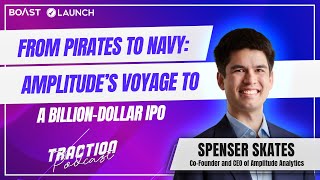
In this Traction Podcast interview, Spenser Skates, CEO and co‑founder of Amplitude, recounts his entrepreneurial journey from a teenage tech‑support business in Cambridge, through MIT’s Battlecode competition, to founding the voice‑recognition app Sonalight, and ultimately pivoting to Amplitude, a product‑analytics platform. He explains how a failed voice‑app taught him the need for deep product insight, leading to the creation of an in‑house analytics tool that revealed the critical impact of voice‑recognition accuracy on retention. This insight sparked Amplitude’s core mission: give product teams granular, actionable data. Skates describes the transition from engineer to salesperson, the importance of spending half his time talking to customers, early sales tactics, and the rapid growth from $0 to $1 M ARR in nine months, then to $14 M ARR in 18 months. He details hiring the first CRO, building successive executive teams, navigating executive turnover, and scaling the organization to a $1.2 B direct‑listing IPO in 2021. Throughout, he emphasizes relentless customer focus, out‑building competitors, hiring people stronger than himself, and maintaining founder‑level vision while evolving into a public‑company CEO. He also shares personal reflections on perseverance, leadership, and the value of aligning personal purpose with building a company.
Chapters
I need some traction.
Hey, Traction fam, we have a real tech superstar today. Big fan of his, CEO and co-founder of digital analytics leader Amplitude. I think worth over a billion dollars, $1.2 some odd billion dollars. Market cap. Spenser Skates founded the company in 2012 to help organizations build better products through data, and he's taken the company public via direct listing in September '21. Previously, he worked as an algorithmic trader at DRW Trading Company and graduated with a bachelor's in bioengineering from MIT, where he was the back-to-back champion of Battlecode, MIT's largest programming competition. What a journey, man. Super excited to have you here. Thanks for joining us.
Oh, absolutely. Very excited. Huge fan of Traction Podcast. You guys have interviewed some incredible founders and incredible companies and have some awesome stories. And so excited to be a part of it as well.
Fantastic. Let's start by diving into your backstory. Where did you grow up? What was childhood Like, was there anything that served as an inspiration to become an entrepreneur? A lot of the entrepreneurs I talked to, there's this common theme around, you know, proving the naysayers wrong or changing the status quo or just unhappy with how things are done and it just burns them and they have to do something about it. What was your childhood and journey like to Amplitude?
I grew up in Cambridge, right outside of Boston. And from an early age, I just always wanted to do my own thing. I didn't know anything else. Both my parents were in the academic world, and so I didn't know anything else besides school. And I thought, hey, if you're smart and ambitious, this is what you do. But school just frustrated me because it was always like you had to do something on someone else's schedule and someone else's way and someone else's time. And my, my first experience getting into the world of business was when I was 16, I started my own tech support business around the neighborhood where I'd go around and help fix people's computers. And I remember back at the time I saw that the Geek Squad as part of Best Buy was charging something crazy, like $120 an hour to help you fix your computer. And as a high school student, I'm like, man, I can do this for so much cheaper. So I'll charge $30 an hour, which was a lot of money for me at the time, but much, much better price. And I ended up going around the neighborhood. I put up some flyers, said computer help, you know, give me a call. I'll come by and help you fix your computer. And just doing random jobs like helping people install their operating system, help them set up their printers. Helping them with their email, stuff like that. And it was amazing because it was the first time I got to do something that really I was in charge of on my own schedule and my own time. And that was a ton of fun. I remember I had to do this thing with the bank where I had someone who needed to write out the check to me as a business name instead of a personal name, except I didn't have a business account. So I just made up, I'm like, ah, just write it out to Cambridge Technical Support and I'll figure it out. And so he wrote it out to Cambridge Technical Support and then I realized like, okay, I actually need to start the business in this name to be able to cash this check. And so I did some research online and like, oh, I guess what I want is a sole proprietorship. So let me set that up. I went into the bank and they're like, you know, Oh, are you 18? And I wasn't 18 at the time. I was like 17 and I was like a few months away from my 18th birthday. And I'm like, no, I'm not 18, but I want to do this business and I'm going to be 18 soon. So can you guys just set it up? And the bank manager was like, okay, all right, I'll figure it out for you. And he set me up an account. And so yeah, I was in business officially as Cambridge Technical Support. So that was my first real experience with entrepreneurship. And I just loved it because I think growing up, so much of your life is dictated by either what your parents do or what teachers want you to do, or just by someone else's schedule. And this is the first time I could really build something myself and I need, you know, I was, I was making, and, and on top of that, I was making great money as a high school student. So it was, it was just the, the best of, uh, of so many different things together. Uh, the, the second thing was I, I, uh, I went to college at MIT just, I actually wasn't planning to go to MIT. I had the impression growing up, I'm like, man, that's where like all the really nerdy kids go. Like, I don't expect myself to go there as well, but it was the best school I got into and I am so, so glad that I went. It was an amazing experience in so many different ways. Lots of, it was a very friendly place, very welcoming place, allowed me to be myself. And the experience I had there was, Well, one of the ones that really stuck with me was the Battlecode programming competition. And it was this thing that combined all these different pieces that I loved. It combined programming, which I, I had a ton of fun doing. It combined, you had to write an AI for this video game and it also combined competition, which I just love to compete. And so it was like the nexus of all these things I loved. And the really cool thing about it is it was very prestigious at MIT, so At the time I was doing it, there were over 1,000 students that participated in this competition, um, between 300 different teams. And if you were one of the top teams, you were a really hot candidate. A lot of companies would want to recruit you. So Google would want to recruit you. Uh, Facebook would want to recruit you. A lot of startups would want to recruit you. A lot of, uh, finance, financial firms wanted to recruit you. And I was like, man, okay, I'm going to set my sights on figuring out how to do really well and win this thing. And I ended up recruiting one of my best friends from college and my roommate Steve at the time to do the competition with me. And we worked like crazy on the thing. I, the month before the competition, I made sure to clear my schedule and just practice on the previous year's code. And then during the entire 3-week competition, I made sure not to do anything else. So like I'd wake up at 10:00 AM I'd go out, I'd drive to, or I'd, I'd take my bike to the, to the Indian buffet place. I'd take out, I'd get like 4 plates of food filled up to the brim and then I'd bike all the way back to my dorm and then I just work, we just work together all the way from 10:00 AM to midnight and do that day in, day out. And we ended up being very close. It came down to one, us and one other team in the finals. And frankly, it was just lucky that, that we ended up winning it that year more than anything else. But that opened up a world of possibilities for me. And I saw, I got recruited by High Frequency Trading, which I spent a year doing a detour into. But one of the things that came out of it was that so many other successful competitors in the competition had gone on to start their own company. So the founders of Dropbox were there. Uh, there was this company Etherpad started by Aaron Iba. There's another company, Tvox. They'd gone on to build their own companies. I'm like, wow, this is really, really cool. Like if these guys can do it, maybe I can do it too. And the interesting thing in talking to a lot of these guys was that they said that the Battlefield experience was the closest thing they had to building a business while in school. And so I spent the next year just studying up on startups and trying to figure out, is this something I'm capable of doing? And one of the things that I took away was that if you were willing to sign up and go hard on something for at least 2 years, then you would find some level of success. Maybe your company would be acquired, maybe you'd raise a round and go on to continue scaling it. You know, maybe it'd lead to some other opportunity, but just if you were willing to stick it out, you would go on to find success. And so I ended up doing a detour for a year in finance. After I left that, I recruited Curtis, my current co-founder, and moved out to California and lived on his apartment floor. And then he eventually left his job at Google. And then a few months after that, we started Sonalight and that was the first product that we went and we did Y Combinator and, and things took off from there.
What was the inspiration to build that first product? What was the problem? How did you come up with the idea?
We thought voice recognition was on the cusp of becoming a mainstream product. This was actually before Siri had launched. And we said, hey, we have these phones now. They're in your pocket. They can actually listen to you while you talk to them. This might change how we interact with technology. So instead of clicking with a mouse or using a keyboard or using a touchscreen, maybe you'll actually talk to your technology and have a conversation with it. And the technology looks really hard, but we think it's just starting to get possible. And we said, okay, well, what are the ways that you're going to want to interact with this technology? Well, one of the most common ways is people actually want to use their phone while they drive, and it's actually super dangerous. And so we said, okay, if we can solve that problem by allowing you to do that hands-free, so you're not distracted and looking at a screen, that's going to be a huge way that this interface is going to break through. So we built this app called Sonolight Text by Voice, which allowed you to send and receive text messages by talking to your phone. So you'd have a conversation, you didn't have to press any buttons, you'd have a conversation with your phone, it would, it would talk back to you. And it was, we were actually one of the first to come out with this technology of being able to talk to your phone while sleeping. This again, this before Siri, before Amazon Alexa, before anything else had done this out there. And we had this really cool demo where I would take my phone and I'd put it in my pocket and then I'd have a conversation with it back and forth and send a text message. And people thought it was the coolest thing ever. They're like, wow, that is magic. And so it was a really, really cool demo and a really, really cool value proposition.
How did you go from Sonolight to Amplitude?
We ended up doing Y Combinator with Sonolight and we had one of the best Demo days out of all 60 companies in the batch, we had something like 12 different press articles cover Amplitude in particular. We got tons, we were tons of hype, tons of traction around Sonalight. It's funny, actually, I should just post this on Twitter where Sam Altman from OpenAI actually had this killer breakthrough. He was advising YC at the time and he gave us this killer breakthrough line where he said, Oh, you guys, Siri just had come out and that was the hot thing. And he was like, you guys should say you're Siri on steroids because instead of having to press a button and then talk to your phone, you can just do it while it's asleep. Just, you know, call yourself Siri on steroids. And that headline, that resonated with journalists and it ended up getting posted all over the internet. Um, and so we were like, we were on top of the world. We were like, man, we're going to go conquer the world with this thing. And the problem was. The product just didn't work well enough. So we got a few hundred thousand downloads. Um, we got a lot of press, we got a lot of attention, but users weren't sticking around. They would use it, they'd try it out, they'd say, hey, cool novelty, but they wouldn't use it day to day to help them send and receive text messages. And the technology wasn't there. The app wasn't quite fully functional enough. Um, and so we knew we had to do something else. At the same time, we had spent all this work and effort developing an in-house analytics tool to help us understand how we could improve the user journey. And so we, we wanted to know what was it that led users to stick around? Like we had this question of. How important is it to be able to have accurate voice recognition? I mean, you know, it feels intuitive that it should be important, but we wanted to know, okay, if we improve the accuracy of these algorithms, what sort of impact is that going to have on the user journey? And so we spent all this time, but what was frustrating was none of the tools off the shelf could answer that. A lot of them could answer, here's how many page views you have, or here's where your sources of users are from. And so we said, okay, well, we're, let's go build it ourselves. And as it turned out, the accuracy of voice recognition is actually incredibly important. A 1%, if you had a successful recognition event, you were twice as likely to become a long-term user than if you failed your first recognition event. So massive, massive impact. And so if you had a 1% improvement in that, that'd result in a 1% improvement in long-term retention. So huge, huge leverage. And what was interesting, when we showed that data to other companies, they're like, wow, I really wish I could get this level of insight about my product as well. Facebook had actually come out with a very famous study at the time, where they looked at what the best predictor of long-term engagement was for their product. Actually, any guesses as to what they found in that?
Let you take that.
They, um, so they found, they actually had a lot of different hypotheses. They thought it might have been how much your profile you filled out or what apps you used or whether you uploaded a photo, but they actually found the most important predictor was the number of friends you added. And if you added 7 or more friends, then you were an 85% chance to stay at least 2 months.
Yeah, I do. I do. I do recall reading about this years ago.
Yeah. And if you were less than half that, if you were less than that, that threshold, it was less than half that chance of retaining. And so that was a huge insight for them. And that led them to become the behemoth they are today. And you might say, hey, Spenser, it's obvious, duh, you got to add friends. But every single social network before them hadn't figured it out. MySpace hadn't figured it out. Friendster hadn't figured it out. Xanga hadn't figured it out. Only it wasn't until Facebook that they figured out that the, the network was the key part of the user, of the user experience.
So in a way, understanding your product's core action, the thing that if users don't do, your product probably won't exist or will cease to exist.
Yes, yes, exactly. Exactly. What is it about your product that makes it so compelling? Another, um, and, and so, so we said everyone is gonna want to use this same set of tools. Everyone's gonna need this level of insight to their customer journey. And so we ended up in June of 2012, we shut down Sonalight and we ended up starting Amplitude. And we said, let's try to figure out how we can make this analytics and make it for everyone. We ended up adding a third co-founder, Jeffrey Wang, at the time. I always say that Curtis is twice as good of a programmer as I am, and Jeffrey is twice as good as Curtis. And so very, very lucky to add him at that point. We launched it in 2014 and then it just took off. I switched over full-time from the engineering to the sales side and we grew from $0 to $1 million in ARR in 9 months. We then tripled or quadrupled the company's growth the next year, and it just kept going and going and going. Got to $100 million in ARR, ended up taking the company public through a direct listing. And then, you know, here we are today, the leader in the market. So it's just been an incredible journey. And for me, it's just about how do we make, how do I, how do I make sure to keep up and, and get ahead of, of where we're going.
I love that. I, you, you identified what your zone of genius is and you found people who are better and then you you focused on your zone of genius, but moving from engineering to the sales side is hard. Walk us through that journey from, hey, you validated the idea, talked to a few people, they saw great value in it, and now you've taken it from zero to a million in 9 months, predominantly you selling, I assume, right?
Yes. Yes.
What was that journey like? One, transitioning from an engineer to a salesperson. And, uh, and how did you make that happen? How did you get your early customers? What were some key learnings or insights there?
The first thing is something that Paul Graham, as part of Y Combinator, was always beating into us, which is you should spend half your time talking to your customers. As an engineer, it's so easy to focus on the building. It's so easy to focus on making the product better because that's what you know how to do. That's what's comfortable for you. But it doesn't matter if you build something that's not valuable to your customers. And the only way you're going to know that is if you spend time talking with them and understanding them. And so that was just the first principles thing where it's just spend time talking with your customers. And for Amplitude and our product, what that meant was doing sales because We were a high, we're a high sales price product that required a bunch of handholding and implementation. And so the only way to make you successful was through going through a sales process where we made sure you were a good fit and helped you get on board with Amplitude. And I remember seeing so many other great engineers and great founding teams who had built these beautiful products, but who hadn't spent the time to talk to their customers and hadn't spent the time to learn sales and ended up going nowhere and failing. And I was like, okay, I know that if I don't embrace this fully and go all in on learning how to be a great salesperson, we're not going to get there. And I said, okay, well, I got to go do this. And so I switched from spending a bunch of time in the engineering of product to sales in 2013. Early 2014. The other really big thing that helped is I got a sales coach, this guy named Mitch Morando, who had helped other companies and other engineering founders learn how to sell. And it was fantastic. He would come and meet with me once a week and every week we'd go through the list of customers we'd be talking to and he would ask, what's the pain? And I'd be like, well, they want to do some charts. And I'm like, He's like, what's the pain and why do they want to do that? And I'd be like, well, they can't do it now, um, on their existing SQL setup. So they want to use us. I'm like, Spenser, I'm still not hearing any business pain. What's the pain? And so he kept beating this into me. And so every single customer conversation, I'd have Mitch in my head asking me, what's the pain? And so I would then in those conversations start to get very, very curious about what they were looking for, what the business need was. How important that was to them. And that transformed me from this engineer who didn't really know how to set up, build a successful business to, to the salesperson. And, you know, again, you know, we, we grew that, you know, it took off like crazy from, and we were happy to be at the right place at the right time where we went from zero to, to a million in ARR in 9 months. And then as part of that, we started hiring salespeople and, I started running the early sales team and then we hired sales leadership and then, you know, continued to scale from there. But it was, it was super important. The, the core two core motions as any B2B company, one is the engineering and building a great product. The other is selling it. And if you get those things dialed in and you do it well, then you'll go take over the universe. But you can do a lot of other things right. And if you miss on one of those, then it doesn't matter.
Exactly. I, I truly, truly believe that, especially in 2023, it's easier to build product, building an audience, getting customers is really hard, but I want to walk through what were the key things you did, key actions you took to sell. I mean, did you feel nervous at all? I mean, I remember the first time I picked up the phone to cold call, man, I practiced for 4 hours. And when the decision maker showed up on the line, I hung up and everyone around me was laughing.
But did you have some? I love it. I love it. Oh man.
How did you get these people in the pipe? I guess being a part of YC helps a lot in that you could have reached out to other founders.
Right.
But what did that journey look like? Who, who did you reach out to? How did you get to connect with them? And what were some things you had to learn about selling in those early days?
They came from all over. So some came from our YC network, like you mentioned, some came from investors we had introed, got intros to, uh, a few came, we did a launch on TechCrunch. Again, I would say don't expect anything from PR in general, but we got a few from that as well. One of the really early personas we found was the Zynga community. So Zynga was a very hot company at the time, top in mobile gaming, had FarmVille, had all these other huge, uh, Facebook and mobile games. And a lot of product managers who had left Zynga had gone on to start their own companies or join other companies, and they didn't have the access to the same analytics. And so when we sold to one of them successfully, the word started getting around and we got introductions to more. That's always the best. If you can find a community of people that really loves you, even if they're tiny and really niche, that's where you want to, that's always where you want to start.
What was the major sales fuck-up you did in those early days that you're like, look back on?
I remember the very first deal I closed. So the we had basically begged people to use Amplitude for free. We're just like, just use it. You know, we'll figure out how to charge you guys later. Just get value out of it. Let's, let's prove to ourselves that this thing works. And I wish we had something like 30 companies using it at the time. And I wish I had asked for money earlier because then out of those 30 companies, but guess how many would have paid us? 5? None. Zero out of those 30 companies would have paid us. Zero of those 30 companies ended up paying us in the end. And so honestly, it was kind of a waste of time for us to build product for them because they, they didn't really care about this that much. Whereas if you, if we had figured out that none of those companies wanted to pay us, then I could have moved on to go find even a single company that would. And so finally, I have this meeting with this company called Super Lucky Casino. This guy named Brett Terrell, who was the co-founder and CTO, ex-Zynga guy. I show up to his office along with our first employee, Alan, at the time. We go through the demo, do the whole pitch. The funny thing, actually, Alan, halfway through the meeting, had a pen explode in his pocket. And I don't know, he was like messing around with his like pocket. And I'm like, Alan, what are you doing? And then like, he takes his hand out and he's like, oh, sorry, my pen exploded in the pocket. And I'm just like, oh my fucking God. And so anyway, me and the other guy had a good laugh about it. And so he goes to the bathroom to wash his hands. All this goes through, all this transpires. We get to the end of the demo and Brett asked me this question I had never been asked before at the end of the meeting. He asked me, how much does this cost? And I'm like, holy shit. I don't even know what to say. No one's asked me that before. I'd never even thought about the question. I thought we were gonna try to get this guy to use it for free and then maybe charge him in the end. And then I remember Patrick McKenzie's advice on always charge more. And so my first instinct was to say some number like $50 a month. I was like, that's the price for SaaS. If you're a SaaS product, it should be $50 a month. I'm like, you know, I might as well just throw out as big of a number as I can. So let me just double that. Let me say $100 a month. I was like, no, no, no, that's still too small. Let me like just 10x that and just say $1,000 a month. So I go out and I say $1,000 a month, which is as much confidence as I can, thinking he's going to be like, what? This is crazy. Get out of here. Um, but his reaction was, wow, that's really cheap, Spenser. And I'm like, holy smokes, this guy wants to buy this for $1,000 a month is incredible. In retrospect, it was very cheap for what we gave him. But I was so, I was over the moon because it was like the first time someone was really paying us for software that we had built and had cared about it. And just, I was so, so happy because we had a first paying customer. And so that was the first deal that we closed at Amplitude.
You know, there's a key insight here, right? I look at startups as 4 distinct stages. You have an idea, you need to validate it. What does validation mean? Can you get 5, 10 people to pay you to try it out? You have an ideal customer profile nailed, does the messaging resonate with them? Truly, especially in B2B, nothing makes the rubber hit the road more than feedback from a paying customer. When people are not paying, they just don't dedicate the time. When they put the money, they are more inclined because, you know, there's, it's on the line item on the company, on the finance team. So I'm glad you, you brought that up and the challenges you had. You got 30 customers and I guessed 5, maybe, you know, your sales prowess, YC network, you might have convinced 5 to pay, but actually that's pretty accurate. Um, previous to Bose, I did another company in the— was an AI sales assistant and we had 10,000 free users, none of whom converted to paid, right? We had to beg a new set of users to pay us when we made it to paid. Moved to paid, but by that time we actually ran out of money. And so key learning here, right? This was 2015, '16. At what point did you feel you had product market fit? And what was that feeling like? What is it? Is it retention? People are just not leaving you. Are they referring you? What is your benchmark of product market fit or what was your benchmark of product market fit?
When we got to that first million dollars, that was the sign that there's a real market for this thing and we just need to keep chasing it and following it and pushing after it. That was the sign that it's not just, we have a real business. There are customers who are willing to pay us. There's a real pain out there and it's scaling fast and our job is just to keep up with it, um, as it goes. You know, that, that first trajectory, so that first customer, Brett at Super Lucky, he paid us $1,000 a month. The next one was Zuhair at Keepsafe. It was $2,000 a month, um, right out in our launch in February. Then it was Here Maps by Nokia, which was $3,000 a month. And then we got The Hunt as well for $3,000 a month. And then we got we got, uh, Hey Labs, which was Siki Chen for $4,000 a month. And then we jumped to $8,000 a month with RDO. And then we got to $10,000 a month with QuizUp. And so as we would just, I'd just keep doubling the, the amount I would ask for in every subsequent sales conversation. And people kept saying yes, yes, yes. And it was clear that there was a real business to be built here.
Amazing. Who are the people that you hired to go from product market fit to scale, let's say you felt product market fit at a million to make that journey from 1 million to 5, 10 million. How long did that take? Firstly, how long did it take to go from 1 to 10?
We were very lucky. It happened fast. We went from 1 million in 2014 to 4.5 million in 2015. To 14 million in 2016. And so we're talking about a year and a half to get to from 1 to 10. So it is very, very fast.
How many people did you, did you have when you landed at 14?
I want to say 35, 40, something like that. Had a whole bunch of engineers and product people. Um, and we had, uh, actually a pretty small sales team at the time. We had 4, I remember we got to about $8 million with 4 account executives and 2 SDRs, uh, which was incredible in, in retrospect. And then we had just started building out the next set of teams at the company, uh, for the next level of scale. So I started hiring my first set of executives. I hired a CRO, hired a CFO that year to help start building us out. I eventually hired an engineering leader as well.
What in that journey, 1 to 14 in 16 months, I know you keep saying lucky. A lot of us say lucky, luck and risk are two sides of the same coin, right? The ones that get lucky keep flipping, flipping, flipping. But what were some key ingredients to take that you had in place you thought, looking back that took you from 1 to 14 in that 2-year timeframe? Like maybe it's people, maybe you had great sales execution. What was happening?
I think there were a few different things. The first was just the market, which is there was a lot of demand from product leaders for great understanding of their customers. A lot of new startups, tech companies wanted to know what their customers were doing. And so it was just a right time, right place, and there was an opportunity there and, and we seized it. On the execution side, the thing we did really well was just building and shipping tons of products. And it wasn't about having one killer feature that was better than everyone else's. It was about how can we create a machine that outbuilds everyone else? Because there were a lot of companies doing analytics at the time. Mixpanel, there's Kissmetrics, there's Localytics, there's Appsalar, there's Flurry. The list goes on and on. There was Heap, there was Keen. There were just so many players in this space. And instead of saying, we're going to bet the company on doing analytics this one way and we're going to carve out this niche for ourselves, it was about outbuilding the competition. And so when they'd ship 10 features, we'd ship 20. When they'd ship 20 features, we'd ship 40. And being more responsive to customer demands, we'd go into a deal, we'd say, what do you need to choose us? They'd say, hey, we need these features. I remember we talked to this Rhapsody music streaming company and they were like, hey, we need 7 features to buy you. And I'm like, 7 features? Jesus, man, that's a lot. Can you guys like rank these features? You know, which ones do you need the most? And they're like, nope, we need all of them. Okay, maybe these 4 ones first and these 3 ones later, but we need all of them. I'm like, all right, whatever, we'll, we'll build it. And I'm, I'm very lucky. I worked with, I had Jeffrey and Curtis as co-founders, just incredible engineers, just churning out product. Um, and they ended up, uh, and that, that was the core of our competitive advantage that we would have engineers on sales calls, talking to customers, understanding what they needed to close the deal. Um, and then just doing that again and again and again. A lot of companies, they separate the engineering and the sales too early. They're like, salespeople are very, very different from engineers. Engineers, highly technical, very in the details, very much about how do you build something great? Whereas salespeople are all about how do I chase the latest opportunity? What's interesting though is a lot of the best ones have huge respect for the other side because they know how hard it is and because sales is just as deep and complex and critical for the success of a business as the engineering. And so we were always very deliberate about setting that tone culturally. Hey, we're going to, even though we're engineering founders, we're going to embrace sales. We love sales. And we're going to be a great sales company because we know that that is the path to success. And so it wasn't a killer feature or killer insight about the market. It was, We're going to outbuild an execution engine that beats all these other companies in this very crowded space.
Makes sense. And that's the way to do it because velocity is the currency of all high-growth startups and you need the go-to-market execution and product execution happening in tandem with speed. Talking to customers. I love that. I love that you're sharing this and it's, it's, it's first principles. It's obvious, but most people don't do it. Still a very top-down sales motion at that point. Did the way you generated leads change at all from 1 to 14? Was it referrals? Were you doing any special form of marketing or were you just hammering the emails, the phones, uh, like in the early days?
We, we've never been particularly good at marketing at Amplitude. It's always one customer at a time that we focused on winning. Like even to this day, we're not, even though we're the big winner in the space and we're larger and we're better and, and we're more scaled, our brand is still not as big as, as some of the other companies in the space. And it drives me crazy as a CEO. The flip side of that is that made us really, really good at winning each incremental customer. Because if you got into a sales conversation with us and you sat down and evaluated us as a real option, we would always win that because that company would come to the conclusion, hey, Amplitude's a much better bet. Product is better. They understand my problem better and they're going to innovate faster than anyone else. I want to go with them. Um, and so it's a combination. I mean, we had salespeople and SDRs doing outbound. Uh, we'd have product launches once in a while that would get in more. We'd have folks referring us. We'd have people going to other companies, but we, we never got systematic and good at tracking it. It was more about let's make sure the folks that are talking to us, we do the best job we can for them.
Amazing. I like, I like that you embrace Your zone of genius and don't try to chase what society or the startup world is saying, oh, you need to do PLG, or, oh, you need to double down on ads or programmatic or something else. You said, you know what, we're just gonna do what we're good at. And in many cases, that's the way to win big is one kind of customer coming through one kind of channel, getting one value. Just because society is telling you that, oh, you should be on Instagram and you should go viral on LinkedIn, but you're having great success doubling down on human-to-human selling, why would you abandon it? So I love, I love these lessons and that's something that every founder should embrace. The path to IPO, how did that come about? Who are the key some of the key drivers on that senior leadership bus that helped you get there? Like, what are some key roles you had to fill?
We had to, I had to, so as, as the company started scaling, as we started to get to 10 and beyond, my focus shifted from running sales to building the executive team. And I had to, that was, it's a constant process. You're always building and upgrading the executives that you have. I mean, we, to get to our public listing, we had to go through, we had our first set of executives at Amplitude who were, helped us build the company in the early days to about $30 or $50 million in ARR. And then after that, you realize you need a different set of executives to really scale the business to get to $100 and beyond. So we got a CFO in place, we got, who was right for helping us go to public markets, Wong. We got a sales leader, Matt, who was good at running scaled sales teams. We had a few other players on engineering and product. Actually, I'll have to give a lot of credit to my current chief product officer, Justin Bauer, who basically joined us when we were about $2 million in ARR and scaled with us for the last 8 years to public listing and beyond. So it's just your job as a founder, once you get past about $10 million, goes to building and running the executive team. And that is so, so, so different because executives are very, very different types of people than founders are. They're a lot more experienced and they bring skills that you don't have and you don't have time to learn. And they're better than you at a lot of those skills. They're better leaders. They're more experienced. They're, they're better at hiring. They're better at their function, there's a whole bunch they're better at. And at the same time, you have to recognize you're the leader of that group that's making the calls ultimately. And so that was an adjustment for me. But we did that. We got into their second executive team and then we took the company public in 2021. And now in the last 2 years, we've just gone through transition from our second executive team to our third executive team where I brought in folks like Thomas, our president to run all of, uh, go-to-market, um, and it's a much broader role than we've had before. I brought in, uh, Chris, our, uh, CFO. Uh, I brought in KJ who runs HR. So it's just, it, it's just a, you're constantly evolving that group. You're constantly, it's just a constant nonstop thing.
At what point you decided to make the CRO hire given your very sales-led organization seems like a crucial one and also it's crucial to your IPO. Um, and what are, what is the job of a CRO at a scaling company and key things you need to look for when making this hire?
It depends a lot by stage. The first CRO we hired is a guy named Matt Holthausser. And the key thing when you're small is that there's not that much going on in the company. And nobody cares about you. You don't have a differentiated product. You don't have a big brand. You don't have a big customer base. You're kind of nobody and you need someone who's good at making things happen out of nothing. And I remember hiring him and Matt in so many ways is a better leader than I was in terms of inspiring people and hiring people and leading them and running meetings and like, holy shit, this dude is like, this is the first time I'd hired someone who was much better than me, had a whole bunch of dimensions. And I was, but what it did was it unlocked the next stage of growth for us. So that was the very, that was the first executive hire we did was that head of sales. And then we, you know, filled out the other roles, CFO, engineering leader around that. And again, it was all about someone who was willing, being a lot like a founder, willing to be scrappy with not many resources and make stuff happen out of nowhere.
Now, when you replace these people, right, you replace a CRO with a new CRO or top them up, what is the kind of conversation you have? How do you make it feel like, hey, you know what, you helped me get to here. Like, how do you have that uncomfortable conversation?
It's so hard. I, you know, I'm still learning it to this day. It's so hard. I think the first thing, and this is where I've gotten tripped up the most, is separating your desire to make them successful because you've hired them, they've come into the company, you've made a big deal of them, you want them to be very successful, they've joined your company to find big success. And so you all want them to be successful and you have to, you know, they, they want, you need them to feel that from you. At the same time, you have to be able to evaluate them separately and say, is this the right person for the next 2 years and the journey that we're going to go on? Or are we going to, is there some, is there some gap that will prevent them from scaling that's just going to get worse over time, in which case I'm going to need to have a conversation. And being clear about that in your head is so hard. One of the things I had to get past as a leader is I've always had this belief in leadership since I was young that you shouldn't be asking someone to do something that you aren't willing and able to do yourself. You had to lead by example first and foremost. Leader goes first. But being a founder CEO of a fast scaling company, you actually have to break that rule because you have to hire people with skill sets that you could never do yourself. Like I could never be a public company CFO. I could never run a scaled sales team. You know, I could never lead go-to-market like Thomas does. And emotionally getting past that took the longest time. 'Cause I'd be like, well, maybe I gotta learn this myself and coach them and do, it's like, can't, like this company's scaling so fast when you're on an exponential curve, it's just, your job is just to keep up with it as it scales. And recognizing that, that's the hardest part, candidly. Once you've recognized that, if you can keep that straight and clear in your head, then it's just about how do you authentically communicate that to them in a way that's true to the relationship and true to them. And you know, you can get, it's kind of like learning sales. Like the key when I was learning sales in the early days was go out and do it and get a coach. Don't go and read a bunch of books at it. You're not going to learn much from reading books. And it's the same self-awareness management thing, you know, go out and do it and get advice and coaching on it as you do it. But it's one of the hardest things that you have to do as a CEO to this day.
You know, I'm smiling throughout our conversation because a lot of what you say is what I say a lot. And, you know, I think it's seen as contrarian advice. So one thing being, I hated reading. I ended up writing a Wall Street Journal bestseller on building communities to grow business. But nonetheless, I hated reading because my style was just do it. And when you do it, you know what your gaps are and then seek advice just in time. Because it's hard to just read like a novel and then not be able to apply it. And a lot of people give me flak for saying that, but hey, you build a billion-dollar company. My company's worth a couple hundred. So it works. It's just hard to implement when you're just reading, when you don't have an immediate application for it. And I find in everything in life, you can read a dozen books on getting in shape, but until you go hit the gym and eat clean and do some cardio, you're not going to see the results, right? And so I love, I love how you share that. Now, you talked about talent a ton. What are some effective methods you've used to attract and retain top talent at various stages of the companies? Like you hired a recruiter, you had in-house recruiter.
Yeah.
How do you find these people?
For executives, there's a whole network, there's a whole set of executive recruiters who specialize in it. And if you're a fast-growing company, you look at them and you'd be like, oh, they cost a lot of money, but they have that network that you don't. And that could be very leveraged. So that's one very tactical thing. The other big thing is just spending time on it. The vast majority of founder CEOs I meet don't spend enough time recruiting from the outside. Even if you don't have a role, just constantly be meeting people and building your network of executives for lots of reasons, because you can learn from them because they might lead to other opportunities down the road because you may hire them one day. You want to be spending a large portion of your time, at least I'd say if you have an open role, you should be spending at least a third of your time recruiting. Um, and even when you're not actively searching for a role, being out there and meeting folks just to calibrate, to learn, always very, very important. I've always been more, one of my biggest mistakes is I've been very inward focused at Amplitude and so focused on the existing team and how do we make them effective. And I probably spent too much time there and not enough on continually meeting great people on the outside. And so it sounds cliché, but again, that's, that's the biggest thing by far. I, I find a lot of founder CEOs get wrong. If you just spend a lot of time, if you get to a point maybe in a recruiting process where you say, hey, you know, this person, they're not the best, but I've been doing a search for a while and I really need this role filled. The worst thing you can do is fill that role with that person that you know is not going to be the group, the best fit. Whereas if you're spending lots of time recruiting, you have a huge pipeline of candidates. You never, you never have that issue because you know you have confidence you'll eventually get someone great.
Certainly, certainly. And I love that constantly be talking to people even when you don't need it. I think a lot of the founder's job eventually is injecting new risk in the business. And I feel like the CEO's job is stabilizing the business and you need to have that founder mindset. And the other part is just talking to lots and lots and lots of people. I think when you inject new risk in the business, new products, new things, it may create some worry or short-term instability, but it eventually, you know, drives growth. And then talking to people just expands your brains and your horizons. Now, going from this pirate CEO in the early days where you're doing everything you learned, you coded, then you learned to sell, you saw great success, to eventually being this Navy CEO where recruiting people, senior leaders, taking the company IPO, what are your top 3 or 4 learnings in terms of switching the mindset, right? A lot of victory is what starts in the mind as an early stage founder to one then of a large organizational executive. And then do you find some of your strengths as an early stage founder are still valuable to your role as a public company CEO?
It's hard. It's a hard transition because a lot of things you're used to doing as an early stage founder where you go fast and you pivot quickly, you can't do as a large company, but you pick up other advantages. You have more resources to attack problems and you have a lot more leverage. The thing I think stays constant as a founder CEO is your job is to think about where the company is going and how do you set up to win the future? And that doesn't change. And your ability to do that doesn't change because you've seen it from the start. You know the customers, you know the product, it's natural to you. And so that leadership comes naturally. The hard part is how do you build the organization? So how do you hire the right executives and how do you have the right organizational setup? And that part and managing that, that's the part where there's a lot of learning. One of the biggest things I'd say is talk to CEOs who are a stage or two ahead of you because that's where you'll get a lot of really great advice. We're very lucky to have Jim Whitehurst on our board who scaled Red Hat to multiple billions in revenue through its sale to IBM. Very lucky to talk to folks like Josh James who started Omniture a generation before us. It's just very lucky to talk to Jay at Confluent. There's a lot of knowledge out there on, on how to build an organization. And so the, that, that's the part that, that you, you're learning for the first time.
As you look back on your journey, what was the hardest, lowest point you ever experienced and how did you navigate it?
Oh, so hard. Every single time where the organization broke and we needed to scale executives. That was really challenging. I remember when I had to let my first executive go, that was really, really tough because it was this person that you had worked hard to recruit and you had tried to get help from scaling the organization and you had told the story and now you're saying, hey, there's this data point that totally contradicts that. And that's a hard thing to make the call of. And I've been through that every single time where we go through that as an executive, where the executive team goes through major transformation. I mean, this last year and a half where we've changed out most of the executive team at Amplitude has been tough too because now you're at even larger scale on a bigger stage and it's just even harder in a bunch of ways. All of that is hard. That's very candidly the hardest part is because, you know, there's these people, they're part of your team. You want them to be successful. They want to be successful. They helped you build your company and get really far. I remember I watched this one interview by Larry Ellison and Larry's not a very sentimental guy. He's incredibly ruthless, but the interviewer asked him, what was the hardest thing you had to do? And he said exactly that. He said, when we got to $100 million in revenue, I knew I needed a different executive team and it was so hard to change them out because he had so much loyalty to that group. And so it's, it's that by far, just recognizing that not everyone is going to continue on, on the journey.
And be fine with it emotionally, seek the coaching and the mentorship to, to navigate that. But then do you find new roles for them, top them up, What is the best practice here?
It varies a lot. Uh, the first thing is being clear in your own head. That's the hardest. That takes the longest. Once you're clear in your own head, then you can find the moves. Normally, by default, you probably move them out of the business and you talk about how to make them transition successfully to their next person. Once in a while, you can hire someone above them and that works out. Um, but, you know, rarely, rarely. So even then, you know, normally that person will leave after a while. And so sometimes you are finding other roles for them. One of the ones that actually has been very successful for Amplitude is how my role and my co-founder's role have evolved over time. Jeffrey ran engineering in the very early days of Amplitude, but he realized he didn't really want to be a manager of people.. And so we moved him into an architect role and that worked out phenomenally well for, for us, for, for me and for him and for Curtis. Curtis went through a similar journey. Curtis has probably had the most different executive hats here at Amplitude. He was interim CFO, he was interim CHRO, he ran recruiting, he ran facilities. He's, he's run like so many different— he ran engineering at one point. He's run so many different parts of Amplitude. And after a while, and he'd do it because it was the right thing for the company. We always need more leadership help as you grow. But he just didn't, and he was actually very, he's a lot of ways he was natural at it, but there were a lot of parts that he didn't love holding people accountable. He doesn't love having to deal with a lot of the people issues that come up. And so we ended up moving, you know, I said to him, hey, okay, let's figure out how to get you into a innovation role where you're working on something innovative for the company as opposed to having to lead a function. So those have worked out quite well and it's through great humility on my part and on their part that we're able to figure out a good path for both of them. And I feel very lucky to still be able to work with both of them as co-founders today. Most co-founders don't don't last this long as a group. And so that's been one place that changing roles has worked out very well.
It's a relationship and it's a journey. And as long as you have alignment of values, I think it will last long. As we close out, any final piece of wisdom, anything that you'd like to share more, perhaps your top key principles that every CEO should prioritize when scaling a company?
Always spend time talking to your customers. That's the biggest one by far. Very easy, whether you're at the early stage or mid-stage or late stage to forget that that's what makes you successful. And understanding that well is, is your advantage as a founder ultimately. And especially for those engineers in the audience that like building product, it's uncomfortable to do and different from what you know how to do, but that's what ultimately makes you successful as a, as a company. And so making sure that you find ways to continually do that as you grow is super important.
Fantastic. I love it. It's very rare that a hardcore engineer talks so much about customer love, customer value. Talking to customers, focusing on sales. Ultimately, as we look into the future, you know, yesterday's innovation always becomes tomorrow's commodity. Real success is built in human-to-human connection, because if you understand your customers and their problems and their aspirations, that gives you a way to evolve your product versus being left behind in the rearview. Thank you so much. Where can we follow your wisdom? Where are you active?
Follow me on Twitter, um, or X.com. I'm Spenser Skates, uh, so just look me up or look Amplitude up and, uh, yeah, follow, follow me there for the, for the latest and what I, what's going on with me, how I'm thinking about the journey and, and lots else.
Wishing you great success, another few zeros in your market cap. Life around being an entrepreneur where literally everything you do, every waking moment, you can't stop thinking about the company. Are there things that you prioritize in your personal life, whether it's working out or diet or exercise or social connection, something that you do as a part of your personal routine that helps you play the long game and run this marathon of entrepreneurship?
Oh, I don't have good advice on this one. Don't listen to me on this one. I, the thing I did do before Amplitude was thinking through what I wanted to do with my life and realizing that building a great company was where I wanted to spend my time. And that, that can get you through all the ups and the downs. A lot of founders end up having existential questions that frankly, I think are distracting, that will distract them from the core motion of building the business. They're like, should we sell? Should we quit? I don't know. There's always some problem. There's always some issue as you continue, whether you're small, whether you're growing, whatever size you're at. And so centering yourself on what it is you're trying to do with your life and how building a business fits, it really does take over your life. And so if you're willing to dedicate it, you can go on to have great success if you're willing to stick it out. And so that would be the biggest thing that I would say. Definitely.
I like how you talked about it. And, you know, I say this a lot as well. When passion meets profession, you can become Michael Jackson or be top at your game. Kudos, man, for finding your passion and giving the world better data and insights on how to build better, bigger businesses. Wishing you great success. Thanks for joining us.
Thank you so much. Thank you for having me on the Traction podcast. Huge, huge fan. Thank you to all the listeners. Uh, if you want to build better products, come check us out at amplitude.com.
More from Spenser

The Library of Minds: Product Expert: The Future is Fully Automated Software Development | Spenser Skates, Amplitude


Why The Second Decade Is The Best For Startups — A convo w/ Spenser Skates, CEO Amplitude Analytics
How Amplitude Became the #1 Product Analytics Tool | Spenser Skates, CEO & Founder