How I Built A $1.4B Software Giant Called AmplitudeㅣSpenser Skates, Amplitude
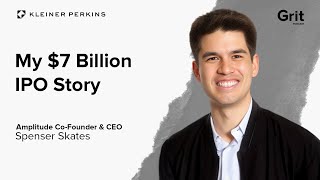
Spenser Skates built Amplitude from a failed voice-recognition app into a $1.4B analytics company by pivoting to customer discovery and spending half his time talking to users. He hit $1M ARR, then $100M, by focusing on deep insights in a crowded market and treating the startup as a full-life commitment.
Chapters
You can start the company at any age. You can start it in your 20s, you can start in your 30s, you can start it in your 40s or 50s. Like any age is possible. The key thing to understand is how hard it is and how much of a life commitment it is. I've been very deliberate about sculpting my entire life to allow me to build this company. And so that extends to my personal life, that extends to where I live, that extends to what I think about. I just, obsess about what I'm doing here day in, day out. Like, very candidly, look, I've fallen out of touch with so many friends because I've been so focused and dedicated on building this. And part of me misses out on that, but part of me realizes that's the choice I made in life, and I'm okay with that, you know, and I'm okay with that trade-off because I knew that that's what it takes to build. My number one advice would be— Hi, my name is Spenser Skates. I'm CEO and co-founder of Amplitude. Amplitude is a digital analytics platform. We help you understand what your users are doing in your digital product. So we've grown enormously fast. We then launched it in 2014. Since that time, we've grown from $0 to $270 million in annual recurring revenue over the course of just under 10 years. And so we have 2,700 companies on us, including a lot of the Fortune 100 in the United States, and then took the company public to the market via a direct listing in 2021. We're valued in the billion-dollar-plus range. Now we're thinking about how do we continue to grow the company and take over the world. Before Amplitude, I was a college student at MIT. One of the things I spent a lot of time thinking, okay, well, I'm an ambitious person. I want to make a big impact. What's the biggest and best way that I can make an impact out there? I was a software engineer and I said, well, let me figure out how to build great software to make the world a better place. And then what's the biggest and best way I can do that? Well, actually, by starting a company. I saw a lot of companies coming out of MIT and people going on to their own entrepreneurial journey. So the founders of Dropbox, Drew and Arash, were a few years before me at MIT. There was a few other companies that had come out of MIT in the years before, and I'm like, they're capable of building a company. There's no reason I can't figure it out, even though I've never worked before and I'm just a young college graduate coming out of school for the first time. So let me go figure that out. I tried to convince 20 other people that were friends of mine to come start a company. But no one wanted to start a company at the time. Everyone wanted to go to the safe job at Microsoft or at Google or go into consulting or finance, except for one person. And that was my current co-founder Curtis. Moving to California, moving in with Curtis, I got a mattress on his bedroom floor and we did that for a few months. And the first thing that we worked on was this app called Sonalight. It was a voice recognition application that allowed you to talk to your phone to send and receive text messages. This was actually before Siri. We actually, we launched it. We had a good amount of usage. We had a few hundred thousand people download the app. And so it's like, okay, somebody's using it, you know, that, that we don't know. There's, there's real usage for this thing. And we got up on stage at Demo Day and we had the most amazing Demo Day presentation ever. The problem was a few months after Demo Day, we couldn't get any of our users to stick around. They would try out the app. They'd be like, wow, this is kind of cool. But then they'd churn out and they wouldn't continue to get value out of it. And so we wanted to understand why that was. We built our own analytics platform to help us understand. So we couldn't get the retention high enough because the key factor was how accurate the voice recognition was. To figure that out though, took all this munging and customization of the data and trying to understand, okay, well, how does that correlate to whether someone comes back 2 weeks later and if they get a first recognition event and it's accurate? And we just spent all this time on this internal infrastructure. When it came time to wind down Sonalight, we said, wow, actually a lot of the companies, other companies we talked to say, hey, we can't get these same insights about the product experience. We really want to know what drives engagement and retention. So can we get what you built on the analytics side? And, you know, at first we said, no, that's just an internal tool we have. But then after we decided to wind down Sonalight, we said, hey, maybe there's something here. I remember in June of 2012, we ended up making the decision to switch over full-time into building out this analytics platform. And that was the start of Amplitude. We launched the company in 2014 and have been growing since. To this day, in terms of folks who I know have my interests as a founder deeply at heart, like Paul Graham and Y Combinator is at the top of the list. Most of the time within YC, because we were working on Sonalight, was spent talking about, hey, how do we grow it? How do we launch it? How do we get more users on it? And we meet with them weekly about it. I remember this one conversation. Sam Altman was starting to get involved at the time because he had just wound down Loopd. I remember Sam really challenged us about how passionate we were about this problem and whether we think we were going to be successful. And I remember saying to him, yeah, you know, we're not particularly passionate users of voice recognition as a technology. We just think it's a cool technology. He's like, yeah, you guys should work on something else. And so that was the genesis of us deciding to wind down Sonolight and then ended up working on Amplitude. One of the biggest mistakes we made with Sonolight was not spending enough time talking with our customers. We would build product because as engineers, that's what you know how to do. You know how to build product. How do you talk to customers? I don't know. Like, you know, it's weird, it's awkward, it's uncomfortable. But one of the things we did with Amplitude very purposely was saying, hey, I'm going to make sure I spend half my time talking to customers no matter what. And so before we even built product, we just reached out to 30 other companies and to do research and to ask them, hey, Is this a pain point? Would you use this? What are your pain points? How do you think about this in terms of how it fits in your business? And through that process, we actually found about 7 companies that were interested in, in using Amplid. Turns out like only one of them actually ended up using it after that. But we felt we had enough validation and enough understanding of the sort of problems that, that they want solved. That's my number one thing, which is as a founder, how do you spend half your time interfacing and really understanding customers? It's so easy to do other things. It's so easy to, if you're an engineer, build product. It's so easy if you're a or a designer to spend time on that. But it's very, very easy to not spend time talking to your customers. And so as a founding team, you have to be very deliberate about spending 50% of your time engaged with users. Perfect, the enemy of good. My point there is that I think one of the mistakes people get into is thinking, hey, I don't want to let go of this idea. We were really in love with the potential voice recognition. It was this new technology that was at the bleeding edge of what's possible. It was hard to imagine a future without it. Very highly technical problem. It was what I'd call a 95th percentile idea. So it was in the top 5% of ideas. After doing it a year, you realize like, one, we weren't passionate about the space, and then two, the technology wasn't quite there yet. And so it wouldn't be possible to create a breakthrough. And so while it was a good attempt, we knew we could do better in terms of what we built. And so we got incredibly lucky. We searched around at a lot of different ideas and we ended up zeroing in on analytics and In retrospect, that was a 99th percentile idea for us, was top 1% of ideas. First, we were— there was a big pain out there. We knew that the web was shifting from a marketing-centric web to a product-centric web and would require a new set of infrastructure. And so what Google Analytics and Adobe had done in the previous generation would need to be redone. There was an opportunity to build something massive. The second is that we were the right founders for it. We were hardcore algorithms engineers. To figure out how to create a system that successfully processes massive volumes of data and spits out a result was perfectly in our wheelhouse. There was— the opportunity was there. It was a great match for who we were as founders. I think of that as a 99th percentile idea, and I'm so glad that we made the decision to wind down Sonolight as a result and go after something great. You, you often want to just go build something, and building stuff is great, but you also have to ask yourself continually the question of, am I building the right thing? I regret it in retrospect. We should have been able to launch in 6 months instead of taking a year and a half. I made such a big mistake. I stopped talking to users in the middle of it, and we just focused on building. And as it turns out, there were a lot of people who would try it out and use it for free, but none of them were actually interested in paying us. And it wasn't until July of 2013 that I actually got our first customer to agree to pay us. And I should have asked for money much earlier because then I would have realized we weren't talking to the right companies. I remember I was in a meeting with this company called Super Lucky Casino, very first Amplitude customer, and I went through the demo and the pitch. This guy named Brett Taylor, and we got to the end of it and he asked me a question I'd never been asked before up to that point. He asked me, how much does the product cost? And I'm like, What? Like, I don't even know what to answer. I've always just given this away for free and assumed people would use it for free. And then I remember the advice of Patrick McKenzie, who says always charge more for your product. And I thought I was going to charge maybe $50 a month for this thing. So I'm like, you know what, let me double that and let me ask him for $100 a month. $100 a month isn't enough. Let me 10x that. Think of the biggest number I could think of, $1,000 a month. So I said $1,000 a month is how much it costs with as much confidence as I could muster. And to my surprise, he was like, okay, we'll pay for it. And I'm like, oh my God, holy smokes, someone actually wants to buy the software we had built. All my dreams of building software that we could charge for had been got validated in that moment where like, wow, I can actually build a piece of value that someone wants to buy. This is incredible. And then we launched the product 6 months later in 2014. So in retrospect, I should have been asking for money way earlier for all those customers. I would have gotten a lot of nos, but that would have been okay. I would have gotten much faster to someone like Brett. And realized I should have been out there trying to keep finding someone until I found someone with enough pain on this that I could get them to pay us money. I was afraid because I knew they would say no, or I had suspicion they would say no. And I wasn't confident enough in my offering yet. I was like, well, I need to make the product better before I can ask for money. In retrospect, that was backwards. I should have just said, hey, look, I know the product's early, but I want you to be able to commit some money so that as we build it and make it better to what you want, you're committing as well with the investment that you're making in it. Right. Frankly a lack of confidence in the product. It was a lack, and instead I should have known, hey, it's okay to have an early stage underdeveloped product and it's okay still to ask for money for it even if it's in that state. And you're going to get a lot of nos, but you don't need, it doesn't matter how many nos you get, you only need one customer to say yes for you to actually build a business around it. And so I would have understanding that how to work that dynamic earlier and just focus on companies who are willing to pay you money would have allowed us to much more quickly get to the state where we focus on customers that, that actually were interested and had the pain enough to pay. So after that first customer, Super Lucky Casino, they introduced us to other companies. Brett was an ex-product manager from Zynga, and he had a lot of other former product managers from Zynga who were used to having this sort of data and insights and who didn't now that they were off at other companies, but who wanted that. And so he ended up introducing us to Siki Chen, who was running this company called Hey, and then a bunch of other ones. And, you know, we, we started to grow within that community. Finally, in February of 2014, we launched the product for the first time. I don't know how the heck they found us, but somehow they saw this TechCrunch article and they're like, let me reach out to you guys. And so we're like, cool, okay. And then they ended up paying us $3,000 a month. And it was like, okay, wow, a legit company wants to buy us. And then it just started snowballing from there where customers were to refer other customers., you know, we would, we would, we would spread as a product. Okay. At the beginning, what was funny was the landscape was very crowded. There were tons of analytics companies that all did similar sounding things. Google Analytics was the biggest and the default thing you put in there, but there were lots of others too. The list just went on and on and on. There were probably 20 or 30 companies in this space. It was a very, very crowded space. The thing we saw when we looked at it is none of them went deep in the problem. So they all did surface level metrics and then stopped there. And we said, hey, if we go much deeper, we think there's a ton of value and you don't have to scale off as you grow, either because you can't get to the data volumes or you can't get to, to large, can't get to the depth of insight that you want to. Most companies don't use this software yet. Most companies don't understand what their users are doing in their product. It's like a black box they cannot see through. Our goal is to open up that box and help everyone see what's going on so that they can understand that experience and create a better one. We grew from 0 to 1 million in the first year, then from 1 to 4.5. Then from 4.5 to 14, then from 14 to 31, then from 31 to 53, then from 53 to 80, then from 80 to more than 100. We launched it start of 2014 and we got to $100 million by the start of 2020. So it was about 6-year journey in total, end to end to make that, which was feel incredibly lucky to have hit that. In terms of when you're going from 0 to 1, you're just begging anyone to use the product because you don't have much of a product or a brand or anything. Be a customer base, or you don't have that much advanced knowledge of a problem. And so you're trying to consistently pull off miracles. And so would spend my time going out and talking to customers directly. I was full-time on the sales side just trying to find opportunities for us to have as customers. And so we would commit new parts of the product. We'd say, hey, if you buy us, we're going to build this, this, and this. That was a core part of the motion because there was nothing there. And so you kind of had to just agree to whatever a customer wanted in order to get them on and get to from 0 to 1. Once you get to $1 million in ARR and to go from 1 to 10, you have a kernel that's working and it's all about just trying to do the same thing. You, you'll still have to do some of it, but then it starts to pick up a momentum on its own. It's not constantly pushing it. You know, there's some momentum it has. Once you get to 10, stuff starts to break down a lot because the what worked in just like doing heroic efforts in single deals does not work. You need to build an organization, you need to build repeatable processes and scale. And so you need to start to bring in outside executives. Who work on taking the thing you had and build scalable programs. Another salesperson on this, how do you enable them? How do you track and forecast so that you can have good forecast accuracy? How can you manage the creation of pipeline regularly? So you're always taking something that's a miracle you pulled off and you're figuring out, okay, how do I create, replicate this in a much more scalable fashion? It's crazy. It's still surreal. I don't believe it. I'm way more successful than I ever thought we'd be. I feel so, so lucky that we were at the right place in the right time and tried to work work on this in the right way. And so I just, I feel incredibly lucky to be here. And so now what I'm focused on is making sure we don't waste the opportunity. We're the leader in the market that we have. We have this promise of how we can go take over things. I'll tell you one bit of insights secret about it, which is that no matter what size you're at, you're always expected to grow more. So everyone wants to know, how are you going to be 10 times bigger than you are today? Even Google gets that question. Even if you're as successful as Google or Amazon or Microsoft, they want to know how you're going to be 10 times bigger. It's both a blessing and a curse. It's a blessing in that there's always an opportunity to do more, but it's a curse just like when I was starting out, I felt unsuccessful. I feel unsuccessful today because there's so much opportunity we have to go realize. So now there are parts that get easier. You get a lot more help there. You get to be able to hire great and talented people. You get the knowledge of being in the market. You have a brand, you have a product, you have customers. But there are also parts that get harder. You know, we have It's hard to run a large organization and be agile. It's hard to make sure you don't get too full of yourself and you aren't in front of what's next. So it's, you still feel like in a lot of ways that entrepreneur from the early days. You can start the company at any age. You can start it in your 20s, you can start in your 30s, you can start it in your 40s or 50s. Like any age is possible. The key thing to understand is how hard it is and how much of a life commitment it is. I've been very deliberate about sculpting my entire life to allow me to build this company. And so that extends to my personal life, that extends to where I live, that extends to what I think about. I just obsess about what I'm doing here day in, day out. And so you have to be in a spot in your life where you don't have anything else going on. My number one advice would be and understand that it takes over every single aspect of your life. If you're willing to do that, I think most people are capable of starting a company. But if you're not willing to do that, then, you know, if you have other constraints or other things happening in your life, like very candidly, look, I've fallen out of touch with so many friends because I've been so focused and dedicated on building this. And part of me misses out on that. But part of me realized that's the choice I made. In life, and I'm okay with that, you know, and I'm okay with that trade-off because I knew that that's what it takes to build. There's this famous Harvard Business School study that looked at the elements of world-class performance across many fields, and there were 3 big ones. One was 10,000 hours of practice, the second is expert coaching, and the third is enthusiastic family support. And so I thought a lot about, hey, how do you set up all of those? Like, you need to spend a lot of time on it, you need to go get help from other people who are really good at this so you can learn much faster. And then you have to set up your personal and family life in a way that supports this. You know, what's tough is a lot of people are not in the place in life where they can do that and just recognizing that that is a trade-off of building a company. But if you can set those things up where you can spend lots of time, where you can get coaching from experts and where you can get the support of your family, then, you know, I think it's very possible to do.
More from Spenser

The Library of Minds: Product Expert: The Future is Fully Automated Software Development | Spenser Skates, Amplitude

Why The Second Decade Is The Best For Startups — A convo w/ Spenser Skates, CEO Amplitude Analytics
How Amplitude Became the #1 Product Analytics Tool | Spenser Skates, CEO & Founder