#58: “Founder” is a status; “CEO” is a skill you’re ignoring - Alisa Cohn.
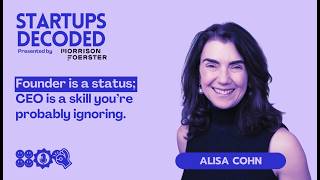
Alisa Cohn, a startup coach, explains why founders need to learn CEO skills to scale beyond their early stage. She outlines three growth phases—growth-hacking, formalization, and scaling—and argues that transparent conversations, deliberate hiring, and psychological safety matter more as companies grow.
Chapters
So first you start delegating the budget stuff and you're like happy to get rid of it. And then you start delegating, you know, sales and other things that, you know, are not so hard for you to give up. But closer and closer you come to the bone of delegating the things that mean the most to you. And that, that becomes very painful.
Welcome to Startups Decoded, the show that gets real about what it takes to build a successful startup. I'm Andy Walsh, 2 times exited founder, strategist, and your host. Each week I talk with top founders, investors, and operators to unpack the plays that drive real traction, not just headlines. If you're building something bold, this is where you'll get the honest insights to scale with clarity and confidence. Let's keep growing together. Hit subscribe and share with your community. It would mean the world to me. Morrison Foster is the legal edge behind the world's boldest innovators. They go by MoFo and are the team behind Startups Decoded. For decades, Mofo has helped startups turn complexity into freedom. Learn more at mofo.com. Hello and welcome back to Startups Decoded. My name is Andy Walsh. If you're an entrepreneur or you're in a startup, you may give yourself the title of CEO. What that means on day one is very different to what it looks like when you reach an exit or IPO. And to get into the detail on that today, I'm really, really lucky to have Alyssa Cohen join me. Alyssa, welcome to the show.
Thank you so much, Andy. I'm so excited to It's great to be here.
We met at a conference and I had the pleasure of listening to you lead a panel and I was really enthralled by that whole conversation and fast forward to today, I've managed to lock you down to jump on my podcast, Startup Decoded. What you do is fascinating and for people that really, really want to start a business because they're thinking about how they change the world, how they change their lives. But I don't think enough people really, really think through what that means as far as their role, the leadership that's required of them, the pressure that goes around it. And you deal with that every day in the people that you're coaching, the stories that you tell. Can you give us a little bit of a background on how you ended up doing what you do today? Because you've got a really unique set of skills.
Yeah. Well, thank you for all that. So it's sort of two-sided because I became a coach and I started working with startups, right? So in terms of becoming a coach, I met a coach at a conference. Conference, and I was like, what is that? I want to do that. I was super, super young, but I like, violins played when I saw her speak, and I followed her around, and I just realized that is me. I have been coaching quote unquote people all my life, and so I just knew I had found my profession. Again, I was super young, and I was on the sort of so-called fast track program to, fast track to partner program at a professional services firm, and I realized I do not wanna do that, but what do I wanna do? Well, I wanna become a coach. Well, I'm pretty young to become a coach. So I joined the startup world back in, you know, 1999. That was a different time. And I was the CFO of one startup and the head of strategy of another startup. I got a ton of leadership experience, obviously. I definitely had startups in my blood. And then that all imploded, of course. And then I thought, well, okay, I'm gonna become a coach now. So I started coaching individuals, coaching companies, and then I really found my true love when I moved to New York. And I found that we were like building this, you know, startup startup ecosystem. Yay, in New York. And I thought, I wanna be part of building that. I wanna be part of startups. And so for 20 years, I've been working with startups at various different stages, like early, early stage, super early, also IPO and post-IPO companies, because I love coaching, which is really helping someone figure out where are they, where are they, where are they going and how will they get there? And I love startups, the idea of like building something from nothing, constantly having to adapt and change, and also taking this very ambiguous, inchoate sort of set of things and turning into something valuable. It's just remarkable to me. And of course, the people involved in startups are remarkable to me.
Yeah, it takes a certain personality type to one, even take a leap of faith and start a business. There's a lot of aspiration and dreams. I had a conversation recently in talking about how mainstream startups have become, and I don't mean the actual companies, I mean as an industry. 30 years ago, it was really niche and people would know about these big tech companies that came, it felt like from nowhere, but now it feels like there's a rite of passage almost as, as a human to have a go at a startup at some point.
Yeah. I mean, rite of passage is very interesting. I certainly think they have become in the past 30 years, as you just said, much more exciting, much more glamorous. Obviously the, the big ones, much more lucrative and just normalized as an, as a thing that you can do that's sort of more acceptable. I think that people who've never worked in a startup do tend to overly glamorize it, and kind of they want to work at a startup, and they want to be able to make a difference, and they want to be able to be part of kind of inventing the future. And I guess I would say, as an insider, it's like, yes, there's a lot of that, and also it's not for everybody. There's somebody who I, um, a colleague of mine who a few years ago, and she, she had come from a large bank, but she had spent her whole career in large banks, and she was like, okay, I want to start, I want to go to a startup, you know, I'm so excited to make a difference, I want to really do something meaningful. And within a year she was back at a large bank because guess what? She couldn't handle the chaos inside of a startup. She couldn't handle not having enough support, like her secretary, EA, whatever, whatever. And she couldn't handle like not knowing what to do when the printer was broken, you know? And that's the way it is in startups. And it takes a certain kind of person.
I went to the Silicon Alley, I was there, anniversary party on Friday night and yeah.
I was there.
It was fascinating just talking to some people and the difference, like I go to events all the time and the difference was that these were the people that had been around from the beginning of New York tech scene.
Yeah.
And there was a lot of battle scars in what people had taken on, what they achieved and to operate in New York outside of San Francisco, which is obviously known as the main tech hub, but New York has evolved significantly. I'd say more so in the last 10 years rather than the last 30, but it took those people in the room. And that effort and energy back then to actually create the ecosystem here in this city.
Definitely, definitely. And when you say more progress in the last 10, I think that's the power of compounding in the sense that, you know, 30, 35 years ago, it was really everyone making their inroads with sort of these iconic early companies and, you know, the iconic early venture firms. And then that had to create an environment and an ecosystem and a community. And then that had to have time to gestate and kind of, you know, compound on its own. And So I certainly think there's been more progress because of the, those foundations that were laid.
Yeah, agree. And it, trailblazing happens in multiple forms, right? It's the actual company that you create, but what happens by nature of that is you start to build a community around you of your staff, the people that help service your business, the facilities that you work in. And that's what's compounded over that time. And I, I love the New York tech scene now. I, you know, from a personal perspective, I couldn't live in San Francisco. I love New York City, but I love now that it's, it's such a robust and and the breadth of people and businesses here is really significant.
Totally. And just to say about startup communities, I actually had Brad Feld on my podcast recently, you know, and he wrote and has written a number of books, but one is, is the quote unquote, The Startup Community and The Startup Community Way about how to build the startup community. And it's really about having the germs of the businesses and they, you know, are able to create people who can invest in the businesses. And then you have an ecosystem that builds up around them of like bankers and lawyers and others who can kind of help, and then suddenly you have support for founders who want to build something where it wasn't possible without that kind of supportive niche. So it really relies on these early people to then also create opportunity for the people who come after them.
100%. And I've had Jason Schuman from Primary Ventures. I had Jeff Becker from Antler, and both of those VCs have created those environments where there's a large community. They do events, they have platform teams, they're supporting it, and that robust breadth of connection allows you to do a lot of things as a founder. And part of that is the support network, which is a lot of the space that you play in because being a founder is hard work, like understatement of the year.
Yeah.
But I don't think people realize first time in how significant that is. For you working with a founder from day one, which is probably not, I'm guessing, your common client, but working with someone who's done that versus someone who's been a CEO for 15 years, is publicly listed and dealing with a different scale, like the contrast contrast of those two different types of characters is significant of how a person who starts on day one is just themselves to when they get to that public listing stage. On that journey, what are the simple steps or phases that a CEO would go through on that journey?
Yeah, it's a great question. It's so funny 'cause I also had Greg Gallant on my podcast. He's the CEO and co-founder of Muck Rack, another iconic New York company, and he's been running Muck Rack for 13 years, self-funded, completely bootstrapped until finally they got some funding. And what he said was, I was a CEO on day one, and I'm the CEO now, you know, 13, 14 years later, and it's the same title, but it's completely different role. So I think that really encompasses everything. When you are the founder CEO in early days, you really are like everything. You're, you're the recruiter, you are the fundraiser, you are the tinkerer of the products, and you're IT support, right? So you, you're just trying to get people to kind of believe in what you're trying to do. Long ago I was in Boston and one of the startup guys that I talked to there, he said, it's like, it's like you tell the customers that the investors are gonna be there. You tell the investors the customers are gonna be there. You tell the employees that the investors are gonna be there and the customers are gonna be there. And you all, y'all meet in the parking lot somewhere and you're like, oh, I can't believe this all worked out. And that's what it's like to be in the initial stage. And so it's very much like about your charisma, quote unquote, your personality, people getting people people to believe in you, which, by the way, is also why you tend to hire the people who you went to college with, who you've already worked with, the sort of circle of trust around you. Those are your early hires. Then as you continue through the journey, a lot of things happen. You have to hire people outside of your own, you know, kind of your own network. And then you have to figure out how to do that. You've gotta be thinking about how to do enterprise sales, not just quote unquote founder sales. You've gotta figure out how to communicate to now a team of like 50, 100, 200, people, which is very different from the way you were casually communicating when everybody was in the same room together, even either metaphorically on Zoom or actually physically on location. And then as you continue down that path, again, so many things change. The way you communicate, the way you structure, the way the formalization, the way you budget, those kinds of things. Everything requires more formality, but you have to be able to do that without giving up the kind of, you know, the founder special sauce that allows you to be the spiritual leader of the company. And you're constantly quote unquote selling and inspiring ahead of where you actually are.
It's really interesting and go back to your example earlier with the person who left banking, lasted a year and then went back in. Those things that you have to do. I recently just launched a sister podcast called Angels Decoded, which is similar format to what I'm doing, but focused around angel investment. And I literally was on the tools. I built the website, bought the domain, started the Substack, set up the YouTube channel and did everything myself. And it's not glamorous work, but it's just, things that you have to do to get the job done. But I see it as an opportunity to create a future state. And having exited two businesses myself, I know what that journey looks like. And for me, I love getting my hands dirty. And quite interestingly, the later stages, and this is something that I'd love to explore with you a bit more, is that you start doing something that you're passionate about. You've got your hands on the tools. The more you grow, the more people you employ, you end up running the business and managing people and actually not doing anything of the fun stuff that you were passionate about to start with. And that's a real shift in mindset and what your day looks like from, you know, 9 to 5, call it, which never is the case, of course, but in that 9 to 5 moment, how you started versus even 2 years in, it looks very different. Helping someone understand that from day one, what are the things that you can start to explore a little bit to play out and stress test yourself as a human and how you process that versus practically how you build systems to plan for the future state?
Yeah, it is so much the heart of the matter, actually, you know, In my book, "From Start-Up to Grown-Up," I'll just hold it up here. In my book, "From Start-Up to Grown-Up," I spoke to one of my former clients, Dennis Crowley of Foursquare, speaking of OG, you know, New York tech. And one thing that he said, which was so poignant, is that as you grow, you have to delegate. So first you start delegating the budget stuff and you're like happy to get rid of it. And then you start delegating, you know, sales and other things that, you know, are not so hard for you to give up, that closer and closer you come to the bone of delegating the things that mean the most to you, in his case, product for sure. And that, that becomes very painful. So I think there's a number of misconceptions that founders have when they get into the business. First of all, they think it's gonna be quick. It is not gonna be quick. I don't know what it's gonna be, but it's not gonna be quick. It's gonna be painful. It's going to be more work and more time than you think it is supposed to be. So that's number one. The second thing is that you absolutely got into this because you like to tinker with your hands on something specific, and ultimately that is not gonna be your job anymore. You're gonna be able to give, you have to, gonna have to give all that fun stuff off to somebody else, and you're gonna have to be dealing with the business angle. So that might be external relations, probably large-scale founder sales, certainly things like, you know, dealing with the board and, you know, that kind of stuff, which is not why you started tinkering with the tools to begin with. And then the third thing is that you're gonna have to give up your kind of natural casual style. Like, just speaking off the cuff, like inventing ideas, brainstorming. You know, founders are very creative and you're gonna have to be very disciplined in the way you talk to your people because the problem is that when you're the founder CEO, especially as you get larger and people don't know you very well, they hold you in reverence. And so therefore your suggestions are orders, your inklings are orders, your brainstorms are orders, and your orders are orders. And it's like you're standing up speaking from a bullhorn. So you've gotta realize that as soon as you say, Maybe we should do this. Suddenly it's kind of done, no matter how important it was to you, no matter how much extra effort it took. They're not gonna be telling you that. They're gonna wanna please you and just have it, get it done. So there's all these different dynamics that you have to be ready for. I guess I would also say that I've worked with multiple founders who at some point along the journey said some version of, I wish I could, you know, it's like, I wish I could leave this company, my baby, the baby I started, my company. But right now I wish I could leave this company and start start over fresh. I wouldn't make all those mistakes. I wouldn't have these people. I'd have a different group of people. And it's kind of this idealistic view of, I've ruined this company. I need to go find another one or build another one. And I think that it's just like, that's the normal part of the grind. You know, Scott Belsky wrote a book called The Messy Middle. And on my podcast, he also talked about, you know, this notion of what it's like to be in the middle of it and how exhausting it is and how you don't know always you're making progress. And the idea that you anyway have to motivate and inspire people towards the end, even when you can't see it. It's just a very challenging journey that takes a lot. I mean, it takes a lot of you. I believe it's like the best vehicle for personal growth there is, but doesn't mean it's going to be fun.
No. And I had a framework played to me, which I've adopted myself. And it talked about 3 phases of that first phase being growth hacking and the ability to just try things, learn and learn very quickly. The second stage being the formalization and understanding of data insights, building SOPs, things that allow you to scale and multiply. And then the third stage being the scale phase where you then start to use that information to grow what you're doing. And for me, those three stages allow you to do a lot of different things from a planning perspective and allows you to think about the people you need, the structure you need, at what point you grow and playing the long game. And, and your book, From Startups to Grownup, almost feels like that is the journey that you go on. And you've got the book, you've got the podcast, and you do the coaching yourself. Those three phases at Messy middle that you just called out there is the part when all of a sudden things start to feel real. But then that's when your role as a CEO starts to change. That growth hacking, you sit in a room with your team, you're doing everything together. The culture is very, very different to what it is when you get to the third stage because you go from hands dirty, as I said earlier, to then managing expectations and manifesting. You talked before around you have to believe in a future state and double down on a future state. It's one of those things that you're playing this game So to step through those stages, the first one in that growth hacking part, I think one of my lessons that I learned, I'd love to get your perspective on this, is that you've got friends, you've got people that believe in you and trust you, and you've got a culture of this closeness. But when you go into that next stage, sometimes the person that who's your friend and worked alongside you, you have to have some tough conversation with them. And it can create a lot of pressure and tension in that dynamic. How do you start to build a culture on that day one that is scalable that doesn't create a future problem based upon the type of relationship that you have with your team?
Yeah, it's such a profound question and everything you said is so accurate. Like the truth is that first of all, founders are not thinking about it. They're thinking about like this cool thing that we're gonna do and we're experiment and tinker our way into it. Number 2, they're hiring all their friends as anybody would because their friends believe in them. They believe in their friends. They understand the work ethic. They can all work together very well. But what they're forgetting is that at some point, when and if we grow, and hopefully we will, like when and if we succeed, you're gonna have to find more experienced people, which are very likely not those friends that you hired in the early days. And so what I think, and I, in my book, I have scripts, about 14 scripts at the end of my book to help you navigate delicate conversations, difficult conversations is one is the conversation you need to have with people as you hire them early days, which is like hard to think if you don't have the experience, it's hard to think about. But the conversation is, I'm so excited about the startup. I'm so excited you're joining the team. I want you to know that we're building a consequential company here, and I don't think you'd be joining me if you didn't believe that. As such, what's gonna happen is at some point we're gonna have earned the right to hire more experienced people. When that comes, I'm gonna be taking a look at you and your role and seeing if we need to maybe bring somebody in When and if that happens, obviously I'm gonna find somebody who will definitely mentor you and help you grow, which is so important to everything and to certainly to me and to our culture. But I need you to know that over time, my hope is that everyone is going to in some ways outgrow their role, and we're gonna have to find more experienced people inside of the company in order to continue helping it grow. So having that upfront dialogue with people, even if they forget about it when the time comes, right, is actually helpful in setting it up for yourself to realize for yourself that nothing early days is gonna be forever. And these people who are going to bring you halfway down the field, which is really meaningful and you have loyalty to them, but if you want the company to grow and if they want their company to grow and they have ownership, so hopefully they do, you're going to need to find a way to probably replace them or layer over them or something with people who have been there and done that before.
I love this advice. It's playing the long game very elegantly. Because I guarantee you that 99.9% of founders are not even thinking about the future state and trying to proactively manage expectations because the people that come in early, there's this, you have to have a certain state in mind and a high tolerance for risk, right? To be able to join a business that probably has no money or limited money, cash flow is terrible, high risk, but there's a high return potential as well. You're likely to get equity as you called out there. You feel like you're part of the culture and the whole system, but your role almost becomes redundant once you start to reach the scale phase because you can't have someone just do the breadth of skills. You start to bring in probably more specialists that know precisely what they need to do to take it from that 1 to 10 stage, like once you start getting that growth. So managing that ahead of time is really important. And as she said, whether they remember that conversation or not, I think it sets a really nice precedent as far as we are doing this. I appreciate what you're able to do, but we are going to reach a point in the future where what you are doing won't look the same, and I want you to be ready for that, but embrace it in a way that's going to help you grow ultimately as well.
Yeah, totally. And I think what you also said was so important, like the risk tolerance of those early employees and the kind of what they're looking for in a job is just different from the later employees. So early stage, they do have a lot higher risk tolerance. Also, they wanna do a bunch of different things and they wanna do them the way they wanna do them and kind of invent the processes. When you are later stage, you need to build processes and then stick to them. You can't just be doing anything you wanna do. You gotta be communicating and systematizing what you're working on. It's a larger context. Some people consider it feeling more, you know, bureaucratic or corporate or something. One of the companies that I worked in, one of the, it was 100 people growing to like, you know, 500 that year. And one of the employees said to me, oh yeah, I just don't like this big company stuff. 100 people, big company stuff. I'm like, why don't you go to IBM? You know, you have no idea. But for him, it felt bureaucratic already. And so that was not the right role for him. Now, at the same time, later stage, let's say mid-stage, we're talking about now, those kinds of people who come in, they want more stability. They want to create process. They actually really want to have process created and then run that process. And then personally, they want a career path. They want a 4K, they want benefits, right? The sort of corporate structure is much more important to them. So that's when you have to have like HR come in and build career layers, career ladders, and, you know, do performance appraisal and have kind of the artifacts and detritus and the details of a larger company that, you know, the early-stage employees are like, I can't believe we're doing this. So that's when you really have to think as a CEO and as a founder that that's going to be an inflection point for sure.
If you're building the future, you deserve a legal partner built for it. Morrison Foster, the legal edge behind the world's boldest innovators. They go by Mofo and are the team behind Startups Decoded. For decades, Mofo has helped startups turn complexity into freedom. They combine deep market insight, tailored legal strategy, and a Mofo passion. Discover how Mofo can support you. mofo.com. In that, do you think that there's a point in a business when it stops becoming a startup and starts becoming a fully fledged corporation? It's nice to hold on to the startup mentality because it sets a certain tone and culture and opportunity. I'll give you a really good example where I look, get on LinkedIn and I see someone, it's like ex-Apple, ex-Microsoft, ex-IBM, and I'm like, Like, sure, but you're a tiny cog in a massive wheel. And like, did you help design the iPhone? Did you help build Watson at IBM in the charge? Or are you just running an SOP in your vertical? Does it actually elevate you? I don't think so. For me, I look at someone in an innovation sense, if I was to employ them myself, who's getting their hands dirty and building things from nothing, particularly in that early stage. Like, you're basically in that type of role in a later stage startup is you're playing a very functional role versus someone who's a true innovator. Is that fair to say?
Yeah. Well, that's totally fair to say. Although it's funny you asked that question. Is there a point where a company stops being a startup? Well, talk to Amazon about that. They consider themselves the world's largest startup, right? So who knows? Also, you're exactly right. You know, like I'll just talk about Amazon for a second. Like you're at Amazon executing, being a cog in the wheel, executing something that was invented 15 years ago, not by you. Okay. That's different from You're at Amazon building, you know, the Kindle. You are at Amazon coming up with, you know, their strategy around integrating Twitch and then running Twitch and then adding services to Twitch, right? So it really depends, like everything, on role. And you can't go by resume. And I think that one thing I would say is that founders get glamorized by resume, like, oh, they were Amazon, they were Apple, they were IBM, they were Microsoft, whatever. They were LinkedIn, whatever. That means like, oh, they know what they're doing. But then it's very helpful to then check in with people as you are interviewing them to seek evidence about what they actually accomplished. Were they just at the company? Were they in the room when something happened? Were they executing a process? Or were they actually the person adding value to that process, inventing the process, you know, making sure that that process even like ran appropriately? Whatever it is, get evidence. Don't just assume like, oh, LinkedIn knows what they're Absolutely.
And I love something you said there. I want to just like poke at a little bit in the sense of when innovation has a process, it's like, is that innovation? I don't think so. It's like the ability to be able to think about how do we come up with an idea, but turn it into a system so everyone knows what's happening. It slows it down. I'm always curious, like you've worked with huge companies, New York Times, Etsy, household names, right? How do big corporations think about innovation in the sense where you start to empower a team and there's people that are really focused on doing it where they'll, they'll have a team breaking things, finding what competitors are doing and having a think tank and they've got freedom to just do almost what they like with no commercial outcome. Have you seen some good examples of larger corporations where they do really have that innovation culture embedded into what they're doing and it hasn't become too systematized?
You know, to me, what I have seen is pockets. So when you're talking about a large company, and I've worked with many large companies, you know, it's the company itself is this monolithic thing, which I don't think is always helpful to examine. What is helpful to examine is the divisions or areas inside of the company, and either they're quote unquote innovative or they're not. And one, I'll give you two examples. One company I worked with, they had me do an offsite for this division, and they were like, we wanna do something super innovative. Like, you know, what do they call those? The moonshots. We wanna do this this moonshot thing and I was like, great, let's do it. Moonshots and da da da. And then immediately it's, well, not too innovative, not too risky, not too moonshotty. You know, like, okay, so it's gotta be a little moonshotty. It's gotta feel like a moonshot. That's the thing. It's gotta feel innovative. We're like doing innovation theater, right? So that's kind of what came up for me as I was doing this. But I would contrast that to large company I was working in. I was working with the head of tax. I'm gonna repeat that, the head of tax.
So— Sounds so glamorous.
So that, so, so exactly. That's my glamorous life, right? So it's And it turned out that, so I worked with him really on helping him find, let's say, his inner voice and his inner rudder. And as a result of that work, he actually came up with a massively innovative idea on the topic of tax that saved the company millions of dollars. And so I think it's so interesting when you get inside the companies to really see what innovation is, where it comes from, how it's created. Is this real journey of discovery and even like rethinking what does it mean to be innovative?
I reference this all the time, but the book David Epstein, Range, I'd love to get David on the show. I just love the way that he thinks and his research goes deep as well. And one of the things they talk about in the book is the ability where you work in a company for so long, you know outcomes historically, you know personalities, what's got approved, what hasn't, et cetera. So there's all this bias. That you bring and the ability to bring someone outside to be able to think about it. And they were a bunch of eclectic people with really specific expertise and it was ultimately problem solving. And they had all these people come together and they couldn't solve this. So they put it out on some kind of obscure zine or blog or something somewhere. And someone in a completely irrelevant industry managed to solve the problem that these people have been working on for months because they had no bias, they'd had no history, and they applied applied what they knew from a different industry to solve the problem that they had. And for me, the structure in that is what is really profound for me, because bringing someone else in to pull apart what you do and put it back together again, particularly today where innovation is happening at such scale that even if you're operating on a model 2 years old, you're already way out of date. So that structure of having someone come in and almost blow things up is really important for large corporations.
Yeah, I love that. That, there was a kind of a trend where I'm not sure if they're doing this as much, but there was a trend a few years ago in OD circles where you'd have these kind of like peer groups. And so the idea is that people outside of your company would come in and give you a day, like, you know, peers of yours, and would give you a day of looking at your business and talking to your people. And it was like, it was called a process. I can't remember what it was called, but it was really powerful because someone just coming in and just like asking questions and why do you do it this way? And, you know, talking through, it both highlights and surfaces areas of, let's say, improvement, but it also, as you're explaining things, it helps you think out loud, which is also a very powerful thing to do. So I, and also the idea of, you know, people solving problems based on insights from all sides, I think has been very well researched, very well trod. And I think it's amazing that when a company or when like a division or a leader doesn't understand how important it is to bring in different points of view into the meeting, I think that's just a lost, it's just a lost opportunity.
Yeah, agree. Having a consultant come in that has specific expertise can play a role to change thinking. If you're a CEO and you've got a team of people, to be able to maximize that person, how do you create an environment where your internal team is open to change? They're brought along on that journey because if you have someone very senior come in that's brought in intentionally to drive a deliberate shift and innovate and evolve things, internal team members can really get their back up and be nervous, can be stressed out about change. Is there a way to structure that where people feel empowered that where they're going from and where they're going to is actually to the collective benefit, including themselves?
Yeah, I think step one is hire people who are like that. People are constantly asking me, how do I motivate my people? And the secret is very easy. Hire self-motivated people, then let them be motivated. So it's the same thing. Hire curious people people who are interested in getting to the right answer as opposed to, you know, guarding their turf. That's number 1. And then number 2 is setting up a safe space because the truth is that, like, if you and I are having this conversation and the truth is that my insights from this conversation are gonna get you fired, yeah, I can imagine that you might be a little uncomfortable about that, right? So it's really gotta be, we're all here learning together, we're all here to improve, and that people are, if they're doing a good are safe, and we're going to find a role for them. So I think those baseline, you know, opportunities are there. But then I think it's also about creating the culture where, you know, Netflix was famous for this. You know, what was it? Reed Hastings was up on a presentation and was looking at some very confronting data that really pointed to his own flaws as a CEO. And he was like, huh, interesting. And let's move on. And then moved on. So, and not like, oh, I'm so So this is not that, you know, not like in a defensive way, but specifically, huh, this is really interesting. Good analysis. Let's move on. Right? And so if you can sort of take that kind of tone and vibe and then spread it out to your people and constantly be like, oh, that's such great analysis. You know, it's good for us to know that. Let's see if we can make some changes as opposed to who's to blame and how could you have done that is really the key to that kind of culture.
One of my favorite structures is psychological safety. I talk about it a lot and it is really structure of what you've just defined. The bad version of that is when you have the HIPO, which is the highest paid person's opinion, and that culture of top-down, just decision-making, shutting down innovation. And if you're able to go bottom-up where everyone feels like that they're on an equal playing field and you have to be vulnerable to do that, you have to admit what you know and what you don't know. And create an environment where people feel like if I've got an idea that they can put it forward and it's tested in an equal playing field where everyone has the ability to say something. So you just don't know where innovation's going to come from in a large corporation and creating a structure and a model where there's a stage almost for people to speak up and do that and try new ideas is really important. And to set a framework from a cultural perspective, as a CEO and as a leader, leader, are there things that you've seen work well to create an environment where people feel like they're empowered to put forward suggestions and feel like they're not going to get their hands burnt by making that step forward?
Yeah, the first key is that when you're in a meeting, leaders speak last, right? Because otherwise everyone's looking to see what you, the boss, is going to say. The second thing is to actually admit when you're wrong, celebrate when you're wrong, celebrate someone else's better idea, those kinds of tools. And then the third is, and I think I have a few clients in particular I'm thinking of who do this really well. It's like, especially when more junior people speak up, the affirmation to that and the sort of uptake of their ideas makes them feel empowered. The truth is that two things make people feel empowered. Number one, feeling listened to. And by listened to, it's like mirrored back, understood, you know, appreciated for their input. And then number two, when their ideas are taken up and run with. And that also makes people feel empowered. So when you start doing those things for people who are not, as you say, the highest paid individual, That is where empowerment really takes teeth.
Love that. The ability to do storytelling internally from a cultural perspective, even externally, if someone has come up with an idea and it turns into an amazing product innovation or something that changes the culture internally, that human storytelling is something we're going to see so much more of in 2026 as AI has just made content the noisiest space in the world. I see a real opportunity for people to become the heroes heroes, because if you've got a business that has millions of customers and you have one person that comes up with an idea that makes all of those people's lives much easier or better and servicing them, actually making them the hero on that creates a really deep connection beyond what the product does itself.
Yeah, 100% agree that storytelling is going to be such a key skill, number one. Number two, what you just said, very powerful, making, really being just intentional, right? So it's not about me and my benefits and the things that I'm giving you. It's more our customers using this product, becoming heroes as a result of it, making them heroes internally. Then the third thing really has to do with the skill of storytelling because so many leaders, I think, they default to data. They default to broad vagaries, right? Sort of, you know, like very large statements that don't have a lot of concreteness. And so the story are anecdotes with details that help people connect into what they're saying and also make it memorable. So that storytelling piece, I think, is such an essential skill for leaders. But then also, if you're an employee right now in a large organization and you're trying to be noticed, learning to tell your story, communicate what you're doing with specific facts, with specific details, connecting with other stakeholders, making them the heroes, all of that is part of a skill that you need to learn to stand out in your workplace.
One of the things that I'm focused on right now, and I'm literally sitting in my new studio, which is exciting, but the space that we have is to actually help think about that from a very foundational perspective as an early stage founder. What is your story? What are the things that you have with your values, your purpose that anchor yourself into the company and build a culture where people feel like they know who you are? And even if they don't engage with you day to day as you grow, they get a real sense of what you are and what you stand for. And I think that that's important because that permeates internally and externally out to the wider business. From a formalization perspective, you touched on it earlier on in the conversation, but I'm really fascinated from a messaging standpoint and scripting. Like when you're in that early hustle stage, you can sit around the table, people have a real sense of who you are. As you grow, it's likely that you won't even engage with majority of of your wider organization, right? It gets so big that it's impossible to speak to everyone or even have met everyone in that point. How do you start to scale yourself as a CEO and leader with the stories that you're telling? And that's internally and externally. How do you formalize that into something where it feels like that you can multiply?
I know it's like the age-old question. First of all, it does get embedded in the culture, right? So it's really about the culture is a reflection of the founder, whether it's like, let's move fast, or let's sort of celebrate our customer, or whatever it is, that's a result and reflection of the founder. So just recognizing that. The second thing is that those founder stories, those early-day stories, those kind of like what it was like, your quirks, your interesting way of showing up, all of that is going to be on a large stage. So just being mindful and intentional about how you run all-hands, how you make presentations, what you might start with, rituals around what you might start with, what you might end with, but then And also, most importantly, really having your leaders tell that story to their people and having that cascade down. Because at the end of the day, people do see you on a large stage, or they see you in the elevator or wherever it is, and they're like, you know, uncomfortable or whatever. So engaging with people in those ways, but really they're going to engage with you through their manager, through your leaders. And so really what I think founders miss in particular is recognizing that they have to intentionally explain to their leaders what they're their expectations are as it relates to managing their people. And that includes the founder mythology, the stories we're telling, the ways we do things around here. All that stuff has to get translated kind of formally so that leaders know what they're inculcating into their people.
There's a case study I wrote up about Notion, and recently they overhauled the way that they do their storytelling, and it was quite fragmented across different teams, and they basically just threw it out and started again fresh. And what they've done is unify their story. So everything that they say internally to their team, externally to customers, to press, to investors, et cetera, is all coming from one central place. And it means that it's easy for anyone to be able to look at that, learn it, repeat it, and have a foundation to come from. And that needs to be repetitious though, as well. And as a great leader, if you're doing press interviews or on stage at conferences, conferences, that repetition comes through and it's really hard for me as someone who loves a chat. I can repeat things, but being scripted versus staying true to yourself is really hard. Do you work with CEOs on public speaking and thinking about that articulation of story and how they're bringing the sense of themselves through, but also following the company story?
Yeah, a little bit. And really the key there is not so much the, I mean, I definitely don't work with them in particular on the words, although I do a little bit of that, but that's really somebody else's expertise, not mine, but my expertise is around how are you showing up? So what do you say to yourself before you walk on that stage? What do you wanna be? Who do you wanna show up as? What do you want them to see and feel and do as you're on that stage? And then also, you know, sort of what, who, what is it, what is necessary right now? Like what does the business need from you? And what does this moment need from you? Those are the kinds of things to really hone into as you walk on that stage.
[Speaker:ANDY WALSH] Great advice. To connect the dots back to what you are doing day to day from Startup to Growing Up, your book and podcast, if you were to read the book, what are some of the things that you share in there that are valuable for founders to think about at this stage?
I know, well, so many things. My book is divided into 3 sections, managing you, managing them, and managing the business. So those are the dimensions along which you have to grow. So managing you has to do with recognizing that the culture's a mere reflection of you, assessing and really thinking about your strengths and weaknesses and kind of how you're showing up, and then also managing your gremlins. Like, it's a really long, hard journey. And so you have doubts, you have insecurity, you have imposter syndrome. And I have a lot of strategies about how to help you with imposter syndrome, which is a very big topic inside of my book. In fact, as I've talked to over 100 founders, we've talked a lot about imposter syndrome on my, on my podcast, also called From Start-Up to Grown-Up. And so if people are curious about how actual founders are dealing with actual imposter syndromes, there's like tons of expertise around there. The second thing is managing them. So it's really learning how to lead people, how to give feedback, how to hold people accountable, how to set up the structure for performance appraisal, how to make sure that your leaders are leading other people, how to learn to manage and delegate. Everyone talks about like, oh, I'm a good leader, but not a good manager. Like it's a good thing. Well, actually your job requires both of those tools, right? And those like, you know, vibes. So it's important to also just have some of the basic skills of management. And the last thing is managing the business. So constantly people will say to me, oh, it's great, we went up this quarter. And I'm like, that's fantastic. but like, what if you should have gone up even more? Like, who knows, right? What did you forecast? How did you set goals? How are you running internal meetings? Even how are you managing the board? All of that has to do with managing the business.
So good. And I realized when you were saying that, I think I need to stop interviewing authors on my podcast. I've got quite a pile of books now that I need to read and I don't seem to have enough time in the day to get through them. So I've got to put my hand up and say guilty. I've not read it yet, but it literally is on a pile of books that are in my to-do to-do list, and I will bring it to the— yeah, I am going to do a reshuffle on that for sure. But I do listen to the podcast, and that's worth checking out too. For people that are curious to learn more outside of the book and the podcast, what's the best way to reach out to you, Alyssa?
Well, you can definitely follow me on LinkedIn. I'm very active there. But you can also come to my website, and I, as I said, I had 14 scripts in the back of my book to help you with delicate conversations. I have 5 additional ones on my website to help you navigate difficult conversations, delicate conversations, and one to make your life better. And that is Alyssa alissacohen.com/scripts. No E's in my name. A-L-I-S-S-A-C-O-H-N. alissacohen.com/scripts.
Perfect. And I'll make sure that I share all that information and you can check out my LinkedIn and find all of those links. This is so good. And for any founders who are listening to this, it's never ever too early to think about a future state because what you need what you need to do in the future is defined from day one. Little things that probably in the moment feel like small decisions can become very big decisions later on. So this is a really helpful peek into that later stages. Thank you so much for taking the time to do this with me today.
Thank you, Andy. I loved your questions. It was so great to talk to you.
Thanks for listening to Startups Decoded. If today's conversation helped you think differently, share it with the founder in your network. And don't forget to subscribe for real-world startup insights every week. We really value your support. If you're interested in partnering with us, email hello@startupsdecoded.com. I'm Andy Walsh. I'll see you next week.
More from Andy



EP#88: Why Most Founders Misread Their Own Traction. Vanessa Larco - Premise VC

EP#87: Founders Obsess Over the Raise. Investors Care About This More. — Carina Cunha






Ep#86: Early Decisions That Define Your Startup Forever. With J.P. Morgan Asset Management
