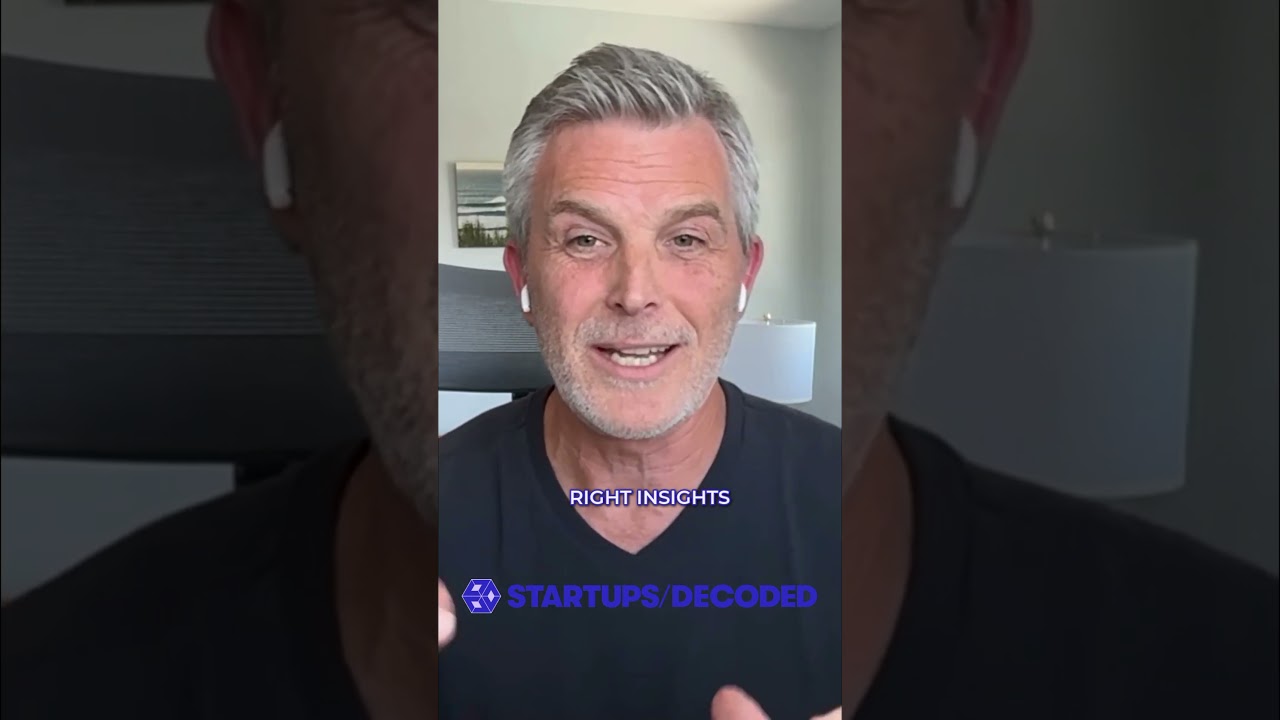
EP#90: Why Most Founders Lose the Room Before They Walk In. Rob D. Willis

Rob D. Willis, a storytelling coach who started as a tour guide in Berlin, explains how founders lose investors before they speak. He teaches the Impact Framework: Problem, Impact, Solution, Consequence. Willis says founders must first understand their audience's concerns, then plant story seeds that stick.
Chapters
So we need to strategically think through how are we going to plant the right seeds essentially into their mind. And that always starts with who are they? Who am I talking to? And going deep into understanding how do they see the situation? What is their background?
What are their concerns?
And building your story around that basically.
Welcome to Startups Decoded, the show that gets real about what it takes to build a successful startup. I'm Andy Walsh, 2x exited founder, advisor, and your host. Each week I talk with great founders and top investors. We unpack the plays that drive real traction. If you're building something bold, this is where you'll get earned insights to scale with confidence. Let's keep growing together. Hit subscribe and share with your community. It would mean the world to me. Hello and welcome back to Startups Decoded. My name is Andy Walsh, and for those of you who listen regularly know that storytelling is one of my biggest passions, and it's got such a rich and deep meaning behind who you are, where you come from, And how you articulate that. So today I've got someone who knows it better than me. It's their life and it's their job. Rob D. Willis, welcome to the show.
Thank you for having me, Andy.
I found you on Instagram and I feel like this is confessing a bit of a sin in the sense that I'm such an anti-social media person and basically don't use it. But when I am on there for my own show and pushing stuff out, there's a handful of people I follow and I found you literally on Instagram and was immediately brought into the things that you are saying. You've got such a fascinating personal journey that led you to do something now that built a career that sounds like was completely unplanned.
Yeah, it just, if you'd asked me what I would be doing 10 years ago, I wouldn't even have heard of this job. In fact, I'm still not, I can't really explain it to my mother what I'm doing now, to be quite honest with you. But yeah, 10 years ago I would've had absolutely No idea that I'd be doing what I do now. And it started, it's changed a lot as well. I started out just doing pure public speaking coaching, and then I gradually moved into the storytelling element because I found that just talking about stage fright all day wasn't interesting for me. I wanted to talk about structure and being more strategic and unpacking ideas. That was what really got me going.
I love that. And we'll get into it today, but one of my instincts too is that stage fright often comes from a lack of belief or a lack of structure. and what you're actually communicating rather than the actual stage itself. So I'm, I'm sure we'll get into the detail, but as far as your personal story, I love it. You are in Berlin, but you are an Englishman. Give us a little bit of context as far as your path into what you do now and some of your key moments that were a catalyst, because founders typically either analyze a space they can go into to find an opportunity or have an observation, and that pattern seems to repeat for them in different ways, different lights. Yours was slightly accidental as we set up, but I'd love to know what took you into where you are now and what were some of those little key beats along the way?
Yeah. So my journey began, my first job out of university, I started working as a free walking tour guide in Berlin. And for listeners who don't know about the free tours, basically they are walking tours. They learn about history, see the sites, and you don't pay for a ticket upfront. You simply give what you feel the tour was worth at the end. And the guide gets to keep those tips minus what they pay to a kind of marketing company. If you're really bad, you could actually lose money. And I wasn't that bad, but I wasn't great. And I wasn't earning enough to live on at the very beginning. I think my, one of my first tours, my worst ever day, I earned only €3.50 for the entire 3.5-hour tour. And I was just so embarrassed and kind of asking myself, okay, why am I unable to do this? And why are the other guides able to do this? And so I began trying to unpack what were the successful guides doing. I went on all of their tours, began to try and work out where were people laughing, where were they engaged, where were they not engaged? And I did try a few different things, but the thing that I eventually landed on was, okay, the people who were earning the most were not necessarily the most knowledgeable, but they were telling the most stories. And The whole tour was built around bringing a few individual characters or sites to life for that group. And that's what really, really worked for people. And that's when I began my spreadsheet. I tracked every single tour that I gave, and I would work out how many people were there, how many people in a group, what they would give me an average tip basically per day. And I would start trying different variables out on them and seeing what would work and what wouldn't work. With that, you get pretty good pretty quickly with, because I was doing also a lot of talks, you know, you need a lot of reps to get good at a skill. And I was doing 2 or 3 a day, every day, all year round, basically. And I got good. And you asked for the beats in the story and like how I learned things. I remember I got it to a point in the first few months where it was working quite well. And then winter came. So winter in Berlin is— you live in New York, so you know about hard winters. It's probably as hard, if not harder than here. But that winter was particularly bad in Berlin. It got down to about -19 degrees Celsius. And I was giving a tour in -19 degrees Celsius, but I thought, not a problem. I know what I'm doing. Give my usual tour. People will be enamored of my storytelling. And I took them around. And I noticed that actually they started to resent me. I thought I was doing it, digging out great stuff, but people were just kind of not having it. And it seems obvious now, it was -19. I didn't adapt at all to the particular moment. And then I started realizing in the data that there were so many factors beyond just delivering a great story, which would impact how much that I would make or not make on a particular day. And I realized that, okay, I can actually begin to impact. I can't change everything. I can't stop it raining or anything, but I can work with the different variables that there are to try and make sure that every single tour I'm making as much as I could. And in the end, I ended up giving 3,000 tours to 100,000 people. And I realized that what I was interested in is, okay, how do you make an impact with people? How do you make them interested in what you have to say? Take your ideas. And that's when I started the public speaking thing, which I always thought of as being like, okay, I'll start this as a side hustle and then slowly move into doing it. But then COVID happened and there was no tourism, so I had to make it work.
I feel like we could do a whole story just on what you did and that leap, because doubling down on being a tour guide, it's not something that I hear commonly as far as, yep, that's what I'm going to do. And saying that, I Lived in London for three years, and I did a couple of walking tours in Berlin myself personally. And the guide was a Scottish lad; he was studying his PhD on the two world wars, very specific. And we walked around, and it was all based on that. And it was some of the most emotional experiences I've ever had. I was literally in tears when he talked about the Battle of the Reichstag, basically for a propaganda photo for the Russians to get a photo of a soldier with the flag on top of the Parliament House. And it was heavy. The tunnels had collapsed. People were just running in and died, and there was a horrendous amount of people that died. But physically standing there was really impactful. But the way he told the story, upon reflection, I've not thought about this for probably 15 years, but that for me is an emotive way to connect with people. But you have to be good because if you're telling ad nauseam facts, it's overwhelming. Like, like anything, if you get too much information, it's impossible to filter out the good from the bad, the important. So that Bastion of Fire that you did, it started off as what was a career path, but it sounds like it gave you such rich insight into something much deeper and much broader around how humans communicate and the right environment to be able to be in, to have that land and be impactful.
Yeah, absolutely. And the point you make about having too much data, too much information, that was me at the beginning. You know, that was Mr. Data, and I wanted to show the nuance and the complexity. And I think that one of the biggest problems that we have in the world today, and the reason that people communicate like that, is that is essentially how we are educated. That is how we are tested in schools and university. Think about it. When you write an exam paper, the person who's reading it, is one, being paid to read it. That's their job to read it. They can't decide to pay attention or not pay attention. And they also understand the topic already. And they're just there to see whether you have got the right facts and enough facts to merit the marks. It's quantity and accuracy of information is how you're being tested. And then we go out into the working world and we start working, delivering presentations, let's say, or giving stakeholder management or whatever it is. And we think we have the same job to show that we understood it, to show that we ticked the boxes. But the people we're talking to are not necessarily paid just to listen to us. In fact, in many cases, an executive is kind of paid not to listen to you. Their job is to kind of filter out as much of the noise as possible to get to what's actually important to them. And they may not understand the topic either. Maybe we have a, we probably do have a deeper expertise in a topic than the people who we're talking to. So simply showing them that, you know, as much as possible is not impressive. It just shows, makes them, it confuses them and bores them.
I'm such a big advocate for succinct information. And I have a background in brand strategy and the best brand strategists and writers that I know Are the people that can deliver the highest impact with the least amount of information. And it's such a skill to be able to structure a sentence or some data points in a way that has impact and it does heavy lifting without having to give too much context or backstory and what's going on. And we're going to unpack that today. I would love to look at it taking us a step back and I don't know how much you went down this path. I'm always curious. So my background's in music. And what brought me to New York in 2012 was I started a business that had 2 parallel paths. One of them was doing audio branding and audio branding in its purest form is anchored around human psychology and how humans process sound. But then there's the composition and production component for the actual part that you hear. And through that process, my business partner did a master's in musicology and you go right back into history as far as original storytelling and Around campfires, tens of thousands of years ago, storytelling was how history was retained and kept and passed through generations. People learned skills and campfire became this really iconic thing. And even now, if you sit around a campfire, there's this emotion that's triggered and most people couldn't explain why, because there's a level of survival, there's a level of direct connection to your own ancestors and what happened there. But the part that I love about music is there's ultimately a story because it's anchored into that whole part. So as human beings, we are hardwired for stories. We know how to tell them, we know how to listen to them, and there's a direct physiological response to them. I'm fascinated in your experience. How deep have you gone into the psychology about the brain and how we process information and understanding that? And we don't need a science lesson. It's more so for me, this is maybe a selfish question because I love this topic, but to be able to articulate how we process information, what we need to do to be able to stimulate someone to make sure that what you're saying actually lands?
Well, 2 writers you want to read, Will Storr and Kendall Haven. Will Storr, The Science of Storytelling, which is a good kind of introduction into this. The point he's basically making is that we understand the world through stories because the world is too complex. So we need to be able to construct it in a way that kind of makes sense to us. Now, Kendall Haven kind of builds upon that and he kind of complicates it and he shows how the story that really matters is not the one that you tell, but rather the one that comes into your audience's mind. I'm using audience as a very kind of general term. It could be just one person, but whoever's listening to you, and that story is going to be made up of 2 things. The story you tell and what's in their mind already. So you can think about this. The example he gives is, imagine you overhear a conversation in which you hear 2 people talking, and one of them says, where is John? And the person next to them says, well, I didn't want to say anything, but I did notice a green VW parked outside Carol's. Now, what's going on there, listeners? Is something naughty going on? We don't know, but there's actually no connection between any of the facts, but we've been given data and what's in our mind is already, for most of us probably, has turned it into a dirty story. So you can see just planting certain words, certain structures in front of someone means that they turn it into a story. They naturally do it. And that's why you can have 3 words, In fact, Will Storr, I saw speak and he said, he gave a 3-word story, which was tiger. Just kind of dwell on that. You think, okay, didn't go too well for that guy. But you see what I mean? It's how we understand. So we automatically create them and we create these stories out of what information is coming in, be that in story form or not. And what is on our mind already. And that story creates an emotion and that emotion creates action.
I love it. And there's so much cultural impact there as well, as far as how you're raised, the environment that you're raised in and what information you're taking in. And there's a guy, his name's Martin Heppel, and he works for this company called the Resilience Project in Australia. And I love sharing this story, but his parents were anthropologists and he grew up for a long time in Borneo as a kid. living with a headhunter tribe. And you can begin to imagine the different context of living with a tribe that have lived the same way for thousands of years as someone who was born into what is a very modern and contemporary society. And he's Australian born and then went there and then went back to Australia. And his view on the world is so unique. And I think about that as a really interesting way, the way that he listens and the way that he connects, because it was so different than most kids who would've grown up in Australia through the same era. And the reason I raise it is that if you put those 3 words in front of him versus someone of his same age who grew up in Melbourne where he lives now, you would get 2 very different stories, right? Not because they're 2 different people, but the context of their history. So what you are factoring in to be a good storyteller is context and enough of the right information so someone can piece together those ingredients and connect dots in the right way Rather than make an assumption and have it misinterpreted. And then that becomes something that's turned into something that is your own version based off your own life experience.
Yeah. And once, once they have the wrong story in their head, it's really hard to change their mind. So we need to strategically think through how are we going to plant the right seeds essentially. into their mind. And that always starts with who are they? Like, who am I talking to? And going deep into understanding how do they see the situation? What is their background? What are their concerns? And building your story around that, basically.
And I want to go off into a slight segue here, but you recently did a podcast with Simon Sinek, who I love, and I'm assuming must have been a pretty humbling experience. for you as a moment in time to go from working for tips as a Berlin tour guide to sitting and recording in person with Simon for his podcast. That's super cool.
It was. No one was more surprised than me to be asked, to be honest. And they said, do you want to do it online or do you— could do it in person? And I was like, I'm going to do it in person. I want to meet Simon Sinek.
Yeah.
And I must say, you see why he is able to command stages when you meet him. Like, he— I think I got Sinek'd a couple of Like he started speaking and I was kind of forgot that I was also on the episode.
I'm fascinated by him and as a strategist, I still use his golden circle, the why, how, what. And I love the simplicity of it because it gets you into the very core facts to be able to simplify something into one sentence and his ability to do that. And again, if you go back to his own story of being young and speaking on small stages, and I think he did a TED Talk way back in the day that basically blew him up and then it just became a catalyst and become the person he is now. His story's fascinating in its own right, but what you are talking about there is that simplicity. And what I'd love to go into now is from a framework perspective, you've created this piece called the Impact Framework.
Mm-hmm.
And, and it's a really simple but structured way to be able to think about how you are telling your story because most founders are victim of oversharing. And you talked before around all the data. People feel like, well, I need to show that because if I don't show that, they won't have the full picture. And I was fascinated and I want to set the scene with this. One of the pieces that you had on Instagram was around the actual format of a presentation and the time that you spend actually doing the talking. And the thing that hit me hardest was basically the opposite of what most defaults would be is to share the outcome or the recommendation at the very start.
Yeah.
And then build off the back of why you're putting that forward and then lead into then a conversation about it. Can you talk us through that to start with before we jump into impact?
Yeah. Well, I will say it depends upon many factors as to what framework you would use. So if someone is already bought into the problem that you're talking about and they simply have a an answer, they want an answer from you, then you're better to go bottom line upfront, deliver the answer. However, if they are not, or if they lack context, we need to give them context. And I think maybe the video you were talking about was my version of SCQA, which is a typical consultant structure. I prefer problem, impact, solution, consequence. And you start off by saying like, okay, what is the problem? What is the impact of that problem? Why do we care? What is my solution? What am I going to do about it? And what is the consequence of that? And that helps an executive come to some sort of decision about what they want to do. But you need to state what the problem is upfront. If you just go in and say, we need to restructure this team, or we need to lay off X number of people, or we need to sell all of our bets overnight. You know, there will be a lot of resistance and that can create reactance if your audience is not yet ready for what you're delivering.
So there's different things that you need to consider, and we talked about who's in the room. So if you are a founder, let's, let's use the obvious one. You're going into a pitch and you are thinking about who the audience is. What are some of the things that you would encourage someone to think about? In preparation for that, because it starts way ahead of time. Let's not go into that, as in the story that you tell to be able to engage people and even get a meeting to start with. I'm talking purely in the room right now. What are some of the things that you would do to prepare for that situation, to know who you're talking to, how they process information, what you need to share, and how you try and generate action off the back of it?
Well, I might just challenge your question there because I don't think if we just focus too much on that one moment. And put everything on one moment. Like, we're gonna go in cold, we're gonna deliver the presentation of a lifetime. We'll drop the mic, everyone will clear and cheer, and then we'll walk out and the money will just kind of come out. It doesn't happen like that. The factors which lead to them investing or not investing begin with the first time they come across you. So we need to think about the arc leading up to that, to that moment. But let's just say, you know, this is one meeting and it's the first time you're meeting them. There are 3 questions that actually Kendall Haven taught me, which I, which I think are brilliant. He says, what do you, the first question, what do you want to happen? So what is your objective for this meeting? Let's say it's an investment meeting. Maybe you won't get the investment in one go, but maybe you can get them to register interest, their name in the book, whatever. Maybe it's a follow-up meeting or technical demo. What is that goal? The second question you then ask, okay, why is that not happening already? Why are they not having my, taking my meeting on that? Why are they not giving me money? Could be a lack of information. It could be a resistance to what's going on in the market. Maybe they see things differently. You need to understand, okay, what would stop them from essentially taking the action you want them to take? And then the last one, which is who needs to make it happen? And this is when you zoom out a little bit and you think about all of the moving parts in a negotiation. Okay. In our example, we're just talking to an investor, but there is more than just that one person making a decision. Probably you're talking to someone in a VC or a private equity or whatever it might be. They have a particular chain of command. They have people they need to talk to. They present their particular pitches that they've looked at in the past week or whatever. They explain the plays to their boss. Maybe there's someone else they need to talk to. You need to understand all of that stuff. And only once you've understood all of these moving pieces can you then really decide, okay, this is how I'm going to attack that meeting. And go through the information. But it's a lot more than just create the perfect pitch, I would say.
I love that. And you caught me out, but you also set up precisely what I want to talk about today because telling a good story is not what you do in the room. It happens a long time before that, to your point. And because I love a good story, a good story starts with some patterns in the sense of the right information, The right arc that you talked about, and then contextually thinking about how you deliver that for the right channel, audience, room, etc. For me, the getting to the heart of who you are as a human being is the part that most people struggle with. In you've lived your own life, you know yourself inside out—the good, the bad, the failures, the successes—and it's hard not to have such a blurred point of view on those things, even to a point where you devalue some of your own achievements. So having the ability to have conviction and confidence. And it's an exercise that I'd love to hear your version of this. An exercise I do is I basically do an audit of someone's history and look at family life, the city they grew up in. What are some of the things that impacted them? Was it a sports coach? Was it a teacher? Was it a friend? Some of those influences, and then look at their achievements. And I love, love to get into the heart of who they are because when people actually do it, and I record these sessions in a video like this, And then they hear it back. It's actually a really powerful tool just to remind them what they've done and some of those things. And then I take that information and distill it down into an articulation that can be repetitious. What's your version there as far as how do you get to the core of a person to think about their own journey and the story arc that they tell to be able to do it? Because for me, that's where fundraising in this example begins, is actually understanding who you are before you even start putting your feelers out to speak to anyone.
There's a couple of things you're making me think of here. The first is there was a point you made earlier that we begin to kind of devalue who we are, and maybe we feel a bit less confident when we're walking into a room, particularly with people who are important or who we admire or anything like that. There's an exercise from a book called Choke, which is all about performance anxiety. in which she gets people to draw a diagram of their life before a big event. So let's say you've got an exam that you're going to be sitting, or you're going to be doing a performance. The idea is to show just how small that performance is in relation to everything else in your life. You might be a father, a friend, a husband. You could have hobbies. You have things that you do. These are all the things that make up you, and you aren't defined by whether you succeed or fail in a particular Endeavor. So that's one exercise that I thought of. You also made me think of, there's a book from a guy called Matthew Dicks called Storyworthy, which is one of the classics in the storytelling world. And it's called Homework for Life. And it's a very simple exercise that everyone can start. And I would encourage everyone to start as well. And what it involves is every day, Have a spreadsheet, put a date, today's date in one column, and then one story-worthy moment, something that happened in 4 to 5 sentences. Then close it. Don't look at it again. The next day, open that document up again, put the next thing in. What this will do for you is, A, it'll give you loads of stories that you can then begin sharing with people and you'll never run outta stories again. But secondly, you'll then begin to change your relationship with yourself. You'll begin to look back on the situations you were in, the times that you were happy or sad or angry or elated or whatever might have happened that particular day. You can then look back to years before and see where you were, who you were with, and give meaning to all those particular moments. That's, it's not, I mean, it's not a shortcut really. It's a long process, isn't it? And you only really get the fruits of it after you've done it for a while. But that is something which everyone could start doing and it wouldn't take them any time and it would be a massive return on investment in terms of what they'd be able to get out of it.
I love that. And I journal every morning and I do it for more mental health reasons, but from a work element to be able to put down something that is impactful and look back at that. And you could put in there, you touched on a little bit around emotional state. Is it a challenge that you had to overcome? Were you in complete flow state and just had this sequence of things happen because you were operating at another level? There's such contextual things as well that you start to track a sense of who you are. And for me, with my own personal therapist, she's great at reminding me of everything that I've done because she knows my backstory intimately. And it's just a really, not like a way to trump anything that I say, but just as a healthy reminder of when I'm having self-doubt to look back at those things. So you also have this long history of everything that you're doing along the way.
Yeah.
I'd imagine that's really good for purpose.
Yeah. Can I give one more exercise?
100%.
People can do now.
Yes.
So this doesn't require you to do the same thing for years and years. So this is taken from a novelist called Kurt Vonnegut who wrote Slaughterhouse-Five, all about the bombing of Dresden, eccentric novelist. And he came up with this idea called the shape of stories. And he said that all stories can basically be mapped across 2 axes. Like in data, you have, is it the x-axis? What's the up and down one? Is that the x-axis?
That's the y-axis.
Is that the y-axis? Okay.
I think.
So that, the up and down one, let's just call it the up and down one. That's good fortune, ill fortune. So good fortune is at the top, ill fortune is at the bottom. And then the side-to-side axis is the left-hand side. It's going to be beginning and end. What I get people to do is take that basic idea and apply it to, let's say, their work life, to their history at a particular company. And say, what I want you to do is I want you to map out the moments of good fortune and ill fortune across that journey. And they give them, you know, however many minutes to do that. And they come up with, you know, a little shape of their story. What it does is it gives you wonderful perspective. A, it shows you, okay, these are the difficult moments, the things that I learned and overcame, and these were my successes as well. And it gives you this kind of philosophical approach. What goes up must come down, but then when it's down, it will come back up at some point. And as long as we keep that perspective, that story, that shape of story, then I think you can be much more philosophical about life.
It feels like it's a nice, practical, pragmatic way to look at that story arc and some of the things I talked about from a therapy perspective, but it's, it's Acknowledging that everything has a cycle and the end of one cycle is not the end. These things happen in parallel or they feed something else. And to be able to be self-aware, to know that it keeps moving forwards and to see that actually sketched out is really helpful, I would assume. Yeah.
And it's a great way to find stories as well. People say, I've got no stories, but they're there. Look at all of the difficult challenges that you overcame in your life. They're all fantastic stories that someone can learn from.
100%. And I, I have a series of questions I ask in a networking environment and they're unrelated to the room. For me, it's startups and investment most of the time. It's actually anchored around personal things and trying to find something that someone is interested in because talking about something that they're passionate about outside of work is typically a softer way in to get to know someone.
Mm-hmm.
Than them having to feel like on the spot they're pitching their business or talking about something really specific. And I build relationships that way that then lead into other things eventually. But starting at a foundation, there's a beautiful human element to that as well.
Can you tell me the questions? I'd love to hear them.
I can. I, I go into, one of them is around high school and, and what they were doing at high school. A lot of time there's music, there's sport. There's academic, there's things that people succeeded at. So I've got one around that. There's where people lived in the world. Maybe there's a travel story, is there? Because people typically have a positive association with that experience of meeting someone different. It can be a friend or influence, someone that has played a role in your life beyond practically, even if it's not like a mentor, it could be a coach. Teacher. We talked about this a little bit before the show. And the career one I have, but it's, it's not anchored in there too much. It can be coming later. I do one around food as well. Like, I love to hear like random food people have eaten or where they've eaten it or the environment that they're in. And it's just things that people have positive associations with. If you were to ask someone some of the top 10 moments of their life, it's almost reverse engineering those typical responses into a series of questions.
Yeah.
to let them share with passion and confidence, because if they're nervous, it allows them to come out of their shell as well. And I have a much richer conversation.
You're making me think of another exercise. God, I'm overloading people here. There's a guy called Dan Manning, also creator on storytelling. And he was telling me, he's got this amazing chart. He looks back through his life and he always asks the question, why do I X? So you could have, why do I live in New York? And you'd probably start off with something a little bit abstract that's interesting place. I thought it'd be cool, or I went there for work or whatever. And the point is to keep unpicking until you find the actual moment that something changed in your life that led you to do that particular thing. Of course, there'd be many moments, but you need to find one particular axis on which a lot of other stuff surrounds that was important to you. That's the story that you're going to tell. That's going to be the kind of climax of the story. And he's got this amazing diagram that he's created of basically his life mapped out in decisions. And he's got his time in the military and time working as a coach and all this different stuff about where he lives, what decisions he made, et cetera. And I think It's the same questions that you are asking and it, it's all a wonderful source of stories that make up the complex people that, that we are.
Yeah, definitely. It, that reminds me of the, and it's, I'm sure it was someone else's first, maybe it wasn't, but the Toyota, the 5 Whys is when they're fixing things that break rather than just go, the screw fell out, so we just replaced the screw. They go deeper into why some of those things happen and there's a series of questions to get to the point. about, okay, now we know what we need to fix rather than just replace the screw every day. We're actually gonna go deeper. And I like that because that depth of curiosity gets to the heart of something in a way that's, that's a practical way of thinking about it. But what you are talking about is getting to the core of you and some of that motivation, the reasons why you've done things. So I love that as an exercise.
Yeah, it brings a lot out. It gives you a lot of ideas for stories. And I think Also, it's just a great way to look back on your life, you know?
Yeah, absolutely. Okay. So let's follow this little mini process through, because I'm liking some of these things that we're able to unpack here. We started off talking about a pitch and that could be the endgame of where you potentially get some capital into your business, but articulating your story in a repetitive way and in the sense of you're not in the room all the time, sometimes you need to be able to come up with a functional and practical way to distribute your story, how do you start to, one, understand yourself, we touched on there, but two, then think about how you package that up in a way where you can start to give people a sense of who you are at scale and build trust and authority in who you are because coming in hot with no context or any information about yourself is always going to be harder to sell or build a relationship or whatever that is with a new connection. So how do you start to think about that packaging?
Are we talking about social media here?
Could be social media, it could be events, it could be email, it could be a podcast. There's many different ways you can do it, but how do you start to get repetition? Because as human beings, we learn through repetition, right? And people get nervous. I see it happen where they're like, well, I've told this story 10 times before. And I was like, yeah, probably to this 5% of people, but not everyone has heard it as well. So thinking about a structured way that you can package yourself up And share it in different ways to be vulnerable, which is something that I always encourage, but also be constructive in the way that you're thinking about your experience, how you solve problems, what your expertise is, and putting that out in the world so people feel like they know you.
Yeah. So what I think this question is really about is packaging. So we're preparing a story. The story is the story. It kind of floats in the ether and the way that we share it is going to depend upon the situation. So if I'm going to The Moth, which is a— it's in New York, isn't it? The storytelling event in New York. Yeah. There's a very particular way I would tell that story, which would not be how I would tell that story online. And it would not be how I would tell that story in a business meeting or even in a pub, probably. You worked in music, A pop song has a structure. A techno track has a structure. There are structures out there that work for a reason. So we need to become students of the genre in which we are trying to release whatever we're trying to release, our story in this case. And even a pitch, you know, it has, it's a structure. There's a pitch deck that's very widely shared, the Sequoia deck, everyone knows it. Follow that. How does your story fit into it? And it's not that you're changing your story. It's not you're being inauthentic. You're just merely packaging it in a way that people know what they're getting and can ingest it in a way that they find satisfying. So I'd understand, first of all, what exactly am I trying to do and where do I want to start doing it? Let's just say someone wants to start creating Instagram videos or whatever. Now your job is not to be Completely original. I'm sorry to say, your job is to fit in with people's expectations of that platform. And you do that by looking at what is working already. So who's kind of like you, whose style you can study and put your own information on your own slant, your own story into. So that's why, you know, get everyone, everyone's doing these tier lists. At the moment, but they're all different. They're all different people doing it about different topics, but they're still taking the same kind of, uh, kind of packaging. This reminds me of a, what I always recommend when I became a tour guide and I was struggling, like I mentioned, one of the guides told me, just find the guide who is most like you. So it's English, male, same sort of age. And just copy them. Just do exactly what they're doing. Use their jokes, use the way, the stories that they use. Just start there. That means that the early stuff that you're creating is not gonna be the most creative. It's not gonna be the most daring, but it, that allows you to begin finding your voice. And you only find your voice, as you mentioned, through repetition, I would say. I have created, God knows, 500, 600 videos on Instagram. I'm still looking for my voice. I don't think you ever really find it. I think this is one of those things. It's this sort of impossible gold at the end of the rainbow that you're just kind of looking for and you're getting closer to it, but it's not quite there. But you won't find it without starting. The mistake would be to think, okay, I'm going to sit down with an expert or I'm going to pay loads of money to have someone. I'm sorry to say this. I know you're a brand strategist. So I'm literally, this is your job I'm talking about. But I hope you would see that the job of a consultant, be they a brand strategist or whoever, their job is to come in and give you like the starting points and then you release it and then you see what's working and then you refine it over time. That brand wouldn't stay the same for 50 years. You know, it's going to change over that particular time. So I think find what's worked, find out what do you want to achieve? What's the best platform? What's working there already? And then just start from there, putting the reps in and trying things out and seeing what works for you. There's no other way to get there, I would say.
The irony of that is it feels like such common sense, but people have this convoluted way of trying to cheat the system, hack shortcuts, trends, whatever it is. And to actually have trust and authority, you need to be consistent. And being consistent means actually just doing the good things well. So for me, that's strong advice. And I'd say for you, I've watched your content and you doing piece to camera is really strong. I'm fantastic in this environment because I've recorded over 100 episodes. I've done a bunch of panels and hosting, and I'm very relaxed in this environment. I never get nervous. I admittedly, I barely prepare for these podcasts. I spend probably 10, 15 minutes. Just getting a sense of the person, some of the themes, and I know enough because I read so much and consume so much information that for me, it's just peeling back the layers. So I'm great on that, but put me in front of a camera to deliver a message, I'm still pretty raw.
Well, I think you're probably better than you think, and you just need a few tricks. I'm sure that I could sit down with an hour and give you an idea of how to make a video. It's, it's not rocket science. Yeah. When you start, you're not going to be very good, but do it. I mean, over 100 times is like the same number of times as you've done podcasts and you'll be good.
And I'm, I want to do it because I feel like it's important now on many levels. And I started this podcast in a very humble mission-forward way, which was to give back to other founders through my network and having interesting conversations and passing that knowledge forward because In the world of AI, information is everywhere, but it doesn't have context. It's not fact-checked. It can send you down the wrong path very quickly, very easily. So now I have this distribution network and I've seen the impact it's had on my own personal network, my own perception in market, and people trust me now beyond what they did before. Not because I wasn't trustworthy, because I hadn't articulated my story. So it's given me a forum to share that. So I love it. I'm conscious of time. I feel like I definitely wanna do an episode with you once a week. I love, love doing this, but it would be remiss of me not to ask you, in the world of storytelling and automation we touched on there, in the where you can regurgitate everything and anything and take shortcuts through AI platforms in storytelling, how do you separate yourself from the pack? I dunno if you have a simple answer to this or not, or if it's a bigger conversation, but how do you separate yourself from the pack when you're competing with someone who has automated themselves beyond reason with a digital twin, analyzing lots of information and trying to optimize for what the market is seeking. And then how you find your independent voice that cuts through from that noise.
I think you have to want to have an independent voice. Like if you're just pandering and creating whatever the market wants, then You're just gonna come out average. Maybe that's a bit cruel to say that. AI cannot create. It doesn't take a small thing and make something big out of it. That's what humans do. What it does is it's a filter. It takes everything in the world and uses a prompt, filters it down to the average of all of the information that has been given. And when you are the average, you're never gonna stick out. You're never going to be interesting in any way. And I'm kind of contradicting myself when I said, you know, study what's working and try and do that, but you do have to find your own angle. Now you can use AI to help you structure it and restructure it and try different angles out, but you have to have an idea. You have to believe something or it's meaningless what you're sharing with the world. And you might well ask, okay, what's the point in even doing it in that case? But yeah, if you are approaching it with the desire to share something, I think you will get there eventually. But don't use AI to create things, use it to structure and find patterns. It's very good at that, but it doesn't create ideas.
Love that. And I did a post recently on Substack. It was a long form. It was full transparency on how I use AI to create what I'm doing. And I had a call out for anyone who thinks it's written by AI and it's not authentically me is to call me out and tell me because as a strategist, I look at lots of information, distill it down into something that I already have an instinct on or something that I want to tell. So I'm looking for a range of data like a good research person would do to substantiate and validate what I already feel is an instinct and present it in a way where it's my opinion, but it's backed up by research. And I use it to consolidate that information down. I have a story arc and I find gaps of information and then I'm writing it and I collaborate on that part of it, but it's still my thinking and my work. And the metaphor I use is it's like writing with a blunt pencil, the AI response, where sharpening the pencil and having a clear response comes from your own point of view and relationship with that. Because the average vanilla response you're talking about is like law of averages. If you get everyone's opinion all in one piece, you're gonna get the median. You're not gonna have the sharp end or something that skews either way. It's never gonna be unique, original, and land. It just fills vague and generic, right?
Yeah. I think it was cool at the beginning. We were like, oh, wow, look, I can, I wrote this with AI, but now it's just so much of it. And we're getting a bit bored of it. I think we're hungry for that connection with a person.
Yep. Agree. I love human connections. One of my favorite things. I talk to anyone and everyone out in my neighborhood. Like I know everyone and it's because I actually stop and ask questions, but the work that you're doing, you're working with executives. Do you actually have any time on your plate to take on new clients? Do you want to connect with new people? I'll share all of your social handles because I feel everyone needs to watch and listen to you because I love what I learn. And this is something that I, I'm not an expert in, but I have a pretty good understanding of.
Love to connect with people. Visit my website, robdwillis.com. Write me a message on Instagram. I read all the messages. Connect with me on LinkedIn. Don't go on LinkedIn that much. Yeah, always open to meet new people.
Well, I genuinely appreciate your time today, Rob. This has been such an enlightening piece, and if you've not got something out of this, you've had your ears closed for the last 50 minutes. So I genuinely thank you for making the time.
Thank you for having me.
Thanks for listening to Startups Decoded. If today's conversation helped you think differently, share it with a founder in your network, and don't forget to Subscribe for real-world startup insights every week. We really value your support. If you're interested in sponsoring the show, email hello@startupsdecoded.com. I'm Andy Walsh. I'll see you next week.
More from Andy


EP#88: Why Most Founders Misread Their Own Traction. Vanessa Larco - Premise VC

EP#87: Founders Obsess Over the Raise. Investors Care About This More. — Carina Cunha






Ep#86: Early Decisions That Define Your Startup Forever. With J.P. Morgan Asset Management