#59: Raising Smart Capital in 2026 — Discipline, Data & Control with Roei Samuel
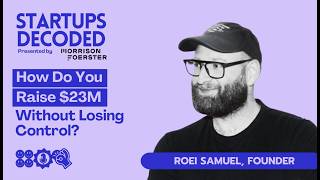
Roei Samuel, founder of Konnected and former RealSport founder, explains how to raise smart capital in 2026: build early revenue and attention first, avoid overspending, and use fractional experts instead of hiring aggressively. He argues that optionality lets founders walk away from bad deals, and that building in public on LinkedIn reduces dependence on venture capital.
Chapters
Well, look, as a founder of an investor-backed business, the reality is you are not at the top of an organization. You're in the middle of an organizational sandwich, right? Below you've got your employees and above you've got your investors. So you're in the middle, you're not at the top. And founders are normally really good at managing one organization. They're not necessarily great at managing upwards in the other because it's such a different skill set, such a different mentality that a lot struggle to evolve.
Welcome to Startups Decoded, the show that gets real all about what it takes to build a successful startup. I'm Andy Walsh, 2x exited founder, strategist, and your host. Each week I talk with top founders, investors, and operators to unpack the plays that drive real traction, not just headlines. If you're building something bold, this is where you'll get the honest insights to scale with clarity and confidence.
Let's keep growing together.
Hit subscribe and share with your community.
It would mean the world to me.
Morris Foster is the legal edge behind the world's boldest innovators. They go by MoFo and are the team behind Startups Decoded. For decades, MoFo has helped startups turn complexity into freedom. Learn more at mofo.com.
Hello and welcome back to Startups Decoded. My name is Andy Walsh. As a founder, fundraising feels like a rite of passage. That dynamic has shifted a lot. And the pattern has gone into smart capital and how you actually open up money in without giving too much away. And to unpack that today, I'm really fortunate to be joined by Roy Samuel. Welcome.
Thanks so much for having me, man.
Pleasure to be here. I love it that you're in town in New York in a week where New York got turned upside down with blizzard and then more snow. And that's your welcoming right here.
It's been a great week to be here, man. It's been a great week. Now, to be fair, we had a few things scheduled. Monday, Tuesday, we managed to rescue this podcast, which was the most important one on the schedule. Absolutely. Yeah.
So I had my event, uh, Startups Decoded Live that was due to happen on Tuesday. Roy was a panelist, but no, the weather had other plans. So we shifted that one back. So rescued that. But today we're here to talk about fundraising and it's something that is on the lips of every founder. And you're on your second business now, exited your first. Um, to give some context about yourself, I'd love to hear a little bit about that business, which was in sport, very different to what you're doing now. Can you talk us through what that looked like?
Yeah, for sure. So I've been obsessed with technology since I was a teenager, right? YouTube came out when I was like 13, 14 years old. So video content creation, very much the obsession after school. Fast forward to 2013, um, developed my first proper technical product, which was essentially a content creation toolkit. So helping people create podcasts, videos, tools for optimizing content for social, really ahead of its time back in 2013. If I look at the quality of those tools now, they would definitely not stand up today. But we got really lucky with that. Very, very fortunate. Applied it to the world of sports and gaming. Ended up working with the Premier League, NBA, NFL. Really, really fun journey. Got up to about 8-9 million monthly users. So yeah, got Really, really fortunate with that. Lots of ups and downs along the way. And we pretty much bootstrapped that business. Pretty much. We raised like a million dollars.
Yeah.
So it wasn't huge. Didn't do any venture capital with that one at all. But to get through that process, and then we were acquired by a big gaming company called Gfinity in 2018. Awesome experience getting acquired by, by those guys going from small scrappy startup of like 25 people in a basement under Papa John's in North London. You lived in in London, so in Kilburn, really not glamorous.
No.
Yeah. Not glamorous. Absolutely. That there was no windows, which definitely helped the rent get cheaper. Going from, you know, that, that sort of scrappy startup to being on the senior management team of a PLC at 26 years old. And the founder who, sorry, the CEO who acquired us was a guy called Gary Cook. Gary was formerly the CEO of Manchester City Football Club. He'd been the chief brand officer of the UFC. Very early on into Nike Jordan within Nike. So just awesome guy to learn from. But during that period of time, during that acquisition and integration of RealSport into Gfinity, I started to do some fractional work and just became obsessed with the idea that fractional work was a great way to live if you could do it. And then yeah, started to build Konnected.
And I know Gfinity, very, very definitive in the elevation of esports right now globally, like huge business. As a young man, really, which you were at that time, it seems wild to look back at that. That. And even ahead of the time in what has now got a term in seed strapping, which is a real buzz right now. It's basically what you did, right? You had some capital to sustain what you were doing, but then build it off your own back with that, that small investment.
Yeah, absolutely. And I think a big part of that living in London and especially the startup venture ecosystem in London, 2014, 2015, if you weren't from that world. I mean, we didn't really even understand venture that well. Me and my co-founder were deluded, right? We had no money. We were like, we're going up against the BBC and, you know, NBC. Like, it was insane. We got very fortunate with it in the end. Yeah, seedstrapping was not a term that we used back then, but bringing that interconnected, seeing that you could raise capital, use that capital wisely to generate revenue primarily, and generate traction. To then be able to question whether blindly following the venture route was the way to go or not.
And that's the part that we're seeing now really get, I'd say, pulled apart and put back together again. Like the, the rise of information at our fingertips has meant that people are getting smarter and aware of what they can and can't do. And not to say that the power has swung back to founders, but any founder who's got half a brain is now looking at the different ways they can get capital, the person that they're going in the business with and what goes behind it. But then the other side of that same coin is also the people that are just desperate to get money. Now with AI businesses, like you're basically just throwing money out the door every time that someone is using your product, like the cost of that. And AWS hand out free credits like nothing else, but it's still really expensive. So people need that money in the bank. And unfortunately what happens in that desperation, right, is that you give away sometimes the keys to the house. And today I really want to get into that. And you've raised, I think, $23 million in total. So a huge amount of money relative to where you're at in the stage of your business. For you, you talked about the seed strapping and the million dollars into Connected. How did you start to think about like playing the game where it actually worked for you with capital, but also having the right people around the table? Because like what you just described is you're trying to take power back in the sense of the power dynamic, not necessarily the power in your company because it is yours, but shifting that. Like, what made you even consider that as far as starting fundraising and going, how do I do this in a way where I can sustain what I'm doing and I don't have this noisy bird sitting beside me, this yapping all day, every day?
I think a lot of it is the fact that founders seem to chase venture dollars for the sake of chasing venture dollars.
Right?
They want that headline, they want that distribution, and they want the attention. So for me, pre— where social media is right now, the edge was venture dollars because you needed that level of paid marketing, paid activation to get attention. But now we see even with lots of paid activation on social platforms doesn't necessarily guarantee attention. So actually the edge, like the unfair advantage is no longer venture dollars as a mechanism for buying attention. It's actually the attention itself. So I think what you're solving for as an early stage founder should be different now. It's not solving for venture, it's solving for attention. So for me, with that in mind, starting to build very publicly on LinkedIn, and I got really lucky on LinkedIn early, just the algorithm favored me, right? I got in very, very early and very, very quickly with that in like 2020, 2021, and was able to use attention to master distribution through that channel to start building revenue very, very quickly. And also because I guess just philosophically, I always felt that you have to get customers paying for your product first, because understanding behaviors of free users, and this was a painful learning for my first company, understanding the behavior of pay— of free users does not necessarily translate to the behavior of paid users. You mastering distribution, mastering conversion to paid early meant that we never really needed capital to go because we had customers funding the growth. And when you have that dynamic, that obviously then gives optionality and optionality is what allows you to raise in a position of power.
The building in public element is fascinating. And the, in the age, to your point where you're in LinkedIn early today, it looks very different as far as the volume of people. I think it's 1.3 billion. Now that are on LinkedIn globally. It's, it's a lot of folks altogether competing for airtime and that storytelling element that you're able to do with your own business. Again, from an intention perspective, was that targeted at investors, fractional people and founders? Did you think about that? We want to share who we are, where we're at, what we're doing, because we think it's important to be able to just engage people, period.
Uh, yeah, it's latter, you know, because we pivoted, right? So we, as with most early stage businesses, we ended up with a different use case for our technology. You know, originally originally Connected was a fundraising platform. You know, so we started building that in 2020 and it got some good traction, but in 2022 we could just see that like the investment market was very, very fluffy. It wasn't necessarily gonna be a good long-term bet with what was on the horizon, but Fractional was. So, you know, we repurposed the technology in that way, but we built community first. Absolutely. To that point, you know, it's about distribution, it's about owning that distribution where you can. But I had seen with RealSport, my previous business, where our big unlock was Facebook groups. Right. And similarly, Facebook evolved from you posted in the feed, everyone who saw you post it, sorry, everyone who followed you saw what you posted in the feed to the algorithm shifting. But Facebook groups still notified everyone if you posted in them. So it was about finding like a growth hack early on to get that distribution. And it was the same with LinkedIn at the start. As you said, it's different now. But if you're a founder, it's about finding that well and going into the taps.
So important, early revenue momentum and my two businesses I bootstrapped, I'd never fundraised in the first two. And the lesson that I learned from that was being really aware of the levers that I could pull to get money in the bank. And it makes you think differently. And if you think about prioritization as a founder and what you need to focus on, it can feel like that you've got 10 things that are equal priority. But if you actually put a layer underneath that about what can get money in your bank today, tomorrow, and set up a pipeline because capital is everything. It powers you to do more and scale, right? You can focus on other things, refining products, doing updates to keep customers happy, think about retention. But if you're not ultimately pulling it down to that one number, then you're missing the trick and it sets up everything else too because pipeline and having a healthy pipeline is, is king and that gives you power. But what it also does is it gives you the upper hand if you do want to fundraise. Because if you are in a situation where your back's against the wall, you're almost outta cash. Mm-hmm. You lose any bargaining power in that conversation.
Mm-hmm.
Because a good investor will see that immediately. Whereas if you've got revenue momentum, all of a sudden that changes. And the topic we're covering today is smart capital. For you, what does smart capital look like in 2026?
Yeah, so just, just going back to your point, because I think it's so valuable, dude, like, I think it's so important. One is everything is downstream from lead gen, right? Like, if you can pull those levers yourself, then you are really master of your domain, even if you haven't figured it all out yet, you know, because finding that product-market fit, finding that proposition, you know, however you want to see it, takes multiple attempts at hammering a customer with what you've got. And your customer's gonna hammer back and tell you either it's good or not. But without understanding the levers of lead gen, you only have X amount of goes. So I think that's totally right. And then talking about smart capital and fundraising, it takes as much effort to fundraise as it does to generate revenue. Generate the revenue and then the fundraising gets easier. So it's definitely the right way around to do it.
And we had, and I've talked about this a bit before, but I think it's relevant for today as well, is that we basically had 3 things that we were selling and one was quite large in revenue, one was in the middle and one was pretty small. But the smallest one was the easiest to sell. So if we looked at our 6-month pipeline and we knew we were starting to drop off, it's like, okay, let's just have 2 weeks of focus, quick turnaround. We'll get $100,000 in the bank, take heat off while we close these other bigger deals. It became a really functional conversation rather than getting stressed out. We knew with pretty high confidence and conviction to know, okay, like, let's just do this. It'll get us back out of it. And then you go back to what you're doing. So financial reporting, is obviously really important in smart capital too, because you need to know in and out cost of goods, team costs, offices, all the things that are just fixed. There's things that just happen every month that you can't avoid, right? You might be able to trim a little bit, but knowing that foundation's important. And to carry on what you were saying from that, once you know that you've got that revenue pipeline and you are thinking about scale, maybe you see a bigger opportunity in a new market, a new service, or you've just got such good momentum. You want to capitalize on high conviction insight that's coming back in. How do you think about that from fundraising strategy, going to market where you feel like that you don't need it? Like it's a very different conversation, but is the approach the same as if you were like running out of cash and needing to get money in desperately? Because the state of mind is obviously very different, but from a practical standpoint, how do you take a first step into that?
Well, this is the thing. It's all about that optionality. And if you're running out of cash, your optionality drastically reduces to the point where taking a deal, which is very much boom or bust, may be the only option. And if you're a founder, it's your baby. You're not going to let it die. So you take that boom or bust option, you know, and that can be fucking awesome. Like it can be the best thing ever. And if you hit that boom and you feel You're one of the 5% that do, then it's life-changing and it's amazing. But there's massive survivorship bias here, right?
Yeah.
We all love the success story and the success stories get the airtime and the attention, but realistically, 95% don't go anywhere and it's painful for founders. And what could have been a life-changing sum of money under those circumstances will go to zero. Now, even if you're making great money, you know, let's look at companies like Lovable. For example, like they're making awesome money. Like they could be masters of their own destiny, but they've gone for it and gone and raised those dollars because actually like they will be an outsized returner. So it makes sense to, but going for that revenue stream means that you can choose whether you want to operate your business in a way that will either 30x, get to multiple billions, or could be a couple hundred million dollars. And I think as a founder, That's a more comfortable place to be. And it's important to talk about it from a founder perspective because the ecosystem talks about it from a returns perspective. And obviously the ecosystem is indexed on LPs, fundraising returns, IRR, not on the reality of outcomes for founders.
The question that I love to be able to put out there and provocative, intentionally so, is the DD that you do as a founder on the investor. And it's something that is not talked about enough in the person that you're getting into bed with. It's like could be 10, 15 years and they're putting money in, but they ultimately have bosses as well. And I'm not talking about the CEO of the fund, it's all the LPs that are putting money in that expecting a multiplier. And depending on how you want to look at it from a fund perspective is driven by that 5%. So like they know that they've got to get a certain multiplier off your company. So just doing some simple math on what is their fund size, what's the number they need to return, and then you go, well, they need to get $300 million out of me. I'm a $100 million max valued business. Then you don't even bother trying because even if you do get capital, like that's going to be a tense relationship all the way through because you're never going to get where they expect you to. So they're going to put unnecessary pressure on you to become a business that you could never be.
Yeah. And the brutal reality of because the OPs are dictating the cadence and the pace of growth, if you take that type of capital at the wrong time, there's know, okay, let's slow down and retool. And with Connected, you know, we've been blessed to probably two stages go through a considered, well, yeah, considered slowdown of growth with the knowledge that the playbooks that get you from 0 to 1 are rarely the ones that get you from 1 to 10. And now that we're at 15, we are also cognizant that the playbooks that got us from, you know, 10 to 15 are probably not the ones that get us to 100. And because we have remained masters of our own destiny in that way, we can say, all right, this year we're going to slow growth down to 90% rather than push it to 120% because we know that that's going to allow us to unlock next year. Right. And those are not the decisions that you make. You might get those outcomes, but you can't guarantee that you will because you lose control of the board. But we haven't done that. So that's been a blessing for us.
The power that happens just by nature of a relationship, but also from a contractual standpoint. And I was reading the Carter Report just through the week and they were, they ran, um, average ownership percentages of founders right through to Series A. And once you got the Series A, it was 13% that the founders retained. So if you think about that from a balance perspective, in the sense of the power coming from your investors, yeah, and it could be a couple of large funds and they're probably sitting on the board and they're looking at it from a commercial perspective. They don't care if it's your baby anymore at that stage at Series A, like they're looking at how do we get an exit this and drive a return and that they're all in on making money.
And you know how good you are at running your business? Their business is doing deals. They're going to be better than you at doing deals. So the marketing of that deal is beautiful. I've had term sheets where I'm like, oh, these guys are awesome. I love these guys. And then it's like you get into the meat of actually what's in their terms. You're like, oh, I can only take this deal if I hate myself and my business. Right? So it's exactly that, like, you know, you're not going to outdo a VC on a deal who has an intention of, you know, purely just returns.
And it's an interesting shift on, as a founder, you have purpose, you may have a very personal reason why you've started it. You could be just to have an opportunity, but you're very focused on the long-term vision. Ultimately, once it starts becoming a commercial machine, that power then starts to dictate internal culture and what you're doing. And I recently just had Alyssa Cohn, and she's a CEO coach, an amazing human. She's got a book called From Startup to Grown Up that you all should take a look at. But she was talking about that, that shift where you go from a founder to a CEO. As an early stage founder, you might have the CEO title, but if you go to Series E, being a CEO at Series E versus day one of when you launch a company, they are two very different job descriptions.
Absolutely, man. I, uh, I'll find out whether I can manage that when we get there. But yeah, it's exactly that. It's exactly that. And the requirements, the responsibilities, the realities of that role so fundamentally shift when your main— well, look, as a founder of an investor-backed business, the reality is you are not at the top of an organization. You're in the middle of an organizational sandwich, right? Below you've got your employees and above you've got your investors. So you're in the middle. You're not at the top. To the people on the lower side, it feels like at the top, but you are in the middle. And the— and founders are normally really good at managing one organization. They're not necessarily great at managing upwards and the other, because it's such a different skill set, such a different mentality that a lot struggle to evolve.
I'm going to tackle that in a minute, but first, I think it's relevant before you even— say you're lucky enough to get conversation, they do diligence, you sign terms and you get money in the bank. Through that process, we talked about doing DD on the actual fund itself as far as who they are, how they operate, fund size, multiplier. There's practical things, but then there's their portfolio too. Is it something that you've seen work well where you're able to speak to other founders who are part of that portfolio of that VC to get a sense of culture or workflow to get a read on what you are likely to expect going forwards?
Yeah, it is really important and it's also really important that you reach out to the portfolio companies that don't get introduced to you by the funds, right? They tend not to refer the ones where it's gone horribly wrong. So it is really important, man. And it's, it's a two-way street, especially if you're taking the types of terms that we're talking about here. You know, the, the better you do on the terms, obviously the, the, the more the risk is mitigated. But if you're getting into a serious venture deal, yeah, absolutely. What I'll also add is, VCs do get a bad rap and we're not exactly changing that, that in this conversation, they do get a bad rap, but they do have reputations to uphold. They are in a relationship business. So they're, yes, they're difficult, but their behavior tends to be pretty good. If you don't know the rules of the game, that's actually not on the VC, that's on you as a founder. Taking private capital from individuals and family offices who have no reputation to uphold, do not care and are seeing you even more of an asset than in a relationship-driven venture ecosystem. That's also, you gotta be really careful. So I see founders say, oh, we avoided VC, but actually not realizing there can be very predatory investors in private markets too, probably even more so than venture itself.
Yeah, agree. And also I want to reiterate what you said there too. This is definitely not a VC bashing session. It's very much an awareness of some of the things that happen like every time in a deal, like you need to make decisions, you need to understand what decision you're making and why and what that looks like longer term from a functional capacity into capital expectations and multipliers. So that's really important. So what we want to do here is air all the things that you need to consider in going into that conversation. And you're right, because if you had PE, you could have someone who's doing billion-dollar M&A activity and all they care about is hitting their targets for the end of the year. You're a, you're a chess piece on a board that they're just playing as part of their interest. So for you to understand what that looks like, a family office, another consideration again. So each of those capital deployment opportunities for a founder, each act and behave very differently. So you might be on a path to go, I just need money in the bank, but it's very short-sighted to not consider what you're stepping into.
Yeah, exactly that. You know, If you want to build a multi-billion dollar company, like venture is the right thing to do. You know, venture is great, but just know the game you're getting into. And also know that as a founder, again, depending on where you are in your life, depending on what you need, depending on what your past has been, you don't necessarily need to go for a multi-billion dollar company. And there are lots of other opportunities out there to raise capital, to do it in different ways, to get traction, to earn life-changing money, and to make a huge impact on your customers and on the mission that you're trying to achieve without necessarily going down that route.
Yeah.
This made me think of something I would love to know. I don't have anything that springs to mind, a company that has gone to the scale of say a Meta or an Apple, Microsoft that didn't have early investment. Like I can't think of one top of mind. There probably is. And I'm not going to say that there isn't, but if you think about all of those businesses, like Mark Zuckerberg had, I think there's 12 early investors. Yeah. And they very early stage for him to multiply what he was doing. They all made hundreds of millions of dollars off it, of course. But at that stage, that was just an idea like anyone else sitting around, you know, in a college dorm room and like working out ways that, you know, he can basically make himself famous in college was his motivation.
Yeah.
To turn it into a business.
Yeah, yeah, totally. I can't think of any new companies like that. When I look at like old school companies, you've got loads of these like massive behemoth private companies like the Koch brothers and all the rest of it, but that just doesn't really exist anymore. And also because Something that goes back to one of the points I made at the very start is so much of this is about attention. And if you're a company that doesn't have much of brand around you, if you haven't done the building in public thing, fundraising can be very attractive because it's hard to recruit and retain great talent without brand. So if, again, if you're one of these companies who doesn't have that, doesn't have that distribution, fundraising can be very valuable because the marquee that you can get with that is strong for bringing in talent, which you do need to make things happen and to grow and to scale. But you can build that attention yourself.
If you're building the future, you deserve a legal partner built for it. Morrison Foster, the legal edge behind the world's boldest innovators. They go by MoFo and are the team behind Startups Decoded. For decades, Mofo has helped startups turn complexity into freedom. They combine deep market insight, tailored legal strategy, and a Mofo passion. Discover how Mofo can support you. mofo.com.
The attention is something that I'm personally passionate about. I come from brand strategy world and storytelling, particularly from a cultural perspective. We were talking just before, I worked in music, art, and fashion. And in those lanes you've got people that are so passionate about consuming the, the version of art that those people are creating, that if you step outside of that circle, even just a tiny portion, you'll have your fingers burnt a lot. So you need to make sure that you're telling a story that's genuine, that's authentic and real. And people talk about authentic conversation, and right now it feels like it's even more important than ever just to be you. And the easiest job you can do as a founder is be yourself and tell your story. And sharing that because to your point, like in the early stages, particularly the founder brand is going to be much more impactful than the company brand. The company is, you know, an idea. It might be in market, but probably no one knows about it. So your personal brand is something that you can build ongoing to elevate yourself because it goes into investment. It goes into recruiting staff, strategic partners. It just opens up doors for you way ahead of starting cold and flat-footed without that.
Totally. And the reality of social platforms now is it's 10x easier to build a personal page than a business page. So yeah, everything leans into being authentic, amplifying that story. I think the authenticity piece is such a good one, mate. I think it's really valuable to bring up because at least seemingly to me, when I see founders building from a place of pure optics rather than authenticity, I don't see them go as far, or I see Maybe they get a big hit, but the ceiling seems to be a bit lower. The bottleneck seemed to be a bit tighter because I think when it's coming from that place of optics and ego rather than authenticity, people feel that. The algorithm seems to feel it somehow. I don't know, but it does, right? So I think it's a really good point.
Yeah. And you can pick it when someone is being themselves. You get a real sense of that person, the story that they're telling, because first and foremost, we're human beings. We're not an algorithm. We're hardwired to get a gauge of someone pretty quickly. There's just a self- protection thing that comes out of that, right? So being authentic and telling the truth, and not to say that the optic version of putting a story out there is a lie, but there's two sides there. And for me, it's— I say it all the time, it's so much easier to tell something that actually happened than try and remember a regurgitated story that you've made up along the way to present yourself as someone that you're not. And that kind of level of being almost contrived doesn't stand the length of time because ultimately people find out who you are. I equate it to dating. It's like trying to put on the best version of yourself for 6 months and then you slip back into who you actually are and you look at your partner and go, actually, we're not suited at all. It's the same thing.
Yeah. I think it's going to be so interesting when obviously we've got now a lot of AI-led selling, right? AI-led brands, AI-led influencers, like all of these things are going and still they have to connect with us as humans first, as you said. What happens when the buyers, become AI? What happens when like we have agentic solutions for all of our purchasing? And that does the humanity just disappear? Because AI would rather buy from AI.
Yeah. And I had Mike Adams on from IntroStars, an interesting chat where his simple example was AI fighting AI, where on a go-to-market approach where you can be really clever on something like Clay and be able to test messaging, see what hooks, start to build up a list of prospects. But then on the other side, the more that people do that, You've got a level of AI force pushing it back. So they're just competing with each other and you're not even aware that that's happening. It just sort of happens. So from a consumer perspective, like B2C, how do you empower an agent on your behalf to make decisions without you in the room? Is it shopping? Is it food choices? Car you buy? Like that's, that's a whole different level.
3 to 6 months away, right? Like it's, it's here. I was reading a really interesting story about one of the mobile networks somewhere in the world was, uh, employing like a frustrating AI agent to just basically frustrate scammers. So it was like an old woman replying and just like really pissing off scammers from somewhere in the world. But then obviously they start using the AI scammers as well. So now you just have like millions of concurrent conversations between like an AI bot pissing off scammers and AI scammers just having conversations, just running up like usage. And no one's involved, but it's just AI scammers calling AI bots.
It's fascinating. That's what it feels like, this set of a movie, like you could do. But not here to talk about agents today. Going back to the dynamic that you have with your investor, like let's just stick in the VC lane for this one. When you are looking at contracting board seats, the role that they play, you've got a really strong point of view on the ability to retain control but still make sure that your investor is happy and plays a role. Can you just unpack that a little bit for us?
Yeah, totally. So our lead investor, Um, now is a group called Anchor Capital and Anchor have invested probably 9 million, something like that. Um, it's interconnected and they don't have a board seat and they don't have preference shares. I've got a really, really strong relationship with, uh, the partner there. Um, you know, 'cause relationships going back to the humanity of it all are so important and I've done a really good, um, and conscientious job of keeping them in the loop pretty much since day one. Investor updates since pretty much day one. Monthly updates. This is how it's going. These are how we're tracking on KPIs. So built up a cadence of transparency, of trust, and most importantly, of delivery against expectations. And because of the transparency-first nature of the relationship, it meant when we came into negotiation around information rights and board seats and all of these things, so much of it was baked into the relationship. It actually didn't have to be baked in from a documentation perspective. Because of the relationship that I have where I'm very transparent, very, very open, when it came to negotiation, like it didn't need to be baked in in that way. So I think, you know, it's probably going to be much harder to say, right, you can't see the books and you can't have a board seat and you can't do this. Like it probably does happen. And you've, I've heard about some deals. Especially at the peak of like 2021, which maybe like that, very few of them went well. Um, but yeah, so I think because we built in that way, we were able to do that. We have a great strong board of non-execs who again, I've built very strong personal relationships with, but they are well-established, very, very credible names. So the trust that they also then have in the non-execs also does a really great job of foregoing the requirement to go and bring in some of these terms. And at the end of the day, we were willing to walk away from any deal. You know, we had two term sheets on the table from a UK VC and a European VC in middle of 2024 and early, yeah, middle of 2024 and early 2025 respectively. And we walked away from the deals because we just didn't need it. You know, and we were in a position to say no. And therefore, when we got to the table with Anchor, where they had known and definitely done the DD and spoken to the other guys, like, did they really walk away from a deal? So it was just, they wanted to do the deal because we'd built that track record. We are, we were growing, you know, at an amazing rate, but in a way where we had strong unit economics, capital efficiency, strong fundamentals, which are the exact fundamentals that let us drive at the optionality of walking away. So it's very, very symbiotic and killing two birds with one stone, building fundamentals gives optionality, makes fundraising easier, which allowed us to do that deal.
It goes back to attention, like crafting that relationship with transparency and openness, telling the right people at the right time, the right level of information.
Mm-hmm.
It's a really simple way just to make them feel like they've already got a seat at the table. And then that allows you to have a much more practical conversation. And it's interesting, like the UK versus the US as far as structure of boards. Like here you'd have a like advisory, which typically on a board, the individuals working with you, and then you have your more formal board. But the non-executive director is a really fascinating difference. In the UK as well, because you can stack it with really interesting people. And you called it out there. If you've got a VC who's investing but sees that you've got really smart group of heads around the table that allow you to succeed beyond what they could do, as long as they're the foundational parts of their contract and voting decisions, transparency are all set up and you're all clear on that, then that can potentially even be even stronger, particularly if they have a big portfolio. And have limited bandwidth to be able to help and contribute in a way that's valuable for both of you.
Yeah, absolutely. I think that's really well put. Out of interest, how do you see that different to the US and how they might use independent directors? I'd love to get your—
Yeah, so the difference, and I'd had it because I started my business in Australia and my first board member lived in London and he was a non-executive director, earned in equity. And the role that he played was like a full board member, but he was acting like an advisor. So it sort of sat in the middle where Here I feel like the advisors come on, they typically play a very specific role and they tap in and tap out. It might be for a set period of time. They earn their equity and disappear where a board feels more formal in what they're doing. The non-executive director sits between both and our, our NEDs played away as board members and made us compliant. Not like we didn't want to, made sure we were documenting our compliance rather. And for me, a non-executive director makes more sense. 'Cause you can still have a more formal boardroom play over that as well. So they're the people that are in the trenches with you. And we had an M&A lawyer as our first, and he set our company up, buttoned up with all the right things, and it didn't cost us a cent other than maybe 2% equity, I think, from memory. And like having that foundation just set us up on a trajectory of strength. And I think the UK model for me is probably stronger in how it operates. Wow.
Very interesting. I love that. One point for Team UK. Very rare that I get it these days, but we'll take it. No, that's That's awesome. And also goes to show in your example there, the value of having the right people around you at that level, because that M&A lawyer, for example, like that is going to be such an edge when it comes to getting the exit that you want or even getting to an exit and transaction. So I think reverse engineering from where you want to be and surrounding yourself with that at that level is very often the difference between success and failure.
Yeah.
And it comes back to life stage as well. And I break it up into 3, which is that early growth hacking stage. We are trying to find signal, get momentum through any which way you can. Basically the second stage is more formalization of insights, understanding, starting to build SOPs. And then third being scale where you have a heavy flow of data and you optimize and grow with high conviction. Yeah. Basically in those three phases and the role that you need in each of those three phases from board members, advisors, NEDs is very different. And you need some linear path that goes through, but the role that they play at each, like you could have someone spend 3 years in the, in the growth hacking stage, help you get to that point where you start to formalize, and then they can tap out and that's okay. Like they've done their job. Carving that out from the early stage through to potential exit is a really strong way and it would support what you're talking about as far as giving VCs confidence and transparency around your thinking about this as an exit from the start.
Yeah, absolutely. Absolutely. And if you are playing that venture game, then you've got to realize that's what this is about. It's all about hunting transaction, which again can be a great thing. It's also why people like second-time and exited founders, because the amount of mistakes you make along the way there for the first couple, first time, first couple times around, you know, is huge. And I agree, setting expectations. And I think this is where advisors have to be really hyper-realistic about where they add value, is knowing where they fit into within that life cycle. And actually the best relationships and most fruitful ones end with a handshake saying, great, I've delivered. And that's, you know, that's where I got to step out. So yeah, I think, you know, that, that level of hyperreality and honesty with ourselves about where we can deliver the most quantifiable and tangible value and be an enabler and facilitator of business growth, rather than trying to be someone who owns it, is actually often the difference between good and great advisors.
Great advice. And the next part to continue that journey, you've set that structure up, you've got the right got board arrangement, you got money in the bank. Spending that money is a real challenge for a lot of founders. And say you raise $9, $10 million and you've got some signal, you've got patterns of behavior, you've got team members, and where you prioritize spending. I've seen a lot of founders almost like blank face going, okay, we did it. Like we were sprinting to that, but now what do we do? And it's easy to go off on a wrong path really quickly.
Yeah. And I see that a lot in companies who raise too early because early signal doesn't always mean you can deploy or should deploy all capital into one early signal. And I see a lot of companies burn a lot of cash where they've understood one channel and understood it well, but don't, haven't even had a chance to think deeply about where else they might look for distribution or, you know, what does influencer marketing look like for us? And then go and spend a bomb on advertising on the Joe Rogan podcast. I did, this is like a specific example of a portfolio company of mine. And just it not land at all. So I think the earlier that you raise capital, the higher risk there is of deploying in the wrong areas. So yeah, you've, you've gotta, and that's the risk that comes with it, right? That's what venture wants is actually take that bet because 10% of the portfolio will get it right.
Yeah, exactly. And it's, it's always a fascinating insight into who's raised funds when you travel on the subway in New York. Rock when you see a startup that's plastered with, with ads in the subway. You know that they've closed some money, they're doubling down on brand awareness, and they're very brand-heavy campaigns that's all around education and getting a bigger market to be able to then market to in more non-traditional ways. So it's always fascinating. I love looking up, and this morning Deal had ads up, last month Clay had ads up, and it's the likely subjects that are going through that huge scale phase of getting market share, hype.
And it makes sense because to attain that level of scale, that's what you got to do. But most will burn out along the way. So for us, we were already at, so we've raised about $20, $24 million now in total over about 4 rounds and rounds got bigger throughout. The last one was 7 or 8. Um, Anchor invested over 2 rounds. And by the time we raised the most recent funding, we were already at like 12, 13 million ARR.
Yeah.
So at that point, like, it's very, very different. Like, you really understand where you're going to deploy capital at that stage because you've already deployed so much off your own balance sheet. I certainly think that when we first raised, you know, our first round was probably $2.5 million. We wasted a lot of that. Yeah, big time. Because we're still figuring things out. We're like, right, you know, we were B2C, maybe we can launch enterprise, start growing NRR more reliably and just I was like, no, we can't, you know, it's an expensive mistake to make. But that's where good advisors around you— I think having that mix of generalists, either exited founders or board members who have been on boards of companies that have gone through that journey, are great. And then very, very specific, single-issue-focused advisors who will know certain unlocks or mistakes within a path. Like, that's how you should be surrounding yourself with that early-stage capital to make sure that you're deploying it Yeah.
And it's interesting, something you said there jumped out. So you feel like you're wasting money on that early stage. It's hard to know though. And like, that's part of that early stage is it's the little tests that you can do and a path that leads nowhere is a path that's closer to where you need to get to ultimately. So you can reframe it. It doesn't mean you can just throw money against the wall and see what sticks. Like it's very much a structured decision-making process, but being aware of that and advisors to your point, but also fractional people. And I love to continue that a little bit. And you're in a unique position because you've created a company in Connected that specializes in pairing fractional workers with founders to help them through that phase. So when you had that capital, you're also in the same network. So it's a double-sided view on the reality of what you need to do. Can you give us a bit of a peek behind the curtain on that?
I think a lot of founders build for problems they're experiencing, right? I guess in that way we're no different. Maybe that was the problem. We raised capital, had to figure it out, and got some fractionals in. Um, so I, I think, yeah, it was, it was definitely something that I experienced at RealSport initially. You know, we were very, very fortunate. We brought in an advisor who had such immense experience in the sports world and had also invested in exited companies previously. And similarly to your M&A lawyer, had that person not been around us, I doubt we got to exit. We wouldn't have because it was a strategic exit that actually we could only have, we only realized the strategy because we had someone who had been there and done it. So firsthand experienced it on that After I sold RealSport and I started investing in companies, I saw firsthand experience of companies with bad advisors and say, okay, this is a car crash. And I was on a non-exec— sorry, I was a non-exec on a business that went through bankruptcy, you know, and that experience is— that is not fun. So learned a lot on good and bad and how influential the right fractionals, advisors, non-execs, fractional execs can be on on a business's outcome. So we started to solve for that. And that's where we see, you know, it's interesting, we ran an event last night. The earlier stage the company is, the more it is actually about the soft skills, you know, the validation, the guidance, the strategic judgment that comes from experience. And the more mature a business gets, the more funding it gets, the more tactical that fractional advice can become.
Yeah.
Which makes sense because the business has a better strategic direction of travel.
That makes sense. Can you give us a little bit of insight? Because as a founder, you've got money in the bank and you are thinking about how you deploy that. There's tension with a fractional person because they're probably going to be more expensive than getting some junior, mid-level person in. But the trade-off is, of course, is expertise to be able to have a greater impact in a shorter period of time because of what they've achieved. How do you start to tell that story to founders? If you are a founder and you're about employing a fractional person to really escalate that and be effective with your capital, and that spend feels high, how do you start to rationalize that as a decision?
Well, I think the market's done a really great job of educating founders for us because whereas it used to be about the brute force of hours spent, right? I need a generalist who's going to be there in the trenches with me because there is so much heavy lifting to do. It's evolved because of automation and AI. Eye to a different type of value. Brute force in ours is now secondary to strategic judgment and guidance because so much of that brute force is done through automation. Even if it's not quite there yet in every use case, that's how founders are thinking. So the mode of operation as a status quo now in the early stage is, one, can I automate it? Right? That is number one. Number two is what else? And then number three is a hire full-time. Time to go and get that done. So in an age where most founders are being very, very industrious, using AI solutions to do a lot of that lifting, being able to bring in someone who's got the guidance to say, well, this is how you should be thinking about it, this is where you should be pointing, is now more valuable than the brute force of ours.
The systems and the strategic expertise that you're bringing in, because the repetition, as you say, is being taken care of, And someone who can come in and just like work around the clock like a machine is not, not like it's unnecessary now, but it's, it's moving to becoming redundant because any way that you can automate repetition can be solvable and it's only going to improve.
Yeah. And if you previously needed to hire 10 brute force generalists, now you need 3. And then what's the smarter way to deploy the capital that would have gone to the other 7? It's the guidance to direct those 3 plus the agentic solutions.
And it's, if someone has implemented the same system 40 times and had success 35, and they can come in and just drop that in and plug and play and you can escalate immediately, they're bringing years of value. And it's, I love that little quote around that you're not paying for the hours that I worked, you're paying for the years of experience that I have. And that's very much that tension around fractional work versus automated work where you're able to bring in the expertise and have high convictions that you can double down on that, but you need the right person also who understands in a startup situation, it's not a large enterprise, the way that they work, the budgets that they have is very different too. So there needs to be a two-way street in the sense of transparency and awareness of what you're stepping into.
100%. And that's why we suggest to most fractionals, most advisors, if you've never worked with a startup before, you need to learn what it is to flex that advisory muscle. Door and go and do some work for free with a startup. You know, in the same way that he did work experience 30 years ago where you weren't getting paid great, it's about flexing that and understanding actually how you apply the amazing experience from an enterprise environment into an early-stage one, because it's very, very different. That's my advice to most advisors and fractionals is start building that understanding, get the testimonial, get the case study, get results for a company and then leverage that. Don't expect that you're going to be going in on an exec salary on your first go because you haven't proven it yet.
Exactly. Roy Samuel, CEO, founder of Konnected, thank you so much. This has been a really fascinating conversation.
Thanks so much for having me, man. Appreciate you.
Thanks for listening to Startups Decoded. If today's conversation helped you think differently, share it with the founder in your network.
And don't forget to subscribe for real-world startup insights every week.
We really value your support.
If you're interested in partnering with us, email hello@startupsdecoded.com.
I'm Andy Walsh. I'll see you next week.
More from Andy



EP#88: Why Most Founders Misread Their Own Traction. Vanessa Larco - Premise VC

EP#87: Founders Obsess Over the Raise. Investors Care About This More. — Carina Cunha






Ep#86: Early Decisions That Define Your Startup Forever. With J.P. Morgan Asset Management
