#61: VCs Don’t Take Power. Founders Hand It Over. With Itamar Novick
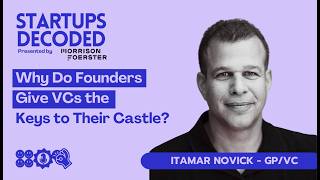
Itamar Novick, a founder and investor with 25 years of experience and over 150 VC investments, explains how founders cede power to investors through poor negotiation and then shares concrete tactics: meticulous fundraising prep, understanding term sheets, reverse vesting clauses, and knowing when to bootstrap instead.
Chapters
You should think long and hard about, if I take this money, can I 10x it? Do I know how to take this dollar and make a 10 out of it? And if not, stop and think, are you doing the right thing?
It's easy to get caught in that rite of passage moment of, I have to do this to be successful, when it's actually not the case.
Yeah, raising money is not success. Raising money is increasing the level of commitment to external parties and the risk and leverage in your business. That's the way I see it.
Welcome to Startups Decoded, the show that gets real about what it takes to build a successful startup. I'm Andy Walsh, 2x exited founder, strategist, and your host. Each week I talk with top founders, investors, and operators to unpack the plays that drive real traction, not just headlines. If you're building something bold, this is where you'll get the honest insights to scale with clarity and confidence. Let's keep growing together. Hit subscribe and share with your community. It would mean the world to me. Morris Foster is the legal edge behind the world's boldest innovators. They go by MoFo and are the team behind Startups Decoded. For decades, MoFo has helped startups turn complexity into freedom. Learn more at mofo.com. Hello and welcome back to Startups Decoded. My name is Andy Walsh. In the life of a founder, VC feels like something that's critical for everyone. It can help empower you to scale, to grow, to block out competitors. but what it does create is a power dynamic that you need to learn how to juggle. Today we've got Idan Novik joining me. Welcome, Idan.
Andy, thank you so much for having me. And now we've got this live audience in the crowd. Thanks everybody for coming in. I can't wait to hear the tough questions you're going to ask me about when it comes to power dynamics between VCs and founders.
It's the best. And I found you on LinkedIn and we were commenting earlier. One of the things that I love is that you're representing the founder, which is almost uncommon, which sounds strange for a VC. And the things you talk about are advice for founders in approaching how they fundraise, how they navigate the deal, and then also how they work with their VC. Because you've come from a founder background, I'd love to know from yourself, how did you end up being in that place where you were like, I need to go into bat now for the founder? It came from a founder life, right?
Absolutely. So I'll give you a little bit of my background and I'll tie that into why I'm really on the founder side, right? So I've been in startups for 25 years, which is pretty much my entire career. And I'm a repeat entrepreneur and startup executive. The last company I was involved in is a company called Life360, which is now a public company, one of the sort of leading mobile apps in the US. Before that, I was a very early employee at a company called Gigya that got sold to SAP for $350 million. So I've been part of kind of two big exits, sort of building from the ground up, you know, and scaling up. Um, and I've also been an investor since 2010. I started my career on Sand Hill Road. I was working for an institutional VC firm. Um, and, and I've done over 150 investments in startups over the last 15 years, including multiple decacorns and unicorns. So I've been kind of seeing this thing playing out from both sides of the table, right? From all sides of the table. I've also been an angel investor, Series A, Seed, and so on and so forth. And you know, for me as a person who's been building stuff from the ground up, I know that what we need as, as you know, as an ecosystem, right, is we need to empower the founders. We need the founders to be successful. And one of the kind of misconceptions that founders sometimes have is that like VCs are always on your side, you know, they're your partners to the journey. And for the majority of time and with the majority of VCs, that's true, but it's not always true. In many cases, it's just a matter of time until friction is gonna start showing up, right? And there could be conflict because at the end of the day, you know, you as a founder, you only have one bet. You're going all in on that one thing, but the VCs have a portfolio, they've got LPs to entertain, all those different things. So when I started thinking about what is my voice, how can I help founders on the journey? I was like, oh, I'll just talk about all the things that founders can do better to kind of better manage their VCs and reduce friction.
So humbling and for me really positive to hear that. And the stories that you hear from founders that have had a really tough time with VCs when in essence they both have a common goal, which is to scale to a point where they can exit and get a really good multiplier. Yet it's like a transaction exists and coming from what you've done, like understanding that intimately as a founder is really important. Can you talk us through your early days of fundraising as a founder? Anything that stood out to you where maybe you had some harsh lessons or where something went well? I'd love to know how that played out for yourself.
Oh wow. I mean, at the early days at Live360, we had so many challenges. I still have a list of 70— 70 prominent VC firms on Sand Hill Road who all said no. It was like, what is this thing, Live360? You're a tracker, it's creepy. I'll never forget a very— I won't name the guy, but like a very, very senior, well-known GP, a founder of a firm was like, oh gosh, kids are never going to have smartphones. That was 2010, 2011. It's like, no, a smartphone is a business thing. It's like business people have it. Kids are never going to have smartphones. We shouldn't invest. I was like, seriously, are you sure about this? I think everybody's going to have a smartphone. Sooner or later, right? So we hit all those misconceptions and all this friction with founders. As a company, Live360, honestly, we barely survived. We barely made it. Like, we were teetering on the brink of bankruptcy. Well, not bankruptcy, but a couple of months away from running out of money multiple times, right? It was so hard, so tough to get money into the company. But eventually we were able to shift the narrative over time and raise hundreds of millions of dollars and go public first in Australia. Now we're public on the NASDAQ, so dual listed. Yeah, but it's been so incredible tough, incredibly tough. And we did all the mistakes, not all, but maybe most of the mistakes that you would expect less experienced founders to do along the way. Overhiring, taking too much money at too high of a valuation, then trying to catch up with the value of the business to the valuation you just raised money on, raising money from strategic investors who then try to mess up with your business, like all those different things. And that's why for from my own personal journey, I'm trying to sort of encapsulate and communicate some of those mistakes to founders so they don't, you know, make those same mistakes.
It's really important. And curly question for you, like, you're a founder now again, but as a GP in Recursive Ventures, you've made over 100 investments in that firm. But if you were to step outside of a VC firm and build a product today, How successful do you think you would be after all the lessons that you learned? Do you think there's enough intelligence in your experience to be able to start something and have a high level of conviction on that would succeed?
I mean, I'm gonna try to talk for this from a data lens, but obviously data is just data, right? So we know statistically that repeat entrepreneurs, especially successful repeat entrepreneurs, have 2 to 3x odds of succeeding compared to, compared to less experienced entrepreneurs. This is what the data tells us. Actually, if you've failed as an entrepreneur or if you've been successful, there is a difference, but it's not huge. What matters is you've tried and you've went through the ups and downs, right, of the startup journey. So from that standpoint, I'm probably better positioned maybe than the average founder. But the reality is, you know, when you look at startups, especially the seed stage, when I look at my portfolio, I've done all those deals. And it's really like 1 out of 20, 1 out of 30 that kind of hits it out of the park. Those are good deals and good companies. I mean, there's so many good companies that have gone so far only to really not create a lot of value at the end of the, at the end of the journey, right? Maybe I have slightly better odds than the average Joe, but the statistics are still really, really hard. And I think founders have to understand that. Follow your passion, do this thing, you believe in it, you're going to change the world. That's the core of what's going to drive this forward. But do that with the understanding that, you know, you're probably looking at sub-5% chance of going big with this thing. And it's okay. And if you're really, really determined to do it, just don't stop. Do the first company, doesn't work out. Okay. Move on to the next company and next company. And every time you do it, you're going to get a little bit better. And at the end, hopefully it will all work out.
Being a founder and being an investor is a numbers game ultimately. And the investors have so much history as far as deal size, category, all the things that they know that they need to do to get a return on investment for their LPs. 'Cause ultimately as a VC, you're working for a whole bunch of other people that are trusting you with their own personal capital. So that flow of money comes from people who have a vested interest But you know, as a VC, those metrics, and you just rolled them off without even thinking twice about it. So, you know, in a balanced portfolio, you need to be able to put money down across the board, but only some of those will drive a return. And it's hard as a VC to not treat that as a transaction when there's actually a human relationship behind it. So to balance that out, how do you think about if you've got someone in your portfolio, you're on fund 3 at the moment, If you've got someone in your portfolio that's clearly on the decline, they're not going to make it, there's no coming back from what they're doing, do you have to make tough decisions and let them do their thing and you focus on the ones that are succeeding? Because you're in a business, right? You have to make a return and that's hard, like people versus capital conversation.
It is very hard. And yes, we as, you know, GPs, as VCs, we get paid to make money. It's called venture capital for a reason, right? It's capitalistic. So yes, we do have to make hard choices. I think the way I try to deal with it, because obviously it's, it's, it's not fun to tell somebody that, hey, your baby is kind of dying, is I just try to be very authentic, very genuine, understand where they're at in their personal journey, and just try to be helpful no matter what, right? Always try to be helpful. You know, if the help is help you shut down the company, we'll go do that, right? And then you'll move on to the next one. And I know that if I'll be there by your side, even as we all just lose money here, then you'd still want me on the next journey alongside you when you come up with your next company. And I think that's really important. I mean, reputation is the number one asset VCs have. And I think whoever in the VC category is gonna systematically kind of screw over founders, they're not going to be the next call, right? For those founders, right? It's part of the business. So that's how I try to deal with it. But look, it's inevitable, especially when you understand that at precedent seed, 85% of companies are just going to, you know, they're going to fail.
And anyone who listens regularly knows I have a real passionate hate about the word fail. For me, fail feels very finite. It's not the end. You talked about if you don't succeed, you can try again. You need to be pragmatic and you need to be strong and you probably need some grief time to be able to move through that. But it's all about learning. I think about test and learn and iteration and something as fundamental as The Lean Startup by Eric Ries talks about that. It's like a methodology that you have. You test, you learn, and then you go forth. And if it doesn't work out, like a scientist would do, you choose another path. And that's positive momentum allows you to continue doing what you're doing, right?
Totally. I actually, uh, this is an interesting take on the founder's journey. I think being a founder is a journey inside your head from where you are today to everything that you need to know to make this business successful. Because if you woke up tomorrow and you knew exactly what's the product market fit, how to market this thing, what exactly do you need to tell the VCs, what exactly do you need to tell your customers, and how to inspire your team. If you knew all of those things, which is what happens when you're 5, 10 years in and you're successful, you actually dial all those things in. If you knew all those things at day one, you'd probably be very successful unless the timing or market killed you, right? So really it's a question of how quickly can you accelerate that journey in your head of understanding all those things. And the best way to do that, one of the best ways of doing that is exactly what you mentioned. It's this iteration experimentation framework of like, okay, let's try this. Oh, it doesn't work. Okay, let's quickly shift gears to try this other thing. The more you try, The more you learn, the more you accelerate that journey, the more likely you are to be successful on the other side.
The word that comes to mind is signal versus noise, and signal is something that's really, really getting used heavily right now as a way to understand data and understand things that are coming at you. And the more that you can hypothesize and think about future state and understand what that data looks like allows you to be objective. But if you're a first-time, you don't have any reference point, you need people around the table that can help you. And that's where a good VC relationship can help and whether it's the person who is working with you direct as a GP, or it could be someone in their team that has some expertise as well. How do you start to think about that workflow with your own portfolio of how you collaborate and how you make sure that they've got the right people around the table?
Yeah. Yeah. Yeah. So philosophically at Recursive Ventures, we are, to be honest, more of a hands-off investor on everything but fundraising. On fundraising, we are committed to be your number one resource as a partner on the journey, right? So, you know, I work tirelessly with my companies 6 months before they go out fundraising. We put together the deck, put together a narrative, figure out what are the KPIs they need to hit to be able to get the next round going. And then for the majority of my companies, I do the majority of intros to kind of follow-on VCs to get their Series A funded. And I've done this with over 50 companies that my companies have raised over $500 million directly from intros I've made with some of the leading VCs on on, you know, in Silicon Valley. So I think the reality for a small fund like ours is we just don't have enough bandwidth to solve everything. Obviously you want to have people to help you with PR and recruiting and strategy and go-to-market. And, you know, me and my team, we've done some of those things. I don't think we're the best at any of those things. So we focus on doing that one thing really, really well, and that's fundraising. Really, I'm, I'm kind of being very sort of high-level thinking about this. What really drives startup success in the early stages? Two things matter. One is finding product-market fit. That's the founder's job. You need to find product-market fit. And the second thing that matters is staying alive long enough, having capital to find number one, that product-market fit. So we, we take care of the second one. We're gonna give you the runway. To hit a park. Now, are you gonna be able to make it? It's really up to you. And what I found to kind of round up this discussion point is that some, not all, but some, and this is what I write about in my LinkedIn posts, of the VCs who kind of jump in with blazing guns and try to help you run your company, they make dire mistakes, right? VCs don't know more than the founders about this industry. They don't know how to run the startups. They shouldn't tell the founders what to do. I do not I don't tell my founders what to do. I'm there as a sounding board. I advise them if they want me to advise them. If they don't need me, I'll fade to the background and let them do their jobs because that's what they're supposed to do. And I can't do, do their jobs better than them. That's also why I don't take board seats, right? I don't wanna be in a position to tell the founders what to do. I wanna found founders that are gonna figure out what to do themselves and then support them all the way.
It's beautiful to hear that. And so many times I hear stories from founders where VCs have been overzealous and they're so firm on their own opinions that it ends up costing the company money, time, and it can even have larger flow-on effects as well. So the knowing what you know and knowing what you don't know, being there to support and be able to openly say, hey, it's not my expertise. There's people that we know that can do that and having a conversation and it's not the focus for today, but going back to day one and having great advisors. People at different stages and advisors don't need to stay the whole course. They can play for a year and they can vest shares over that time and they can help you on their own expertise just to course correct you and get you going in the right direction. If you have the balance of the right advisors and the capital that you're talking about, you got the best chance of success. That's right. If you can learn quickly and listen to the right people, and that's the trick, right?
Listening to the right person and knowing which opinion to, like, as a founder, should I take in or like, okay, yeah, thank you for saying that. And That's why some of my best founders, they just talk with everybody and ask everybody for their opinion. They're genuinely, truly open to feedback and they ask for feedback on a continuous basis. They hear everything out and then they make their own decision, right? So it's not that they're not independent thinkers. They're independent thinkers who are, um, you know, very decisive when they actually make a decision. They go all in, but they, they try to be very well informed and leverage a lot of mentors in the process of getting to that decision.
It's the best way to do it. Like anything in life, if you took one person's opinion verbatim and you just followed that, and you could end up anywhere, right? So it's like a balanced, well-rounded point of view. And that may feel at the moment in time too arduous and too time-heavy to find those people, distill that information and make a decision. But the time and money that you save by doing that in the long game is, will pay it back 10 times over. I can promise. It's like having been there and made some quick decisions or listened to advice to directly, but you get some harsh lessons.
You're a bit of an entrepreneur yourself. You've done some, built some great companies.
I have. I've had 2 exits and I would never say that I'm an expert though. I'm happy to share my advice and say that based off the context of what I know, here's a path I think you should do. But I like to give people frameworks of here are the things you need to populate. Like ask yourself these questions, start to play it out a little bit, and then you'll start to see a pattern and letting people find a way forward without telling them precisely what they do. It's like if you just keep giving them answers, they're never going to learn, right?
That's an art, man.
That is literally why we started Startups Decoded was to have these conversations and let people learn collectively. And now fast forward, we're sitting in a studio, we've got an audience in the room, which is for me humbling to be able to do that. And the reason that we're together today is to talk about the power dynamic. And you've set the scene up there very elegantly as far as some of those conversations, your lessons, et cetera. How soon in the fundraising journey as a founder do you need to start understanding the power dynamics of an investor, the role that they play, and how you ultimately define the terms, not contractual terms, but as far as how you collaborate and work together? Is that before you even think about fundraising in your operating agreement? How soon do you start that?
Yes, your operating agreement should already be informed by some of the best practices that would help you, you know, potentially better maintain control of your company and set the right guardrails around the foundation of the company and the relationships with all the different stakeholders around the table, right? So even your first step of, you know, building this, uh, what people call it, marriage with your co-founder is very, very important. For example, a lot of founders forget to do what's called reverse vesting, right? Of making sure that, hey, only if we stick around do we actually get to keep this equity, right? And let's say you haven't reverse vested and you You start a company with, with another co-founder, you get them 50% of the business, a year later they're gone. Now you have this deadweight on your cap table. Nobody would fund you, right? So that's kind of a grave mistake that sort of has nothing to do with VCs. It's got everything to do with the company's inception, but it can really derail your odds of effectively working with VCs and raising money moving forward, right? So I'm just giving you guys an example, but in most cases, where the power dynamics between VCs and founders really gets more kind of, you know, sort of prominent is the Series A in today's market. The Series A is now increasingly typically the first priced round, right? And we know that when you raise money on a SAFE, it's kind of very lightweight. It's like a future promise to give you equity. VCs, investors in those SAFEs don't have control. They're actually not even on the cap table. Right? Like we don't have a say when we do a SAFE, but in that price round, whether it's institutional seed or institutional Series A, that's when you get the kind of the, the buck, you know, with all the investor rights and, and, and disclosures and, and, you know, equity on the cap table, all that. That's kind of the first place where you really want to start paying attention to what's in the docs. And there are quite a few things there that can literally kill your company. That you should be aware of. So part of it is getting a great lawyer and making sure you like actually push them and say, hey, what does this mean? Have your lawyers teach you what this means for you. And I always like asking them, like, 'cause if you're a lawyer, you're focused on risk, right? But it could be this tiny little marginal risk. It could be this massive risk. So I always ask the lawyers just like, How big of a risk is it? Tell me what's the case study in this? Like, how does this look? Right? So ask those questions. That's one. And the second thing is, I think if you are playing the venture capital game, you're building a venture-backed business, you wanna build this multi-billion dollar business, right? That's why you're doing it. I think you should educate yourself about these dynamics, the terms, all those things, because if you don't, it might as well come to bite you in the behind.
If you're building the future, you deserve a legal partner built for it. Morrison Foster, the legal edge behind the world's boldest innovators. They go by Mofo and are the team behind Startups Decoded. For decades, Mofo has helped startups turn complexity into freedom. They combine deep market insight, tailored legal strategy, and a Mofo passion Discover how Mofo can support you. mofo.com. Absolutely. And shout out to Morrison Foster, who are my legal partner for Startups Decoded. And the thing that we do actively, and I'm now number 4, as in 4 startups, I don't know everything. And there's things that we're doing now together where I'm relying on them. And it's something that you see feels like a really heavy cost at the start. To be able to get a partner with a law firm. And it's a lot of money, but I promise you it'll pay off so much long-term to have the foundations in place. And I was lucky that I had a lawyer with an M&A background and a global perspective. And the agreement that he had us set up was so watertight. But what it also did, which was interesting from a culture perspective with me and my two co-founders, was ask some really uncomfortable questions. And they didn't go in the agreement, but there was things like, like what if one of the co-founders cheats on the other co-founders wife. How do you balance that kind of conversation?
Really all— this has happened before.
And the data that you need to know is that startups typically last longer than your average marriage in America. So if you think about who you're choosing and the time that you spend on a partner and getting married, that your startup will last longer than that, then all of a sudden you're in this really different headspace where you think about this person I'm getting into metaphorical bed with is going to be around my side. I'll spend more time with them than I will with my own partner. So understanding that person is one thing, but two, understanding how you make decisions around like different dollar values, investment amounts, drag and tag decisions that will happen right through to the end of your company, even post-exit, how long you stay around for. So that sets up a journey. So in that trajectory, I'd love to get your take here. Once you set up the right foundations and you're thinking about fundraising, you may do a pre-seed or an angel round and starting to get capital. What sort of role should those people play in, in that stage as an investor in your company?
The VCs.
Yeah, the VCs.
So, uh, I did a survey amongst founders asking them, what is the number one thing you want from VCs? Guess what they want? Capital. That is the number one thing that founders want from VCs. Capital now in this round, join the round, and helping them raise the next round, which is, you know, what we do, as I mentioned. So I think, I think that is definitely the right role for VCs to play, like help funnel more money into the company, right? Help position you right to be successful in your fundraise. Because again, if you're building a VC-backable, a VC-scale business, sort of at least the way it has worked until today, and there's a huge shift in the market we should talk about with seedstrapping at some point, you're going to have to raise more and more money so you can spend more on R&D, spend more on go-to-market, scale up, you know, you're really racing against yourself and all your other competitors because it's all about velocity. It's all about momentum. Startups win because of velocity. Sometimes the velocity is not there in the beginning, but then somehow magically 5 years into the journey, bam, they hit outta the park, right? As it goes, you know, up in the right very, very fast. And that's when, you know, value creation really happens in startup land, right? And you need, you need money to do that. So I would say leverage your VCs to get more capital into the business, leverage your VCs to have them whisper the right things in the other, like in their VCs' communities. So, you know, you'd get traction. VCs gossip all the time. We all talk about you guys behind your backs. It's part of the job, right? So the right word at the right place, the right time with the right set of folks can actually make a huge difference. and that's how you really wanna leverage your VCs. On the flip side, I am a believer of sometimes you need to actively manage your VCs and actively manage your board, and you don't let them make decisions for the company. You're the founders, you're the CEO, you make the decision about what the company needs to do and how, how it needs to look, and you should bring your VCs along, but that doesn't mean they call the shots, right? I am a firm believer, and I don't have data about this, but I'm curious if we can find the data. The most value creation in startups happen when the founders go all the way from the first guy writing the first line of code all the way to running a public company as a CEO. And obviously it's a big journey, right? Just look at history, you know, Mark Zuckerberg, Google. I mean, if the VCs unseat you. On that journey, can I come to Series B, Series C? It's like, oh, the CEO is not that good. They don't know how to scale. He can't take the company public, doesn't know how to go, go to market beyond $100 million of ARR. Let's replace him or her. That is the beginning of the spiral down, right? We want founders to go all the way, and for founders to go all the way, you gotta, you know, you gotta put the VCs in, in the right place, right? This is your show. Run it. Have everybody come along.
It encapsulates perfectly the episode topic today, which is that VCs don't take power from you. Founders hand it over. And that power dynamic starts from the first day that you want to hit market and fundraise. You feel like you're beholden because you're desperate to get money in the door and you feel like you need to do whatever it takes to get capital in. So automatically from the psychological perspective, the mind game is that you are giving them power immediately. Immediately because you are doing everything you normally wouldn't with any other relationship just to get money. And that can flow into a contract, your working relationship, and everything that you're doing. So you need to flip the script and to do that takes a lot of confidence. But the way that I coach my own portfolio, and I'd love to get your take on this, is to treat fundraising like go-to-market where you're thinking about who your ICP is, who's that perfect investor that I want to get in front of? How do I find more of those people rather than pitching 100 people, you find 10 people that are perfect for you and really double down and craft that relationship. Like that means everything to you. This desperation of trying to find all these people and just pitch ad nauseam. One, it burns time, but two, you get nos. And from a like morale perspective, if I was pitching 100 people and I had 95 nos, I'd feel like a piece of shit. And so stepping outside of yourself and going, okay, let's play the practical exercise. In your experience, how do you think about that stage of fundraising where a founder needs to take control as much as they can?
Yeah. So we have a full playbook for our portfolio on how to raise the next round. That's really where we're most, that's our superpower, right? And I'm very much like you, but maybe even more pointed. For me, a fundraise is basically a sales go-to-market exercise. And the 3 things that I always emphasize with founders is one, one is you have to be extremely well prepared. No half-assed collaterals, no BS decks, like shine. Let's make sure your materials shine. Let's make sure you have an amazing deck, an amazing narrative, amazing story, and amazing data room if you're at that stage where a data room is required. One. Two is like you said, in all sales, Who is your ICP? Who is your target? Don't tell me about Sequoia. Who is the individual GP in the individual firm that has a track record and knows your space really well that is gonna love this and why, right? And like jot them down. Who are the 50, 100 targets? Again, individuals that you think are gonna be great for this. And once you have that, what is the path to get to them in your network, in your body of advisors, investors? Friends, family, whatever it is, who is the person that's best situated to make a warm, meaningful introduction to that GP? Because all this cold calling stuff, it doesn't work. It doesn't work for me. It doesn't work for the majority of people, right? It's like the way deals are made is somebody I know and trust is vouching to that person saying, this is an amazing idea. This is an amazing team. We gotta go after this. And that's where I, you know, pay attention and I'm not different than all the other VCs out there, right? So you gotta be super targeted. You gotta know who you're reaching, gotta know why everything has to be personal. I don't send generic introductions to other VCs for a company. I was like, hey, because you invested in blah, blah, blah, and you had an operating role in this company, you seem to be a great fit to invest in this company that's kind of playing in the same space. We wanna talk to you. Guess what? They pick up the phone. It works, right? So that's the, that's the second thing. The third thing, which I think a lot of founders don't do necessarily well is they lose control of the process. If this is a sales process, you wanna be in control. You decide the timing, you decide when you talk to them. A lot of founders, they just take random cold calls from associates and venture firms. My companies don't do that. We don't talk to random people. We go out when you're— when we're ready at the right time to the right people who are decision makers. And we get it done because all the other stuff, it sucks away energy from you. You're just giving away knowledge of what's happening with your company in the market. Then all the VCs gossip behind your back and it's not helpful. You're just wasting time, right? So my companies, they hit the ground running and around when everything is 100% ready to go. They work in waves and they just, they've, my founders, they focus. Like I actually tell the CEO, whatever you're doing, you're off the case. You're gonna spend 20, 30% with the company. And you're gonna spend 70, 80% with VCs, but we're gonna get this done in a month. And that is a, actually a much better time management for you than spending 8 months begging people for money. And this whole time your company goes sideways, right? That's my philosophy for most fundraising. It's like concentrated, well-prepared, ready to go.
And if you look on any public website of an investment firm of any kind, they'll have their thesis, they'll have their portfolio company. And in the age now of AI and any kind of search, There is no excuse for not spending 10 minutes doing a search to find out all of this information to know you're talking to the right person. Because if you're not talking to the right person, you're wasting their time, you're wasting your own time and morale, which I talked about before. I've got a friend who's an angel investor and she's got all this on her website really clearly spelled out. You have to read it before you even submit stuff. And she says that 70% of people that send it through don't align to her thesis, but still send it anyway.
I mean, we get it all the time. So at recursiveventures.com, We have a form that you can fill in and it clearly says we will not read your stuff unless you can name one mutual contact that knows us and knows you and will vouch for you. And we ask for the LinkedIn URL. The number of submissions we get where people put their own, the CEO of the company, their own URL there, not a referral, is mind-blowing. It's like the majority of them. I'm like, dude, we're not gonna read this thing. It's like, read the instructions, you know? But yeah, I feel like, I feel like founders don't always understand that some of these like, you know, kind of spray and praying with VCs is actually derailing their efforts. If you go to a Series B investor, right? A growth stage investor, and you're a seed stage company and you're gonna try to pitch them, you're not just gonna get a no, they're actually gonna think less of you because it's not, it's not a good fit. And when you try to get back to them in the Series B, They're like, oh yeah, this woman, she's like, you know, she's off. Like she doesn't understand the rules of the game. So how you position yourself and who you talk with the right time, the right person is really, really important. And it resonates with VCs.
The personal brand goes a long way. And you, you talked about gossip. VCs talk. And if you think about where most VCs are, they're in proximity of each other, whether they're in San Francisco, whether they're here, other markets around the world. Like they'll know, they all meet up and talk and they share deals. Quite often there'll be someone who's high profile and smaller VCs will just ride the coattails of the hard work that they're doing. And that's how deals get done. So being aware of those conversations and your own personal brand, you can burn future bridges with one bad lazy move.
Absolutely.
I want to move on to contracts and cap tables. So from a contract perspective, at the start, you might start with a safe note ideally in an SPV. And again, if you're not knowing the difference, an SPV allows you to maybe have 100 angels represented by one person. So from a compliance perspective, it saves you a whole bunch of work down the line. Like you don't have to deal with 100 people on your cap table. So from that structure there, terms that go into it to set up the future state, say you get to a Series A, what are some of the big ticket items that you should be putting on once you go to a price round? could be a pre-seed, seed round. What are some of the big ticket items you should really be focused on?
Yeah, so this is a very long subject. I'll try to summarize the key things I think are takeaways for founders, but I tend to think about direct control and nuanced control as like the two main categories, two main buckets on how you should think about those different terms, right? And this is also pertains to financial control. So First of all, you need to understand what market is. If you give one VC or more terms, favorable terms that are off market, let's say a 2x preference, it's rare, but it still happens, right? Or super pro rata rights, right? Or there's so many, it's like a laundry list of so many. You have to understand that once you've done it once, it's game over. Everybody's gonna ask for the same thing again and again, and every subsequent run you're gonna get from now on. So Keeping your company as sort of white, kind of vanilla as you can is helpful to level the playfield, right? And this pertains to all the typical terms that you'd see in the price round, preferred multipliers, participating preferred, you know, ratchets, anti-dilution, all that. So all of these, and you can walk through with your lawyers and kind of understand what's market, what's the right dynamics, right? right? That's one thing. That's more like direct. The indirect is also very, very important, and some people kind of miss the cue on that. So I really like it when founders maintain board control for the long term, right? So for example, a typical advice you'd hear me tell some of my founders is like, you're two founders, that's two board seats. You know, first seed investor comes in, takes a board seat. Now it's 2 to 1. See, Series A comes in. Now I got 2 VCs on the board. Oh, by the way, it's, uh, it's an even number and board should be an odd number. So now your VC is putting another VC or a friend of theirs on their board and suddenly you have 2 founders and 3 VCs on your board. Guess what? You're now one step away from losing your job as a CEO founder, right? So you can actually proactively circumvent that from happening by, for example, from day one, having a subject matter expert, an industry expert, citizen independent chosen by Common on your board. And now you're starting with 3, now with 2. Guess what? You just pushed out losing control of your company, right? As an example. So nuance control, board, the board represents all shareholders. They can do a bunch of stuff. Some of the stuff that they do is not necessarily constructed, so you can circumvent some of those cases ahead of time.
Are you seeing more that founders are getting aware of the share value that they have is different than their voting rights? So in that situation, if the board is stacked against them, that their shares may be equal potentially in a later stage company, but their voting rights are much higher, so they're not getting taken out by other people who aren't part of the original company?
I do see that more and more, more voting powers within companies. Obviously with tax, potential tax reform suggested in California, people are hesitant of doing that because you're supposed to pay taxes on unrealized gains for based on your voting power, not your actual equity position. But that's on the sideline. I think what we're seeing more and more is that repeat entrepreneurs especially understand that they wanna maintain control for the long term. And they set those things in place, kind of priced by the market. If you don't have leverage, if you're not a repeat entrepreneur, if you're not, uh, you know, a hot company or in a hot sector, you're probably not gonna be able to get away with it. But if you're good enough, if you're smart enough, you can create the dynamics that would lead to a bidding war on investing in your company, AKA being oversubscribed. Where you can dictate the terms. And I actually support and like that. Yeah, I'm a VC that is all in on doing that because again, I want the founders to go all the way. I want them to run a public company. And I think angels and seed investors like us at Recursive Ventures, we're the most aligned with the founders, more aligned than any of the subsequent VCs that would come afterwards. Because some of those VCs that come afterwards, they screw you guys founders as much as they screw us. right? We all get screwed by, you know, when a company's successful and there's money to be made, everybody jumps in. Everybody wants a bigger piece of the pie. It's a capitalist world. We all wanna make more money, right? But that impact that, that, you know, that drive to make more money could actually hurt the company in the long term. It hurts the original founder vision. And that's why, you know, we wanna stop that. We wanna make sure that the founders see it all the way through. And if they can have enough leverage in the market to maintain control.
Advice. I think everyone should write that one down because it's really important. It's easy to gloss over that future state in the urgency to get capital in the bank. You just shortcut it and you're not taking the right steps to do it. So focus on that. To go to a slightly different lane, you've talked publicly, which I loved, one of the great things I read in one of the reasons that you'll decline a founder is the fact that they don't need capital and they're chasing the pack and wanting the headline that they've done fundraising. Can you talk us a little bit about like why you're doing that and some of those examples?
Oh gosh, there's so many mistakes that, that happen there. So first of all, I have to say that many, not a majority, but quite a few deals that we see are not deals that should be venture-backed to begin with. I think founders are not always well enough educated on what should be VC-backed and what shouldn't. If you're not out there to build a multi-billion dollar company in a big category, just don't take VC's money. It's a mistake because you're inherently misaligned with the VCs. VCs operate under the VC power law. We don't, from a financial standpoint, we don't care about a company that exits for $200 million. That does not move the needle for our fund. We need the 1 or 2 winners that are gonna be $10+ billion, the decacorns. That's what we're all chasing. So if you're not building a decacorn, and the common mistake there is not that the founder's not trying to build a decacorn, it's just they haven't necessarily done all the research required to understand that the decacorn cannot be built in this category. The market is not big enough. Their ability to have a one winner takes it all, or a one winner takes it most dynamics, which is typically what drives those big outcomes doesn't exist in this market, and yet they go and they raise VC money. And what happens at the end? They're misaligned with their VCs because their VCs want to go big and the business is not capable of doing that. So that's the number one mistake I see founders do where they have a solid business in hand. They can make millions of dollars a year in profits if they do well, right, with this business. But no, it shouldn't be venture-backed, right? So that's definitely one thing. The other thing, which I think is interesting and, and sort of AI is what's driving all this stuff forward is, you know, you can just build so much more and so much faster with so much less. So whenever you take capital from a VC, it's a commitment. It's a commitment to give them, the VCs, 10 or 50x or more on the money they put in. What happens if you can't produce that, right? You should think long and hard on whether you can take that money and 10+ exit. And if you can't, again, you're gonna be misaligned with your VCs. So what, you know, I'm like a huge supporter of is what's called the seed strapping movement, right? We've had founders bootstrap. It's basically no VC money. We're gonna build this business and, you know, build a big company, which is great and entirely possible. We've seen that happen again and again, but now we're starting to see a new generation of founders saying, you know what, let's just get a seed round together. Enough money so we can quit our day jobs, start this company, hire the first employee, rent our first office. And then from there with AI, we're gonna, you know, scale up very efficiently. We're gonna reach profitability very quickly, and we're gonna grow the company from there without outside capital. And I love that. We're actually coming up with a new set of documents similar to the SAFE that YC, you know, put forward to support those seed shopping founders where they're saying, hey, this is the last money I'm gonna take. And with this money, we're gonna run, run, run and build a public company. Right. And I love that. Right. It's good for the founders. It's good for us as seed investors. I think it's good for the, you know, entire startup ecosystem.
I saw an interesting case study. I can't think who did it now, but basically comparing two different life journeys of two startups side by side, similar category, and the one that seedstrapped versus one that had funding rounds all the way through. And the dilution that happens right through to the end and what you get as a return on an exit versus what you would get as an owner that had majority, like percentage shares in that early stage, paying yourself out profits. And it was amazing that if you don't get later stage investment, you actually come away with more money, plus you get it as you go rather than at the end. There's this holy grail thing about an exit and it's like, it's actually not sometimes great.
Exactly. Exactly. I actually have multiple posts like around the same topic of like this founder was in a position to sell, maybe they got an offer, the VCs turn it down because you guys probably know that when VCs invest in a priced round, they have preferred shares and typically preferred shares can block as a class the sale of the company. So basically the VCs take away your freedom to choose when and how you wanna exit, right? right? So the founders could sell, the VCs blocked it, put more money into the company, founders got more diluted, capital was not well used, did not get the ROI that they wanted, and it ended up selling at the same price they could have sold like a couple years ago or maybe even more. But the founders walk away with significantly less, you know, money in their pockets, right? So that's why at every intersection when you're like, okay, should I be fundraising? Or should I be selling the company? Or should I be partnering with, you know, another company? Whatever it is, right? You should think long and hard about like, if I take this money, can I, again, 10x it? Do I know how to take this dollar and make a 10 out of it? And if not, you should think long and hard about taking that money. Stop and just think holistically about like, are you doing the right thing?
It's really important. It's easy to get caught in that rite of passage moment of I have to do this to be successful when it's actually not the case.
Yeah, raising money is not success. Raising money is increasing the level of commitment to external parties and the risk and leverage in your business. That's the way I see it.
I would be doing a disservice to founders if I didn't put you on the spot and ask you, you are a pre-seed, seed investor. What are some of the things that make a founder or their company really stand out when you're doing that first assessment to go through to a pitch stage?
So look, at the stage that we invest, it's all about the people. That's what we care about most. And we spend a lot of time thinking about, are these the right people, right? And we look for certain characteristics and actually we standardize what we see in scorecards based on multiple dimensions when it comes to the founding team. So the main things that we look for are subject matter expertise, like did they know the space? Are they well connected? Can they, you know, sign up the first customers based on their relationship? Do they know how this industry works? That's one thing. The second thing that we look for is completeness. Do we have all the right DNA, all the right pillars in this company to be successful? Sometimes it's just a CEO and a CTO, you know, a business person and, and a technical person. Sometimes it's really about product innovation. Sometimes it really depends. You have to have the right ingredients in place. So we start, we try to score, rank that, understand, you know, how well this team, this founding team is composed to, to to, you know, to get to success. And the other big sort of thing that we're looking for is grit. It like this entrepreneurial journey, like the, the ups and downs is incredible. You're gonna, you're gonna be facing headwinds so many times. All this stuff is gonna get thrown at you. And actually in startups, most of the time you feel like you're a failure. It's a failure. It's not working. That's how you feel day to day, right? And some people are good managing that, managing failure. Managing the perception of failure, and others are not. It's natural. So we try to think really long and hard about, are they gonna be able to go all the way with, with all the headwinds that, that come along in the journey and challenge the founders to see if they have that grit, right? If they can do it. So those are some of the main characteristics that we look for.
Solid advice. I had Mike Maher from Sidecut Ventures. He's an ethical-focused investor here in New York City, and he does a 30-day boot camp almost where where he gets to know the founders and sees them at their worst and their best. And it's all around grit that you described, is understanding those moments of glory and pain, like how they respond, how they navigate it, how they bring their co-founders in and move forwards. And that is one of his big signals.
Smart guy.
Super smart guy. So we're at time. I really want to thank you, Idemar Novik from Recursiv Ventures, for joining me today. This has been an absolute pleasure.
Thank you. It has been an absolute pleasure. And thank you again, Andy, for having me. Thanks for having everybody here came join us, ask questions. Excited to be here and hope to be back in New York soon.
Thanks for listening to Startups Decoded. If today's conversation helped you think differently, share it with the founder in your network. And don't forget to subscribe for real-world startup insights every week. We really value your support. If you're interested in partnering with us, email hello@startupsdecoded.com. I'm Andy Walsh. I'll see you next week.
More from Andy



EP#88: Why Most Founders Misread Their Own Traction. Vanessa Larco - Premise VC

EP#87: Founders Obsess Over the Raise. Investors Care About This More. — Carina Cunha






Ep#86: Early Decisions That Define Your Startup Forever. With J.P. Morgan Asset Management
