Ep#12: The Green Skills Revolution
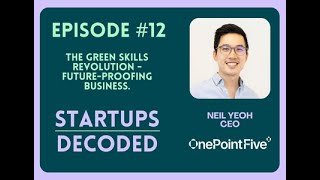
Neil Yeoh, CEO of 1.5, talks about building a climate advisory startup and the skills gap in sustainability roles. He explains how fractional advisory models work and why companies struggle to hire for positions that didn't exist five years ago.
Welcome to Startups Decoded where we uncover what it really takes to build and scale startups. I'm Andy Walsh, founder and strategist. Each week we will bring you actionable insights and real stories. Let's dive in. Welcome back to Startups Decoded. Today we've got another guest in another industry. I've already shared my passion for climate and sustainability, but today I've got an expert in Neil yeoh. Neil is CEO of 1.5. Welcome to the show, Neil.
Yeah, it's great, great to be here.
It's. For me this is good in both ways in that we get to have a good catch up on which we don't do enough. But we also get to talk shop, which is more important today I think for people listening to find out what you're working on and the things that are going to be interesting to other people rather than what you and I would normally.
Two Aussies bantering basically.
Yeah, exactly. Two Aussies have found themselves in New York together at the same time. Didn't know each other in Australia though. Right, nice. Well, kicking off just to sort of set the scene. I'd love to be able to hear from you 1.5 and the type of thing that you're doing there.
Yeah, so 1.5 is the startup that I founded about five years ago as of February 14th. So Valentine's Day might be a special day for everyone around the world. It's back when I decided to take the big step in and it's basically a climate advisory and academy firm doing both fractional advisory work through an expert in residence model which we can cover, but additionally also an ed tech training platform which we've done cohort based training for over 800 people in 50 countries.
Amazing. And the thing that I love to learn about in these is like basically where the industry is currently at. And I feel like that with the climate expert and residents plus the training as far as the type of content that people are interested in, the things that companies are focusing on, there's a lot of insight that you gain by offering that service. Right. It's not just a service, you're actually getting real time feedback from your customers.
Yeah, honestly, it's part of the startup story. Wouldn't have imagined two years ago us launching an edtech training program, but it was a classic startup moment of which, you know, we're grappling with product market fit and just realized that more than half of our job on the advisory side was trying to educate our customers in a market that was growing but very Immature, that we needed to actually show up with something that would help us. And so the training program we built was actually supposed to be for our contractor network on our expert and residents model. But I decided to make it a public website as a landing page and just to see what would happen. And next minute we got 300 applicants. And then fast forward to today, we've done 800 graduates and have turned it into its own certification program.
It's. They're the things that I love in the world of startup, where you're trying to solve a problem that you knew existed for you, but then the bigger opportunity that came off the back of it. Sometimes you can have the best idea in the world and thinking you're solving the biggest problem in the world and it just doesn't stick for whatever reason. Other times you can start something and it takes a whole new direction and becomes bigger than what you ever planned it to be. And I love that in the sense of not saying that what you did was an accident, but finding the need. And a question I'd love to ask you, because I think it's actually common, is that in any startup, particularly today, is that more often than not you're having to educate the market on the technology, on why people need it. It's not like launching a new seltzer drink where people already have a long history understanding what the category is, sort of building the category at the same time you're building the product. So for you, in those early days, you talked to it there a little bit around the education. But when you're having to sell your services and educate at the same time in market, how did you tackle those two together in the early days?
Yeah, well, I mean, the first thing I need to say is when we started 1.5, I was trying to build a B2B marketplace for climate experts, like say a Fiverr or Upwork for climate. And the reason why it actually didn't work in that phase is exactly what we're seeing in the AI growth field right now, which is you have to. The market's getting built whilst you're also trying to service it. And I feel like AI is a very classic case. Sustainability is still that case. And was that case during the COVID crisis when people thought, well, the world is going to end, so I need to also contribute to something of a greater good. And so when we launched as the pilot there, we realized that people didn't have enough knowledge to either know what they needed or what the pathway to do that work is. And even what Talent they required. And so it actually worked in our favor in the early days to just act as a fractional advisory team, what we call the expert in residence model, which was seasoned consultants that now quit and are recovering and are more entrepreneurial. And then using what happened during COVID when we launched, which was this trust of working with anyone online, you know, now we're talking online, have not actually met more than actually we haven't met more than 50% of our clients before, which is crazy. And I don't know if that would happen pre Covid. There's this sense of trust and access to expertise or people from all walks of the world that we thought, why don't we bring that into the consulting world, which is written with issues of generalists and people not doing the work that they know how to do. And so that's where that first model came, which was, okay, why don't we talk to say food and ag experts in Indonesia or energy experts in one state in the US and bring those hourly expert interviews into the project work that we did. And that helped us grow for the first three years. And then naturally as we realized that people still weren't getting it and we had at that time had a partnership with another fellowship program to develop cohort based training. And what was interesting there was that we fell into it because we weren't planning to build any training material. But I angel invested into a company called Climate Base, which is the indeed for climate jobs. It's climatebase.org and they were blowing up at the time and their founders were actually ex coding academy boot camp founders. And so they're not climate experts, but they realized that in the climate job market people weren't getting jobs because they didn't understand the climate sciences and the industry knowledge. And so he tapped me as an angel investor and said, hey, like I know that you do advisory work, but would you be open to building some kind of a boot camp training fellowship for our large people, like a large pool of people looking for jobs. And so I said, well, it's not really what we do. But I think I just lent in and just said, well, we'll give it a shot. Because I also found that my training, which I did at Yale in environmental management just wasn't up to date. And I felt like we could have done a better job. And so it was ironic that we did that two years prior. And then as we realized that we're educating people, we built the specialist program for corporate sustainability. So whereas they were doing the general practitioner training, we had then learned how to do boot camp style, engaging content and applied that into our own product that now we're servicing.
It's such an interesting story and people talk a lot in the startup world of pivots, but it feels like that this sort of came through you having conversations but actively listening to your customers. And validation is obviously a critical tool with market feedback. And there's a lot of conversation at the moment because of the rise of AI and a lot of people creating new startups in categories and they're competing, actually getting feedback from customers, retaining customers is more important than it's ever been. So for you in that validation phase, you talked about a B2B marketplace and then going into education, training sort of through that. What were some of the markers that you saw as far as customer feedback or things that really allowed you to have confidence to move forward into where you are today?
Yeah, I think a lot of it was using what we have. So I think one analogy that I would use is that any person out there, you might have 52 cards in a deck, but you're only given a certain number of cards and you just have to play those cards as best as you can. And those cards can be your zones of genius, your values, you know, your background, what, what native skills you have, what you've nurtured throughout your career. Which, you know, if I had a topsy turvy career from engineering, management consulting, you know, I used to cycle competitively for Australia, did like a Ironman, and then switched into impact investing, worked in Kenya. And so you're aggregating all these experiences over time to sort of present, you know, what best things I can bring forward. And so for me, when I started the company, it was okay, I'm good at, I love teaching, I love, you know, the idea of giving advice, but in a tangible way where I hated what it was in management consulting. And initially when I started my company was like, I do not want to start a consulting company. You could have, you could have said, Andy, like, you could have gone, Neil, like what company do you want to start today? And I would have said anything but a consultancy. And you can see how, like when I first started it, it basically was a consultancy plus, you know, a fractional expert network, but it basically is consultancy. And it actually took me like the first year or so, to be honest, to say, hang on a second. Well, if I lean in a bit more, I'm the perfect person to solve this problem. Like if I am a recovering management consultant, which a lot of people out There probably are. Why is that the case? Because in some senses the world still needs people to advise. We need people to solve problems. Right? I may get rid of jobs, but the creative element of people won't go away unless we don't have a world with people. And it took me at least a year to get over that ego of going, okay, I don't want to start a consultancy, but then realizing, well, actually I'm in the best position to solve the problems that I hated about consulting, but lean it into something purposeful and then change the model completely. And so this kind of idea of an expert in residence model where we can fractionally add capacity and capabilities very agilely to do work in a field that was evolving almost like a wave that was rising and cresting, you know, we almost needed to like swim to catch the wave. It actually became the biggest advantage that we had to build a successful business from the start. Leaning into my own zones of genius and experiences, but additionally kind of like using that to create something that was better than what I had in the past, rather than looking away from it. And then we added the new stuff like the edtech and training through, just moving with improvisation, but through where that wave then took us to then catch the next one.
Interesting. And as far as the, the zones of genius and zones of brilliance, I love those things as far as where you shine, but then also be able to be in your optimal. And the consulting part for you, if I heard you right then, was there was a lot of frustration in the process. And do you think that was a lack of genuine progress? Is my experience with consulting that consultants are great at keeping themselves around the table long term, making some progress, but maybe not closing projects out completely.
The way that I look at this is just think about any job out there. It can be consulting, it can be investment banking, product managers, software engineers. When a market matures, we basically build businesses around these intangible roles that should be done in this way or are done in this way. And with any organization that grows with that, it becomes very bureaucratic and very hierarchical very quickly. And I think what that does is it just zaps a lot of that creativity. I think we talked about this just earlier about range from David Epstein, that specialists can actually hinder our ability to be innovative and actually be entrepreneurial in creating something that's different. And so I would actually say that consulting is one example of that where we've built these huge businesses. You know, whether it's McKinsey Bay BCG or the Big Four around this idea of selling a service in a particular way. And what I would say is that there's nothing wrong with management consultants. Right. They're smart people making decisions and they've helped a lot of businesses and even governments. The problem is the specialization of what that becomes like. There is a very solid label that people would put on a management consultant as much as they would an investment banker and a software engineer that stops those individuals who are in those fields to think outside the box. And so I myself was that. So you either exit it by like quitting the job, maybe going in house and doing it less stressfully, or you can leverage your experiences to like change that status quo. So when I say that we are consultants or advisors, we're kind of like in the new age world, we have a different spin to it. So sometimes we're also having to like re educate. But I think that's, that's how I'd sort of perceive it.
Yeah. And if I'm interpreting the climate expert in residence in the right way too, it sounds very much like a fractional role where you're able to look at a certain company, understand where they're at, how they can improve, putting strategies in place and helping probably get that started. But I'd love to hear from you as far as sort of what a project scope typically looks like for a climate expert in residence.
Yeah, yeah, this is a great question. I mean, we had to trial and test this a lot in the early days and to be honest, right. The early days it would be more consultancy and we had this network. We didn't know how to use it, when to use it. So not everyone was getting tapped for the work. But after testing a couple of models, we're like, okay, should we charge a retainer model, like a fixed fee of certain thousand dollars where we do like gap assessments and follow their team almost like a fractional cso. Do we do the work ourselves and maybe only tap the experts when we need them, or do we actually bring experts in and actually do parts of the work, or should the experts do the work entirely? This is the kind of things that just, you're like, okay, I have no idea where this starts. And I think that led me to what we ended up doing was to stop over engineering it. And what we ended up doing was I just reached out to contacts and we had this Google Slides deck that I just built very scrappily of these different slides with these different options and ways to work. And what I would do is I'd just pitch them and just say hey, this is the problem, this is the solution that I have. And we'd talk about it and I'd watch their body language even not what they're saying, but also what they're saying in terms of, okay, what's top of mind, what resonates, what doesn't, and getting their honest feedback. And then basically 15 minutes after each of those calls, just like updating and changing the slides, we ended up having this slide deck of 150 slides, but the ones that we present are only 10. And they were iterated up just by going out with the MVP and going, okay, what's actually resonating? So what I had to learn to ask, learned from my consulting world was that perfect slide decks, which is one of our issues, was actually the opposite of what we needed. What we needed was to figure out how to direct ourselves to that service market fit. And it ended up being, you know, that companies and sustainability experts were actually executives. They were struggling with like a couple of things, right? They were struggling with the capacity. They just had more things than they could do. They were also struggling with all the expertise that's needed because sustainability touches anything from energy to architecture to blah. And they were overwhelmed with the amount of solutions and fact confused with the changing environment. And a lot of the work was actually project based, not warranting a full time staff hire. And so with those four problems, which I identified over probably like a hundred calls with your customer type of thing, we ended up realizing that what they need is both capacity and expertise. So what we did was just tack on ourselves in a fractional way. So it could be a fixed cost fee, it could be retainer, it could be on demand. Those became our three models. But the same approach was there where they would have someone that's trusted, like myself, come in with my team and then once we need expertise, would like call them in as we needed. But they wanted to have a trusted group that could also take on the work, not just the expertise.
Yeah, and that resonates. On episode two, we had Lucy Woofenden and she does ultimately fractional CMO work, but she has an agency now and she's going from placing fractional CMOs into companies, into placing teams that can do the whole thing. And you sort of scale up and down as needed. On that side, it sounds like you're doing something similar, but for you too, there's a lot of moving parts and I think this is important as well, what you actually deliver. To be able to drive change is important at a corporate policy level. And for any Compliance at a government side as well. But you're also dealing with change management because if the changes that you recommend are implemented across the whole company, which I assume they would be, then all of a sudden the whole company has to change how they do things and people typically don't like change. So within that you're having to not just be an expert on subject matter in the sense of climate, but also in how do you manage change management and get people to follow the new process.
Yeah, exactly. And actually that comes to the research that we ended up publishing last year, which is on our website@opf.degree forward slash insights, where we had garnered a data partnership with LinkedIn. So LinkedIn is a huge, like online living CV place for everyone. Right? And just like with AI and the rise of sustainability, as we talked about, a lot of people weren't speaking the same language of okay, what skills do you actually need to either be a sustainability professional or even an AI professional? Like, we don't know that. And we, and what we found from our educational technology work was that we needed a bit more in the taxonomy of this work. So I'll give you an example. In the 2010s, you had digital marketing, right? And social media was just coming up. And so all these courses came up to like train digital marketers because it was a niche side thing. Like, I think everyone now who owns social media is on social media or listening to this podcast is somewhat a consumer, if not a producer of content, whether it's your own post. Digital marketing now, like fast forward 15 years later, has become interweaved with. It's embedded, right? It's embedded into everyone's professional roles in some way, in some format. Right. And sustainability is kind of feeling the same wave where it was very isolated in 2020 that you hire a sustainability head. I don't know, maybe it's in the CSR arm and it's like a nice to do versus a must do. But we don't really have this taxonomy of skills of like, what do I need? Is it the soft skill change management? Is it the technical skills? And so what we ended up doing was we built off some of the past research that LinkedIn did, garnered a data partnership and launched this climate workforce paper that has had 1001500 downloads now as of the last couple of months after it was featured by Axios to even S and P Global, Business Insider and Yahoo. Finance to basically start to etch out like, what is wrong with the climate workforce market right now and how do we actually solve it not only generally, but also in industries like the energy, finance and, and fashion sector. And what we found was that there were these top 11 skills that these individuals needed. And that was surveyed out there. That covers things that you talked about in three categories of broad climate fluency, which is almost like the change management, the climate fundamentals, then this business generalist knowledge like supply chain management to the strategy, problem solving, creative problem solving, all the way up to the technical side of carbon accounting and data modeling that was finally starting to show. Okay, this is actually what a sustainability professional or sustainability adjacent professional should be able to have in order to execute the work. And what we noticed was that there's already a lot of overlap with existing roles for people who have operation roles, marketing roles, finance roles. But because human resources is a lagging indicator to the job market, which right now, if you see it in the top 25 most growing jobs in the US alone, sustainability specialists is number nine even amongst AI jobs. Yet the people getting those jobs come from crazy different backgrounds. And we're like, why is this the case? Well if you kind of then look at the taxonomy of skills and what do you actually need? You realize that 50% of it is already embedded into past roles. It's the 50% of these green skills, which are these skills that are specific to tackling the climate crisis, like greenhouse gas accounting, net zero strategy, lifecycle analysis, marginal abatement, Costco that aren't getting filled. And because of that gap, people are having issues to sort of make this work sticky. Whether I'm a consultant, you know, providing you advice externally or you're internally doing it, it's the same thing. And that's where we kind of like left it, where we realized to get the climate job you need the green skills, but to get the green skills you need the climate job. And we wanted to break that catch 22 by providing this program. But then go even further to say, okay, there is something systemically wrong that needs to foundationally be built for the market to succeed. And we realize that we need to be speaking the same language when it comes to skills taxonomy and figuring out what is happening in the job market when say an Andy Walsh who comes with huge amounts of experience suddenly can't get a climate job even though you know you do. Our course turns out that mid career professionals are getting asked in job descriptions to do crazy things that I wouldn't even qualify for because the person that built the job description also doesn't understand the market and so just says okay, we want someone with 15 years of sustainability reporting and disclosures, where 15 years ago was when the first reporting and disclosures actually got launched. So there's literally only like two people in the world who could actually fill that job. And so what ends up happening for those roles is that, you know, chief sustainability officers just changed from different companies. They're like, I'm heading up Levi's now I'm heading up Starbucks, you know, and it's not actually net additive to the workforce when you actually realize, well, what's the job in the first place? And last thing I'd say is that we actually talked to the head of sustainability from Meta, right. And she realized that half of her job right now is just stakeholder management and change management to basically absorb these regulatory documents in the EU and then tell the legal team, the finance team, okay, what does this actually mean for me? And she was saying, none of this other sustainability stuff right now matters for me. It's the, all the experiences that I had from the past, general business knowledge, yet people trying to get those roles, it's another story.
Yeah. And if you think about a parallel industry, and let's just use accounting, because it's probably the easy one across the board, whether you've got your first job or whether you're the CEO of the biggest accounting firm in the world, people know Things like, like K1, W2s, all these forms for tax. When it comes to sustainability and climate, then there's not a standardization of language. So one, you need to get the whole market up to speed on consistent use of terminology so they're talking about things in the right way. But then also you get into standardization of benchmarks and metrics, et cetera, as well. And even somewhere like the US that can, I assume, be very different between state to state and also at a federal level.
Yeah, it's absolutely ridiculous. You're absolutely right. The problem that we have in our field is that we've tried to do things, but we've made it too complex. We call it the Alphabet soup of terminology. We have everything from ghd, lca, tcfd, issb, ifrs, s1, s2, you name it, sasp, gri, and all these things probably will go over the generic person's head of going, okay, how do I act? What are we supposed to do? And so I feel like in spaces that are growing and changing rapidly, and I think hopefully people understand the real crises of the climate. Like if you just look at and understand physics and science, we're consuming more than 1.7 earths than we can replenish. And this is not just a nice to do. This is a sustainable business. This is the business strategy of twist century. Like if you think about it, commodity prices, supply chain issues, weather patterns that cause billion dollar impacts. If a CEO is not actually thinking about sustainability in their as part of their business strategy, in five, 10 years time they're going to have no businesses. I think we need to go beyond just the quarterly earning calls or the monthly or the annual and think about more long term. And so I think in some senses that that issue needs to be solved for and that's why I think we have an advantage that I didn't realize by having this academy that when you try to make things make sense, it actually raises the C level of expectation of what then an advisor or consultant should do. Because they shouldn't be just explaining stuff that's a waste of money and they shouldn't be doing things that an organization should be able to do themselves, which is like reporting and measuring. What they should be doing is giving the expertise to take that step further. And unfortunately, unfortunately, because the market has been so convoluted, right, there are a lot of bad players in the advisory market who just lean in on that complexity and say, well, pay me this money to do this work. Whereas we're like, okay, we trust in our ability to give even better advice. Why don't we raise the sea level and even digitize our content which is what we're working on right now. So we now are doing like masterclass style 123 to 7 minute videos that explain these concepts in clear, crystal clear, simple ways. You brought up accounting. We use financial accounting as an example to teach greenhouse gas accounting such that we can distribute this content in like a masterclass format to our clients, give them access to it, and then supplement that with the advisory work if they need it. And that completely changes the model. Where initially one of our advisors were like, well wouldn't you just build your own competition by training people on how to do what you do? And I actually said, well, the best role for a startup entrepreneur is to lean in and go, hell yeah. Like creating my own competition is more like one. There is much more work that needs to be done and we need to build the movement. So going back to the reasons why I started this in the first place, but second of all, it forces not only us, but everyone else to evolve or get kicked out. And that kind of excited me as an entrepreneur that if I just built a traditional sustainability consulting firm, I would literally be pulling my Hairs out. And I would not be like here at year five going to you like being this passionate. And so I think you just go with the ebbs and flows to build up the whole, the whole thing.
Yeah. And I think for me the difference in the way you're describing that is that and it happens in other categories as well is that quite often the first company to market that gets success can have to literally carve a path. It's rougher, it's denser. Going through the forest, there's no path through to knock your way through. Whereas the second and third, fourth businesses that come through have that path well trodden and can take those lessons. But we're still talking about an industry that is completely unrepresented from a funding perspective. At a corporate level. If you looked at Fortune 500 companies, they're not going to be investing anywhere near the money that they should. But they're under like these corporations are under pressure from investors, from shareholders to make sure they're maximizing profits. So they're going to do probably the minimum requirement based off government legislation rather than be ahead of the curve and set a benchmark for other companies to step up and replicate.
Yeah, I think that's the thing. I would say it's the don't look up movie. If people haven't seen it, is that where kind of a subject of our own mindsets as a human race. Like I think it's easier for us to tangibly see what's in front of us. In fact, Seth Godin, one of our early advisors, given that he launched the old MBA, he helped us build the 1.5 Academy which is our eight week training program that I talked about. He actually said well if greenhouse gases were purple we would have solved the crisis years ago. Right. So number one, we don't see the problem or it feels too long in the future that there's natural human psychology that forces us to change our mindset. Also the systems of which we built business is very short minded. I don't want to say short minded but if you even look at statistics on the C suite now they have less and less tenure and they're forced more and more even with politics to businesses to get short term returns no matter the cost. And so we've kind of also created systems that don't let us look at what is 10 to 20 years down the track which would be net positive. And so we make decisions that actually detriment us in the short term. And so I think that's part, part of our role is how do we actually not go against this tide but almost think about how we go use this tide to create change. And I think that's where a lot of the sustainability and climate space is going now because of this issue with geopolitics. It's actually forcing professionals like myself to show up and go how do we go even that step further and show the financial return on investment that there's avoided costs from this work and actually show it physically and get those people involved if regulations aren't going to be the ones that hold people down to start getting involved with the finance sector. And I think it's a combination of all of that bug. But the good thing is that we do have other jurisdictions that are doing it.
And I see two things that could directly impact companies and I see it with brand purpose in a very adjacent category. So next generation of consumers say Gen Z and then we'll go into alpha will be are already making decisions on brands based upon their purpose and what they stand for and why they operate, who they support, et cetera. And climate is creeping up at the same kind of expectations. So when you have consumers at large driving purchase behavior based upon green credentials of large corporations, if they see a downturn in revenue because of that, that's one way it's going to get their attention. I would say the second one would probably be around how do they actually invest money now to save money in the future or create new opportunities? And I don't know much about that. That's your lane. So is that probably a fair assessment those two ways to put pressure on corporations outside of government? Of course.
Yeah. I would actually even as a contrarian view say that companies don't really care about that front end if they can get away with greenwashing. To be honest. Like the rev side is definitely the tough part. But the tough part of proofpoint and I think that's where rubber is going to hit the road is how do we actually measure that but the cost side massively and we can do a lot more work there right now. Greenhouse gas accounting, environmental modeling doesn't include financial modeling as much as it should. Like we're kind of stuck in this measurement and reporting world because the that's where everyone's focused. But that doesn't do anything. It's just kind of like why have a fast furniture or you know say a H and out there they have a lot of sustainability stuff but. But at the same time they're fast fashion. Right. So are we actually trying to change the model or Are we just trying to report our way out of it? So I think there is this kind of concept of avoided costs is one where why don't we actually measure the avoided costs because of sustainability work where we use less energy, water and waste, for example, materials and actually put it as a line item in the financial report and say, well, this is because we invested into renewables, because in financial accounting, okay, great, we made more profit margin, but it never gets attributed to the work that's being done. And then perhaps that kind of unlocks annual budget for like sustainability teams. Or another thing is rather than paying for carbon credits, where a lot of companies are purchasing credits and offsets so that they can either should be meeting their net zero goals, sometimes they're doing it for business as usual. But flip that budget amount and say, well, how does that become an internal budget that we then purely just invest into decarbonization and look for our own return on investment? You know, I would say that carbon markets are still important, but if we try to internalize that work and start to integrate it and then the final option is there are still regulations like out in the eu, despite omnibus, if people know about that, there's some issues with the watering down of regulations, but what it's forcing is getting sustainability through double materiality to actually put the information into their financial reports. And what's that? What's happening there is now you're bringing in other stakeholders like legal and finance and operations. They actually have to be part of it because this is actually mandated reporting that has forced the conversations to ripple out from these like small echo chambers of sustainability professionals, but to the work that actually matters.
Yeah, And I was talking just the other day to a startup and they have, they're working on digital twins and one of the things that they're doing is using drones and surveying buildings. And they were talking about just by having this full representation of a digital twin version of the infrastructure that they can reduce their energy costs by 25% just by understanding that building better so you can replicate it digitally and find ways to save money so it pays for itself, even though you have to invest up front. So I think that we're going to see more of that technology become available where you have better visibility on. On how you can actually save money by investing money.
Yeah, yeah. And I think the overall thing that we need to know is that with these markets, especially as entrepreneurs and coming back to your startup, the whole point of this podcast of like startups and founders and things like that is that we have an opportunity to create the innovation and change that we need to see in this world. I mean, two years ago when we launched the 1.5 Academy, you know, we had first mover advantage. A lot of people wanted to move into climate, they had purpose, so they took our course. Right now, naturally, two years later, there's a lot more of these boot camp training certificate type courses and we're needing to evolve ourselves. Okay, what's the next step? How do we make bigger difference? And so through this workforce playbook, we realize, okay, we need to then move up to the B2B route and get to the thousands of workers so that people aren't quitting their jobs to try to get this elusive climate job, but start to embed sustainability skills into procurement roles and everything and start to white label it. So. So in some senses, with these evolving and changing times and of uncertainty, I think that startup founders and those working on the front lines, even investors, have a huge opportunity to create the change that they want to see in this world. If there's a lack of funding in other worlds, there's geopolitical risk. I think the one thing that's never going to go away is human ingenuity. And I think we say it sometimes that the climate crisis can be solved by the best of human ingenuity. And that's actually what we represent as 1.5. Not just from an advisory standpoint point, but through the scatters of like close to a thousand people around the world who we can mobilize in different ways. But we always need to like reinvent ourselves such that as an entrepreneur, we're not like falling into the trap of just being like everyone else. But at least in my opinion, what keeps me going is knowing that I can have an outsized impact using my talents and skills for the greatest good and to their fullest potential. And as long as I do that, I feel like that's what makes a startup founder impactful.
What a beautiful sentiment. And I think to your point, even for other categories outside of sustainability, all think that way, right? As far as it's not just a commercial outcome where there's a genuine purpose and a double bottom line or even triple bottom line, right, where you can drive change at large. I think that's really nice thing to sort on today because we're at time as far as connecting with you, learning more around your programs, et cetera. What's the best way to reach out?
Yeah, so you can reach out to me on LinkedIn @neil yo y u o h and Neil Neil Armstrong and otherwise. You can Follow our website www.opf or 1.5 www.opf.degree and forward/ Academy if you want to check that out. We also have a free monthly newsletter to Get Smart About Climate, which has over 4,000 subscribers now. And so all about this is to help people use their gifts for the greatest good and for their fullest potential.
Sounds great and I'll of course put details in show notes so you can get those links and contact details and I'll share it on my LinkedIn when this episode goes live. Neil, thank you so much for making time today. It's been really fascinating to learn about 1.5.
No worries. Thanks Andy.
You're listening to Startups Decoded. This has been another fascinating episode for me. We'll be back next Wednesday with a new guest. Please follow Share 5 star ratings all the way. Thanks for joining. We'll see you next time.
More from Andy



EP#88: Why Most Founders Misread Their Own Traction. Vanessa Larco - Premise VC

EP#87: Founders Obsess Over the Raise. Investors Care About This More. — Carina Cunha






Ep#86: Early Decisions That Define Your Startup Forever. With J.P. Morgan Asset Management
