Ep#16: The Founder’s Blueprint: Building Startups in 2025 with Majd Alaily
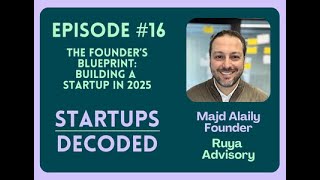
Andy Walsh talks with Majd Alaily about building startups in 2025. They cover founder mindset, product building, go-to-market strategy, fundraising, and how to manage failure and blind spots as you scale.
Welcome to Startups Decoded, where we uncover what it really takes to build and scale startups. I'm Andy Walsh, founder and strategist. Each week we will bring you actionable insights and real stories. Let's dive in. Hello and welcome back to Startups Decoded. Today we're looking at startups holistically and I've got a really experienced guest in mash. Alali, welcome to the show, man. It's good to have you.
It's good to be here, man. We've been talking about this episode for a while, so I'm happy we get to record it finally.
Yeah, we have and we met through LinkedIn and right now there's a lot of activity on LinkedIn. It's really changed and simply for us, it was a comment on each other's posts. I found what you were doing really fascinating, but also really insightful. I think that there's some people in the world that have managed to extrapolate startup process and turn it into a business and I think you've done that very elegantly and we'll explore that a lot today. To get things started, I want to talk about pretty broad topic, but you're in Lebanon right now, but you've lived all over the world and that global perspective is fascinating. But let's go back to the start actually as far as study, what you did and what you thought you probably were going to do coming out of that.
Yeah, that might be a long story because I actually have a bachelor's in biology, believe it or not. And I was a pre med student in my undergrad days. I hated every minute of it. I'm able to say it out loud finally. And I went into the first year of med school. So I got admitted, started the medical school thing, hated that even further. And then I was like, this isn't a path for me. Like I need to find something more, more challenging in a sense where like I need to solve big problems. I don't want to do like whatever doctors do. At least that's what I thought. And so it put me on a track where I went into business school, went into consulting, finally found a really cool, like a really cool company to work, like Google where I stayed there for a long time and then eventually ended up in the startup world. But my origin story is not like if you talk to my 19 year old self and told him like this is what you're doing right now, that would be insane to him.
Yeah, study's such an interesting thing. It's going to be something 100% that will change in the next five years. As far as how we learn, how we get qualifications, whether that's a formal institution, whether it's in a job that can do both, there are a lot of elements that will shift. My experience was when I was 17, 18, thinking about study, I had no idea what I wanted to do and that changed. It changes 10 times over. So. But I think for me, the regiment of study, collaboration, learning process, I did a double degree in marketing and exercise science and I was doing biomedical science, doing a lot of research. And I think that that process really helped me, like the actual anatomy and physiology and all of those things I would never use. There's all these broad range of skills that I think apply into being a modern founder in today's world.
100%, you can always kind of connect the dots and trace back, like, oh, I know how to do this because of these certain experiences. So I'm not definitely, I'm not dismissing it, I'm just saying that there's going, there are now and there's going to be even more, like a lot of atypical career paths. Like you're not in a straight line or you're just moving forward progressively in a sense. And I really resonate with one point you said, which is like, what do you know at 17, right? Can you actually make a career choice for the rest of your life? As a high school student, you've never really worked, you've never been out in the real world. You've just been like, cramming studies, whatever that means in your culture. And now you're like, okay, choose a career path for you. So that's definitely going to shift either like willingly or forcefully. Like, academia is going to be in some way disrupted and people will rethink how they actually learn things or how they prepare themselves professionally for sure. So there's a lot there. But it's just, it's just, it takes a, it takes a toll as well. When I started my other startup four years ago, I went from like the super cushy corporate environment where like, so many things are given and then I'm just working on my own all the time. And you just, you're so overwhelmed. And I used to describe to friends when they would ask me, like, what is the founder experience like? I would say it's basically getting punched in the stomach every single day and then coming back the next day for more punching because, like, nothing's working for you at the beginning. You're so overwhelmed, you're so under Resourced. You just feel like you know what is going on here, and it's so painful, but you keep coming back. And so it's a bit sadistic as well, I guess, but, yeah. And so if you can take it with the right set, you know, frame of mind, it can become a really good learning. But I don't want to undercut the emotional impact that failure can have on a founder because it's really heavy as well.
Yeah, yeah, that resonates a lot with me, and I remember that feeling so well. My first startup was in 2012, and I didn't think about failure. I was confident enough to know that what I had done previously would set me up to do what I was going to do. But there were times, like, we bootstrapped and there were times when cash flow problem was like, okay, we may run out of money here. And then I can't pay for rent and food, take care of my family. Just foundational things. But you have to be able to compartmentalize those things to try and maintain some semblance of mental health.
And I think another level of anxiety from a cash flow perspective is if people are expecting salaries from you, which most of your professional career, you never think about. Like, you're an employee and you're getting paid every month and you're good to go, and then suddenly you're like, wait, I need to pay Andy by the end of the month. Like, how do I get the money? Because the guy's been working for a month. And so that's another level of anxiety that you. You eventually experience when you first start, which is like, they are dependent on me professionally. And if you have a family, that's even more complicated. And so that. That really makes the process tough. But again, I really believe, like, in toughness, you lear much like when you're exposed, when you're challenged, when you're pressured, when you're pushed, this is when you also develop skills and learn. So it is very much a mindset. Like you said, if you have the right mindset, like, these challenges become fantastic growth moments for you, but they will hurt in the process as well.
Yeah, yeah, absolutely. And I'd love to sort of dig into two things that you touched on there previously. One of those is blind spot. And it's something that I'm. I'm so passionate about, like, learning and discovering in that you can be so strong with your conviction on something that you learned a long time ago that may not be relevant now. And it's so easy to get caught up in Your own little noise that your brain is sort of putting out there. But you have to be able to understand when something is not right and when someone else's opinion is needed to be able to give you that breadth, to have conviction to move forward. And I love Blindspot as an alternative to failure. Cause failure feels very finite in that if you fail, that's it and there's no way to move forward. Failure is, say in research, if something that you want to do improve. If it doesn't work, it's like, okay, it didn't work, but it's not the end. It just means that you learn and you've got a broader range of knowledge to be able to move forward. So I think that, that as a mindset is something that you have to accept. And going into a startup is like when you, day one, you start your business, you have to be able to accept that there's going to be things that you test and learn that don't work. And that the things that don't work sometimes are more valuable than the things that do.
100% they are more valuable. Trust me. You learn so much when things don't work because it pushes you to ask a lot of really good questions like, why did this not work? What did the audience prefer? What kind of reactions did I see? So again, sometimes it's so much better to get really bad results at the beginning because they give you such guidance on where you should go and they eliminate a lot of options for you. But the idea of blind spots, I think for founders, if we really want to anchor it around the founder spot, is honestly the biggest blind spot that I've seen with founders, is that they become so attached to their idea and their vision and what they think they're doing that they completely lose contact with like the outside world or like some form of pragmatism around. Is this solution needed? Am I solving a real problem? Like, am I doing something that has impact or not? Because, you know, I don't know, you might be a coder and you love coding and you're super excited about building all of these super cool features that you think are great, but you don't stress test these assumptions enough or validate them enough with, with people in the real world, with people who will eventually pay you for that solution. So that's really. I think most founders will have that as their biggest blind spot in their early days and that will be a very painful learning moment for them, as it was for me and many other people. And this is what I do with a lot of founders as well that I work with, which is like, guys, we need to make sure that we're building something people want and that's worth it. And not ideas that we're just excited about because it makes a huge difference in how the product develops and how the solution rolls out in the market.
Yeah. And going to that further, I'd love to get your take as far as when you are talking to founders, which you touched on there. If you have an idea and you're so passionate about it and then it doesn't stick, or if it doesn't work, it feels like it's a reflection of you rather than the business that you've created. So are you having those conversations to try and encourage founders or coach them to separate themselves from the business? And if something doesn't work, it's not reflective of them. It's an idea that you've tested that hasn't stuck. And then how do you move forward from that without feeling like you've let yourself down?
I think it's two things. So, one, again, I love that you're focusing on mindset because this isn't something talked enough about in the startup space, which is how do you develop a healthy mindset that can deal with adversity, that is agile, that is able to dissociate from the business. Because in the startup space, you are the business. Like you're a hundred percent focused on it. You don't do anything else. Most of the founders quit their jobs, they quit their hobbies, they quit everything and they focus on building this one thing. And so it does become a litmus test of like, if this works out, that I'm a success and if this fails, that I'm a failure. So it's. I love that you're talking about mindset. One more practical thing that I always work with when I talk to founders is just really manage the time you're kind of ruminating on an idea or a concept. The longer you spend thinking about something, the more you get excited about it, the harder it is for you to dissociate. If you, Andy, for example, you're working on a product, wherever it is, right. You're launching an app, and if you have this idea that you end up validating in a couple of days, it's going to be much easier for you to course correct and not take it harshly and not be like overwhelmed by feedback or even accept it, versus if you spent six months on it and thinking about the features and the UX and the UI and how it looks like and what you wanted to do and maybe even developing it. And then I as user come and like, I don't understand how this works. You know, this is going to be a really hard sentence for you to hear. And most of the time you won't accept my feedback. You're like, that guy's an idiot. He doesn't know what he's doing. And so try to manage the time that you're just, you know, falling in love with your idea and try as fast as you can to kind of put it out there to get feedback because then emotionally it'll be easier for you to manage. Two, you will be able to course correct much faster. So these things usually help out when it comes to, when it comes to this. But honestly, again, like, I really resonate with the idea of mindset because in the early days, the founder is the business, like there's no one else, you're on your own, or maybe you're a team of co founders. So if you have the right way or mechanisms in your brain, a lot of things will go easy for you. But if not, then you'll, you'll struggle a lot on.
Yeah, and there's a saying that I wish that I'd came up with, but it's paraphrasing, it's strong convictions weekly held. So you need the ability to be able to make a decision, go after something, but be happy to be proved wrong. And that's fine. Right. And it feels like again that it's attached to you, but it's not. It's just a lesson to learn to move forward. So, but to pause there for a moment, as far as what you're doing with Rua Advisory, I'd love to be able to talk about like what that business came from and what sort of work that you're doing day to day.
So I'll tell you the origin story of the business, but basically during my time at Google, I spent a lot of time exploring innovation. And how did you bring innovation to, in a business context? So eventually a lot of the projects I would do would be like, oh, you're launching a product or a rebrand or you have this big initiative. How can we use, you know, creative approaches to be able to come up with great solutions for that? And so the, the creative process is, is very much straightforward and people who know me know this sentence because I say it all the time. It's the easiest way explain. You need to define which audience you're serving and extract an amazing problem from that audience that you think you can solve. Second is you need to come up with a great solution to address that problem. And you're either kind of presenting something that's different to what's out there in the market in terms of solutions, or transformative that kind of completely pushes the benchmark of what's possible from a solution standpoint. And then three, you need to kind of validate fast your assumptions, the solution itself and how do you develop it before you start over investing so you make sure that you're not moving in the direction that doesn't make sense. So that's the innovation process process. And so four or five years ago, or four years ago, I was like, fine, this is the startup process. Like I'm just using this process in a corporate environment, but how can I bring it to the startup world? I was like, okay, I'm going to build my startup and I'm going to use all of these processes to do everything in the startup from like building the product, building the acquisition, building the strategy, building the fundraise, everything. And so it went quite well. And my first startup did quite well in terms of performance. So we hit almost a million active users a month in two years, like fully organic. We had a really nice pre seed raise with angels and grants. So a lot of things worked well. And in that kind of context, I started connecting with other founders that would ask me questions about their businesses, like how do I do this on product or how do I do this on strategy? And so honestly I was like, okay, there seems to be like a business opportunity here and so why don't I open an advisory where I help founders on these things using a lot of my experience and my learnings. And so to go back to your question, and I know I'm a bit of a rambler, Andy, just for you to know. So let me know if I'm overdoing it. But yeah, so to go back to your question right now, what we do from an advisory standpoint based off of all the experience I mentioned, is we help founders on three things. So how do you build your product and validate fast using innovation? How do you go to market to get your first few customers also in a fast way to be able to learn what works and what doesn't. And how do you do your first fundraise in the right way? So very early venture focus for early stage founders on these three core topics that make sense and then we walk them through processes or like I like that you talked about, you know, I'm distilling frameworks Because I am. And so I kind of have a framework about how to do these different things from a building standpoint, from a go to market standpoint and a fundraising standpoint. And that's basically it. And it's been a fantastic ride so far. From an advisory standpoint.
Yeah. And it's really like for me a landmark sort of thing to be able to implement. I remember, excuse me, my first startup, and that was building the business, but also building the operational process and then learning as you go. And it feels like that if you're able to roll out those three parts around product build, validation and fundraising, it allows you to sort of catapult your thinking and escalate and move at pace to get to a point where you know where you stand, I think much sooner than what you would do if you did it by yourself. But the thing there that I'd love to understand is founders, quite often they have a level of confidence, which is a necessity. How do you go into a conversation with them to sort of demonstrate the value? So they go, yep, I actually do need help with that. And you're aligned on goals and success and what that looks like?
Yeah, that's a good question. I would actually say it's usually, at least from my experience, I do the other way around, which is again, I assuming we're trying to see if we work together, I would start by asking you, like, what are the challenges you're facing, Andy? So again, like you have this podcast, what is the biggest challenge preventing you from growing this into a, you know, a multi million subscriber? And then we'll talk about this and you can say, you know what, maybe it's the content itself, which is more a product discussion. Maybe it's the way we distribute. So it's a go to market piece or a differentiation piece. Maybe it's a, you know, funding or equipment or you need specific ways to promote it that require. And then based off of this, you kind of slot in how I help. And so I usually don't try to assume that I know what makes the most sense for a founder. We have a discovery conversation and within that I try to see like, are there spaces for me to help or not? And in some cases there aren't. And I say like, I'm sorry, but I don't know if I can help you, but maybe these, some, some other people or some resources that can. But once we zero in on like, you know, go to market, makes sense for you, then we start talking about this and this is how I can help you on go to market, this is what I've done for other people. This is the process and what it looks like. So this is what you can expect in terms of deliver. And so that's the two part process. I will be honest. Obviously, sometimes you guide. This is a sales process. So you guide people to like realization sometimes, or you guide people to whatever, but they're realizing it. It's not like I'm coming to tell them, you know what, go to market is a problem for you and can fix it. Okay, why aren't you growing? It's like, okay, maybe this is the problem. And then you move from there. And that's how it usually works.
Yeah. And I think one of the words you said there for me really, really resonates, which is discovery. Because you're not selling something that's tangible. Right. It's not like you're selling them a soda or a sweater. It's something. It's almost like coming in as a fractional co founder in a way, in your ability to open up a conversation, understand where someone's strengths stop, and start making sure that you can compliment what you're doing. But both of you have the right intention and mindset from the start about where you want to get to. So I 100% see the value in what you're doing, which is why we're having the conversation today. And I'm sure that what you're doing has evolved a lot too. And this is probably a whole nother episode. But building a startup today is different than what it was even a year ago. Yes. The way that startups are created and being able to do the three things that you're talking about, probably aside from fundraising, which is still quite convoluted, I would say that product build and validation has shifted dramatically. And how are you seeing that change happen with founders that you're talking to today versus one year ago, two years ago?
Yeah, I'm going to give you an answer, but I will just caveat this by saying, obviously things are moving very fast, and so maybe in a couple of months we'll hit another level of sophistication in terms of technology or what's out there that maybe this becomes obsolete. So who knows? But this is very much linked to what I'm seeing right now. So I would say that the three elements that we did talk about in terms of milestones, so building, going to market and fundraising are being disrupted. And I'll take you through each one. But from a building standpoint, it's much easier right now to build early concepts of your business. Don't think we're at the stage where you can actually build real products that work and are functional and are mature using AI or no code tools or everything floating around. I just had a different conversation around vibe coding right now. And so this is a very kind of trendy topic, but it is still a way to kind of build great prototypes and a way to be like, able to build early versions of your product. But eventually you still need to get your hands dirty to come up with a great solution. So building, building is disrupted in that space where validation is much easier. But also competition with you is much easier. Because if it's much simpler to build a product, then if you, andy, build a SaaS tool that does super well, then I can just come in and copy your concept and build another SaaS tool and compete with you. And so there was a point where like startups, maybe not a year ago, but maybe five years ago and beyond would compete on the value of their fe. Like these features were so great that people will buy your product and it was a sustainable or competitive advantage. Now this is something that seemingly will disappear. And so you need to think about it much more in terms of how do I stay relevant from a product standpoint before we even talk about branding or reputation or go to market. So that's where I'm seeing on build. If we talk about the go to market piece, again, it's much easier to go to market today. But the problem is, is you need. The biggest challenge that will arise for most people is this idea of defensibility. Like, how do I make sure that I build a business that can survive and thrive, especially if, you know, in a sen product is commoditized so everything looks the same and there's no real difference. And so something that I now encourage all the founders I talk to or work with to do is to start immediately thinking about these things. How do you own distribution in a way that keeps you relevant? Or how do you own some form of proprietary data or IP that keeps you relevant? Because these are some of the, you know, moats that you can create to get people to get people stay like to stay, stay away from your, from your territory or to keep your product relevant. So this idea of going to market today is, is something as important as the bill, which is what I'm trying to say. So distribution is super crucial. If all the products are equal, how do I get a great distribution to maybe get an edge over competition? How do I build defensibility as well, and so that's the second part, third part, on fundraising, I would just say that honestly, fundraising might become less relevant in the future again, if building is easier and go to market is easier. And so now you have this bootstrap model that's coming up everywhere where it's like, it's never been more easy to bootstrap than today, which is kind of true for a lot of industries that aren't very resource intensive. So you might see as well like a shift in economics in terms of when is it really the time to go get money for your business and could you even build a business without a fundraiser and just completely bootstrap it? And I think that model is going to become even more realistic in the next couple of months to a year or two where you could literally, you know, Andy, with a couple of people, use a lot of the technology out there to build a successful business that makes money and not rely on investors to be able to make it happen.
Yeah, and I'm definitely seeing the same theme as far as my own portfolio, but also conversations that I have with founders. The other part there that I think is interesting too, I had Nick Sober, who's a chief product officer at avalfi, on episode 10, and he was talking about also the pattern because of the speed to market and revenue much earlier than before that. We're also going to see probably earlier exits was his forecast, where an acquisition can happen in two to three years rather than sort of five years plus because of that. And the other part in there too, like, sort of complements that. I'd love to be able to talk a little bit more around the moat and you touched on it there. If technology is accessible and you're able to build something quickly, it means that anyone can do the same thing, sees the same insight or problem that they're trying to solve. So the validation piece is critical there to make sure that you have a product that's been validated and your acquisition process is easier and faster and then retention is driven to a level. So the two parts around that, like that early exit, if you can get momentum and revenue quickly, the acquisition process and having an exit strategy defined is going to be really important. So let's unpack that a little bit more. Do you think that if you're getting early revenue, are you talking to your founders about an exit it already in their planning?
It depends on their ambitions as well. You know, certain founders want to build a business that endures. Certain founders have this idea of like, I'm excited about building and so I want to build something, ship it, sell it and then build another thing. So it depends on their personalities. But yeah, these conversations can come much earlier in the process, I'll have to be honest. It'll depend on the business we're building and the industry it's in. I don't think we'll have early exits in a lot of the more traditional spaces right now. I think it's harder to actually build the business because most spaces are very saturated. Like if you take, I don't know, fintech or, or Health tech or edtech, there are so many competitors out there, so how do you stand out? How do you actually build something that's, that's, that is in a way able to become a great business? It's. Or an acquirable business is a bit complicated. If you are in one of the new industries that are more related to AI LLMs, these things could be more possible or easier at an early level. But right now, actually the trend we're seeing is exits are becoming slower or they take much longer times if you look at the numbers. I remember seeing something from Carta recently on this because again, it's harder to get to a point where you're acquirable and the business is sustainable because so many things are happening in the market today that it's, it's, it's a bit of a more complicated play. So that's an exit. It's always good to talk about this early if that's important. But it depends also on, on just the founders, their personalities and their needs. Keep it in mind. But honestly, right now, like building a great business is, is the priority. I would say if, if we're really starting up in those early days, which is the founders I usually talk to.
Yeah. And if it's something that you're passionate about, it's sort of. I see it a lot with exited founders that to. And they almost feel lost. It's sort of like they've had that adrenaline for so many years to get to a point where they exit. And sure, they might be financially independent, but they still have passion and purpose that they want to be able to do. So the alternative is to stay in the business. And if you can drive AR to a level where you're making good money and if you can do that with a team that's much smaller today because of the evolution of platforms that you can integrate now, and you're making a really nice EBITDA at the end of each year and you're living your passion and purpose it's like, why would you get investment and why would you exit if you're able to sustain that? And even that dream world of you might just become the chairman and dip in and out and have a CEO that runs your business and you're just getting a healthy clip every year, that, for me sounds pretty appealing, for sure.
I mean, two things. It depends if the opportunity for exits come and honestly, it depends how much money you're offered. If you're offered a lot of money, you might be able to trade that life off. So it really depends on that situation specifically.
Yeah, yeah, absolutely. But let's not focus too much on exits. I'd love to go back to foundations of startups. So at that early point we covered a little bit there, but I'd love to go into it a little bit more around the right tech stack. And if you're thinking about a product build, if you're able to do this very quickly, it means you're reliant on a product that may only been in market for a year, two years. Within that, what sort of advice are you giving to founders to think about with choosing and the claims that are made to be able to trust something that you rely on to earn money to be there in one year, five years time?
Yeah, it's tricky. It's very tricky because again, like right now, we're going to see a big wave of SaaS, products that are half billion baked because people are going into kind of this hustle mode when it comes to SaaS. So, yeah, it depends. You have to do your research. You need to make sure. I would actually take a step back and say from a techstar perspective, first of all, it's super important that you think about what you need first and what your needs are and what kind of strategy you have. And then you go shopping for tools. Because a lot of the times people just get influenced by what they hear, like, oh, this tool's amazing, everybody's using it, or there's a lot of marketing or hyper on something and then you go for for it. And then you need to figure out what kind of executions do I want or applications I want. And again, this is not the right way to do it. This is more like, this is our business, these are the things we're struggling with. What kind of tools can answer these problems? And then once you get to that level, you do some due diligence, which is what kind of tools are out there, which ones seem to be more reliable or sustainable, which ones seem to have good testimonials or good feedback. What have I heard from my entourage? But just don't miss the step of thinking about your needs and thinking about what problems am I trying to solve and then bringing that tool in in, because that tool will not tell you how to use it and will not tell you like, what kind of use cases you need. And that's something that a lot of people trip up on. And then finally, a very pragmatic thing. But never get the annual, never get annual billing on SaaS. It never works. Always get monthly. In three months you'll see like, am I still using that tool 80% of the time? You might not be. And you can cancel that. And so sometimes this idea of savings doesn't make a lot of sense. It must test of like, is this an essential tool or not? Because you have SAS creep, right? Like, so many people start getting so many different tools and then they eventually end up with so many subscriptions that don't make any sense. So, yeah, that's it.
Yeah. And it's something that it's easy to feel like, okay, this is a small investment and it's going to save us x amount of time. And you rationalize it, but then realize it's actually not saving you time or money and it may not even be fulfilling the full need of what you needed it to. So you've got to be able to do those tests. Right. And be pretty pragmatic about the role that it plays and is it successful and put metrics in place to be able to measure and trust.
More from Andy



EP#88: Why Most Founders Misread Their Own Traction. Vanessa Larco - Premise VC

EP#87: Founders Obsess Over the Raise. Investors Care About This More. — Carina Cunha






Ep#86: Early Decisions That Define Your Startup Forever. With J.P. Morgan Asset Management
